


If you have never read Moby Dick, it may be because you have heard it slandered. Too dry, someone might have said, or too long, or too problematic. Frankly, they’re right. It is a book with a hundred chapters in the middle that you can skip, and the tradition of hunting whales would indeed prove catastrophic to our planet. But Moby Dick is worth reading for these and other qualities: it is filled with poetic language, its cetacean hyperfixation is delightful, and nestled amidst its many charms is one of the most lovely and compelling romances I have ever read.
Spoiler: Critical plot spoilers ahead, but it is a very old book and I promise it is not ruined by knowing what happens.
Our protagonist, Ishmael, is ostensibly a working-class man gripped by a sinister ennui. He intends to take to the ship to cure himself, and the meat of our novel is the years-long circumnavigation of the globe he does on the whaler Pequod. Before he even sets sight on the ship though, he finds himself looking for boarding in a place where all the rooms are booked out. The innkeeper offers him a choice between sharing a bed with a stranger and sleeping on the bench in the main hall.
Ishmael asks after the manner of man he expects to bunk with and is told all kind of strange, sly things. Perturbed, he nonetheless resolves to try, and gets in the single bed to wait for his partner. In the middle of the night enters our deuteragonist, Queequeg, a Polynesian prince from an island of cannibals who is a harpooner by trade. Instead of introducing himself like a normal person would, Ishmael freezes into silence. There is a very awkward moment when Queequeg gets into bed and starts to feel up Ishmael, astonished at the strange creature in his sheets. Our man, in true bottom fashion, stammers and blushes and screams for the landlord to come rescue him.
The landlord, who finds it very funny to have engineered this meet-cute, explains to Queequeg that Ishmael is bunking with him, and the Islander agrees congenially. Ishmael crawls back into the bed with him, not before noticing that his bunk mate is in fact ‘a comely-looking cannibal’.
Thus begins their relationship, which will only be truncated by death.
A handful of chapters after meeting him, Ishmael admits that ‘no more my splintered hand and maddened hand were turned against the world’. Although he is supposed to be taking ship for mental health reasons, it is Queequeg that has ameliorated Ishmael’s self-destructive mood. Our protagonist’s entire character arc happens in the first dozen chapters of the book, where love reconciles him to a great many things about his cannibal friend, and forms his philosophy on the wider world. The book, which has been lambasted for racism, spends no small amount of time dismantling Ishmael’s prejudices as he grows closer to his new friend.
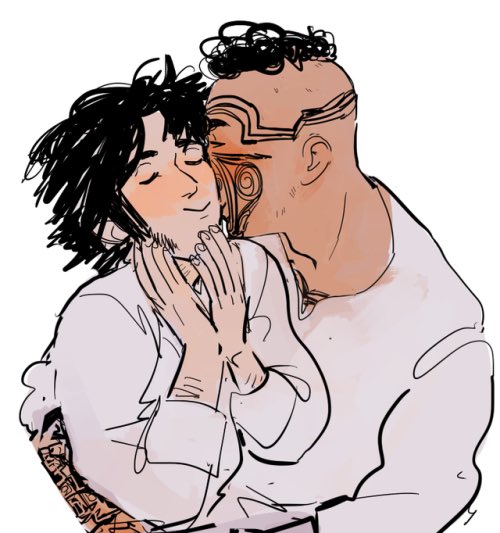
Queequeg, for his part, ‘clasped (Ishmael) round the waist, and said that henceforth (they) were married’. (The motif of weddings follows our lovers for the rest of the book.) He wants to continue sharing Ishmael’s bed, and take the same ship. He proves himself a devoted partner, and though they draw a polite veil over the rest of their relationship, we know that even aboard the Pequod, they are together. They eventually go on to make each other the legatee of their wills, and isn’t that love? To look at another person and think, I hope you survive me, and care for them as best you can?
The spiritual marriage between Ishmael and Queequeg forms the basis of the novel. Ahab’s infamous quest for vengeance against a minding-his-own-business whale is often mistaken to be the crux of the narrative, but ultimately what we have is a far more subtle and powerful narrative. Remember the hundred chapters I mentioned above? That is essentially Ishmael’s dissertation on whaling, with philosophical digressions and rhapsodies about his heroic husband. It is sandwiched between the rising action and climax of a disaster movie about queers on a boat falling in love.
Moby Dick is the story of Ishmael seeking meaning to his life, and finding it in the tattooed arms of Queequeg.
If you have never read Moby Dick, I urge you to do so now. I have an ardent and sinister desire to spark a Moby Dick renaissance, and the queer love story at the heart of this poetic book is worth sharing.

What an intelligent review and recommendation. Thank you Nam Perugu. I am reading it and may skip along the hundred chapters in the middle, but now I am interested in hearing Ismael crow about the heroism of his beloved. I very much enjoyed the beginning and reading Ismael:
“admits that ‘no more my splintered hand and maddened hand were turned against the world’. Although he is supposed to be taking ship for mental health reasons, it is Queequeg that has ameliorated Ishmael’s self-destructive mood.”
And I loved your commentary on a true display of love:
“They eventually go on to make each other the legatee of their wills, and isn’t that love? To look at another person and think, I hope you survive me, and care for them as best you can?”
Scott, in Vista California sending good vibes and a thank you hug to Hyderabad.
PS. Can one find good vegan food in Hyderabad ?
What a sad, empty life, to look for confirmation for your chosen lifestyle everywhere, and to think to have found it where there is none.
Melville is clear that, for Queequeg and his kind, ‘to be married’ is to be a ‘bosom friend’. It’s literally the title of the tenth chapter. Men have had bosom friends since the dawn of time. And literature is full of these male friendship stories — even the Bible has one, between Jonathan and David and, guess what, the gay community says that they had an affair. Ishmael and Queequeg have no sexual interactions anywhere in the book. Also, Ishmael says he’s a ‘good Christian’ and, you know, Christianity isn’t really into sodomy.
But let me tell you one more thing. You got the whole story wrong. IT IS about ships, fascination, fury, vengeance and…WHALES! It’s in the title. One can’t be so blind — and so stupid. You will try to preach about your crazy secular religion, naively thinking that Moby Dick is about being gay. Thankfully, the world won’t buy it. Grow up.
I was glad to read your rebuttal, because I was wondering how I could have missed the theme of such a long book. It’s been at least twenty years since I read Moby Dick, but I like to think I would have noticed a homosexual thread. I would have been neither shocked nor obliviously to it.
I assumed the language to be the vernacular of the time and didn’t look for hidden meanings. I knew boarding houses and sailing ships were about providing sleeping space and accommodations were sometimes shared with strangers, as I’ve read various places over my 65 years of reading. Navies did, and perhaps still do, employ the “hot rack” method where one sailor gets out of bed and another gets in.
I thought Moby Dick to be about madness, obsession, courage, duty, friendship, spirituality and whaling.
The initial review had me wondering how I could have missed the homosexual theme, to the point I was considering rereading it with its
excruciatingly detailed descriptions of whaling practices. To be fair, I believe that detail would have been of interest to Melville’s audience of the era. But thanks for saving me from it, as once was enough.