



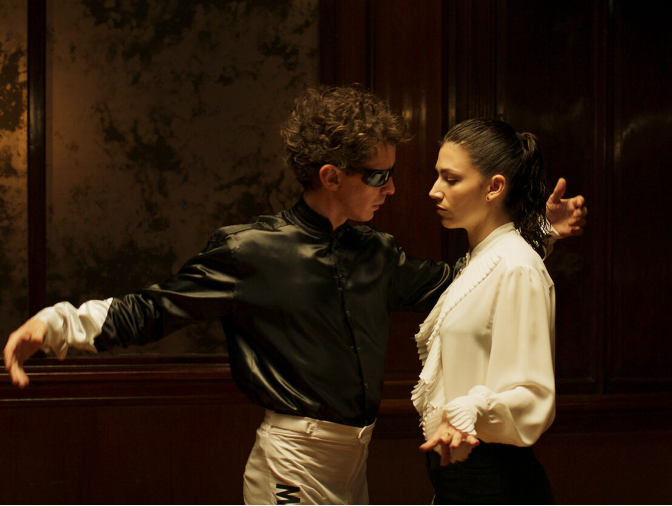
The vibrancy of the Juhu PVR theater, everyone is excited for the last film of the first day of MAMI Film Festival. They are locked in like a flight is about to take off. There are rumors about how great the film will be simply because of the promising poster and description. People and film bros have lined up since evening to be able to get in, the games to get are each one of their own. Next thing I know, I’m seated and watching the jockey’s lining up with their horses, with the race about to take off. Our leads are flirting through their eye protection goggles and satin suits. And Remo, our lead under a drug-induced high, is left behind his horse, suffering a slap right from the fields’ warm sand.
This is just the beginning of the movie, characters have been slapped and the director isn’t shying away from introducing our characters’ most authentic self–the sad, mysterious, tortured poet, lover, sorry I mean sportsman.
In one word, the movie is blunt. It’s vibrant with its visuals, sound and sharp dialogues, delivered hot and fresh by each and every actor. Right from our villainous, creepy mobster father–Sirena and the four motherless children who adopt the lead–Remo/Dolores/Lola (will explain the name of the comedy in a bit) as their mother.

The Queer Ride Of Sports
Sports, while it has been established that is superficially straight and inherently queer, Luis Ortega, the director, writer and producer of this gritty, fluid and queer story gets it. With Remo’s love interest, Abril is also a jockey herself. Who is currently favored by Sirena (who was a weird sexist dude) as well, but that doesn’t add any strain on Abril and Remo’s love. Instead, we see Remo begging to be loved openly by Abril, who only ever says one thing, “for me to love you, you must die and be reborn again.”
Sounds toxic, I know, but as the film proceeds, with Remo crashing and accidentally killing the very expensive horse Sirena got him, we understand that it was necessary for Remo to crash, burn and be born again.
What we see forward is Remo’s body, the horse, being ridden by a woman–Dolores– has taken over his body, mind and fashion as the Jockey. I realized this in hindsight but Remo was never a part of this story, just the horse/body to be ridden by Dolores and eventually Lola.
In simpler words–Remo is a trans woman, who has been trapped in a self-destructive lifestyle, destroying and breaking everything Remo stood for, just to be able to live as Lola. Once Remo’s body is destroyed, Dolores/Lola take charge.
Abril knows this, and she will fight the world to ensure Lola returns safe and sound back to her arms.
How To Tell A Trans Tale
Consider Ortega a part of my carousel of filmmakers to follow closely. I’m yet to watch his previous work–El Angel– that was screened at Cannes’ Un Certain Regard back in 2018.
While this wasn’t Ortega’s first tango with Cannes, it is still pretty impressive to have only ever made 5 films and hit the nail every time (or so I’d assume, judging the level of artistry seen in El Jockey).
Usually when telling stories of transgender folx, there’s a certain empathetic or sympathetic lens expected, but Ortega went a step ahead and decided to show Dolores as this lady, waiting to get out and put her love out in the world.
So while Remo doesn’t talk, show expressions or even his eyes for most of the film––Lola is the opposite. She talks, she listens, she advises and loves without begging for it. A major contrast between Lola and Remo is that Lola never had to beg Abril to love her. She knew Abril loves and that Abril also loves Ana (yes it’s a pan-Polyamory representation too!).

Conclusion
Without giving too much away from the ending, do expect to tear up to see Lola proudly be herself. If there’s one thing I’m a sucker for, is being able to see characters finally find peace within themselves. When I saw Lola, with her longer hair, climbing ceilings, cutting hair and being gentle. It only made sense why Remo was so destructive, and that it was Lola who had accompanied us throughout the film.
If Remo is destructive, Lola is someone who has learnt how to nurture.
