


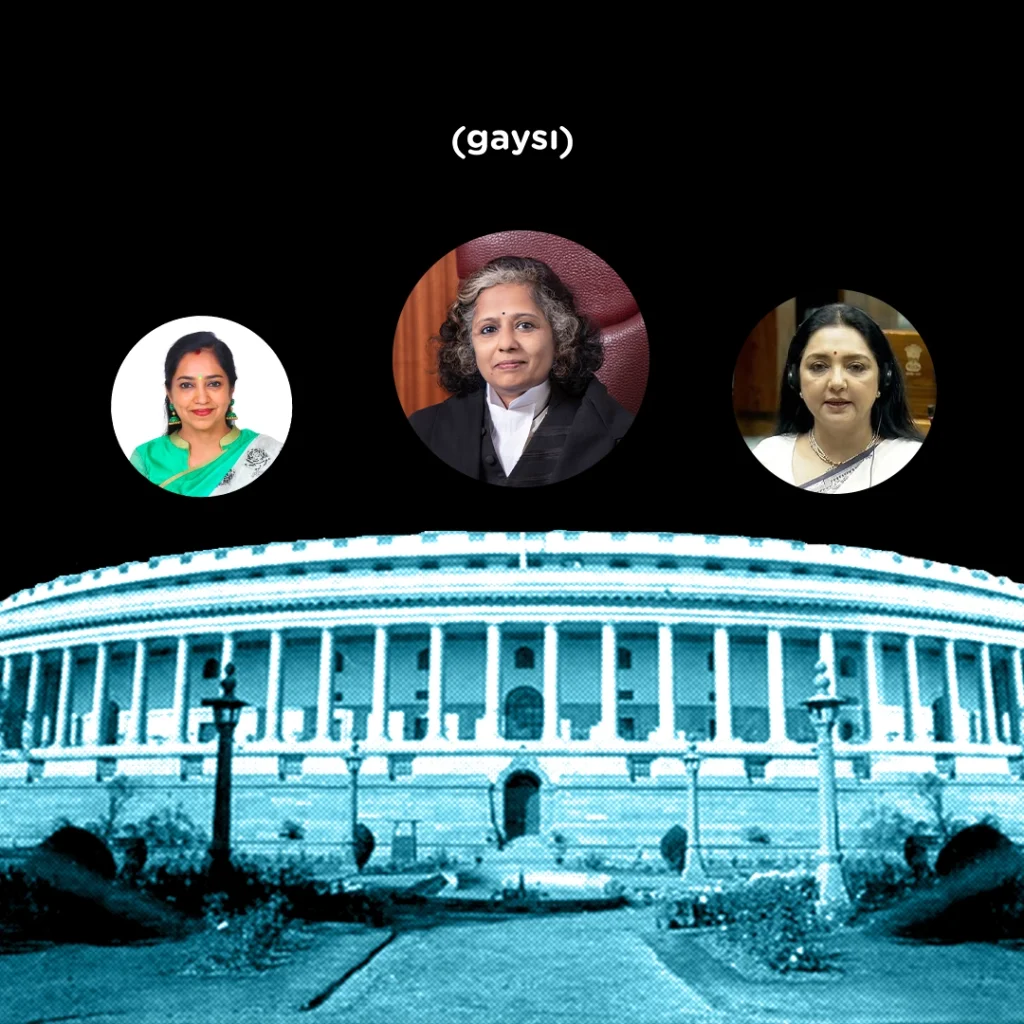
Parliament passed the Transgender Persons (Protection of Rights) Amendment Bill, 2026 on March 25, 2026. Here is what happened, who said what, and why it matters.
On the floor of the Lok Sabha and the Rajya Sabha, over two days of debate, 28 Members of Parliament stood up and spoke about the lives of India’s transgender community.
Twenty of them opposed the bill.
Eight supported it.
The bill passed anyway.
What The Bill Actually Does
The Transgender Persons (Protection of Rights) Amendment Bill, 2026 builds on the 2019 Act that first recognised trans persons in law. Framed as an effort to strengthen safeguarding mechanisms, its provisions instead deepen control and move the law further away from its stated purpose.
In practice, it does the following:
Removed the right to self-identify your gender—a right the Supreme Court established as fundamental in the 2014 NALSA judgment.
Introduces a medical board-led process in which legal recognition is contingent on a doctor-led recommendation—marking a departure from the self-identification framework upheld by the Supreme Court.
Narrowed the definition of who counts as transgender, excluding trans men, trans women, and several gender-diverse identities previously recognised.
Required hospitals to report gender-affirming procedures to government authorities—a direct violation of the Supreme Court’s 2017 Puttaswamy judgment on the right to privacy.
Introduces broadly framed criminal provisions that may be open to wide interpretation, creating potential risk for NGOs, peers, and family members engaged in allyship and support.
All of this without consulting the community it claims to protect. Including the National Council for Transgender Persons, created specifically to advise on such matters.
What Parliament Said
The opposition was not small or partisan. It spanned the INC, DMK, SP, AITC, AAP, NCP, Shiv Sena UBT, RJD, CPI(M), IUML, YSRCP, JMM, and BJD. Across party lines, across states, across political histories, the arguments converged on the same points.
| “You cannot certify a human soul through a medical board.” — Dr. T. Sumathy, DMK |
Dr. T. Sumathy, Member of Lok Sabha from the DMK party, held up Tamil Nadu’s self-identification model—welfare boards, healthcare access, no mandatory medical certification—as what the Union government should be learning from, not dismantling. She called the bill a constitutional regression, and not a technical correction as claimed.
| “We are not just amending a law — we are erasing people from it.” — June Maliah, AITC |
June Maliah, Member of Lok Sabha and of the AITC, pointed out that of nearly 4.9 lakh transgender persons recorded in the 2011 Census, only 35,000 have applied for identity certificates under the existing law. The system was already failing most of the community. This bill makes it harder.
| “There is a fundamental difference between legislative majority and moral majority.” — Prof. Manoj Kumar Jha, RJD |
Saket Gokhale, MP in the Rajya Sabha from the AITC, read out mental health data that should have stopped the House cold. He also revealed that the parliamentary affairs minister intervened to push the bill to a vote rather than allow full debate, and that when members approached the ministry, they were told consultation was “not needed because the bill had already been introduced.”
| “A right without consequence is not a right. It is merely a suggestion.” — Swati Maliwal, AAP |
Swati Maliwal, MP in the Rajya Sabha from the Aam Aadmi Party, named a specific person: Jane Kaushik, a trans teacher who was qualified, hired in two states, and forced to resign, not because of her work, but because of her identity. She raised a legal inequality nobody else had cited: sexual abuse of a trans person carries a punishment of 6 months to 2 years. For cisgender women, it is a minimum of 10 years. She asked the House directly — is the dignity of a trans woman worth less?
The Numbers They Read Out
Sanjay Singh of AAP brought the budget figures that expose the government’s claim of commitment to trans welfare:
| a) 31% of trans persons have attempted suicide 50% of those attempts happen before the age of 20 b) 5,566 certification applications already rejected under existing law — no explanation, no appeal mechanism c) ₹52.91 cr allocated for trans welfare in 2023–24 d) Only ₹6.59 cr actually spent (12.5% utilisation) |
A government that cannot spend the money it already allocates for this community is now passing a new law claiming to help them.
What The Supporters Said
The supporters of the bill cited cultural traditions, mythological references, government welfare schemes, and the need to prevent misuse.
The misuse argument deserves particular attention because it appeared repeatedly, and without evidence. One BJP MP described personally following people dressed as trans persons at traffic signals, noting they had families and homes, and used this to justify the need for medical verification. No data was cited. No study was referenced.
This line of reasoning is deeply unsettling. It relies on surveillance, anecdote, and suspicion, not policy evidence. It assumes that trans identity must be proven false before it is accepted as true.
It also reflects a fundamental misunderstanding of lived realities. The existence of a family or a home does not mean access to dignity, safety, or rights. Transgender people in India continue to face systemic exclusion from formal employment, are pushed into precarious or informal work, and struggle to access affirming healthcare, safe housing, and discrimination-free workplaces.
To suggest that the mere presence of a home invalidates marginalisation is not just inaccurate, but a refusal to engage with how exclusion actually operates. What is being framed as preventing “misuse” ends up legitimising scrutiny of already vulnerable lives, while ignoring the structural barriers that remain unaddressed.
However, the argument that large numbers of people are pretending to be transgender to access scarce and stigmatised government benefits in a country where being visibly trans still carries daily violence and social exclusion, was presented as sufficient reason to strip an entire community of constitutional rights.
The most structured defence came from a BJP MP, the Minister of the bill, Dr. Virendra Kumar, who is also a medical doctor. He drew a distinction between personal identity (which he acknowledged the State cannot regulate) and access to state benefits (which he argued requires verification. It is a more coherent argument than most. But it rests on a false separation.
In practice, identity and access cannot be split. Legal recognition is the gateway to documents, employment, housing, healthcare, and welfare. Making that recognition conditional means making access conditional. This is precisely what the Supreme Court addressed in the NALSA judgment, which affirmed self-identification as a fundamental right, not one that can be limited to the “personal” sphere while being denied in public life. The judgment does not create a distinction between identity and entitlement.
Once verification is introduced at the point of access, the right itself is diluted. It no longer exists unconditionally—it exists at the discretion of the system. If the concern is truly about welfare and targeting vulnerability, the gaps are elsewhere; and longstanding.
There has been no serious movement on horizontal reservation for transgender persons across caste groups, despite clear demands from Dalit, Bahujan, and Adivasi trans communities. At the same time, the Union Budget 2026–27 offers no new schemes, allocations, or targeted measures for transgender persons, effectively folding their needs into generic programmes that do not account for structural exclusion.
Even existing support systems remain fragile. Garima Greh shelters are limited in number and uneven in reach, with some centres shutting down and funding patterns fluctuating over time. This raises a deeper question about what “protection” is being prioritised.
Because access doesn’t begin at verification. It begins much earlier, with the ability to live safely, to find housing, to complete education, to access dignified work and affirming healthcare. When these are already out of reach, adding layers like medical boards does not create access, but assumes it. It reflects a distance from the material realities of how most people in India live.
If the State can step back from welfare, from housing, from livelihood—but step forward to regulate identity—then what remains of its commitment to dignity? At that point, the question is unavoidable: is this still a welfare framework, or something else entirely?
The Minister defended the bill by citing 60 trans persons invited to Republic Day, a canteen run by trans persons at a government building, 67 training programmes, and 23 Garima Greh shelters. Although these are real initiatives, they are not a defence of removing self-identification rights.
Then The Supreme Court Weighed In
On the same day that the bill was being debated in the Rajya Sabha — March 25, 2026 — it was reported that a Supreme Court-appointed Advisory Committee headed by former Delhi High Court judge Justice Asha Menon had written to the Government of India citing concerns about various provisions in the amendment and requesting its reconsideration.
| “The provisions of the Bill are against the NALSA judgment. We request the Social Justice Minister to withdraw the Bill.” — SC-appointed Advisory Committee, Justice Asha Menon (Chair) |
A body constituted by the Supreme Court said, on the record, that a law passed by Parliament contradicts a Supreme Court ruling.
The government passed the bill anyway.
What Happens Now
The bill is about to become law. Both motions to refer it to a Select Committee were defeated. Every opposition amendment was recorded as “not present, not moved.” The clause-by-clause vote passed. The Rajya Sabha passed it. The Lok Sabha had already passed it.
It will almost certainly be challenged in the Supreme Court. Multiple MPs said so on the floor of Parliament itself. Given that the SC’s own advisory committee has already said it contradicts the NALSA judgment, that challenge has a strong foundation.
But court timelines in India are long. In the meantime:
The medical board requirement is law.
The mandatory reporting of gender-affirming procedures is law.
The criminal provisions are law.
The narrowed definition is law.
Sources: Lok Sabha & Rajya Sabha debate transcripts. Document compiled by Hyderabad Against Trans Erasure. Notes by Picnic (He/They).
