


A few months ago, when I was feeling rather alone in an emotionally overwhelming situation, my therapist taught me how to externalize it and allow an object of my choice to hold it for and alongside me. It might sound a little woo-woo when put that way, but I must add that it was incredibly helpful as a technique to ease the discomfort of the situation. In narrative therapy, this is an approach quite commonly used to help children express how they feel, perhaps through their favourite doll or soft toy, without making them uncomfortable about articulating hard-to-express emotions or feel as though they are under the scanner for psychological excavation.
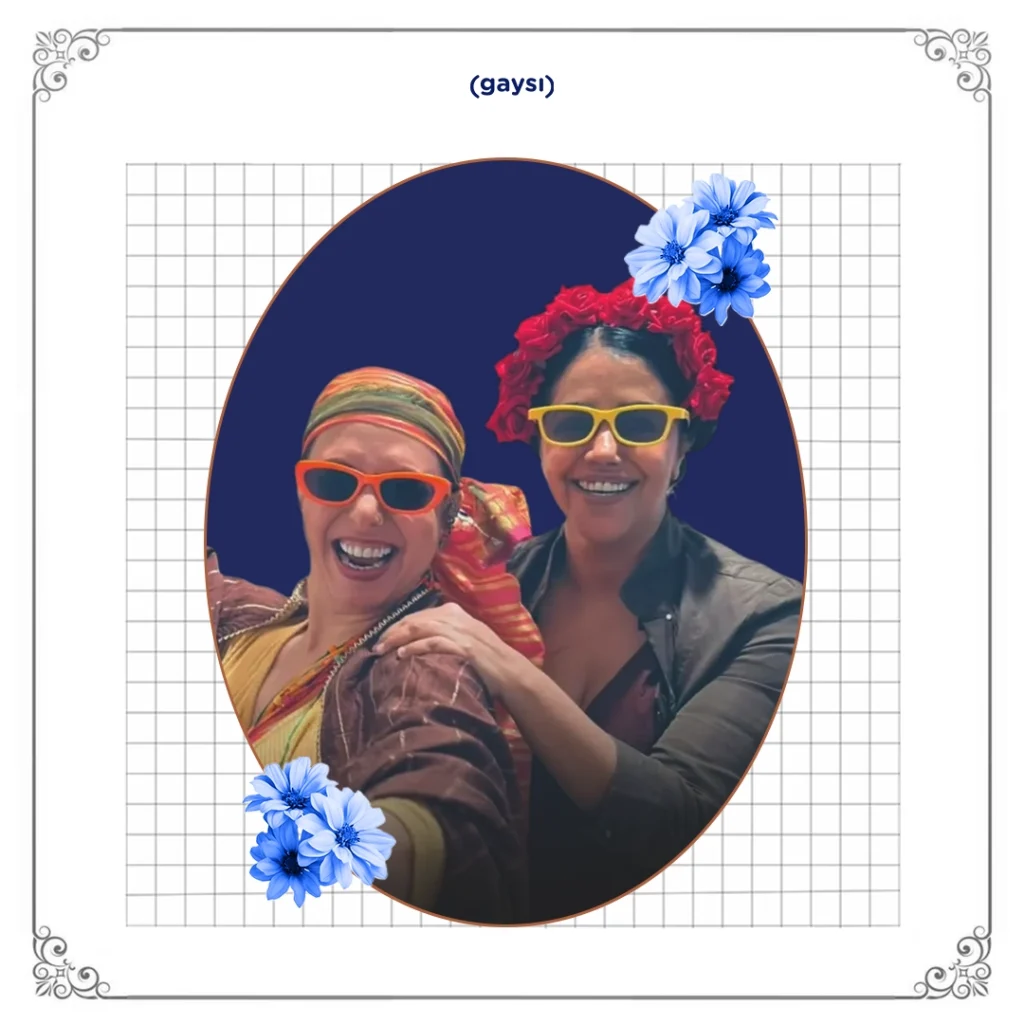
I went into Chai Queens expecting it to be a laugh riot for some reason. Instead, over the course of the hour-long show, the audience is invited to accompany two women, Bubbles and Tejal, on a journey through a shared history that each of them circles around but cannot quite confront directly. They run into each other after fifteen long years, their reunion filled with what can only be described as sapphic pining from a distance.
So they get a little help from their childhood dolls, Ginny and Binny, whom Bubbles has carefully kept all these years, and stage the dolls’ wedding. Through them, they are finally able to share their deepest feelings for one another, and how neither has had an easy journey in the other’s absence.
As children, we all engage in play and create rituals around it. These are often private little worlds that we invite very few people into. Tejal and Bubbles too built such a pillow-fort for themselves, where they found joy in their shared adventures of girlhood. Within that space they found respite from the unspoken rules imposed on them, and from there grew the bond they share.
When they meet again after all those years, they are unable to fully articulate the pain of having lost each other after Bubbles’ forced marriage to a man at the tender age of nineteen, and Tejal’s subsequent departure from the city they once called home.
They reunite at Bubbles’ daughter’s wedding, but really, what unfolds is the spiritual consummation of their own relationship. Many sapphic experiences, especially in childhood, have often been written away as a close friendship lost to some inexpressible “fight”. It isn’t just the pressure of coming out as queer. It is also the strain of navigating that truth under the daily boot of patriarchy, which often breaks our hearts as we feel compelled to leave behind loved ones who might still be in the closet, without ever quite giving us the fabled ‘closure’.
The staging felt minimal, and the props were woven so fluidly into the scenes that there was never really a clunky moment. The chemistry between the two actors came through as incredibly lived-in, tender, and quietly aching in a way that resonated deeply with me.
Throughout the show there was plenty of playful sparring between the 2 protagonists, as they strived to stay present despite the thick tensions between them. The moments of levity emerged through humorous exchanges between Bubbles and Tejal, such as an exchange between them in their present age, where they make veiled jibes at one another, overcome by jealousy over Bubbles’ husband and Tejal’s flirtatious attention toward another woman at the event. There is even a hint of the infamous “fuckboy” energy that sometimes emerges to compensate for the tender ache many sapphic heartbreaks carry over feeling ‘unchosen’.
The members of the audience seemed pulled into the story for the duration of the show – in certain moments, quite literally. Some were invited to join and dance as part of Ginny and Binny’s wedding celebrations, and sweets were distributed among those still seated as part of the festivities. It was Bubbles and Tejal’s world, and for a brief hour, we were all living inside it.
The final moment of the play offered a resolute expression of queer joy in reconciliation, despite a story shaped by longing, yearning, suspended affection+devotion, and cheeky flirtation.
One of the most beautiful elements was the use of sarees as props. The intimate act of tying a saree around one another, taking it off, or briefly sharing a dupatta as a piece of clothing or accessory becomes a quiet language between them. These gestures evoke the tender forms of bonding that often emerge in girlhood: the shared intimacy of bodies, clothing, and the gaze of the world around them, and the small ways in which girls learn to subvert that gaze together.
Chai Queens depicts precisely this unspeakable nostalgia, weaving through non-linear timelines and memories through rituals and emotions tucked away in the dolls of our girlhood.
Watched it at the Mumbai Fringe Festival, 2026, and I hope it finds many more stages.
