


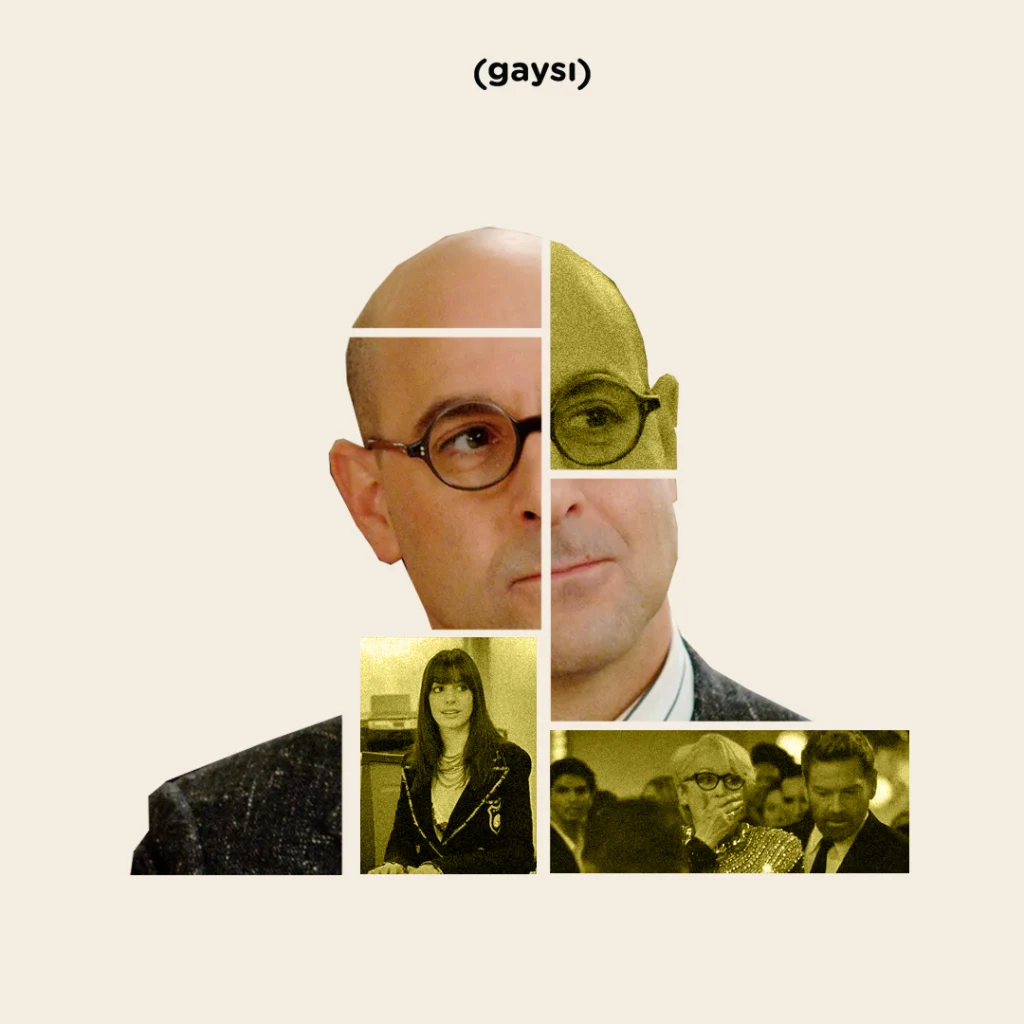
I write to understand whether seemingly progressive commercial cinema, while marketing itself to attract a queer audience, espouses the cause of queerness with the honesty it deserves.
Nigel appears wearing a signature signet ring, his bald head reflecting sunlight as he walks around Central Park giving directions to the models posing for a spring collection under the very formidable and cold Miranda Priestly. Miranda, in the sequel, is more human, less intimidating, and tired. She finally has a supportive romantic interest who stands up for her through the turmoil of the publishing world, as rival oligarchs crunch numbers to make reportage less relevant.
Her true lieutenant in this journey, though, has been Nigel, constantly by her side, supporting her through her career. He was there before Andy, during Andy, and after Andy. Nigel remains that permanent fixture at Runway who has access to what most girls and gays would kill for—the joy of being surrounded by the most creative and fabulous pieces of clothing, apparel, and shoes. Nigel is steadfast in his determination, measured in his words, and wise with his counsel. His devotion towards Miranda through the films is unquestioned and never failing. Nigel writes her speeches, decides who wears what, is the voice that gets everything ready before Miranda arrives, and he has done this dutifully for over twenty years.
The first film ends with the great betrayal of Nigel by Miranda, a promise unkept and conveniently traded to maintain her position at the helm of affairs among those who matter in fashion. In spite of the slight, through the sequel, Nigel remains by Miranda’s side, acting as her trusted aide, making sure all her orders are followed up as commandments and seen to fructification. Miranda continues to overlook him for roles that his experience, knowledge, and stature demand, and he appears to have made his peace with it, admitting to Andy that Miranda did what she did to him twenty years ago a million times more.
The portrayal of Nigel is a wonderful yardstick for understanding the limits of queer acceptability in popular culture. While the indomitable Meryl Streep has gone on record to share her admiration for queer folx and their contribution to the creative arts, the films have set limits on the ambitions that Nigel harbors. In the first film, shot in the 2000s, he laments to Andy about his dream and turning it into his reality in the face of adversity. Produced for about thirty five million dollars in 2006 and grossing over three hundred twenty five million dollars, the film’s reach reflects both its popularity and its cultural acceptance. Nigel’s personal life remains guarded, and the movies maintain a studied silence about who Nigel really is beyond his work. We know about his childhood yearning to work in fashion and his eventual arrival at Runway, but very little else. The sequel refuses to look beyond Nigel’s work, and unlike other main characters, we know very little about his life outside of Runway and Miranda. This refusal to develop Nigel beyond his work deprives us of seeing him in the same human light as Miranda, who now has a supporting romantic partner; as Andy, who is trying to find love; and as Emily, who has indeed found a devoted lover. Real-life parallels exist in very successful gay men who guard their personal lives, like Tim Cook, the soon-to-retire CEO of Apple, or Sam Altman, the co-founder of OpenAI. Contrast this with the lives of other billionaire tech CEOs like Elon Musk, who openly discusses his rendezvous with various women and the children he has sired with them.
Nigel’s ability to be useful is not just tied to his brilliance in the trade of fashion, his keen eye for aesthetics, or his flair for fabric, but also to his subservience to the boss, Miss Priestly. Both the acceptability of queer relationships and queer assertiveness continue to be constrained, and things get only worse in South Asia, where we continue to face the wrath of a homophobic and transphobic state machinery. Wherever there is a hint of queerness, it is often spayed with a certain muteness to make it more palatable in the public eye. There is this notion of ‘respectability’ associated with a particular performance of queerness to which popular commercially successful cinema remains limited.
While queerness is not a subject the film approaches head-on, the noise the cast and crew have made around the subject has not translated into a sensitive and meaningful exploration of the queer experience. The only other queer character given some airtime in the first movie was Doug, Andy’s friend, whose character didn’t make it to the sequel.
The Devil Wears Prada occupies a unique position because of its relevance as both a commercial and critical success, while also emerging as a cultural phenomenon. Its success is a testament to its relatability with the audience, which points to a mirroring of the audience’s values with those of the movie. I have attempted to look at the tonality of queerness in popular ‘progressive’ cinema, made by actors who are vocal supporters of the LGBTQIA+ community. The queer ambition is toned down in this kind of depiction. You can be successful but not too successful. You can be present in the room but not command it. You may have well-meaning peers and superiors, but that support may not always translate into an ability to achieve your ambitions.
Finally, in The Devil Wears Prada 2, Nigel gets an opportunity to command a room, granted by Miranda. For a woman who could send Emily away for not being a visionary and could look into people’s souls through their eyes, she had still refused to understand both the ambitions and desires of her closest ally, Nigel. The movie waits till the very end to allow Nigel to have his moment. His ascent to the top and his success are delayed, much like the challenges that queer folx face in having a fulfilling and successful career in the face of systemic obstacles. Would it be wrong to suggest that queer characters appear as accessories in women-led films, much like how women appear as accessories in male-led, patriarchal, misogynist filmmaking projects, of which there is no dearth at the moment? Why is it difficult to imagine a trope where Nigel, the gentle and caring one with an eye as keen as Miranda’s, takes over Runway and makes it a more humane place of work?
Both the acceptance of queer cinema in big-ticket projects and its portrayal remain limited, skewed, and tied to profits. Producers, directors, and actors who are practitioners and voices of progressive politics continue to depict queerness in a certain palatable way while constantly advertising to attract a queer audience. The Devil Wears Prada 2 had so many more opportunities to represent different shades of queerness, opportunities that have simply been missed to appeal to a wider audience.

Soo true✨