



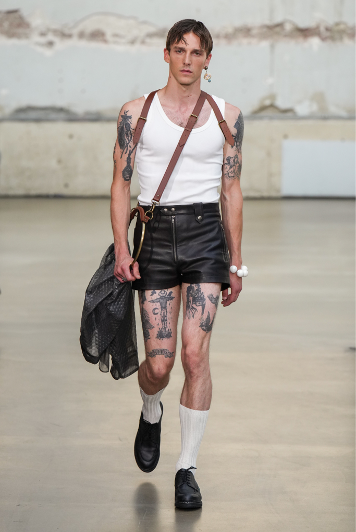
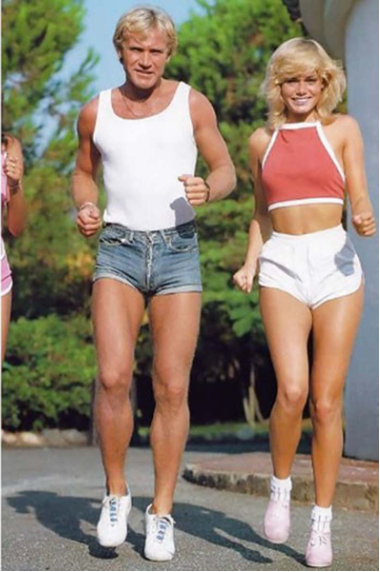
Slutty shorts have had girlies, gays & theys in their grip since 2021. Actually, it’s been a thing since the 1950s (probably longer, but let’s begin here). Short shorts, right from the pin-up days to the ‘hot pants’ of the 1970s, have come a long way and in fact, right back to where we started: aka the upper thigh. Many queer people even speculate that short-shorts were meant to remain an essential part of our fashion journey as a civilization. But it all changed with the hyper-masculine and homophobic trends of the 1980s when we said, “but what about the children?” As if children needed to be protected from the vision of people’s thighs!
After the extremely low-hanging, loose silhouette of “board shorts” in the 90s to the 2010s, we have finally returned to hot pants. We are once again falling in love with the himbos, realising that the real problem was never masculinity ” but rather “toxic” masculinity. We simply can’t get enough of these short shorts or slutty shorts as Murray Clark called them in a recent piece for GQ UK.
Fashion magazines have been baffled trying to figure out how they haven’t left the “trending” chart in 3 years (remember when trend cycles were a decade long?). And maybe the reason for the collective agreement that short-shorts are the right length, is because it maintains a very soft idea of masculinity.
The celebrities spotted in short-shorts have been praised for not just their gains but just how comfortably these men are able to exist in their “masculinity”. They feel comfortable with their gender identity enough to simply wear things they like, and show off their body.
The rise of queer men and their fashion
This isn’t the feminisation of fashion but rather, queerification of masculinity, because duh, the gays have been doing it forever.
We spoke to Arya (he/him), a cisgender bisexual man belonging to Gen-Z, who is interested in art, expression and being loving and adventurous. When asked about the short shorts trend, he said: “I find short shorts super super super hot.” The thing about masculinity for a lot of Gen Z queer-men like Arya is that they are okay with defining it on their own terms. They lean into the discomfort of unlearning traditional notions and ideas, considering it a part of their personal journeys. Here’s what Arya had to say about navigating his relationship with masculinity:
“I feel accepting of who I am. I’ve realised that I see it more holistically now. Being queer, I used to want to run away from “masculine” things, like gym, exercising and a lot of sports. I would see it as a complete no-no. I’ve only now tried accepting the good parts of traditional masculinity, the entire spectrum; where I am comfortable tapping into my masculine energy as well as my feminine energy and striking a balance between them.”– (Arya (he/him)
Redefining masculinity through the lens of queerness is not just about being inclusive, but also allowing for expansion through creativity in the fashion community. After all, the business of fashion across the globe, and even in India, continues to be dominated by cis-men who are successful designers and businessmen running the game.
The tightrope of fitting in and standing out
Navigating one’s individuality, while also trying to find a place for yourself in a community is quite stressful – what with the pressure to fit in and keep up! It’s no surprise that so many of us feel overwhelmed with trying to distinguish ourselves by uncovering our personal likes and dislikes.
“When you dress well and allow yourself more space to explore fashion, it gives you a broader view of how you can look and feel. You can feel more like yourself. It’s a way of expression. Fashion is very important to me. It is a channel of expression at the end of the day and being able to express your thoughts through art or fashion always helps.”
We spoke to Ashwin Thiyagarajan (he/him), whose eponymous brand is focused on making clothes that pay tribute to both culture and nature. He does this through an amalgamation of traditional Indian handicrafts with contemporary and western construction.
“We live in a world that demands you to be sure of who you are. Clothes definitely help create a visual representation of your identity. Whether you choose to express yourself through khadi neutrals or bright hues, even if it isn’t the biggest giveaway, I think it can be a wonderful teaser to who you are.”
When asked about his thoughts on men’s fashion today and the impact of short-shorts;
“It’s high time men played the fashion game. There are a few celebrities who have started dabbling with different silhouettes and I love it. We come from a culture where men used to adorn themselves with a lot of jewellery and elaborate clothing. The colonial influence has really put our masculinity in a box and left no room for creativity. I’m a big advocate of short shorts. My shorts are never longer than 13-14inches. I have a great pair of legs and there is no reason why I shouldn’t flaunt them.”
We’re loving this display of diverse and fashionable masculinities! We are also wondering what a great pair of legs means? Do short shorts only look good on some men because of their muscular legs? Or can it be something that can be size and disability-inclusive too? This blog post by an amputee about why they choose to wear shorts, so their prosthetic leg (and therefore their disability) is visible is giving rizz! Of course, there’s also the ease of access which allows them to slip it on comfortably or adjust their prosthetics whenever required. But beyond the practical, why can it not be accepted as an aesthetic and fashion-driven choice? Who said disabled folx cannot sport a cute fit?
Identifying the way we view pieces of clothing (for instance, as slutty!) and what function they serve can take the fun out of fashion! Similarly, shorts on anyone can be slutty shorts if that’s what they themselves deem them to be.
We love to see short-shorts on different body types, and we’re convinced that no one will be disappointed!
Slutty shorts for the win!
