



About a month ago, a friend shared a viral video with me. It showed a parent promoting an adhesive named Girlie Glue, proclaiming it to be a natural-made adhesive for kids and pets. Founder Katie Hydrick, says she got the inspiration from being “tired of slippery and uncomfortable headbands” (so relatable) and her kids not having “enough hair” for a clip. It’s so true, because how else are people supposed to understand that your child is a girl? Hydrick said she wanted something easy and so, she did what most entrepreneurs do: find a solution to a self-created problem! To be frank, personally, it seems wrong to accessorize babies of any gender. They are just fresh out of the womb, give them a breather; besides, they are already experiencing so many new things.
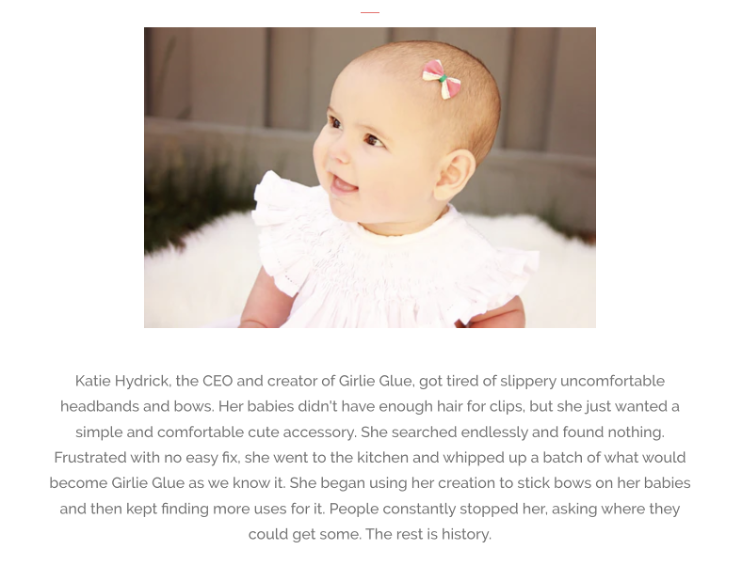
One can’t even imagine the toll this might take on kids who are tagged fussy when they’re just overwhelmed by people fidgeting with them. People’s criticism of this product in the comments almost made the world look sensible for a second. They make a good point by talking about harmful gender roles and feminized beauty ideals being pushed onto the scalps of wee babies! Considering how sensitive kids are to any sensorial stimuli, imagine having a sticky bow stuck to your scalp every day. Yikes.
The tweet below actually brought up a great point about piercings or as the Western world calls it, ‘mutilating’. It is often observed that American and predominantly white parents are against piercings. Unless the parent is desperate to present their child as a girl.

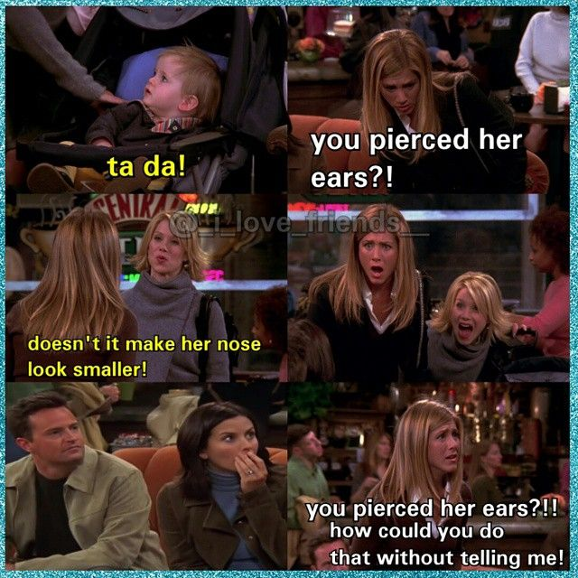
One memorable time we encountered this “logic” was in the show F.R.I.E.N.D.S when Rachel Green’s sister pierced Emma’s ears to make her look more “feminine” by making her “nose look small”. Rachel, though rightly pissed at her sister for not taking her consent before piercing her child’s ears, missed one more reason to be exasperated; why did Emma have to “look” like a girl at all? Emma probably didn’t care about gender expression just yet!
But it’s never as simple as just gender roles or its performance. Gender performance that we learn is also dependent on what gender around us looks like, and how it is represented in isolation but in regards to our social context.
The problem is not making young girls wear dresses to make them look pretty. It begins with picking a dress for the child so that they represent your specific gender values. We learn to perform gender from our parents and other caretakers, who have learnt it from theirs and so on. But it’s never just limited to that, the concept is also encouraged and developed within the cultural community we are living in. We are taught to pick out clothing designs’ based on our social positions and what they represent. For example, a frock is mainly designed to look pretty, and is not a practical choice to go hiking in. It has frills and lace, and is made of uncomfortable tulle material that holds its shape. It’s seen as“too” pretty to be destroyed while playing in the park. So kids in this attire will usually be found sitting next to their parents or playing in a manner that is very conscious of their clothes and restricting their movements so as to avoid ruining it. Their posture at every step is to ensure they don’t flash themselves.
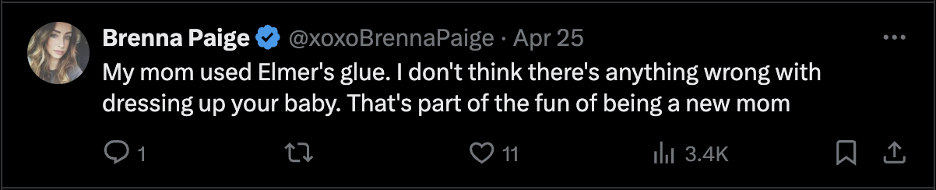
The tweet above, highlights another great concern, how far can parents take their pursuit of fun? For many parents, it is thought to be originating from their own unfulfilled dreams and aspirations that they project onto their kids. But we have to ask ourselves, where do these aspirations come from? We should question how much pressure our parents, or we as parents, put on the child to fit into this purported idea of gender. The act of sticking a bow on your kids’ heads is not as harmful as the reasoning behind it, which seems to stem from your fear of your child being accidentally misgendered. Bows could be fun for you but it could translate into something that children will feel the pressure to adhere to as they grow older.
Also read: The Shades of Body: Addressing Body Positivity through a Queer Lens
For kids assigned female at birth and raised as girls based on this, such pressures begin to show up as early as when they are toddlers. There’s always pressure to remain “gender-appropriate” and look “cute”. Things are slowly becoming more relaxed (thanks to the evolving feminist movement) since there are more practical clothing options for all kids. Also, it is possible that many parents who have been subjected to the same treatment, now try to protect their children from this (unless you’re Mommy Girlie Glue).
In a community setting like schools, which can often have standardized and gendered rules of dressing, it is hard for children to express themselves, especially in India where gendered uniforms are the norm. When I was growing up, I remember being subjected to strict school dress codes, right from the select few hairstyles I was allowed to the shine of my Mary Jane.
Also read: ‘Gender-Neutrality’ in Schools Across Kerala: Invisibilization or Equality?
Glad to note that things have relaxed for younger Gen Z and older Gen Alpha young folx, who are the current school population. Sue (name changed) (she/her), who used to teach in private and alternative schools in Tamizh Nadu mentioned how her previous workspace didn’t follow a traditional uniform. The children were allowed to dress in casual wear, as long as they followed a few ground rules like not wearing branded or logo-heavy attire, a way to ensure an equitable student community.
According to her, the only hiccup was that “long hair, was something restricted to girls. [Girl students] could grow their hair out and wear ponytails, and braids or even leave it loose if it’s not too long. But, boys had to always maintain a certain length when it came to their hair. Why do these kinds of things have to be gendered if they are accepted for one gender? When it’s acceptable for one gender, why is it not acceptable for another gender?”
Meghna (she/her), also an educator who works at a school with a similar philosophy, observed that the female students in her school preferred to keep their hair long. Despite the short hair rule, male students experimented more with cuts and colour, she observed.
The same relaxed rules for girl students’ hair being “free to style”, received a different response in the school she teaches at. It would be easy to say that children have agency to express themselves, but children are often, if not always, perceived as representing their parents. It is worth noting that young students are still forming their opinions and figuring out who they are. Considering the power dynamic between children and systemic rule-setting by adults, it is understandable that they often accept and submit, instead of critically engaging or rebelling back. That’s when adults around them are expected to facilitate and make space for them to express themselves.
One such instance occurred in Meghna’s school: “So we have a [student] who is non-binary and they dress depending on how they feel. They have supportive parents, but issues often arise between peers. Some boys who consume a lot of ‘alpha masculine’ content online, often make fun of kids who present in ways that are [they’re taught to see as] ‘feminine’. As teachers, we have had conversations with them, but the problem is that so much of this doesn’t happen in school; it happens online and in spaces where we don’t have any visibility [as teachers].”
Parents also have trouble navigating/restricting content that children see online, as it is a vast new territory. Understandably so, as the older generations weren’t bombarded with overwhelming content like younger folx may be exposed to today. In a way, it’s a good thing that we’re encouraging more conversations about this and questioning how children are being subjected to some sort of policing around their gender expression. Girlie Glue, at first, seems like a sweet moment a mother may be sharing with her child. However, broadcasting this moment exposes the mother and child to much more fundamental discussions online.
We live in a paradoxical time where kids have never had so many resources at their fingertips and they have more flexibility with self-expression than the previous generation, and yet we find them under more pressure than ever to perform their gender and identity.
