


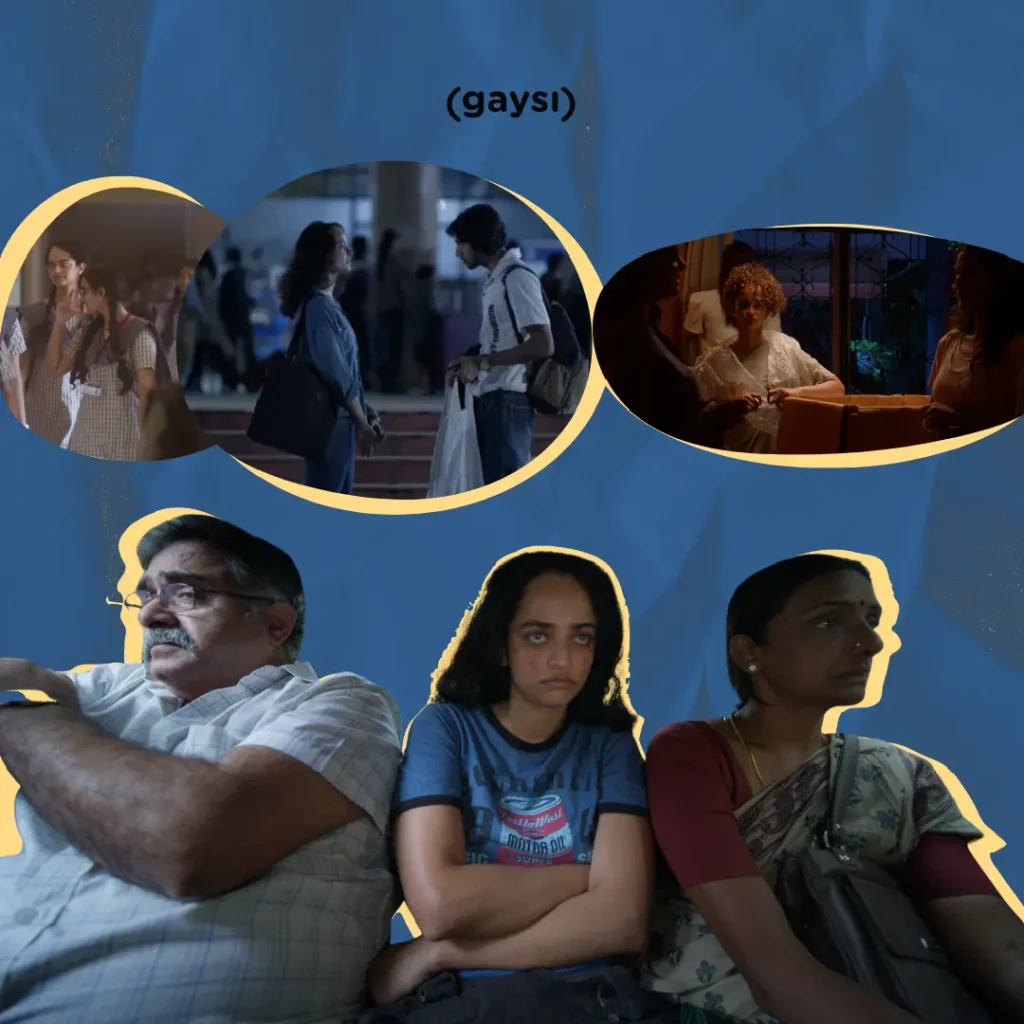
Bad Girl (2025) is often described as a film about female desire, morality, or rebellion, but none of these frames quite capture what the film is actually doing. At its core, it is a deeply unsettling portrait of millennial adulthood, where the old guarantees no longer hold, the new ones are unreliable, and the individual is left repeatedly asking whether the problem lies within them.
The film begins with a dream in which a young girl imagines a small home, intimate and warm, shared with a man she believes will love her, and the ordinariness of this fantasy is important because it is not aspirational in the way cinema often imagines women’s futures. There is no grandeur here, only the hope for stability, affection, and a sense of arrival. When she wakes up disturbed by the dream itself, asking why she keeps imagining such things, the film introduces a question that will haunt her life in different forms, shifting with age but never disappearing entirely: Is something wrong with me?
As a schoolgirl, this question is attached to desire, fantasy, and curiosity, which the film places alongside her lack of academic success in a way that mirrors a familiar and deeply flawed cultural logic. Girls who are not “good at studies” are often coded as undisciplined in other ways too, as if intellectual inadequacy naturally bleeds into moral or sexual excess, and the film’s willingness to lean into this association is uncomfortable precisely because it reflects how easily society makes such connections without evidence or reflection.
What the film does with adolescence, however, is far more interesting than a simple morality tale. Menstruation appears not just as stigma or pain, but as something girls talk about, strategise around, joke with, and occasionally weaponise, whether it is chalk used to hide a period stain or excuses invented to escape sports class, and these scenes capture a form of everyday resilience that does not look like empowerment in the cinematic sense but feels emotionally true. At the same time, this ordinary bodily experience is relentlessly regulated at home, where kitchens become forbidden spaces during periods and purity is enforced as routine discipline rather than explicit cruelty.
Desire, once noticed, is quickly punished. Classmates call her a despo, boys label her a slut, and when another girl is caught kissing a boy at school, the blame is redirected towards the protagonist as a way of minimising her own transgression, triggering an institutional spectacle in which bags are checked, phones are searched, and her mother’s position as a teacher turns the incident into a public humiliation. What is striking here is not the severity of the punishment, but the eagerness with which systems move to restore order, not to protect anyone, but to reassert control.
At home, control takes quieter but no less damaging forms. A bright pink bra becomes evidence of filth. Astrologers and temples are consulted as if desire were an illness that could be cured through ritual. Her father draws a line that reveals a hierarchy of shame, explaining that he never minded her academic failure but that this is different, that this has crossed limits, making it clear that in this moral universe, wanting is a far greater offence than failing. Her grandmother goes further, blaming her daughter-in-law for not staying at home, for working outside, and for having given birth to a girl at all, exposing how deeply misogyny is embedded across generations, often transmitted through familial expectations rather than overt violence.
When the protagonist reaches college, the narrative does not shift into liberation so much as exposure. She is sexually active and unapologetic, but visibility does not bring ease. Her relationships are unstable, shaped more by absence than abuse, and when a boyfriend leaves for an internship and slowly withdraws without formally ending the relationship, the emotional fallout is devastating enough to manifest physically, as she stops eating, becomes dehydrated, and is hospitalised. The film is precise here in showing how emotional neglect can corrode the body, how distress does not always arrive as a breakdown but as quiet depletion.
Importantly, the film refuses to flatten her romantic life into a series of disasters. Not all her relationships are toxic, and one of her later relationships, an interreligious live-in partnership, is shown as caring, communicative, and functional. What undoes it is something far more difficult to articulate: the slow realisation that she is falling out of love at the same time that she is acutely aware of her age and the pressure to settle, a confusion many adults experience but rarely see reflected without judgement. The relationship does not end because anyone is cruel or inadequate, but because love itself proves insufficient as a long-term guarantee.
By the time she is thirty-two, she has changed. She no longer clings to relationships with the same desperation, she lets go more easily, and she moves on with less obsession, but this growth does not deliver the stability that self-improvement narratives promise. She is unmarried, her friends are getting married and having children, and her mother asks whether she is not worried, reactivating the same question that followed her since adolescence, now translated into the language of timelines and achievement: Is something wrong with me?
What makes Bad Girl resonate so deeply is that it places this question within a broader social context that offers no easy answers. An acquaintance tells her that he is getting divorced because there is no love left in the marriage despite therapy and effort, quietly dismantling the idea that marriage itself is a solution to uncertainty. Lives that appear settled are revealed to be fragile, and the hierarchy between those who have arrived and those who have not begins to collapse.
The film’s most devastating commentary on social memory arrives when she returns to her old school for her mother’s retirement. Sitting in the audience, she turns around to ask a group of girls to stop gossiping, only for them to recognise her first as the retiring teacher’s daughter and then, more tellingly, as the girl whose story is still told as a cautionary tale. In that moment, decades of growth, self-reflection, and emotional labour are erased, replaced by a simplified narrative designed to discipline others, revealing how institutions preserve women not as people but as examples, frozen at the moment of their perceived failure.
The death of her grandmother further sharpens this critique, as mourners speak of purity and discipline while recalling how she spent her final years bedridden, dependent, and unable to maintain the very standards she enforced, exposing the futility of moral control over the body. This realisation deepens later through the metaphor of her cats, particularly when one escapes after her mother opens the windows, triggering panic that sends both mother and daughter to a psychiatrist, where the mother finally recognises that the fear she feels for her child is the same fear her child feels for her pet, reframing decades of control as anxious care rather than simple oppression.
The film ends where it began, with the idea of home, but transformed. She moves into a small, rule-free space after years of living under restrictions, and as she inhabits it, the imagined home from her childhood dream overlays the real one, not as fantasy fulfilled through romance, but as belonging achieved through autonomy. She decorates the space, cooks for herself, lives with her cat, and allows herself a form of contentment that does not require explanation or validation. Before the final moment, she reflects on how the freedom she enjoys is built on the struggles of her mother, her grandmother, and generations before them, acknowledging inheritance without resentment and telling her mother that she loves her, a sentence that arrives late but lands heavily.
This is where Bad Girl becomes something larger than its protagonist. For many millennials today, adulthood has not followed the sequence it once promised. People are working, often continuously and without clear payoff, forming relationships that are intense but unstable, meaningful but not always permanent, and trying to make peace with the fact that not every ending arrives with clarity or justification. Relationships do not always end because someone was cruel or toxic. Sometimes they end because love changes, or because two people grow in directions that no longer align, or because the pressure to settle collides with the quiet knowledge that staying would be dishonest.
What complicates this further is the constant negotiation with parental expectations, shaped by a generation that reached stability earlier and under different conditions, making comparison feel both inevitable and deeply unfair. At the same age that millennials are still figuring things out, their parents were often already settled, already secure, already certain, which turns every conversation into a subtle reckoning with delay, difference, and disappointment. The questions multiply: Did I leave too soon? Did I stay too long? Did I choose wrong? Am I losing out? Is this freedom, or am I just late?
Bad Girl does not offer answers to these questions, and it does not try to console its audience with narratives of eventual arrival. Instead, it recognises the disorientation of a generation living without a stable map, where success is unclear, relationships are provisional, and self-doubt becomes a constant background noise rather than a crisis. The film understands that the most exhausting part of this condition is not instability itself, but the need to keep explaining it, to parents, to society, and to oneself.
In refusing to resolve its protagonist’s life into something easily legible, Bad Girl makes a quiet but radical claim. There may be nothing wrong with her at all. What may be wrong is the expectation that a life must follow a particular order to be considered complete.
