



Debalina Majumder’s (she/her) documentary, Gay India Matrimony, which was released in 2019, was shot between the years 2013-2018. These are coincidentally the exact period between when section 377 was upheld as a homophobic law and later, in 2018, when it was read down. While the primary language of the film is Bengali and English, it manages to address exactly what it needs to. It’s about queer folx being shunned out of society, being kept at bay and away from love & community. But when have we ever paid heed to that?
Queering the Movement
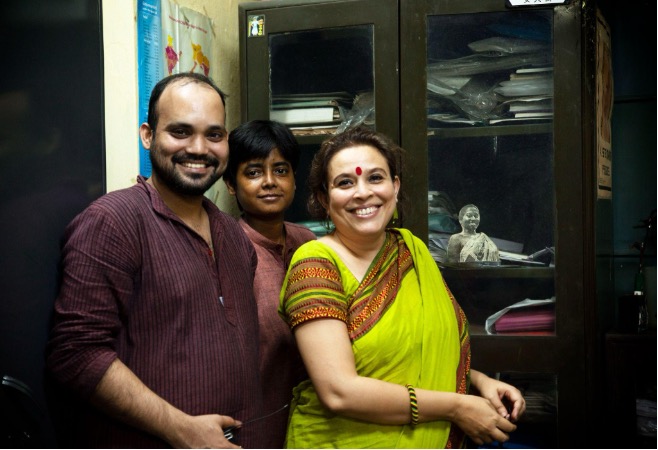
Watching the documentary is a bitter-sweet experience that’s comical, awkward, sarcastic, eye-rolling, and honestly, a little sad. It takes us through the lives and romantic aspirations of Gourab Ghosh (he/him), Sayan (he/him), and Debalina, three queer adults looking for a marriage match for themselves. There’s a cameo from the folx at Sappho For Equality who humorously talk about important things that show how much we rely on hetero-patriarchal systems. It made me question the nature of the institution of marriage, which very much makes promises of being the ultimate safety net.
“The controversies surrounding Gay India Matrimony has made it even more popular than we could have imagined. Both the right wing and the left wing have stopped its screenings, which tells us that we must have asked some very fundamental questions that hit at the heart of the society we live in..” – Debalina
Gay India Matrimony was screened at festivals just before the lockdown in 2020 and had a couple of in-person screenings before everything shut down.
Taking us through the quest of finding partners for our 3 leads, the documentary shows them using all possible modern media available for matchmaking. Everything from advertisements in local newspapers, to matrimony websites and even Facebook!
Majumder takes us through 2 different weddings, where she interviews 2 queer people who are struggling to find a partner and acceptance within their family and peers, either for their queerness or for their political beliefs. One thing that struck me was Gourab’s attempt at finding love at the wedding of his comrade. Gourab laughs in the film, stating that the suitors that he could’ve possibly linked up with, immediately dispersed when they heard him chant the Communist Party’s “lal salaam” to their comrade. He went on to compare how love and the communist revolution both use the colour red, saying, “love is radical just like a revolution”.
What Type Of Couples Do We Prioritise?
When asked about her own criteria for finding a partner to marry, Majumder begins by listing different qualities and immediately realises that she might be asking too much of a single person. Sayan argues that if you want to commit to just one person for your whole life, why should you ask for anything less?
The documentary definitely made me question the monogamous structure of marriage, not just in patriarchal spaces but also within queer companionship. Especially the part where academic Ispsita(she/her) raises valid points on why marriage as a structure promotes patriarchy, queer marriage would then still play into that structure. Then I thought how would this documentary play out when polyamrous folx demand legal recognition for their partnerships as well? Afterall, our legal framework at the moment mainly supports monogamous relationships. But in a country that barely recognises interfaith and inter-caste marriages, queer and non-monogamous relationships feel like a distant dream.
It’s been some time since the documentary has come out and we reached out to Gourab who has some new insights on marriage now.
“My idea of marriage is largely shaped by Bollywood, so I obviously always wanted to have a Mehendi ceremony. But I think that in weddings each ceremony or ritual has some significance behind them. When queer couples perform them they are borrowing them from a heteronormative structure and using it very consciously. So, while I will probably want to put Mehendi or Haldi on my hand, I will also try to politicise the interaction, in my own ways. My understanding of same-sex marriage is that there has to be some sort of civil partnership rights. But in the film we think about whether it should be civil partnership rights for queer folx, while it remains marriage for cis-het people. This would mean putting these relationships on a hierarchy! So, we want marriage rights, even though it has its own problems, rituals, institutional stereotypes, and biases. Then the next step would be to abolish the institution of marriage from the inside.”
Digging into the director’s vision
We also asked Debalina Majumder to share her thoughts on how the film has moved through time, especially since review petitions challenging the Supreme Court’s October 2023 judgement are being considered,
When did the idea for this project come into your mind? How do you think it ages with the current discourse on queer couples getting marriage rights?
As countries were legalizing same sex marriage, I myself was debating and engaging with the subject of marriage with many activist friends. They maintain that marriage is not on the agenda of the queer movement because it is inherently oppressive and patriarchal. Though not a believer of this institution, I found myself asking, can I reject a structure when my state doesn’t even sanction me the right to participate in it? But as I pondered over these questions, the Supreme Court ruling on Section 377 (in 2013) came, that recriminalized non-normative sexual orientations. The film has aged very well, it does not merely talk about queer marriage, but so much more. Hence the questions raised by ‘Gay India Matrimony’ resonate by opening up the issue of marriage itself — which we know, is constantly being redefined even in our status-quo state.
Do you think marriage rights will be a monumental change for the LGBTQ community? Given patriarchy is sustained by the institute of marriage, will this then change the way we look at legal partnership/companionship?
Within the queer movement itself, there is a sharp divide on the issue of marriage. As state after state in the US, some countries in Europe, our neighbors in Nepal, start accepting same-sex marriage, there are many queer activists who have said that the state is co-opting the subversive potential of the queer rights movement by giving them welfare benefits of the state if they marry. Do we not want welfare measures, legal recognition and sanction, insurance benefits, right to take medical decisions about loved ones? Of course, the queer movement does. But at the same time, rights, welfare measures, and partnership entitlements must not be limited only to people who marry. This way those who choose not to marry will be outside of the ambit of welfare. But, if all of us are equal in front of the state, then why not marriage equality? Marriage limits the partnership to two people, and is inherently patriarchal. The structure of family as we know it today, is also patriarchal. The challenge to patriarchy therefore can hardly come from within marriage. It should not be the sole responsibility of queer folx, but be carried out by all people. But for those who want to get married, the options must be made available.
Also read: Thailand Becomes the Third Asian Nation to Legalise Queer Marriages!
Marriage promises a bouquet of rights. How can we ensure that queer people who are not married have access to those rights of community and partnership too?
Are heterosexual people who are outside of marriage, entitled to the same benefits, as the married ones are? From social welfare to employment entitlements, as well as societal approval, unmarried people are denied it all. It is not different for queer people. I am not a lawmaker. Neither am I very well versed in all kinds of partnerships that exist all over the world. But we can learn from community practices, where the community (imagined in the broadest sense) takes care of its own. Our imagination must be radical– friendship, not only partnership, queer kinship, not just blood ties, should show us the hope for future — we have already created models for radical togetherness, the rest of the society just needs to catch up with us.
How was this project initially meant to be executed? Did the technical vision change as you got more perspectives involved?
I always wanted to make a fun film, since much of queer life is filled with violence and unhappiness inflicted by society anyway. Initially, we planned on two interlocutors, Sayan and myself, but later Gourab came on board. So our interpersonal dynamics and our dynamics with our friends, colleagues, family shaped the narrative — something that could not be predicted — imparting a quality of aliveness to our film. We were lucky to be surrounded with so much wit, much of which is reflected in the film. At the same time, we couldn’t predict the sombre and sometimes downright homophobic reactions that we would encounter — which added shades to the film, and needed modification of the tone. The music was also necessary to set up the fun tone – Santajit Chatterjee was a gem. Abhro Banerjee has always been my go-to editor as he set the pace of the narrative and created a medium which could tackle serious questions without appearing serious.
