


After We’re All Going to the World’s Fair and the beautifully devastating I Saw The TV Glow, Jane Schoenbrun is going camping. Unfortunately, or fortunately, depending on your relationship with horror movies, there is a masked killer involved.
Teenage Sex and Death at Camp Miasma, Schoenbrun’s third feature and the conclusion to what they have called their “Screen Trilogy”, opened the Un Certain Regard section at Cannes earlier this year. This time, instead of haunted televisions or cursed corners of the internet, Schoenbrun turns their attention towards one of horror’s oldest playgrounds: the summer-camp slasher.
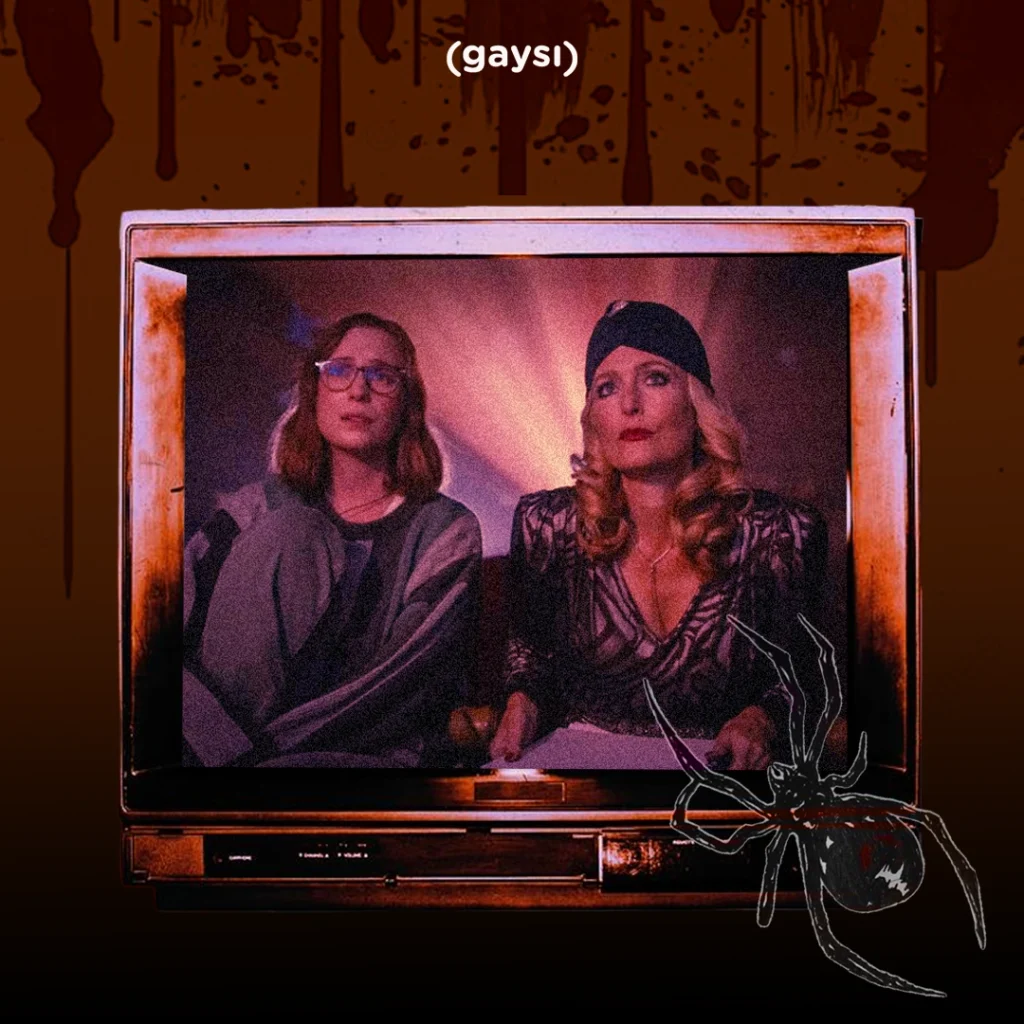
Hannah Einbinder plays Kris, a queer filmmaker hired to resurrect the fictional Camp Miasma franchise after years of increasingly disposable sequels. Her fascination soon shifts towards Billy Preston, played by Gillian Anderson, the reclusive actor who survived the original film as its Final Girl. When Kris seeks Billy out, professional interest gradually mutates into something considerably bloodier, stranger and hornier. MUBI describes their descent simply as a world of “desire, fear and delirium”.
So why queer horror fans should be keeping an eye on Camp Miasma?
1. It gets its knife into the slasher history.
The summer-camp slasher has never exactly had an uncomplicated relationship with gender. Schoenbrun knows this.
The fictional Camp Miasma movies contain the kind of transphobic baggage that echoes very real horror history, allowing the new film to interrogate decades in which gender nonconformity was routinely transformed into something monstrous, deceptive or threatening. Reviews have specifically noted how Schoenbrun confronts horror cinema’s history of misogyny, exploitation and transphobia rather than simply recreating its aesthetics.
But this isn’t a solemn lecture disguised as a slasher. Schoenbrun appears far more interested in taking the genre’s discarded parts: the camp, the questionable sequels, horny teenagers, Final Girls and problematic monsters, and asking what happens when queer people get to play with them ourselves.
Considering queer audiences have spent decades reclaiming horror’s monsters and outsiders anyways, it feels strangely appropriate.
2. The psychosexual nightmare is back.
If I Saw The TV Glow made fluorescent children’s television feel like an existential threat, Camp Miasma seemingly asks: what if desire became the haunted house?
Early responses have described the movie as surreal, funny, bloody, romantic and aggressively horny, while Cannes itself situated Schoenbrun’s latest somewhere between Lynchian nightmare, queer gore and the contemporary slasher.
Sex, fandom, filmmaking and obsession begin bleeding into one another until it becomes increasingly difficult to tell where the performance stops and genuine desire begins. It’s less straightforward “killer stalks teenagers through the woods” territory and more Persona after several cocktails at a queer horror convention.
Exactly as it should be.
3. Hannah Einbinder and Gillian Anderson. That’s it. That’s the reason.
Well, almost.
Einbinder’s Kris doesn’t merely admire Billy as a performer. Their relationship becomes emotionally and physically intimate, with fascination sliding steadily into obsession.
And putting Hannah Einbinder opposite Gillian Anderson creates a particularly delicious variation on the fan-meets-icon fantasy: young queer filmmaker meets the mysterious older Final Girl she has mythologised, only to discover that getting close to your object of fascination might be much stranger than admiring her from afar.
It’s sapphic desire made dangerous, uncomfortable, funny and surreal rather than polished into an uncomplicated romance.
In other words: Gillian Anderson. Hannah Einbinder. Blood. Sexual tension.
Camp attendance suddenly feels mandatory.
