


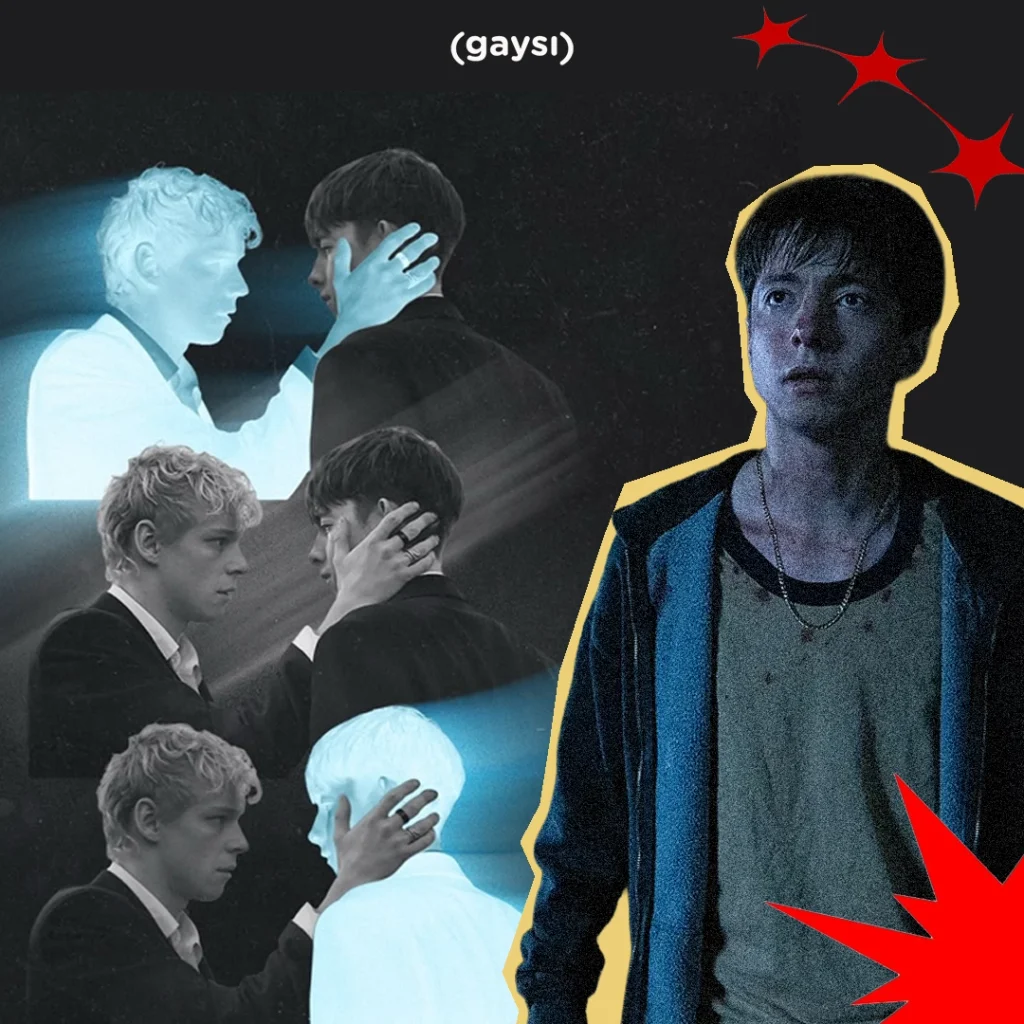
“Thou shalt not lie with mankind, as with womankind: it is abomination.” This verse from Leviticus 18:22 of the Holy Bible (King James version), alongside Leviticus 20:13, is the quote most cited to justify the vilification of homosexuality among Christian communities.
Thus, it comes as no surprise that Adrian Chiarella’s queer religious horror film is named after this controversial section from the Bible.
To the unversed, the film follows two boys in a small evangelical Australian town who soon begin to be haunted by a violent entity that threatens both their lives.
What is inventive about this particular film is the fact that the supernatural entity has no form of its own, or rather, we never see its true form. It appears to the characters as the person they most desire, thus making the entity a personification of desire itself. But the desire isn’t all rainbows and sunshine – it is violent. It aims to destroy. Kill.
Growing up in a community where faith is foremost and scripture is sanctuary, queer folks often struggle to come to terms with their desires, tending to hide or change them. Our desire is seen as sin, something shameful, something to run away from. And when desire becomes fearful, internalized homophobia becomes the demon haunting you every step of the way.
What the teenage boys in the film are fighting isn’t a literal supernatural entity – it is their own desires, their internalized homophobia, their fear. This is something most queer people can relate to because we all go through a version of it before we fully come to accept and love ourselves for who we are.
When we watch the film, we are actually witnessing the journey of these young boys coming to terms with their sexuality as they struggle with fear, shame, and Catholic guilt.
Throughout the film, the boys are constantly trying to hide and run away from the terrifying entity. When it takes the shape of the person they desire, how are they to know if they can ever be held safely?
Then comes the climactic scene where the entity overpowers one of the boys (Naim) and picks up a heavy object to kill him. Trapped and unable to run away, Naim stops struggling and instead strokes the entity’s face gently, almost lovingly. The entity freezes. Confused. Conflicted.
This gives Naim the opportunity to escape and save himself.
The entity in the film operates on a level unknown to us. But as a manifestation of one’s desire, it can be understood that Naim embracing it signifies him accepting his own desires. Knowing he cannot outrun or escape it, Naim in the pivotal moment chooses to stop struggling and face the music. He knows he cannot run away from his desires; they would catch up with him.
And accepting his true self saves his life.
Throughout the film, Naim constantly tells Ryan his plan to leave the town alone. To run away. To never follow him. But the final scene of the film shows the two on a bus together, riding to an unknown – but perhaps better – place. Out of the town that constricted and conspired against them.
Naim catches a glimpse of the entity outside as the bus passes by, but he isn’t fearful anymore. He has chosen to be with the person he likes. Perhaps, the fear and shame may still be rooted far underneath the surface. Living in an unforgiving world where same-sex desire is constantly being denigrated and queer folks targeted to this day, it is understandable to feel unsafe sometimes. To be guarded. To limit one’s visibility.
The demon may always be around, hiding somewhere in the corner.
But you have the power over it.
