


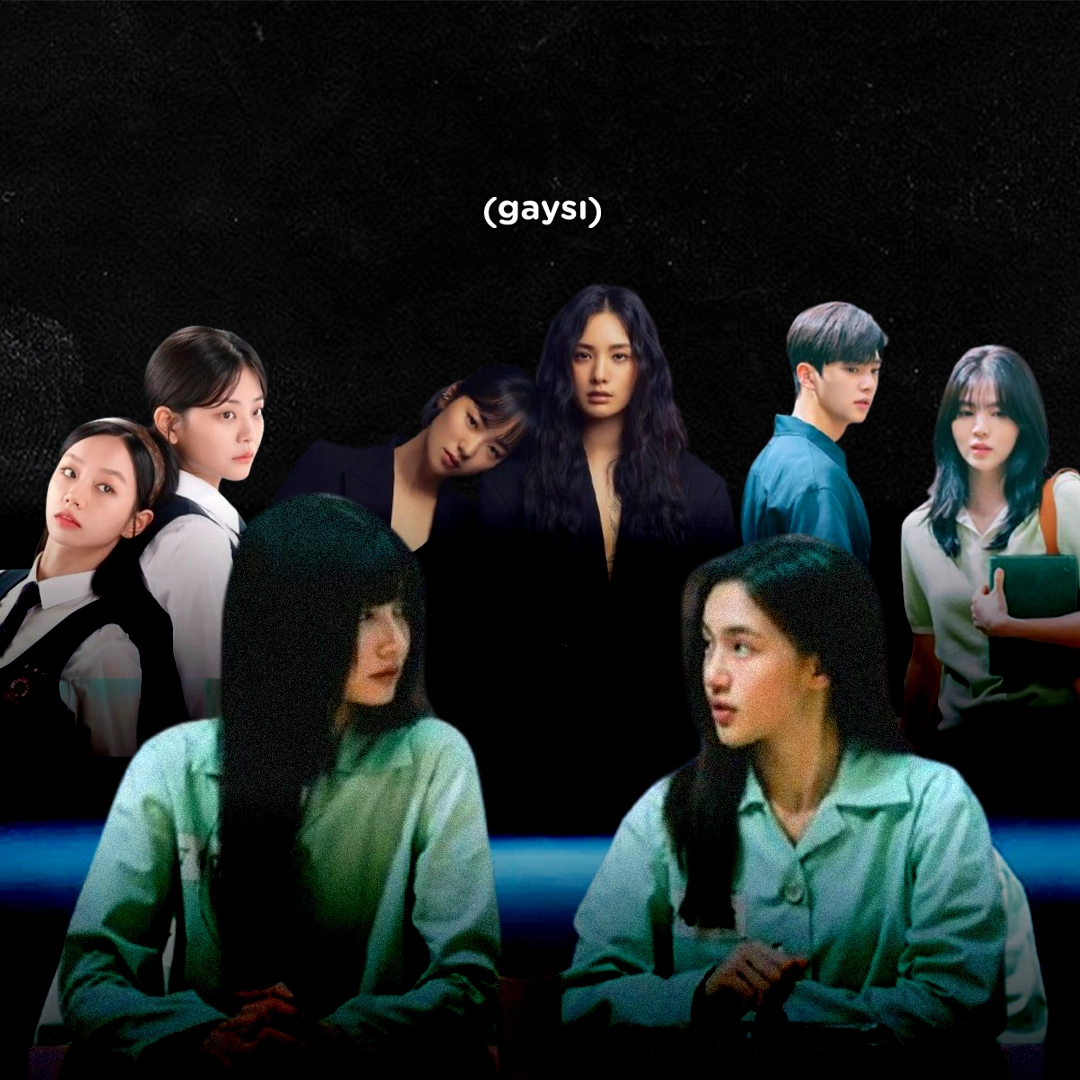
Sometimes, Korean GL does not walk into the room holding a rainbow flag. Sometimes, it enters as academic rivalry, a toxic friendship, a girl staring at another girl like she is either her soulmate or her final boss, and a script that keeps pretending this is all very normal heterosexual behaviour.
That is the strange, delicious frustration of watching sapphic tension in Korean dramas. The girls are yearning. The camera knows they are yearning. The fandom knows they are yearning. Only the plot is acting innocent.
This is why Friendly Rivalry became such an interesting flashpoint for GL viewers. On paper, it is a teen mystery thriller set inside a brutal elite school where girls compete for grades, power and survival. But the relationship between Yoo Jae-yi and Woo Seul-gi is not just another tense friendship. It has the grammar of romance: obsession, jealousy, possession, intimacy, emotional dependency and the kind of charged closeness that makes every scene feel like it is holding its breath. It is not simply “are they friends or enemies?” It is “why does this rivalry feel like a breakup that has not happened yet?”
For fans used to surviving on sapphic crumbs, Friendly Rivalry felt almost shocking because it did not fully hide behind plausible deniability. Its central dynamic is openly intense, visually seductive and impossible to separate from GL readings. It understands that desire does not always arrive softly. Sometimes it arrives as competition. Sometimes it arrives as waiting to destroy someone because you cannot bear how much they see you.
And yet, the fact that this still feels rare says a lot.
Korean dramas already know how to do longing. They have built an entire global empire on slow burns, repressed desire, accidental hand touches, rain confessions, childhood trauma, class anxiety and people staring at each other across hospital corridors like oxygen is optional. The K-Drama format is practically made for the GL story. Imagine the emotional devastation of a sapphic second-chance romance, the chaos of a rich girl/poor girl melodrama, the aching tenderness of two women choosing each other against family expectations. The ingredients are already there. The industry just keeps treating GL like a risky seasoning instead of the main dish.
This becomes even more obvious when we look at Thailand. Thai GL has moved from niche internet obsession to full-blown fandom machine. Shows like GAP: The Series, 23.5, Blank, The Loyal Pin and Pluto do not ask viewers to decode every glance. They sell the romance openly, the couples are promoted, the fandom acknowledged, the edits are inevitable and the actresses become GL stars, not just actresses who happened to do one ambiguous “friendship” scene.
Thailand GL’s boom is not perfect, of course. It still has its own issues with fanservice, industry pressure and uneven storytelling. But it has something Korean GL still rarely gets: infrastructure. A Thai GL can be marketed as GL, watched as GL, discussed as GL and loved as GL without everyone acting like the audience hallucinated the whole thing after one meaningful look.
Korean dramas, meanwhile, often place sapphic desire in the side pocket. Nevertheless gave us Sol and Ji-wan, whose friends-to-lovers arc was, for many viewers, far more emotionally satisfying than the main heterosexual situationship. While Na-bi and Jae-eon were busy turning toxicity into an aesthetic, Sol and Ji-wan were offered something softer: the fear of ruining a friendship, the pain of being misunderstood and the relief of being loved back. Their story mattered because it was not just subtext. It allowed two women to move from ambiguity into tenderness.
But SolJiwan also exposed the problem. Why did the queer romance have to be the side dish when it was clearly feeding half the table?
Then there were dramas like Glitch, which may not be a conventional GL romance, but absolutely understands the emotional charge of female intimacy. The story follows Hong Ji-hyo as she searches for her missing boyfriend with the help of Heo Bo-ra, a UFO enthusiast and a former friend. But beneath the aliens, cult and conspiracy chaos, the show’s real electricity comes from Ji-hyo and Bo-ra’s messy reconnection. Their bond feels too complicated to be reduced to “friendship” and too carefully written to ignore as queer-coded. It is not necessarily romance in the neat, labelled sense, but it carries that very sapphic ache of unfinished history: the girl you lost, the girl who knew you before you learned how to perform normalcy, the girl who makes your life blow up and somehow brings you back to yourself.
That is where Korean GL often lives: not absent, but displaced. It appears in the intensity between women in thrillers, the devotion between best friends, the unspoken longing in school dramas, and the “she changed my life” narrative that somehow never gets named. Shows like Mine gave us a rare openly queer woman in a glossy chaebol drama, while web series such as Lily Fever, Out of Breath and She Makes My Heart Flutter proved that Korean sapphic stories do exist, they just rarely receive the same spotlight as Korean BL.
The audience is already there. Friendly Rivalry became a talking point. Nevertheless proved a sapphic side couple could steal hearts. Glitch showed how queer-coded female intimacy can thrive within genre storytelling. Korean GL is not invisible because nobody wants it. It is invisible because the industry keeps dimming lights.
