


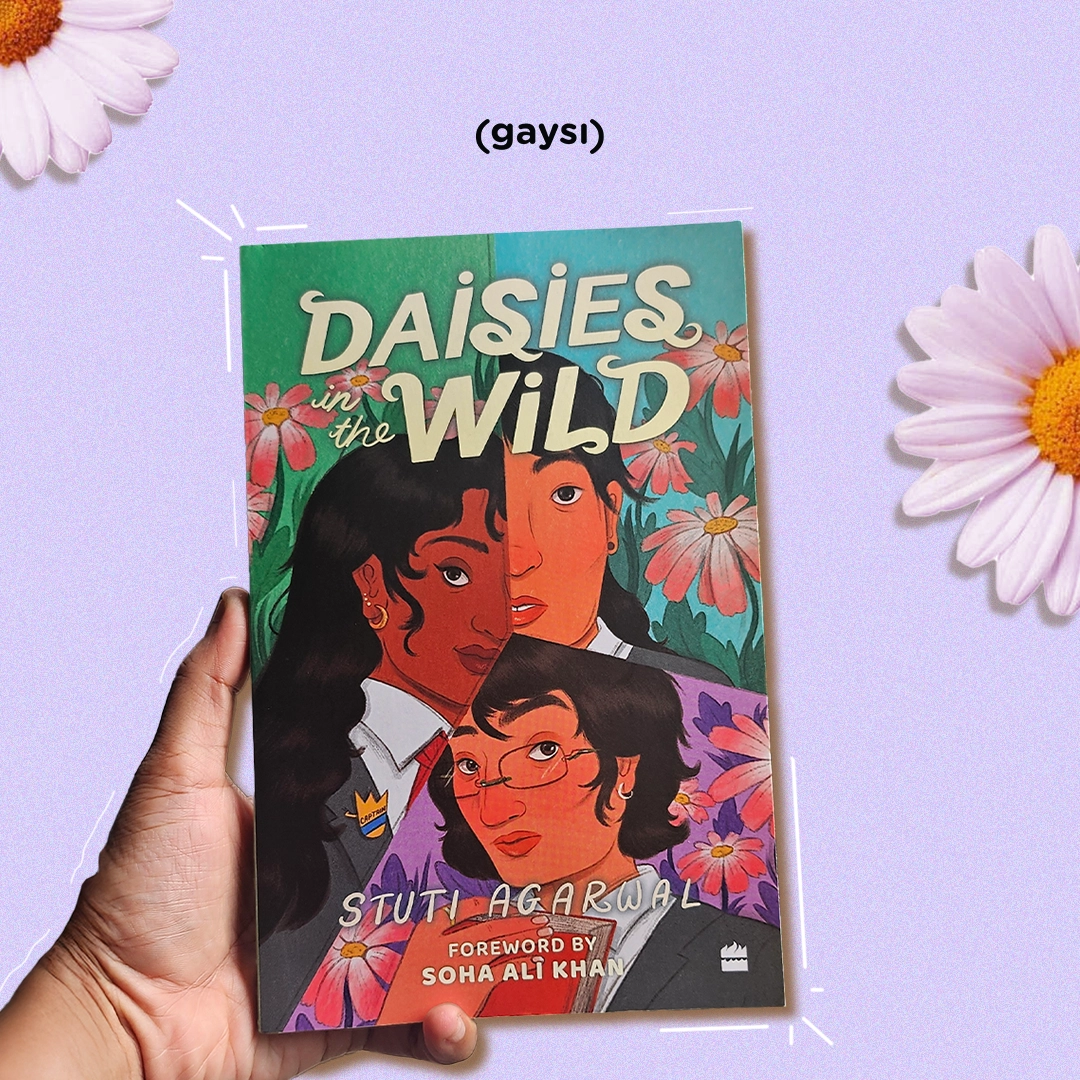
Being sick makes you crave all sorts of things, comfortable, warm and mostly cozy things. Things you feel safe to be around, to drink or to eat. That was my week when I picked up this novel by Stuti Agarwal–Daisies in the Wild. I don’t remember what it was about the book that caught my eye, surely the cover because I remember telling someone, “I think it’s time I read some sapphic-coming-of-age story.” The vibes of the cover perfectly matched the vibes I was craving. And behold, that very week I got hit with super bad cold and was basically forced to read this in a cough-syrup induced haze, with my mother’s amazing adrakh-wali chai and loads of khakras (don’t ask me why this is my version of sick-comfort food, but it is).
Daisies Lost In Themselves
So the story is told from three different perspectives, we’re allowed to peek into our three main leads right from the get go–Pema, Nidra and Inayat. All three of them are students at the prestigious boarding school in Darjeeling. Pema is a local student who doesn’t reside (regretfully) at the school hostels, Nidra is a house captain, frontier in everything sorta baddie and Inayat is the new kid who never seems to talk much (at least at the start). We soon realise that all three of them are always thinking of different things, worrying about all the things you’d expect teenagers to worry about and even spiral into misunderstandings only teen-brains can speculate.
Out of the three, Pema reminded me of my younger self the most, I’m a yapper-overthinker and always felt left-out in school. Not because I was friendless, but like Pema describes, others’ are always just better friends to each other than to her. Not going to lie, I always assumed she’d be the one to first crush on Inayat but turns out it’s just a friend crush. But even that friendly-crush felt so intense that I was reminded of all the embarrassing things I did in order to just feel less lonely. I guess, in a way Pema made my teen self feel seen and heard in ways I haven’t seen in literature yet. You combine all the pop-culture references she throws around and that’s basically me like 10 years ago.
What was truly remarkable about Agarwal’s writing is that it felt fresh and totally new. While she managed to affirm my younger self by saying what I’ve heard so many people already say, her attempt at feeding affirmations to us creatively is what resonated. It’s not just blank narrations in forms of perspectives, it’s three different perspectives, voices and experiences condensed spectacularly in 158 pages. Even in a cough-syrup haze, I gobbled the book in 2 hours.
Daisies Found
Reading these experiences also reminded me of an old friend who was one of the first Indian queer internet friends I made back in 2014. We’re still pretty good friends and I thought of her as I read some very fomo-inducing descriptions of Darjeeling.
When I think of Inayat, how she embodies everyone I’ve somewhat had a crush on over the years, I also aspire to be half as brave as her in the way she owns up her queerness. Which brings me to the undefined (in a good way) acceptance of Nidra. Nidra reminds me of all the people who I’ve seen over the years unsure of their own queerness and unsure of accepting it.
Nidra is every queer person who hasn’t been able to find community in any spectre of society. I worry about them and it felt refreshing getting this side of exploring your identity and being on your own longer journey of being queer. This was a great addition of truly showing what “everyone’s journey is different” looks and feels like.
Beauty Of Being Understood
While all three emphasise on wanting to be seen, wanting to be missed, and even chasing the feeling of belonging, somewhere towards the end we realise that all teen years will teach you that the key to feeling like you love yourself and do have a place to belong, has to start with you. Inayat doesn’t waste time in unabashedly loving herself, Pema learns to start doing things for herself and people she loves and Nidra begins to let go of everything she once loved and start afresh.
At the beginning I didn’t understand what Soha Ali Khan’s foreword meant in terms of what I could expect from the book. But looking back at it now I realise just how much more this means to contextualize the book. Mothers, parental figures in this book may be an invisible force for most of the book, but when they do show up (or not) how it completely changes our three protagonists. I also see why stories like these end up becoming that comfort, lesson and guide for every time a young soul or our younger selves would rely on.
PS–I totally think this book deserves a mini-series adaptation.
PPS–While I totally know why the book ended where it did, I NEED a sequel.
