


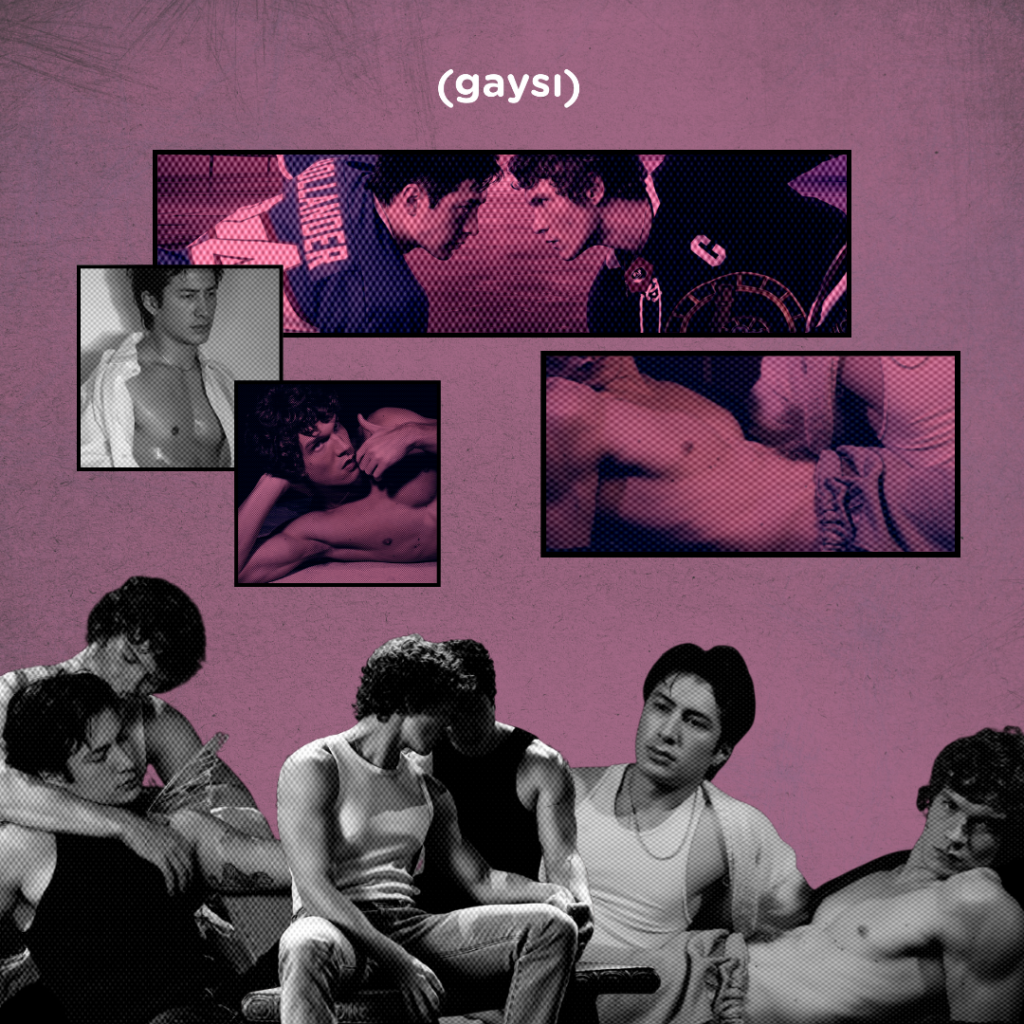
The gays are awakening to Crave Original’s Heated Rivalry becoming an internationally viral pop phenomenon that has also been renewed for a second season. Tracing the journey of closeted professional hockey players, the series has a happier ending than most, and has caught the imagination of a global audience including the queer folx of India. On the microblogging site X (formerly known as Twitter), threads and comments can’t stop thirsting over the main leads Shane and Ilya.
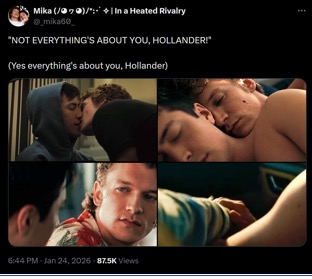
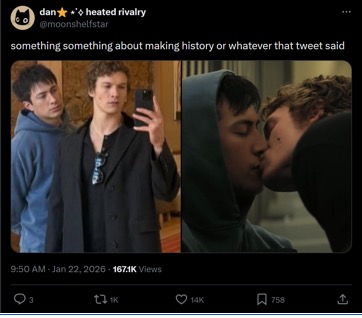
The series travels wildly in time but the leads however appear to not age over a period of ten years, feeding into the narrative of ‘agelessness’ that is a conventional stereotype forced upon women and the queers. One finds it difficult to believe that a young Shane who just made his debut and texting in pre smartphone era and a Shane who later becomes the Captain, Facetiming on a slick new iPhone look so similar, with a hairline that stays the same, not a semblance of a wrinkle over a 10-year period. It shouldn’t come as a surprise then this is a clear mirroring of this obsession that the gays have with aging and the lack of representation of growing old as a queer person. Particularly of importance in the context of India or other countries once colonised by the western imperial powers and still colonised by Victorian morality, is that we continue to look for queer elders who were often denied a chance to exist.
Queer folx age differently, oftenafter living battered lives with scars from bullying, alienation and discrimination. In an interview, Connor Storie who plays Ilya Rozanov notes talking about his younger self – “I love that little guy. I love him. I used to not like him.”
It wasn’t easy for a kid like him growing up in Odessa, Texas.
“I was this artist, sissy boy in West Texas that didn’t want to play football,” he explains. “I wanted to play pretend and play dress up and disappear into weird worlds and entertain and try to connect with people that way, and that was just not the norm out there.”
The idea that for him to like a younger version of himself, a version that he identifies as ‘a sissy boy in West Texas that didn’t want to play football’, is a realization that is happening when he is portraying a hypermasculine character whose expression is that of a well built jock who also is an elite sports player. This is representative of what it takes of queer folx to often love their younger selves. It is the complete annihilation of one’s identity and this hyperfixation to metamorphose into a socially acceptable version of queerness that deserves respect but not so much, because hurt and bullying is built into the idea of how queerness is perceived in our societies. It is only when this validation is received to balance out the past hurts, that one becomes tender to a former self that was perfectly alright, only not an acceptable enough version of one’s queerness. This is a burden that so many queer people carry that even as a certain version of queerness is starting to become passable, straying off that version brings enormous scorn.
While this might be expected for professional sportspersons—even though “looking fit” is not always synonymous with actual athletic performance—the same aesthetic is extended to Kip Grady, a key romantic interest who works at a smoothie shop. His body is portrayed in a way more commonly associated with professional bodybuilders than with someone whose job or daily life would require it. This hyperfixation on a particular body type that is fair, hairless, with rippling muscles and visible vascularity, continues a long-standing trope within a narrow, stereotypical cis-gay visual culture. One that not only alienates and minimizes bodies that fall outside this ideal, but also places the onus on individuals to “transform” themselves to fit a conventional standard that is especially prevalent on Indian queer dating and meeting apps, ultimately feeding into what is a systemic issue.
The show feeds into a version of queer hierarchy and it is evident where the bisexual Ilya is seen as a ‘top’ and Shane is depicted as a ‘bottom’. It feeds into a very problematic idea of hierarchisation of queer identities where being a top is somehow superior and lived experiences of gay men are testimony to how prevalent bottom-shaming is. It is a direct borrowing from heteronormativity where a man’s role is cemented as a giver and the woman as a receiver. In reality, these categories are extremely fluid and fixating on them is misogynistic, which sadly has found favor among a lot of cis-male queer folks.
Director Jacob Tierney on women loving the show and the BoyLove genre in general, talks about the presence of male vulnerability that attracts women and how there is a sense of safety that comes from women not having to imagine themselves within the relationship or anticipate the risks that often accompany female characters in heterosexual romances.
Tierney, in an interview with Variety, said, “So you are watching something happen between two men, and there is no fear of violence. There is no fear of things turning into stuff that women have to deal with too much in real life, and don’t want to deal with in their fantasies, and ultimately, this is a romantic fantasy.”
It is worth noting that the contextual setting of this fantasy is the arena of sports, which for most gays and queer folx is a site of eternal and chronic violence. It is a very common queer experience to feel alienated from sports because of locker room culture, which is a cesspool of toxic masculine, misogynist, homophobic and transphobic humour. Even in episodes one and two of the series, while Shane and Ilya fuck in private, the lock room conversation is about the rivalry they share and Shane’s team mates talk about ‘fucking’ Ilya as a derogatory homophobic reference. To manifest this as a site of romance is so far removed from the everyday existence of queer folx. While in the west, sporting stars have started to ‘come out’, in India, there are terrible consequences for sporting stars to embrace their sexuality in public, including loss of income from advertisers and sponsors.
Homophobia is not an internalised struggle; the idea of coming out is not the difficult part, but it is the structural struggle forcefully built into the very idea of queer identity which necessitates this ‘coming out’. Sadly, even this doen’t warrant an end of the societal exclusion of gays and theys. Our institutions like schools, hospitals, workplaces thrive on rampant homophobia, medical curricula continue to list lesbianism as unnatural sexuality in Indian medical undergraduate textbooks. The idea that one has to come out is seen as the defining arc of the queer experience in a society where being straight is the normal and this hyperfixation on coming out doesn’t then hold accountable the institutions that have necessitated this outdated, patronising, controlling ritual. The gayness is never assumed, it is an afterthought and love is conditional even with closest structures of cis-het units like families on one’s sexuality. By basing the storyline on coming out, the show gives a free pass to institutions that make the existence of queer identity an eternal and perpetual struggle. Its fetishisation of a certain body type and contextual exotic-ness of a setting that takes place in a sporting arena deprived of any nuance which has made its popularity possible amongst a certain audience demographic.
