
We live in an increasingly homogenized world, a world obsessed with trending narratives and viral moments. But untold doesn’t mean nonexistent, does it?
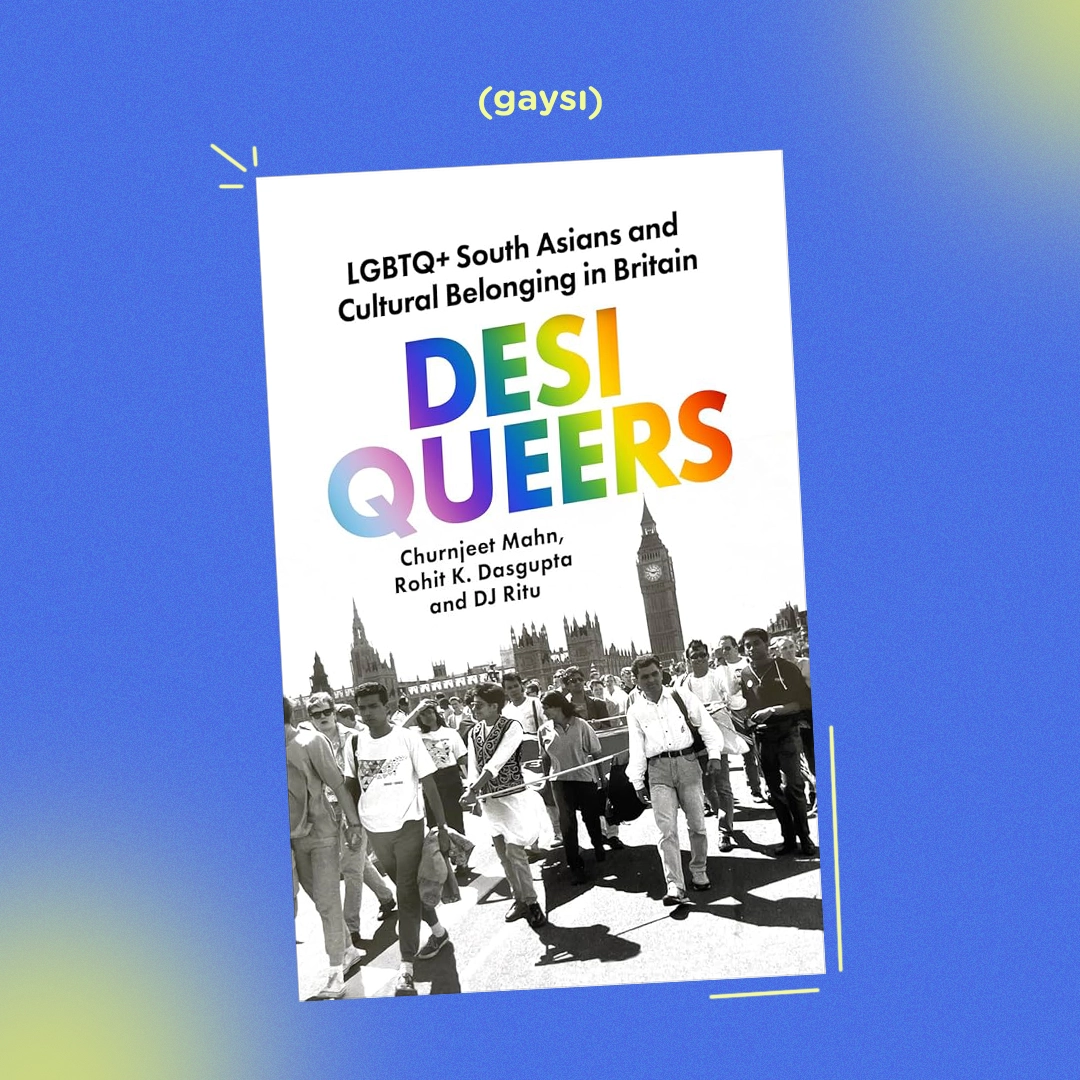
Set against a culture of forgetting, Desi Queers: LGBTQ+ South Asians and Cultural Belonging in Britain by Churnjeet Mahn, Rohit K. Dasgupta and DJ Ritu refuses to let decades of organizing and creating disappear into the gaps between “British queer history” and “South Asian diasporic history.” It tells a story of finding belonging and solidarity amidst external hostility.
The book is important, necessary because it offers a vocabulary for thinking about how spaces are made and unmade. Who gets to feel at home, who doesn’t, the fickleness of rights, and how much unseen labour it takes to create even a fragile sense of “us” together. It treats belonging as something to be built over and over again.
Also read: Decolonizing Queerness: Abolish the Western Lens with Intersectional Collectivism
To quote the authors, “The stories we tell are messy—they interrogate power structures; community fractures; funding regimes and social structures, but through it all, hold space for queer care and kinship (…) [they] are not new; they’ve just been pushed to the margins.”
What makes this history particularly urgent is how it demonstrates coalition-building in practice rather than theory. While contemporary activism often fragments into narrow identity silos, these communities understood that survival required cross-racial solidarity and building alliances across differences without erasing specificity.
The alliances it traces—between South Asian groups and Black British organisations, between queer migrants and local anti-racist campaigns—prefigure many of the questions that continue to trouble present-day activism. In India, for instance, anti-CAA protests and campus movements have repeatedly shown how coalitions can generate extraordinary energy when different struggles come together, while also showing how quickly those same alliances fray once the immediate urgency passes. Within queer spaces, calls for solidarity with Kashmiris, with anti-caste movements, with Muslim communities facing state violence, are sometimes met with an uneasy silence from those for whom such alliances feel ‘too political.’
As Rohit Dasgupta, one of the co-authors, noted in a chat with me earlier this year, “Today, I think the community is more atomized. I understand the reasoning behind that. Your needs and approaches are often specific. But today, with so much transphobia and effort to divide communities based on religion, class, ethnicity, there’s something to be said for looking back.”
What the book brings to the table, then, is less a romanticised past than a set of working examples of solidarity. The coalitions it documents may be tangled, perhaps short-lived, but they make the argument that meaningful change has always depended on people being willing to be inconvenienced by each other’s realities.
The communities in Desi Queers model a different kind of long-term, infrastructural solidarity: disco nights and newsletters that double as informal support systems; collaborations beginning with shared dancefloors extending into shared campaigns against immigration raids or racist media narratives. At a time where a great deal of “solidarity” plays out as statements on social media rather than as sustained, material commitments, this is important to learn from. The histories captured in the book indicate how coalition-building is largely about repetitive, sometimes tedious work—translation across languages, agreeing on how to respond when one part of the coalition is targeted more harshly than another. In that sense, the solidarity-building it records is a continuous practice, one that demands imagination and the humility to be altered by others’ realities.
Unlike America’s privileged upper-class, upper-caste diaspora arriving with educational and economic advantages, Britain’s South Asian communities largely emerged from “various migration patterns, including indentured labour in the Caribbean, migrations after the Second World War and independence, to Britain and the United States, and movements to East Africa and the Middle East, among others.” Each wave carried distinct traumas and relationships to both homeland and host country.
Through five carefully researched chapters, the book traces how South Asian queer activism built its own infrastructure of belonging. Beginning with how these communities found strategic shelter under “political Blackness,” the first chapter demonstrates how organizations like BLGC (The Black Lesbian and Gay Centre) and Haringey Lesbian and Gay Unit became crucial allies in progressive anti-racist queer activism.
Also read: Manu and Mya Mehmi: A Conversation on Trans Dalit Assertion
Central to this history is Shakti, founded in 1988 and generally credited as Britain’s first queer South Asian organization, whose twin creations (the Shakti Disco and Shakti Khabar newsletter) created key spaces for the South Asian diaspora to express themselves in, to find themselves in.
Club Kali, co-founded by DJ Ritu and still operating today, symbolizes the persistence of this space-making project.

The book then maps the parallel evolution of cultural resistance, examining how South Asian queer artists have continuously expanded the possibilities for representation and visibility. We begin with foundational figures like:
a. the photographer, curator, and writer Mumtaz Karimjee (In Search of an Image, 1988; My Mothers My Sisters Myself, 1988),
b. writer and filmmaker Pratibha Parmar (Bhangra Jig, 1990; Khush, 1991; Sari Red, 1988),
photographer Sunil Gupta (From Here to Eternity, 1999; Ecstatic Antibodies: resisting the AIDS mythology, 1990),
c. filmmaker and poet Ian Iqbal Rashid (Touch of Pink, 2004; Black Markets, White Boyfriends and Other Acts of Elision, 1991).
Thereafter, through contemporary cultural activists like the writer and weaver Raisa Kabir (In/Visible Space, 2014; নীল. Nil. Nargis. Blue. Bring in the tide with your moon…, 2020), filmmaker Shiva Raichandani (Queer Parivaar, 2022; Peach Paradise, 2022), drag queen Asifa Lahore and photographer Charan Singh (The Promise of Beauty, 2023; Kothis, Hijras, Giriyas and Others, 2013), we see how each generation builds on previous innovations while adapting to new challenges and opportunities, creating a chain of creative resistance.
Yet this creative genealogy tells only part of the story. Rather than present these communities as uniformly progressive heroes, the authors maintain rigorous intersectional honesty throughout their archival work.
The authors highlight the gendered realities of queer existence through details like the “goodbye parties” for queer men—ritualistic farewells before heterosexual marriages, made bearable by their “insincerity; everyone knew they would be back in a few weeks. But the case was entirely different for the queer women who entered heterosexual marriages,” no winking acknowledgment of temporary departure, no expectation of return.
These gendered disparities extend throughout the book’s examination of how supposedly progressive spaces replicated broader social hierarchies. Post-9/11 dynamics brought new tensions as Islamophobia and Hindu nationalism infiltrated queer organizing, creating fresh divisions within communities already navigating racism and homophobia.
Even within Shakti itself, the authors show how Shakti Disco, that pioneering space of South Asian queer celebration, ultimately banned drag performances, albeit temporarily, due to masculine normative pressures from within its own community. Some men in the group were comfortable with a discreet, “acceptable” queerness but saw drag as too feminine, too flamboyant, too camp, too visibly gender-nonconforming, and therefore pushed it out of the space. Spaces fighting for acceptance thus policed expressions themselves.
Also read: Rebellion vs. Commodification: Has Drag Lost its Edge?
The authors note: “Whilst drag has always been a site of ‘performance,’ ‘humour’ and ‘unapologetic’ expressions of embodiment, it is also a joyful and political reclaiming of space when respectability politics have seeped within queer politics (…) If dragging up for the disco could be part of the fun, and part of the queer flexing of normativity, what was so incendiary about a drag performance?”
In these decisions about costumes and performances, the book paints something more holistic about queer communing—how easily spaces built for survival can start to mirror the very hierarchies of caste, class, gender and respectability they were meant to resist. It is this attention to the mundane, to the almost-administrative ways in which joy gets to be managed and trimmed, that makes it so compelling to read.
Yet, the book also documents how these same communities transformed constraints into innovation. When conventional nighttime venues remained hostile, for instance, “a generation of South Asians in the 1980s developed an underground music scene with a pragmatic twist: this scene took place during the day.” Such ingenuity exemplifies how marginalized communities recast the very constraints designed to limit them into opportunities for connection and resistance. The limitation, therefore, became liberation.
Or as the authors write, “These were never pristine, ready-made spaces for queer life. They have been, and continue to be, freighted and hard-fought rights to joy and survival.”
In documenting these ‘freighted’ histories, Desi Queers performs crucial cultural work. It does so by converting ephemeral traces into durable records of survival. This includes the reconstruction of spaces that might otherwise survive only as anecdotes—daytime discos, basement meetings—and the printed stuff: flyers, newsletters, posters, tiny classified ads that might have been lifelines to someone.
Rohit says, “There hasn’t been a book on the South Asian queer diaspora quite like this one, and we’re very humble about that. The book is just one story; we’ve only scratched the surface. We hope many more stories come out.”
Particularly striking are the ledger-like details of how the Shakti Disco’s bhangra-infused chart nights came to be, or how Club Kali’s 1995 launch drew hundreds to bar-dancing amid post-Section 28 backlash. Such documentation changes the notion of queer South-Asian community as part of one-off events into a genealogy of resistance. It shows how cultural spaces can be lifelines when state and family infrastructures fail queer lives. The communities it documents built belonging from scratch and created infrastructure where none existed. Each flyer and film were passing tools for the next wave to build visibility from inherited fragments.
Against deliberate erasure, it insists on memory. Through oral histories and archival materials relegated to forgotten boxes, the book counters mainstream narratives, fills the cultural gaps between “South Asian diaspora” and “British queer” histories. Against simplified narratives, it demands complexity.
In our era of algorithmic attention and manufactured virality, such patient and persistent work of community-building offers a different model altogether.
Their example is a reminder that recognition has to be taken. One disco night, one newsletter at a time.