


[Co-written with Nand]
OK so what even IS this book
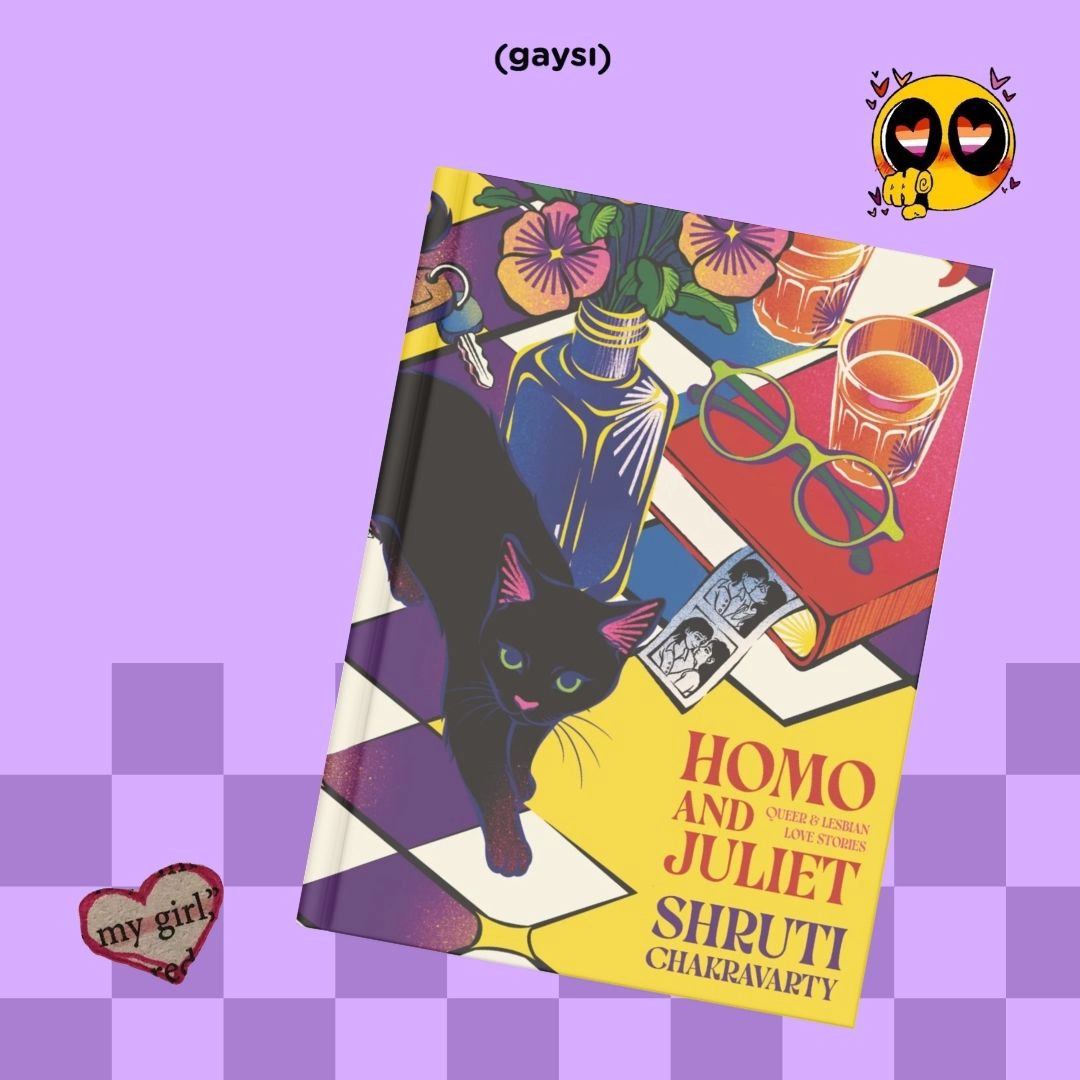
So picture this: Romeo and Juliet, but if it had been about women. It is not ur regular fictional star-crossed tragedy with balconies, poison and fake deaths. This is Shakespeare’s title but Shruti Chakravarty stepped in and wrote eight real love stories of sapphic and non-binary couples from across India, published by Yoda Press (cult-favorite indie house, certified queer-lit hall of famer).
And when I say “love stories,” I don’t mean eight variations of girl meets girl, girl falls in love, society says ew, the end.
Thank god.
Instead, the book takes us through wildly different sapphic lives… women who fell in love before they even had the vocabulary to understand what they were feeling, women who were married to men, people navigating gender and sexuality, partners finding each other online, queer parents, chosen families, sex, desire, fetishes, heartbreak and all the deeply unserious and deeply serious business of trying to build a life with another person.
Basically, it asks the very queer question: okay, but what happens after you realise you’re gay? I mean lesbian.
And other very important questions ranging from who gets to be the big spoon to who meets the parents, who pays the rent, what happens when your family thinks your girlfriend is “just a friend,” and whether your relationship survives a road trip where the car decides to have a breakdown.
And this is where Homo and Juliet gets interesting.
The stories aren’t interested only in queer suffering. They are interested in queer domesticity, the extremely revolutionary act of two queer people simply trying to have a life. [YUPPP]
Eight love stories, one very long history of sapphic yearning
What makes the collection work is that the eight stories don’t exist in a vacuum. Read together, they start to feel like a timeline of what it has meant to be sapphic in India.
At one end are people who had feelings for women at a time when there was no Google search. Imagine having a crush on your best friend and your only available diagnostic tool being “am I just very fond of her?”
At the other end is a generation that can literally open an app and go, hmm, which woman within 8 km would like to emotionally devastate me? The distance between those two worlds is the story.
Across the book, queerness moves from something that has to be hidden, misunderstood or survived to something that can be searched for, named and openly lived. And that doesn’t mean the newer world is suddenly easy. It just means somebody, somewhere, had to make it possible to get here.
The stories move through different relationships without giving us one neat definition of what a queer relationship is supposed to look like. Which is probably for the best, because apparently heterosexuals have been assigning relationship roles to everyone for centuries and we really don’t need another group project.
The book’s real achievement is in showing that queer love isn’t one experience. There is no single sapphic template. There is only a whole bunch of people figuring it out as they go.
Plot twist: the real villain is heterosexual marriage
One thing that keeps coming back across the stories is marriage. And not in the cute “when are you two finally getting married?” way. More in the “this woman has a husband and also a girlfriend and somehow everyone is pretending this is fine” way.
For many of the women in these stories, marriage to a man wasn’t necessarily a choice between two equally appealing futures. It was the default thing. It came bundled with family approval, financial security, and social respectability. Which makes choosing a woman a much bigger risk than simply choosing who you love.
You could lose your home, relationship with your family, financial security or social standing. And this is where the book quietly makes a larger point about how patriarchy and queerness collide. The book makes you realise that sapphic liberation has always had a material cost. Love is romantic in theory; in practice, it is figuring out whether you can afford to choose your girlfriend.
These stories make visible a particular bind for queer women: the very institution that was supposed to secure your future could also be the thing you had to escape to live honestly.
Which makes all those seemingly ordinary relationships in the book hit a little harder.
Okay, but how much of my gayness was already pre-installed?
This was probably the part of the book that stayed with me the most. Reading these stories as a younger sapphic person comes with a slightly uncomfortable realisation:
Holy shit, we have it so much easier.
Not easy. Let’s not get carried away. But easier.
There are words now for things previous generations couldn’t name. There are queer communities online. Dating apps. Instagram pages. Films. Books. Therapists who won’t look at you like you’ve just announced a particularly creative mental illness.
You can, in some circumstances, come out. And the book makes you realise that even that sentence is a privilege.
Because many of the people whose stories are being told here didn’t have the luxury of announcing their sexuality and waiting for everyone to process it. They had to calculate what they could lose.
Some hid relationships. Some entered heterosexual marriages. Some had to leave behind financial and familial stability. Some found each other without even having the language to explain what their relationship was.
Meanwhile, our generation is out here downloading a dating app, setting the gender preference to women and then complaining that nobody knows how to communicate.
The audacity.
But beneath the joke is something genuinely moving: the path to queer life has already been paved by people who had to walk it when there was barely a road.
They fought for it. They chose their girlfriends/partners over the lives they had been told they were supposed to want. They built chosen families when their actual families wouldn’t show up.
Basically, every time we get to casually say “my girlfriend”, somewhere in the sapphic cinematic universe, an elder lesbian deserves royalties.
Sometimes the queer agenda is just… surviving a road trip
For a book about people who have had to fight pretty hard just to love each other, Homo and Juliet is surprisingly interested in the mundane. And I mean that as the highest compliment.
Because queer stories so often come with a mandatory suffering starter pack: homophobia, coming out, family rejection, trauma, repeat. Important, obviously. But eventually you want to see queer people doing something other than crying beautifully in the rain.
This book lets them be people.
They flirt, argue, have sex and then look after each other. They have tiny domestic moments that would be completely unremarkable in a heterosexual love story… except queer people haven’t historically been given enough space to have those unremarkable lives.
One of the stories that really captures this is Aditi and Ameya’s disastrous road trip, where the car overheats, water has to be found, dogs get involved, and a fence is apparently no match for sapphic determination.
It’s simply: can we deal with this together without killing each other?
And honestly, that’s love too.
But representation has a funny way of working like that. Sometimes the radical act isn’t coming out. Sometimes it’s just being.
Your girlfriend is not “the man,” babe
Another thing the book refuses to do is squeeze queer relationships back into heterosexual packaging. Which, frankly, is rude. We escaped the box. Why are you trying to put us back in it?
Chakravarty’s discussion of butch and femme relationships is particularly interesting here. Because apparently if two women have different gender expressions, everyone immediately wants to know which one is “the man.”
The answer is: neither. Please rest.
Butch does not mean male. Femme does not mean “the woman.” And a relationship between a butch and a femme doesn’t automatically recreate husband-and-wife roles with slightly better eyeliner.
One of the interesting things about queer relationships is that the usual heterosexual script isn’t necessarily available, which means couples have to negotiate their own.
Who cooks? Who drives? Who earns more? Who is the emotional support lesbian? Can both be the emotional support lesbian and simply collapse together at the end of the day?
There isn’t necessarily a predetermined answer.
And the book extends this conversation beyond butch/femme identity through its inclusion of trans and non-binary experiences. If anything, Homo and Juliet seems to suggest that one of the strange gifts of queerness is being forced to ask questions that heterosexuality often answers for you.
There is no “correct” way to lesbian.
And we don’t have answers on how to be together either. The answer, delightfully, is: you make it up.
And sometimes you make it up badly. Which is also very lesbian.
The collection’s variety helps here. No two relationships seem to follow exactly the same script, and that refusal to present one definitive version of queer love is one of its biggest strengths. There are different generations, identities, gender expressions and relationship histories rubbing up against each other.
But eight stories can only hold so much of a country
If Homo and Juliet has a limitation, it is also the limitation of the project itself: eight stories can give us a window into queer India, but they can’t possibly give us the whole house.
The book’s range is impressive, but there are moments where you find yourself wanting even more specificity… particularly around language, region and the cultural worlds these relationships come from.
India does not have one queer experience. Queer desire moves differently through different languages, cities, classes, generations and communities. The stories occasionally make you wish the book had dug even further into those differences. Because the most interesting thing about these relationships is precisely how much of them is shaped by the world around them.
Those questions hover over the collection, and sometimes I wanted them to hover a little less and be interrogated a little more. But perhaps that’s also what makes the book useful: it leaves you aware of all the stories that aren’t here yet.
And if Homo and Juliet is an archive, then it is an unfinished one. Which feels fitting. Queer history has always been a little bit about finding fragments… someone’s diary, someone’s ex-girlfriend, someone’s secret photograph, someone’s story finally told out loud.
This book simply adds eight more. And honestly? We’ll very very very happily take them.
