


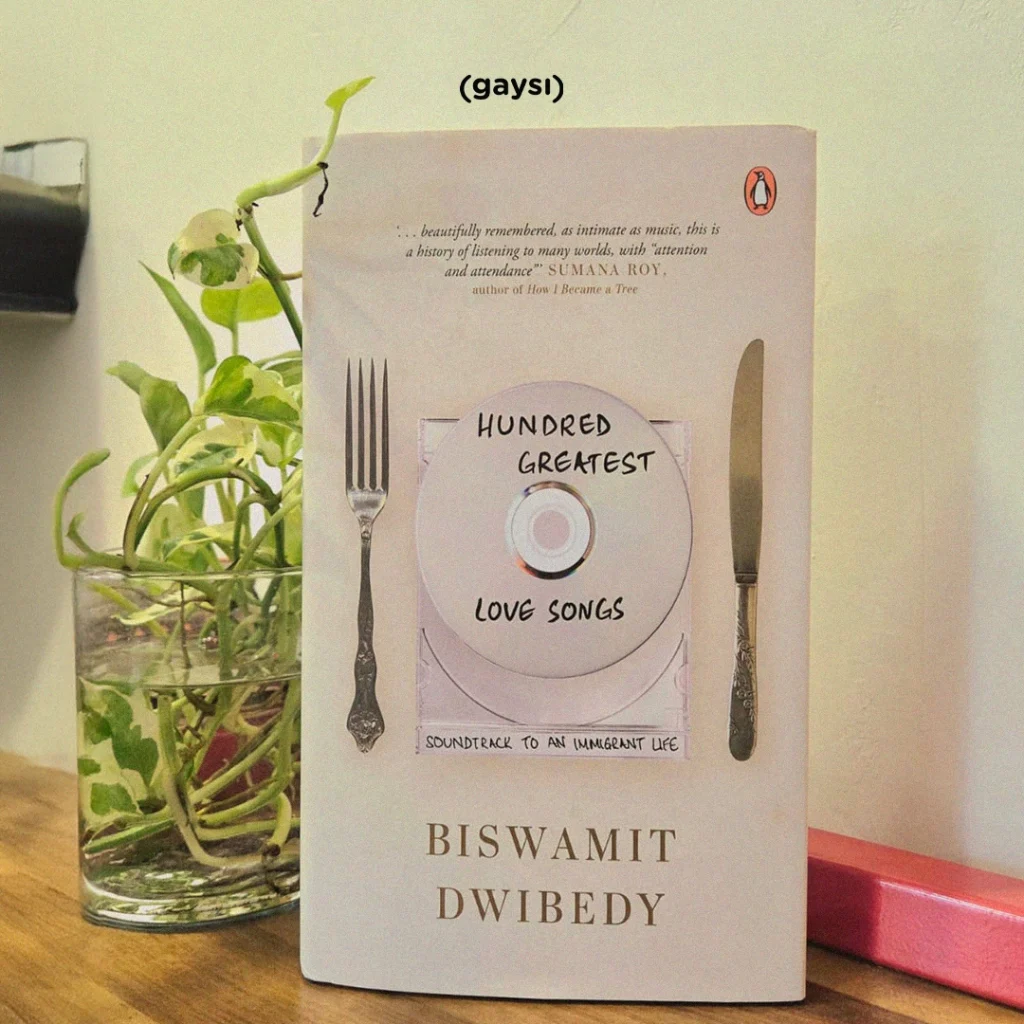
2025 has been a great year for queer memoirs and autobiographies. From Walk Like A Girl by Prabal Gurung to now Biswamit Dwibedy’s Hundred Greatest Love Songs, which takes us through his journey of immigrating to the United States right at the turn of the millennium.
Everyone talks about Y2K, the “aesthetic” fashion trend and cultural moment of the 2020s but this book takes you through the real Y2K. The one our older South Asian siblings or relatives who migrated around 9/11 actually lived through. If the anxiety of being queer wasn’t enough, you had to add racism into the equation too.
Being a brown man in the Midwest meant wanting to find safety in your own community but being queer meant double isolation, not just from young Indian social circles, but from fitting in anywhere at all. Yet this text keeps reminding us: not all hope is lost. Music, poetry, and literature connect people across lives, circumstances, and the sour phases that eventually turn into memories. Music becomes that tool of translation we all need when social security is hard to come by.
It’s Either All-In or All-Out
Dwibedy walks us through a reality many LGBTQ+ immigrant students still face today, the rigidity of Indian social expectations that follow you across continents. Just as Dwibedy struggled to negotiate the unspoken social contract between Indian students abroad, it’s striking (and sad) how similar the stories remain even today. Tales of isolation from cis-het Indian peers, of not quite fitting into predominantly Western queer groups, of trying to stay afloat with all the new freedom handed to you. It’s suffocating at times, confusing, and mostly liberating.
The book creates a lyrical map of the constant tug-of-war between the self you’re supposed to shed and the self you’re trying to become. As readers, we spend the early chapters anxiously waiting for our narrator the author, the protagonist to grow into the person he is today. But how do we become ourselves?
Who are we when there’s the constant fear of simply existing of being a suspect today and a victim tomorrow?
And who do we become once all of that is part of the past?
Dwibedy navigates this balance with gentleness. He treats his younger self with a kindness you only wish someone had offered when you were younger. It’s a reminder that everything we do every song we hear creates a ripple effect that shapes our lives for years to come.
Songs That We Keep On Repeat
The book begins in the soft, hazy glow of a time when Western music was still a novelty in India, a privilege he acknowledges while also appreciating the artistry of Indian music from the same era. We see, through his eyes, how globalization reshaped Indian media, and how a certain kind of Indian art now only exists in nostalgia playlists on Spotify.
The book reminds us to keep people alive through their songs.
What song did your brother play while studying?
What song did your best friend want for her wedding, versus the one she settled for?
It reminded me of that old Tumblr line: “I am a mosaic of everyone I’ve ever loved.”
At first glance, the book reads like a romantic love letter — a written mixtape for someone. But as the pages unfold, it becomes clear that it’s a dedication to love itself: the service, devotion, and vulnerability it takes to love people and see their humanity again and again. My favourite line sums it up:
“In the end, this book is about nothing else but the pleasure of someone else’s company, while a song you both love plays in the background.”
Discovering Family and Found Music
This book honours every relationship we form as humans, the fleeting ones, the temporary ones, the blood ones, and the ones we craft for ourselves. It lets you wonder, reflect, and find ways to honour your own connections.
Maybe it’s the girl whose eyeliner you once fixed in a bathroom, whose name you never learned.
Maybe it’s someone from a dating app who became a lifelong friend.
Dwibedy’s writing creates a tender in-between space between his world and ours. It’s no surprise coming from a poet. Allow yourself to drift in and out of the word-daze and observe how it sits with you.
Becoming Yourself
As someone still waiting for my life to take shape in my 20s, I gravitate toward authors who look like me, think like me, and offer solutions I wish I had the courage to pursue. The kind of writing that makes difficult days more bearable with fresh perspective. Queerness is a double-edged sword and you don’t get clear answers about it from anyone. But reading each others’ experiences helps.
Through this book, I’ve found language for my own experiences, something that years of intellectualising could never offer. So if you’re young, queer, creative, or simply curious, I think you’ll find something in Hundred Greatest Love Songs that you’ll carry with you long after the last page.
(And yes — read it while listening to the songs he mentions. It’s worth it.)
