


There’s something deeply human about the urge to simplify what we don’t understand. We draw lines, coin labels, manufacture neat binaries: straight or queer, normal or deviant, man or woman. We abhor complexity, revel in simplistic narratives, instinctively group people under the burden of labels, stamp stereotypes upon factions, and treasure the moral superiority that comes with being judgmental. Be that as it may, life isn’t as simple. People are complex, and with that complexity comes messiness. As American poet Walt Whitman reminds us, “I am large, I contain multitudes.”
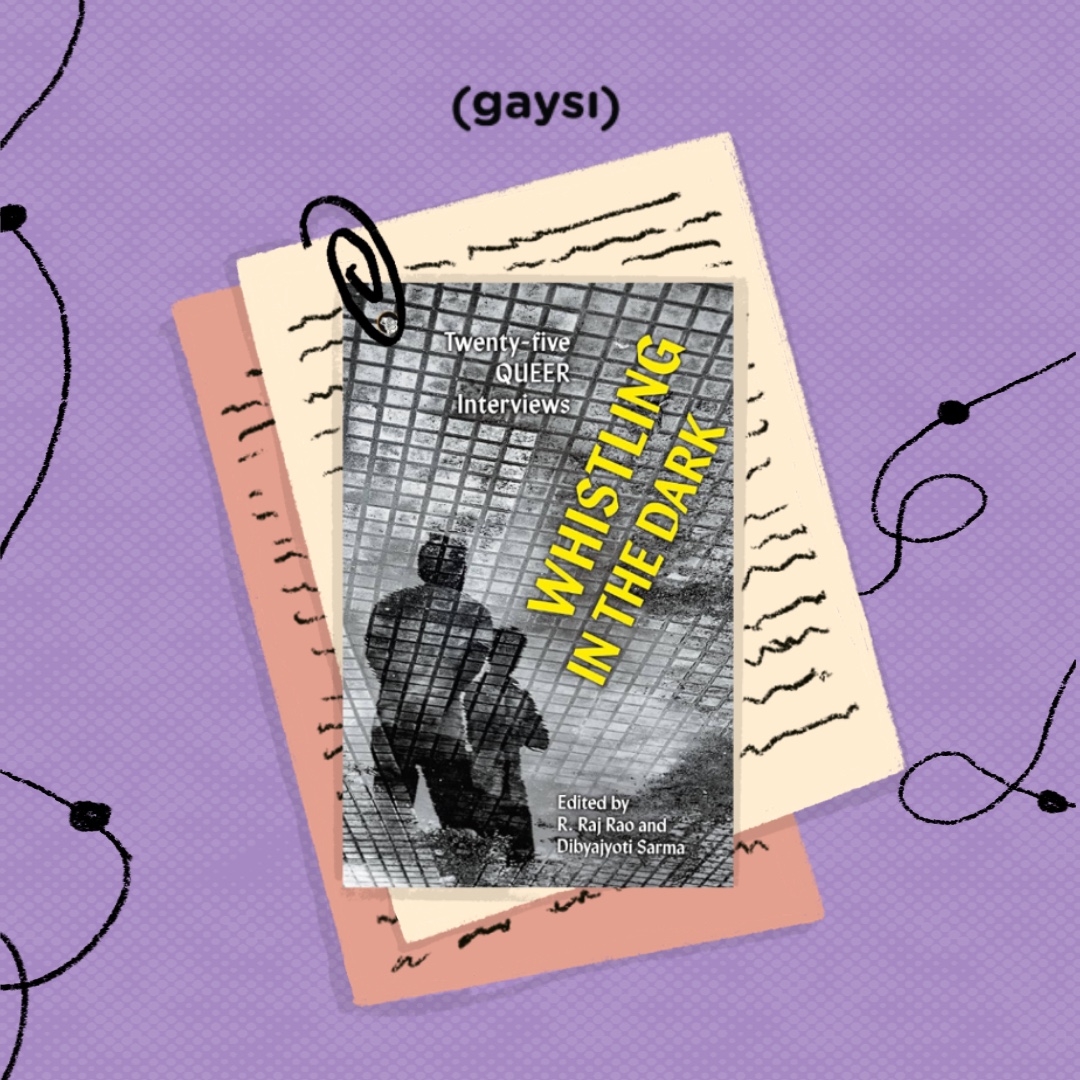
Whistling in the Dark, edited by R. Raj Rao and Dibyajyoti Sarma, is a record of such multitudes—twenty-five interviews spanning class, caste, geography, gender, and grief. In its pages, we meet people who contradict each other, confuse you, challenge the boxed-in beliefs you carry. And that’s exactly the point.
First published in 2009 and now updated with four new voices, the book reads like a time capsule. The interviews were conducted across decades, yet the questions feel painfully current. The ache of invisibility, the awkwardness of labels, and the tension between being seen and being simplified. The editors make no attempt to smoothen the edges. And in doing so, they preserve something closer to the truth.
The Question of ‘Queer’
What does it mean to be queer? Ask twenty-six people and you’ll get twenty-six answers, none quite like the other.
Ana Garcia-Arroyo, a Spanish author, says, “Queer has been inscribed with very pejorative meanings like ‘strange’, ‘deviant’ or ‘atypical’, but of course, this is very reductive and parochial. At the same time, ‘queer’ embodies a ‘verb’, a constant action, rather than a noun, a fixed identity.”
Mohammad Soltani, a painter from Iran studying in India, has a different take: “(….) the very fashionable term ‘queer’ literally means bizarre and weird, and we use it happily to characterise our behaviour. I admit that there is a difference, but not to such an extent; this is insulting. There is nothing queer in my behaviour.”
The interviews are charged not just by who’s speaking but also by who’s asking. The editors know when to nudge and when to provoke. Their questions can feel loaded, accusatory even, but they bring clarity. And thus, you read questions like, “You know, in spite of all that you say, we think that the seeds of sex work were sown in your mind during the time you traded in girls. You’re just in denial.” or “Your drawings. We get the impression that you attempt to sublimate your sexual fantasies in them. Would you agree?”
Access, Alienation, and Language
The caste, class, religious and linguistic lines are often visible in how support is accessible to some and unavailable for others. Manish Pawar says, “One thing that put me off was that in places like the Humsafar Trust, all the discussions were in English. I felt alienated.”
Even inside the so-called safe spaces, caste, class, and language create new, invisible lines, deciding who gets heard and who is sidelined. Bindumadhav Khire, a queer activist from Pune, insists on writing in Marathi. When asked why, he states how “It is a big misunderstanding that the English-speaking intelligentsia is liberal. All classes are conservative. It’s just that the English-speaking intelligentsia/socialists/secularists are more hypocritical than the rest.”
Contradictions, Not Consensus
Flip a few pages, and the contradictions multiply. There’s no ‘message’ being delivered here, just multiplicity. Queerness, for some, is identity. For others, it’s invisible, incidental, even irritating. There’s no dominant narrative, no singular ‘gay experience.’ Instead, it’s a spectrum of want, belief, shame, and assertion, colliding across class boundaries and consciousness. For example, when prodded by the editors with the claim that “being gay is not about having sex, it’s about a lifestyle”, Arman Pasha retorts, “What do you expect me to be, a laughing stock? How I seek release is nobody’s business but mine. Just as how I live my life is nobody’s business but mine.”
The book also confronts a bias among many: that all queer people must be progressive. But isn’t that akin to expecting the entire cis-het population to hold the same political views, or all citizens of a nation to speak one language (oh wait!)? When asked whether he has an insecurity underlying his need to play ‘the man’s role,’ Satish Ranadive responds, “I’m conservative. I believe in strict gender roles. Nature made man to be the penetrator and that’s how it should be. Without this, how can the life cycle continue? I may be homosexually inclined, but I’m still a man.”
The Language of Intimacy
For every person like Satish who draws such hard lines between roles and rules, Whistling in the Dark offers a counterpoint: people for whom queerness is closely related to intimacy. The German visual artist Marc Ohrem-Leclef’s photographic project on male touch in India—on the casual physicality of platonic bonds (part of the larger homosocial behaviour that R. Raj Rao calls yaari/yaarana)—exemplifies how queerness can live in the spaces between words, between labels, in the touch that doesn’t need an explanation. Holding hands. Reclining on each other.
What the book shows above all is that queerness in India is not one thing, but a spectrum refracted through caste, class, belief, doubt, touch and silence. The richness comes from the cacophony, from listening when we’d rather look away, from understanding that perspectives don’t need to be agreeable to matter.
Or, as Marc says, “If we choose to listen, the more voices we can hear, the richer we all may be.”
