


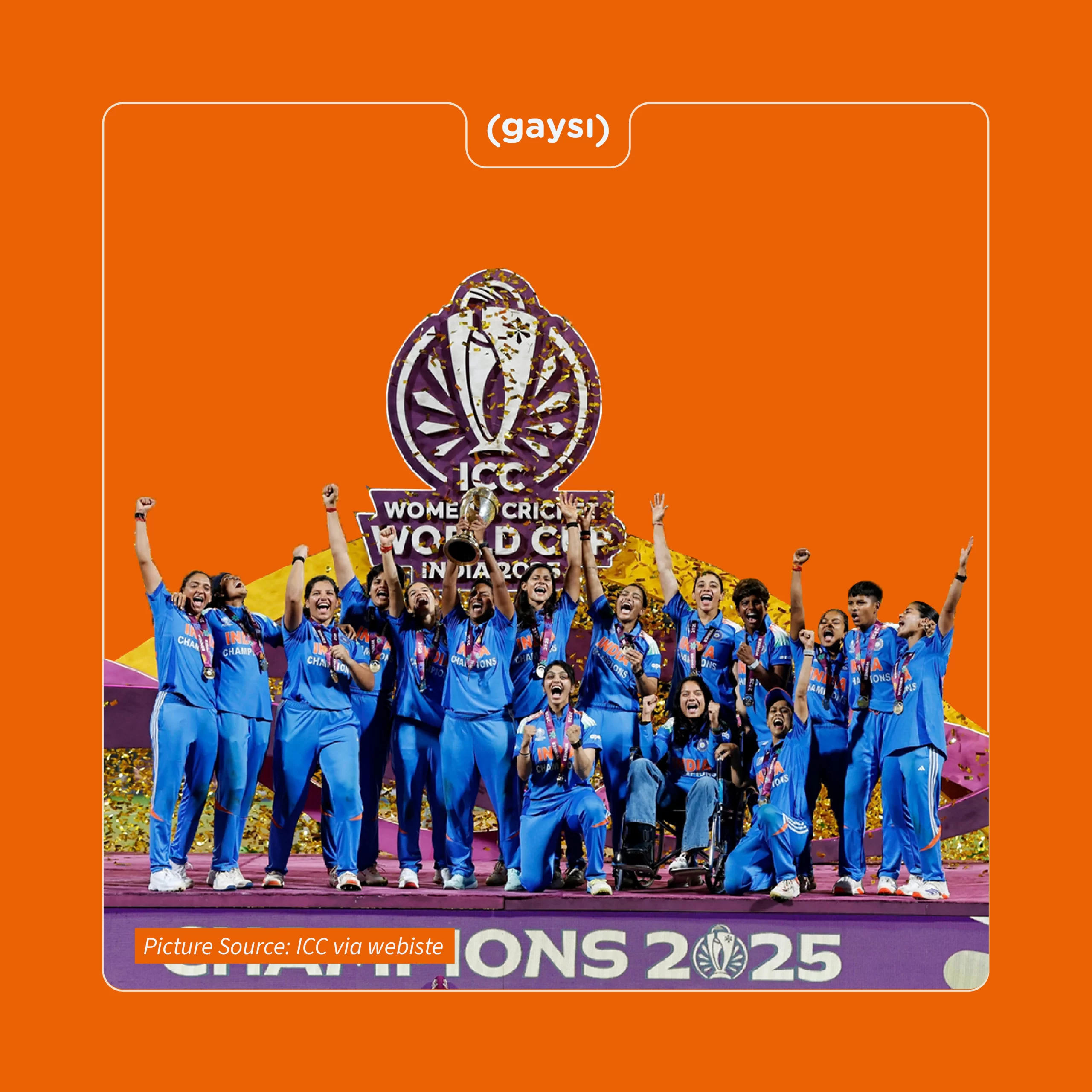
On November 2, 2025, the Indian Women’s Cricket Team made history. They won their first ever World Cup on home soil. It should’ve felt like the homecoming moment of the decade. But for many of us watching from our living rooms, group chats, and queer corners of the internet, it also carried a quieter, heavier truth: that “home” still doesn’t feel like safe ground for women in Indian sport.
Coach Jackie, a former U.S. women’s soccer player and openly gay commentator, said it best, pointing out how when the men play at home, it’s an advantage, but when women play on homeground, it’s often a double-test. For men, the roar of the crowd is love; for women, it’s judgment waiting to happen. A missed catch or low score or a one-off loss doesn’t bring analysis of the game, but insults tied to the tired old chorus of “go back to the kitchen” or “can’t even hold a bat properly.”
So when the women won this World Cup, it wasn’t just a victory over South Africa in the finals, but a win against that chorus. Against centuries of being told the field is not a space where we can be nurtured or grow. As Shafali Verma said after the match, “Surely we don’t belong in the kitchen now. There are many girls in the team who come from small towns and are now champions of the world.”
It’s a powerful statement coming from someone who, as a young girl in Rohtak, had to disguise herself as a boy just to get a chance to play. The fast bowlers back then thought she was “one of the guys.” That image of a young Shafali having to un-gender herself to access the sport she loved says everything about how our playing fields are built. Boys get unbridled access, while girls get permission to participate. And to claim space in a world where men sit at the top of the sporting food chain, women often have to first shed the very identities that make their presence revolutionary.
As a queer girl growing up in India, I remember how early those lessons began. We were allowed to play, but only with “the girls,” only in ways that looked proper. By the time we hit our teens, most of my classmates had stopped going out during sports period altogether. They’d been told their boobs bounced too much when they ran, or that their skirts revealed too much, or that girls shouldn’t come back sweaty and scruffy from the sun. Some worried about tanning; others about being teased. The boys, meanwhile, owned the open football field on our school grounds like it was their birthright.
Also read: S se Sports, Q se Queer, T se Trans
When the girls’ football team needed to train for inter-school tournaments, we’d only get the ground once or twice a week, usually after working hours, when most of the school was gone and most girls weren’t permitted to stay out of the house. There were no women coaches. Just men, some of whom could be casually lecherous, who made us feel unsafe, who taught us early that the pitch was not neutral ground. That the game, like the world, was already uneven playing ground.
That’s why I resonated so hard with Jemimah Rodrigues, who batted India into the finals after being benched for months, after not even being picked for the 2021 squad. Her comeback was cinematic, the kind of script Bollywood would soften with violins and slow-motion shots. But life, as usual, didn’t offer her a montage. As soon as her innings went viral, an old controversy began doing the rounds about how her honorary membership at Khar Gymkhana was revoked (after being offered to her in 2023) because her father had disobeyed the club’s by-laws by organizing religious gatherings associated with Brother Manuel Ministries, a Christian spiritual group. The club, led by senior members and a former president, put her membership to vote, and voted her out.
In India, caste, religion, and gender quietly stalk your achievements, waiting to claim them as conditional. Jemimah’s case is particularly telling, because the controversy wasn’t even about her, but about something her father was associated with. Yet, her name was the one dragged through the mud by her nay-sayers. Because here, a woman’s identity is never fully her own; it’s tethered to a father, a husband, or some man presumed to be her guardian. You can score centuries, break world records, but you can’t outrun home-bred prejudice.
Also read: Imagining a Queer Future in Sports, One Trans Person at a Time
And if you’re queer or gender-diverse, that shadow turns into a spotlight of scrutiny. Just ask 23-year-old Anaya Bangar, Sanjay Bangar’s trans daughter, who earlier this year partnered with Manchester Metropolitan University to prove, through biomedical data, that she’s a woman “fit” to play for India. Her glucose levels, muscle mass, oxygen uptake, every data point became a passport to legitimacy. Her body became both a site of science and a statement of defiance.
Anaya’s quiet rebellion challenges not just the ICC’s 2023 trans ban, but also the moral panic that still shapes how we think about “women’s” sport. Who counts as a woman? Who counts as worthy? The answers, it seems, are always political. The fear isn’t about fairness, it’s about control. When women win, when they outperform men, it unsettles a social order built on the assumption of male physical/biological superiority. That’s why trans women are so quickly painted as “men invading women’s sport,” while cis women are often coddled as the weaker sex, which is a framing that conveniently distracts from real inequities like nutrition, access, and safety.
Also read: Valentina Petrillo and the Fight for Inclusion: Breaking Barriers at the Paris Paralympics
Take Deepti Sharma. In this very World Cup, she became the first cricketer, man or woman, to record the double of 200 runs and 20 wickets in a single tournament. Across nine matches, she scored 215 runs, including three half-centuries, and finished as the highest wicket-taker with 22 wickets. It should’ve been an unqualified celebration of greatness. But that’s the thing, when women excel beyond comparison, the narrative shifts from praise to panic. Their success doesn’t just rewrite record books, it threatens hierarchies.
That’s why trans women are so quickly painted as “men invading women’s sport,” while cis women are coddled as the weaker sex, a framing that conveniently distracts from the real inequities that define who even gets to compete. In a country where women still eat last and often eat what’s leftover, where boys get protein and girls get anemia, “performance” starts long before the pitch.
In a country where women still eat last and often eat what’s leftover, where boys get protein and girls get anemia, “performance” starts long before the pitch. Most women athletes in India still struggle for funding, equipment, and medical care. And when they do speak up about harassment, abuse, or bias, the system punishes them for it. Sexual predators like Brij Bhushan Sharan Singh can face trial for harassing women wrestlers and still return as guest of honour at the relaunch of the Pro Wrestling League, their reputations barely scratched. In a country where the government can host a Taliban diplomat at a press meet without inviting a single woman journalist, and where not one man in the room speaks up, silence is not just complicity, it’s policy.
Calling out that silence rarely sways power structures. Instead, it fractures solidarity. Some women and queer folks, out of exhaustion or pragmatism, curry favour with those in power — the only way to stay in the game. Others stay quiet, afraid of being branded “controversial.” Survivors often fight alone. And the men who claim to be allies? They post solidarity statements, then return to their everyday lives, unbothered by the misogyny they could challenge in real time but rarely do.
For most women athletes, sport in India is like walking a tightrope over a minefield. One misstep, and the headlines switch from “rising star” to “controversy queen.” Clubs that welcome male cricketers with brand deals and champagne open the door to women with suspicion and small print.
Queer sports romances in fiction/fan-fiction are striking a chord because queerness and sport share something fundamental. They’re both about bodies in motion, discipline under pressure, and finding freedom in constraint. Loving someone who understands that rhythm, the exhaustion, the competition, the scrutiny, is rare in heteronormative relationships. It’s why so many queer athletes fall for other athletes; there’s no translation needed. Straight-passing partnerships in sports films (Mr. and Mrs. Mahi, anyone?) often stumble on ego, the husband resents being not appreciated for coaching her, the wife’s success becomes emasculating. Even in Chak De! India, Sagarika Ghatge’s character, Preeti Sabharwal, is told by her hot-shot cricketer boyfriend to quit hockey because it’s a “stupid game”, and to spend her life following his game instead, after he’s elected to the vice-captaincy of the Indian cricket team.
Also read: Rise of Queer Sports Romances: Making Sports Queer?
That’s the emotional subtext women in sport live with: that their passion is secondary, that their place is negotiable. But not on November 2, 2025. On that night, the field was queer in the truest sense, not in who was kissing whom, but in who was allowed to exist fully, joyfully, against the odds. The cameras caught celebration, but the real story was underneath: a collective exhale from generations of women and queer folks who’ve been told they don’t belong in the “gentleman’s game.” Maybe that’s the legacy of this win. Not just medals or records, but in that redefinition.
