


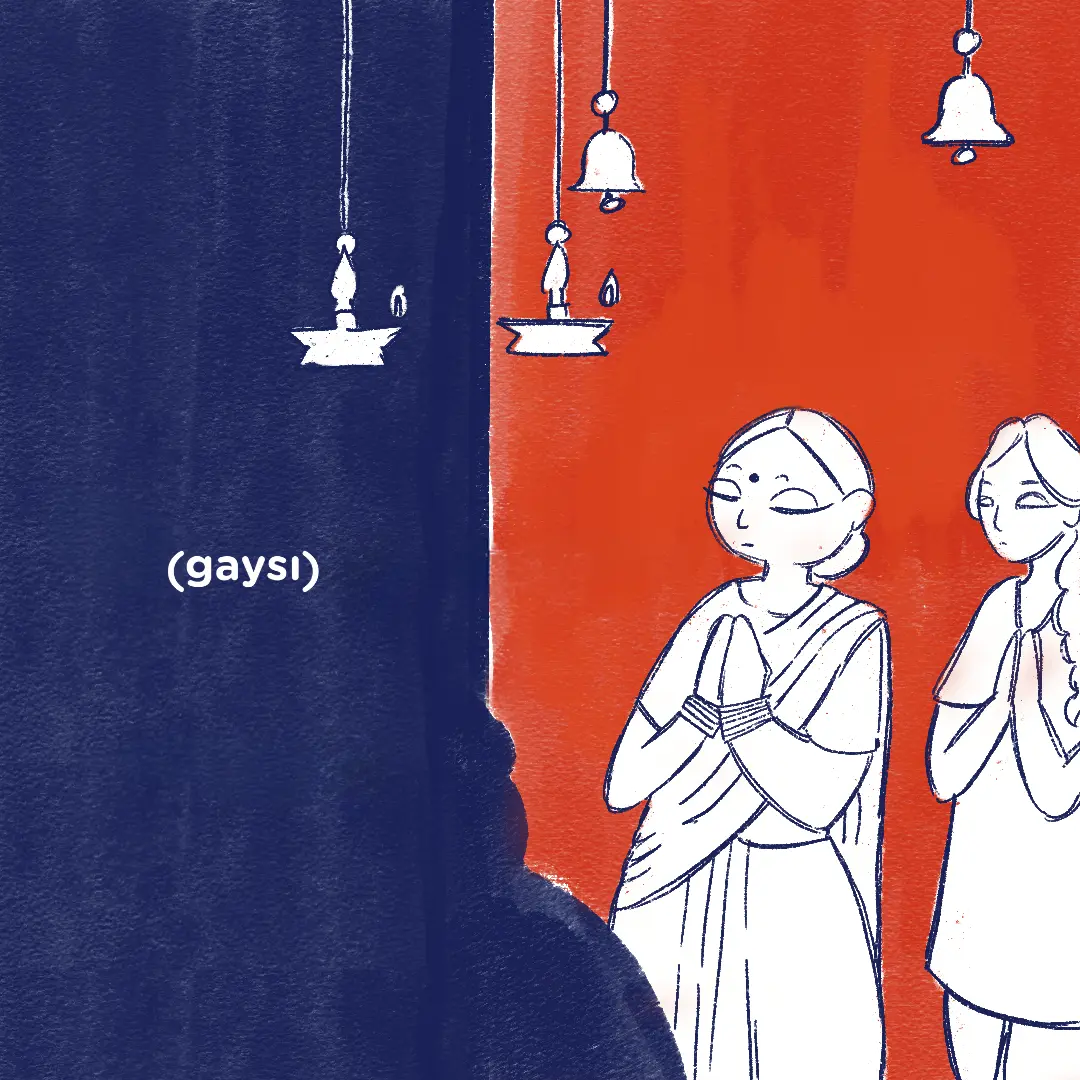
At every Navratri I go to the same spot in the family temple, standing right behind my mother. The marble floor is cold through the soles of my bare feet. The camphor smoke irritates the back of my throat and causes my eyes to water a bit. Marigold petals, which have still not dried from the morning, remain attached to the skin of my wrists. As the aarti starts I fold my hands just as I was shown when I was a child, lower my eyes, and form the well-known Sanskrit words with my mouth even though I no longer understand them.
I am a lesbian, and my family knows this in the same careful and incomplete manner in which many Hindu families come to know such things. There was no door being slammed or a voice raising itself to end the conversation forever; instead, there was only a slow decline in activity. Over the years the questions concerning boys became fewer and fewer. Conversations about my future started to glide past me as oil slid over water. Inside the temple the subject just disappears. We don’t mention it here. We don’t mention it almost anywhere.
Last year, on the last night of Navratri, the flame moved around the circle. My aunt leaned in so closely that I could smell the jasmine oil in her hair and also the slight metallic odour of the silver plate. “Next year you should come with a mangalsutra,” she whispered, her face lighting up. “Then it will look complete.” The heat from the camphor touched my knuckles and I smiled in exactly the way that was expected of me. In that brief interaction the conditions of my presence were completely clear: I could stand there only in the role of the daughter they had still been waiting to finish.
The performance consists of simple, repeated gestures. I get there early so as to help arrange the flowers. My fingers know exactly how to put the marigolds and the roses without having to think about it. I light the long cotton wicks of the diyas and watch the small flames catch and then become steady. When the prasad is presented to me I take it in both hands, the sweetness of the sugar and the soft texture of the halwa being clearly felt on my tongue. My body remembers all the movements from when I was a child. However, it cannot recall how to accommodate the contradiction which now exists within those same movements.
The goddesses whom we revere in this place are fierce: Durga with her many arms, Kali with her wild hair and hanging tongue, and Lakshmi who walks upon lotuses. They are independent, powerful, and terrifying in their fullness. Yet the same tradition which puts them at the heart of the sanctum still manages to demand that my life should be directed towards a husband, a home that has a particular appearance, and a future that can easily be explained at family gatherings. Positioned in the row of women, with the scent of incense heavy in my clothes and hair, I feel both claimed by the ritual and at the same time quietly erased by it.
I never hate these evenings, because that would be easier. I was brought up to know the particular quiet which comes when the temple bell rings, the warmth that results from bodies being close together in that little sacred room, and the way the oil lamps cast a gentle, shifting light over familiar faces. A portion of me still grows tender when the singing begins, while another part keeps a little way off, observing the careful way my face is arranged, the swift change of subject whenever the subject of marriage comes up, and the exact manner in which I leave a version of myself outside the door before I go through the threshold.
In certain years the burden becomes so great that I decide I shall never go back. I picture myself saying to my mother that I have a headache or that I have work to do or one of those other harmless excuses. She then turns her head while the aarti is being offered, looking for me in the usual spot, and at that moment the choice has already been made. I go because the alternative seems to be a different form of violence, one that I haven’t yet got the strength to carry out against the people who have raised me. So I take my place once more. I light the diya and join in the singing. In my body I carry both versions of myself: the devoted daughter that the family is still able to see, and the woman who loves women and doesn’t know how to bring that truth into this room without breaking something fundamental.
The moment almost occurred two years ago, on the sixth night. That night the temple was busier than normal. The air seemed heavier and the smoke denser. The flame was moving slowly along the row of women. Although my hands remained steady on the plate my throat suddenly closed. For a single, suspended second the words rose hot, dangerous, and fully formed. I could have said them here, with the goddess watching and the family crowded in on all sides. I could have allowed the performance to break apart in the middle of the aarti. The moment lasted longer than it should have. My aunt’s shoulder touched mine and somewhere behind me a child started to cry before being quickly silenced. Then the second had passed. I passed on the aarti plate. The singing went on without any break. No one noticed that anything had almost happened.
I then went out into the cooler air. Some of the leaves from the neem tree by the entrance had fallen onto the stone path. I stood under it and waited for the two versions of myself to recover and become one again. The private self which I had left at the door was still there, patient and unchanged, as though it had known I would come back for it. Once more I picked it up, as I always do, and started the journey home with incense in my hair and the taste of prasad still on my tongue.
Between the festivals there are smaller performances. The way I tilt my head when relatives talk about possible matches for other girls of my age. The careful neutrality I display when someone asks me about my ‘plans’. The deliberate silence I observe in certain conversations so that the evening may stay peaceful. Each little act of managing has a price, and over the years this cost builds up in the body causing tightness in the shoulders, a certain kind of tiredness following family gatherings, and the feeling of having been slightly altered by the end of the night.
I sometimes find myself thinking about the possibility of completely rejecting the performance. To remain away from the temple for the entire duration of the festival cycle and to let that absence convey a message. This idea causes me both relief and a sharp kind of grief which I am not prepared to look at in depth. It is still enough to bring me back to my mother’s face when she searches for me during the aarti. In our family love still has to take a particular form. I have not yet discovered a way of altering that form without damaging the love.
I keep coming back; it is not because I truly believe the prayers that I say out loud, but since the other option still seems too severe. I fold my hands, look down, and take part in the singing when it begins. At the same time, I keep the rest of myself just out of the reach of the light in the temple waiting under the neem tree, or walking a few steps behind me on the way home, or sitting in silence in the back of my mind while the camphor burns and the women sing.
One day the distance could disappear and one day I might be able to be in that place without having to leave any part of myself at the door. For now though, the ceremony goes on, ordinary and repeated, composed of cold marble and camphor smoke and the specific weight of being both there and at the same time carefully incomplete. I light the diya, take the prasad, and carry the contradiction home with me in my clothes and in my mouth, as I have been taught to do.
