


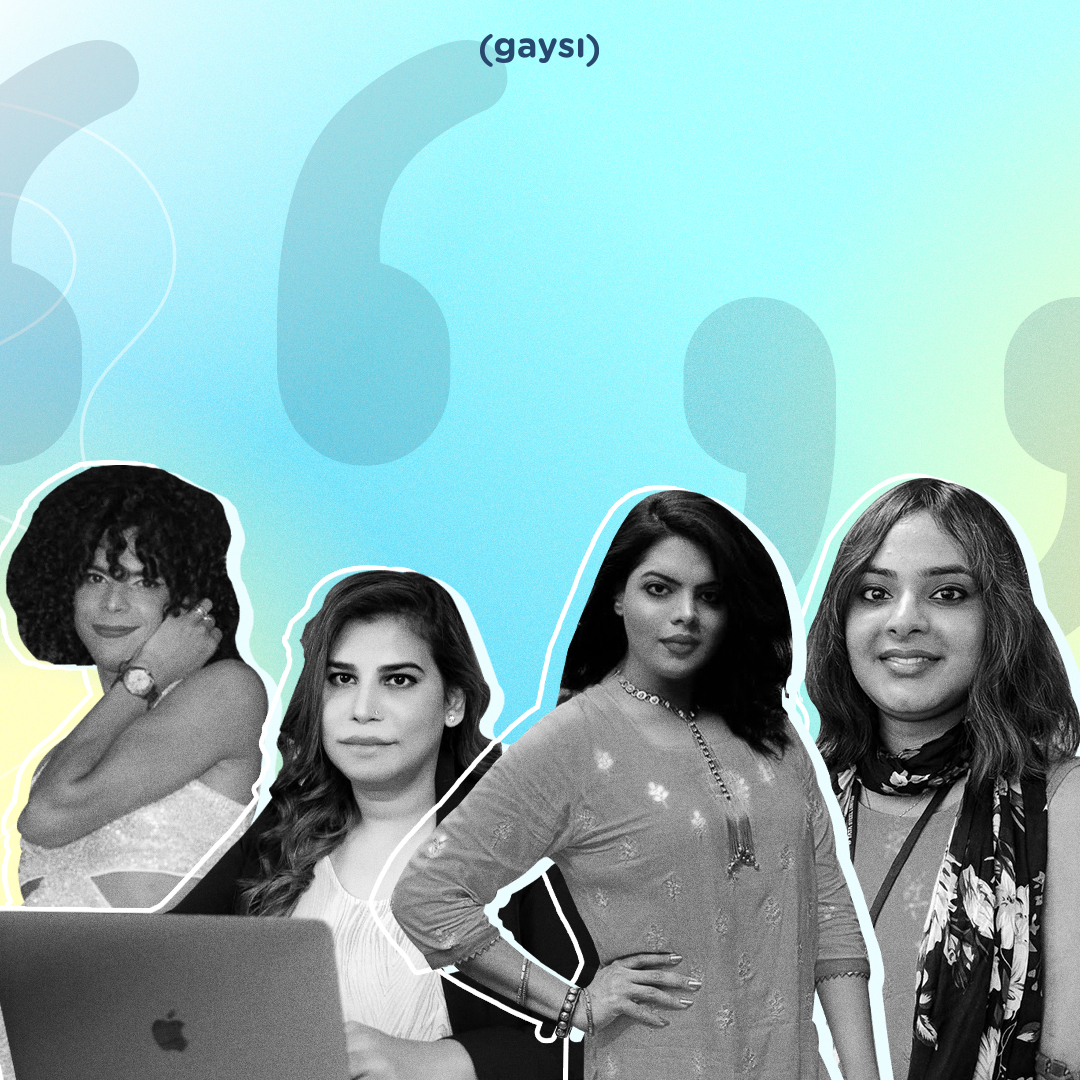
As I sit here, writing this article, I can’t help but reflect on the incredible journey that brought us here to this moment. Growing up, I never imagined a world where trans women like myself could occupy the spaces I now find myself in! An interview with trans women working in Corporate India? The very notion seemed unfathomable, like an unattainable dream hidden behind a thick veil of societal norms and binary expectations.
As someone who only transitioned as an adult, I have navigated life with an undeniable sense of disconnect. I felt trapped within a gender binary that didn’t align with my true self, constantly wrestling with a suppressed longing to express my gender in a way that I felt was authentic to me. Yet, the world around me seemed to whisper words of doubt and limitation, suggesting that certain spaces were reserved exclusively for those who fit neatly into predefined categories.
But today, Zainab Patel (She/Her), Anubhuti Banerjee (She/Her) and Kavya Jaiswal (She/Her) are some of several incredible trans-women breaking through those very barriers and defying the limitations that society imposes on transgender folks. Kavya Jaiswal is currently employed at Godrej Properties as a senior customer relationship manager. Anubhuti Banerjee is Senior Manager IT, executive of the Chief Information Officer (CIO) and leads Digital Transformation and Strategy at Tata Steel. Zainab Patel, who is one of the petitioners in the NALSA Hearings and in the Marriage Equality hearings in the Supreme Court, works with Pernod Ricard India as the Chief of Inclusion and Diversity.
What motivated you to pursue the career you have?
For Kavya, it was word of mouth, and a conversation with Zoya, the diversity and inclusion specialist at Godrej Group of companies, that motivated her to take on the position. She already had the relevant and required experience for it. Kavya elaborated on how the inclusivity she witnessed and the respect she received during the interview process helped her decide. The safe space created by her organization had her convinced: “I can be who I want and still rock the corporate world”.
A focus on diversity and inclusion in the workplace is vital for retaining team members. In the largest survey of transgender people to date, 78% of the respondents reported experiencing at least one form of harassment or mistreatment at work because of their gender identity; more specifically, 47% reported being discriminated against in the hiring, promotion, or job retention processes. The LGBTQIA+ community is aware of this and individuals seek out places of work that are sensitized and have diversity in the workplace.
“When I was first hired at my initial organization, I encountered substantial discrimination, which made me acutely aware of being treated differently than my colleagues.” Kavya continued, “In those early days, I was grappling with numerous questions about my own identity, feeling isolated and alone in my quest for self-discovery. I have noticed a shift in how people perceive and approach me now. Individuals engage with me directly, seeking out conversations and interactions with respect.”
For Zainab, a trailblazer by all counts, the very fact that there were barely any people that she could look up to in these spaces motivated her to be the person who could potentially be someone that other queer folk would find inspiring. After working in health and human rights for almost two decades, she joined KPMG as the Diversity and Inclusion specialist. Through her work, she is opening the doors of many others to gain access to these spaces.
Anubhuti shared that, “Since my childhood, I have known deep within me that I am a woman. Being a self-made woman was something I chose as some sort of a goal, an ambition. And workplaces, and financial independence – along with social and emotional independence – were essential to be able to achieve that.”
“It is absolutely amazing, you know! When you are included somewhere, and when you speak others value you. That you are a part of the company, part of the people you know.” Kavya exclaimed.
What are the challenges you faced as a trans woman in the workplace and How have you overcome these challenges?
For Anubhuti being the first trans woman to openly transition at her place of work came with a unique set of challenges. Emboldened by the landmark NALSA judgment in 2014, she recalls joining a renowned group in India that has been around for 100+ years “I was expecting other visibly queer folks and maybe policies that are inclusive, only to find that LGBTQIA+ representation and awareness was scarce, if any.”
Also read: Three Years after the Historic NALSA Judgment, Have Trans Indians Truly Benefited from it?
As a pioneer, she faced challenges that she didn’t wish others following in her footsteps would have to experience. Recognizing that her own coming out would contribute to this goal, she engaged with the chief diversity officer, discussing concepts of gender identity and expression. Although these terms were initially unfamiliar to the officer, they offered their full support and committed to minimizing any difficulties she might face. This support at that time meant a lot to Anubhuti.
Prior to the NALSA judgment, the legal and societal barriers were too high for trans-persons to overcome and be out at the workplace. Zainab, someone who was a petitioner for the NALSA judgment recalls working with NGOs and within the UN system prior to the Trans Act being passed; “at that point of time, gender transitioning, equal opportunity policy, and gender neutral washrooms were unheard of” During her transition, she encountered issues such as deadnaming, misgendering, body shaming, and pressure to conform to traditional gender norms.
Zainab experienced reverse-stereotyping/counter-stereotyping, “on literally a day-to-day basis.” She continued, “People have said it innocently, without understanding what the implication of this is – ‘Why don’t we see many such people like you, Zainab?’”
People often expect transgender persons to fit into their idea or image of what an acceptable and respectable transgender person should look like or behave. This can be a painful hurdle, for instance, if a transgender woman is expected to conform to traditional feminine appearance and mannerisms, she may face barriers to leadership positions or client-facing roles if she doesn’t fit those expectations. This type of reverse stereotyping can prevent transgender individuals from fully expressing their authentic selves, while hindering their professional growth and development. Something Kavya experienced in her first place of work.
Since Kavya did not look like their average employee (who fell into the gender binary), she ended up facing a considerable amount of discrimination. She ended up feeling really isolated and it sent her on a whirlwind of second-guessing and body image issues. Recently she saw someone going through the very same hurdle and was able to step in and support her. A new colleague at her workplace was facing difficulties in adapting to the formal corporate environment, as someone from a different professional and economic background. Initially, the person felt isolated during her joining period, but Kavya was able to offer her support and assistance, professionally and personally.
“The blanket statement of support” from the organization she worked in gave Anubhuti a significant boost in confidence, especially as someone who had previously doubted whether the world truly saw her. And if they did, did they see her as someone who offered value? The support from her place of work helped give her some much-needed determination. She organized her resources, sought legal advice, and began the process of sharing her authentic self within the workplace. Something that would have likely set a precedent for others who worked there or would work there in the future. Making their journey considerably less stressful.
The support that each of these trans women has been able to find within their places of work or outside of it has arguably been their greatest ally in overcoming the challenges they face in corporate India. Although Zainab believes that progress has been made, she acknowledges that there is still a long way to go in order to ensure that everyone feels accepted and included. Zainab mentioned the concept of “othering” queer individuals, where they are expected to leave activism at the office doorstep and conform to the status quo. This expectation undermines the potential need for advocacy and social change within the workplace and society.
Did you have access to Employee Resource Groups, support from HR or other transgender folks you could potentially discuss issues with?
“No!” laughs Zainab good-naturedly before continuing, “I mean, look at it in context to the time I am talking about – 2008 to 2014. Which is when I was socially and medically transitioning. Back then, I was working with NGOs or within the United Nations system, where there were no employee-resource groups.”
Change happened slowly for Zainab, “Only when I only joined the Bangkok regional hub in UNDP, as a policy analyst of human rights in 2015-2016 did I see representation. That’s when I met with the Global Group of LGBTQIA+ individuals, which identifies as the Pride Network within the UN. That’s when we first started talking about affirmative action.”
Zainab admits that things have come “full 360 degrees” since then. “I now lead the Employee Resource Group at Pernod Ricard India.” Even at her previous position in KPMG, she was the co-lead for the Employee Resource Group for Women, both in India and globally. “In fact when I was part of the ERG in KPMG, it changed the conversation and dynamic around gender equity for the group. I brought my experiences as a New World Feminist to the group.”
Anubhuti would have loved to begin this interview by talking about the wonders of ERGs.
In 2016-17 she sought to have discussions with people from different organizations who were also driving the change for LGBTQIA+ inclusion in the workplace. She managed to meet Parmesh Shahani (Godrej), Ritesh Rajani (IBM, now Target) and Ramkrishna Sinha (then Intel, now Pride Circle). However, at the time, she was yet to meet a trans woman in corporate India.
“Initially, I didn’t have any visible trans-women as colleagues at my workplace. Honestly, I couldn’t find any visible trans women in all of corporate India.” She felt it was important to form an LGBTQIA+ employee resource group “called WINGS and it was one of the first if not the first LGBTQIA+ employee resource groups in the Tata Group and the wider manufacturing industry of India.. although I’m hesitant to use the term ‘first’ because the terminology is not clear.”
“Knowing that other organizations were also striving for change gave me a sense of solidarity that Tata had a parallel journey. We started the employee resource group. We ensured gender-neutral restrooms were available early on, and now they have become the norm in almost all our facilities, developed inclusive policies, and conducted a significant hiring drive specifically targeting LGBTQIA+ individuals. Having transgender individuals in our organization became a litmus test for inclusivity,” Anubhuti explained.
Anubhuti and the group’s efforts were recognized by the World Economic Forum, naming them one of the global lighthouses for diversity and inclusion. They were the only Indian company and one of the top 8 worldwide to receive this recognition. “One of the happiest moments for me was seeing the positive impact of having queer and trans women in the organization, particularly on the women already working there. I observed a significant transformation among women as we embraced inclusion. They felt encouraged to be their authentic selves at work, and this positively influenced their overall experience. It wasn’t solely due to our efforts, but it played a significant role in transforming the workplace.”
Kavya shared the same joy when she spoke about her involvement in an LGBTQIA+ resource group at Godrej Groups. This involvement allows her to support other LGBTQIA+ members and participate in and help with planning monthly calls and fun engaging activities aimed at educating people and encouraging them to be better allies to the community. She believes that taking such initiatives is crucial to fostering inclusivity for individuals with diverse identities and gender orientations. She expressed gratitude for the brilliant allies and colleagues in her organization who actively engage and work towards creating a more supportive and inclusive workspace.
Kavya recounted a moving incident she experienced when speaking at an event in Nasik. A woman in the audience felt emotionally touched by Kavya’s story and was moved to tears. She opened up to Kavya about the time her gay son came out to her. The mother found solace and strength through Kavya’s narrative, as it was one that reflected joy in it. Kavya feels that sharing her story allows folks to humanize trans-folk and our experiences, thereby allowing harmful and negative stereotypes to come undone.
Why is it significant to the LGBTQIA+ community that you are a visible trans woman?
“That’s a fascinating question, and one I’ve found myself wondering about” replied Anubhuti.
“The two aspects of society that have the most profound impact on the everyday lives of transgender folks are the public forum, including government and societal debates, and the legal status. However, there are also private and public institutions that operate within our society. These institutions are governed by various policies, such as HR policies in corporations or educational policies in schools. These policies often take time to change and are most often influenced by individuals within the organizations. By being visibly present in organizations, like we are, makes it possible to initiate change from within.”
She continues with the fervor of someone who has spent many a night pondering: “From an external perspective, corporate positions or issues may not receive attention unless there is a stakeholder or someone within the organization striving for or directly affected by that change. Therefore, it is crucial to have trans/queer people visible in these spaces.”
Zainab illustrated how people seek examples of growth and success to identify with. “When they see individuals like Zainab, Rayyan, Trinetra, Anubhuti, and many others being visible and achieving success in various domains, it creates an aspirational roadmap for others. It’s not necessarily about becoming role models, but the visibility itself is important. While my journey may not be the same as yours, when you see someone out there in the world, it gives you hope that if Zainab can make it, then perhaps I can do even better. It took me 23 years to reach where I am today, so it’s not an overnight process for sure. But I’m here.”
In Zainab’s context, her recent entry and acceptance into the corporate world is atypical to her much longer career. “Five years ago I came to corporate, I joined at a time when inclusion was finally being taken seriously. Today, with the attention on diversity and inclusivity, people will have even greater chances of success when they immerse themselves in it. Moreover, there are more opportunities available today.”
Zainab Patel happens to be someone Kavya looks up to. Kavya was inspired by Zainab’s story, saying it gave her hope, and drive to imagine such realities for herself. Pushing her to take the current job up despite the self-doubt, “Initially I was unsure whether I would be able to pull this off, that is being in a client-facing role as a Relationship Manager. Having faced so much discrimination and internalized so much stigma, there was self-doubt.”
For Kavya, the meaning she derives from being able to support the community is fulfilling. “Fulfillment comes when you are fulfilled with yourself”, and being a support to other transgender folks and someone of value in her organization is something that has helped her find a lifelong yearning for purpose. “Today I am the only Relationship Manager who is a trans woman here. It occurred to me, if I didn’t do it others may not have thought it possible. Zainab really made it possible for me. Today I know where I stand and am able to talk to any client, any senior manager with confidence.”
Anubhuti also added, “Workplaces can undergo transformation simply by having trans individuals present. As you rightly pointed out, the mere presence of trans people challenges the preconceived notions we have grown up with. It helps break down myths and normalizes the idea that being transgender is perfectly normal and acceptable. By working together as colleagues on a daily basis, we can dispel these misconceptions and pave the way for positive change from within.”
Zainab left me with this parting thought, one I relate to: “I am 43 years old now, and when I started my journey, my only reference point were [trans people who were pushed out on the streets. However, today I no longer need to look at them as my sole reference point because there are even more visible examples of lived transgender experiences.” Zainab is one such example for this writer.
What are some of the most rewarding aspects of your job/ stability/ working in corporate India? How has your experience as a trans woman in the workplace contributed to your sense of joy and fulfillment?
“Let me clarify unequivocally, that the monthly financial remuneration deposited in my bank account on a designated day ensures stability and allows me to pursue my activism and social work unhindered.” stated Zainab honestly, “I refuse to hide behind the pretext of claiming that I love my job simply because I love it. Yes, I do appreciate certain aspects of my job, but I also value the monetary compensation it provides. My job secures my physical well-being, which is its greatest advantage.
“One of the most rewarding aspects of my job is the ability to live a life that was once unimaginable for me.” Anubhuti observed introspectively, “As someone who knew their true gender identity but was not seen as a woman by others, I aspired to be a self-made woman. Today, looking at myself, the work I do, and the way I present myself fills me with immense PRIDE. It makes the 10-year-old version of me proud as well, considering the limited visibility and opportunities we had back then, which unfortunately still hold true today. However, it is heartening to see people advocating for change in our society and organizations.
“I have been able to support my family” Kavya explained how her job and position has allowed her to support her family for whom she feels responsible. In addition to financial stability, it allows Kavya the opportunity to support the community through her work in diversity and inclusion – something that she finds deeply fulfilling and rewarding. Her position also contributes to her idea of herself and her identity.
Kavya explained that as someone who has faced discrimination and lives with the stigma that society holds around the transgender experience, people often see you for your gender identity using it to stereotype your personality. Kavya does not believe one’s gender identity constitutes their entire personality. “I just wanted a company to see me and say, I don’t care if you are trans man, woman, non-binary, whatever. We just care about your skills and what you can bring to the table for our organization” At work, she is seen and acknowledged for her work and the value she adds to the business. This contributes in positive ways to her own idea of self. “We are not just our gender identities, sure that is a major part of us, but besides that we have so much more to offer society.”
Zainab echoed the same, “No matter how low I may feel in my personal life, entering a workplace that embraces me for who I am, brings me immense joy. From the drivers, receptionists, hospitality and cleaning staff, to the kitchen staff and senior management, everyone recognizes and acknowledges my presence.”
For Anubhuti, “Being part of a company with a history of pioneering efforts is gratifying. Through my talks and engagements in various corporate settings, I witness the positive transformation happening in many workplaces. Knowing that I have played a role in this movement brings me great joy and a sense of fulfillment.”
Anubhuti’s experience allowed her to explore leadership opportunities and venture into new territories, “Even in my current role, I work with cutting-edge and niche technologies, shaping positions and strategies. This role was entrusted to me because I demonstrated a willingness to take risks, embrace change, and understand the evolving cultural landscape.” Anubhuti believes that transgender individuals possess a unique perspective on societal shifts due to the challenges we face in a world not built for us.
Zainab spoke about an ex-colleague who reached out on Linkedin to say, “I always looked up to you because you chose to dress in a way that was different. You brought color into the office, wearing sarees, while others wore business suits or muted colors. Even your attitude was vibrant. In my mind, whenever I saw you walk, you personified Durga. You exuded empathy, strength, independence, and articulate expression. You never hesitated to voice your own opinions or stand up for others.”
Durga is often considered symbolic of feminine strength and power. “Reflecting on this encounter, I realized it was a profound comparison. In the past, during a war between Pakistan and India, Atal Bihari Vajpayee referred to Indira Gandhi as Durga, a symbolic representation of her strength. Now, someone else was calling me Durga, and it deeply impacted me. Whenever I feel down, I revisit that message because sometimes, just being oneself silently empowers people who may not even be consciously aware of it.”
Regarding personal fulfillment, Anubhuti said, “The greatest happiness that I have found is simply being true to myself. Over the years, I have experienced moments of gender euphoria, both from creating the conditions for it and from unexpected encounters. I consider myself fortunate to have had opportunities to contribute and pursue my desires. While challenges still exist, such as finding housing as a trans woman … every small victory, like being called “ma’am” or finding love and friendship, adds to the happiness and fulfillment I feel. I hope to continue experiencing such revelatory moments and embracing the responsibility that we have to set an example for others. By sharing the spectrum of our realities, we humanize ourselves and strive for a more inclusive world.”
What advice would you give to other trans women who are looking for fulfillment in their careers?
“I am not going to lie, but it’s going to be difficult, especially if you are someone from outside the corporate culture and moving into the corporate culture. You may have to adapt aspects of your personality or feel pressured to do so.” advises Kavya. She feels it’s best to try to leave our baggage from our earlier experience and give it a fair chance. But for this you need to first accept and give yourself a chance, and believe that you can do it. She believes that through perseverance, hard work and some luck you can achieve stability and independence through your work, which is rewarding in and of itself.
“You might need to remind yourself, I’m doing this for me. I don’t want to live the stereotypes or be a statistic, that I’m going to be myself and rock this corporate culture.” Kavya also recommends doing research and looking up the organizations that you are considering working with or those that are offering you a job. Check their organizational policies, do they have a gender equality policy or an Employee resource group? What is their health coverage policy, do they cover gender-affirming procedures? “For example in Godrej Group they reimburse you for medical expenses incurred during certain gender-affirming procedures.”
Anubhuti too emphasizes on the importance of doing research into where one may plan on working. For instance, some organizations hire transgender/ minority representative people to fulfill diversity quotas into roles with limited career prospects. Anubhuti continued, “As trans individuals, we have the power to choose inclusive organizations and careers that genuinely fulfill us. Don’t settle for inclusion for the sake of it. Take ownership of your career and decide who you want to be.”
Zainab stated, “I believe that it is important to go beyond our current limitations and conditioning. Sometimes, due to our life experiences, we may have developed a sense of defeat. As trans individuals, we need to dare to be ambitious. No one will hand us a clear roadmap. The challenges we face may take different forms, and we need to have foresight, resilience, and a willingness to embrace change. These are things that are rarely emphasized for women in general, and especially for transgender individuals. We are often told to be grateful for the opportunities created for us, to wear our PRIDE on our sleeves, and simply go to work.”
Anubhuti observed that trans women often face economic exclusion, which can lead us to believe that we are indebted to educational or professional institutions for allowing us to be part of their organizations. “This belief is entirely false and misguided. We belong there because we deserve it. We are just as capable as anyone else, regardless of outdated notions of merit and educational qualifications. Embrace your own worth and stand up for what you deserve. Remember, it’s not a favor that anyone is doing for us.”
Despite the lack of a defined and clear path, Zainab advises that,“We should continue striving for our aspirations. We should never let anyone define our worth or limit our potential. Let’s challenge the norms, break barriers, and create our own success stories. It won’t be easy, but the journey toward fulfillment and accomplishment is worth it. Remember, as trans women, we are capable, resilient, and deserving of the highest achievements.”
Anubhuti, in conclusion, also reminds us to not take it all a whole lot seriously, “If you have a creative vision after working in the corporate world, go for it. Don’t let obstacles, insecurities, or fears of inclusion hinder your true self because we only have one life. Keep moving forward and choose yourself. Believe that you are ready for the responsibilities ahead or that you can grow into them. Whether it’s a career switch or becoming a parent, if you feel prepared and eager, don’t allow societal norms or legal institutions to hold you back. Every day brings new opportunities for us to be valued and equal parts of society. We deserve to experience not only the challenges but also the JOYs that may come with living in this world.”
Source
- Ank Parkhe research
- Nida P research
