


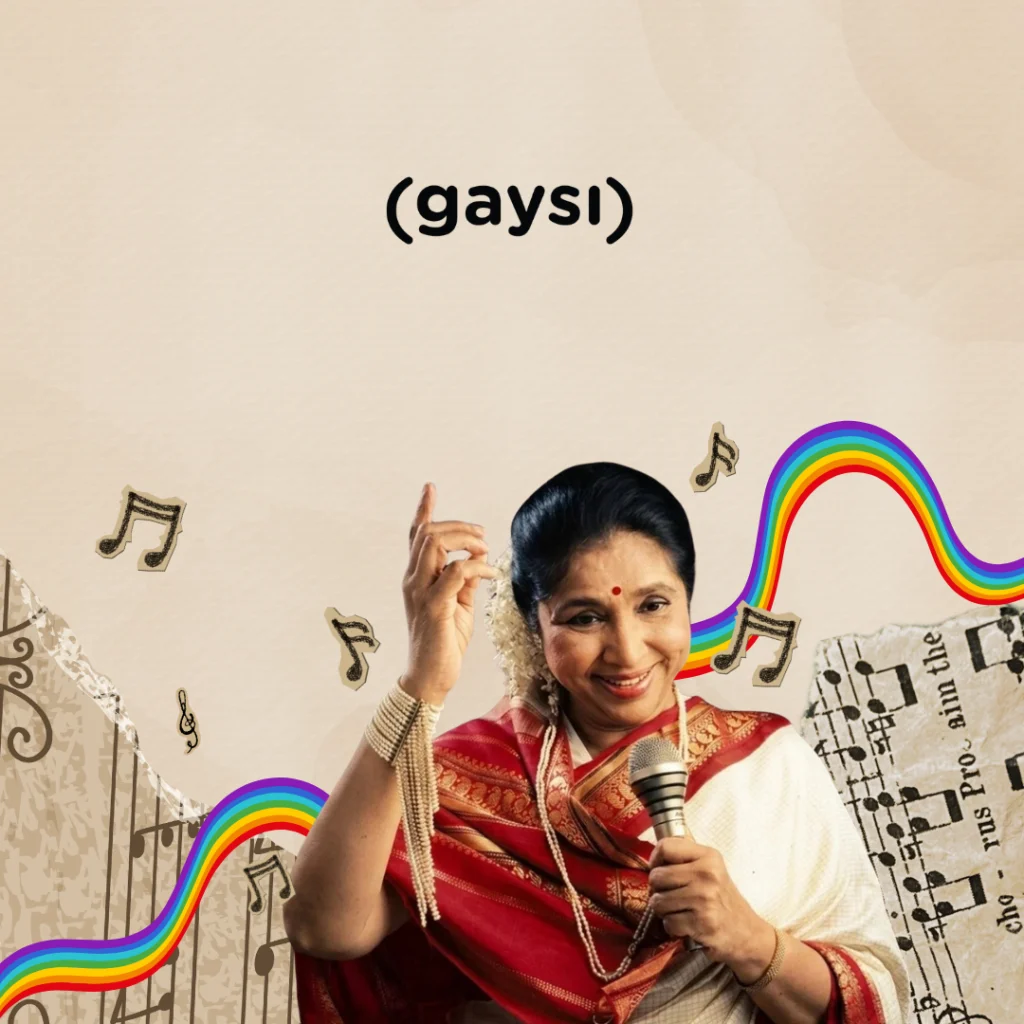
‘Aaiye meherbaan, baithiye jaanejaan…’ (Come, o gracious darling, be seated…) As the strains of the immortal song flow through my window, I marvel at the impact of Asha Bhosle’s inimitable voice on my life. A voice that fired so many imaginations, not the least of wooing a hard-to-please man. A GenX gay adolescent hardly had any positive affirmation of his identity. The gay haven was often our make-believe world, where we wove hopes against hope. And the voice of Ashatai often gave them wings. The artist par excellence had something to offer to everyone, including the gays.
The GenX had its unique struggles in India. It grew up with a measured expression of desire. The precarity was even higher for those with alternative sexual identities, hardly ever touched by the winds of change. The fear engendered by Section 377 made caution overpower courage. An environment of denial and consequent frustration made many of us seek solace in the icons on the larger screen. Since our relationship concerns were shared with women, we would identify with the female characters through the voices of Lata Mangeshkar and Asha Bhosle. However, hope and courage for me were always in the voice of Ashatai. A gay icon so different from the usual Hollywood ones.
Questions may be raised about Asha Bhosle’s status as a gay icon. Typically, these are female artists like Cher, Madonna or Lady Gaga, identified (often) by a ‘huge’ voice, attractive dresses and a ‘hint’ of real-life tragedy. They usually are the divas associated with camp or exaggerated feminine expression. Like gays, they transgress the norms and strictures. Also, as Daniel Harris’ essay ‘The Death of Camp: Gay Men and Hollywood Diva Worship, from Reverence to Ridicule’ suggests, we vicariously live the diva’s attempts to woo handsome men. This description, though, does not fit the unique cultural context of India. The icon is not always the on-screen performer.
The Indian cultural industry, including cinema and popular music, operates differently from the West. Popular music and its icons here belong to the movies rather than to music bands. Movie songs, in turn, have their own distinctiveness. The musical score, the lyrics, the music arrangement, the rendition and the on-screen performance are all handled by different artists. So who embodies the song? It is mostly the singer and the on-screen performer. Nevertheless, in the audio-dominated legacy (centred on radio, records and similar devices), the on-screen performance is mostly unseen. Hence, the voice becomes the defining element of the music. So, the verve of ‘Jawani janeman, haseen dilruba’ or ‘Kya gazab karte ho ji’ comes through the voice for most of us. The female singer, being the conduit of the emotions that matter, can definitely be considered a gay icon.
Asha Bhosle’s impact on the gay psyche is similar to that of the Hollywood divas. The work of ‘Madonna in a saree’ (as she was once described) provided an antithesis to submission and docility. The GenX gays took their own flights of fancy through her unconventional songs, with uninhibited expression of desire. For example, a government employee living a straitjacketed life in a mofussil town would dance to the mellifluous rendition of ‘Raat akeli hai’ when alone. The South Asian expatriates would gyrate to her cabaret numbers like ‘Piya tu ab to a ja’ in their safe spaces. The serious medico would turn into a playful Umrao Jaan as he came to terms with his identity. There was no dichotomy in this. It was a search for expressions when the world demanded a façade. The guilt-ridden gay men, frustrated with the fleeting encounters in unsafe cruising spaces, had some respite in Bhosle’s playful banter. Needless to add, the classic diva performances in the movies were mostly on her songs. From item numbers to drag songs – the best ones owe their success to her voice.
Asha Bhosle’s iconic status among gays can be attributed to aspects beyond her voice as well. The first was her stage presence. While most stalwarts stuck to the podium, very few, like Asha Bhosle, made it lively by utilising the space. When the white saree was the norm, Asha Bhosle dressed in bright colours. In her personal life too, she showed the assertiveness and agency that most gay men dream of.
Asha Bhosle’s songs reverberate in gay parties even today. The songs are being remixed and reinterpreted, which is itself an homage to their timeless quality. It is almost six months since her demise, and her songs give no less hope in times when queer identities are more conspicuous.
It feels almost surreal to hear the beautiful song on this lonely evening. As if she is motivating me from her heavenly abode. I no longer feel lonely as I hum along. In times when electronic chaos overpowers even a prima donna’s voice, I am so lucky to have access to Asha Bhosle’s beautiful songs. The voice that inspires. The body of work that is unparalleled. The legacy that has something to offer to everyone, including me.
