


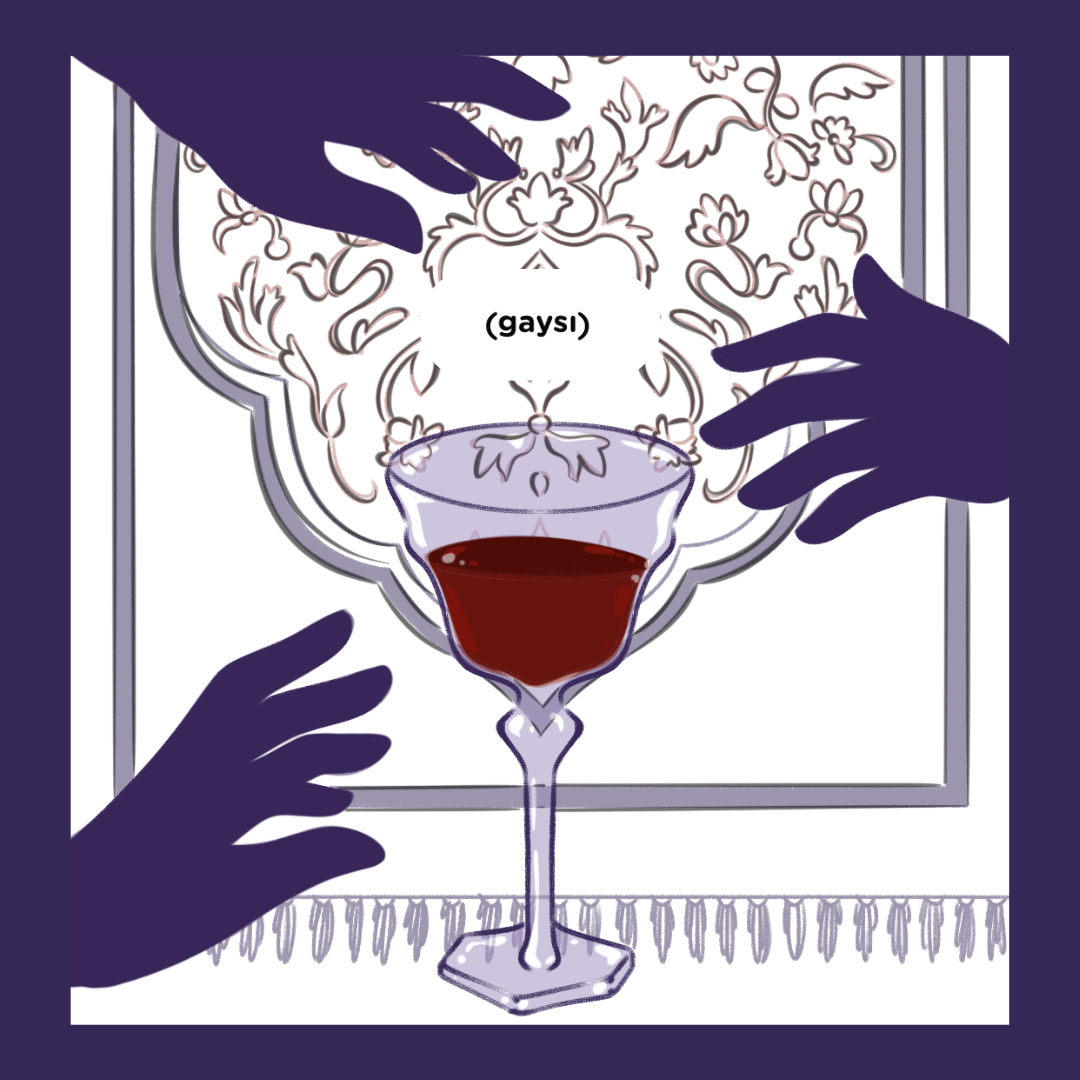
I over-consumed alcohol for years.
I used to tell myself it was social. Harmless. A way to take the edge off after long days of holding other people’s stories. When I finally admitted to my psychoanalyst that the first sip of red wine immediately calms my nerves and opens me up to connect with others, he paused and said, “What if it just helps you connect with yourself?”
I remember blinking at him.
I brought that revelation to a colleague at work, a queer Indigenous therapist. Without missing a beat, she said, “Well, yeah. The goal of colonization is to fragment the self. And capitalism depends on the fragments to keep us dependent.”
I was shook.
For many queer Muslim men, fragmentation begins early. We learn to split: dutiful son and secret lover. Pious student and cruising adult. The one who lines up shoulder to shoulder in prayer and the one who sways under neon lights at 2 a.m.
For a long time, I thought alcohol helped me connect with others. What if it was stitching me back together, temporarily, from the fragments?
In my co-edited collection Queer and Muslim, I interviewed Shafik, who spoke about how identity exploration is less about choosing one truth over another and more about resolving internal conflict without amputating parts of the self.
Substances can feel like a shortcut to integration.
So can prayer.
Congregation moves me. The hum of recitation. The choreography of bodies rising and prostrating together. In those moments, I am not split. I am not performing. I am not negotiating. I am held in rhythm.
At an afterparty, bass reverberating through my chest, something similar happens. My body loosens. Shame thins. I laugh more easily. I feel porous. Levitation is not the right word, but it is close.
One is called worship.
The other is called indulgence.
Both alter consciousness.
Both suspend the voice that polices me.
Both return me to myself.
The difference is not as simple as sin versus sanctity. The difference is infrastructure. One is socially sanctioned transcendence. The other is stigmatized relief.
While writing The Mental Health Guide for Cis and Trans Queer Guys, I examined the forces shaping queer men’s mental health: stigma, family rejection, racialization, economic precarity. I was careful not to frame compulsive substance use as a moral failure or a lack of willpower. More often, it is something we slip into when the self has been under pressure for years, when fragmentation feels easier than feeling everything at once.
In The Politicized Practitioner Series, Vol. 1, the contributors and I examine how colonization and heteronormativity shape therapeutic training and practice beneath the language of inclusion. Capitalism and empire discipline our bodies into splits: sacred or profane, public or private, faithful or queer.
Editing Queer and Muslim softened me. I sat with stories of people who leaned into faith, who accepted exile, who built entirely new spiritual architectures. Their brilliance unsettled my cynicism. Their beauty complicated my binaries.
Between the prayer rug and the afterparty, I have come to this: altered states are not the problem. Fragmentation is.
If colonization fractures the self and capitalism monetizes the pieces, then of course we will reach for whatever briefly feels like wholeness. A glass of wine. A crowded dance floor. A night of chemsex. A long sujood. A protest chant. A lover’s hand.
The question is not why queer Muslim men seek altered states.
The question is why we were never given safer, communal, and sustained ways to feel integrated without them.
It’s been over 2 years of not drinking. It’s been extremely difficult.
I chose that path not because pleasure is sinful. Not because sobriety is morally superior. Not because I care that some God cares what I put in my body (She likely doesn’t). But because I am hoping that sitting with myself will let me see the fragments—mend them or accept them as they are.
The real work is not abandoning altered states. It is building conditions where wholeness is possible.

“Identity exploration is more about resolving internal conflicts without loosing part of self than choosing one truth over other.”
I feel like I know the meaning of these lines but can’t bring it to my consciousness. And the feeling if unsettling.