



Godrej Properties Limited (GPL) has positioned itself as a company keen on engaging with the queer community—whether through dedicated hiring initiatives for queer talent, its collaboration with Gaysi to document queer working experiences, or its latest integration of EqualiTEA Cafés at its property sites and Marketing Office and Show Apartments (MOSA). The EqualiTEA Café, an on-site café initiative, is run primarily by transgender individuals and people with hearing and speech impairments.
Gaysi family was able to attend the inauguration for the new branch at Godrej Reserve at Kandivali East, Mumbai!
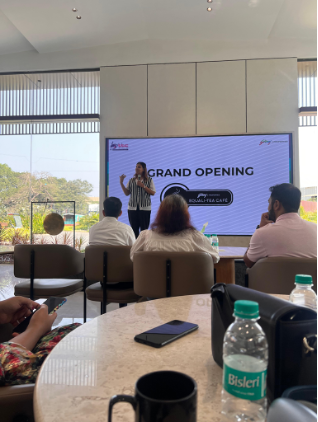
While this move signals a step toward inclusion, its true impact depends on long-term sustainability and meaningful investment in queer and trans-led businesses. The initiative in Mumbai is in collaboration with Zainab Patel (she/her), a queer rights activist and founder of The Trans Café and TransFromation Salon. Patel also serves as the Diversity and Inclusion head at the Samavesh Chamber of Commerce, which supports LGBTQ+ business development.
Two new cafe sites have been introduced in Pune which are run by Shikandi Foundation, a trans collective. And the cafe in Delhi is run by folx with speech and hearing disabilities supported and aided by ISL (Indian Sign Language) interpreters as well!
For the EqualiTEA Café to be more than a symbolic gesture, it requires deeper structural support—ensuring economic stability for trans entrepreneurs, addressing barriers to employment beyond token hiring, and creating pathways for growth. If companies genuinely wish to champion inclusion, investing in and learning from such initiatives will be key.
Creating Spaces for Visibility
At the opening of the EqualiTEA Café at Godrej Reserve in Kandivali East, Zainab Patel (she/her) spoke about her vision for the initiative: to eventually hand over full operations of the cafés to new entrepreneurs. Rather than retaining any share of the profits, she aims to create a self-sustaining model—one where each entrepreneur, in turn, hires more queer individuals, expanding employment opportunities within the community.
Jamini Baviskar (she/her), the Diversity, Inclusion (D&I), and Campus Lead for GPL’s Mumbai Zone, shared how the idea took shape. She credited her senior, Zoya (they/them), the Pan-India Lead of D&I and Employer Branding at GPL, for championing the initiative. More importantly, she highlighted the need to create employment pathways for queer individuals beyond the company’s existing queer-specific hiring program—which, until now, required candidates to hold a bachelor’s degree.
Creating Jobs for Security
For many trans people, inaccessibility to formal education remains a significant barrier, often pushing them toward high-risk professions. Recognizing this, GPL sought to build a system where queer and disabled individuals could access meaningful, inclusive employment—one that didn’t hinge on formal educational qualifications.
The introduction of on-site cafés run by queer and disabled entrepreneurs is not just about providing jobs—it’s about fostering financial agency and skill development. Zoya explains that beyond employment, the initiative has another crucial purpose: placing visible queer entrepreneurship in spaces that are typically upper-class, upper-caste, and predominantly cis-het domestic environments. By embedding these cafés within everyday corporate and residential landscapes, the initiative challenges conventional notions of who belongs in these spaces and who gets to thrive within them.
Creating Opportunities for Everyone
Zoya explains to Gaysi that the idea is straightforward: with Zainab Patel’s involvement—both as a business owner who exclusively employs transgender individuals and as a leader within the Chamber of Commerce—there is direct access to a network of queer individuals seeking employment opportunities. The challenge, however, lies in integrating these opportunities into existing corporate structures.
So, how does one enter these systems?
Godrej follows two partnership models when working with individuals and small businesses:
For smaller sites, the focus is on direct employability—hiring individuals to work at the cafés and serve customers.
For larger sites with higher footfall, the approach shifts to vendor partnerships, where small businesses supply snacks and other essentials while also employing queer and disabled individuals.
Zoya elaborates: “When the site is smaller, the concept is about employability—because whenever you give someone a job, you truly transform their life in many ways. And that’s the aim. For example, in the north zone, we have speech- and hearing-impaired individuals on third-party payroll, working with us there. Here in Mumbai, it’s the Trans Café.”
At its core, this initiative serves as a crucial stepping stone—offering individuals foundational skills, financial stability, and workplace experience that can propel them toward long-term professional growth. More than just employment, it’s about creating real, lasting access to economic security and upward mobility for those who have historically been excluded.
Looking Ahead: Beyond Visibility to Lasting Change
A trans-run café in a corporate space is more than just a symbolic gesture—it’s a step toward normalizing queer presence in everyday professional environments. But the hope is that it doesn’t stop here.
Visibility is important, but so is sustainability. The real impact of initiatives like EqualiTEA Café will be seen in whether they lead to long-term financial security, career growth, and economic mobility for queer and trans individuals. Can these opportunities evolve beyond employment into pathways for business ownership, stable housing, and leadership in these very spaces?
For true inclusion, the goal isn’t just to create jobs—it’s to create futures. Where trans and queer entrepreneurs aren’t just invited into these environments but have the means to shape, own, and thrive within them. As more businesses explore models like this, the question remains: How do we ensure they lead to real, lasting change?

I want to know more about it