


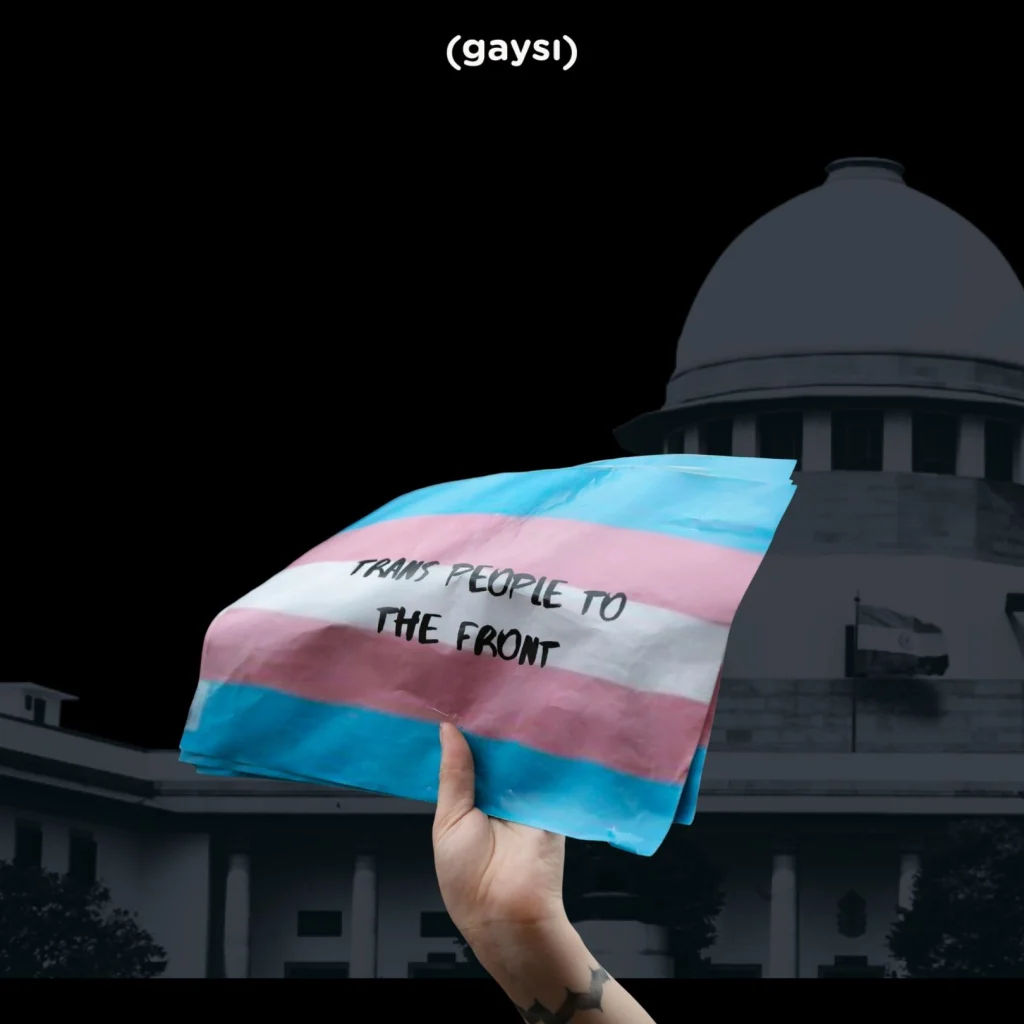
A trans person’s body is a precise meeting point of two impending crises.
Earlier this year, the Transgender Persons (Protection of Rights) Amendment Bill was hastily passed by both houses of Parliament despite facing resistance from queer communities, activists, and opposition MPs. This Bill had very little interest, if any, to protect its transgender citizenry. Instead, it strips people of the right to self-identify gender, in an attempt to erase trans men, non-binary, genderfluid people and, in some instances, trans women from society’s consciousness, legally.
It marks a major setback from the landmark ruling in NALSA v. Union of India (2014), in which the Supreme Court upheld the right to self-identification of gender without the prerequisite of undergoing medical procedures. A win decades in the making. Conversely, this Bill limits the status of being trans to a socio-cultural identity (hijra, kinnar, aravani, or jogta) or to intersex people. In doing so, the government wants to draw a line in the sand that separates a ‘real’ trans person from a ‘fake’ trans person by monopolising how people get to identify. Conveniently, they discard any and all identities they deem unfit or inconvenient for their pro-Hindutva agenda, creating a grey zone by design – a place of further hostility for marginalised communities.
Wherein the State has granted itself the unchecked authority to make decisions about its citizens’ identities and bodies. In return, the citizens will be presented with a certificate and identity card – verifying them as trans but only if they fall in line and present their gender according to the government’s guidelines or risk being abandoned. This can mean losing out on a place to live, risking protections at work and being pushed out of social security benefits and welfare schemes. A little undemocratic, perhaps.
In the midst of all of this, there has been another danger looming on the periphery, one without a face, religion or gender for the ruling party to discriminate. It has been quietly creeping into our lives slowly and steadily at first, then all at once. And now, it is virtually impossible to ignore.
Our world is burning. Literally.
As temperatures across the country have continued to rise over the past few years, heatwaves are becoming more common and more intense, in both duration and frequency. This is no longer a matter of a very hot day, week or month but a much bigger systemic challenge at hand – an ongoing state of oppressive heat inflicting harm so violent that it can be deadly.
For trans people, the threat compounds. An ordinary day in public, in sweltering heat, a trans person finds themselves in a quandary unfamiliar to their cisgender peers. To wager or not to wager – whether to drink water to quench their thirst and risk having to use gendered toilets or to endure quietly and risk heatstroke, or possibly something worse. They find themselves cornered into situations where they are weighing their options incessantly, cautiously reading the room, and running permutations and combinations of possibilities, whether basic human functions are worth risking their lives.
This same person is expected to carry mismatched ID to a bureaucratic appointment, sweating through the heat and the exhaustion of being misgendered at every counter. They find themselves stuck in a time-loop of old-fashioned administrative protocols at the behest of legal institutions and changing policies; facing humiliation and dejection just for an opportunity to be accepted as who they choose to present themselves.
The Transgender Persons Amendment Bill and a heatwave are not dissimilar. Both tyrannies are inflicted from outside, experienced from within; neither is an inevitable outcome. They have been perpetuated by the same institution – one written in Parliament, and one accumulating over years because of policy failures of the same system, and they both land with remarkably brute force on its citizens. When all is said and done, these two issues converge into one lived day, one body and one tragedy; which leaves trans people to bear the brunt of dealing with the social, legal and moral failings of our society.
Despite the odds stacked against them, India’s trans activists remain tenacious, and they refuse to go down without a fight. They are outside. They are showing up – protesting, building communities and organising from small bylanes to big grounds. They are at the Koovagam festival, rejoicing in their transness as the world insists there is nothing to celebrate – making themselves heard, seen and understood. Showing the world how liberation is inseparable from solidarity. Ultimately, their resilience maps out exactly what our policies have time and again failed to deliver.
References
https://prsindia.org/billtrack/the-transgender-persons-protection-of-rights-amendment-bill-2026
https://indiankanoon.org/doc/193543132/
https://internal.imd.gov.in/press_release/20250115_pr_3554.pdf
https://atmos.earth/political-landscapes/trans-joy-persists-amid-indias-growing-climate-crisis/
