



As I write this article, the world is engulfed in many wars. Despite the ceasefire between Israel and Palestine, the war still rages with new casualties each day. The Ukraine and Russia war has still not found any solution to peace. In South Asia, Manipur’s ethnic conflict continues, lingering a deep trauma upon its citizens. Myanmar remains in the turmoil of power struggles, while Bangladesh faces economic and political uncertainties. India and Pakistan are running their relationship on a knife-edge, despite diplomatic visits. Meanwhile, Trump’s return to power in 2025 has ignited mixed feelings as his new policies could impact nations worldwide.
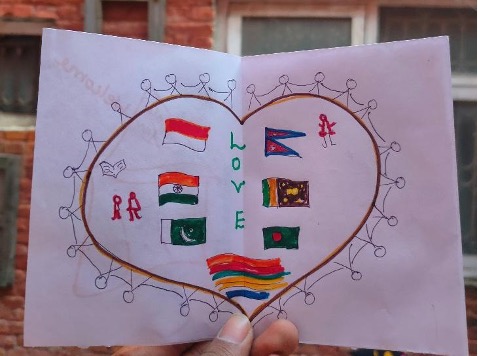
Amidst this chaos, a rare moment of South Asian solidarity unfolded in Nepal. I was honoured to be part of the inaugural “The Queer Unschool South Asia” (Nov-Dec 2024), organised as part of Aziz Sohail’s Curatorial Practice PhD at Monash University, tentatively titled ‘We Cannot Cross Until We Carry Each Other: Queer Curating as Making Kin in South Asia (s) and its Diasporas’. Eight Practitioners from South Asia – Bangladesh (one), India (three), Nepal (two), Pakistan (one), and Sri Lanka (one) gathered at Kaalo.101 (EkSeyEk) which is a femme-/queer-run creative space, for a month in a spirit of conviviality, knowledge-sharing, and re-thinking regional imaginations of our nation-states.
The Queer Unschool South Asia
The Queer Unschool South Asia was a one-month-long experiment of utopian living, abolishing patriarchal norms with queer love and care, where everyone was both teacher and student. The program was designed to focus on our South Asian queer histories and identities.
And for me, meeting my fellow South Asians was a surreal feeling. Despite all the nations’ historical conflicts, we created special bonds that allowed us to move beyond our past and look forward to future collaborations. In each workshop, we shared our histories, desires and vulnerabilities, and created a safe space for each other.
A Dalit participant from India found solace in the space, safe from caste oppression. As someone who grew up listening to Pakistani music and watching Indo-Pak cricket, meeting a Pakistani queer person was overwhelming as such cross-border gatherings are rare. Thanks to Kaalo’s hospitality, we found a home away from home.
Despite all the sweet memories, the journey wasn’t without struggles. Getting visa approval was the first hurdle—Indians had easier access, but others, especially my Pakistani friend, faced intense scrutiny for being a female and travelling solo. Navigating our mental well-being and maintaining personal boundaries were given utmost importance in the commune. Also, to work with limited resources was a big challenge to accomplish.
Despite the hurdles, we forged deep connections and cared for each other, making the experience truly transformative.
Rethinking Borders Through Queer Bonds and Art
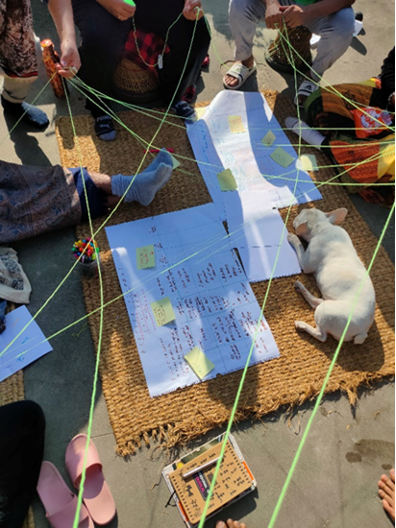
Even after the Queer Unschool ended in December 2024, our solidarity has persisted amidst the political instabilities in our nations through social media.
The program allowed us to imagine a borderless South Asia, where government restrictions are minimal. It also asserted that queer histories are not exclusive to the West—South Asia has its own queer struggles that get neglected by mainstream narratives.
Thus, Art became the tool to create a borderless South Asia. It can cut across space and time, envisaging a different world.
The Queer Unschool with Aziz’s vision of creating queer kins among the South Asian diaspora needed a strong medium that could hold the tormented souls of South Asia. Hence, art seemed to be the greatest medium. Most of us were not trained artists, so we redefined art’s motive. In Anshika’s workshop, we reconceptualised the format of books beyond their traditional settings. Likewise, in Sa’dia Rehman’s workshop, we navigated the Bagmati River by observing its bits and pieces through observational sketches. In Ujjwala and Dia’s workshop, we illustrated our utopian worlds. Thus, everyone brought their version of artistic expression beyond the formal artistic practices. Also, it made us reflect on our flaws and strengths and accordingly map out how we can maintain our boundaries and emotions.
The Future of South Asian Solidarity and Queerness
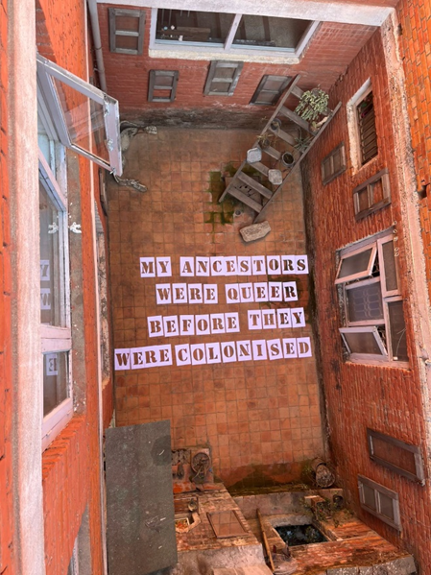
All eight participants arrived in Patan, Nepal, with the hope of finding a new home far away from our actual homes. It was our utopian idea that we would somehow be able to find a home in every nook and corner of the world and there would be a community to which we could belong. Hence, Kaalo became our new home, and the Queers from South Asia became the community. As adults, we all are running away and trying to find new opportunities, and most importantly, a space where we can express ourselves with a free mind. Such a space is rare, especially in the context of South Asian societies. But Nepal and Kaalo gave us that freedom to be who we truly are.
Thus, the future of South Asian solidarity has hope because of the resilience and persistence of the diaspora in uniting and collaborating with each other. So, Queerness seems to be a tiny ray of sunlight in our dark world that goes beyond the ideological limits. It’s a tool for all the marginalised and oppressed who want to rebuild this world with empathy and equality.
