


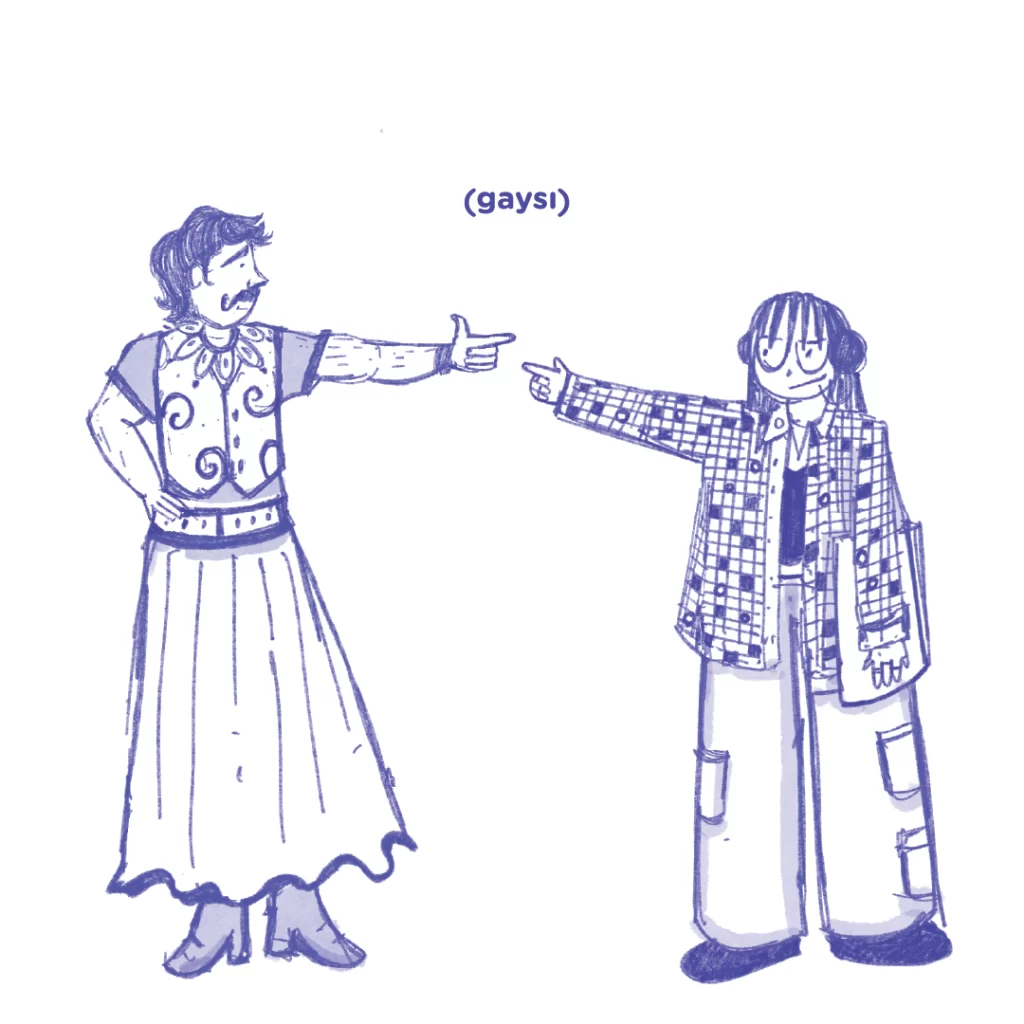
The clash of aesthetics and subcultures is back—and honestly, it’s time for your local queer fashion enthusiast to break it down. As someone who finally feels a sense of belonging within a metropolitan queer subculture, I find myself asking: What looks gay enough? And why does everyone suddenly serve cunty?
Does being part of a subculture mean I always have to look a certain way? In this piece, I’ll explore the nuances of queer aesthetics and the desi queer subculture through the lens of fashion.
Read more: Performance & Uncovering Identities Hidden Behind Clothes
Do I look gay enough?
As I began to understand what it meant to be openly queer, my early internet days shaped my perspective—watching Eugene Lee Yang evolve from the BuzzFeed office crush to someone fully embracing his queerness. I noticed a pattern: there’s always a visible transformation when someone realizes they’re queer. The idea that a queer person must look queer enough became ingrained, reinforcing the stereotype that queerness and an innate passion for fashion go hand in hand.
It felt like a rite of passage—actualizing your identity meant breaking free from the mold with a makeover, in true 2000s chick-flick fashion. Was there no other way? As a teen drawn to fashion, I found myself caught between two extremes: either Anne Hathaway’s glow-up in The Devil Wears Prada or Carrie Bradshaw’s eclectic chaos—or, on the other end, the tomboy/butch lesbian archetype. There was no in-between. So, I tucked away my fashion instincts and ventured into the sciences instead.
Read More: Unpacking The Harm Of Stereotypes In Lesbian And Queer Media
Queerness Is Fashionably In!
Even after realizing I was queer, my style didn’t change much. This was peak 2016, a time when fashion trends aligned with my existing aesthetic (still a huge fan of skater skirts, bomber jackets, and fishnet stockings). I didn’t overthink my style because most of my queer references were still predominantly Western—I had no real sense of what a desi queer aesthetic even looked like.
I leaned heavily on Western styles, from Dark Academia (glad that phase is over) to the ultra-polished K-pop idol look. These two aesthetics were worlds apart, but both were mainstream enough to let me pass as mildly straight. Through them, I learned how fashion could shape perception—how to dress for my body type, to strategically layer, conceal, and use accessories to make my otherwise basic style seem intentional.
This cycle of experimentation lasted until the pandemic. Once I was home, I distanced myself from these external pressures. In my room, my closet was shut—but I loved living in it. I realized it was the one place where I didn’t have to worry about looking straight or not looking gay enough. And long before dressing like a Gujju uncle became a legitimate desi queer aesthetic, I had an entire pandemic-era collection of it hidden away in my room!
Read: Short Shorts And Queering Masculinity
Am I Underdressed Or Is It Norm-core?
As much as I hate the idea of changing aesthetics with every trend, I have to admit—I love the rise of Normcore. It technically doesn’t even need to be an aesthetic, but slap a -core onto anything, and suddenly, it’s legit. And let’s be real, I do love the romanticization of everyday life.
What I find hilarious is that no matter what I wear these days, Pinterest will always have an oddly specific aesthetic label for it. If I throw on a printed shirt, I’m suddenly serving Hawaiian-holiday-dad realness, Gujju-uncle-meets-Jethalal core, or some iteration of a queer aesthetic. But the moment I wear Indian clothes? People who know I’m queer will immediately categorize it as Desi Dark Academia—for the artsy queer who secretly wishes they were a humanities student, minus the obligation to be political.
Read more: Catharsis, Divinity & The Breaking Of Genres: A Conversation With Aish Divine
Aesthetics And Convenient Identities
This Barbie can dress however she wants for the day, it’s the freedom of choice that capitalism guarantees.
See, I get it—I love having the freedom to dress up however I want. But let’s be real, it’s kinda fake. The Nod Mag covered this issue, pointing out how every so-called unique trend and personal choice is actually just something we’ve been spoon-fed. Fashion today is all about convenience—thanks to fast fashion, you can dress however you want because the system churns out cheap copies at an absurdly fast pace.
That’s why I think the biggest difference between subcultural fashion and aesthetic dressing comes down to how clothes are acquired and why. Aesthetic dressing is about looking like something, while subcultural fashion is about representing an idea. And that distinction changes everything.
Read More: Shopping Cart Filled With Queerness And Of Consumerism
The Queer Subculture?
What is the queer subculture? How does it take shape in urban spaces compared to rural ones? To be honest, as an urban queer person, I don’t think it’s my place to dissect what rural queer subcultures look like, so I’ll stick to what I can observe.
Among my fellow Gen Z queers, I’ve noticed that while we all have our ways of expressing identity, there’s still this unspoken pressure to look just queer enough—enough to set ourselves apart from the normies. It’s similar to how I always feel the urge to carry a piece of K-pop merch, just in case I spot another fan in the crowd and share a knowing smile. It’s about signaling belonging, even in unfamiliar spaces.
But lately, it feels like queerness is being reduced to just fashion choices. In the rush to look visibly queer, we’ve lost sight of why fashion has been so integral to the community in the first place. Historically, queer aesthetics have always been intertwined with other countercultures and movements—ones that have stood alongside us in the fight for visibility and freedom.
I don’t think queerness is a single, distinct subculture—maybe that’s where we limit ourselves. At its core, queerness is about freedom. It’s about the right to love who you love and to exist safely. It’s not just about wearing gender-free clothing and calling it a day.
Yes, the ability to dress however you want is a choice worth celebrating, but it’s not the end goal. And at the end of the day, it’s only human to want to carry symbols of your community—to find recognition, to seek connection, even in the overwhelming maze of capitalism.
