


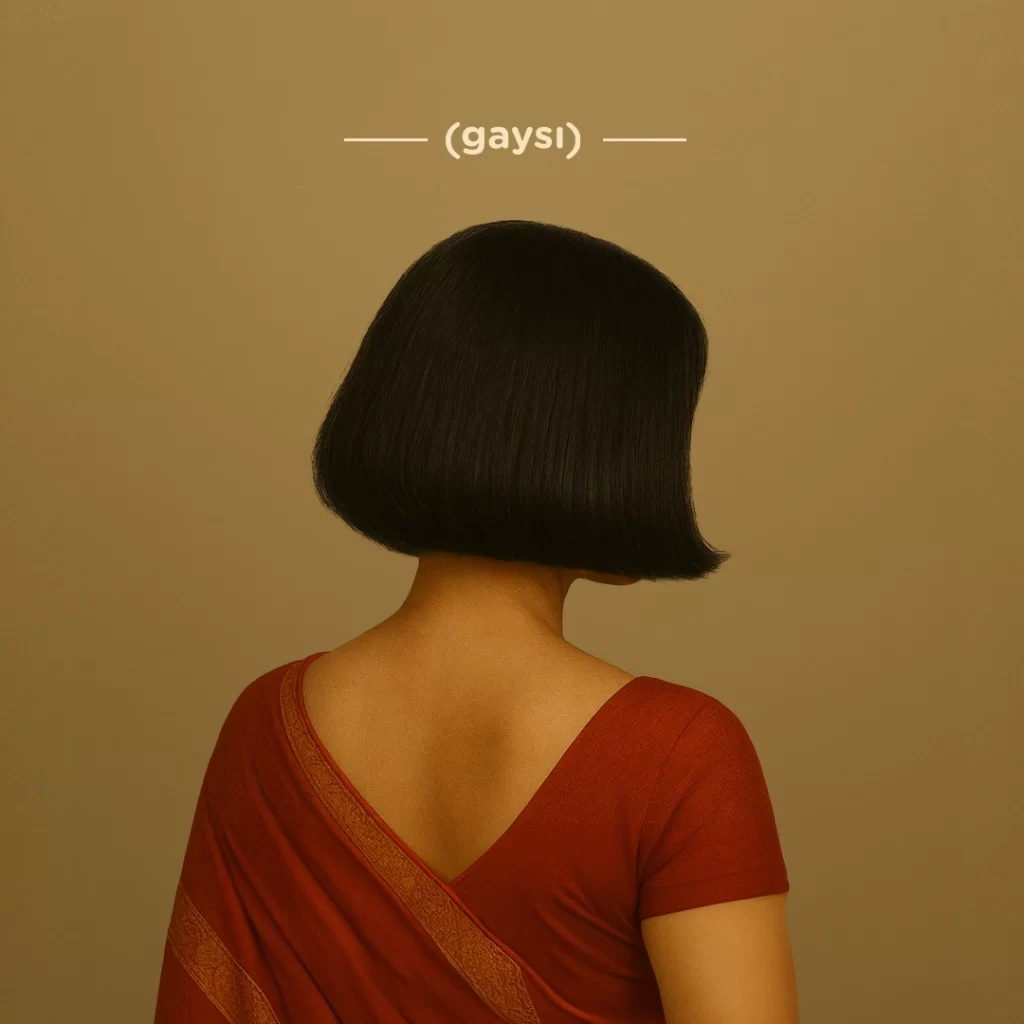
It was the evening of Diwali puja, and everyone in the house was buzzing with thrill to be in the Diwali puja pandal. Everyone was getting ready, putting on their flared, shiny dresses, ready to shine in the puja ceremony. But there I was, stuck in my own swirling thoughts. My mom was busy arranging her pleats while my sister was perfecting her low bun. Meanwhile, I stood in front of the mirror and asked myself: what should I wear? A saree like my mom and sister, or should I go with something more casual, like a salwar suit, or maybe a jeans and kurti combo? I was standing there and talking to myself in the mirror, thinking that whatever I chose to wear tonight, it should suit my skin and complement my new look. And then, like an annoying little echo in my head, I heard my mom’s and daadi’s voices again. “How could you cut your hair so short? How will you wear a saree without long hair?” It was like a taunt that had been troubling me since the moment I chopped off my long hair and embraced the boldness of a deep short bob cut. And suddenly, my mom’s words clicked in my mind—not as criticism, but as a reflection of the gendered conditioning of the wardrobe. Who says I can’t rock a saree with short hair? I didn’t need to fit into those traditional, outdated norms of beauty that try to shape and decide my gender identity and sexuality. I didn’t need to have long, flowing hair to wear a saree to fit into someone else’s idea of sexuality. So, I grabbed my mom’s saree and draped it in the most traditional way despite the bob cut.
When I walked into the pandal, the air seemed to change. The looks and whispers about my fashion protest—it was as if I had just broken some unspoken norm. But instead of feeling uncomfortable, I felt empowered. I stood tall, my confidence increasing with every passing gaze. My bob cut, my saree, and most importantly, my skin—it all felt perfectly in sync. I wasn’t just wearing a saree; I was owning it. Everyone stared, some with raised eyebrows, others with admiration. I was breaking the fashion norms, making my own rules, and I was doing it with pride. That evening, I didn’t just celebrate Diwali, I celebrated my sexuality too.
As far as I can recall, fashion has been more than just an outfit choice for me—it’s a form of expression, a mirror to my identity, and at times, a silent protest against the expectations society tries to bind me in. As a bisexual woman, I’ve always found that my wardrobe is more than just fabric stitched together—it is, in many ways, a political statement.
Growing up, I remember the unspoken pressure to present myself in a way that matched the ideal image of a woman. My friends used to wear classic feminine dresses, maintain their hair, and paint their nails in various shades. Meanwhile, I always used to feel a quiet discomfort. The idea of “feminine” fashion—high heels, long nails and hair, makeup—that never felt nice on my skin. All of it felt like a mask that I couldn’t maintain nicely. But as I grew older, I began to realize that my fashion choices were, in their own way, a declaration of my autonomy. I cut my hair short without being apologetic about it. I hardly wore makeup because it felt alien to me. I started to mix and match clothes, wore clothes that didn’t hug the body, and wore pairs that were unisex. I clipped my nails short and let my natural self shine through. Soon I realised that all these choices are not just fashion choices, but also a political aspect of my body and myself. And I made it clear to myself that I will not be confined to the boxes patriarchy tries to put me in.
Being bisexual added another layer to this journey. There’s an unspoken expectation for queer women to conform to certain standards—to fit into either a masculine or feminine role, whether in their relationships or how they present themselves. But I never wanted to be categorized. I never want to be told I had to be either fully one or the other. I wanted to explore a range of expressions that felt true to me, not just to some external standard. And in that exploration, fashion became the loudest expression of my refusal to conform.
In a world that constantly tries to categorize us, to box us in and label us, one of the most radical acts is to simply dress as we are, not as others think we should be. And when I stand in front of the mirror, putting together my outfit for the day, I remind myself that every choice I make is a reflection of my identity. It’s a reflection of my politics. It’s my silent protest. And in a world that demands conformity, that is the loudest declaration I can make.