


The fact that police officers’ moods can affect it makes me ask once again the same question about home
What is the value of safety in such a situation?
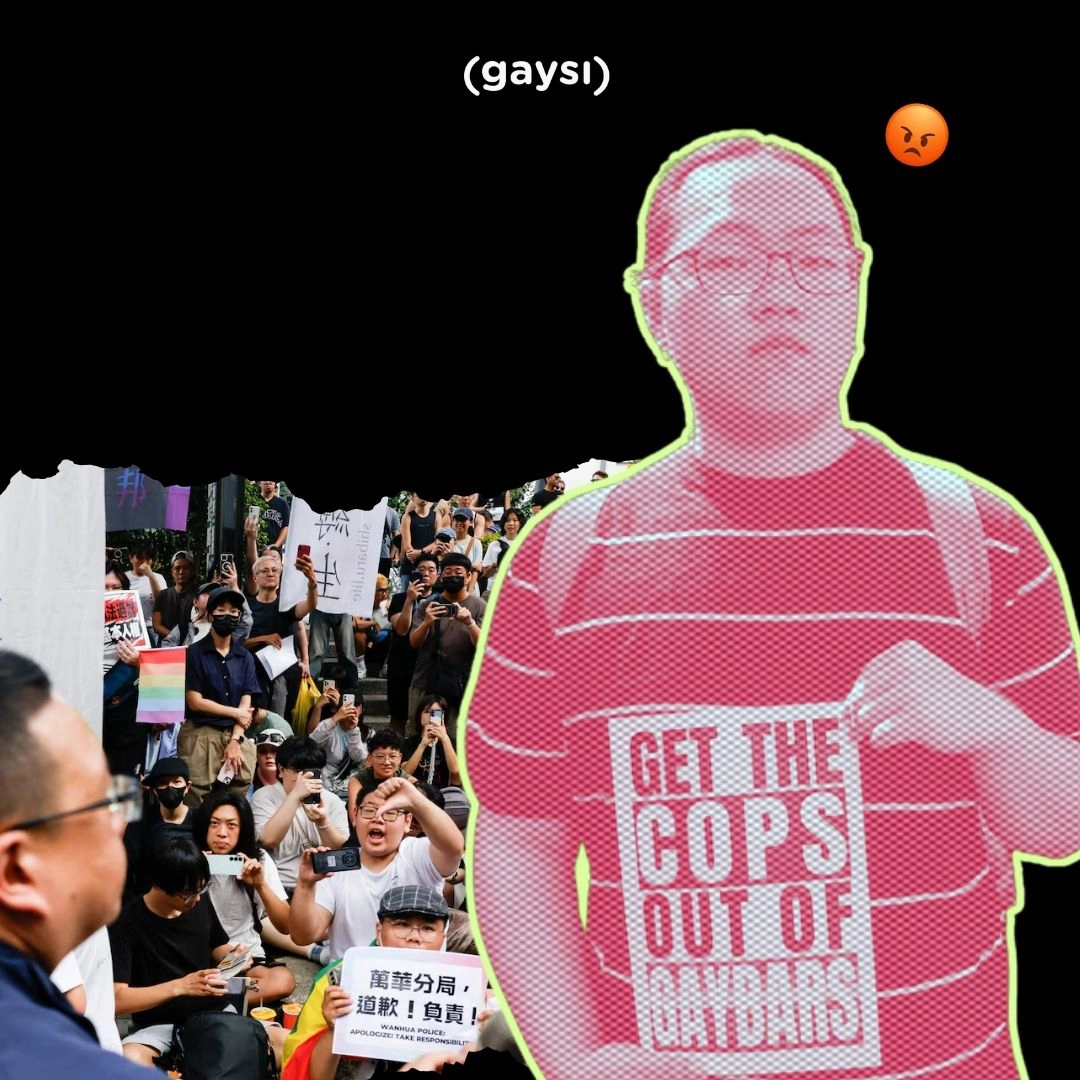
On the 3rd of October 2026 the music ceased at Commander D, a gay club with a long history of featuring BDSM themes located in the Ximending district of Taipei. Over thirty uniformed and plainclothes officers entered and, as the media reported, by the end of the operation the police had taken 51 patrons for questioning and arrested the owner.
The authorities stated that the raid came about as a result of complaints concerning possible breaches of public decency and had been carried out on the basis of a search warrant approved by the court. According to the police, 13 complaints had been received regarding the venue from January up to October 3. Both customers and advocates raised questions as to the extent of the operation and the way in which the people inside were treated.
I am not sending this from Taipei, but I have read this account just as many South Asian queer people do when reading news about places that are seen as examples: with admiration and with a subtle question as to what takes place after the rainbow flags have come down.
Rights on paper, fear in practice
Taiwan was the first place in Asia to legalise same-sex marriage in 2019 and the Pride parade in Taipei attracts large numbers of people. That is no small achievement. However, legal recognition and personal safety are two different matters.
India is fully aware of this gap. When the Supreme Court interpreted Section 377 more leniently in 2018, many of us were moved to tears. However, decriminalisation did not stop family pressure, discrimination in the workplace, or the inconsistent way the police dealt with the issue. In 2023, the Court refused to grant marriage equality and thus left the matter to Parliament. And even before 2018, the 2001 arrests in Lucknow of men charged under Section 377 including those outreach workers involved in HIV prevention demonstrated how a law could turn community work into a cover for suspicion.
The point is not that Taiwan and India are identical since they aren’t. Rather, it is that the strength of rights depends on the everyday interactions people have with the state.
When enforcement becomes humiliation
Videos and eyewitness accounts of the Commander D raid were widely circulated, among them being a clip of an officer making an inappropriate comment to a customer who uses a wheelchair. Other accusations dealt with the rules about the use of mobile phones and the situations in which people were taken to the station.
On October 4, approximately 100 people took part in a protest. Taipei Mayor Chiang Wan-an initially defended the search before issuing an apology and stating that the city was committed to equality, and the police then declared that disciplinary measures would be taken against the officers for making inappropriate comments and for failures in supervision.
The importance of those steps cannot be overstated since they are something that most communities never get. Yet punishing individual officers does not deal with the underlying structural issues. Was the legal basis for each detention clear? Were the patrons treated as individuals with their rights intact or were they treated as a group to be managed? What kind of safeguards should there be when the police enter a venue associated with a stigmatised subculture?
The way you are spoken to, the searches you undergo, and the way you are made to feel regarding your body all have an impact on policing. For those who have spent many years coping with stigma, this experience can continue to resonate long after the inquiry has concluded.
The politics of the “respectable” queer
Support for queer rights is greatest when queerness appears familiar for example, when couples want to get married, when families are asking for recognition, or when there is a cheerful parade. It becomes more difficult when queer life includes BDSM, cruising, nudity or other consensual adult sexual cultures.
In South Asia we have a similar situation: the ‘good gay’ is the one who is a professional, discreet and monogamous person and who asks for marriage and no more than that; all the rest, including sex workers, the hijra and trans communities, those who enjoy kinky relationships and people who cruise in the parks, are expected to remain invisible and take on the associated risks.
Acceptance based on respectability is merely conditional acceptance; two people one who wants a conventional marriage and the other who is exploring BDSM need not have the same lifestyle in order to be entitled to equal protection.
Now, it should be pointed out that a specialised venue doesn’t legally include everyone within it. If the police have reliable evidence of illegal behaviour, then they are entitled to carry out an investigation. The key idea here is that scrutiny should be based on evidence and on proper procedure, not on assumptions regarding what a community is like. Once that boundary becomes unclear, people start to question whether their privacy is safe and whether it is worthwhile exposing themselves when asking the state for help. That kind of doubt amounts to a form of exclusion.
Memory shapes reaction
The martial law in Taiwan did not cease until 1987, and some members of the community have drawn an analogy between the raid and previous instances of harassment. However, this analogy should not be taken as evidence that Taiwan is retreating towards authoritarianism. Instead, the legal grounds for the action and the official response have to be evaluated on the basis of the evidence.
Yet memory accounts for the strength of the reaction; those who remember the cost of the shift from repression to recognition will see any sign of collective suspicion as something that goes beyond an isolated incident. The South Asian queer communities, possessing our own legal legacy from the colonial period, have a clear understanding of this instinct.
Pride cannot be the only measure
A city’s dedication to LGBTQ+ equality cannot be judged by the scale of its parade or by its international reputation; it must also be assessed in less obvious areas such as clubs, community spaces and private networks where people explore identities that may not be accepted elsewhere.
The fact that safety exists does not mean that one is exempt from the law; it means that the law is applied in a fair way, that investigations remain accountable, and that the dignity of anyone who is suspected is never something that can be overlooked.
True accountability would involve more than just making apologies; it would require a transparent examination of the operation, the introduction of clear safeguards regarding searches and detentions, and a direct response to a difficult question: would a similar venue serving a different community have come under enforcement of the same magnitude and in the same manner? That question needs evidence, not an assumption in either direction.
What a safe haven owes its people
Taiwan’s achievements should not be undone because of a single event, and its reputation for progress should not mean that its institutions are beyond criticism. The way the community has responded, from the protests to calling for answers, shows that queer people are not passive recipients of recognition; we are constantly making equality a reality.
To us who are watching from outside, the raid serves as a useful reminder not to regard legal achievements as the end of the journey. Safety means having the ability to gather without being seen as dangerous, to explore consensual adult sexuality without being confined to a stereotype, and to interact with public institutions without our dignity being turned into collateral damage.
A place being called a safe haven is not determined by how friendly it appears to the world; it is determined by the way it treats the people who are most easily excluded from that promise.
