


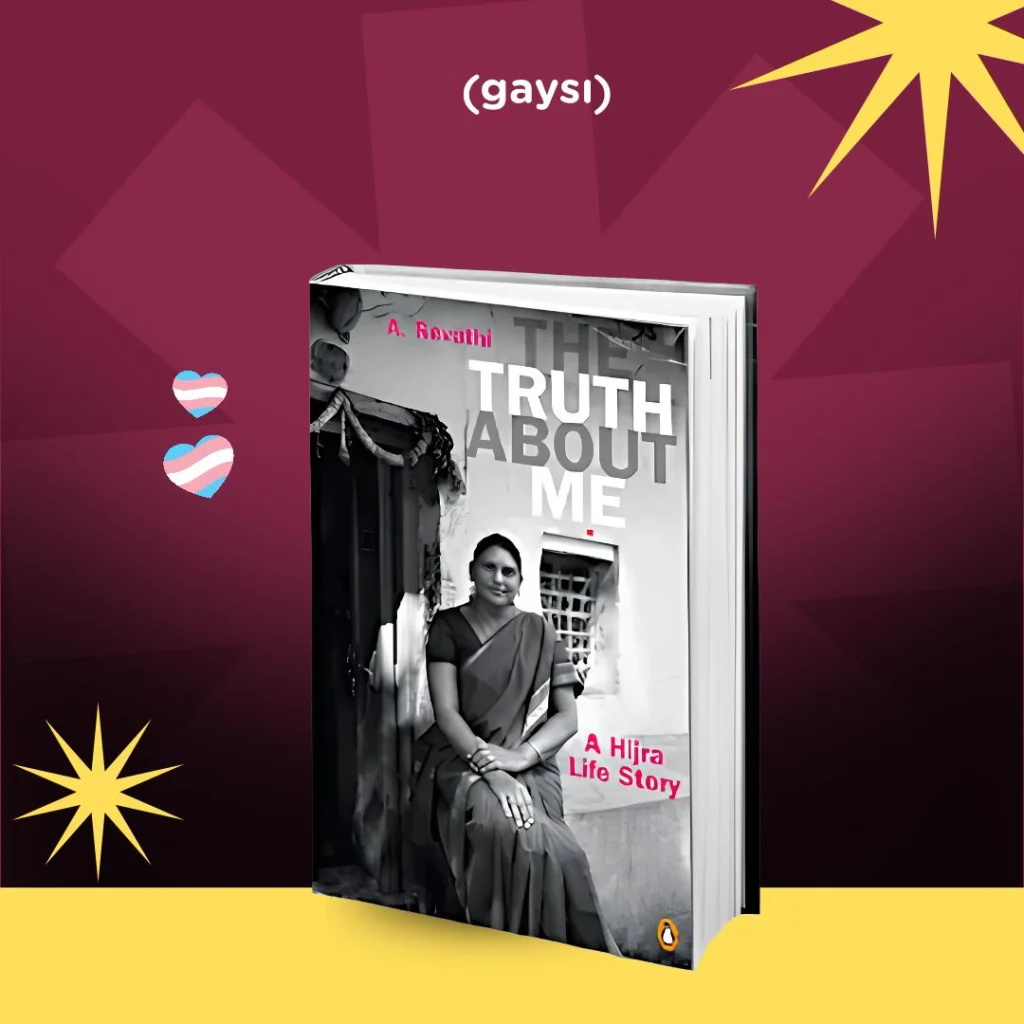
A. Revathi’s The Truth About Me: A Hijra Life Story (Penguin, 2010; translated from Tamil by V. Geetha) remains one of the most important first-person accounts of hijra life written in India. It is not a story of becoming exceptional. It is a story of wanting the ordinary and discovering how systematically that ordinary is withheld.
Born Doraisamy in a village near Namakkal in Salem district, Tamil Nadu, Revathi grew up marked as a “girl-boy.” The book opens with the small, daily violences of that marking: beatings from brothers, ridicule at school, the family’s attempt to force a masculine life of lorry work and marriage. What Revathi wanted was not spectacle. She wanted to wear a sari without being punished, to move through the world without constant correction. When she finally left home as a teenager and joined a hijra household in Delhi, the relief of recognition was real but so was the discovery that the community itself offered limited routes to survival: ritual performance (badai), begging, and sex work.
What gives the memoir its strength is the way it clearly shows the discrepancy between cultural visibility and material dignity. Although hijras have long held a paradoxical position in the Indian public imagination, welcomed at births and marriages, seen either as figures of ritual power or as a comic threat, they are denied the basic circumstances needed to lead a decent life. Revathi documents the real-world effects of this contradiction: experiences of harassment by the police, violence at the hands of clients, the ever-present danger of being assaulted, and the difficulty of finding housing or employment beyond the limited roles that the community is expected to take on. She is open about the hierarchies and exploitation that exist within the hijra system itself. While kinship can offer protection, it can also impose restrictions. The desire for a romantic relationship, for secure work, and for having one’s own room constantly comes up against the structures which keep hijras on the margins economically and socially.
What gives the book its value over mere testimony is Revathi’s emphasis on the ordinary. She does not wish to be regarded as sacred or tragic. Instead, she simply asks for the same basic conditions most people take for granted: security in public life, the possibility of earning without continuous humiliation, and the opportunity to build relationships without being reduced to a body that can be bought or turned into a spectacle. When she later secures a position at Sangama, the organisation based in Bangalore, and begins to get involved in activism, the change is not portrayed as a miraculous leap into respectability. Rather, it is shown as the gradual and difficult achievement of access to a different range of opportunities, opportunities which should never have been something special.
The book thus makes a political claim which is structural not just a personal one. It is possible for society to see a marginalised group as culturally legible, indeed it may even idealise it or give it ritual status, while at the same time systematically refusing its members economic independence, bodily safety, and ordinary social membership. According to Revathi, dignity is not simply an abstract acknowledgement of identity; it is achieved (or denied) through work, housing, family ties, access to medical care, and the various everyday institutions that determine who is allowed to live without having to constantly negotiate their survival.
The Truth About Me was the first autobiography of its kind in English from a member of the hijra community. More than fifteen years later it still reads as urgent. Legal recognition has advanced in limited ways; public conversation about gender has expanded. Yet the gap Revathi describes between being seen and being allowed to live remains stubbornly intact for many. The book’s lasting force is its refusal to accept that gap as natural. It insists that the right to an ordinary life is not a secondary demand after identity is acknowledged. It is the substance of dignity itself.
