[Disclaimer: The review of the movie is purely based on my point of view and do not represent the sentiments of the transgender community as a whole. Every transgender person’s lived experiences and life struggles differ based on their backgrounds and the intersections of various identities, which potentially shapes their opinion to a large extent.
People often take personal opinions of individuals from the oppressed group as the representation of the entire community, and hence the disclaimer. Extrapolating personal opinion and imposing it on the larger trans community is totally wrong, and creates biases. This is my experience as a Savarna transgender woman watching Chandigarh Kare Aashiqui. And I am someone who always sees the glass half full.]
Trigger warning – Mention of Transphobia.
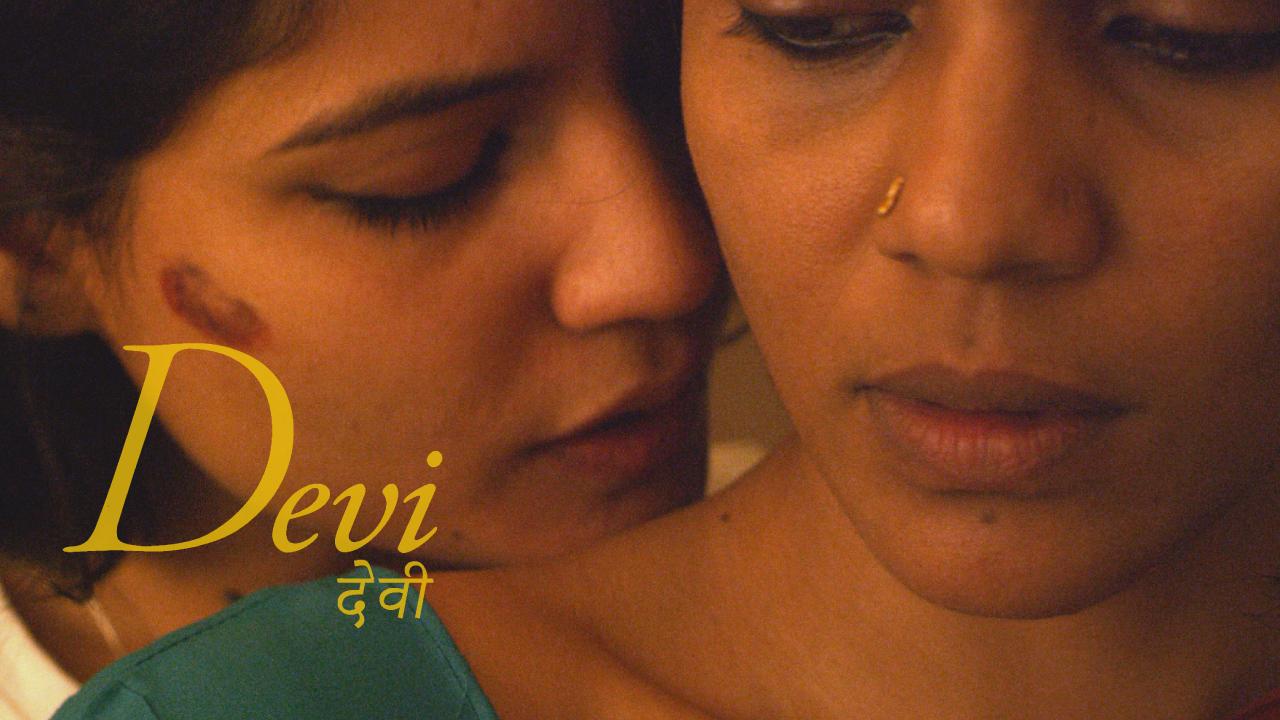
The movie was released last Friday and believe me, I had no intention of watching this film since Bollywood is best known for churning out transphobic content. Transgender persons have mostly been used as comic relief in the past. So, I was not ready for yet another transphobic Bollywood creation. It is the movies that were meant to raise awareness about the LGBT+ community that have done the most harm.
The Trailer:
When I first watched the trailer of Chandigarh Kare Aashiqui (CKA) it brought back horrible memories of another film released earlier this year, Pati Patni Aur Panga. It mirrored the same storyline: that of a cisgender man falling in love with a transgender woman. I refused to watch the film because the trailer itself was mighty triggering.
In one of the scenes, the transgender character played by Aada Sharma (a cis-woman) says “6 mahine pehle main ladka thi, sex change karke main ladki bani hoon.” This particular dialogue triggered the hell out of me.
Transgender women are (and have always been) women, born in a body that is socially misconstrued – why is it difficult to understand?
the same storyline, a cisgender male falling in love with a transgender woman. I refused to watch the film because the trailer itself was mighty triggering.
In one of the scenes, the transgender character played by Aada Sharma says “6 mahine pehle main ladka thi, sex change karke main ladki bani hoon.” This dialogue triggered the hell out of me. Transgender women are women, born in the wrong body, why is it difficult to understand?
Some tears and smile:
Last Sunday, while I was busy scrolling through Instagram, I saw a post by Gazal Dhaliwal, an out-n-proud transgender woman and Bollywood writer. Her balanced and positive review prompted me to book the tickets and dare to watch it.
I reached PVR Bandra in the evening with no hopes from the film, but packed with courage to guard my sanity against the transphobia I was expecting to witness in the film. But to my surprise, I cried a lot, many times, throughout the 2-hour long movie. Although it has its flaws, it made this transgender woman smile in the end.
Characters and the movie:
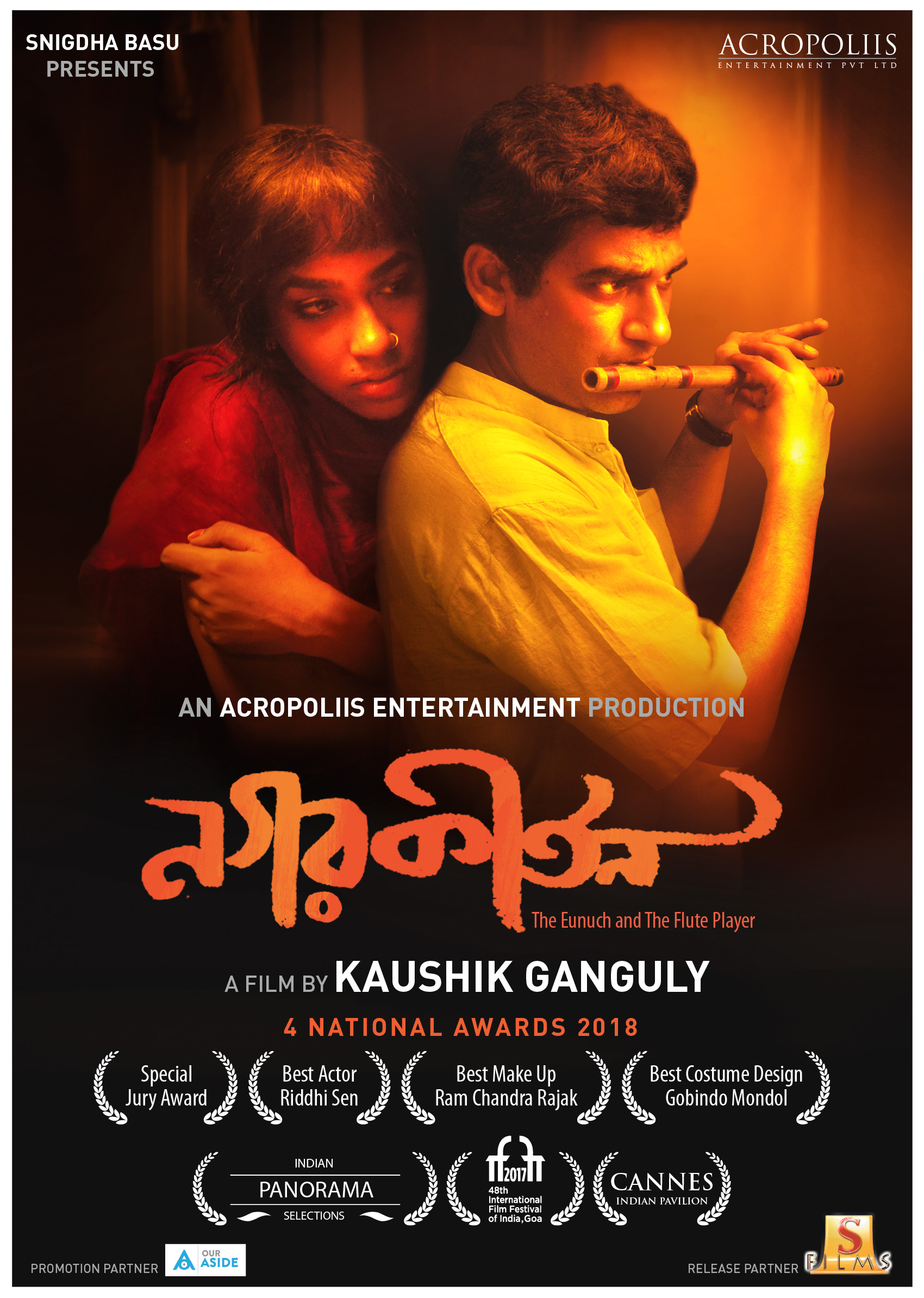
CKA is Manu Munjal’s and Manvi Brar’s love story. Ayushmaan Khurana plays Manu’s character, a fitness freak and gym owner from Chandigarh dreaming to be the G.O.A.T., a.k.a. “Gabru of All Time”, and is, of course, a transphobic person. Manvi is played by Vaani Kapoor, a young transgender woman struggling her way through life and fighting every battle with a smile on her face. This movie is about Manvi’s pain from gender dysphoria and the struggles faced by her for being a transwoman. But this story is equally about Manu and how he learns and unlearns to overcome his transphobia.
In a not-so-serious manner, the film tries to convey a very sensitive story on the silver screen. The film-makers are bold to have chosen a subject that is seldom discussed.
Regardless of its flaws, the movie is an honest effort to highlight the pain and sufferings of the transgender community and to start a conversation, which is unexpected from Bollywood. It does a decent job in creating awareness without making it look like a documentary. It maintains a good balance of lighthearted, humour, and thankfully not at the expense of hurting community’s sentiments. Overall, for me it was a great experience.
It is a conversation starter:
CKA has its flaws as expected from any Bollywood movie. As usual Manvi’s trans girl character is played by a cisgender woman Vaani Kapoor, which has often been a point of concern in global cinema, be it Bollywood or Hollywood. It is not that we don’t have talented trans actors and yet time and again the film-makers cast cisgender persons in a trans-person’s role. The trans community doesn’t need such representation, and moreover, a cisgender person can never feel the pain of a trans person or be able portray it authentically on the silver screen.
However, just like Gazal’s insta post said, I am also happy with the fact that transgender persons’ stories are being told on screen, and that too in a positive light. This is a good start considering Bollywood’s history of irresponsible representations.
Resonance with Vaani:
As for Vaani’s performance as Manvi, I never expected that she would be able to pull off this role, but she proved me wrong. I could see the resemblance of my pain on her face. The finer things, like the fear of the unknown, the silent fight against society, and attempts to smile despite being in so much pain… it was all there.
The film has many relatable scenes, for instance, in one scene she walks past a group of people and sees their reaction through a mirror, and then she smiles happily for she could pass through them as a woman.
Another scene shows her making a profile on a dating app and facing a dilemma about which gender to choose before opting for her true gender – “Woman”. Or when she gets asked out on a date, the excitement on her face mixed with the fear of rejection.
The constant looking in the mirror before meeting anyone to make sure she is ‘looking like a woman’, the woman who she really is. The pain when she is explaining to people that she was born a girl but in the wrong body and that it is not her fault.
Through all these and many other scenes, Vaani does live up to the role. For the first time on the Indian silver screen, I saw my pain reflected and it made me cry a lot, several times. Kudos to Vaani Kapoor for breathing life into Maanvi’s character. The best part of her performance, as a transgender girl, that it felt like I was on the screen and it never felt like someone else is narrating my pain on my behalf.
And now some flaws:
Other than a cisgender woman playing a transwoman’s role, another flaw in the movie is usage of transphobic slurs that has been rightly called out by many from the transgender community. But in my opinion showing Transphobia is necessary to portray its ill effects on transpersons and to convey the message that social and behavioral changes are both urgent and essential. Maanvi’s daily struggle also shows the transphobia of the society which most transgender persons face in their everyday life.
Manu’s unlearning and learning phase where he goes through all the reading, research and consultation to understand transgender persons is a crucial part of the film. Here, the filmmakers have beautifully explained the concept of gender being in the mind and not in the body. I felt the learning phase seemed rushed and more like a fast forward. But remember this a Bollywood masala film and not any documentary, but it would have been great had they given some more screen time to this “learning about the Transgender person” phase of Manu.
Overall a good experience:
My biggest fear about this movie was triggering dialogues like I said before: “Main ladka thi fir ladki bani”. Pleasantly, the movie never showed such transphobia or misinformation that is typical of Bollywood. Maanvi consistently says that “I was born a girl, just in the wrong body without any fault of mine” and this is an accurate way to describe a transgender woman.
Another thing which I could relate to was when Manvi’s father says to her “Why should you be ashamed, you should be proud of yourself.” These were the exact lines my sister told me when I came out to her. Manvi’s character is that of a strong, independent and unapologetic transgender woman who has the full support of her father. But in reality, majority of transgender persons never get such kind of support from their families, but yes there are exceptions, like me and the character in this film.
Society has always portrayed transgender women in a typical way and when they meet a transgender woman like Manvi, they just cannot accept them. They prefer and want us to be submissive, apologetic and say sorry to every being all the time. The world wants transgender persons to live at their mercy. Bollywood is no different, it has also portrayed transgender women in the same stereotypical roles. Manvi breaks all these stereotypes. Despite its flaws, I had a good experience and did enjoy the movie. I cried with Manvi and laughed with her too.
Message to my trans community members:
To all transgender persons like me, if you are going to watch this movie, be prepared for its flaws and portrayal of transphobia. Please do not expect this to be a trans-awareness documentary. It is not even a movie made to compete with world cinema, but just a light-hearted film with good intentions and sincere efforts.
Well, we do not teach quantum physics to a 6-year child, do we? To me, it is the kind of movie that my sister can show to my extended family to help them understand and learn about me. Indian society is gradually learning and a light-hearted humorous tone to narrate a stigmatised story is the best way to start a conversation, in my opinion.
Takeaways:
In my opinion, this film has definitely kickstarted conversations in Hindi-speaking households, the one our society is hiding from, and that my dear friends is the biggest takeaway we can ask for from this movie!
The film also spelt out two more messages loud and clear:
1. Gender is in the mind and not in the body.
2. If Manu Munjal can learn about gender and unlearn transphobia, well, then anyone can.
With this film, the film-makers have taken a genuine step and made an honest effort, and I appreciate that. Maybe next we will see transgender actors in central roles on the silver screen, hopefully soon. Like Anjali Ameer, remember? But, till then this is a start and the start is good, if you ask me.
Though I have not said much about Ayushmaan Khurana, everyone in the movie has done a commendable job, including Khurana, who is brilliant as a supporting character. Sorry (not sorry), but for me the movie is more about Manvi than anyone else. As a transgender woman, for the first time I saw a Bollywood movie that I could relate to, and so how can you expect me to talk about anything other than Manvi?
Kudos to the makers of Chandigarh Kare Aashiqui for an honest and hearty effort to bring the story of a transgender woman on the silver screen in a positive manner and, not to forget, with a happy ending. Life and struggles of every trans person is different and so is their opinion. Hoping Bollywood will make more such films with fewer mis-steps and cast transgender persons in transgender roles in the future.
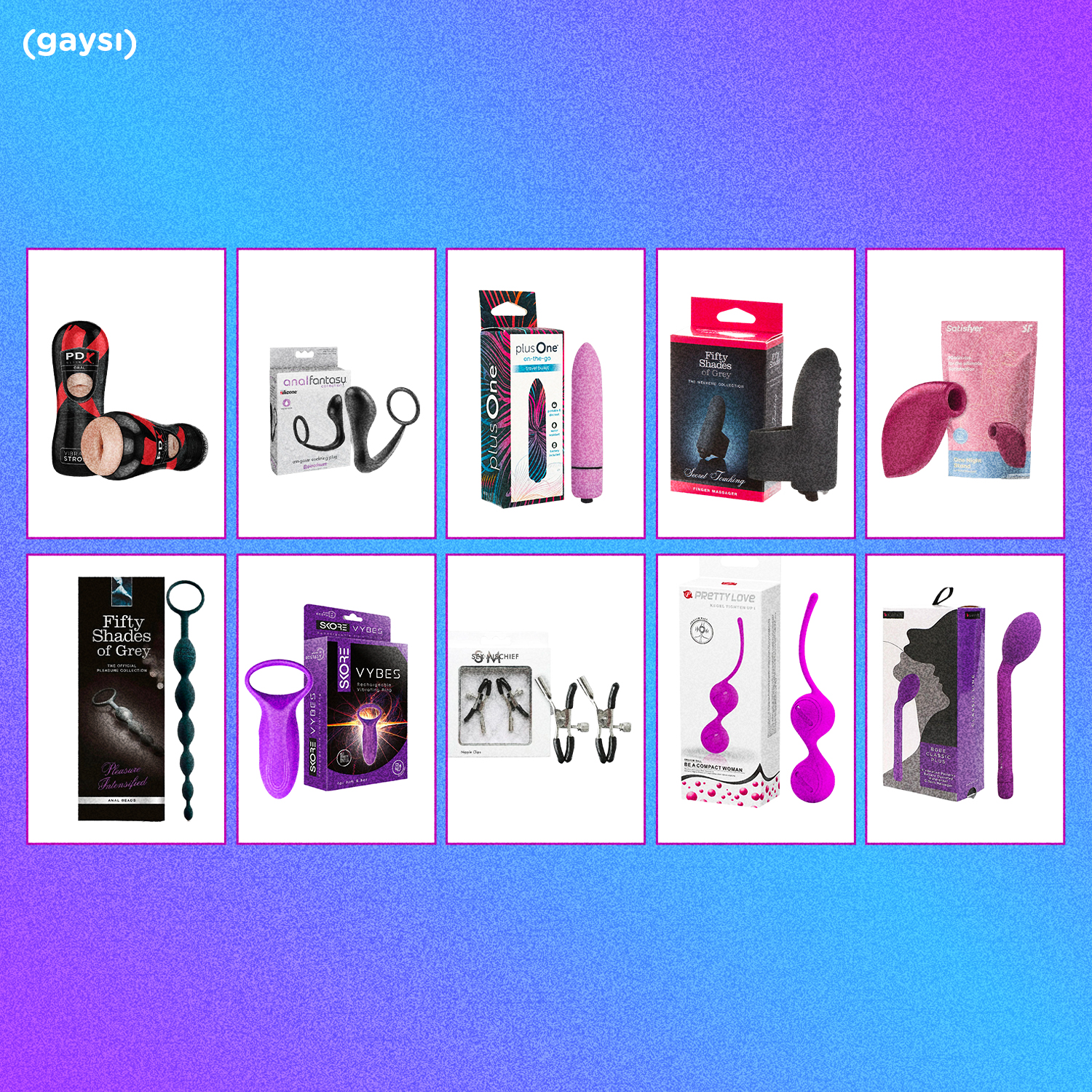
If you are still scratching your head about what to gift your partner [or your friends, or even yourself], then remember: toys are not just for children! Whether you are playing by yourself or with a partner, we guarantee you a sex toy that will make the rendezvous feel like nothing you have ever experienced before. And, if you are wondering, “What’s adult toys got to do with Holiday Season?”, we, your trusted sex toy connoisseur, are here to tell you that the perfect Holiday Season-themed experience is all about a little curation. Here are a few collections, that you can experiment with.
A) The Kinky Candy:
i) Whipped Desserts Flavoured Cream Lubricant:
Desserts are not the only thing that tastes better with whipped cream on. Top off the delicious food that is your partner with this velvety smooth, water-soluble lube and take your foreplay to the next level. The lubricant, apart from being sugar and paraben free, is water-based and latex-free, which means no mess, no fuss and only fun.
ii) Sex & Mischief Metal Handcuffs:
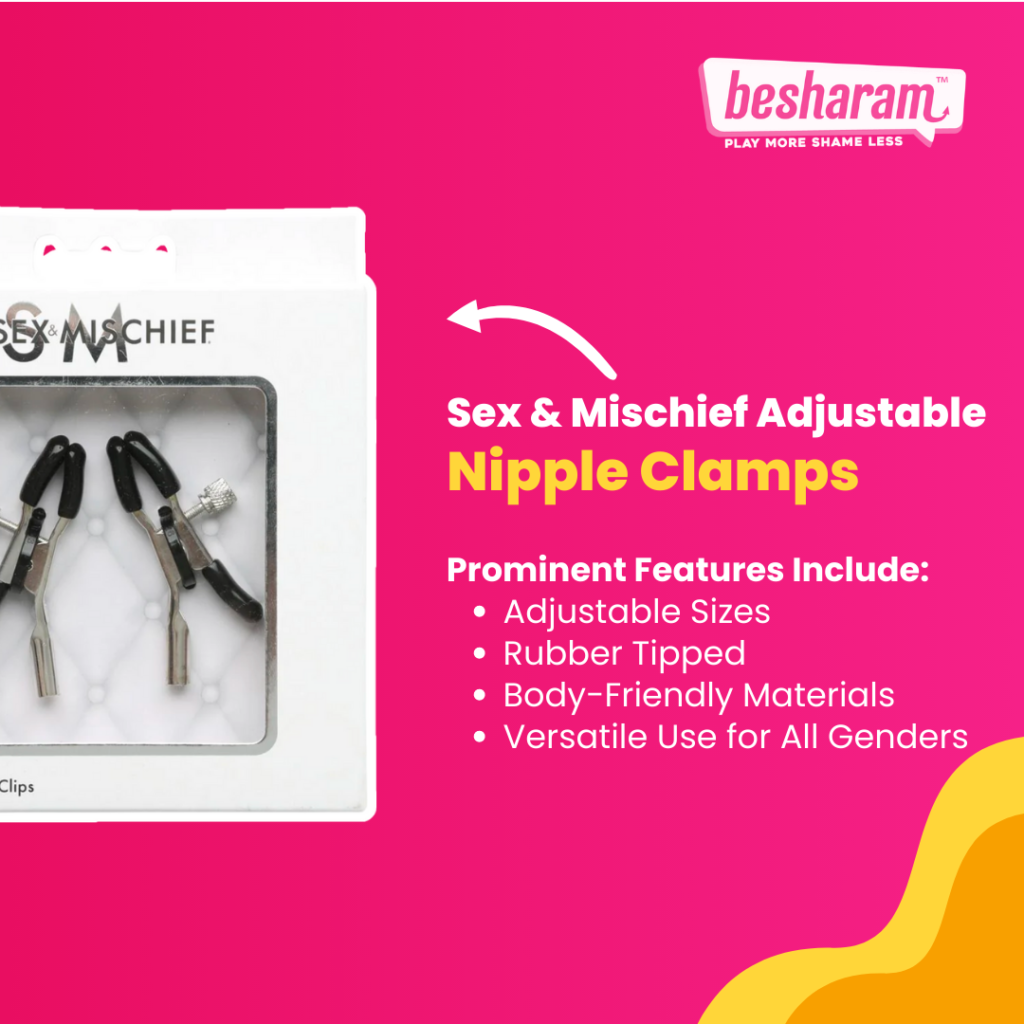
Embrace your kinky self, and add some handcuffs to the mix. Designed for novices and experts alike, these nickel-free metal handcuffs are adjustable despite the sturdy look, crafted for couples to truly experience the pleasures of bondage, dominance and submission.
iii) Rubber Cock Ring Set:
This set contains 5 cock rings in varied colors that will give you stronger erections and make you last longer. Pair it with the handcuffs for your partner and take them on a ride that lasts the night.. Don’t worry about size, because you can choose between 1.25″, 1.5″ or 2″ of dimensions.
B) The Sweet ‘n’ Spice:
i) Screaming O Soft Touch Bullet Vibrator:
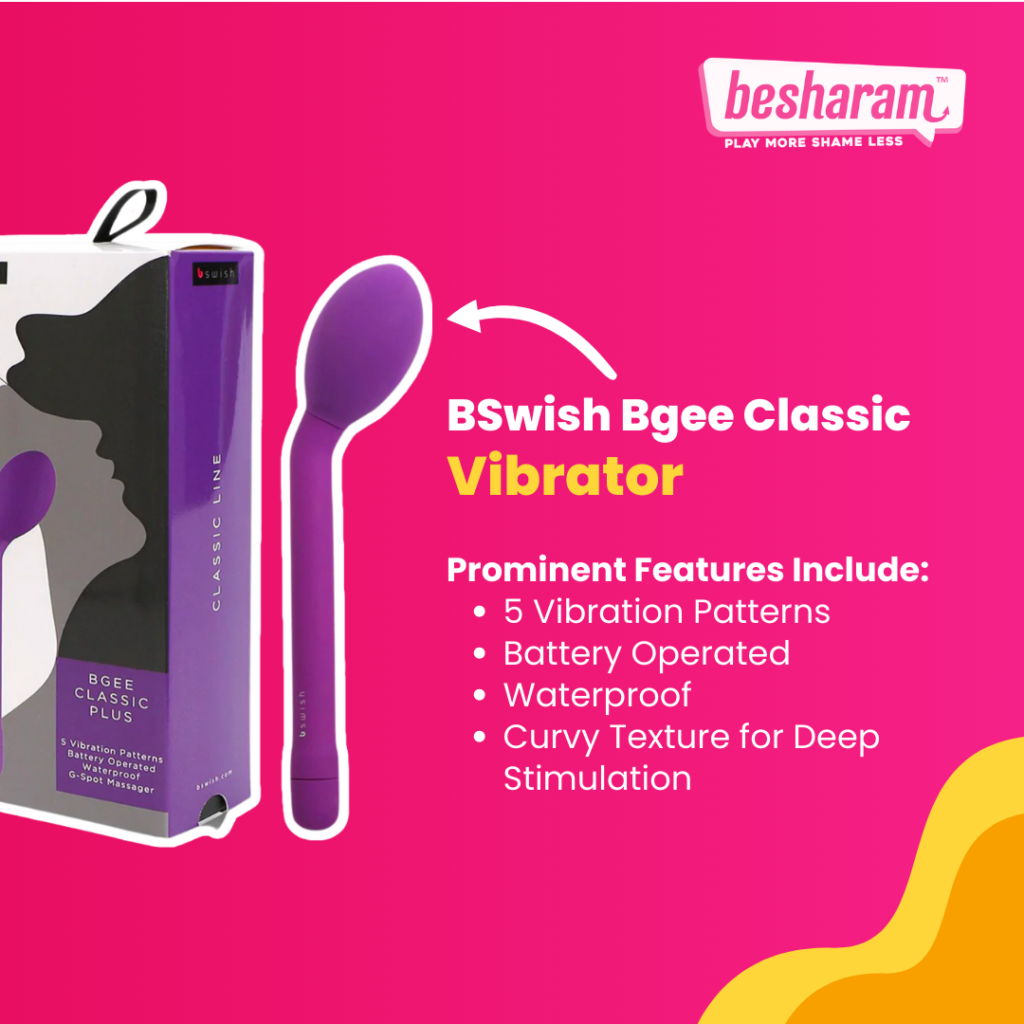
If you are looking for something that will get you writhing in pleasure without having to shell out thousands, then, look no further. With theScreaming O Soft-Touch Bullet Vibrator you can enjoy three different speeds as well as pulse setting. It’s mini size allows it to be the perfect travel companion, so you can enjoy the big O, wherever you go.
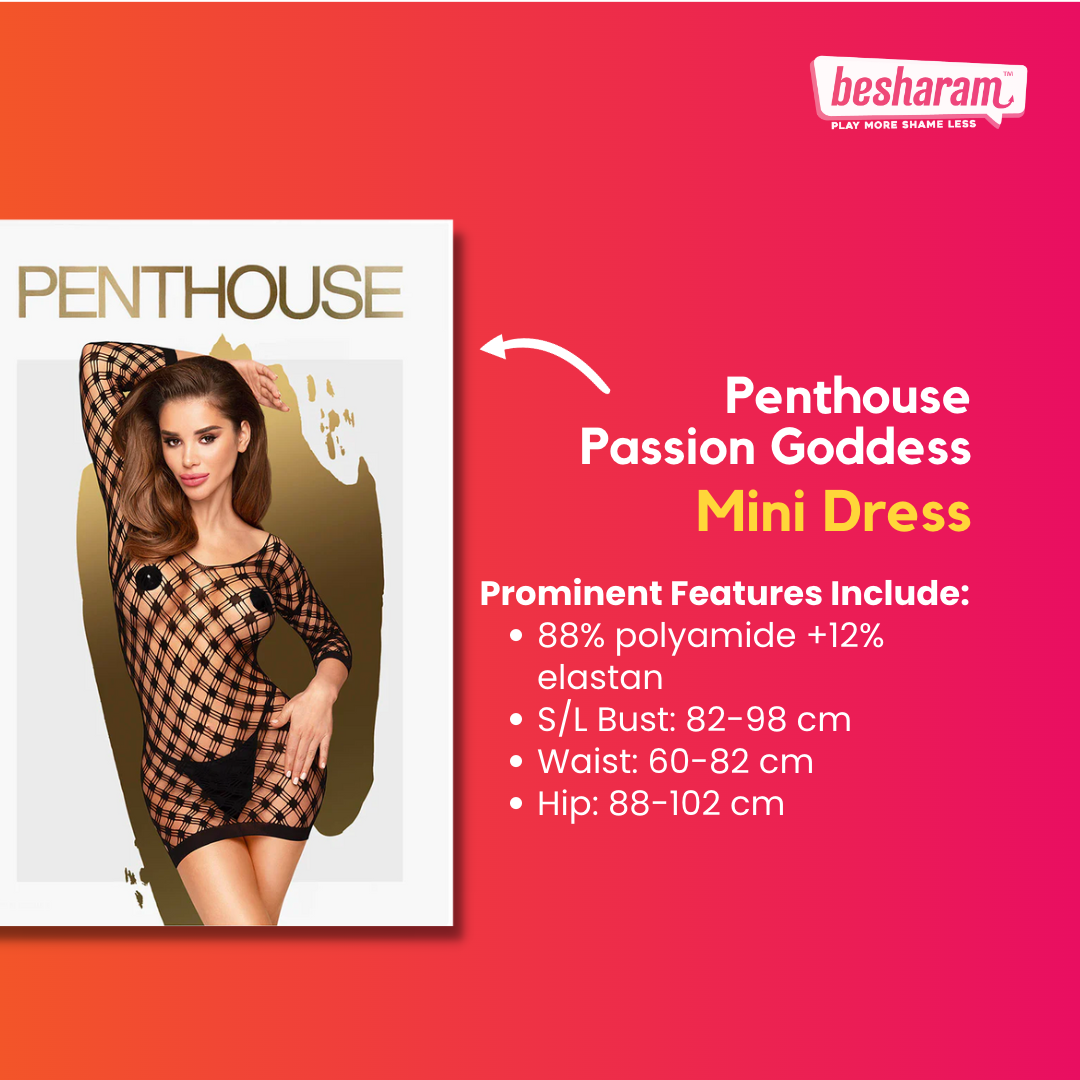
ii) Penthouse Passion Goddess Mini Dress:
This mini dress has been designed to leave you looking like a goddess, so that your partner will be left with no choice but to worship your body. This transparent dress with a checkered pattern is the only lingerie you need to get the juices flowing. Worrying about the fit? The lingerie is one size fits all with S/L Bust – 82-98 cm, Waist – 60-82 cm, Hip- 88-102 cm.
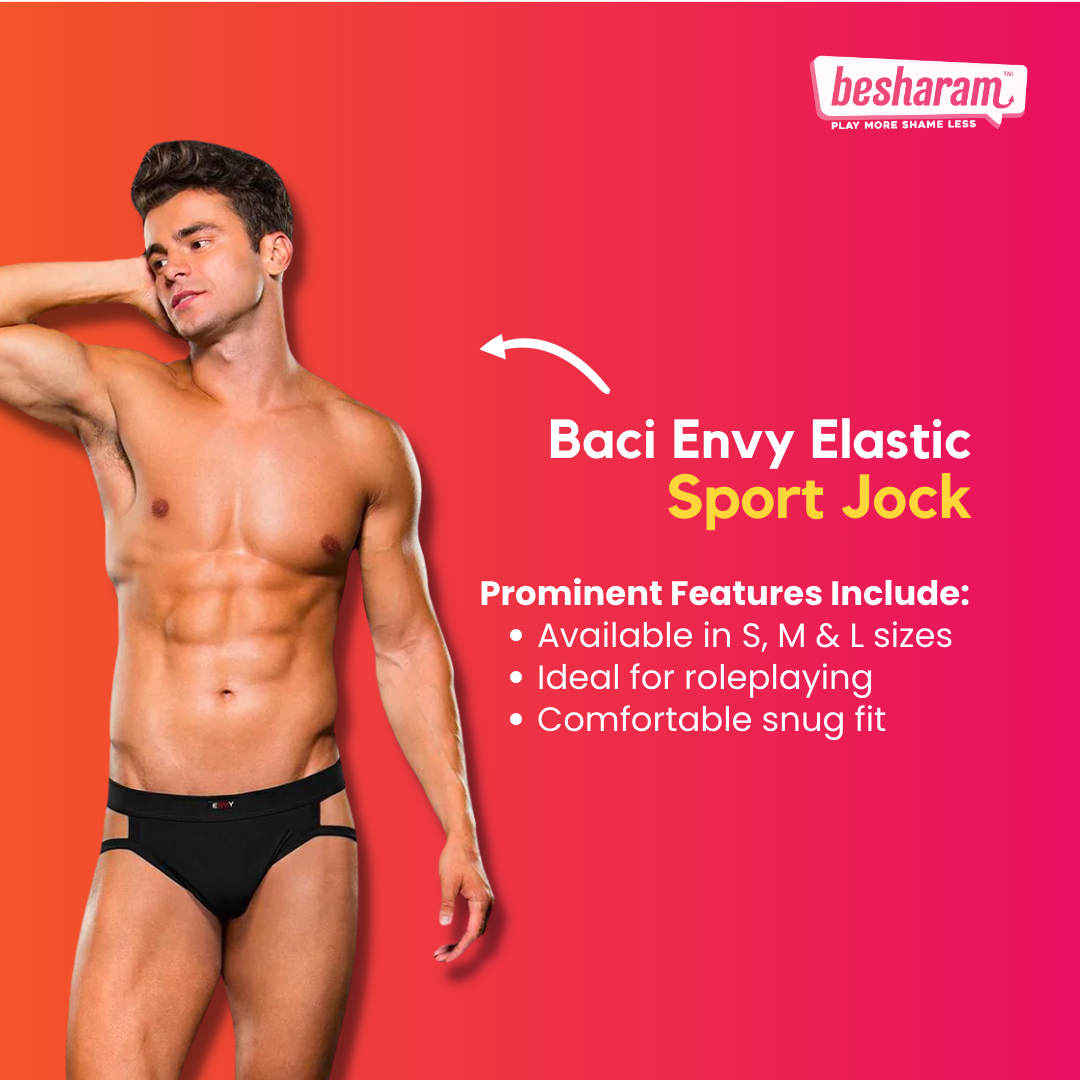
iii) Baci Envy Elastic Jock:
Flaunt that booty, and feel like your sexiest self in these jockstraps. The elastic sport jocks are made of breathable Polyester, and available in S/M, M/L, and L/XL size. Ditch the notion that they only belong on the football field, and enjoy the breathability that this sexy undergarment offers.
C) The Mistletoe Kiss:
i) Anal Fantasy Fun Beads:
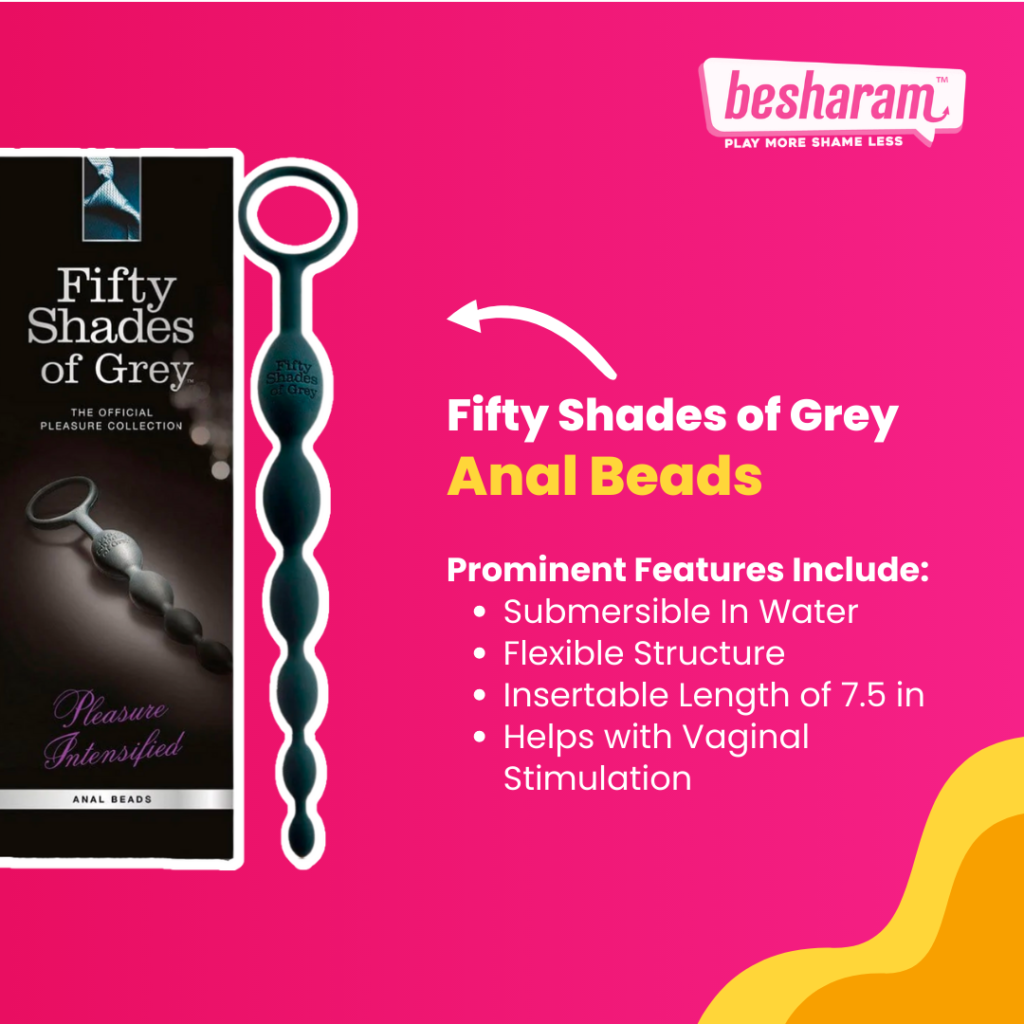
Perfect for beginners, the Anal Fantasy First Time Fun Beads, will allow you to explore the thrilling world of anal pleasure at your own pace. Pop in one bead in at a time and gently tug the handle to release each bead for better stimulation. Made of ultra-hygienic silicone, the shaft is flexible boasting a lemgth of 10.03 inches, to give you the advantage of teasing all the right spots.
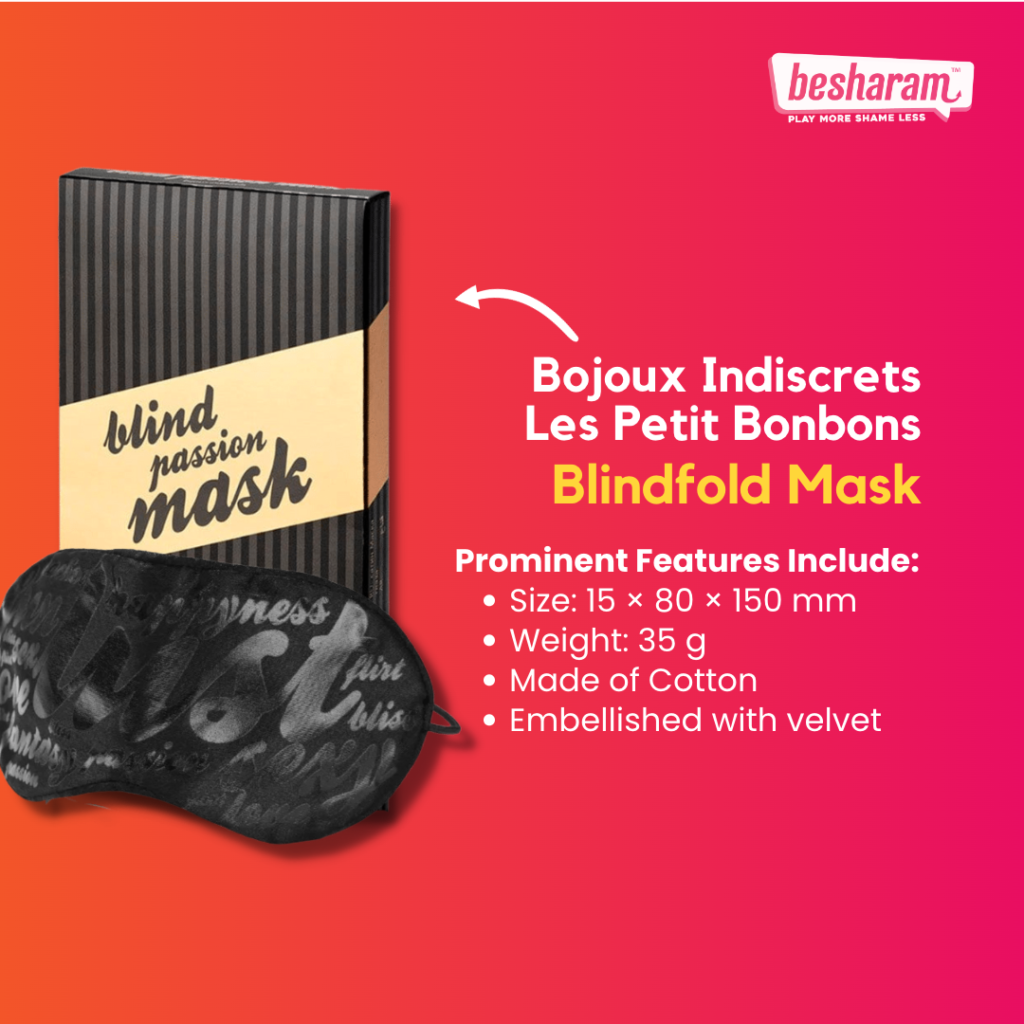
ii) Bijoux Indiscrets Les Petit Bonbons Blind Passion Mask:
There is nothing sexier than having a partner you trust. Use the Blind Passion Mask as an exercise in trust and let your lover take on the reigns. With your sight taken away, all your other senses will be heightened, allowing you to experience every touch with a new level of intensity.
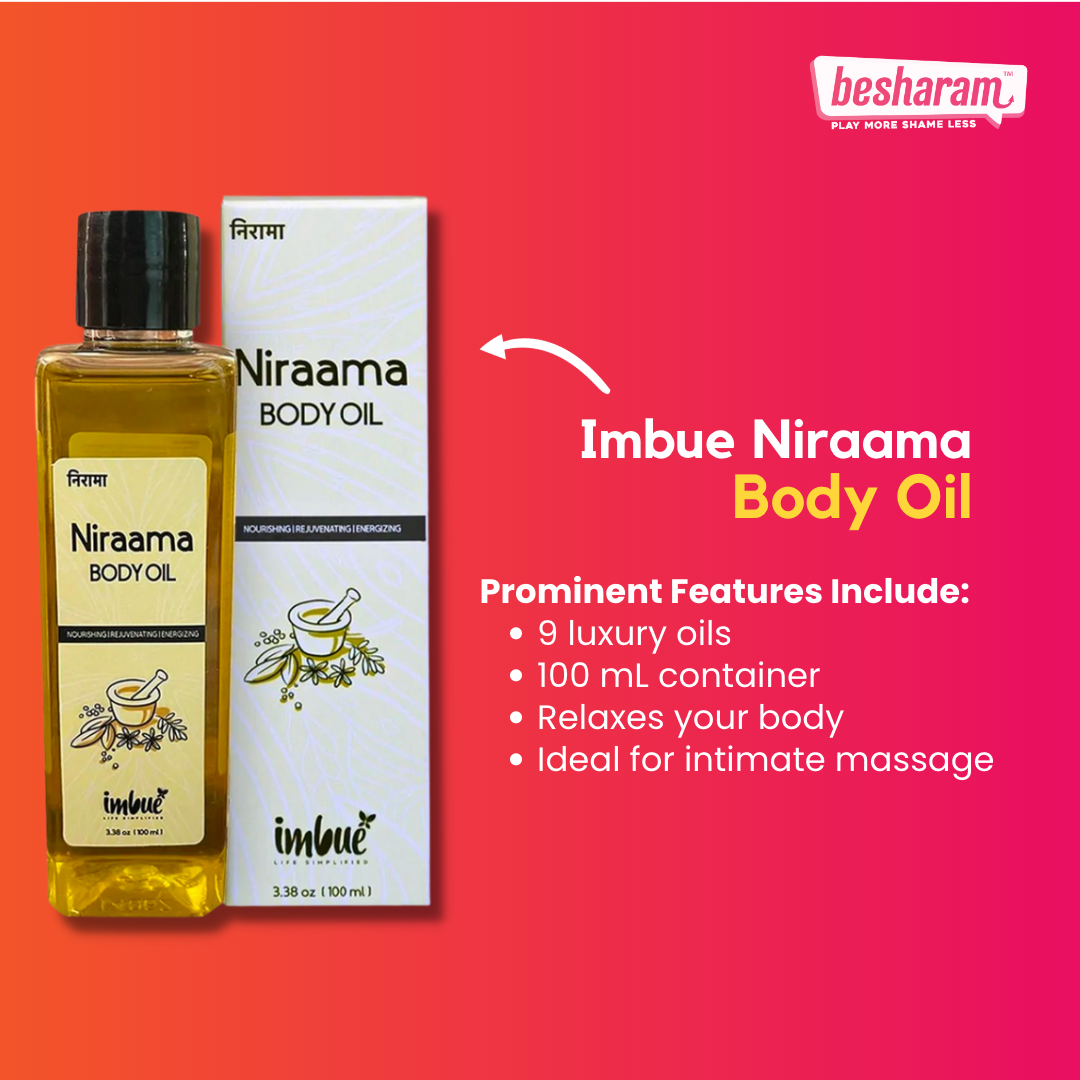
iii) Imbue Nirama Body Oil:
Offer your partner a sensual but calming massage to clear off all the tension that the past year has brought. Or, add the oil to a warm bath that you both can enjoy. Enriched with 9 luxury oils, the body oil will allow you to truly reap the benefits of the after-sex glow.
Disclaimer: Please note that these collection names do not exist on the website. They have been curated for the creative benefit of the listicle.
Just like the fairylights that go up on the Christmas tree get entangled in one another, so do the memories of family and Christmas over the years. There is something about the approaching countdown to the big day that makes one search for nostalgic warmth in those memories. For queer folx especially, it can be a time of revisiting the loss and pain that comes from not feeling seen or welcomed in the home you grew up in. Quite a few people from the community can also feel triggered this time of year by religious and/or childhood trauma. However, the definitions of ‘family’ are as abundant and unique as the literal snowflakes which feature in everyone’s imagination the moment there is any mention of Christmas. So many of us grow up loving the trope of ‘found family’ in literature and films, seeking to belong and have roots in a place where we’re finally understood. For those of us who have been lucky enough to foster healthy relationships and equations that allow us to feel familial love outside our biological family trees, Christmas can also be a time for starting new traditions.
Whether it is hanging Pride ornaments on your Christmas tree or having a Found Family dinner, Christmas can be a time when you reclaim your space at the dining table and your right to joy and the spirit of celebration. A particularly fun tradition is watching Christmas movies while counting down to the big day. Unfortunately, most old and new movies revolving around the holiday exist in heteronormative universes where women are one-dimensional beings who hate the festival, but eventually come around. While recent movies like ‘Single All The Way’ and ‘Happiest Season’ have claimed space for queer identities within these red and green universes, the surface-y nature of the genre can be off-putting for people who are looking for more depth and emotion. This is perhaps the frame that Carol fits perfectly, being at once an instant classic and a nuanced exploration of emotions. While the lyrical nature of the romance between Carol and Therese is written and talked about quite a lot, familial relationships are definitely something that is also thematically and beautifully explored in the film.
Carol and Therese meet for the first time when Carol is purchasing a gift for her daughter for Christmas. The scene of Therese standing in her red Santa hat lives rent free in most of our heads – thanks to the immediate spark of chemistry between Cate Blanchett and Rooney Mara – and establishes the significance of Rindy’s existence in their story. It is the love that Carol has for her daughter which takes her into that store, and it is that very same love which makes her decide to stay away from Therese when her husband threatens to take Rindy away if she continues to see Therese. This threat of familial loss is one that, unfortunately, a lot of queer people know too well. Having to choose between being true to yourself and having the warmth of familial love in your life should never be something that people need to worry about. The magic of the film is when Carol realises that she cannot possibly be a good mother to her daughter without being honest and present for herself, and feeling comfortable in her own identity.
The film also addresses the fact that Rindy’s father is clearly manipulative and has systematically worked to remove support systems from his wife’s life. For a lot of us, this fear or memory of emotional isolation can become heightened over family-oriented holidays like Christmas. Watching Sarah Paulson’s character have Carol’s back is a super cathartic experience. Carol beautifully traces the emotional intimacy between these two exes and highlights how the familial bond has stayed between them, even when the romantic possibilities have ended. It is a beautiful portrayal of a Found Family born from a lost love. Through the two women’s conversations with and about each other, we get a glimpse of their resolve to be there for each other. It also highlights the importance of fostering healthy bonds that are nurturing in nature. Of course, as a film which primarily focuses on romance, it also works to use the setting of Christmas to bring the two protagonists closer to each other. And through the evolution of their romance, we get a glimpse into the family that you find in your partner. While we see Christmas trees, snow, and a Christmas themed colour pallete in the first half of the film, we also see Carol and Therese navigate through the kinds of situations that reflect the queer experience of navigating through the world.
It is a movie that has the potential to make you feel seen as you watch it, and that’s why it’s a great movie to turn to if you’re looking to add something to your personal watchlist, your date night film choice, or your Found Family tradition night for Christmas. The holiday season can bring memories of feeling like we have been left out in the cold for quite a few of us. Sometimes – just sometimes – the reminder that we are not alone and that our chosen family is just as valid and full of love is the long-awaited Christmas hug we all need. The kind that helps you open the doors of your home to the possibility of cheer, celebration, and happiness.
When Sulagna married Kshama five years ago in Canada, it attracted quite a bit of scandal back home in Mumbai. She could see the prying eyes of the neighbours whenever they came home to meet her parents, even more so than after they had adopted Kshitij. It was also only after Kshitij that her extended family was convinced that this was not a phase, and their niece’s perversity was there to stay.
But Sulagna was probably about to prove them wrong. She had filed for divorce.
Her marriage had begun to crumble around a year and a half ago. Or maybe it had begun earlier, but Sulagna had refused to acknowledge it. Kshama had been the first person she had ever been in love with. It’s difficult to let go of your first love, even after the love fades. It’s also difficult to acknowledge your failure in making your marriage work – even more so when you have fought against society to have that marriage in the first place.
Sulagna had only dated men when she lived in Mumbai. For most of this time, she hardly knew there were other options. But once she met Kshama, things changed. Sulagna stopped hiding behind the bi-curious tag, even to herself, and tried to love Kshama with all her heart. And it worked. Once she got accepted into a university in Canada, and Kshama also managed to get an on-site assignment in the country, she decided to come out to her parents and introduce them to the love of her life.
Apparently, her parents had suspected all along that she was lesbian. After all, she had never introduced them to any boyfriends. But once she told them she identified as bisexual – and couldn’t necessarily claim the “Born This Way” narrative – they seemed less accepting of the relationship. But a few months and the sharing of numerous LGBTQ resources later, they got on board. After all, they had always known their daughter was a rebel without a cause.
But to go to them now, and tell them that her marriage was over… and that she was swiftly falling in love with one of her male colleagues! Sulagna could not stand to think of all the uncles and aunties for whom she would end up validating that it was not natural for two women to be together – also the look of disapproval on her parents’ faces for having made them, as well as Kshitij, go through all of this, supposedly pointlessly. To have to deal with these while simultaneously facing ostracization by the very queer community around whom she had built her life in Montreal!
She will not apologize for her queer identity, the same way she will not apologize for liking a man. And she will continue to work to normalize her kind of experiences to her family and community in Mumbai, as well as her new family in Montreal. She hates the idea that she is living at the periphery of both the worlds she knows. Neither Here, Nor There. But she is determined to create her own identity from this space.
“Hey, you sure you want to do this?” they asked, a little breathless. A smile creeped on his face as he tugged at their hair roughly to indicate his approval.
“I take that as a yes, then,” they muttered into his mouth as their lips touched fervently. A rush of adrenaline passed through their spine as they took his shirt off and ran their tongue on his warm skin. They felt him shiver under their touch as he brought his arms to rest on their shoulders, holding them tight, like his every touch had a purpose. They pulled back from running their tongue on his shoulder to nip at his collarbones. He sighed with his body and his head fell sideways, arms tightening on their neck.
“God, you have no idea how long I’ve been dreaming of this. It drove me insane sometimes. To imagine you, here, with me, like this,” he whispered in the darkness of the room. Boon smiled to themself and blew on the mark they’d just bitten on his skin. Somehow that shifted the energy in the room as Ash took control of where they were headed and placed Boon firmly on the bed, only to fall loosely on top of them. He kissed them with intent, like he wanted to drive his point across, to etch it permanently in Boon’s lips – the secret whispers only visible to them in the dark.
Ash slipped Boon’s shirt off their shoulders and kissed every inch of their skin he could land his lips on. It felt manic, rushed; as if he were afraid Boon would disappear if he stopped touching them, so he fit in as many kisses and touches he could in that moment. Not knowing what was waiting ahead of them, not knowing where they both were going, Ash only knew now. And in this moment, he had what he longed for – Boon’s arms around him. He was safe.
Safety, however, did not stay for long. As both of their hands danced around on each other’s body, lips lingering an extra few seconds after contact, eyes raking every expanse of warm, honey skin; it was then, in the midst of it all, when Ash let it slip past his tongue. “I love you.”
He almost whispered it to himself, not really wanting Boon to hear it. A secret uttered to the shadow of the moonlight snaking through the curtains. Between wet lips and tugging hands. A confession between him and the higher powers that be. Words mumbled by a man drunk in the stupor of something so surreal. It did not feel like the sound came out of his own lips; he felt it being whispered down at him from the voices beyond the ceiling. He wished for the words to fade between the sheets on which they laid.
“Wh-what did you say?” Boon jerked their mouth back from his crotch and looked at Ash with confusion etched in their visage. “No, you don’t.” They almost laughed at him, as they stood back up and inched away from him. Boon could not believe what they’d just heard. It was almost funny to them.
“Would it be so bad if I did?” The fog that numbed his senses had dispersed and Ash felt naked and vulnerable. Small. Alone. He gripped the sheet tighter in order to ground himself to this reality; this wasn’t a nightmare, but he almost wished he was asleep.
“It’d be ludicrous, Ash. You know that. We can’t be-” Boon threw the sheets off of themself and got out of bed to look for their strewn clothes. “We can’t be together! I thought sleeping together would be harmless because there weren’t any feelings involved. How could you not tell me this before?” Boon felt cheated. They found themself shaking like before, only now they were shaking out of nervous energy, and not sexual desire.
“I-” Ash wiped the back of his hand on his cheek to wipe the tears that had managed to escape his eyes. His throat was closing in on itself as he dared himself to speak. “I didn’t know you’d react like that. I haven’t done a great job at hiding my feelings for you, Boon. I thought you knew.”
“That is a huge thing to just assume, Ash. I did not know! I would’ve never done this if I knew!” Boon recoiled from the harshness of their own words just as they realised what they’d actually said. They saw the broken look that Ash wore on his face as he stood up to retrieve his pants. The silence in the room was thick. Boon simply stood, hands unmoving, limbs frozen as they saw Ash dress himself up, biting back tears that spilled nonetheless.
Just as he was finished, Ash held his face high up, almost defiantly and looked Boon right in the eye, as he said, “I’m sorry you had to find out this way. I’m sorry for assuming you knew what I felt for you. But I am not sorry for being in love with you.” He laughed wetly, tears choking him up. “Loving you is like breathing. It is inevitable, I never stood a chance. So, I can’t apologise for that.” He looked at Boon with a forlorn expression masked behind a simple smile. Boon couldn’t muster up the courage to smile back at him. They just looked and looked as he slipped past the door, out of their house. Out of their life. Never once turning to look back at them.
Now
“So wait, I’m confused. What does this story have anything to do with what you told that woman on the train?”
Boon smiled over the rim of their beer bottle.
“It’s all about taking that leap of faith. There would’ve been numerous ways, probability wise, for how that night would’ve unfolded. I spent days and weeks and months thinking about the What Ifs and Hows. What if I didn’t let him go? Would we have ended up together? Would we have been a good couple? Would that have changed the kind of people that him and I ended up becoming? Would we still be together after all these years and yada yada yada.” They took a thoughtful sip of their drink and continued, sensing the confusion still lingering in the stranger’s eyes.
“It was when he had gone far away from me that I’d realised how much of me he took with him. I had to lose him to know how much I loved him. How arrogant I was to not have seen it coming before. He called it as inevitable as breathing; love. I just had to have the wind knocked out of my lungs and be left gasping for air to know what he meant by that.” Boon laughed sadly and stared at the stranger.
“He jumped and I wasn’t there to catch him. When I jumped, he wasn’t there to see it. We never got the timing right, but we did end up in love with each other. All I mean to say is that it is only now, in hindsight, that I can understand why Ash wasn’t sorry about falling in love with me. Why he was so unflinching about accepting the truth, the same truth that scared me. You don’t get to choose who you fall in love with, the only thing that you can choose is what you do about it. He chose to be honest, he didn’t let the fear of rejection stop him from verbalising what he felt. There’s power in that, and there is so much strength in that. In the ability to stand tall and ask. No matter what you might get in return, there’s courage in asking for what you need. Sometimes, it’s understanding, sometimes, it’s patience… and sometimes, it’s love.
“He knew that what he was asking for, I wouldn’t be able to give him. He didn’t pity himself for it, though. And that’s what he taught me. I can’t save him from the heartache that I gave him and I couldn’t save myself. When I finally let go of the sadness that I had locked in my heart, the sadness that sat there in the shape of his face, I stopped pitying myself. I think that’s what it’s all about; we fear sadness so much so that we hold ourselves back from asking for things, lest we be rejected or left alone. We thrash around in that ocean of sadness and gloom, fearing that we might drown; our thrashing tires us out and it is only then when we actually drown. If we let that wave wash over us and wait for the outcome, nine times out of ten, we float back up to the surface.
“That is why I told her that it’s better to have loved and lost than to have never loved at all. It gives you character. And it might end up making a good story to share with a stranger.” Boon finished and the stranger smiled, a touch of sorrow shining in the glint of their eyes.
“That is actually very insightful. I wasn’t expecting such a rousing speech at 7:30 pm on a damn Tuesday, but here we are,” the stranger said, managing to get a chuckle out of Boon. A beat passed between them, as they both took a sip from their drinks. “Do you know what he’s doing these days? Where he might be?”
“I heard from a friend that Ash got engaged last year. He probably must have married that person by now. Didn’t think of him as the marrying type. Things change, I guess. He seems happy, that’s all that matters in the end, doesn’t it?” Boon said, staring at the glass case of wine bottles behind the bar they sat at.
“And are you? Happy, I mean.”
Boon paused to think for a moment and then replied, “I’m trying to be. Haven’t gotten it all figured out yet.”
“Well, trying is all that matters. To “trying”,” the stranger said, raising his beer bottle. Boon clinked it with his own and brought the bottle to their lips. “Oh, my friends have arrived, I’ll take your leave now. It was nice meeting you, Boon. I hope you figure out what needs figuring out.” They shook hands and the stranger winked at him.
Just as he was about to turn, Boon remembered he never asked his name. Just then, the bartender slid him his card and he read the stranger’s name as he took his card back to put it in his back pocket. Prateek. Hmm.
Boon turned back to stare at the glass case, a smile lingering on their features.
The holiday season is here, which means it’s time for Hallmark movies, eggnog, and gift-giving. Whether you are playing Secret Santa at the office, rushing around doing last-minute shopping before you travel home, or finding a good end-of-the-year gift for yourself, here is a list of queer-owned businesses you can shop from. While this is in no way an exhaustive list, you just might find at least one company that is selling just what you need.
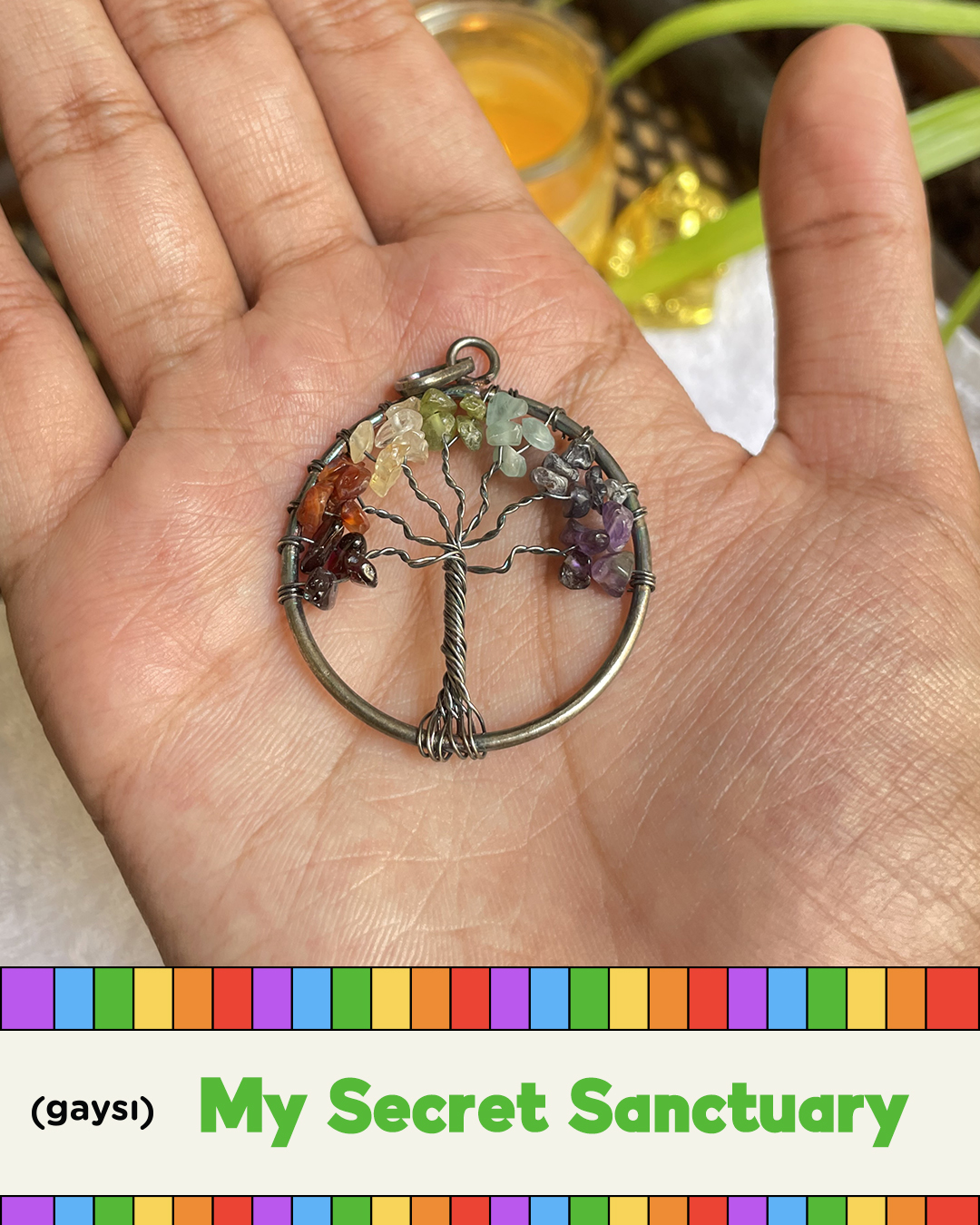
My Secret Sanctuary
Interested in astrology and tarot reading? My Secret Sanctuary might just be up your alley! Started by Rishi, My Secret Sanctuary is an online tarot reading service, which he hopes to expand into palmistry and astrology reading. Crystals, semi-precious stones, and hand-made items that help with manifesting are also important parts of their business. It all began when he found an interest in tarot during the lockdown. At that point, they were involved in activism for the queer community, which had begun to take a toll on his mental health. He decided to take a permanent break from activism in the form of protests and rallies. “As queer people from marginalized communities, their existence, and their opinions are all a form of protest,” he says.
The business had become a way for Rishi to be independent while fulfilling his spiritual purpose of giving back to the community. “I realized I was what I was doing was not just fun, but also a way to help people spiritually align with their path and purpose,” he shares. Today, his partner is also involved in the business, and they sell jewelry created by him on the platform.
Through the business, Rishi says they are able to sell or advertise any form of social projection while maintaining integrity in their personal identities. “Our future plans include training marginalized groups within the queer community, especially the trans folk, so we can give back and empower the community. We want to create something from the queers for the queers,” he shares.
An advice he has for organizations that hope to show up for queer communities? Rishi urges that they organize sessions that educate people about queer communities, mental and sexual health as well as the various social issues that the community deals with. “Invest in NGOs that help the queer community, and help those who are fighting the good fight on the legal front. You don’t need to be a billionaire to help those around you. You give when you are in abundance, but at the same time to manifest that abundance, you need to give,” he shares.
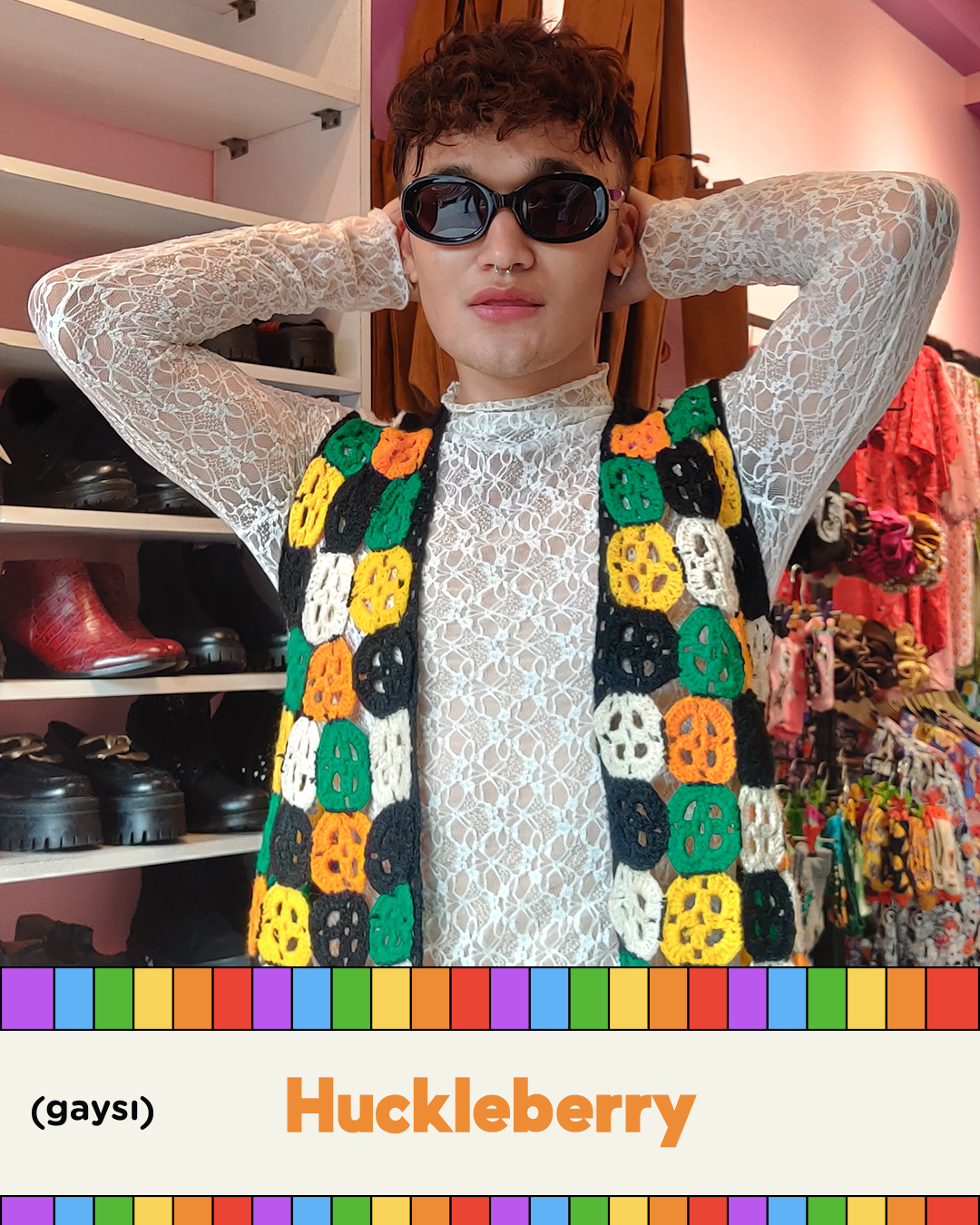
An online and offline thrift store based in Hauz Khas Village, New Delhi, it was started by Neha Shenaz in 2020 after the pandemic hit. It was named after the book, The Adventures of Huckleberry Finn. “We sell handpicked & unique clothes, boots, shoes & accessories that will make you slay on a budget,” she shares.
For Neha, running a queer business means being free. “A lot of people try to fit clothes & accessories into binaries and ask us if we have ‘feminine looking boots’ or leave comments about how some product ‘looks very manly’. For us the mantra is simple: if you like it & fits you well, you wear it,” she explains. She hopes that her business grows to become a safe space for queer folks who are into fashion. “They can wear, try whatever they want to without being judged or talked about,” she says.
Don’t just turn to the rainbow in the month of June, says Neha. “Educate oneself; one can always use gender-neutral terms. Secondly, treat queer folks as human beings, and thirdly, employ queer folks,” she advises other businesses.
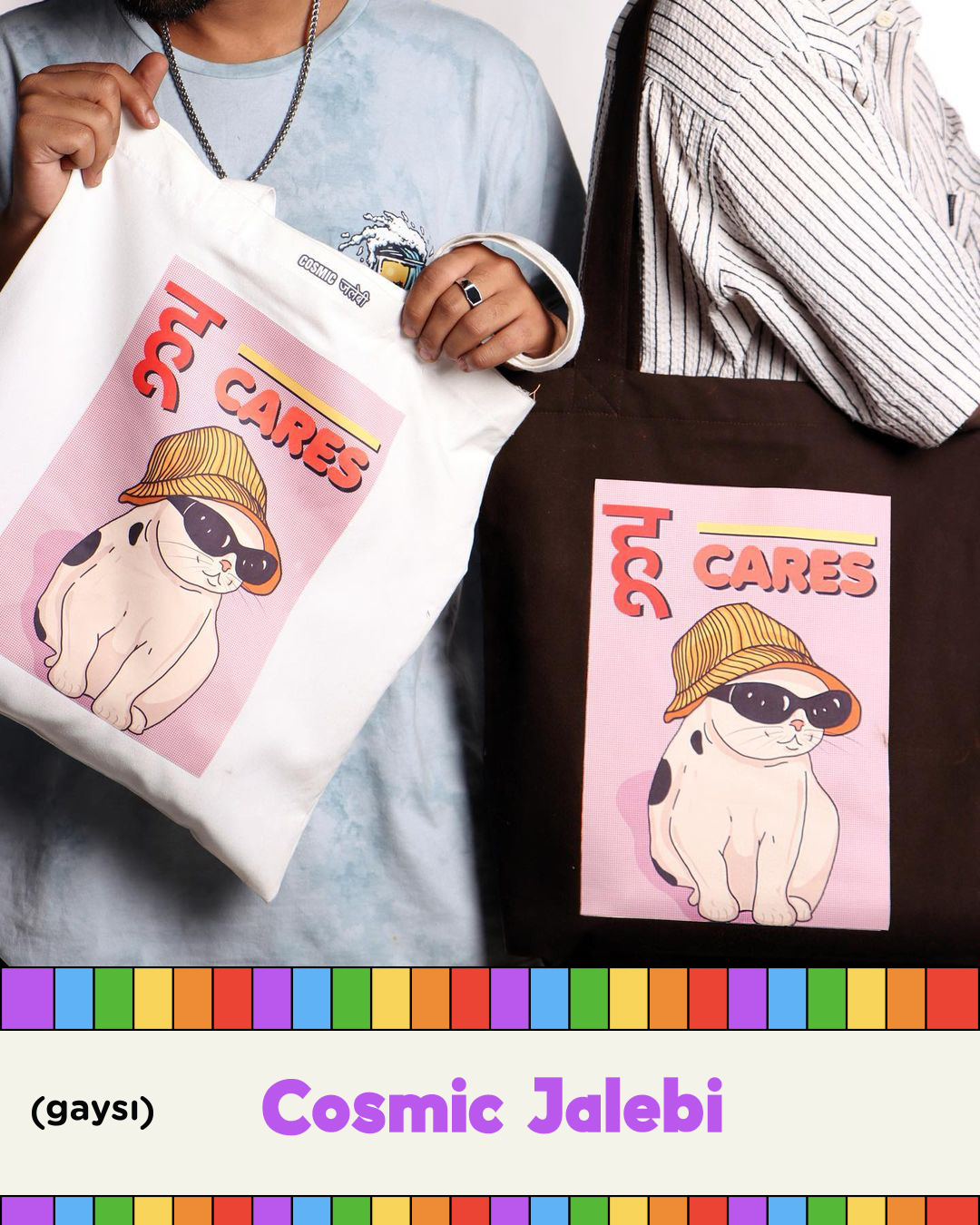
Growing up as queer kids in Indian middle-class families wasn’t easy for Syed and Utkarsh, from traumatic high school experiences to dealing with problematic family members & relatives. Becoming financially independent was extremely important in their quest to build a life where they could truly be themselves. While they tried to work jobs, not only did they not provide them with the freedom and satisfaction they wanted, they were not always inclusive. So they decided to use all their savings and start something that inspired and empowered people like them.
Self-expression, they say, is an integral part of human existence. Having never found the right kind of saucy, bold, and expressive clothing & accessories that helped them express themselves freely, they decided to change that. “We channeled all those years of frustration and create accessories that are queer, expressive and help people be their unapologetic selves,” says Utkarsh, before adding, At Cosmic Jalebi, we aspire to build a community of people where everybody celebrates each other’s differences and be their unapologetic/authentic selves without any fear of judgment.”
Being queer and in business, they say, is the best thing that happened to them. “It gives us the freedom to do things our way; if we want to feature visibly queer people on our campaigns, we don’t need any cishet person’s approval. We have the power to not only inspire the people of our community through our story but also empower them by providing them with employment and other opportunities. Being a queer business feels like a superpower. It feels like we’re finally on our way to be in a position, where we can create an impact in people’s lives and make this world a better place,” shares Utkarsh.
Instead of asking corporations and the government for acceptance, inclusivity, or employment, Utkarsh believes it is time for people from the community to join forces and show cishet corporations how things are done. “We want to set an example by building a successful and huge business where everyone feels empowered to be their true selves regardless of their difference, where inclusivity and diversity is not just a ‘Pride Month’ campaign but a core value, where everyone is treated with love, respect, and dignity.
We feel that doing all of this is going to create a lasting impact and it’s also going to force corporations to learn and evolve,” he adds.
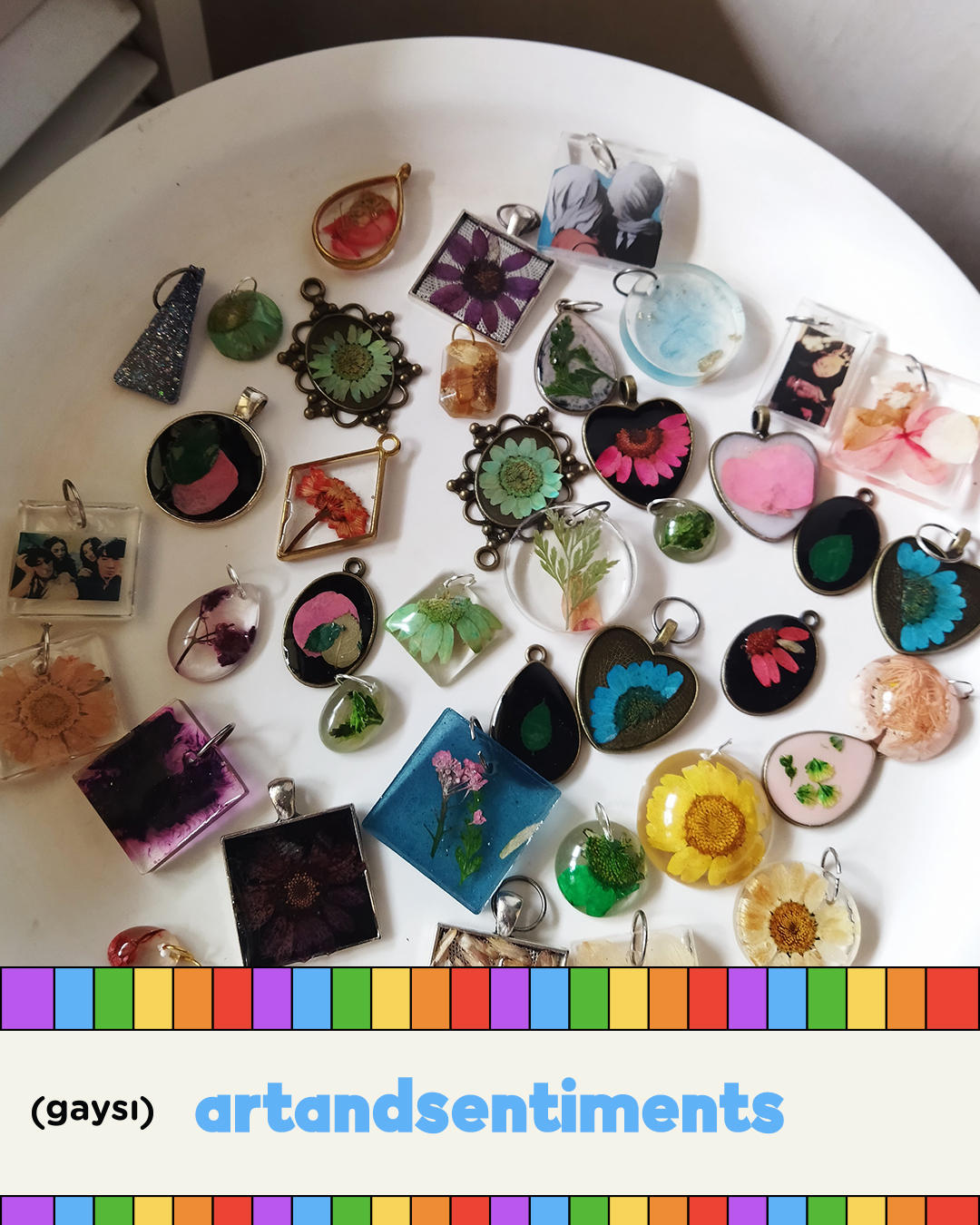
Co-founded by Deepali Gupta, artandsentiments is a brand that sells artisanal resin flower-based handmade jewelry, home decor, prints, frames, and more. A multimedia artist, who plays around with several mediums, Deepali has always loved working with flowers. Two years ago, during the pandemic, she learned about resin art, a medium that could be used to preserve flowers. “I’ve always wanted for people to wear my art; it is a way of them having a part of what I love and who doesn’t love some wearable nature?” she says.
Being a queer business helps her learn more, she says. “And, there’s just so much more love always. It’s more about the relationship with all my people and never about the transaction,” she says.
An advice for organizations hoping to stand as an ally for the community? “Include us in their businesses in all aspects and have something for everyone. Create much safer spaces so that people can just be who they are, and give us more opportunities,” she adds.
Where to shop from? Shop on their website and DM them on Instagram for customizations.
Needles and Monkey
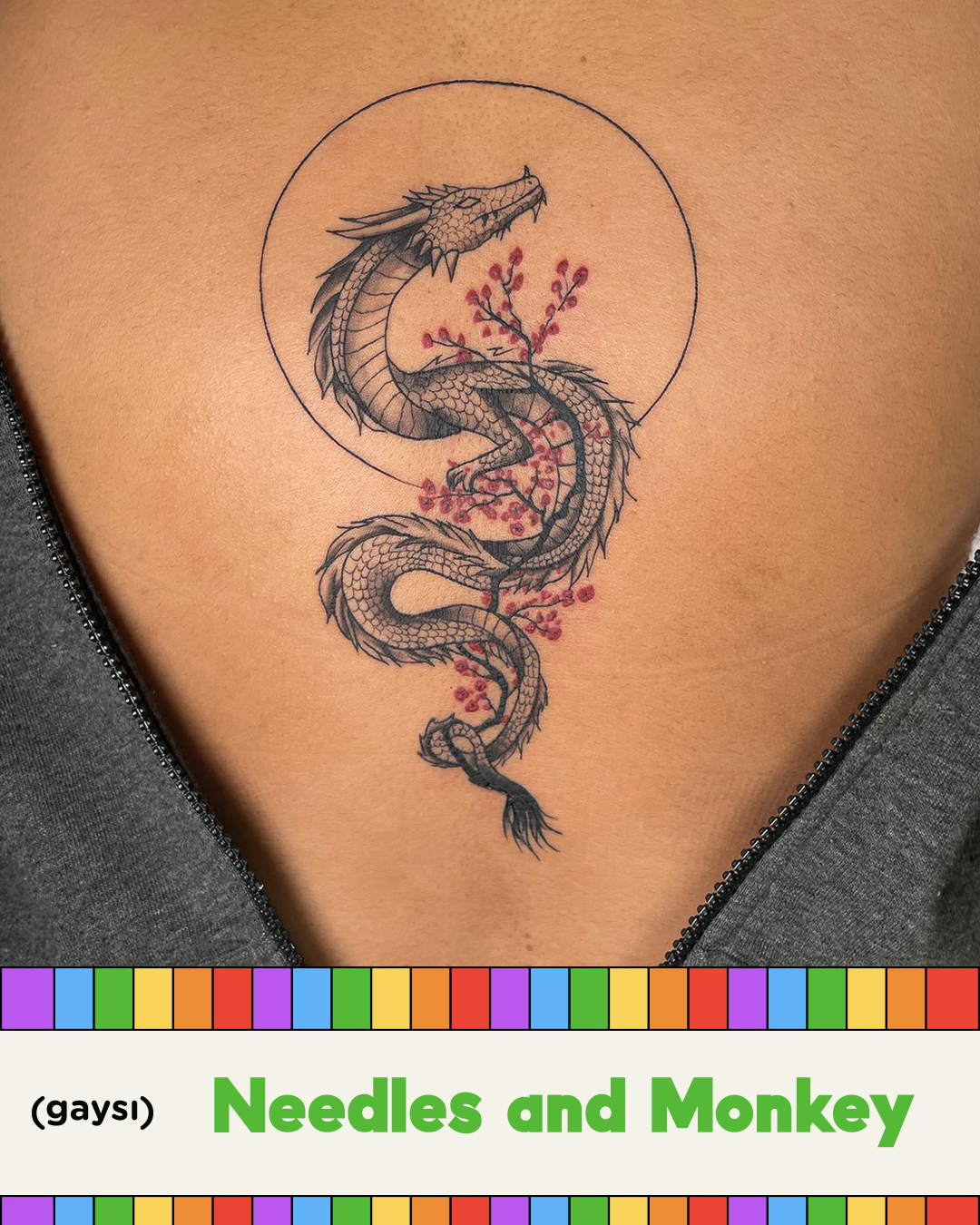
Letitia Mendes, graphic designer, and tattooist banded together with their friends, Ali and Kaushik, during the lockdown when they realized they wanted to do something different in the tattoo and piercing space. “We wanted to create a safe space, free of judgments where one can be themselves and express who they are when getting a tattoo/piercing. Tattoos are often a piece of our soul that we wear on ourselves. Needles and monkey is not just a tattoo and piercing studio but also a place that supports talented artists who need a space to tattoo from with no strings attached,” they say. From bringing a concept to reality, Needles and Monkey is a team of experienced artists in the industry that offers aims to design intricate designs to showcase your personality in the form of art on your body.
Being a nonbinary person in business with allies as partners means to be seen and respected as a person/human and not for one’s gender or sexual orientation, shares Letitia
In a world where rainbow capitalism is the norm, Letitia wishes that more business owners would take the time to learn, listen and educate themselves and the people within their business to understand queer people. “ Don’t assume but ask politely if you’re not aware of the terminologies; respect one’s identity and pronouns and use gender-neutral greetings,” they add.
Where to shop from? You can book an appointment online, or visit their studio at Malad West, Mumbai.
Quire Studio
Run by Jesmin Ahmed, Quire Studio is an aesthetic, sustainable, and handcrafted lifestyle brand with gender-neutral, budget statement pieces. “We had this vision in mind and we kept growing with time. We started in March 2021 with only jewelry. Our product line has now expanded to jewelry, candles, and home decor pieces,” she says.
Their goal is to ensure all products are gender-neutral. “We cater to all kinds of customers. Being queer is part of our identity and being inclusive is essential for us not only as part of the business but also our product line,” she shares.
From simply promoting or collaborating with a queer business, to enabling mediums that allow them to flourish, there is so much that organizations can do to stand as an ally. “A lot can be done if one is open to actually listen and identify the needs,” she adds.
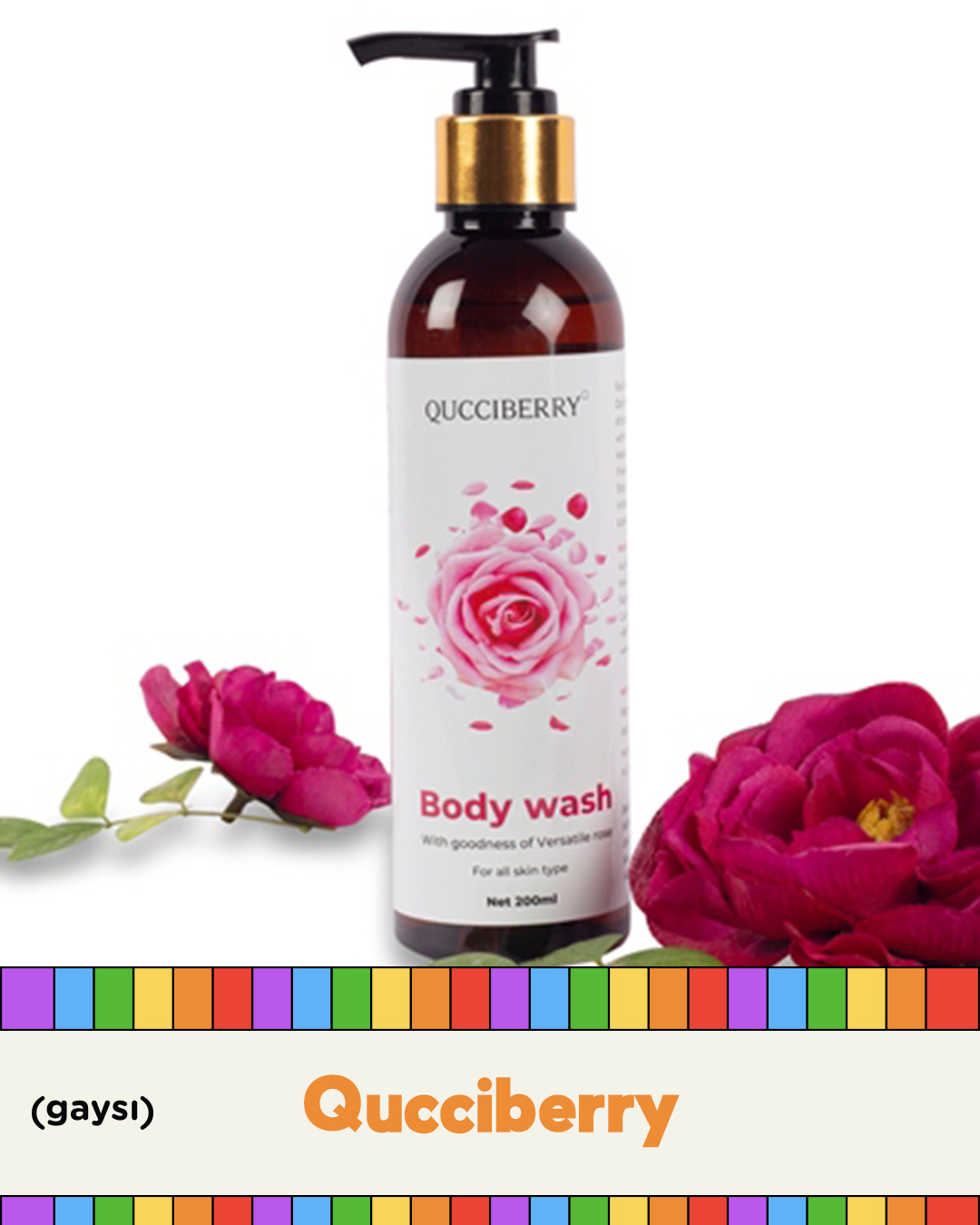
Run by Varun Abraham, Qucciberry is a fashion and lifestyle brand, that aims to make fashion accessible for all. Even the brand’s logo, a lamb with a rainbow-colored horn, was created as a symbol of diversity. “It is weird but sweet. I wanted to convey the idea that we may look different but we are all good,” he says.
The journey to becoming an entrepreneur was not an easy one for Varun. Trained in culinary arts, Varun began his professional life as a Trainee Chef. However, following the sexual and emotional abuse, he had to face, he decided to leave the field and began working in a BPO. “I had to deal with several instances where I was set up for failure. Managers would not give me good headsets and then, quality managers would raise questions about my work,” he shares. His parents, he says, advised him to change how he appears, and to try to look more masculine so that his queerness was not noticeable. And at the time, he listened.
It took him three more years to realize that the answer was not in trying to make himself fit. “Being a queer-run business means accepting yourself as who you are and accepting others. I want to use my business to stand up for the community, fight for my own rights and for future generations,” he says.
If big corporations really want to be an ally, they should be doing something every month to allow for more exposure to the LGBTQIA community, he says. “People bully you explicitly or implicitly and leave you without options, making it very hard to survive. Instead of spending on campaigns, hire people from the community, be inclusive in your workplaces, and don’t set us up for failure,” he adds.
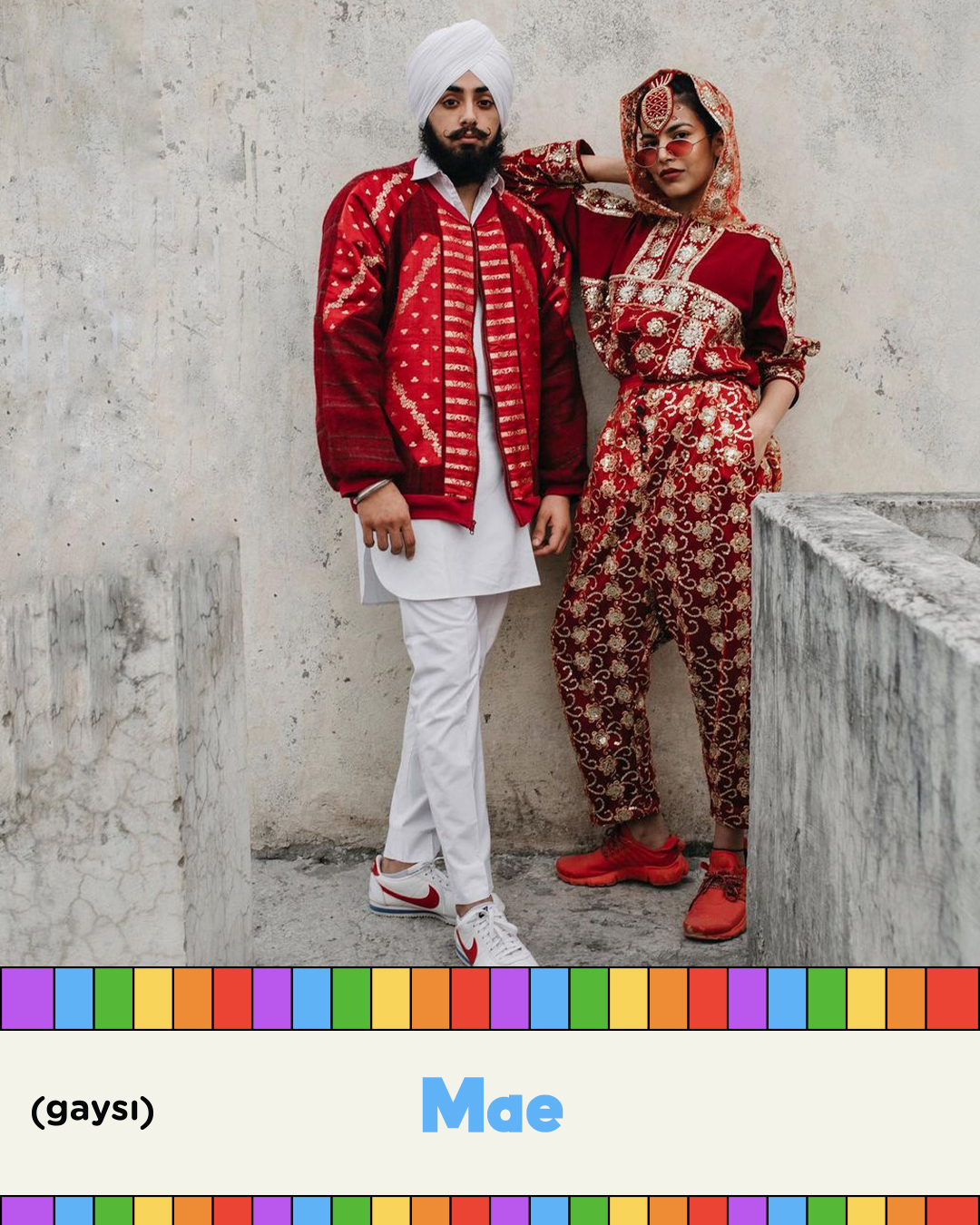
Mae is a Delhi-based indie clothing label founded by Jayeta Rohilla. “We take pieces and fabric seen in a traditional way, such as the ghoongat or the saree, and upcycle them to create pieces that are comfortable and modern. We draw nspiration from the fabric to hopefully, change the narrative to make it more resonating. Traditions are nice, but they need to be updated,” says Jayeta.
Mae finds its roots in Jayeta’s wish to create clothes that would help her showcase her aesthetic while being a reflection of who she was. “I started the business 6 years, but it took me a good 3 years to find my voice,” she shares. However, the journey is not without struggles, “I want to create gender-fluid clothes, but at the same time there are some measurements I need to refer to to get the fitting right, so I struggle with this. I want to be able to dress people of all body types. Clothing as it is, doesn’t have gender, but how do we categorize things when the world is so binary?” she shares.
On Mae’s website, you will find members from the community modeling their clothes. This, she says, is what companies should be doing to show up as an ally. “Put us on the catalog and, on the website and not just some banner to feature as some highlight. We should be generically included, throughout the year,” she says.
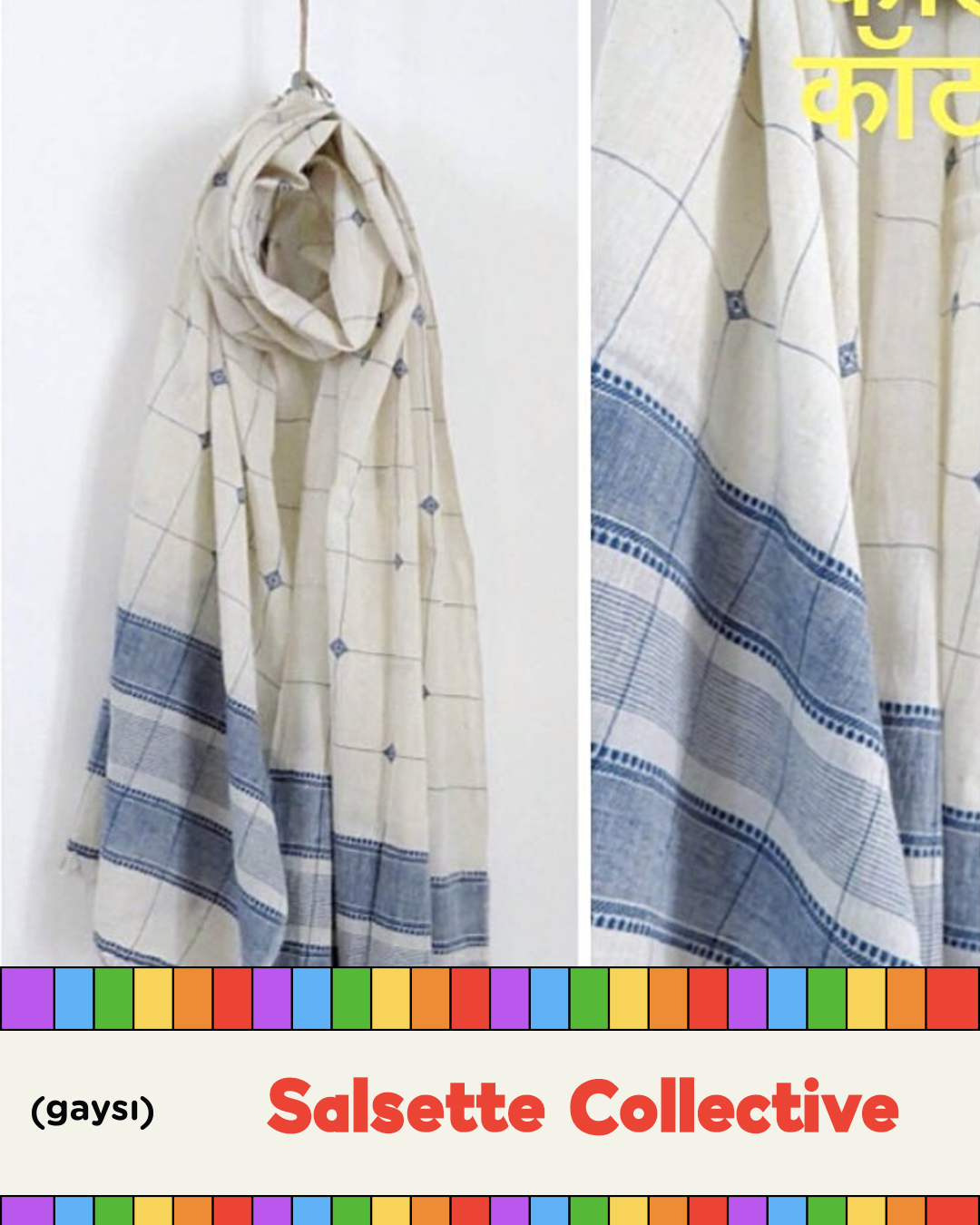
Founded by Francis D’costa and Nisha Nichola Jacob, Salsette Collective sells handcrafted textiles, such as home furnishing and stoles. They create artisanal products by working with artisans from Nagaland, West Bengal, Assam, and Kutch in Gujarat.
Skip the tokenism and invest in sensitization workshops to make your workplaces inclusive, Francis advises businesses that spend on campaigns during Pride Month. “When homosexuality was criminalized, how many companies came out and stood as an ally? Today, it is okay, so they will spend money to seem cool. I wish people did sensitization workshops as a policy to fight deep-rooted patriarchal prejudices,” he shares.
Where to shop from? You can view their products and DM them on their Instagram page.
TW: mention of gender dysphoria, body dysmorphia, description of socially-idealized body imagery
Most trans men dream of having a flat chest. We are conscious about our physique to the point of constantly daydreaming about what it would be like to ‘look like a man’. While some of us (myself included) are busy daydreaming, a select few have put in the work to make that dream a reality.
Sculpted arms. Toned abs. Sturdy legs. A chiselled physique. No, I am not talking about Hrithik Roshan. Although he IS the closest we Indians have to a ‘Greek god’, I am referring to bodybuilders i.e., athletes who work on their body.
Yes, those beefcakes who participate in tournaments—showing off their bodies and muscles we didn’t know even existed. If I am making it sound trivial, it is not. Humour is how I cope sometimes when I am intimidated, by hunks or anyone else. And, boy, am I in awe of the likes of Praveen Nath and Aryan Pasha!
Chota Packet, Bada Dhamaka!
Praveen Nath recently made the headlines for winning the Mr. Kerala (2021) title in the trans category. He arrived on the scene by participating in a bodybuilding tournament, where Praveen bagged a title and forced people to take note of him—the newest, nay, freshest entrant in bodybuilding. He was the only bodybuilder participating in his category, but his victory was as monumental as anyone else’s. At 23 years old, and five-foot-some-inches, he might appear small, but he stands tall. Let me tell you why.
To be able to participate fairly, Praveen and his trainer, Vinu Mohanan, had to convince the concerned authorities from the Body Building Association of Kerala, to create a separate category for trans-men. Praveen wasn’t about to back down when they initially refused for he has endured years of systemic invisibilization.
The bodybuilder had studied up till the 12th standard in small-town Kerala, which is often advertised as progressive than the rest of the nation, but decided to apply for a transfer certificate while pursuing his bachelor’s degree. Why did he quit midway? No points for guessing: the teachers and students were transphobic.
What’s Working Out As A Trans Guy Like?
If an institute of intellectual training failed miserably at being trans-inclusive, can we really expect a house of physical development to do so? “I tried to workout in a couple of gyms in my hometown, but the staff and members were hostile. They would say negative things about LGBTQIA+ people,” rued Praveen.
Seeing cis-guys flaunting their perfect pecks can make one feel many things: excited, envious, dysphoric, daunted… the list goes on!
I spoke to a young trans guy like myself, who happens to be a techie living in a tier-1 city. “I want a muscular physique, but I avoid going to gyms. I have invested in some basic equipment and I prefer working out at home instead,” he confessed.
Those of us who can afford to pay for a gym membership hesitate to do so, precisely because we are intimidated, or worse: insulted.
“Mere Coach Amma Aayenge”
Working for Sahayathrika, a queer rights organisation, in Thrissur changed all that for Praveen, though. Not only did the organisation help him reconcile with his family members (a mother and two brothers), he also met his coach, a former bodybuilder, at a local gym there.
Having his “amma” back on his team gave him moral strength. Working out with Vinu thrice a day helped him build his physical strength. They obtained a special permission to workout during the lockdown as gyms were shut, so Praveen’s preparation wouldn’t suffer.
But, he was (and is) still missing something crucial: sponsorship and financial support.
“Money Makes The World Go Round”
Bodybuilding is an expensive sport. Staying in tip-top shape means that one has to regularly exercise and access gym equipment. It also means that one has to eat a protein-heavy diet, which doesn’t come cheap. Not to mention steroids, supplements and whatnot.
Aryan Pasha, the man who has been an inspiration for many in India—by being an out and proud, trans bodybuilder—has only competed in the men’s physique category thus far. “I like the competition! I was a skater before I became a bodybuilder so, you can say that training and competing are ingrained in me,” said Aryan, a 29-year-old, Delhi-based lawyer.
Despite winning multiple medals (two of them being a silver at Musclemania India, 2018 and a bronze at IBFF India, 2019) and being well on his way to participate in an international tournament, the bodybuilder has not been able to find a sponsor yet.
“Everyone wants a piece of my story, but nobody wants to fund me. I have stopped giving interviews to fitness platforms for the same reason. They want to use me to appear progressive, but they fail to put their money where their mouth is,” explained Aryan.
Train, Gain, But Be Ready For The Pain
He doesn’t want to discourage other trans-masculine folks from pursuing bodybuilding, but he wants us to know it’s expensive. “It’s not easy to sustain yourself as a trans bodybuilder, unless your finances are in place, and that’s the sad reality of it.”
Praveen admitted to getting inspired to bodybuild after landing on Aryan’s Instagram page. “I had a smoking and drinking problem. I was also gaining weight. I had also just broken up with my ex-girlfriend at the time. I knew I wanted to do something, but didn’t know where to start.”
Seeing Aryan’s workout videos and muscular photos pushed Praveen to work towards building a fitter physique. Aryan too, worked on himself using knowledge from the Internet. “Pretty much all you need to know is available on the Internet!” he claimed.
Nonetheless, the trans bodybuilder has decided to personally train another young and upcoming trans bodybuilder. “Coaches don’t know too much about trans bodies. Be it about us taking testosterone shots regularly, or getting specific surgeries, you have to account for these when training a trans guy,” Aryan pointed out.
One can only hope that young trans-men who see Aryan and Praveen living their truth, are inspired to do the same.
There was never any lightbulb moment when I realized I was bi; I just always was. There was never any internal struggle, I never even felt the need to come out. Straight people don’t carry the burden of coming out, so why should I? Some people who found out were surprised, some weren’t, but most of them have more or less been accepting of it.
Whenever I envisioned my future, it was always the idea of a hetero love that I grew up watching in movies. I was telling a friend recently that even my dreams don’t allow me to think in more expansive ways. An American colleague of mine recently got engaged to her girlfriend; she shared a picture of a party with their families celebrating the moment. I was happy for her but there was a twinge of sadness as well knowing that that would never be a reality for me. I’m not even talking about marriage rights; I know we will have to rethink entire institutions to be able to fully embrace our queerness. I will be speaking about weddings in this essay as that is perhaps the biggest, most prevalent form of personal celebration that exists in our country.
None of the elders in my family know about my sexuality. I come from a family where even inter-caste love is punished. I shudder to think what would happen if someone dared to break the gender barrier as well. At most weddings, the standard question people my age get asked is, “So beta, why don’t you just get married?”. And then an uncle who thinks he’s very funny will ask, “Are you gay or something?” and then proceed to laugh at his own, very unimaginative joke. Now, what if that someone is actually “gay or something” and wants a big wedding? As an introvert, I personally dislike huge gatherings but what I’m saying is that this should be an option for queers who do want such things. I’m also, of course, referring to a certain class that can afford to host such large-scale events.
What I perhaps envy the most above my American colleague is the ease with which she is able to live in the world. The fact that she is able to love freely without fearing any repercussions or drama. The fact that her family and her community have so willingly welcomed her partner into their lives. The most I can hope for is tolerance, nothing more than that. It’s such a pathetic word – “tolerate”, you tolerate a cold until it passes, a headache, the traffic, and minor inconveniences in life. I want us to be able to celebrate queerness outside the confines of pride parades and gay clubs. Sometimes, it all feels like wishful thinking, to be honest. Do I even need to seek the validation of the people around me? Is it validation? I’m not sure, is it time to stop pining for something unattainable?
I hope that in the next year, we’re all able to celebrate our queerness with unabashed joy no matter what that looks like. I want that for myself in my daily life, to make concerted efforts to literally dream bigger and to live joyfully in a world that does not make it easy. The works of other queer artists – the poetry of Mary Oliver, the paintings of Frida Kahlo and Amrita Sher-Gill, all of whom came before me – are a testament to our glory. In contemporary times, people from our own Indian LGBTQ+ community such as Manvendra Singh Gohil, Jerry Pinto, and Laxmi Narayan Tripathi give me hope. In an interview, Tripathi once said, “I don’t believe in dressing like an activist, what does that even mean? Wearing bland clothes and a jhola? I’ll wear my red lipstick, my brightest sarees, and talk about trans rights.” In 2023, I hope that we’re able to truly celebrate ourselves in all ways, and others will have to just deal with it.
The International Olympic Committee announced a new framework for transgender and intersex athletes this week, removing problematic policies that required competing athletes to undergo “medically unnecessary” procedures or treatment.
The new framework consists of these 10 principles:
Inclusion
Prevention of Harm
Non-discrimination
Fairness
No presumption of Advantage
Evidence-based Approach
Primacy of Health and Bodily Autonomy
Stakeholder-Centered Approach
Right to Privacy
Periodic Reviews
Important to note however that the new guidelines are NOT legally binding — it’s up to independent sports federations to implement policies — but it replaces the 2015 IOC guidelines indicating testosterone thresholds for transgender women.
“This Framework recognises both the need to ensure that everyone, irrespective of their gender identity or sex variations, can practise sport in a safe, harassment-free environment that recognises and respects their needs and identities.”
The Olympic Committee
“Far too often, sport policy does not reflect the lived experience of marginalized athletes, and that’s especially true when it comes to transgender athletes and athletes with sex variations. This new IOC framework is groundbreaking in the way that it reflects what we know to be true — that athletes like me and my peers participate in sports without any inherent advantage, and that our humanity deserves to be respected.”
Quinn, the world’s first trans nonbinary gold medalist.
“Sports are for everyone, and fairness in sports means inclusion, belonging and safety for all who want to participate, including transgender, intersex, and nonbinary athletes.”
Alex Schmider, the associate director of transgender representation at GLAAD, and the producer of a documentary about young trans athletes, “Changing the Game”.
“The new IOC framework gives guidance to sports bodies on how to draft & implement eligibility criteria which upholds the rights of all athletes — regardless of gender identity, expression and/or sex variations — to participate in sport free from discrimination.”
Chris Mosier, a transgender advocate and the first known transgender man to represent the United States in international competition.
[The following article is a personal story, containing references to external and internalised queerphobia and references to the absence of faith. This is not meant as a critique of any religion or way of life.]
A couple of days ago, I received a message on my Tumblr blog from a baby desi queer. It was a gushing response to the fact that I was “lgbtq in India and an adult in university” (mostly in all caps to emphasise how wonderful my existence was to the sender), thus attesting to my supposed success in life, as an out and proud specimen of my kind. I suppose I should feel flattered that I have become something of a guru to younger queer people, particularly South Asians, because they frequent my blog in droves to ask me questions: How did you come out? (I didn’t) When did you realise? (The first day of preschool) Have you been in love? (Yes, daily, on multiple dating apps.)
Which, in turn, leads me to the conclusion that I only exist taking up as much space as I do and as loudly as I can, because I spent fourteen years of my life surviving an all girls’ Catholic Convent school, where the only pride you could exhibit was the pride of being loved by Our Father in Heaven. Surviving Catholic school as a queer is very much like surviving a horror film – ‘Was it worth the trauma?,’ you ask yourself, was it worth rolling your socks to ankle-length and singing Christmas carols under the watchful eye of the plastic Jesus figurine in your classroom, and the answer, unequivocally, is not really. If you have seen Derry Girls, you might have a fair idea of how it works. Then again, I’m Bengali, and not even that show can begin to comprehend the layers of gay drama unfolding within the walls of a convent school in Bengal. Believe me, things get juicy.
Chapter One: To All the Girls I Have Loved Before
Picture this: Alo in her single digits, attending primary school, wobbly-kneed and button-eyed. You’d think she would have no game, you’d think primary school and game shouldn’t even be in the same sentence, but you are wrong. Before I knew the multiplication table of six, I was dropping love letters (written in glitter pen, so you know things were intense) into the bags of girls I liked. Not that any of them ever read it. And not that I was very poetic about it, though I think Dear X, I’m sad when you are sad, so don’t be sad has a nice rhythm to it.
There was also the thing about being partnered for music classes, where there was a lot of prince-and-princess role-playing, which needless to say, was quite a lot for a gay six-year old. Once, I was cast as Sleeping Beauty for a school play and a classmate gave me a chaste kiss onstage, as my prince to the rescue, with hoots and applause from the audience, even as the nuns-in-charge gave us withering looks. I still remember the uproar in the class when we were assigned roles as couples attending Cinderella’s ball for the annual musical programme. We would be giggling and blushing when our “princes” walked by, or maybe that was only me, because I am gay and because it is okay sometimes to look at things with rose-gold nostalgia and feel like that was lovely. Years later, when I would watch anime like Sailor Moon or Bloom into You, I would recognize that sweet thrill that comes from intense female friendships formed between schoolgirls with their pleated skirts and braided hair, and think, I lived through it all.
Chapter Two: I heard she’s a lesbo!
Dostana released in 2008, and with it, a plethora of new colloquialisms was unlocked by my classmates. Gay was still okay, something to be looked at with wondrous pity, but lesbians – “lesbos” as we tasted the tang of a new insult – hit too close to home, seemed too potent a threat. In the following years, there was a school ground witch hunt: every single tomboy with short hair who didn’t shave or sat with legs apart was dubbed a lesbo – that omnipotent, ominous word. I had a falling out with my long-time best friend in sixth grade, and soon after I cut my hair short. When I showed up at school with my new haircut, she looked me pointedly in the eyes and said, “You look like a lesbo clown”. I have no idea if the teachers knew about this, if they were simply too uptight to stop the name calling or if they felt, Voldemort-style, that putting a name to the whole affair would be firmly locating it as a lived reality.
Either way, by the end of 2014, our school was – to quote Derry Girls – seemingly ‘wall-to-wall with lesbians’, and not a single one of them seemed to have any clue about it. Or maybe they did. Maybe they enjoyed it. For me, the reckoning was still years away. I dreaded being clubbed in with the tomboys and began presenting aggressively feminine, shaving my unibrow and wearing blinding pink, overcompensating for the fact that Jesus was watching and probably knew that I wanted to kiss girls. I don’t blame Jesus. High school is nightmarish, and shit happens.
I do blame Karan Johar though.
Chapter Three: Lemons are Not the Only Fruit
My gay awakening coincided with the rise of fanfiction culture in the late 2010s, when – Oh, horror for the nuns! Horror for the Catholics! – we discovered sites like Fanfiction.net or Quotev.com and began aggressively searching up inappropriate stories about Harry Potter characters making out or anime couples hooking up in the most seedy spots (broom closets were quite popular). I discovered I enjoyed reading Ginny Weasley x Reader fanfiction a little too much, especially when they were steamy; these pieces were called “lemons” in the jargon of the lesfic writer. I also discovered that many, many of us, were into somewhat questionably homoerotic activities, serenading each other and pretending to kiss under our blazers a la Aditya Roy Kapur and Shraddha Kapoor in Aashiqui 2, holding hands at the back of the classroom, playing “house” with our assigned “wifey” . I look back at it all with the indulgent affection of a jaded adult queer, but also with a certain degree of horror, wondering how the hell I lived through it all.
I know now, years later, that I wasn’t the only queer at my school then; there were others, in the same year as me, who were of the same disposition and had been backed into similar corners under His Watchful Gaze. I know we were not perverts or predatory for the way we desired, and I know our scepticism in the face of Catholic guilt was not because we were degenerate, but because we were essentially playing in a field that was destined to fail us, and I say this as someone who loved her school years. But somehow, despite it all, we survived. We survived the intense religious imposition and the rigorous disciplining and the taunts of our own classmates. We survived the rigid structure of enforced femininity, which punished anybody who wouldn’t abide by its arbitrary rules. To all the baby queers reading this, there is a whole vista of life out there, and it doesn’t end with your Catholic convent upbringing. My message to you would be to let go of your shame and not let the drudgery of schooling affect you into submission. Queer joy will be yours, just wait it out, better days are coming, and it’s not all bad, kids.
Oh, and by the way, don’t try to convince the nuns at your school to host a Pride Party. Speaking from, um, second-hand experience. Just don’t.
“Oh, you don’t need to make it sound so dramatic!”
“It’s not me who’s being dramatic right now though. You can’t keep moping around, Kia. I’ve never seen you so hung up on someone like this before.”
“Hey. I’m not hung up on her okay? It’s difficult to explain. I just-”
“No let me simplify it then – you are in love with her and you don’t want to accept it because you’re afraid she doesn’t like you like that.”
Kia felt a strong urge to lie and deflect his logic with the shitty reasons she repeats to herself every night when she can’t fall asleep. But, she knew he wasn’t entirely wrong. And she hated that.
“I don’t think we both know enough to qualify what I feel as love. That’s the only comment I’ll be making.”
“You are incorrigible! Ugh! Anyway, if you’ve decided to mope around then so be it. I’ll let Dhruvika know you won’t be joining us.”
“Thank you, Kuuush.” She extended his name and her friend on the other side muttered a small goodbye in return. Kia knew she was being dramatic, but she did not have the mental energy to meet new people right now, especially if new people included her friend’s new boyfriend. Being around couples was the last thing she needed.
She felt a movement to her left and looked up; it’s the stranger she saw almost every other day on this train route. They had gotten up and stood near the door. They both had travelled probably a hundred kilometres together in the last year yet she still did not know their name. There’s a comfort in their presence, though; they had exchanged several smiles and knowing looks when someone said something funny very loudly, even though they had never said a word to each other.
“I couldn’t help but overhear your conversation. It’s absolutely none of my business, but,” they paused, and Kia peered up at them quizzically. It startled her a little to feel their voice directed at her. “Someone once told me that it’s better to have loved and lost, than never to have loved at all.”
“Huh?”
They stifled a laugh at her cluelessness. “I mean I know it sounds like a load of shit, but hey! If one’s already hurting over unspoken rejection, might as well just go all the way and get a confirmation, you know? What’s the worst that could happen? You’d be in pain? As if that’s already not a thing. Equation remains balanced nonetheless, you know what I mean?” they finished with a shrug.
By the time Kia could fashion a coherent response, the train reached their station and they gave her a smile before stepping off to the platform, only for her to be left to stare blankly at their retreating figure. A loud crack of thunder roared in the background as the train rolled on.
Well, that was weird.
~~~~~~~~
Rain had never been Kia’s favourite. Even as a child, she associated rains with every negative emotion in her limited repertoire. Growing up, the feelings associated with this gloomy weather only got worse. And today of all days, Kia thought the weather perfectly reflected the turmoil she felt inside; the loud crackling thunder voiced her own soundless screams of helplessness, the bountiful raindrops, pelting down as hard as rocks, too closely resembled the tears she couldn’t bring herself to shed and the cloudy, sunless void shadowed the numbness she felt within her bones. So, to her, the weather seemed perfectly befitting to be absolutely pissed to the highest points of piss-tivity.
Vandana opening the door, wearing a bunny t-shirt and fuzzy socks, did manage to soften her from within, but Kia wasn’t ready to drop her dramatic act yet.
“You look like an angry cat that fell in a bucket full of water.” An amused smile played on her lips.
“I am really not in the mood right now, V.” She muttered as she started moving inside the gate. But before Kia could step in, Vandana stopped her right as she lifted her foot, as she retrieved a soft towel that sat on the stool near the door and proceeded to bring that towel near Kia’s face. Kia stood there silently, while Vandana tussled her hair and soaked the excess water dripping from her hands and face into the towel. Kia’s heart pained with this display of affection and she almost let out a few tears of frustration.
“Okay step in now, soldier. Take your shoes off just here, I’ll pick ‘em up when they’ve dried. Go change, I’ll put the kettle on for you.” As she stepped aside, Kia walked in with her heart heavier than before, vision blurred by the tears she was still not willing to shed. Kia wanted to scream at Vandana, tell her to stop being so kind and helpful and cute and lovely and…
She threw her wet bag on the chair when she stepped in her room, but before she could start taking off her drenched clothes, Vandana barged in casually.
“Why aren’t you screaming about how much you hate monsoons today now that you’ve finally been soaked?” Kia turned to look at Vandana’s face to call out her faux-genuine concern. But she only found knitted eyebrows and a creased forehead staring back at her. She didn’t understand how Vandana was capable of seeing through Kia’s façade without any difficulty. How did Vandana learn about her so thoroughly, to know every silence’s meaning without Kia ever spelling it out for her?
“Maybe getting my clothes and hair wet were all the signs I needed to finally stop crying about it. Go out, let me change now.”
“Ha-ha, funny. I know that isn’t it. Also, I don’t mind seeing you change. So out with it, pun intended.” Vandana winked. Kia could only sigh.
“V, you shouldn’t say things like that! Please, just believe me you don’t wanna know.” Kia felt bile rise in her throat at the thought of confessing the things that have kept her awake. How she craved V’s warmth on her skin, how she yearned to touch her lips and kiss and bite and let Vandana take over everything she had to offer. It immobilised Kia on a regular basis – the strength of her desires – but the fear of losing Vandana over something like this awakened her fears simultaneously.
“K, need I remind you that I once heard your two-hour long rant, fuelled by weed and pizza, about how Shrek and Fiona’s relationship represents the most culturally important depiction of love for our generation? I did not want to know that, but I did like it. So, try me, please?” Vandana pouted for a good five seconds before Kia softened over her puppy eyes, defeated.
“I’ll-uh-ugh…okay just turn around and I’ll-I’ll speak.” Kia stuttered and Vandana, smiling triumphantly, turned around in a second. Ah shit, here goes nothing, Kia prepared herself mentally. “Well, um. I have been struggling with uh, trying to un-understand what we both are. As in where we both stand, you know?” Kia huffed her way through, while pushing her wet jeans off.
“Okay…not sure if I follow you, but keep going.” She heard Vandana think out loud and braced herself. While putting on a fresh pair of pyjamas, she continued, “I mean, I don’t know who we both are for each other. V, I…I’ve had many female friendships in my life. And I’ve been close with many of them, I know what female friendships look like. But with you…with you, I don’t know. It’s different? I don’t understand it, but it just feels unlike anything I’ve ever experienced. You-you do things for me that no other friend has ever done,” she emphasised. “You take care of me, you learn to cook new things for me because you know I’ll like them, you bring me things I mention in passing and surprise me with them, you kept these dry clothes and a towel ready for me at the gate because you knew I’d be angry and wet! Even my mother hasn’t done that last bit for me, V.”
“And I don’t know! Shit, I might as well be overthinking or reading too much into things or just being stupid, but god! I don’t know if friends act like that! I have seen you with your friends, and I see how you act with them and I can’t help but feel a difference, or maybe its just me fucking wishing for a difference.” Kia laughed humourlessly. Her thoughts whirred in her mind rapidly and Vandana’s silence only made her more nervous. So, she continued blabbing.
“I don’t want to cross any lines but fuck, I don’t even know where they start! I want so many things but I’m so scared, V. I’m so scared of doing something or saying something. Scared of losing you because of it. I don’t want to lose what we have…but fuck, I also want so much more. I want…I want you. But I don’t know where you stand! Because what if it’s all just me? What if all that I’m noticing is what I want to happen when in reality, none of that exists? What if I’m just your good friend?” Kia felt tears running down her cheeks as she threw her top on the ground. Her hands trembled as she picked up a dry shirt and started putting it on. Her nervous fingers struggled to button it up and she sobbed out of frustration.
Suddenly, she felt arms on her waist, turning her around. She turned to see Vandana’s placid eyes shift with an emotion she couldn’t put a finger on. Vandana tucked her hair behind her ear, grazing her cheek with her knuckles ever so slightly. Kia shivered under that slightest of touch and closed her eyes. Vandana cradled her cheek with one hand as she moved her face close to Kia’s neck. Her lips sent jolts of electricity down Kia’s spine and she unconsciously tilted her head to allow Vandana more places to explore.
“Is this what you want?” Vandana sighed into the crook of her neck as Kia nodded numbly. “Say it,” Vandana whispered in her ear, trailing her lips along Kia’s jaw.
“Yes,” Kia whispered back and that jolted Vandana into action as she kissed fervently along the side of her face, kissing her jaw, the pulse on her throat that beat loudly, biting her ear, nosing her cheek. With every new kiss, she asked Kia, “And this?” Kia replied “yes”. Vandana’s warm hands found their way under Kia’s shirt, holding her tightly by her waist, digging her short-clipped nails into her skin. Kia wanted to scream, every inch of her body felt like a minefield that Vandana’s lips tiptoed around, bursting waves of sensations into her nerves, making her knees weak with anticipation, pleasure – a pool of want swarming in her stomach.
Vandana’s hands snaked their way up the front of Kia’s stomach, her nimble fingers trailing the outline of her breasts. Vandana pulled her face out of her collarbones and looked directly at Kia’s red and swollen lips that she had bit onto, to stop the rampant noises that dared to escape her mouth, catching them in her throat. Kia opened her eyes to see Vandana staring back at her with a question floating in her eyes. Kia felt herself lean in, as if her lips hid a magnet that can’t help but be attracted to whatever promise Vandana’s mouth held. It was natural – how easily they fit into each other’s mouths. Their hot breaths mingled in a steamy embrace as lips clashed softly aagainst lips. Kia felt V’s hands pulling her even closer, no space dared exist between them in that moment, as Kia tangled her hand in her hair.
They kissed for who knows how long. Kia lost her grip on reality and drowned in the pleasure she derived from Vandana’s lips. Their hands roamed through each other’s bodies, stopping to caress at places, to hold on tighter. Their lips melted together in perfect sync and the noises of their wet kiss filled the echoey room they stood in. Vandana parted their lips as they both kept their eyes closed, breathing in each other’s breaths, faces still close. Kia realised that the rain had stopped. She opened her eyes and saw Vandana staring back at her, eyes glinting, lips bitten red, hair tousled around her forehead. The setting sun threw shards of bright golden light in the room, filling up the atmosphere with the warmth Kia felt in the pit of her stomach.
Vandana finally broke the silence, “So…how long have you been assuming I’m straight?” Kia blushed furiously.
“In my defence, assuming you were straight was the less painful option. I didn’t want to think you were queer because I guess that would’ve meant that you do like girls, but you just… don’t like me. I didn’t want to deal with those thoughts, so I just chose an option that helped me stay in denial?” Kia confessed, eyes hung down in shame. She thought Vandana might pity her stupidity, but she tipped Kia’s chin up and kissed her softly on the lips. The kiss wasn’t heated like the one before, but there was a firmness in it that grounded Kia’s wavering thoughts.
“I can’t believe how you manage to make your high Shrek feelings sound so coherent and confident, while your own damn sober feelings are all over the place.” Vandana giggled and poked Kia’s stomach with her finger. Kia whined loudly. Even when she daydreamed about telling Vandana about her feelings, Kia never thought that that ogre would play such a huge role in that scenario. It all felt like a dream to her; she feared she was going to wake up any second and realise that she was still on the train and all of this was just her mind playing tricks on her.
But as she stared into Vandana’s eyes, sparkling in the golden light that spilled into the room, and felt her heart beating rapidly against her throat, she knew. This was happening, this was real, Vandana would not disappear if Kia tried to touch her. The reality felt as bizarre as any dream Kia had ever had. All her fears melted away in the mellowness of Vandana’s touch; she was awash in an amber glow.
And as Vandana whispered to her: “We’ll figure this out together, K,” Kia felt like a blue sky after stormy clouds cleared; she sensed within herself a clarity she hasn’t experienced in ages. She believed without a doubt.
At the Age of 21, I came out as a gender fluid person to the world by making headlines in a local newspaper article. Though it seems straight forward, as I evolved with self-identifying my gender, the fluidity became nowhere a specific identity. This was also around the same time when fashion brands started using the term “Gender fluid” to describe certain articles of clothing and each time I saw my gender associated with that label, it felt like I was playing dress-up. People started looking for signs to qualify my gender fluidity and my unconventional dressing sometimes became the template for them to agree with my gender fluid-ness, which bothered me to my core. Expecting a Gender fluid person to dress in a certain way to prove their fluidity was triggering for my dysphoria.
Since I was 10 years of age, my gender played a vivid role in my life and identity. Early signs of me not submitting to my assigned gender was when I started wearing ‘opposite gender’ clothing. When I was growing up my gender imagination was always seen as fluctuating. Sometimes, I presumed myself to be a girl and sometimes a boy. The idea of gender was like a switch to me to transcend from one idea of myself to another. For a long period of time, I couldn’t understand the triggers of gender dysphoria. Suddenly it started with a small thing. Going shirtless at the age of 9 was terrifying for me. I felt so much of dysphoria to show off my naked torso that I never wanted to show it off to anyone, including my mom and dad. However, with exploration of sexuality and gender somewhere this dysphoria surpassed my gender expression. I later realized that I have both gender and voice dysphoria and that makes my gender sometimes detached and sometimes attached to my physical body.
I started using the word Trans Non-binary that is an umbrella term for trans identities that don’t fit into binaries. It was never evident for me to see where I fit in. My gender dysphoria is more with gender expression and less with the anatomy of my body. I never hated the body I was born with, the parts it has. However, I felt that I am still as equally as a woman as a woman, and both and sometimes even Xeno-gendered. That was the time I realized that I didn’t have a specific word to address my gender identity.
People still question my Trans identity when I present myself visibly as male without drag. I do it to express myself as a demi boy. But, with drag it helps me blend and surpass all the boundaries of any gender structure. I came across Gender Maverique when I was working on a pride flag project. When I read about it, I could see that it checked a lot of boxes that spoke to what I feel about my gender.
Maverique (pronounced mav-uh-reek) is a term to describe those whose gender exists outside of the binary completely. It exists on its own plane of gender, seperate from all others. It is a gender characterized by autonomy and inner conviction regarding a sense of self that is entirely independent. It is not neutral, nor is it lacking in anyway. Maverique can be viewed as an apocrine gender to some individuals, but not to all.
When I read about the Maverique I could see that there is a sense of intersectionality of other genders represented by it, an identity that make total sense to me. Gender maveriqueness felt like an identity which fit my non-binary-ness, xenogenderness and gender flux-ness in just one label. For a lot of people who are on the non-binary gender spectrum, it’s difficult to identify or affirm with the classic definition of non-binaryness majorly as this is more to do with their inner workings and imagery of one’s gender over the gender expression. The idea of not adhering to a specific popular label makes identities like mine go invisible. The intersectional nature of sexuality, gender, class and caste always plays a major role in bringing certain narratives of gender identities to mainstream representation over others.
For me, the gender maverique label became a space to self-declare my identity and feel safe in the label. However, for people who aren’t aware of these nuances, I still use non-binary, an umbrella term, to identify myself. Sometimes it’s exhausting to explain how I feel when I use specific gender label and hence, I choose it when and where I want to use the label.
Reclaiming an identity is always a ritual for me. When I discover something new about my body, I celebrate it by creating art inspired by the same. As Art reflects Reality, I opened up about my gender label to Aniket, a friend of mine. I wanted to celebrate the gender marveiquiness with reflective art. So, we decided to do a photoshoot to celebrate my own skin. I wanted to use the colours of the gender marverique flag as my tapestry. The maverique flag was designed by Vesper H. on June 16, 2014. The color of the flag has its own meaning; the yellow denotes Independence from other genders. Yellow was chosen because it is a primary color, which means that it cannot be obtained from combining other colors, like how maverique is not derivative of other genders. The second colour is white, which is meant to signify Autonomy and independence, especially from the gender binary; and orange is for inner conviction regarding one’s gender.
I combined an orange ghagra and a yellow blazer to create a look for the same. Ghaghra, a garment which was initially used by Men and then by women becomes a label-less clothing, the blazer became the not derivative garment which is used by all the genders. I used a pagadi as well to hide the way of relating visible hair with a particular gender and that’s how I created this look. Aniket helped me in styling the same and helped me add complimented jewelry for aesthetic purposes. When I was standing in front of the camera I could feel my gender marverique soul speaking its heart out to its fullest and this photoshoot became a way to self-accept and celebrate my identity.
While we celebrate the non-binary awareness week every year in July, it’s the right time to read and learn about multiple gender spectrum identities within the non-binary spectrum. And it’s not about creating new label for sake of it but having the right vocabulary to identify oneself and when any queer person creates the 1000th label to identify themselves to the fullest, it is important to recognize that all labels are valid and hold importance to queer liberation.
Watching transgender characters on screen is exhausting for the most part. Even the films and shows that don’t intend to mock or vilify us end up doing exactly that. Thankfully I’m born in an age where slowly, transgender writers are crafting our own narratives for the screen. Representation is important no doubt, but the authenticity matters more. I’ve compiled over here, a list of my top 7 TV shows where the portrayal of transgender characters felt wholesome.
Euphoria
This show deserves all the praise that it got and then some more. Mature themes like sex, addiction, and Machiavellianism are dealt with a lot of sensibility, while not shying away from getting dark. The trans-girl character, Jules, is never advertised as a “trans girl”. Rather, she is a very fleshed out, multi-dimensional character, who just happens to be trans. All of the dialogues feel very human. A trans-person, this articulate and honest about their experiences, felt refreshing. This was only possible because writer Sam Levenson was constantly engaging with Hunter Schaffer about their transness and how she would like to portray Jules. What’s more, they even had a trans consultant for the show. This show is also one of those rare instances where it looks at the ugliness of addiction and is unflinchingly honest about how difficult recovery can be.
Skins
What Euphoria laid bare for television today, Skins did all that and more back in 2007. It deals with really messed up and unlikeable teenagers, who are bent on their hedonistic pursuits. There are multiple queer characters in the show and two possibly trans-masculine characters. They never really talk about their transness, but hint at it. This is also the first time I had seen “binding” on screen. Props to the show for highlighting mental health issues and eating disorders at a time when it was taboo to do so.
Glee
Glee might have been the biggest show at its time of release to be unabashedly gay. What’s more, it was a big budget primetime major network musical. I imagine that Ryan Murphy would scream at his writers every time they wrote new material – “MORE GAY!” While Glee did have trans characters, it’s important to acknowledge its flaws. The jokes often target marginalised communities and then tries to redeem the characters who made them. There are unhealthy doles of body shaming, queerphobia and racism. It’s difficult at times to understand if Glee is problematic in parts or whether it is trying to highlight societal issues. Personally for me, what started out as a ground-breaking show turned into a hot mess after the third season. Bad writing and inconsistencies make it a nightmare for even the most ardent fans. The first season will however, keep you alternating between hysterical sobbing and maniacal laughter bouts.
Pose
This one’s probably Mr. Murphy’s redemption, after making problematic shows like Glee to others like Nip/Tuck which were outright transphobic. Pose broke numerous records, including having the largest transgender cast in television history. Two of the writers for the show – Our Lady J and Janet Mock are trans, with Mock having director credits on a few episodes as well. A testament to why minority stories need to be enacted and told by people from within the community, Pose can be a difficult watch. It tells the story of queer chosen families, trying to thrive amidst the AIDS epidemic in the 80s and 90s USA.
Sense8
This one’s for sci-fi lovers. The Wachowski Sisters used racially diverse characters to tell a grand story that spanned multiple nations. In addition, the trans character in the show was modelled in part after Lana Wachowski’s own experiences as a trans woman. Despite showing monumental promise, the show got cancelled after season 2.
Sex Education
Sex education felt incomplete till season 2, as it was a show with high expectations of being politically correct (PC). It covered most of the bases of representation apart from having trans characters. Thankfully season 3 was worth the wait. Dua Saleh plays ‘Cal’, a non-binary rebellious teen, who doesn’t shy away from voicing their needs in a world designed to deny them. Their on-screen character really resonated with me. There comes a point where they are getting intimate with a straight boy who can’t acknowledge the queerness of the relationship. They decide to not go ahead with him as that would mean having to be ok with their transness being invisibilised. It feels nice to see a marginalised character choosing to be alone, instead of settling.
Her Story
If long form TV shows spanning multiple seasons feels like a lot of commitment, this show is perfect for you. With an average run-time of 9 minutes, Her Story tells a powerful tale in just an hour, spanning six short episodes. What’s more – you can stream it for free on YouTube. It’s created by transwomen and shows the work and dating lives of two trans-women, living in LA.
Television and films have a long way to go in terms of accurate minority representation. I’m just glad that the harm caused by decades of problematic transgender portrayal is steadily being rectified. A part of this change comes from audiences being fed up of the same tropes and caricatures and wanting better. The future is slowly unfurling for trans creators and writers. I’m just happy that I have to fight a little less than my trans ancestors to have my voice heard.
Is Kink Queer or Is It About Respectability Politics?
Kink is an umbrella term referring to specific sexual desires people have, which can encompass a range of preferences from dirty talk and spanking to BDSM, pup play, and more. It is also a way of defying conventions, and it’s important to reassess the connections we cite between kink on one hand and respectability, morality, and decency on the other. These connections arise from how the larger society view sexuality as immoral, as a subject of taboo, and impure by some extension – that which is not deserving of room in a public space, where dignity, respect, and morality reign.
Respectability politics – a type of politic of social capital where collaborating with the law and respectable and conventional norms provides legitimacy – underpins an assimilationist approach to queerness. Where being as similar to cishet people and their conventions is ideal, aspirational even. Basically, it’s the idea that marginalised groups need to behave or act in a certain way to validate the compassion shown toward them. It becomes complex when people lie at multiple intersections of marginalities, one of the prime examples being kinksters at Pride parades. This is crucial because sexuality has been seen as a taboo, especially since alternative forms of sexuality challenge the traditional understanding of love, monogamy, family, and pleasure. And at a time when people of all gender identities and sexual orientations are taking up public space and becoming more visible, those who prescribe to the norm feel like they’re facing a threat.
Sex has been largely seen as a way of procreation, but kink views sex and even self-expression through the lens of pure pleasure, which is why there’s always a group of kinsters at Pride. Pride parades cannot be sanitised and made just ‘family-friendly’ when families are one of the institutions which has been most oppressive to queer-trans people. Harnesses, leather suits, ball bags, puppy hoods, and furries aren’t going to hurt anyone. Vox defined the persisting problem of “sex in connection to respectability politics” as similar to the villain in Hollywood horror movies – infamous of never dying.
Sanitisation Restricts Accessibility
One of the major arguments that’s always making the rounds on Twitter is that you can’t expose children to sexualising stuff. However, Lauren Rowello argues that policing how others present themselves is not a great way to introduce the idea of pride to children either. In fact, children (in a guided and safe way) can also learn how the queer community transcends so many conventional ways of living, being, and loving. There’s opportunity to teach people that kinksters expressing themselves is not obscenity, and that they don’t force anyone to participate in kinks. Pride is about queerness and queerness is about joy, and kink can be a part of that.
One tweet that’s against kink at Pride stated,“Pride should be a cool, queer-friendly block party you can attend to meet with organizers and get cute shirts. Everyone should be able to attend. It should be safe and uncontroversial. Dismissing accessibility as “sanitization” is a really underhanded and disgusting strategy.” But again, whose accessibility are we talking about? And who exactly is the Pride event(s) catering to? Pride has been a protest and will be a protest, it’s not some mere rainbow celebration led by those who have assimilated as the most respectable of all the queers, which are predominantly cishet gay men.
Queerness Is Beyond Assimilation
Robin Domernoof says that queerness is beyond sex, seeping into political resistance against hegemonic ideas of living. Unfortunately, Pride has been appropriated and is about selling stuff as part of the capitalist ideology. So where do we find space for radical politics around loving, living, and being? I want the queer life that bell hooks talked of when she said that sex is a dimension of being queer, but it is also about having a self that’s at odds with everything around you, constantly reinventing and finding a place to thrive and live.
A comment on a YouTube video by the Youtuber Vaush discussing the kink question argued that the demand for family friendliness is arising out of the support and sponsorship corporates are providing to Pride to show themselves as progressive and inclusive and they need more people, especially cisgender people, to attend. However, Vaush’s rationale seems to stem from support for normalization, which is closely linked with the idea of assimilation to the wider values held by the normative society. Pride isn’t merely the rainbow t-shirts and badges. In fact, it comprises the still sexualized symbols of leather.
Leather in Kink Has Historical Significance
L.V. Loya Soto argues there’s a cultural and historical significance of how kink is connected to Pride (for instance, the gay male leather subculture in the late 1940s). If we dig a little deeper into the history of Pride, a bisexual activist and leather fetishist Brenda Howard is known as the “Mother of Pride” for their efforts to organizing the first ever Pride march. This wasn’t a great time for queers as there were rules like the three-article rule (which limited gender expression), the anti-sodomy laws (many of which still exist), homosexuality as an illness til 1973, and the Lavender Scare (queer people simply denied employment and ostracized).
Kink has been in defiance of all these draconian laws. The kink community was amongst the frist to respond to HIV/AIDS crises, eventually stepping in as sex educators and care-givers. The leather community has fought alongside trans women, queer people of colour, homeless queer persons, drag queens and lesbians. The furore regarding kink is baseless because wearing gear at pride is as legible as wearing swimming suits at the beach, it’s not about whataboutery but asking why queer people are blamed indiscriminately. Kat Blaque doesn’t support a public BDSM scene but that’s not what’s been happening at pride. Using ‘shame’ to restrict queer people’s expression of their joy, identity, and sexuality defiles of the whole point of pride – sexual liberation.
Pune Pride And Restricting Flamboyance
Even in India, in the year, 2017, the organizer of Pune pride declared that “there would be no cross-dressing, flamboyance or anti-national/anti-religious sloganeering at that year’s Pune Pride.” Even cross-dressing wasn’t allowed. And this isn’t even about kink, this is just about ‘flamboyance.’ Bindumadhav Khire further said to the Pune Mirror – “Pune’s pride march has always been a conservative one. We don’t want people to dress in a manner that embarrasses the community. There are families joining us and it wouldn’t be right if we allow people to simply have fun and not work towards our cause. Some people even get drunk during the march and misbehave —we would want to avoid all that.”
The idea of discarding flamboyance or “nanga naach” in favor of pleasing the cishet gaze is, again, respectability politics. In a paper by Brian A. Horton titled Fashioning Fabulation: Dress, Gesture and the Queer Aesthetics of Mumbai Pride, Horton discusses how pride is a public event and queer and gender non-conforming subjects use flamboyant clothing and gestures as modes of taking up space, arguing that “pride is also among the few remaining public bastions of queer fun.” Lastly, rather then centring of the narrative of queer pain as a model for social recognition that leaves out queer joy, frivolity and pleasure through a public display, whether it be through kink or through flamboyance, are both unapologetic expressions of queerness.
Although many of us today associate it with the glamorous and path-breaking RuPaul, drag culture is not alien to Indian performance art. ‘Launda Naach’, for example, was a popular folk dance of the Bhojpuri-speaking community, performed by men who dressed up as women. The art form was popularised by poet and playwright, Bhikhari Thakur in the early twentieth century. Today too, India has a colourful drag culture, with so much that is yet to be explored.
These incredible desi artists are experimenting within drag and owning it by incorporating elements of Bollywood, various performance art styles, and their unique personal journeys.
Also known as ‘Suffocated Art Specimen’, Patruni is an expressionist dancer, performance artist, visual artist, model and drag queen. They have performed at Hyderabad Lit Festival, ICCR, NHRD, among other national and international spaces, and have given Tranimal Drag Art a unique, Indian approach. Patruni has founded Dragvanti, an online platform for the drag community in India.
Inspiration: Daniel Lismore, and the queens of the yesteryears like Bal Gandharva, Chapal Rani, and Bhikari Thakur.
Can’t start your day without? Tea! Chai with gossip is definitely sickening.
Celebrity crush: Gottmik. I can’t take my eyes off them.
Xen Aerat is an artist on a quest to promote equity in all that they do. Currently, she is pursuing explorations in the realm of abstract art, drag, performance, and movement. They believe that the artist is present in everyone, and that art is an articulation of an experiential, individualistic exploration of existence.
Inspiration: True inspiration is an internal process. Everything else is a replication or a spin-off.
Can’t start your day without? Smiling at myself in the mirror and offering kind words to the being in the mirror.
Hiten Noonwal is a performance artist, multidisciplinary designer, design educator, and cosplayer. Having worked as a fashion designer, they have received over 500 awards in various fields of art, fashion, and design. They were listed by Vagabomb magazine among the world’s top seven genderfluid artists breaking stereotypes through their performances.
Inspiration: Anything and everything around me in physical and energy form – incidents, feelings, artists, people, animals, etc.
Can’t start your day without? Water! I need two glasses first thing in the morning.
Miss Bhenji is an aesthetic drag queen and psychologist who has performed across Mumbai, Delhi, Bangalore, and Goa. She mostly performs Bollywood numbers, followed by funny and engaging interactions with the audience.
Inspiration: Madhuri Dixit Nene for dance, Kareena Kapoor Khan for channelling my inner diva, and Bianca Del Rio from RuPaul’s Drag Race for being a true queen!
Can’t start your day without? My phone, of course. Every story is new gossip!
Saransh Sugandh is a visual and performance artist, researcher, educator, and facilitator. As Avatari Devi, they work at reimagining Launda Naach – a folk theatre form from their native state of Bihar where men dress as women. They have a keen interest in documenting and working on indigenous knowledge traditions. Their films have been nominated and screened at festivals such as Mumbai International Film Festival, CMS Vatavaran, Dominican Republic Film Festival, and the IDSFFK (Kerala).
Inspiration: Bhikhari Thakur, for being seriously ahead of his time. Bianca Del Rio, for slicing anyone who takes themselves too seriously. Ritika Mittal, for following her ethic and her heart so passionately.
Can’t start your day without? Lemon, water, and besan laddoos!
Current celebrity crush: The lyrically articulate Alok Vaid-Menon.
Born and brought up in New Delhi, Mallika now lives in Toronto, Canada. They perform at all major nightclubs in the city. Sprinkling the magic of Bollywood in her performances for the Canadian audience, she has rightfully earned the title of ‘Bollywood Queen of Toronto’ and ‘Madhuri Dixit of Drag’.
Inspiration: I am a huge fan of Madhuri Dixit, Rekha ji, Sridevi, and Helen. Recently, Nora Fatehi. Also, my mom! The strength she is giving me by accepting me has given me a sense of pride.
Can’t start your day without? A cuppa chai!
Celebrity crush: Some of them are Ranveer Singh, Aditya Roy Kapur, and Prithviraj Sukumaran.
Malai says she gets her drag name from being catcalled one day. “They said that I’m so thick, that I look like a malai kulfi, and I just ran with it.” Having grown up in a small town in India, Malai now lives in New York.
Inspiration: The beautiful women in my life, on and off screen. My mother is my number one source of inspiration when it comes to embodying beauty with grace. I watched Urmila Matondkar in Rangeela and I remember thinking – what a woman! I realized that as a gay kid, it is important to have female role models who are unapologetic and bold with their choices, like Rekha, Sridevi, or Madhuri.
Can’t start your day without? Thinking about what I’m going to do next. I have so many dreams and sometimes you just have to remind yourself of where you’re headed.
Celebrity crush: Vicky Kaushal. I’m also hopelessly in love with Abhay Deol and I’m hoping one day he’ll respond to at least one of the 3,500 messages I’ve sent him on Instagram.
Cologne Doll started her drag journey in Hyderabad, in 2019. They have performed at several clubs, virtual events, at the Hyderabad Art Gallery, as well as at Toronto’s Rangeela Pride, 2020. She is known to turn up the party with her lip syncs.
Inspiration: Iconic Indian actresses, and sensations like Amy Winehouse and Lana Del Rey. My drag sisters, and the will to go beyond societal norms is very inspiring to me.
Can’t start your day without? Good positive reinforcement through words, which tells me to stay true to myself. Also, some Indian gooseberry pulp with water.
Kiran Kore has achieved inspiring success in the dance world by becoming the first male Lavni dancer to perform in a Marathi film, titled ‘Chhatrapati Shasan’. He has won over 400 prizes in state, national, and international dance competitions, and has done over 100 charity shows in rural areas to help disabled, orphaned, and HIV positive children.
Inspiration: I don’t have a guru in the dance field, so I take inspiration from every artist.
Can’t start your day without? Listening to dance music and practicing.
“What do you like about me?” Kim always asks as he carries Jon away to another reality.
“Everything,” the answer is whispered. Jon caresses Kim’s waist, rolls him onto his back and straddles across him. “Everything,” he always replies in the darkness, blankets draped over them and shirt slipping off easily. “Everything.”
“Then… what do you like about us?” Kim murmurs, cold fingers running over golden and heated skin.
Jon rolls his hips, brushes himself against the other. It is his wordless answer. Nothing else needs to be said. Nothing else needs specifying, regardless of Kim’s incessant, unsure inquiries. Jon places his hands over the other’s, pushing them harder onto his flesh and muscle, onto his existence.
“Everything.”
Kim glows in the dark, like he isn’t of this earth. Like he is not human, but celestial.
He turns Jon into someone else too. Jon changes whenever he is in Kim’s arms. He has never been held like that. He hasn’t been touched or kissed or even called the way Kim pronounces his name. And it makes Jon realise what an island he is, how quiet his life is despite all the noise residing around him. When Kim looks at him, when Kim touches him, when Kim is inside him, he isn’t Jon then. He turns into someone else. He turns into someone who loves Kim with everything he has.
“What do you like the most about this world?” Kim persists.
It is strange to do this. It is odd to be like this and to feel like this. The fingers in him, the slickness of their slide, the edge of a razor-like stare—everything is so strange to Jon, regardless of how many times they do this. Every encounter is new and unexpected, like he’s never experienced it before. Everything Kim does and everything it makes Jon feel, it is all so strange. One minute he wants to stop and speak his mind, spill serious utterances and truthful thoughts between them. And another, he wants to never stop, never say a word, never reveal more than Kim’s assured fingertips are willing to breach.
The softness of the mattress, the brightness of the moon, the chill in the air, the stretch of his ribs. Nothing is familiar no matter how many times they meet. No single time is the same as the others. No single time feels real. All their nights are dreams.
Panting, heated, needing, he lays on his back and locks his legs around Kim. He looks up expectantly, waiting for him with a palm on his hipbone. “I like this world… because you live in it,” he whispers.
Kim’s actions are always careful, gentle. He is always so deliberate when he moves, but his words are like knives.
“And what if I didn’t?”
Jon lets out a long sigh when he is finally given, when he finally receives. When Kim is finally piercing him like the needle he is, Jon coils his arms around the other’s neck. There is an unassailable need to be inseparable. A fervent yearning to speak with the same tongue, breathe with the same set of lungs, pump the same blood with the same pulsing heart. To think with the same mind and grasp with the same fingers and push the ground away with the same feet. There is a lust, to be one. To be the same person. To press against one another so hard that their skins and tendons and bones all mesh into one, devoted, intimate whole. One body. One being. One life. There is an emphatic desire to be one, and it lives in both. They needn’t give it voice; they needn’t even think of it when they are together in the same cramped quarters. But Jon knows and Kim knows. The desire makes itself plain, makes itself apodictic. They cannot dispute it. They cannot deny it, nor lie about its existence. It thrives within them, in the places where their bodies are joined.
“… then I’d want to be wherever you were.”
And that satisfies Kim. Every time he pushes in is more perfect than the last. Every time is more filling, more complete. Every time Kim pulls him by his thighs, every time they are joined the closest, Jon whispers the other’s name over and over, calls for him over and over. It is like giving himself up, like surrendering himself.
Jon’s love is thick. Viscous. It is love, of this Kim is certain. Because what else could weigh so heavily on his chest? What else could drag him down, bend him in half with its sheer mass as he lugs it in his trembling hold?
When Jon hums softly in their kisses, when his body burns from head to toe. When Jon breaths in what he breaths out—what else could Kim call it but love?
He doesn’t know for certain, he admits. He’s never experienced love before. It could be anything, really. Infatuation. Addiction. Obsession. It could be anything. He doesn’t know. But when Jon laces their fingers together, gasps every time he rises and sits back down onto Kim, when he closes his eyes and lets his head fall back. When he looks like he is trying to memorise how every slide feels… when Jon murmurs Kim’s name like it is a small prayer, it doesn’t matter what this is. Kim doesn’t feel the need to find out. He wants to stay ignorant. He wants it to run its course though him, though his blood and bones. Like a passing disease. He wants it to take over his every cell, corrupt it, and then let go of him when it has done irreversible damage.
He wants this fever, wants this calenture that no one can detect until it has claimed too much of him.
This man, his front against a wall and his arm hooked backwards onto Kim’s neck. This man with arched back and heavy arousal—whoever he is and whatever is in his heart, Kim doesn’t want to dig in and find out. He doesn’t want to look for answers, he doesn’t want to ask for explanations, he doesn’t want to follow his suspicions and uncover clues that will break the dream. He doesn’t want to wake up from this. He doesn’t want the desolation of reality. All he wants is Jon’s silken body shuddering against him. All he wants is the breaking voice moaning for him. Kim, Kim, Kim. All he wants is to keep hearing that grating and irreverent keen.
He wants nothing but that golden sound claiming his name.
He wants nothing but those short golden fingers clutching his hair.
He wants nothing but that golden stare boring into his chest.
He wants nothing but the wild pulsing heat around his yearning.
He wants nothing more than to bury himself into the man, to stay there eternally, to live in him, to make a house of him.
Rebecca, I, and a few of our friends were helping Ananya clean up after the party was over. Billie Eilish played on one of our phones at a low volume. “Hey”, Ananya gestured to me, “Wanna step out for a smoke?” she asked, handing me a pack of cigarettes.
We stepped out to her balcony, both our hips resting against the railing. The metal was still wet from the rain. I could still feel the slight drizzle on my arms, and watch as the drops settled on her frizzy hair. I had goosebumps from the chilly air.
I unboxed the pack and took out a cigarette, handing her another one. “Aren’t you supposed to do that protective senior thing wherein you tell me smoking is bad?”
Ananya was a fresher, and new at the hostel. The seniors tended to be quite welcoming, and my group of friends was especially parentified.
“I’m guessing that would be pretty ineffective while I’ve got two cigs in my mouth” I said.
“Have you and Rebecca known each other since your first year?”
I smiled. “Pretty much. I sat next to her on our first day and I decided we were going to be best friends”
I still remembered the pink camisole and blue jeans she was wearing that day, and how skinny she used to be. God, we used to be so dorky.
“And how long have you been dating?” Ananya asked.
I chuckled. “We’re not dating. That’s hilarious”
“Are you kidding me? She’s obviously in love with you”
“She doesn’t love me. She wants me. There’s a difference” I said.
“And how do you know which is which?”, she asked.
“I guess..when being wanted drains you, being loved restores you”
“And is that so bad? Being wanted?”, she said.
I nodded.
“What’s the worst someone can do? Leave? Are you that afraid of being left?”
I ashed my cigarette.
“No. The worst they can do is make a character out of you, and stay.”
***
The morning light escaped through the thin fabric our beige dorm room curtains, not beaming enough to discomfort the eyes. Rebecca and I spilled into the room at eight in the morning and onto her single bed, taking our shoes off, stretching, curling, relaxing our muscles after a taxing night.
We lay our heads just below the bed post on her bare sheets, her one good pillow vertical above us. After deep breaths and yawns, we found ourselves facing each other, our noses touching so barely that they almost weren’t.
Her eyes were welled up from puking her guts out in Ananya’s kitchen sink. She passively moved an inch closer, sucked on my bottom lip, and moved back. “You smell like tequila” she scoffed.
I placed my thumb on the bone sticking out at her waist and shifted my palm to the small of her back. I saw the exhaustion in her eyes; I knew what she was thinking- “How many times are we going to kid ourselves?”
And I didn’t want to hurt her again, but the world was sad and I was mean and she was the only thing that made sense.
I climbed on top of her and began kissing her and didn’t stop until my lips were bruised. “I’ve missed you so much”, she’d say every time I ran my hands through her hair.
***
Early in the afternoon, Rebecca grabbed onto her sheets tighter and snuggled in. She opened her eyes to the light coming through the window, and winced.
“Can you delete the sun, please?” she whined, lazily running her hand over her bed, expecting to meet mine. She quickly realized I’d shifted to my own bed after she fell asleep.
“Did I do something wrong?” she asked, jerking awake.
“No, I just..”
“Regret last night?”, she filled in.
I stayed mum.
“I can’t keep doing this” she said and sighed. “I can’t pretend like I don’t still want to kiss you when we’re sober.”
“I love you” I said to her.
She got off the bed and moved to the study desk, which I was sat at. She undid my ponytail and let my hair fall. Moving my hair to the side, she gently kissed my neck, wrapping her arms around my shoulders.
Gender-specific clothing norms and conditioning are omnipresent in modern Tamil Nadu. The schools and colleges across Tamil Nadu have gender-specific dress codes. While male students are often prescribed a uniform of shirt and trousers, female students are frequently prohibited from wearing similar western-origin silhouettes. A GO issued by Govt. of Tamil Nadu on May 2019 instructed the female staff to wear a saree, salwar kameez or churidar with dupatta and men to wear a shirt with pants or vetti* (dhoti). Gender-specific dress codes and conditioning are widespread in Tamizh cinema as well. It is pretty common for Tamizh heroines to dance in snow-clad landscapes wearing sheer chiffon sarees while the hero is well-covered for the weather. The disparities in the clothing of men and women are glaringly evident in item songs where women are dressed in scanty clothing, unlike men. However, it is also a recurrent theme in Tamizh films where the cis-male protagonist will lecture women on modesty and clothing. In the Tamizh film Aaru (2005), Aarumugam played by actor Suriya commands the woman to stitch lengthier clothes and not wear jeans and crop tops revealing the waist. In the film Sivakasi (2005) Muthappa played by actor Vijay shames the woman for wearing short skirts instead of a saree blouse.
Tamizh cultural conservatism is a common theme binding the various gender-specific dress codes and conditioning. In several instances, these dress codes are rooted in the notion that women wearing short clothing contradict Tamizh cultural ethos. The Tamizh song “Senthamizh Naattu Thamizhachiye ” (1994) conditions Tamizh women to wear selai (saree) and not body-revealing swimwear. In the 2012 hit song Club le Mubbu le, rapper Hiphop Tamizha’s lyrics state that women have left behind kanjivaram silk (sarees) and are draped in handkerchiefs instead. Although the two songs were released in different decades, they echo the same values of gender-specific modesty and clothing norms. Both songs take refuge in Tamizh cultural conservatism attitudes to declare that Tamizh women should not wear body-revealing clothes.
However, Tamizh cultural history has abundant evidence to imply that women dressed in body-revealing drapes for millenniums. The descriptions of pudavai (saree) in Silppathikaaram, Kalithokai, and other ancient Tamizh texts indicate that the pudavai was draped on the waist in lungi style and covered only the lower body. The norms of nudity itself didn’t vary between sexes in ancient Tamizh society. The primary attire of ancient Tamizh society consisting of meladai and keeladai was devoid of gender tags. Meladai (a shawl draped on the torso) and keeladai (a draped lower garment) are gender-fluid garments that trace their evolution to the Indus Valley Civilisation. Even up till the late medieval era, Tamizh people covered themselves in modest fabrics, animal skins, vegetation, and jewellery made of sea shells and clay – however, the ancient Tamizh clothing attire wasn’t reduced to “menswear” and “womenswear”.
Accessories and jewellery items like thodu (earring), valaya (bangles), makuta (crown), maalai (garland), silambu (anklets), nose ornaments, pearl necklaces, girdles, and stone-encrusted lockets transcended between genders in the ancient Tamizh society. Although jewellery was largely gender-fluid throughout the history of the Indian subcontinent, anklets were a gender-neutral trend unique to Tamizh kingdoms during the early medieval era. Only women are chiefly depicted wearing anklets in the Mauryan and Satavahana arts. However, ancient Tamizh arts depict many men wearing leg ornaments. Sandalwood paste was among the earliest cosmetics used by all genders in ancient Tamizh society. People also decorated their hair with flowers, garlands, and natural fragrances. Stretched ear-lobe is another key body modification depicted in male and female figurines dating to the medieval Chola era. Gender-bending was common in Tamizh performing arts like koothu and sadhir.
However, the reference to gender-fluid styles in Tamizh cultural history itself doesn’t imply that it was utterly devoid of gender norms. Some earliest documented examples of gender-specific conditioning date back to the Sangam age. The Sangam literature indicates that young men were educated on subjects like governance and warfare whereas women were trained in literature, music, drama, and home science. Many ancient Tamizh texts like Silappathikaaram attach notions of morality and purity to a woman’s karpu (chastity). Tholkappiyam states “achcham” – a woman’s innate fear of hurt to her modesty among the three great feminine virtues. Kural (57) states that “the chief guard of a woman is her chastity.” Thaali (mangalsutra) was specifically worn by married Tamizh women.
The gender-specific disparities in the clothing of Tamizh people were amplified during the colonial era. The male zamindars, aristocrats, and bureaucrats who worked under the British government wore tailored western silhouettes like shirts and coats with traditional vetti. Unlike men’s clothing which focused on functionality and comfort, Tamizh women’s clothing focused on vanity. Western silhouettes like shirts and trousers didn’t gain prominence in the wardrobe of Tamizh women until the modern era after representation in office spaces.
Access to education and representation in the workplace has remarkably changed the wardrobe of the modern Tamizh woman. Traditionally masculine silhouettes like shirts and trousers are common staples in the wardrobe of modern educated Tamizh women. Several viral reels on Instagram feature girls dancing in vetti and lungi. The cultural shift in the clothing of modern Tamizh women is reflected in recent Tamizh films like Kabali (2016) and Natchathiram Nagargiradhu (2022). In the Tamizh blockbuster Kabali directed by Pa Ranjith, Yogi (Sai Dhanisika) dons a short hairdo, jeans, biker jacket and combat boots. In the film Natchathiram Nagargiradhu, the character Rene played by Dushara Vijayan portrays a 21st-century Tamizh Ambedkarite woman who is open to sex before marriage, questions the necessity for marriage, and wears Western silhouettes with green-coloured hair. Unlike the gaining acceptance of conventional masculine silhouettes among women, men wearing conventional feminine silhouettes continues to be a subject of taboo and stigma. In many instances, male gender-bending is depicted in Tamizh cinema to either invoke comic relief or a sympathy-yielding tragedy. The Tamizh film Sivappu Manjal Pachai (2019) makes a reference to why men dressed in traditionally feminine clothing are ridiculed.
Gender fluidity and gender conditioning have existed in parallel throughout Tamizh history. However, the definition and conditioning of “what’s feminine” and “what’s masculine” have constantly changed and evolved with time and society – because gender is fluid.
[Author’s note: Vetti* – The word vetti is the Tamizh derivative of the sanskritized veshti. Many ancient Tamizh-origin clothes were named after how they were cut – like vetti derived from (vettu meaning cut), thundu derived from (thundu meaning chop), or kizhi (handkerchief in which coins were kept which translates to tear).]
Gopi Shankar Madurai, founder of the Srishti Madurai volunteer movement and former member of the National Council for Transgender persons, who resigned as a protest against the ‘ceremonial’ nature of their position, has been brutally attacked in the national capital by an unknown group of 6 people.
Gopi Shankar was taking a stroll in Karol Bagh after dinner on the 12th of November, when this incident occurred. The attackers surrounded them and asked for money, and attacked Gopi Shankar when they refused, according to news reports. They suffered severe injuries to the eye, nose, face, and hands, and have undergone 2 minor surgeries.
A case has been filed under the IPC:
1. Section 323 for voluntarily causing harm & hurt
2. Section 341, which seeks punishment for wrongful restraint
3. Section 34, due to being identified as an act done by several persons in furtherance of common intention
This news comes on the heels of several requests by Gopi Shankar since 2021 for security and protection from the governing authorities, after receiving threats to their life and safety from various groups. This is the 5th instance of violence that they have suffered, and the first 4 instances were in their home-state of Tamil Nadu.
Intersex Asia, where Gopi Shankar formerly served as a board member, has released a statement condemning the attack as well as lack of action against those who have perpetrated the crime.
This raises the question of safety of several intersex and genderqueer activists in the country who speak truth to power and reject seemingly progressive legislation, in favour of systemic changes.
Gopi Shankar had resigned from the National Council for Transgender Persons, where they were the south regional representative, citing bureaucratic insensitivity and harassment. They were the only intersex person on the council. They had also complained of transphobic behaviour from administrative officials in Mamallapuram, which they had filed formal complaints about, to no avail from law enforcement agents.
This feeds into the larger critique of the Transgender Persons (Protection of Rights) Act, 2019, which did not seem to have been rolled out in consultation or with the consent of the large and varied transgender population in India. It was also met with nationwide protests upon being passed in the Lok Sabha.
Gopi Shankar is the first openly intersex person to have contested in the Tamil Nadu Assembly elections in 2016 and also coined the Tamil term, ‘paalputhumaiyinar’ to refer to genderqueer people in 2011. An attack of a queer person of such public standing, with little acknowledgement from various authorities and institutions of power, is sure to send a jolt of fear, grief, and upset through the veins of the LGBTQIA+ community in India, due to concerns of safety in public activism.
Much of mainstream media persons who publicly reacted to the Iranian women’s movement and spoke out in their support, often ignore the systematised gender-based violence that affects our own population.
After the release of the much-awaited third season, critically-acclaimed hit series Sex Education was trending on Netflix India at #1 — and for good reason. The show, known for effortlessly tackling subjects considered taboo, has returned with a mission to highlight even more perspectives, and with a Dolores Umbridge of its own.
Following the dismissal of Moordale Secondary’s detested headmaster Michael Groff, the school decides to bring in a new headmistress, responsible for rebranding the institution and undoing its image as ‘Sex School.’ At first impression, Hope Haddon seems progressive and exciting, keen to include the young voices that constitute the school and truly take the institution forward. With time, however, it becomes apparent that she is more than the students bargained for. For Hope, furthering Moordale Secondary only means improving the school academically. Starting with lines and notices asking students to walk in a single file and bright yellow lockers painted over with grey, Hope goes to great lengths to ensure that the school is nothing more than a one-track, serious place to learn. In no time, she implements uniforms and begins to punish students for any display of individuality: from hair colour and makeup to LGBTQ+ pins. In an attempt to tackle the lack of comprehensive sex education, Hope introduces an outdated ‘Growth and Development’ course, consisting of videos that discourage homosexuality and women that preach abstinence. She disallows the students any agency or free will, insisting that school is the time for education and not distractions or sexual exploration.
It is no surprise, then, that Sex Education has found such a wide audience in a country that entirely skips over the eighth grade biology chapter revolving around reproduction. It is beyond normal for schools in India to monitor students’ uniforms, keeping an eye on the length of their skirts or whether they have nail polish on. In the school that I attended, girls with hair below their shoulder had to double their braids up. If they didn’t wear black ribbons or oil their hair, they were called aside after the assembly and punished. Even mehendi could not be worn without permission — piercings, tattoos, or hair colour were out of the question. If students were found carrying cellphones to school, their phones were confiscated — often even unlocked and gone through — for as long as the institution liked, paying no heed to the fact that they were students’ private property, and may be required in some cases. At Moordale Secondary, when Hope confiscates three students’ cellphones for a week, Indian students didn’t see the scene as a horrifying dystopian hell, but a reminder of the good, old days of school. It also felt normal when students were repeatedly reminded that they are ‘representing the school’ on a trip — a statement that, in my school days, always made me feel trapped – like I was an incomplete person bound by a single institution.
One of the reasons for Sex Education‘s popularity has been the immense diversity of its characters. The show expertly conquers realistic storylines revolving around queerness, race, gender, and disabilities. With this season, it takes things further byintroducing its first non-binary character: Cal. Cal is black, non-binary, and has moved to England from Minneapolis. Played by Dua Saleh — a non-binary Sudanese-American recording artist, songwriter, poet and actor — Cal stands up against Hope after being forced to wear a uniform that didn’ align with their gender expression, and is repeatedly disrespected, disregarded and even locked in a classroom for their refusal to back down and conform. Their fight for acknowledgement is frustratingly realistic, showcasing that simply ‘accepting’ genderqueer people is not enough — it is just as important to educate oneself to make them feel comfortable and safe. Jackson Marchetti, head boy and former swimming champion, tries his hardest to do exactly this because he cares deeply for Cal. Through this plot, the show also points out how marginalised individuals are often pitted against each other by people in power. When Cal refuses to wear a skirt but a younger non-binary student is too afraid to stand up for themselves, Hope is quick to label the latter as ‘good.’ In truth, Cal is neither ‘bad’ or a troublemaker for defending what they believe in, and there isn’t anything wrong with the other student for preferring to stay quiet. It is easy, however, to divide and rule: marginalised individuals are often prepared for cut-throat competition, as there are apparently only a few that can be successful. The privileged — cisgender, straight white people like Hope — easily take advantage of this.
In its third season, Sex Education‘s storylines are grittier, darker and more mature. The show feels less like the teenage dramedy it used to be, as it goes through serious issues like Maeve’s mother’s addiction, Aimee’s ongoing recovery from being sexually assaulted the previous season, and Adam’s navigation of his sexuality. Maeve and Otis’ characters almost take a backseat for the entirety of the season — and Adam surprisingly emerges as the character we sympathise with the most.
The moments between Adam and Eric are the most heartwarming of all: the two understand and enjoy each others’ company, and Adam is clearly comfortable being himself when he is alone with Eric. His commitment to improving — not just for his boyfriend, but for himself — is touching, and we cannot help but feel for him when he bashfully tries to write Eric poetry, asks Miss Sands how he can be better at school, and tries his hardest to communicate well at all times. He also strikes an unlikely friendship with Eric’s ex boyfriend, Rahim, and stands out as having one of the best character arcs of not just the season, but the show so far.
Along with Adam, we also sympathise with his father, Michael Groff, the villain of the last season. Until now, it had been easy to dislike Michael Groff — but Sex Education refuses to create one-dimensional, cartoonish characters. Instead, it now shows us Michael’s side of the story, and with it, tackles topics like toxic masculinity and generational trauma. Adam and his father both end up in somewhat the same place: unhappy, distant, and unable to express their emotions. But in this season, they both attempt to break past this cycle, finding things that bring them joy.
In season two of the show, Michael Groff’s ex wife, Maureen struck an unlikely friendship with Otis’ mother and sex therapist, Jean Milburn. In this season, their friendship only strengthens as the two put unconditional trust in each other. The female friendships in Sex Education become a ray of hope as everything else collapses. Aimee and Maeve are inseparable, constantly guiding each other towards what is best. Ruby — who begins to date Otis — is also supported fiercely by her friends, as she navigates a relationship like never before while also being a caregiver to her sick father. In its very deliberate way, Sex Education provides relief from the female rivalries we are so used to seeing in mainstream media, especially in high school stories.
Isaac, Maeve’s friend and love interest, had become one of the most hated characters on the show after he deleted the voice message where Otis confesses his love for Maeve. It seemed cruel of Netflix, then, to turn the one disabled character from the show into a villain. In the new season, Isaac’s perspective is explored more as he comes clean to Maeve, and admits to always feeling unseen and alone without her. His redemption undoubtedly works — we not only forgive but also sympathise with him. George Robinson, who plays the character of Isaac, has talked about how it was shaped around him. “A lot of it was just having these open conversations about my experience with disability. Laurie [creator and writer of Sex Education] also spoke to a lot of people within the disabled community and various charities,” he told Digital Spy. “It feels like that’s the approach with all the characters on Sex Ed. It’s a really open, collaborative experience. I think that’s part of what makes the show so vibrant.”
Sex Education has repeatedly proven that its representation is not tokenistic. A majority of the characters in the show come from marginalised backgrounds, and their stories are told with honesty and openness. The show casts disabled people as disabled characters, non-binary people as non-binary characters, and does not restrict itself to light skinned black people. It also subtly tackles the issue of tokenistic representation, when Hope chooses Vivienne to represent the school because she is a “strong, smart, young woman of colour”, and then admits that it is, in fact, about how progressive it looks. It seems cruel to use mere teenagers as pawns, but the situation is unfortunately not far from reality.
The third season of Sex Education is even bolder than the first two, once again breaking the mould, and cementing itself as one of the best young adult shows out there. It is real, heartbreaking, and at times, euphoric. The downside to this is that it does feel a little distant, as beloved characters begin to grow up and apart. Ultimately, though, it is the perfect representation of why we need a show like this, and why we need sex education. As Indians, we are used to adults telling us that now is not the time to focus on “all of that.” We are brought up believing that education and relationships are mutually exclusive — as if we cannot have a life outside of studying. Sex Education is a realistic depiction of institutions and how they attempt to control us by leaving students with little freedom or agency. It is also a depiction of how we, as a society, can move past this, to experience the euphoria that comes with being honest and open about subjects that have been considered taboo for far too long.
“And just like that it’s Dashami [2] already.” sighed Soma while wearing her ear-rings and appraising herself in front of the mirror. Diana sat on the edge of their bed, already dressed, and offered an empathetic smile.
“Well, Aashchhebochor, abaar khabey! [3] Isn’t that what your people say?” remarked Diana with her best Bengali pronunciation, attempting to provide some assurance and consolation to Soma.
“It’s hobey, not khabey[4],” laughedSoma, as she enunciated the words properly to mark their difference in pronunciation. “Though your version rings true as well.”
“Oh! My bad. They sound so identical.” exclaimed Diana pretending to be embarrassed, knowing full well the distinction between the two verbs, having been with this Bengali [5] for over a decade. She smiled, contented because her deliberate goof-up had cheered up Soma.
They had been over this numerous times over the past years, this roller-coaster ride of intense emotions during DurgaPujo. The festive build-up of exultation and celebration which commenced on Mahalaya [6], and reached an ecstatic fever pitch on Ashtami [7]. Andafter Navami’s [8] evening aroti [9],it was followed by a sharp, doleful realisation of impending Dashami [10]. Then there was Dashami morning, filled with an evanescent sense of denial and dejection.
The first time they had taken part in Pujo together, Diana had been perplexed by a thorough change in Soma’s demeanour during the festivities. The usually calm and reticent woman had transformed into a boisterous adolescent, trying everything and stopping at nothing. Diana had tried hard to maintain a nonplussed expression at Soma’s uncharacteristic antics, but the occasional awed, wide-eyed stare had gotten the better of her.
Though Diana had known Soma better than most others could claim, she had to gradually come to terms with the fact, that there was another side to Soma’s persona, unbeknownst to her, which only made an appearance during Pujo each year. Then again, Diana figured, long-term relationships were filled with all kinds of revelations, and this was of a nicer variety.
During their first Pujo, poor, bewildered Diana had chosen a peculiar moment to elicit an explanation behind Soma’s overnight metamorphosis. She had been holding her tongue to the best of her abilities. Nonetheless, when she observed Soma rambunctiously coursing through her third plate of ill-advised, rich food for the day, with her fingers and lips covered in gravy, while standing near yet another Pujo food stall; Diana simply couldn’t keep quiet anymore. She was worried about Soma, and wanted to help out if something was bothering her. Diana thought that a good, open conversation might be just what Soma needed; the lack of which may have prompted her to seek solace in biryani [11], fishfry [12] and then koshamangsho [13].
Diana did not wish to offend Soma. On the other hand, she did not understand how best to broach the subject. Finally, she took a deep breath and politely gestured towards Soma and her half-eaten plate, and asked, “What is all this?” with hesitant curiosity.
Soma slowly looked up from her plate, noticed clueless Diana, and grinned through gravy stained lips. “It’s Pujo!”, Soma stated in a casual tone, like it was the most obvious thing in the world, after chomping and gulping down another mouthful of delicious mangsho and ruti [14].
“Right. It’s Pujo.”, reiterated Diana, who hoped that repeating Soma’s answer might bring her some clarity. It did not. She didn’t press her any further. If Soma wanted to eat curry and make merry, she wouldn’t stop her. Diana took note of the situation and thought it best to stop by the pharmacy on their way home, and stock up on some medicines for indigestion. They would certainly need those. Since Soma didn’t mix well with food laden with spices and oil, and had miraculously forgotten that, Diana would have to step in.
The next morning, Soma had been incredibly grateful for Diana’s medical intervention and had sheepishly taken the medicines from her. This became a part of their Pujo tradition. Soma would stock her plate with various food items and Diana would stock her bag with medicines and water. She didn’t complain or fuss because- “It’s Pujo!” and evidently all was fair in love, war and Pujo.
__________________________________
This Dashami, Soma and Diana were dressed in similar, white, Kasavu [15] sarees, embellished with a gold and deep red border. Diana’s mother had especially brought them from Kerala on her last trip. She found them most fitting to be worn on Dashami, when Bengali women wore laal paad [16] sarees. Soma was delighted at the idea and found it rather endearing. The couple rarely wore similar outfits as both had their own sartorial likes and dislikes. Today was different, and it felt good for a change.
Moreover, Diana had gifted Soma some delightful handloom silk cotton sarees for Pujo. Soma in turn had bought her colourful cotton fabrics and had gotten them tailored into gorgeous kurtas. Her mother had presented Diana with a splendid blue silk saree, which Diana had worn on Ashtami, accompanied by Soma in a magnificent kantha [17] embroidered kurta.
__________________________________
It was almost nine o’clock now. “Hurry up! We don’t want to stand in long queues at the pandal.” pleaded Diana standing at the door. “We need to get back before lunch.”
“Just a minute.” Soma responded while arranging some mishti [18] and a small container of sindur [19] on a steel plate.
“Done. Let’s go!”
Standing in queues had become commonplace for Diana once she began attending Durga Pujo with Soma. She had learnt to wait in disorganised queues to catch a glimpse of the Goddess and offer their prayers. She had faced the jostling of devotees during Pushpanjali [20] and the evening aroti. And of course, earned a place in the long queues for proshad [21] and bhog [22].
Much to Soma’s amusement, Diana had developed a taste for the delicious preparations served as bhog and the assortment of fruits, dry fruits and mishti served as proshad. This resulted in less grumbling and more eager anticipation on Diana’s part while waiting in queues. Moreover, being taller than Soma, she found it easier to get a glimpse of the Goddess amidst the crowd. It also helped her get the flowers and bael [23] leaves first from the baskets passed around for Pushpanjali, and she utilised the opportunity to collect Soma’s share too, handing them over with chivalry to the shorter woman.
For Pushpanjali, Diana wasn’t earnest to get the complicated Sanskrit mantras [24] right. She didn’t comprehend all the words but she understood the essence. Soma had given her a synopsis of everything that the mantras and prayers conveyed. Diana understood that by participating in Pushpanjali, the devotees humbly submitted themselves to the care of a higher power. Diana was familiar with that feeling. It’s what her parents had taught her to do at church.
While everyone else tried their best to repeat after the priest, Diana stood next to Soma with her eyes closed and head upright, carefully holding the flowers between her palms, while confidently praying in Malayalam [24]. Since her prayers were concise, she always managed to get done before the others and then spent the rest of the time, looking around, gazing at the Goddess, the mandap [25], the priest, other devotees, or at Soma who looked serene and happy when she prayed.
[1] Sindur Khela – A Bengali festive ritual that takes place on the day of Dashami during Durga Pujo. Traditionally, married Bengali women apply vermillion on each other to commemorate the departure of Goddess Durga from her home on earth, and return to her celestial abode on Mount Kailash.
[2] Dashami – The tenth day of Navratri and the final day of Durga Pujo, celebrating the triumph of goodness over the forces of evil
[3] Aashchhe Bochor, Abaar Hobey! – An oft repeated slogan during Durga Pujo, especially as it nears its end, in order to bring a sense of assurance to the devotees. The slogan means that in the swiftly approaching year, Pujo shall be celebrated once again.
[4] Khabey – A Bengali verb to denote the act of eating.
[5] Bengali – A person who traces their origin from Bengal.
[6] Mahalaya – The first day following the end of Pitri Paksh or the month of Shraddha, during which prayers and oblations are offered to ancestors. It signals the auspicious beginning of Navratri. Traditionally, at dawn Bengalis listen to the recording of Birendra Krishna Bhadra’s rendition of the Chandi Paath, delineating the origin of Goddess Durga and her victory over Mahishasura.
[7] Ashtami – The eighth day of Navratri, and the most important day of Durga Puja as Shondhi Pujo takes place on this day. Shondhi Pujo facilitates the transition from Ashtami to Navami.
[8]Navami – The ninth day of Navratri.
[9] Aroti – A ritual of worship wherein the Gods and Goddesses are offered light, water, air, fragrance and clothing, to the rhythmic beats of the Dhaak and Kashor Ghonta.
[10] Dashami – The tenth and concluding day of Navratri and Durga Pujo, celebrated as Vijay Dashami.
[11] Biryani – A delicacy consisting of aromatic rice cooked with meat in a closed pot with a selection of spices.
[12] Fish fry – Bhetki fish which is deep fried in batter to make crisp, flat cutlets.
[13] Kosha mangsho – A mutton dish with tender meat and thick, flavourful gravy.
[14] Ruti – Roti or flat-bread
[15] Kasavu – The traditional variety of clothing in Kerala, white in colour with a gold border.
[16] Laal Paad – The traditional Bengali saree with a red border worn on Dashami. Laal Paad sarees may have a white, pale yellow or cream base.
[17] Kantha – A specialised form of Bengal handloom featuring colourful embroidery patterns.
[18] Mishti – The Bengali term used for sweets.
[19] Sindur – Vermillion
[20] Pushpanjali – A ritual of worship, wherein the offerings of flowers and bael leaves are made to Goddess Durga and her Children by the devotees as they repeat Sanskrit mantras after the priest.
[21] Proshad – Sanctified cut fruits, dry fruits and mishti given to devotees after Pushpanjali.
[22] Bhog – Sanctified food served to the devotees at lunch time on the days of Saptami, Ashtami and Navami.
[23] Bael – Wood apple
[24] Mantras – chants and prayers
[25] Malayalam – The language spoken by people in and from Kerala.
[26] Mandap – The designated area wherein the idols are kept and worship rituals are performed by the priests.
Feeling stressed? Missing your partner? Single and feeling kinky? Want to sleep better? Have a really bad case of cramps? Well, it turns out the answer to all these problems often lie in your own hands.
While there is a lot of taboo around masturbation, the fact is that solo self-pleasure has a lot of benefits. It releases endorphins, triggering a positive feeling in your body, and relieving the stress and anxiety you might have been carrying. It is also a great way for you to understand your own body and its needs, which can go a long way in improving your relationship with your body and your sex life.
And, you can take things up a notch with the help of a sex toy. One understands that shopping for a sex toy, much less the best one for you, can be a daunting experience. If you are on the market for the first time, this might mean that you might have to experiment a little before you land on the one that will get you to throw back your head and curl your toes as you reach peak pleasure no matter what. But to be fair, this might just be the best kind of research there ever might be.
Whether you are a first-time buyer or an expert looking for something even more exciting, Imbesharam.com has got your back. I have curated a list of some of the best sex toys in the market that will help you maximize self-pleasure.
1. PDX Elite Vibrating Oral Stroker
Wrap this PipeDream masturbator around your shaft and massage the penis. The Fanta Flesh material and the vibrations, thanks to the bullet vibrator that you can insert inside, will enhance the experience. To get things to the next level, insert the vibrating bullet into the hole on the bottom of the sleeve. You will thank us later for the tip!
2. Satisfyer One Night Stand Clitoral Stimulator
This one is for vulva owners who would like the feel of another person pleasuring them without having to deal with the hassle of meeting someone. The Satisfyer One Night Stand simulator is also a perfect choice for beginners. The ultra-smooth texture of this little vibrator that you can easily glide on your clitoris, and the 4 varying intensity levels, all work together to get you writhing with pleasure. Only drawback? It will only last 90 minutes.
3. Fifty Shades of Grey Secret Touching Finger Massager
If you are someone who likes things a little risqué, then this discreet finger massager is for you. The slender body and textured surface of the tip with the steady speed of this slim bullet-powered massager[1] will allow you the chance to enjoy some lithe stimulation that will slowly and steadily arouse pleasure. The thick loop on the massager helps you hold the toy steady on your index finger while leaving the rest of your fingers free to explore as you please.
4. Anal Fantasy Assgasm Cock Ring ButtPlug
Sometimes, things can tend to get done sooner when you take matters into your own hands. If this has been the case for you, get hold of the Anal Fantasy Collection Ass-Gasm Cockring plug. This cock ring plus butt plug/prostrate massager will allow you to have harder erections, stimulate the prostrate, last longer in bed and have orgasms like you never imagined. Use a little anal lubricant to increase the pleasure levels.
5. PlusOne Travel Vibrator
This vibrator is the perfect match for those who might be on the go constantly. Its discreet size makes it easy to hide in your purse or luggage. This mini travel bullet is also quiet, unlike you when you let this vibrator work its magic, which makes it perfect for your needs regardless of where you are..
6. Skore Vybes Rechargeable Vibrating Penis Ring
This reachable vibrating penis ring is going to change the way you have understood pleasure. Power on the ring, wear it, and choose between 7 different vibration modes, with each able to enjoy your body in new and varied ways. You can control the vibration intensity with the help of a remote, making it a great partner for you when you don’t feel like making a lot of effort.
7. Fifty Shades of Grey Anal Beads
Recommended by EL James herself these unisex anal beads are a game-changer. While these beads are designed for anal stimulation, they also act as an additional vaginal wall stimulator for vulva owners. r Simply insert them into your bottom and stimulate your p-spot while the finger loop at the base helps you thrust, twist and play as you please. These are perfect for beginners, so fret not and plunge.
8. Sex & Mischief Adjustable Nipple Clips
If you are someone who enjoys nipple play, then these adjustable nipple clips are perfect for you. You can adjust the pressure with the help of the thumb screws allowing you to control the right amount of painful pleasure. Of course, while they are called nipple clips, feel free to experiment and use on other parts of your body!
9. Pretty Love Tighten Up Kegel Balls
Everyone knows Kegels are important, and these Kegel Balls might just make it more fun for you to work those pelvic floor muscles. These double balls are made of silicon and are extremely flexible. They are easy to insert and remove and with each movement, you will experience internal stimulation that will allow you to have a better sexual experience and a heavier orgasm.
10. BSwish Bgee Classic Vibrator
If you are just looking for something simple that can get you riding that wave of pleasure, this is the toy for you. Hit that magical g-spot with the help of this B Swish Bgee Classic Vibrator. Its multi-speed functionality and five different vibration patterns, allow you to take charge and control the speed at which you orgasm.
The campaign is being seen as a reaction to the recent conversations around LGBTQIA+ folks within the mainstream Islamic culture. Within the western context, Queer Rights activists often ally with Muslim Rights activists. It is done with the understanding that all Muslims are equally oppressed and can relate to each other; that they are likely to support each other.
This in turn led to an increased visibility of queer folks within the western Islamic culture and family systems. Additionally, in the post covid world there has also been an increase in the visibility of both queer culture and Queer Muslim persons. This led to a lot more discussions about contemporary mainstream Islamic Culture’s point of view on LGBTQIA+ issues.
With this, a renewed interest in the hidden queer folks of Islamic culture has begun, with people putting together research papers and well-researched YouTube videos showcasing the presence of queer folks throughout Islamic history.
Around the same time, Ilhan Abdullahi Omar became the first woman of color to represent Minnesota at the US House of Representatives. She is also one of the first two Muslim women (along with Rashida Tlaib) to serve in the US Congress, and came out in support of the LGBTQIA+ community,
This seems to be the last straw, in response to which the Middle East (Saudi/Iran)-led conservative Islamic schools called for these Anti-LGBTQIA+ measures and campaigns.
Qatar, (Host of the FIFA World Cup 2022)
Qatar security forces often arbitrarily arrest LGBTQIA+ identifying folks subject them to emotional, physical and sexual abuse in detention even as recently as September 2022. This has come under increased scrutiny as Qatar prepared to host the Fifa World Cup 2022 in November. Although For the World Cup, Qatar has consistently said “everyone is welcome” and rainbow flags can be displayed in the eight stadiums. But this approach has only caused more offence and dismay among LGBTQIA+ identifying people within Qatar.
Qatar has harsh anti-LGBTQ laws, with same-sex sexual activity punishable by up to seven years in prison. Human Rights Watch documented six cases of severe and repeated beatings and five cases of sexual harassment in police custody between 2019 and 2022. Security forces arrested people in public places based solely on their gender expression and unlawfully searched their phones. As a requirement for their release, security forces mandated that transgender women detainees attend conversion therapy sessions at a government-sponsored “behavioral healthcare” center.
Dubai, UAE
“Teachers returning for the new academic year in the United Arab Emirates were struck by a new bureaucratic demand. In a new code of conduct, one clause in particular jumped out: “refrain . . . from discussing gender identity, homosexuality or any other behaviour deemed unacceptable to UAE society”. School management, responding to the perceived clampdown, have removed rainbow flags from classrooms and told teachers to remove rainbow wristbands. Children have been told that discussion of topics such as same-sex marriage and homosexuality is no longer allowed. – Written by @simeonkerr For @financialtimes.
Amazon blocks searches for LGBTQ+ products in the United Arab Emirates amid regional anti-homosexuality push
“After hearing from the Emirates, Amazon had its Restricted Products team take steps to remove individual product listings, and a team that manages the company’s search abilities hid the results for more than 150 keywords,” the Times wrote in its report. Those keywords included “lgbtq,” “pride,” “closeted gay” and “transgender flag,” among others, the CNBC report said.
IRAN
2 Iranian women have been sentenced to death for their activism in support of the country’s LGBT community.
The state IRNA news agency reported the sentences of Zahra Hamadani and Elham Chubdar on September 5, a day after the Hengaw human rights network said it had received reports that the two were informed of the punishment a few days earlier.
Iran’s Islamic Revolutionary Guards Corps (IRGC) had accused the two of “promoting homosexuality, gambling, fraud, and promoting illicit sexual relations and publishing them on the Internet.” @rfe.rl The UN has demanded Iran to halt the death sentence.
Egypt
The Egyptian education ministry has ordered educational directorates to integrate concepts of sexual education, sexual harassment and sexual violence into the basic education curriculum, local media reported on Thursday.
The move is an aim to protect children following increasing public concern that they may imitate “deviant” sexual behaviours – which many in Egypt consider to include homosexuality – as children watch content online, according to Sada El Balad and Egypt Independent.
Internet in Egypt
An anti-LGBTQ campaign named Fetrah is making waves on social media after it urged users to promote the idea that there are only 2 genders, male and female.
Taken from the Arabic word for “human instinct”, Fetrah surfaced after International Pride Month in the Middle East.
Its creation follows a number of political controversies particularly in Saudi Arabia where authorities announced a recall of all rainbow-colored toys and clothing for children in Riyadh for “promoting homosexuality”. @euronews
Iraq
We’re already exposed to all kinds of harassment and attacked on a daily basis,” he said. “And that’s even before this law to criminalize homosexuality has been enacted.”
In July, Iraq’s government announced that it was planning a law prohibiting homosexuality. Iraq is one of three Arab-majority countries in the Middle East that doesn’t explicitly criminalize same-sex relationships. The others are Jordan and Bahrain.
If the law is passed, it would bring Iraq in line with the rest of the region. Most other Middle Eastern nations outlaw same-sex intimacy more directly, punishing it with anything from fines to prison to, in Saudi Arabia, the death penalty, @dwnews.
Netflix – Saudi Arabia, UAE, Kuwait, Oman, Bahrain, Qatar
Saudi Arabia led all 6 Gulf states, including the UAE, in demanding that streaming platform Netflix remove shows deemed un-Islamic. The call followed a local media campaign accusing Netflix of promoting homosexuality, a criminal offence in many countries in the region. Written by @simeonkerr For @financialtimes.
Saudi Arabia
Saudi authorities seize rainbow toys in crackdown on homosexuality
Pencil cases, skirts and hats among items targeted for ‘contradicting Islamic faith and public morals’ @guardian.
Lebanon
In the face of threats and threats, the LGBT community, which is already marginalized in Lebanon, has abandoned organizing gatherings and activities, and its supporters have recently canceled advocacy movements after the authorities tightened the noose more and more under the pretext of customs and religions and in the midst of an economic crisis that doubled the isolation of its members.
“It has become very frightening to be a LGBT person in Lebanon at the moment,” Tarek Zeidan, director of the LGBT rights organization Helem, told AFP.
Indonesia
Indonesia’s LGBTQ community fears crackdown under legal reforms.
Indonesia’s parliament is currently debating on the country’s criminal code. LGBTQ rights activists are worried new legal standards on morality could be used to persecute same-sex couples, @dwnews.
Mystical Shayari’s latest offering ‘Yeh Duniya’ is what happens when you bring together heartbreak, the loneliness of belonging to a world that can’t seem to make space for you, and well, spunk. So it comes as no surprise when Zulfi, one-half of the two-member band says that they have been inspired by P!nk.
In 2018, before Mystical Shayari was even born, Zulfi penned down ‘Yeh Duniya’ after significant heartbreak. “It was about the philosophy of heartbreak, as much as it was my way of announcing to the world that I choose this life and I yearn to make it happen,” they say. The spunk, KC-J adds, acts as a way to self-heal; it’s a way to put together the broken pieces of your heart together.
While Zulfi had all but forgotten about the song, KC-J found themselves in love with the melody. “It just stayed on with me and I kept playing it on my ukelele,” they say. ‘Yeh Duniya’ is a reference to a world that is keeping people apart, as much as it is a statement about those crisis moments in life where you have to make choices about having to leave a few people you love behind because they are unable to move forward with you.
Musical Shayari, the duo says, was born out of a commitment to each other on this path they have taken.
“We have been friends and have worked together since freshman year of college. Art can reveal the injustices in the world and it helps the world cope with them. We wanted to fight and respond to the world and bring together our talents and love together to do so”.
says KC-J
In each other and in their art, they were able to find themselves. Their first song, ‘Ascending’, was about taking the dirt and the anger and making it light, they explain.
Mystical Shayari is supposed to be a force against evil or injustice. “It is a way of communicating that you can be different,” says Zulfi. As two people interested in mystical poetry, albeit of different eras, it seemed only natural that they name themselves ‘Mystical Shayari’. “We follow the Shayari culture of sitting around and sharing poetry. We start our performances with an open mic so in a way, we are also a platform. We are an open band so we have different backing in different shows and cities,” they add.
Coping with hate
For them, the plan was always to return to Pakistan and make music. However, the hate can be heartbreaking. “It just reiterates the fact that the world doesn’t have space for us, the way we want to exist,” says KC-J.
A few weeks ago, the band posted photos of themselves posing at Quaid-e-Azam Monument in Islamabad. The post, however, met with such outrage that the band deleted their Instagram. “There was a concern for our safety recently. Not just ours, but also our collaborators. When we welcome them, their safety is a promise we offer. But, so far, we have been unable to ascertain their safety,” says Zulfi. However, just as much as they are forced to retreat, they look at these instances with a steely resolve to return stronger. “We go back to the drawing board. We plan, re-strategise and sing even louder in closed rooms. We are [an] underground feminist movement in every way,” they add.
Mystical Shayari and its work exists in a space of navigating between good and evil or life and death, says KC-J. “In that battle, we are in the space and time where shaithan is winning, and we have to deal with it and learn to overwhelm that hate with love.”
This hate, they add, is not consistent with the dream of Pakistan – the vision Jinnah had for Pakistan. “We represent the minority they are trying to suppress and we may do that wearing sequins, but no one said that was illegal!”
As difficult as things get, they are nowhere close to quitting. ‘Sure, we think of running away to Nepal sometimes, but we have never questioned the decision to come back. For us, it is not just about the art, it is about the audience. We want to play for those who are denied the room to express,” explains KC.
For them, the hardest part is getting their family and friends to come around.
“It is difficult when our loved ones try to reassert the idea that we need to stop on the heel of such instances. But, we knew it would be difficult. We are still, as a nation, healing from the bruises of the Partition. But, if we weren’t here, doing this, we would never have known that there is so much more than the haters,” they add.
At the moment, as the two recuperate from the anger, they are also waiting to release their third single as well as the music video for their second single, ‘Disco Ran’. Their album, ‘Gulistan’, will most likely hit the stands by the end of the year. And, in the end, they choose to deal with the hate with the same tune of spunk that they choose for their music. “All we have to say to the haters, especially the men, is that we expect you and we eat people like you for breakfast,” says Zulfi.
That afternoon, Narendra was not getting sleepy. His body was no longer weak. His body had not had so much energy in over 10 days. And in over 10 days, his body had also not released any energy. His desperate body, its untouched flesh, bones and hair and its profuse smell, sweat and heat were all ready for a ravishing cum-back. Briefly criticizing the inaccessibility of porn to his blind eyes, he resorted to his fine sense of creative imagination. He retrieved his favorite velvet towel and gave noisy love to himself. As tired celibacy escaped from his sogginess, he drifted into a sound sleep. An hour later, the sleep of ecstasy was interrupted by Siri that extended a humble reminder. Excited again, Narendra wanted to prepare. his Unholiness gathered his clothes but was unable to find the towel. Between his legs, under his genitals and beneath his back, it remained unfound. His hardworking right hand stumbled upon it near the pillow. He was not surprised at the unhelpfulness of his generally smart nostrils in aiding the discovery. While the virus had left his body, his sense of smell had not yet returned. He could not smell the towel, his hands, the clothes and his body. This instance of self love was quite as relieving but it’s culmination seemed weird, less complete, less real. His excitement became less enthusiastic.
An hour and a half later, the doorbell bursted out and as Narendra made his way to the door and the lock, he heard the visitor probably storing some residuary plastic in one of their pockets. The unlock resulted in a long hug, impulsive and risky. Akbar made their way out of the eventually lose embrace by shifting their arms beneath those of their lover and locking their hands behind his lower back deliberately increasing the tightness. Narendra was expected to wrap his arms around the neck of his tall lover. And he complied. Akbar initiated a moist kiss. A series of soft kisses were exchanged. Then Narendra tasted something, Akbar’s mouth tasted of chocolate. Narendra initiated few frail kisses. ‘’You are still weak’’, Akbar concluded as their lips reached for Narendra’s forehead. They tilted Narendra a little, picked him on their forearms and carried Narendra to his room.
The air drive halted at the bed top and Akbar removed their bag and undressed. Narendra heard Akbar unbutton and uncover, and then unbuckle, unbutton, unzip and unravel. His nostrils attempted a few shallow breaths. Akbar settled their naked body on top of their lover’s. ‘’I have missed you’’, they declared as if pleading and ventured inside his mouth. Their mouth move downwards and kissed and bit his left nipple. ‘’I’ll see you tonight’’, they murmured to the nipple. ‘’You should rest. I’ll cook dinner.’’, they announced and exited the room shutting the door behind them.
Narendra searched for the clothes that had just left Akbar. He smelt each one. But every attempt remained a try. Their flesh had felt cool. But he could not smell if evaporation was producing a cooling effect on their tired body or if their skin had recently showered. And the chocolate smelling mouth used to be his fetish. The aroma would generally accelerate his sex drive…fuelling him…making him relentless, vigorous and even more energized. But loss of smell meant lack of passion. Hugs could no longer suffocate and kisses became gentle. He felt blinded, crippled and disabled. Literally then, his experience of romance became less sensual. Yes, he was weak…yet again.
Narendra was able to guess dinner. In the high of happiness, Akbar misunderstood their lover’s wisdom and marvelled at his sensitive sense of smell. After doing the dishes, they aimed for the bedroom and the bed.
‘’Hello gorgeous!’’, they greeted their partner as they placed themselves on him. For at least one long minute, Akbar inactively admired the beautiful face that fronted theirs. Then they kissed his perfect eyelashes, licked his lips and bit his jawline. They removed his warm t-shirt. A sight of his unshaven fleshy chests had always titillated them. The vanilla fragrance from the pits motivated them and they continued downwards. The jogger and the underpants were removed and Akbar paused at Narendra’s pubes, smelling. ‘’This smell…your smell…I have missed you!’’, they said in between intervals of admiration and began an oral revision of their lover’s historic geography. ‘’Let’s switch… ‘’, they requested a while later and rested their back next to Narendra.
As Akbar bottomed, Narendra started by kissing their lips and moved downwards. Because the usual citrus fragrance was unusually missing, the demoralized him moved further down. Narendra paused at Akbar’s pubes, smelling. Frustration arrived at an opportune moment and he hastily hung their legs on to his respective shoulders, spread his legs out around Akbar like a delta, spread there ass cheeks, began stroking, kept at it and had them both climax.
Narendra’s face was neutral after the sex. Akbar noticed the unlikely. ‘’Your sense of smell has not yet returned…has it?’’, they asked and Narendra landed into an extremely tight hug. ‘’Yes. I know you as much for your smell as much as I know you for how you feel. And I can’t smell you. And I don’t know if I am smelling of you! I felt hard but I don’t know if it was for you. Right now, you could be anyone who feels like you. Even as I have you, I still miss you! I really do!’’, Narendra elaborated and dozed off in the warmth of the embrace.
The following morning, Narendra woke up to an empty bed. He went to the living room where he heard his lover probably lotioning. ‘’Hey you!’’, he was greeted, kissed and embraced. ‘’Now I am a new me for the new you. It is not a sufficient replacement but an innovative temporary change.’’, Akbar announced. ‘’And how is that?’’, Narendra asked greedily. ‘’Taste me!’’, Akbar requested. Narendra remained static. ‘’Taste me!!’’, Akbar repeated…commanding. Narendra licked him as directed. Their lips tasted of milk chocolate, their neck of lemons and their nipples of caramel. Narendra initiated a kiss…softly…then passionately…and they repeated….
“If we know when the love leaves, passionate lovers would have broken their heart and broken hearts would have fixed their hearts without pain.
If we know whom the love chooses, love loses its power and bravery.
If we know how love creates, emotion loses its liveliness and we lose our curiosity.
If love is uncertain: How and when,
Why love to be considered as pain rather than the emotion to be felt?
Why love to be considered as a sin rather than as a quest to look forward to?”
Karthik read the above excerpt from the short story, “The Lover’s Poison” by Sharath Kumar. He read it word-to-word and then line-to-line, with such utter tenderness as if they’d be scattered out if it hadn’t been read gently and slowly. His lips moved in the slow-motion flapping of a butterfly’s wings. He read it again. The short story was not only well-written, but it also pierced his emotions and thrashed his heart. “Love”, “broken heart” and “pain”, all these words made him fall into a whirlwind of grief. Tears dribbled from his cheeks and splashed onto the paper.
He re-read it like a classic novel so that he could have his wife’s reverie, feel her love and presence. Once she had said: My world is always little – only a few friends and family. It doesn’t mean that I have a calm and ordered life with my friends, nor do they. They have their own struggles that have an impact on my life and their life as well. No matter how close they are, I can’t read their minds. No matter how many secrets they share, sometimes I can’t understand enough. It’s a helpless situation, where it befuddles me about how to act and how not to. Human emotions are complex, there is no point in judging one another. No bond or relationship is perfect. Nevertheless, I choose to be kind and respect their feelings. Love draws me towards them to give comfort, my love somehow guides me. Therefore, even if we have quarrels, let’s be kind and maintain a serene bond.
Those words made him feel fortunate. She was always an inspiration to him – her intellectual thoughts, her compassion for all beings, her curiosity towards mysteries either in human behaviour or the universe at large – she would understand everything all by herself, with utmost dedication and patience. His wife, Kamala, along with his parents, had left to go to Kamala’s parents’ home. They travelled at night by car. It was a long and tardy journey. The roads were uneven with no street lights and when Karthik’s father took a turn on the road, they were hit by a lorry. Fire erupted all over and spread to the trees, the lorry and the car. The road was filled with ashes.
Since then, Karthik’s cheeks had never moved, except for wailing. There were no characteristic half-moon curves on his cheeks anymore. He spent years altogether in solitude, by reading, writing, and working at a literary magazine. After years of tussling with melancholy, he realised that we can’t erase memories, but we can bottle them up into different forms, such as in the form of writing, in reading books and doing the things that our loved one did or doing the things that we love. Somehow, it all became tolerable for Karthik as years and months passed by. He thought of reading again to bottle his wife’s memories in that story.
He did the last reading, kept it aside, selected the cover story of the month for the literary magazine. In his email to Sharath Kumar, he conveyed his congratulations and invited him to the office to select a cover design for the story. Next day, Sharath waited for a few minutes in the visitor’s cabin and met the editor, Karthik. They had a beautiful conversation in the afternoon, when they talked about books, writers, poems, poets, philosophers, paintings, politics and life in general. Karthik was very excited with the conversation and broadening his eyes he said, “I would like to celebrate your presence with a love poem from Khalil Gibran’s book called Prophet:
Love has no other desire but to fulfil itself.
But if you love and must needs have desires, let these be your desires:
To melt and be like a running brook that sings its melody to the night.
To know the pain of too much tenderness.
To be wounded by your own understanding of love;
And to bleed willingly and joyfully.
To wake at dawn with a winged heart and give thanks for another day of loving;
To rest at the noon hour and meditate love’s ecstasy;
To return home at eventide with gratitude;
And then to sleep with a prayer for the beloved in your heart and a song of praise upon your lips.”
There was a deep abyss of silence between them. Sharath’s face was filled with ardour and ecstasy. He couldn’t move his eyes from the book. “Thanks for reading out the poem, this afternoon’s purpose has been fulfilled by this poem. I would never forget this moment,” said Sharath. “I appreciate your love of books and literature, and I would like to ask one thing: why did you like writing and how did you develop your writing style?” asked Karthik.
Sharath went into deep introspection with his sharp eyes focused on the paper of his short story and in a moment lifted his head and said to Karthik, “poetry has always been internal energy, whenever I look at something which is beautiful I tend to describe in through poetry, say it as “poetical” or say it as “looking like poetry”. Along with the poetry, I started loving lyricism, started reading books on lyricism, and wanted to write in lyrical style as well. Whenever I read lyrical novels or poems, I feel, as if some solid delicious food like chocolate melting down in my mouth, when we eat or look at favourite our food it gives us good texture and activates our senses more, to the nose, tongue, broadens eyeball, a little jerk sensation to ears. In the same way, whenever I read lyrical books, it activates my senses and unlocks the mysteries of my own imagination.”
Karthik, amazed at his perspective and answer, said, “your answer will make me start reading lyrical novels. Thanks for that. I ordered juice for us; drink the juice and you can continue your work; sorry I took so much of your time.” Sharath’s face blushed and he said with chuckles, don’t take so much trouble, I don’t need any drink now. “There is no such trouble, I’m so pleased to offer it to you. Consider it as a treat, Sharath.” As they were blabbering, a peon came and said in Telugu, Karthik babu I didn’t get the juice, most of them are closed, I don’t know why. Even when I went to Ramu Babai shop he said that he’s not opening a stall since last month.
“Okay, shiva(peon)”
“I’ll leave now, Karthik”, said Sharath hurriedly
“Sorry for that, let’s meet sometime” shaking Sharath’s hand.
Sharath left the office and after two hours, even Karthik went home.
Karthik had never had this long a conversation since the death of his wife and he felt comfortable; the conversation had soothed him. He felt Sharath had filled him up with completeness and was mesmerised by the time they spent together. His loneliness was cracked up by Sharath’s words and enthusiasm. He went home and sat facing towards the window. Holding the cup of coffee, he thought of the words he had read in the book in the evening – love and loss. Karthik felt love and loss rhymed as one after the other in the words as well as in real life – love after loss.
Sharath had always loved writing from a very young age. Writing and reading had always been ardent activities for him. Along with the writing, he was a researcher and professor at IISER. There was nothing else to do in his work apart from writing and researching in the lab. In the intervals, he used to edit his poems and other writings. At lunch, he would write wonderful pieces. This continued for years but didn’t satisfy him. He left the job and his research-work at the age of 32 and decided to be either a journalist or a full-time writer.
His parents had forced him to marry but he never had an interest in marriage. He was in a relationship just once. He married at the age of 26 and lived with his wife for five years. In all those years, there was no love for her, he never loved her. To his wife, this was first love. She used to wait for Sharath’s love every day, she did everything to get his attention, making food, decorations and giving him his favourite books. But Sharath didn’t see her as anything more than a close friend. She never lost her hope and did almost everything for him that he never imagined.
One day, she bought a dress – a navy blue shirt and brown cotton jeans – and arranged for a candlelight dinner with him. She was excited as usual, however, Sharath had decided to get those divorce papers signed on that very day. Her excited heart changed suddenly into a trembling one. On that day, she came to know about his bisexuality, that he is attracted to both sexes but prefers the same-sex.
She didn’t fight or threaten but accepted him with all her love. They got divorced in a few months. Despite knowing the fact that he was bisexual, he took a very long time to accept it. The deep-rooted homophobia caused fear in him, which was derived from his orthodox father. Since a very young age, Sharath was imbibed with homophobia in his mind by his father. One day, Sharath held his best friend’s hand and went out for ice cream at the age of eleven. Even though they were best friends, this enraged his father, causing sweat to trickle upon the tip of the nose and palms. By the time Sharath came into his house, his dad had waited for him and was drinking hot water with fierce eyes as if the hotness was getting transferred straight from the cup to his body. He came near to Sharath with silent steps and beat him with long canes until he fainted on to the floor. He was further punished by being locked-up in the room. Many other scenes made him be wary of getting close with whom he was attracted, and that caused great terror in his blood. He never forgot his dad’s words. He used to say, “Better you would have died in your mother’s womb, won’t you feel shame by holding others men’s hands.” He had an abusive childhood where no one helped him to get over his trauma and neither did he have any friends to take help from.
Karthik called Sharath and said, “Good Morning, Sharath. how do you do?”
“I’m fine,” said Sharath with chortles.
“I have called you because I want to talk to you. We are going to write a cover story on the Andaman Islands.”
“Okay,” said with perplexed eyes
“I decided to appoint you as a writer for this project”
“Okay”
Sharath was confused and couldn’t figure out what words to speak, the only word he got in his mind was “okay”.
“Without further ado, I have planned to leave tomorrow. Get ready.”
“Okay”
“We might stay there for three days”
“Okay”
This exchange brought a smile to his face and amidst the sea of enthusiasm, he forgot to thank the editor.
After listening to that news, he couldn’t control his excitement. In that enthusiasm, he wrote another story for five hours in the night, and still, there was enthusiasm in his heart. Sharath woke up early in the morning, packed all his clothes for five days for the tour. First, he kept his kindle, then his journal and his favourite pen and after that, he kept all his clothes.
Both of them reached the airport, boarded a flight for the Andaman Islands and reached in a few hours. They landed in Port Blair airport and they went to Havelock Island, which is two kilometres from Port Blair. Along with the two photographers, they booked the hotel near to the island. They had lunch and siesta, and afterwards. Sharath decided to meet up with Karthik. They both went together to the shore and were walking barefoot. There were palm and coconut trees beside them. It was 5 pm, the crimson red sky was changing into the grey sky; the sun was hidden between the clouds as if the clouds had been split up to get a narrow view of the sun; the meditative sounds of waves thudding against the rocks and on the seashore; the heavy, wild wind which was flapping branches and bending the palm and coconut trees to and fro; all of this made Sharath take a deep breath in order to get blended into the heavy breeze. Karthik just wanted to spend time with Sharath.
They were walking slowly on the shore. As they were walking, the waves splashed towards the feet of Sharath. This made him smile and he looked at Karthik’s face as if he had achieved something. Karthik felt envy looking at waves while they touched and splashed. In that moment of time, he wanted to be the wave. They walked for a few minutes, and they sat on the sand. Karthik sat with the support of his hands, spreading his legs forward, while Sharath folded his right leg and kept his right hand on the spreading his left leg forward with the support of his left hand. The breeze around them was heavy and wild but between them, it seemed attractive and magnetic. Everything arranged into the pattern of welcoming them for intimacy like an invitation – the waves, breeze, sea and the hidden sun. There was no more distance between them, they could have touched their hands if they moved at once but they didn’t. They are both just a few centimetres apart. Except for the giggling and quick glances at each other, there was no real conversation, it was more silence than expressions. This silence had been tuned to their intimacy even more.
Karthik held his breath and said, “Thanks for being with me, I will never forget this moment. I’ll write about this moment in poems and it will reflect in every writing that I undertake, even though it is in different forms.” Sharath did understand his emotion but didn’t say anything or react, but held his hand tight, observing the fingers and skin. He did that for a few minutes, looked at him and said with tears in his eyes, “you make me feel comfortable and enthusiastic…no, no, no…it’s best to say that you are my comfort and enthusiasm. There was a close friend of mine, his name is Arjun, he was a close friend when I was in trauma, he used to help me wherever he can, as soon as he became close to him, I feared at the same time I used to feel happy that I got a good companion. I feared it because of my dad. After a few days, I deliberately left him. Since the day my dad came to know about my bisexuality, he worsened my days by not allowing me to make friendships with neither boys nor girls. He had taken me to the therapies and psychiatrists, he considered it as a disorder. By all these, I have faced a great amount of loneliness and suffering. you remember when you asked me about how I developed my writing and reading habit? When I’ve no one to share my feelings and deepest thoughts with, fears, likes or dislikes, I used to write and sometimes I read. This is how these two became a great companion. You gave me strength and made me believe in the things that I hadn’t even hoped about; your companionship and support made me love the things which I have hated for a long time, such as homophobia, even though I’m bisexual.
The grey night then changed into a dark sky. It was night and they slept facing each other on the shore. It was the starless sky; the moon was glinting above and far to them as if it’s to give light to them to look at each other’s eyes deeply. I’m glad that we found each other said Sharath. Sharath took Karthik’s palm kept on his right cheeks and rubbed his chin slowly and soothingly.
Karthik said: I got a life that I never expected and you got a life that you haven’t guessed. we have a love for each other, which we have been deprived of for years. I have the responsibility of you and you have the responsibility of me. I have healed and you came over your fears. It’s about us, more than one life.
There is something about photos that instantly transform moments into memories. This is doubly so in the case of physical images. It is as though the moment of capture crystalizes some essence where it can no longer be seen as a part of your life but becomes something complete, something gone. I have this polaroid photo, tucked in the back of an old sketchbook. I initially kept it there to hide from prying eyes but over time it became a home of sorts. From time to time, I flip through all my sketchbooks to remember the person I was with each flip of the page. The presence of the photo often takes me by surprise – as if it were an unannounced visitor, welcome but unprepared for. I am caught off guard by the flood of memories.
It is a photo of me, a younger me, with a man next to me. We are sitting cross-legged in a park. On the horizon, I can see the Santiago skyline, nondescript in its modernity. The two figures are leaning on each other, slightly unnaturally but with matching expressions of contentment.
Four years ago shouldn’t feel like the lifetime it does, but I often struggle to remember moments from that time. My tried-and-tested method of repressing memories of pain had worked too effectively, leaving huge gaps of time – ripped pages in an already frayed book.
I was living with my mother in a foreign country. I was out of a job, barely spoke the language and had no friends. My conversations with the friends I had back home were strained as they all struggled to maintain normalcy in the hubbub of their own lives. I felt alone in a way that I had not for years. I had never thought of myself as a particularly social person, but in light of this particular level of isolation I began to crave conversation, contact of any sort.
Sex was easy; you didn’t need to speak much to arrange a hook up. “Activo/Passivo?” “Mi casa/Tu casa?” I enjoyed that for some time, but actions that didn’t stave away loneliness in Delhi did not have much of a chance doing so thousands of kilometers away from familiarity. It had occurred to me when I came to Santiago that there was a possibility that I could date someone.
It wasn’t as though dating was impossible in India but somehow it had never happened. It always seemed as though no one was interested, or I wasn’t. Whatever the reason, it always seemed easier to default to endless strings of hook-ups that were doomed from the start. There was a comfort in that I suppose. A dependable end of the line just around the corner preventing you from having to hope for something. Moving to an entirely new country as an adult, I was faced with possibilities and that in itself was frightening.
My initial attempts at meeting people were fairly fruitless. Either it went nowhere or it went straight to bed. Either way, it was over before it started. But eventually, the odds did win out and I was asked out on a proper date.
The man was only a few years older than I was. Younger than I usually went for but he seemed nice enough and that was more than I could ask for on most occasions. He told me to meet him at the Costanera Mall, which was a relief because I could actually navigate myself there without much hassle.
I found myself there half an hour early, pacing the busy halls of the building, pacing in a way that I hoped wasn’t nervous. In comparison to Delhi, Santiago seemed sparsely populated and it was a strange comfort to stand amongst people living their lives. I hadn’t been there for long before I saw him coming up the escalator.
I took the opportunity to examine him in as unobtrusive a manner as I could manage. He was as he looked on his profile – already a positive – dressed casually in a polo shirt and shorts, wearing almost stereotypically geeky glasses. It was the look of someone who seemed unbothered by the perspective of others.
As he reached the top of the stairs, we stood in front of each other awkwardly for a moment, unsure of how to proceed. We eventually settled on a hug. I tried to school my expression but I had the sinking feeling that I was failing to keep a smile at bay. It was all so exciting.
In my broken Spanish, I asked him what we should do now and, matching my grin, he told me to follow. We walked to the supermarket and he started picking out snacks. I wasn’t sure what he had in mind but I wasn’t opposed to snacks. Seeing as I still didn’t have a job or much money to my name, I tossed in a bag of chips into the cart and resolutely pretended I wasn’t hungry. He paid that no mind and slowly started piling on chips and drinks.
Something must have caught his eye because he walked away for a moment and left me to look through the aisles. I was half-heartedly glaring at some cookies when he abruptly returned and took my hand. He evidently wanted to pull me to another aisle but I was too surprised to mask it. I pulled my hand back. He looked taken aback for a moment but then grinned asking me “Tienes verguenza?”. Even with my limited Spanish I was able to understand that. “Are you embarrassed?”.
The truth is, I was. My years of insisting that I was confident in my sexuality felt stripped bare by the simple gesture. However, I was loathed to admit it so I adopted a posture of nonchalance and grabbed his hand in return. He laughed at that but didn’t let go. We continued to explore, all the while my hand burned with the unaccustomed warmth. No one turned our way, there were no disapproving looks. It was disorientingly normal.
We walked out of the mall to a nearby park, him having paid for everything, in spite of my half-hearted attempts to split the bill. He picked a spot in some shade and we sat for what was apparently an impromptu picnic. I wasn’t an expert on dates, but I couldn’t fault the idea either, so I gladly sat there.
Though conversation was difficult, we slowly managed to convey some details about each other. He was Venezuelan and had come to Chile to escape the political situation at the time. He was also recently out of a job, a fact he seemed fairly unbothered by. I had handled my own lack of employment with much less grace and I wasn’t even in danger of losing my visa as he was. He told me about his family back home. I felt strangely connected to him for that. We were both aliens in a sense.
As the day went on, I got increasingly invested in the conversation. I began to spin fantasies of what could be. Would we date? Was this going to be my first relationship? At some point, we started leaning on each other, one thing led to another and under the blistering sun in full public view he leaned down to kiss me. It was a lingering kiss, the kind I would see in movies and scoff at. It wiped my mind clean of any other thoughts. There were other couples there completely unaffected by the seismic shift that was happening within me. Late, as I was laying with my head on his lap, I looked at him and thought, well this is what love must feel like.
Earlier, I had noticed a woman walking around taking photos and presumed she was some local photographer honing her craft. At some point she had wandered closer, but being as involved as I was in other pursuits, I hadn’t noticed her. Her voice broke through the pleasant haze that surrounded me. I was too disoriented to make out what she was saying but she was smiling and pointing to her polaroid camera. I looked at my date questioningly and he talked to her in rapid Spanish. They seemed to come to some understanding because he pulled me up and told me she was going to take a photo of us.
At that point, any embarrassment was long gone and I happily posed with him. Apparently, there was some money involved in this transaction because he handed her a note as she passed the photo to him. As she walked away, she looked back and said that we made a cute couple. I agreed.
We both looked at the polaroid as it developed. We looked for all intents as purposes like a loving couple, perhaps a bit unsure of ourselves but eager nonetheless. He smiled and handed it to me “Para ti,” he said.
Soon after, the date ended. We parted ways reluctantly; I couldn’t get enough of the new found freedom to touch and was loathed to stop. Eventually, I headed home texting him about how much I had enjoyed our day together.
Over the next two weeks, we continued to talk. Once I locked myself out of the house and I sat on the curb almost in tears as I called him. He offered to come over to wait with me. It was one of the sweetest things anyone had offered to do for me. But, the weeks dragged on and the conversations tapered. I couldn’t say what happened but my defenses kicked in and I shied away from messages. It was as if the magic haze had dissipated and was slipping out of my clenched fingers.
Later, I tried to rekindle the spark but there was nothing there, not for either of us. It was as if the two people from that park only existed in the small rectangular memory that I kept in my sketchbook.
As sad as it may sound, I sometimes think back to that day as one of the happiest moments of my life. I had never felt so free and so appreciated as I did in that moment with him in the shade, a world apart from everything I knew. Four years have passed since that most cherished conversation with him. Two memorable weeks of conversation, and we never spoke again.
Intersex folx are literally invisibilized when in infanthood, their bodies are widely altered through invasive surgeries for cosmetic reasons. This cultural and medical interphobia results in the community being unable to access healthcare. The Delhi High Court recently gave the government 8 weeks to submit a response to the recommendation of Delhi Commission for Protection of Child Rights (DCPCR) to ban such procedures except in the case of threat to life.
I spoke to Duha (she/they), a microbiology student in Bangalore. They have extensively worked in the grassroots organisations that work with Intersex people and their visibility. In the interview, they speak at length about their lived experience of attempting to access healthcare as an intersex individual. This sheds light on the necessity to deeply reform how medical practitioners interact with and address members of the non-cis-heteronormative community.
Q. How often do you go for any medical consultation? What usually impacts your decision to approach a medical professional or self-medicate?
I visit hospitals at least twice a month and it’s mostly to prevent further [health]scare or [the exacerbation of the] pain that I have been experiencing for a while. Often, when I wish I didn’t have to access a doctor’s services, it is because of the judgmental questions and looks that I have to face while accessing healthcare as an intersex person.
I do not self diagnose myself at many points because it has its own consequences down the line and because it has always been dismissed as incorrect by the medical community. From the receptionist to the pharmacist, I have faced prejudices and it has greatly impacted my attitude towards hospitals and doctors.
Q. Could you share an example of any moment when your access to healthcare has been delayed?
In 2020, I fell sick with a very rare autoimmune disease and I was in a lot of pain and kept screaming for help while waiting for the doctor, outside his cabin. I was asked to keep shut or warned that I would be asked to leave the hospital (without receiving the care I needed): Mind you I was in a wheelchair and throwing up constantly and couldn’t walk. My treatment was delayed because the nurse thought that my symptoms were not severe and that I could be made to wait a while with suppressants. After 5 hours of waiting, I was attended to because I had fainted and it was gathering negative press for the hospital.
Q. Are you aware of any government schemes/plans/ additional help that you are eligible for?
As much as I would like to approach Government schemes, I would rather not. I have my family working in government setups and I see the resources they are provided with. However, I do know that when I say that I don’t want access to the kind of healthcare that they provide government setups it comes from a privileged space.
(Writer’s note: The exclusion of gender and sexual minorities from healthcare set-ups in India greatly impacts those with less financial privilege or familial support to a great extent in terms of their physical, mental, and sexual health. This degree of lack of access to healthcare worsens for people whose intersectional identities, such as caste or mental illness, are further socially and institutionally discriminated against.)
Q. What are some ways in which healthcare providers could ensure your comfort and privacy while seeking treatment/consultation?
I think that, first and foremost, the medical fraternity needs to understand that it’s 2022 and queer people exist, people with disabilities exist, fat people exist, and people of other diversities exist – and they exist for themselves and not for the medical fraternity to treat them like textbook subjects.
I wish that doctors are not burdened but rather given awareness that fat people and their issues are not always dependent on them being fat or eating a certain diet. Shaming of any kind needs to go away. We approach doctors or health care-givers to be free of bias and judgments, but instead we get a lot of [judgment] along with our [heavy] medical bills.
By now we also know that just education is not enough. We also need accountability and repercussions if they don’t oblige to give proper healthcare services.
Q. What do you wish you could tell your younger self to affirm their experiences?
I wish I could remind and tell myself that loneliness or exclusion isn’t always bad. Sometimes it’s a window of opportunity to let us build spaces together- and that you will continuously learn and grow as you move ahead in life.
My childhood was a short recollection of everything entrapped. I would constantly battle with who I am and who I must appear to be as per society’s expectations. I loved experimenting with my mother’s clothes, jewellery and make up. Behind those closed doors, I lived my true self.
Society saw me as a boy but I could never identify with being one. It was all a trance growing up. When I was 11 years old, I was molested and it led me to shut myself from the world. Through everything, my parents have been my strongest pillars of support. They never let my hand go as I braved the fog of finding my identity. My friends are still trying to get a grasp of the entire set of QUEER Terminology but despite everything they have always stood by me. And I consider myself really fortunate to have them in my life.
I had begun to find difficulty in using the male washrooms and almost stopped using them before I came out, but to my biggest win, my school opened a gender-neutral toilet. To look at age-old practices being molded towards creating a more open and gender sensitive environment, gives me the kind of joy and satisfaction that is unmatched. My school has been my safe haven for it as they have always been very welcoming of new ideas, without discrimination. It is always advised to start small and I guess I am almost on the winning edge with this practice. My only wish is to have a more welcoming and compassionate society, one devoid of bias and discrimination against trans-people. To look at people as being people, isn’t that hard. Perspectives don’t change in a day. Awareness about gender identities and sexual orientations should begin from a young age to ensure that the coming generation can build a better world.
To the ones reading this, I hope you always remain true to who you are, despite all the curveballs society throws at you.
For aeons now, clothing and fashion have been one of the most popular tools to express oneself. Thanks to the intervention of capitalism and colonialism, clothing has also been differentiated based on gender. Despite the arbitrariness of these categorisations, we have a variety of clothing options for myriad occasions like casual, formal, cocktail, weddings, semi-formal, and so on. And also because it’s Pride and a massive opportunity for the fashion industry to make more profit, we also have the rise of a new set of clothing that caters to the concept of gender neutrality.
Recently, we have seen quite a few celebrities asking the world to stop misgendering them, like Elliot Page who came out as a trans man, and Demi Lovato who came out as non-binary. It seems like more and more people are feeling confident in using their platform to break out of the gender binary. There are also several trans models who are making a name for themselves in the fashion industry, like Geena Rocero – a Filipino-born American model and trans rights advocate who will be releasing her memoir, Open The Light, soon. Loiza Lamers is a trans model from the Netherlands who won Holland’s Next Top Model Season 8, and is the first trans model to win in the history of Top Model. Alex-Mariah Peter also recently won Germany’s Next Top ModelSeason 16 and is the first trans model in Germany to win this award.
Looking for people closer to home, we also have a few trans models in South Asia who are making a name for themselves. Kami Sid is Pakistan’s first trans model and a very vocal advocate for trans rights. Anjali Lama is another trans model from Nepal working under the fashion agency Feat.Artists. She also won the Fashion Excellence of the Year Award (2020) in an award show hosted by Dream Search Agency.
Jin Xing, a trans model from China will be collaborating with Dior on their new fragrance campaign. A ballet dancer and an army colonel, she was the first person to proudly talk about her gender-affirming surgery in China. Nana Youngrong Kim, a gay man from South Korea is making a name for himself as a drag queen despite the negative reactions from the conservative society.
Despite these amazing models doing amazing work in the field of fashion, to me, it seems like gender neutrality is the latest trend for clothing and fashion – a capitalist move instead of being genuinely inclusive and progressive. Honestly, what on Earth does “gender-neutral clothing” even mean? Clothes do not have a gender. They are meant to cover our bodies and protect us from the weather. And in the process of finding beauty in something so utilitarian, we converted it into a market, and we called it art and made specific clothes for specific genders to make more money. I am not a fashion enthusiast, but from what I see, gender-neutral clothing is just regular T-Shirts and pants and skirts but looser, flowy, has more fabric and comes in boring neutral colours. Maybe because loose clothes hide your physical body, and so they hide what sex you are, it is somehow classified to be beyond the binary.
Ground Y, for example, is a Japanese brand by Yohji Yamamoto. The concept is to create “genderless and ageless” styles and it’s mostly monochromatic clothes in white or black. The clothes are oversized, flowy and have an asymmetrical cut. But it’s interesting that although the description says “genderless and ageless”, there are still categories of “men” and “women” one can filter through while shopping on their website.
Stella McCartney, Gucci, Adidas and so many other popular brands are releasing their own gender-neutral clothing line, and although they are more colourful and bright, I think they’re only looking for a new demographic to sell their products.
Designer Angus Chang, Ogilvy (an advertising agency) and Conde Nast Taiwan joined to create gender-neutral uniforms for Banqiao High School in Taiwan, which is basically just really loose clothing, and the boys get to wear skirts. Their agenda for this move was to promote gender equality. Equal pay for all the faculty members regardless of gender, a comprehensive sex education syllabus, allowing the use of the student’s desired name and gender on school documents, and so on are probably much better, feasible steps to gaining gender equality within the campus, but maybe that’s just me.
All these mainstream brands use words like “genderless” and “beyond the gender binary” and “self-expression” to promote their clothes, but all it does is reinforce the idea that the only difference between men’s, women’s and gender-neutral clothing is the manipulation of language for corporate gain, and the arbitrary assignment of labels. These mainstream brands that are capitalising on gender neutral clothing are also the very same brands who perpetuate toxic beauty and body standards for people, especially women. The models employed are also mostly straight people and not non-binary, genderqueer or trans folx. These companies also look at non-binary as a fixed identity, not as a fluid and dynamic label that is used to express identities beyond the binary. It’s problematic that people understand “trans” or “non-binary” to be fixed and universal experiences for queer people.
Gender-neutral clothing also has a lot of layers, textures, and fabric which can be overstimulating to neurodivergent people. Studies also show that a significant chunk of neurodivergent people experience non-typical gender and sexual identities. So at the end of the day, gender-neutral clothing isn’t actually beneficial for enbies who are neurodivergent and this also makes it ableist.
What I find ironic is that when women wear suits, they are often called powerful or boss women, but if men wear skirts, they are either labelled gay, or called the epitome of positive masculinity. But this is restricted to white men or celebrities like Ranveer Singh, Karan Johar and Harry Styles. But my dad wearing his dhoti or lungi around the house is considered to be a part of South Indian tradition, or Scottish men wearing traditional kilts are not Instagram worthy fashion icons. Men wearing skirts or what is traditionally feminine clothing, are said to be participating in cross-dressing or in drag, but the same isn’t said for women who wear traditionally masculine clothes. If skirts are for women and pants are for men, then kurta and leggings shouldn’t be my college dress code and my mother shouldn’t be allowed to wear her comfy churidars. Because the classification of men and women is so rigid, gender-neutral clothing is the new attempt at being “woke” by the fashion industry.
Western clothing markets have a double standard for clothing and fashion, and popular fashion brands are up and centre for fighting for equality, authentic self-expression, and breaking the normative gender binary only as long as they have monetary profit in it for themselves. I’ve also noticed news articles about these new trends concentrated only around Pride month and not sometime random, like February. Where is my gender-neutral winter wear that apparently is an accurate expression of the fluidity and the complexities of my gender? Since these brands claim to really care about the LGBTQ+ community, I would like to see receipts for all those massive donations they surely must have made in secret to the various organisations and NGOs working for the equality and rights of the queer community, especially considering the heightened violence the trans community in America has experienced over the last few months.
Cishet patriarchy dictates that there must be a clear and rigid classification of the genders, and capitalism decided to monetise it. Gender-neutral clothing still dictates and reinforces the gender binary and others anyone who doesn’t identify as a cis man or woman. It’s not really blurring the lines of the gender binary if the fashion industry is making separate sets of clothing for separate genders. They’re simply creating a market for a new trend. It’s another way for cis people to control the gender identities of other people.
Allyship is primarily seen as the support given to a movement by someone who is outside it. However, today much of allyship has become performative activism and woke posturing on social media spaces which don’t directly lead to any immediate change in material conditions. Allyship should be based on community accountability, should exist beyond media screens, and should seep into the privileged, private spaces of our homes.
TehQuin D. Forbes and Koji Ueno explore how queer people evaluate straight allies. According to them, there are three distinct allyship forms through expectations from allies: post-gay, political, and ‘pieced together’. Post-Gay discourse finds allyship supporting queer people only in our personal lives, where queer people’s lives are not lived, but rather negotiated. On the other hand, political discourse around allyship is supporting the queer community and participating in larger political, queer movement. The third discourse, pieced together, is a mix of these two positions.
Very often, the term “allies” refers to a privileged identity group that supports marginalised groups. Allies are seen as an asset to the movement and this adds to their sociological significance. While it’s true that allies can provide for resource mobilisation, they also stand to benefit by being part of the movement— feelings of reward, an elevated sense of being, and superior morality. In order to better understand the role of allies in identity-based movements, we need to focus more on queer people’s evaluation of accounts of allies and allyship as opposed to focusing on the perspectives of allies. Research such as “Let’s Not And Say We Would” has shown that allies are not always helpful and may even turn to victim-blaming when it comes to standing up to queerphobic people, which is one of the many ways allies can be superficial in aiding queer people.
Post-Gay Allyship
The meaning of queerness is shaped by historical and geographical contexts. The post-gay allyship is limited to privileged queer people who can mute their queerness and assimilate into the wider heteronormative society. An instance of this can be seen through diversity and inclusion policies in the corporate world, where allyship is very superficial—wearing a Pride T-Shirt in June or using pronouns to appear inclusive only when queer people are present in a given space. There is no political action based on the social justice framework to address the real gaps such as queer people missing at the top of the hierarchy. The focus is on normalising queerness but without challenging the heterosexual matrix.
When queer people identify with monogamy and ask for same-sex marriage to be legalised they are, in some ways, embracing the very institutions which exclude most queer people. The focus is on assimilation into heteronormative society, which often means giving up on markers of queerness something that comes easily to ‘straight-passing’ queer folx. The queer movement centers intersectional identities like Dalit queers, Muslim queers, working-class queers, transgender sex workers, and transpersons. In contrast, in the same-sex marriage rights discourse (post-gay) within the queer movement, those with wealth and caste privilege undermine the core principles of the movement or create incongruity. If we look closely, cishet allies make films on same-sex marriages and engage with queer politics at a superficial level without the expectation of challenging these institutions.
Within post-gay allyship, queerness is not considered crucial as part of individual identity. Identity is not seen as ‘political’ in essence. Hence, support for queer politics is minimised and individualised. Some people value relationships with straight people over allyship and are okay with forgetting queerness as part of their identity, also known as ‘queer blindfolding.’ At the same time, queer people, primarily cisgender queer people, might see queerness as inconsequential in shaping their life and politics. This is because they’re privileged in other ways (caste, class, and cis privilege being primary) which make them less vulnerable solely on account of their queerness. Post-gay allyship, then, become more about assimilationist politics.
Political Allyship: “Us versus Them”
The political allyship is centred on the “us versus them” framework, highlighting the differences between queer people and straight allies. This framework is utilised more by queer people with intersectional identities as they’re often the ones who get invisibilised from the broader movement. The discourse on political allyship will have expectations from queer allies that are politicised instead of personalised. The focus is more on informed action and affirmation, which require a systemic understanding of queerphobia and other discriminatory institutions. Political Allyship asks for differences to be affirmed rather than othered.
Political allyship doesn’t look for finding commonalities with allies or a degree of sameness. Instead, it looks for differences to be celebrated. Here, the emphasis is not on ‘trying to be equal to straight people’ through other identity axes like caste, class, or cis-privilege. This also comes in when people performatively ask for pronouns only when other queer or transgender people are present, which again is a nasty form of allyship. Allyship is a more extensive process that requires political support for the queer movement – going to protests, holding discussions with stakeholders, passing the mic, among other actions that lead to sociopolitical gain for the queer people. This is natural as expectations are high from allies when one occupies a more vulnerable social location.
Pieced Together Allyship
Allyship becomes complex to define when queer people have expectations that take cues from both post-gay and political discourses. Here, queer people feel that they cannot put too many expectations on allies before they are educated by a queer person first. There is no depreciation of queerness like post-gay allyship nor exclusive focus on queerness and its political aspects like political allyship. Here, the focus is on allies’ intention and willingness to learn rather than their specific action. The problem with pieced together discourse is that it might not address intersectional queer identities, leading to failed allyship.
Moving beyond Allyship
Allyship is not fixed, and queer people’s expectations of allies vary greatly depending on privileges and socio-cultural contexts. Tashi Choedup, Research Fellow at Anveshi Research Centre for Women’s Studies, believes that we need relationships, not allyship. They should be based on working on a fair and equal world for everyone without any form of discrimination. Allyship should come in the form of unconditional support without any saviour complex, instead of being ‘politically correct’ and having a tokenistic checklist. Allies can help marginalised groups access resources. The support can, at times, come at the cost of assimilation into spaces and cultures that are normative. This goes against the promise of queer politics, where reclamation of spaces was one of the primary agendas.
Reference(s)
Forbes, T. D., & Ueno, K. (2020). Post-gay, political, and pieced together: Queer expectations of straight allies. Sociological Perspectives, 63(1), 159-176.
Ghaziani, A. (2011). Post-gay collective identity construction. Social Problems, 58(1), 99-125.
On dark cold days when you seek your lover’s warmth by the window with a cup of tea, or when you feel that aching loneliness of being misunderstood, or when you feel detached from yourself and the pain and the heartache is almost crushing, poetry is the one thing that brings you peace. Poetry makes strangers fall in love, brings friends closer to family, and brings yourself closer to a more wholesome world.
Of course, like any text, poetry is open to interpretation. More so than any other text, in my experience. But contextualizing a poem is just as important. One thing I’ve learned about meaning and interpretation is that the silences speak louder than what is seen. And these silences and hidden codes are what make poetry all the more bewitching than the most obvious meanings we are told.
Agha Shahid Ali is one such poet, whose silences and secrets call you in like a siren at sea. He was a gay Muslim man who was born in Delhi, brought up in Kashmir, and later moved to America. His intersectional identity factors heavily in his poems which makes them more raw and captivating. However, the multiplicity in his identity is often ignored and reduced to simply that of nationalism and loyalty to Kashmir. He was controversially named the ‘National Poet of Kashmir’, but in an essay by Amitav Gosh, he declined being called a ‘nationalist’ poet which makes a lot of difference on his identity.
I decided to speak to three of my friends- Meghna, Yashwant, and Parth, who are much bigger fans of Shahid than myself who could tell me more about him as a queer poet. Parth came across Shahid when he was reading Amitav Gosh’s essay on Shahid, The Ghat of the Only World, where he talked about how Shahid was okay with being called a national poet, but not a ‘nationalist’ poet. He says that the ambiguity and the beauty in Shahid’s poems and especially his ghazals are what kept Parth so interested in Shahid.
Meghna said she first came across Shahid in 2003 when she was teaching at Stella Maris College but the first introduction to him did not reveal his queerness. They learnt more about him as they engaged more with him and eventually did her Ph.D. on him. She could connect Shahid and Micheal Ondaatje (a Sri Lankan- Canadian poet) with Salman Rushdie’s notion of the ‘Imaginary Homeland’. “Because my family is all over the place, I don’t really have roots in one place, so I worked on these two writers who have hybrid identities and that’s okay”. What stood out to her was that for someone who doesn’t feel like they belong anywhere, the space of the text itself can be home. Shahid magnified that a lot for her, because the space of poetry is so revolutionary and political, where nothing normative holds.
Yashwant started reading Shahid because of Meghna. She recommended Country Without a Post Office when xe asked for a depressing writer. Yashwant’s personal exploration of pain and suffering inspired xis B.A thesis which was the idea of emotional sadomasochism found in Shahid’s poetry, and also xis Masters dissertation topic on borders (both physical and metaphorical) also based on Shahid’s poetry. Meghna and Yashwant agree that although Kashmir is a prominent presence in his poems, it is not chauvinistically imposed. Rather, Kashmir becomes a place where Shahid is from, but it is not his only identity.
Meghna expressed how Country Without a Post Office, one of Shahid’s most famous works, is so explicitly queer, and yet, people unsee the lover part. The narrative goes that the speaker goes to Kashmir, even though it was a place ridden with violence, looking for his lover. Although missing, he finds letters that were written by his lover that never reached the speaker because there were no postal services to deliver those letters. The speaker says. “…Phantom heart, pray he’s alive. I have returned in the rain to find him, to learn why he never wrote…” and “…I see his voice again: “This is a shrine of words. You’ll find your letters to me. And mine to you…” Meghna adds that for her, the experience of reading the poem is vivid and cinematic in their head like a movie, and this dramatic effect is found throughout his poems, like how he writes, “It’s raining as I write this. I have no prayer. It’s just a shout, held in, it’s Us! It’s Us!”.
She also talked about how much she loves Shahid’s connection to the planet because, for her, ecological spaces are queer because these are spaces where there is no imposition of societal rules and regulations and there is a blurring of the binary between nature/culture; in that no one owns mountains, deserts, the ocean and so on. “Like in the poem Stationary, the desert is seen as a space of liberation for the speaker, and even in Snow in the Desert, the bond between the speaker and the planet is so strong because he is losing things, and so is the planet. There is no need to conform to a certain identity here, one is free to be themselves without judgment.”
Yashwant pointed out how while xe was doing xis dissertation and had to do a literature review, there was little to no material on how Shahid’s poetry is queer. There are mostly only readings of his poems from a nationalist point of view, or interpretations relating to violence and colonization, even though his poems are obviously queer. In reference to Country Without a Post Office, xe found it interesting how Shahid presents the idea of border crossing, how the letters can’t be transported to the speaker, and even if the speaker were able to get the letters, he wouldn’t be able to write back because the lover is missing, so where should the letters go? And it’s the same thing with physical borders as well, we require a passport to cross them depending on how borders and nations are decided.
In Stationary, the act of writing becomes a means of crossing borders and the speaker asks the lover to take elements from nature, like the desert and moonlight, and write to him.
The moon did not become the sun.
It just fell on the desert
In great sheets, reams
of silver handmade by you.
The night is your cottage industry now,
the day is your brisk emporium.
The world is full of paper.
Write to me
~ Agha Shahid Ali
Yashwant said that what happens while interpreting Shahid is that there is an emphasis on nationalism, on physical borders, but his identity as a gay man is completely put aside, even though both these identities are parallel. “People say that since the text is open to interpretation, the author can also be writing from the perspective of a female narrator, like no, don’t rob us of the only few queer poets we have by assuming it’s a female narrator. This is the problem with Indian academia, that stuff on Shahid is so normative that one biography did not even mention the fact that he was gay, and this is shocking and sad and unfair to his works also,” Yashwant lamented.
When I asked why Shahid’s queerness was ignored then, Yashwant thinks that it is mostly ignorance on the part of people, and there is also an insistence on focusing on one identity tag at a time, instead of recognizing a multitude of identities coexisting simultaneously. For example, Shahid is a queer Kashmiri-American poet, but people only do a surface reading of him. And it’s also because of the heteronormative structure we live in. Even for Urdu poets like Ghalib, popular interpretations overlook the lack of gender, or how it’s written from a feminine perspective, and the readings done mostly conform to a heteronormative lens. Even though Ghalib is called the Shakespeare of India, people don’t realize that Shakespeare was queer too.
When I asked about how his lover is represented in Shahid’s poetry, Parth says he uses a lot of metaphors from Urdu poetry like the lamb, the moth, the bulbul, a nightingale, and other such images to represent his lover. Yashwant believes that Shahid is very private about whom the poem is dedicated to, so although there is an actual person, it’s not made explicit who that person is or what their relationship is. And in most cases, the speaker and his lover are not destined to be together.
Shahid doesn’t make it explicit in his poems about the speaker’s gender or sexual identity. From what I’ve read (and I haven’t read all of his works yet), the speaker is seen from an ambiguous first-person perspective, and their sexuality and gender aren’t made explicit. And neither is the person the speaker is writing to. We get the sense that the speaker is addressing a lover, but we don’t know who it is. And so, it’s easy for people to assume that the poems depict heterosexual relationships, especially given our socio-political context. Like the phrases “Write to me” or “Phantom heart pray he’s alive,” we don’t know exactly who the speaker is or who is being addressed because no one is named, and their relationship is left to the understanding of the reader.
Parth said he found it interesting that in ghazals, although the predominant theme revolves around a young male lover, there is a lack of an explicit gender or sexuality being assigned, and this ambiguity pushes people to assume things for the poem, which results in subsequent straight-washing. Adding on, Meghna thinks that there shouldn’t be specific queer readings of a poem when the poem is inherently queer. They think that since Shahid is already from a marginalised and controversial space, a queer narrative would be detrimental to the cause of nationalism. “Like in India, we have the problematic category of the “third gender”, but even when it comes to trans people, we don’t often talk about nonbinary or gender fluid people, it’s like a certain kind of queerness is allowed, but not others.” For Meghna, Shahid is someone she goes back to talk about intersectionality and erasure of queer identity.
Yashwant also brought out the idea of ‘strategic essentialism’ which was proposed by Gayatri Chakravorty Spivak (Indian literary theorist). Xe explains that in Shahid’s case, interpretations mostly look at his roots of him being a Kashmiri, but there is a notion that because they are looking at his roots, they don’t look at his queerness. The point is that Shahid is looking at his roots while also having a queer identity, and his homosexuality cannot be ignored just because he comes from a homophobic culture. When Shahid worked on translating Faiz Ahmed Faiz, another Urdu poet, even though Faiz’s poems were already queer, the translations are further queered because of Shahid’s identity as well. For example, instead of ‘Laila’ in Faiz’s version, Shahid translates it as ‘lover’ which makes it more ambiguous and queer.
Meghna said that one of Shahid’s favourites was Emily Dickinson. She adds that people like Audre Lorde, Shahid, and Dickinson, and even the romantic era poets, have in a way, reinvented the cannon and established a space for queer poetry to blossom, and inspire the present and future generations as well, because there is so much to read in between the lines that mainstream or traditional interpretations don’t capture. So much of poetry has been straight-washed because of political and cultural contexts, that we miss out on queer interpretations because we are taught not to look for them.
When I inquired which poem of Shahid a beginner should begin with, Parth recommended his Ghazals or The Butcher or Stationary, which are his personal favourites. Yashwant recommended Country Without a Post Office. For Meghna as well it was that or The Veiled Suite where interestingly, his lover is presented as a doppelganger. She says that each poem, according to her, reads as a separate narrative instead of a continuation. And based on the context of the poem, the speaker and the lover are different characters.
Personally, when I was reading The Veiled Suite, I think the speaker and his lover are on a time limit for how long they can spend together, and so they meet up in this discreet apartment where they are hidden from the rest of the world. The speaker is desperate to get more time with his lover and so he wants to merge the two of them together to make sure he won’t be forgotten when they part. Shahid is someone you savour and soak in until you are drenched in his misery and his sorrow and his joy – until you forget your own. He is not someone you can breeze through, and his poems speak volumes about queerness, nationalism, colonisation, heteronormativity and so much more that it’s impossible to read him multiple times and not discover new meanings.
Regardless of where you fall on the spectrum, if you are a pet owner, you will agree that your furry friend has made your life better in ways you didn’t even imagine. Pets bring a sense of joy, and comfort, and occasionally when they destroy your favorite sweater, tears.
It is a proven fact that pets improve the quality of life of pet owners. They improve mental health by reducing stress, anxiety, and depression. Their presence helps combat loneliness and improves your mood. Interacting with animals helps lower cortisol levels and lowers blood pressure, improves child development, and has even proved to improve life expectancy. But, very little has been said about the effect companion animals can have on the quality of life of sexual minorities. The very little research done in this field has largely focused on how animals have been used as tools of control and coercion against women in abusive relationships. However, as the studies on the intersections of human and animals have grown, they have started exploring how kinship with their pets have helped improve the feelings of loneliness, and isolation and have even played a role in dealing with trauma in the lives of LGBTQIA++ people. The explanation seems rather straightforward: in a world that is still making its way towards acceptance of sexual minorities, queer people have less social support, and having a pet helps provide that emotional support everyone seeks.
‘Daisy Saved Me’
Sanchita Sharan, a Mumbai-based photographer, and mom to one-year-old Daisy grew up in a farm-style home and so the idea of pets was not new to her. However, she only ever gave her heart to Zack, a puppy who stayed by her side through all the hard times. “My mom is bipolar, and we used to be left alone a lot and Zack was just always there. I started living in a hostel soon after, and when I came back home for the first time, I found that my mom had given him away,” she says. Sanchita never let herself get attached to another pet until she found Daisy.
“She saved me,” shares Sanchita. Daisy had been abandoned during the pandemic and had ended up in a shelter. Sanchita who used to volunteer with pet shelters saw a post about her and went to meet the pup. “She was sitting under a table, scared, not letting anyone touch her. I just sat by her and played with other dogs. It took 4 hours before she trusted me enough to let me touch her. She never barked at me, but never left me alone either” she says. This has stayed true to this day. Daisy follows her when she wakes up in the middle of the night to go to the washroom, sits beside her no matter what mood she is in, and even helped her deal with her depression. “I have been battling depression for the past 10-12 years. I am suicidal and have been on medication. I am married, and I have friends and people I care for, but none of it even seemed like a good enough reason to stay. I have desperately looked for something keeping me grounded, something to hold on to, and nothing ever really clicked, until Daisy,” shares Sanchita, before adding, “She doesn’t need anything from me, she just wants to be there.” Watching how Daisy loves her has taught her how to love selflessly. “She never leaves me. Everyone I have loved has left me at some point, but she never does” she adds.
Teaching Responsibility
For Anjali Tolani, her 13-year-old Labrador, Puchka, was a way to learn to be an adult. “I was terrified of pets growing up. But, I was gifted two pups when I moved out of Bombay. At the time I was running a resort, so they were taken care of by the people there, so the responsibility was not solely on me. But, they helped me get over my fear,” she says. Puchka entered her life in 2009 when her brother gifted her a 2-month-old pup weighing 4.4 kilos. “I was going through a phase of extreme maternal instincts. I wanted a child, but there was no way to have one. I had just gotten out of my marriage and I was living in a remote location where the odds of meeting someone new was next to nil,” she says. While the thought of getting a pet never occurred to her, it seems her brother had the foresight to imagine that Puchka was all she needed. “Having him has satiated that urge and at the same time scared me off from having my own child,” she muses. From someone who has always shirked away from commitments and has been disinterested in the idea of being tied down, she says, Puchka transformed her. “I used to travel for two months out of the year, and being responsible for someone meant having to give that up. But, he taught me to not be so flighty and be an adult,” she explains.
Talking to him has also become a form of therapy for Anjali. “I am prone to depressive phases and when that happens I don’t want to talk to anyone, which is okay when I am by myself. Now, that’s not an option. I can ignore many people and things but ignoring his needs is not an option. As it is you are wondering whether you are doing enough, so there is no room to wallow, which helps me snap out of it quicker,” she adds.
Learning to be a family
Vrujen, a Goa-based poet and bartender, was gifted Isabella by his partner Kunal, about two years ago. Learning to find joy and meaning in everything around him has been the greatest lesson Isabella taught him, and of course, responsibility. “I truly believe people should get pets before they even think about having kids. Not because the lives of pets are lesser, but because it allows you to get a very small glimpse into how intense it can be,” he opines. Isabella, he shares, has brought out a paternal instinct in him and has also put his own childhood into perspective. “How we parent is based on how you were parented and there is a moment when you can choose what kind of parent you want to be. When I have to correct Isabella, I think about how my tantrums were tackled and I try to deal with the situation in the way in which how I wish my parents would have. But, it is not always just that clear-cut; parenting is always so instinctive,” he adds.
An interesting tidbit Vrujen likes to add is that Isabella is a queer cat. “We thought she was a girl, and hence, named her Isabella. But then, we found that Isabella is in fact a male, and their testicles had not descended and had to be removed. We tell everyone her pronouns are she/her/they.”
Being a family pet, Isabella has been a source to comfort on an individual level, as well as a source of support system around the house. Kunal agrees although he disagrees that Isabella is Vrujen’s pet. “I got her as a pet for us. But, if we break up, I am taking her; she is mine,” he says, chuckling.
Unlike Vrujen, Kunal grew up with a plethora of pets, from turtles he tried to raise in secrecy to parrots who flew in and never left. However, Isabella is different. “As a kid who grew up in Saudi, there was a certain aspect of loneliness and pets helped with that. But, it was also about fun and about what I wanted; it was more selfish. But, now, Isabella is family and she has a say in what happens around the house. In all our decisions, she factors in, which I would not have done as a child,” he explains.
Chosen family
Hyderabad-based Anil is the founder and Vice President of Mobbera Foundation and parent to 5-year-old Tasha. While Anil never had pets growing up, they decided to adopt one after they ran away from their family so that they could live their life unapologetically. “I wish I had pets growing up. Even though they can’t talk, they teach us so much. They show us unbiased love, and in turn, teach us to love ourselves,” they say.
Tasha has been Anil’s chosen family. “Tasha is my daughter; she is my lifeline who saved me from depression and anxiety and taught me to cope with my self-harming thoughts,” they share. Abandoned by their biological family, Anil yearned for someone to call their own. Her love, and cuddles, have been a constant reminder of their place in the world. “With her, I know I am not alone in the world and I have learned that family does not just apply to humans or blood relationships,” they explain.
Tasha has also taught Anil to be a good mother. “Being a mother is not associated with gender identity, it is a behavior, and having Tasha has helped me develop those skills,” they say.
The Not So Rosy Picture
Just like any parent, most pet parents will agree that raising a pet comes with its own set of stress factors. Whether it is a human child or a pet, having someone rely on you can be an overwhelming experience. As rewarding as it is, it also comes with making some hard choices.
For Sanchita, traveling has been a challenge. “I love traveling, but now I have to do a lot of homework and ensure that the place I am going to is pet-friendly. I adapt in ways she can be included, which means there have been a lot of treks. Daisy enjoys them, because she can be off-leash,” she shares.
Anjali too has had similar concerns. “I live a vagabondish life, but he adapted. We have gone on road trips together,” she shares. But, it has not been an easy ride. “I travel a lot for work and until three years ago, I didn’t have full-time help. So when I had to travel there was the guilt of leaving him behind. I started being selective and going only when no one else can be sent, and sometimes, I have resented him for it,” she shares. While she agrees that her life would have been freer if he wasn’t there, it in no way outweighs the positives he brings into her life, she concludes. “We are like an old couple that grew old together; we both have knee problems. He also has spondylitis and arthritis, and I can see that he has his struggles, but he is still a puppy at heart. “It is not lost on me that he is toward the end of his lifeline, and I want to spend as much time as I can with him. He was the naughtiest pup, and sometimes I miss seeing that energy, but even now, he is so excited for his walks and loves to run around, and when I see him, I know I have no excuses,” she adds.
At the end of the day, that is the love that Puchka taught her; to be there irrespective, to sit beside the one you care for even when the energy drops.
For Kunal and Vrujen, raising Isabella has been an exercise in patience. “No matter how hard we try, there are just some things we don’t understand and I get frustrated with myself and with the pet because any solution to fix the problem is lost on me at that moment,” says Kunal. Many such instances have ended in tears.
Vrujen agrees and adds that it gets easier to read your pet as you build a connection, but it is a slow journey. “When I lose my patience and lash out at her, I find it really difficult to come to terms with,” he shares.
But there is no doubt that they would do this all over again. Albeit a slow one, they agree, it has been a beautiful journey.
What does a day in the life of someone living with chronic physical and mental illness who works from home look like? Most days, all work happens from bed. The bed is then transformed into an office. For those of us who wish to compartmentalize our spaces, we drag ourselves to the desk. We perform the labour our sick and fatigued bodies allow us to do, and most days it needs that extra push. The day drags on: the coffee passes the baton to the heating pad which then passes it to the quick afternoon nap. When the race is complete, retreating back to bed is the grand prize.
For someone who works from home, my days are frequently punctuated by someone telling me how fortunate I am to be making money while “relaxing” at home. In the process of moving from the office to home, a common narrative that disabled people have had to deal with for years has emerged: working from bed is lazy. This is based on the ableist notion that work requires mobility and that real work is accomplished through toil and effort. Additionally, it is conceived on the capitalist principle that each and every interaction, word, physical action, and minute of every day should be focused on achieving both symbolic and material gain. Therefore, work done from home or while in bed is not real work, and if it were, it would not be considered to be valuable work.
As the world opened back up after Covid-19, people rushed to embrace the “new normal”, offices hurried to welcome their colleagues back to the workplace, and companies scrambled to make jobs inaccessible again. People were invited back into the professional workspace and this meant that marginalized folks, disabled and queer people, were once again made to return to the battlefield that they had been given a break from.
Over the past few years, as the pandemic necessitated, work from home became a mandate that many employees benefitted from, especially those who live with disabilities and non-conforming gender and sexual identities. For many people with disabilities, home-based work can be especially beneficial. It can help ensure that pay levels and raises are more based on actual job performance and qualifications rather than stereotypes and workplace cultural dynamics that have been shown to disadvantage workers with disabilities. It can also help ensure job retention. But most importantly, remote work becomes a way for disabled folks to keep working without losing income, especially when surviving in the traditional office space is difficult. Disability also extends beyond the obvious. People with invisible disabilities find it particularly difficult to function in the workplace, in part because society’s understanding of disability is limited and the existence of diverse ways of being disabled is difficult to comprehend. However, with the world going back on-site, disabled people and people living with chronic illnesses have been forced to navigate what the post-pandemic workspace means for them.
The growth of LGBTQ+-friendly online spaces was one result of the rise of social media during the lockdown. People in the queer community were able to establish friendships, learn more about various identities, and find acceptance from both others and themselves thanks to platforms like TikTok, Instagram, and Facebook. Having more space to themselves, allowed members of the LGBTQ+ community to better explore their sexuality and gender identities. However, when one is required to return to their workspaces, these new identities do not translate as easily. Coming out to people at work especially can be a career gamble for some individuals. The workplace can be a significant barrier for those who choose to come out as transgender—using the restrooms, maintaining a gender-affirming appearance, and dealing with coworkers’ reactions can all be difficult to navigate. For non-binary people, navigating pronouns and gender non-conformity in a conventional office setting can also be riddled with emotional labour that can be tiresome. In a conventional office setting, LGBTQ people frequently have a harder time being themselves. Many people have experienced discrimination because of their gender identity or sexual orientation, which can cause feelings of isolation and shame. For those in this circumstance, options are fortunately available. People who work remotely may find it more comfortable to express themselves without worrying about criticism or retaliation. Additionally, there are many workplaces where one’s competence is questioned when it is revealed that one might be queer. For the disabled individual, it’s often the plight of being turned into “inspiration”.
Last month, the Netherlands declared remote work a legal right. This implies that the law forces employers to consider employee requests to work from home as long as their professions allow it. With this, the Netherlands has become one of the first countries to legally allow employees to work remotely. However, it is difficult to take such demands into action without a pinch of salt considering these laws were mainly put in place to safeguard the interests of able-bodied workers, even when disabled folks have been asking for these accommodations for the longest time. Disabled workers now have the option of working remotely from the comfort of their homes, which offers more flexibility, accessibility, savings on travel time and costs, and even the privacy necessary to address medical issues that cannot be handled at work.
For people with disabilities who might find it difficult to travel or visit the office, this is especially crucial. Another aspect of working from home other than the flexibility has been clothing. Within the home, there is no need to follow a particular dress code. Clothing can be extremely important to an individual’s identity and sense of self, especially for those with disabilities and queer people. However, the dress code required for employment in a conventional office setting may not be suitable for your disability. You can dress however you want and feel as comfortable as usual when working from home without having to worry about what people think.
I have ADHD, so even when I crave stillness and quiet, my brain refuses. Some days, I’m more interested in figuring out what that picture in my boss’s background is than what he’s trying to tell me about one of the most important business processes. But my greatest fear was that I would be found when I was in the physical space. Would my colleagues and seniors be less trusting of me because of my neurodiversity? Would admitting to my illness jeopardize my professional credibility? It is also obvious that when I’m sick, both physically and mentally, my work suffers. How can I make accommodations that won’t just help me survive but also succeed? I find it easier to centre myself when I’m at home. I don’t feel isolated. Everything I need to feel affirmed is right here. And many disabled and queer people share this need. This is why working from home is a need. Because for those of us who have to struggle to survive the traditional workplace, it means preservation. It is the required destruction of able-body-centered industry.
At the very start of June month, I was preparing for the rainbow marketing and pinkwashing to kick-off, as is expected every year to cash in on Pride Month. As part of this month-long campaign, all the brands, organizations, people and communities change their logos, adopt rainbow branding, while conducting talks, shows and much more every year to keep the conversation going on the inclusion of people of marginalized genders and sexualities. As with every other year, all the spotlight that is deliberately kept away from me for the remainder of the year, suddenly falls on my face, as I am a queer performer in occupied spaces. Each of these spaces become a battleground for me to re-tell the story of my gender, sexuality and the significance of my existence.
While this was going on, I always had a 100% clarity on my sexuality. Initially at the age of 5 I experienced attractions to only two genders and came out as bi, but as I grew, I started getting attracted to folks from across the gender spectrum and began identifying as Pansexual. I always stick to my Pan identity firmly, but did not realize that even that would be invalidated.
As I started connecting more emotionally and physically with my current partner, who belongs to the ‘opposite sex’, and my interactions increased, I realized that there is no patten to my physical interaction. Now, I was intended to settle that pushed another alienated idea of connecting romantically with a certain gender and aromatically with another. These emotions were indeed confusing as I wasn’t fitting into the conventional delineations of pansexuality, since my sexuality applied even to agender and xenogender persons and sometimes to cis-gendered people as well.
Sometimes these labels of sexuality caused me more stress and trauma. It led me to the idea of defining all my partnerships and prove time and again my position within the LGBTQIA+ community. My sexuality has been validated with my choices and redefining it with a label was something which was upsetting and deteriorating to my well-being and I believed that it’s more than just a mere definition.
This was the time I came across the term: “Pomosexuality”. Pomosexuality describes people whose sexual orientation isn’t represented through conventional terms, such as homosexual, heterosexual and bisexual. Some pomosexual persons may be queer, or questioning, while others may not. As and when I read further, I understood that Pomosexuality, also called Labeln’t, refers to someone who denies or does not fit any labels for a particular kind of attraction. A pomosexual person rejects, has an aversion to, or does not fit any commonly-known sexual orientation such as gay, straight, bisexual, asexual etc.
This can either be because one finds the typical way of describing sexual orientation wearisome. It caused a huge burden on me when I was expected to define things like “I am attracted to x”, “I like to romantically kiss x”, or “I am repulsed by x”, and in Pomosexuality this approach is not applicable to my sense of identity. This is also to indicate that a pomosexual person may or may not feel sexual attraction, but is not interested in specifying whether they feel it, or to whom. They do not want or need a specific label.
I also dig up the history behind this word and learnt that the term was coined in 1997 by Carol Queen and Lawrence Schimel. Pomo is short for postmodern. The term was never meant to replace LGBT+; rather, the LGBT+ community with its own labels and theories serve as the starting point for the concept of Pomosexuality. They draw parallels with the postmodernist art movement, stating that the beauty of Postmodernism (a la pomosexuality) cannot be appreciated without looking at its roots in modernism (much like the LGBT+ community). Their book acknowledges that the “neatly organized” sexual orientation labels found within the LGBT+ community might fit some, but not all people can find themselves in those labels.
My quest to define my sexuality has finally met a satisfying end. This was a moment for me to redeem my true self and own my feelings, attractions and affiliations, while receiving validation. I believe that there was not a correct word in English to define my sexuality all this while, and pomosexuality was something that came along at the right time.
When I started coming out as pomosexual to people, that’s when the struggle started. Some believed that I was misspelling the word ‘homosexual’. Some others believed that this is a fancy word to define my sexuality or attributed it to having a fear to come out as a homosexual, due to which I was probably using this word to hide my sexual relations with men. Some even ridiculed the entire existence and called me an attention-seeker.
When we are still fighting for the acceptance of lgbtiqa+ and marginalized genders in the very first place, my sexual identity is completely invisibilized. Alternative sexuality acceptance still has a long way to go and the fight has not even begun for pomosexuals. This was the time I realized that there is something which can reach faster than my voice of explanation. There is something which can make people intrigued to think about the word Pomosexuality and that was my art.
I really wanted to celebrate my true sexual identity and as a tribute to many such people who identify with me; I wanted to create a work of art to stick into the context of the present narrative. I have always believe that sometimes art has more power and acceptance than words and hence, used my secret weapon. I wanted to use my Drag sensibilities to talk about the journey of self-acceptance of my own sexual orientation. As the pomosexual flag sports the colours of ponk and white, I wanted to create a look inspired by these colors and present an image of pomosexuality. I took the help of Manab Das, a friend and a photographer who helped me recreate what I had imagined.
Using major shades of Pink, white and blue I decked up in a soft saree, and an open sleeve. I expressed my sexuality by showcasing my upper body bare while some parts were covered. I used objects like A soft Panda toy (an object of indescribable gender and sexuality) to show the idea of ambiguity of my attractions. The imagery was majorly focused on recreating a look inspired by the Pomosexual Pride flag and we titled the work, Pink Flamingo, a reference to the older Hollywood movie where sexuality and gender was destroyed by John Water and Divine.
This persona made me sync with the acceptance of my sexuality and helped me sink into self-acceptance. The imagery was clicked as a photo performance to bring in the performative art of Drag. This was my way to send out the message of acceptance and importance of self-declaration of gender and sexuality and accepting people for what they want to be identified as. There may be a fair chance that as we progress there may be many alternative terminologies to describe various sexualities and genders, so much so that every individual might have their own pronoun and sexuality. But even if that’s the case, there is a need to acknowledge our collective responsibility to respect and identify people as they identify themselves. Only with this thought process can we make this world a better place for everyone. It’s important to remember that there is no queer liberation until the very last queer person gets their right to live with dignity and that is the true meaning of Pride that we need to celebrate.
Cuba just ratified the world’s most progressive Family Code in a referendum with 67% of the vote on September 25.
On the morning of September 26, Alina Balseiro, president of the National Electoral Council (CEN), reported that with 94.25% of the votes counted, Cubans decided by an overwhelming majority to ratify the implementation of a new Family Code. 74.01%, or 6,251,786 of the total 8,447,467 eligible voters living in and outside Cuba, participated in the referendum. Of the 5,892,705 votes counted, 3,936,790 votes were for “YES”, while only 1,950,090 votes were against the code.
The 100-page code, written in consultation with the general public, has been described by experts as the most inclusive, progressive, and revolutionary code in the world. This new code legalizes equal marriage and equal adoption rights for individuals regardless of their sexual orientation. It also acknowledges the rights of surrogate mothers, as well as women’s work in the home and the importance of grandparents to families.
Redefining Family
It is the first code adopted by a country that would guarantee the right of all people to form a family without discrimination. The code, hence, also recognizes that family as a concept extends the boundaries of the traditional structure, and accepts grandparents, step-parents, and surrogate mothers. For example, it recognizes the role of grandfathers and grandmothers in the transmission of values, culture, traditions, and care. It also factors in prenuptial agreements and assisted reproduction.
The new Family Code promotes equal distribution of domestic responsibilities amongst men and women and extends labor rights to those who care full-time for children, the elderly, or people with disabilities. The code establishes the right to a family life free from violence, and one that values love, affection, solidarity and responsibility. It codifies domestic violence penalties and promotes comprehensive policies to address gender-based violence.
Rights of Children
The Code also outlaws child marriage and corporal punishment, stating that parents will have “responsibility” for children and not “custody”, which means that parents are expected to be “respectful of the dignity and physical and mental integrity of children and adolescents.” It also asserts that parents should grant maturing offspring more say over their lives.
Better Nation, Better Future
This code is important on an international level as it acts as a beacon for future legislation across the globe. For Cubans, the code is an especially refreshing one, as, during Fidel Castro’s rule between the 1960s and 70s, gay people were sent to work camps to be “re-educated”.
It is also important for the way in which public opinion has factored in, showing how democracy should truly be at play. “This is a milestone in the advancement of democracy,” said the global grassroots progressive coalition. “Nowhere in the world has a family law been submitted for public consultation and subject to a referendum.”
The code, drafted following the 2019 legislation that barred discrimination based on gender and sexual orientation, will reform and update the Family Code that was passed in 1975.
President Miguel Díaz-Canel, celebrating the results in favor of the option “YES”, tweeted, “Approving the new Family Code is doing justice. It is paying off a debt with several generations of Cuban men and women, whose family projects have been waiting for this Law for years. From today we will be a better nation.”
“Our people opted for a revolutionary, uplifting law that drives us to achieve social justice for which we work every day. Today we are a better country, with more rights,” tweeted Foreign minister Bruno Rodríguez.
Esteban Lazo, president of the National Assembly of People’s Power, Justice Minister Oscar Silvera Martínez, the executive secretary of the Bolivarian Alliance for the Peoples of Our America – People’s Trade Treaty (ALBA-TCP), Sacha Llorenti, were among the others welcome the new code.
The All India IT and ITES Employees’ Union (AIITEU) recently released a charter demanding legal protection, healthcare, and Workplace reform for LGBTQ+ employees in the industry. As of now, the union has 5000 members nationwide.
According to a 2018 survey by the Human Rights Campaign, 46% of queer workers are closeted at work. Considering that there are currently no specific anti-discriminatory workplace laws for the queer community in India, this percentage is sure to exponentially rise if this survey was conducted in-depth through a census exercise across the nation. The recognition of the very real issues that Indian queer IT workers, therefore, face in the workplace is what led to the design of this charter. As the AIITEU website states, “The IT and ITeS sector is still rife with regressive and exclusionary attitudes towards queer workers. Laws and policies to protect queer workers often end up making the workplace a more welcoming and accommodating place for all workers.”
The demands put forward by the organization include a call for proper channel of recourse in case of workplace discrimination, the availability of mental health care, gender-neutral washrooms, and sensitisation workshops, among other points. It also specifically touched upon the need to reform professional communication so that it is gender-neutral and gives employees the space to use their chosen names and pronouns. Nihira, a union member, said: “The charter came out of many discussions with our members. All of them work either directly in the IT sector or are involved with some form of technology services in their field of work…Essentially, the charter came about because we realized that there is a serious gap in public discourse and state protection extended to workers generally, and in the IT sector, specifically. Whereas in certain other countries, there are facilities like gender-neutral bathrooms and other such facilities for queer employees, in the IT sector in India, you do not see it. Even if the company is a multinational organisation, the benefits are not provided to the local community in India.” As employees in the west widely unionize and demand worker rights, systemic racism continues to limit these rights, gate-keeping it from the Global South, as a result of the lack of political will to invest in local communities in non-white-dominant countries.
She went on to talk about how the union is therefore attempting to rally for queer workers at the state and company levels for this very reason and highlighted how the visibility of queer IT workers is extremely minimal in India. Nihira also expressed the need to build solidarity with other sectors and spoke about the importance of policy reforms being comprehensive and inclusive, “IT work in India is very insular- on a white-collar level very elitist, and on a blue-collar level very sidelined. The blue-collar IT workers are completely left out of conversations (as a result of exploitative company policies). Our charter tries to bring together all of these elements of the sector.”
Talking about the importance of access to healthcare, she elaborated that it needs to be “healthcare that includes trans-specific care, trans-affirmative care, care that is not based on the condition of you proving to someone that you are a heteronormative cis person…As a result of the COVID pandemic, we saw that so many people who are queer workers were completely left out of the conversation in the IT world. Even when the questions of ‘work from home’ and all came up because there are many queer workers who do not have a permanent home. Who have had to leave home, who have been forced to leave home.”
Speaking about people who ended up forced to return to abusive environments she shared about how these workers had not been provided with access to mental health care by the companies. According to Nihira, the union is also rallying to make the state definition of protection granted to a “woman” more queer-affirmative in language and implementation, while also introducing anti-discriminatory laws safeguarding the queer community.
The AIITEU comes under the ambit of the Centre of Trade Unions (CITU), which means that shares the vision of AIITEU. If and when AIITEU is successful in advocating for change in the companies of its union members, it can then start a conversation with CITU about how this model can benefit workers in other sectors as well. As another AIITEU member, Humpreet, commented: “When we try to fight for our rights purely as an IT worker it does not have substantial implications, but doing this as a union, where we are all together with each other- it matters far more”
One of the English translations of ‘Almari’ is ‘closet’, which is largely used in the context of ‘coming out’. It’s considered that only LGBTQIA+ people have to come out of the closet and tell the whole word ‘who they are’—as if heterosexuals don’t come out every day by introducing their spouses and talking about their love interests with people in their everyday life.
Also, post coming out, there’s one more step in the process waiting to close the loop: acceptance.
The discussions around closetedness, coming out, and acceptance have largely been topics of much interest for those studying queer theory, which is why it’s often too much — read boring, uninteresting — for allies and potential allies to digest the meaning and essence of the process.
Pop culture doesn’t help either. It’s often marred with bad storytelling, flawed viewpoints, and uninformed opinions; therefore, there’s an urgency to produce content that resonates and engages with people from varied lived experiences. FNP Media’s short film Almariyaan, inspired by Ajay Krishnan’s sketch, fills this gap quite effectively.
Karan’s woke parents and their teacher Jagoo
Written and directed by Jiya Bhardwaj, Almariyaan stars Pranav Sachdeva, Supriya Shukla, Shrikant Verma, and Rajesh Sharma in the lead roles. The short, in just over 18 minutes, does what most full-length movies are unable to: meaningfully engage the audience on a sensitive issue.
Its opening shot offers a prelude to the perceived reluctance of the protagonist Karan (Pranav Sachdeva) to ‘open up’ to his parents. The way he looks in the mirror convinces you that he’s hiding something. It’s because that’s what movies have taught us.
But to undo what they have been conditioned to think and do (being homophobic, for example), Karan’s parents — Aarti (Supriya Shukla) and Rajesh (Rajesh Sharma) — are taking coaching from Jagoo (Shrikant Verma). They find it an opportune moment to exhibit their wokeness and implement Jagoo’s lessons when their boy, Karan, asks them to assemble as he has something to share.
Their excitement knows no bounds. For this anticipated ‘coming out’ occasion, the mother brings paraphernalia to celebrate it. Seeing this, the annoyed child requests their parents to behave like a ‘normal’ person, but the trained mother blurts: What’s normal for us may not necessarily be normal for others. The father nods in agreement.
This movie perfectly presents parents’ struggle to ensure that they don’t end up hurting their child. It’s heartwarming to see that; however, their ignorance towards their child’s agency to come to them willingly makes space for humour that’s enjoyable.
‘The Art of Acceptance’
Jagoo sir’s interesting tutorials on becoming aware of LGBTQIA+ people’s struggles and helping parents master ‘the art of acceptance’ are hilarious. Shrikant is a delight to watch. Each time he appeared, I broke into a guffaw.
Inspired by their teacher’s strategies to help make coming out easier and encouraging for their child, Aarti and Rajesh start singing a pride rap — ‘mera chanda layega ik banda’ — by Dev Bhardwaj. When it gets too much for Karan to bear, he shuts them up and ‘comes out’ as homophobic.
This makes for a funny ‘tables have turned’ moment that leverages a reverse-psychological conversations conversations to present an empathetic view of LGBTQIA+ people’s alienation by society. Without being preachy, and using humour as an instrument of change, the scenes towards the end convey the timeliness and importance of this movie.
On FNP’s website, I found Pranav Sachdeva’s confession, in which he says that he was “borderline homophobic before Almariyaan happened.” He further shares how he “transformed as an individual after doing this film,” as for him “the role was internal, not just as an actor but as a human being.”
As an ally, to admit their ignorance and to contribute — through any means, in this case, a movie — a viewpoint that may help kickstart a perception shift in the society are decent first steps that Pranav has taken. He exercised a choice that Jagoo left us with to make when this movie ends: Mera gay hona meri sachhai hai, aur aapka homophobic hona ik choice. Ye farak mat bhooliyega. (My being gay is my truth, but you being homophobic is a choice. Don’t forget this difference.)
The slow humdrum of the mantras being drowned out by the boisterous dhol being beaten at the entrance. Men crowding around the bars and laughing while women giggled around tables at the opposite end of the lawn. Flowers. Fairylights. Live food counters. How original.
“Just give the envelope and leave…” Ruhi’s mom pleaded on the phone. It had taken her mom a full week to convince her to attend this distant relative’s son’s wedding in her college town. Two minutes in, Ruhi already regretted giving in as the pencil heels that she had borrowed from her roommate began sinking in the grass. And it’s not exactly like she had felt comfortable in them before this either- so she spotted the nearest table and sat down to take a breather.
Ruhi heard her before she turned around. The lyrical voice of the woman sitting behind her was rising and falling even when she spoke the most mundane sentences as if she was constantly reading inscriptions off castle walls. No, Ruhi corrected herself. Not reading. Creating. At first, she thought she was hearing wrong, but soon she couldn’t control her laughter. When the third man that had approached the table since Ruhi started counting left, she decided to turn around and whisper, “I know what you’re doing”.
If Jhilmil was startled, her eyes didn’t betray it even for a second. She tucked a loose hair strand behind her ear and leaned in as if they were co-conspirators, “And what is that?”
Her immediate abandonment of the space between them made Ruhi smile, “You are making your male cousins sneak alcoholic drinks to you in mocktail glasses in exchange for relationship advice.”
Ruhi wasn’t sure how she would react, but none of the options in her mind included the laughter that was coming her way now. Usually, her nerves would’ve kicked in by now and she would have started wondering if the person in front of her was laughing with her or on her. Not today, though. The sparkle in Jhilmil’s eyes gave off such warmth that Ruhi felt drawn in.
“Do you want some too? I’m Jhilmil, by the way.”
“I’m Ruhi. And what are we talking about here? Alcohol or advice?”
Jhilmil raised an eyebrow and smirked, “Alcohol. Because if the last two minutes have been any indication, you know how to begin a conversation with a woman, unlike my sorry cousins. What would I even teach you?”
“I don’t know”, Ruhi tilted her head, “I think I could use a little help when it comes to taking the conversation forward.”
Jhilmil giggled and patted the chair next to her.
“You could begin by asking about her interests.” “Okay so, for example, Jhilmil what are your interests?”
Jhilmil shook her head and bit her lip, “No, that put the onus on me. You have to notice the other person enough to come up with a direct question.”
Ruhi squinted her eyes for a second and then said, “So what interests you about other people’s relationships so much?”
“Very good”, Jhilmil whispered and then continued in at a normal volume, “I like knowing what makes human beings click together…I’m a little bit of a romantic in that I believe that loving is the best thing we do, so I like knowing how we decide who to love.”
“And what have you found out so far?”
“No, no, no”, Jhilmil rolled her eyes, “This way it’ll become like an interview. And later when I replay this conversation in my head I will wonder if it was only interesting because it was about me. You have to contribute your opinion too!”
Jhilmil’s kohled eyes were wide in expectation and Ruhi resisted the urge to keep looking into them, and to avoid that she started gesturing wildly, “Well, I don’t know how other people make their decisions, but for me it’s about the vibe I feel when I interact with the person.”
Before Ruhi could continue, Jhilmil ran her index finger across Ruhi’s palm, “Like a spark?” , her tone had just a hint of mischief.
“Usually yes, but it has to be more than just that, right? A spark implies something that is there for a second.”
“Exactly. Which is why now would be the perfect time to change the dynamic a little…add a little movement. If this were a restaurant situation maybe we could recommend dishes or drinks to each other, if this was a pub you could’ve asked me for a dance, but here…” Ruhi looked around at the aunties and uncles clad in their bright wedding guest clothes and judgemental eyes, “You just might have to get a little creative.”
“Do you want to go for walk? This is a pretty huge resort and the poolside is gorgeous.”
“Lead the way”, Jhilmil smiled, but the moment Ruhi stood up her heels reminded her of why she had sat down in the first place.
“Such a small problem? Wait…have you met the lucky couple yet?”
They had known each other for less than fifteen minutes but Ruhi could tell that Jhilmil’s mind was bubbling with a plan from the way her face lit up.
“No…?”
“Okay great. So listen, I’m the bride’s sister. If I hold your hand on the way to their seats so that you don’t fall, people will assume you’re one of our distant cousins. There are so many anyway. You can give your envelope, and then, here’s what we’ll do…”
Jhilmil texted her cousins on their group chat with her plan so that they could each play their part. Ten minutes later Ruhi and Jhilmil were walking by the poolside, talking about their lives growing up in different cities, with the groom’s shoes on Ruhi’s feet.
“You’re brilliant, you know that, right?”, Ruhi stopped midway to look directly at Jhilmil.
“Thank you, yes I do know- we had to come up with a hiding place for those shoes anyway, so I thought why not…also, very good. That was a well-timed compliment. I had been thinking about how one was due any time now.”
Now it was Ruhi’s turn to laugh, “What about me? Am I doing well? Does this walk pass your movement criteria?”
“It’s great, but ideally by now you would find an excuse in the environment to come closer to me.”
Ruhi looked at the pool for a second and wondered about recreating the scene from cheesy movies where people sit with their feet dipped in the water and talk about why they are who they are. Then suddenly, it hit her. Traces of the slow song being played in the lawn were vaguely in the air, and she took Jhilmil’s hand in her’s. Feeling their fingers entwined was magic in itself, but Jhilmil squeezing her hand back made her blush.
“Okay good” Jhilmil smiled, “but what’s the excuse?”
“Will you dance with me? This is not an excuse. This is what I want.”
Jhilmil looked around to make sure no one was coming- this was still her sister’s wedding, and relatives could be counted in to snoop from anywhere- and then quietly draped her hands around Ruhi’s waist.
They had barely begun swaying two minutes ago when Ruhi’s phone rang.
“You were going to leave in ten minutes, Ruhi. You still haven’t reached and the warden is getting restless.”, her roommate whispered.
“I need to go. But will I see you again? Will you visit Bombay more often now that you sister is here? I would love a chance to show you how well I do on a date without play by play instructions. I’m a fast learner.”
Jhilmil nodded and pulled Ruhi close. Instead of aiming for her lips, she bent towards her ears and whispered, “can’t wait.”
Forty five minutes of Bombay traffic later, Ruhi entered her hostel room and began narrating everything to her roommate breathlessly, “there was this girl who was drinking alot…I mean not drinking alot she was like talking alot to her cousins and I was sitting on this chair and then we danced and oh my god..”
“Ruhi listen, I appreciate your excitement but you’ve got to slow down, okay?” Her roommate giggled, “let’s focus on one thing at a time. For starters, whose shoes are you wearing and what did you do with my heels?”
A friend and I were having a conversation about how we perceive gender and its performance in our everyday lives. This friend identifies as a gender-fluid, non-binary trans person. I passed them a cigarette the tip of which was little wet, we began talking about how this would be considered a ‘kiss’ and they said in response, “It has been years since a girl flirted with me”. I smiled in response, appreciating that they received my action as ‘flirting’. “So, do you identify as a girl? You just did!” they said. “I do, at this moment. Gender is fluid and right now, I choose to perform ‘feminity’ in this conversation”.
It has been a journey for me to become acquainted with these words around gender and sexuality. Knowing the vocabulary has made conversation on university campus easier and has helped me locate my self in relation to my gender identity, gender expression and sexuality. My friends and I are also learning that we’ve been fooled by the idea of the gender binary and the norms of heteronormativity that dominate our aspirations of love and relationships. But the journey has not been easy. There are people out there, including my younger self, who lacked the understanding and the vocabulary to identify themselves, but have always been who they are. That’s where I’m at right now: realising I’m bisexual.
Growing up as bisexual person in heteronormative society of a small town.
I was living in a state (Bihar) with the least resources and high up on the illiteracy index of India, a third world country. Those were the days when access to Internet or a phone was not available to me. I met another student, a girl, at my school. We lived in a hostel. She and I had different schooling background. I had a slight upper hand in English as a language due to my school sponsored education from the ICSE board. She had finished her class 10th from the Bihar state board. Yes, the same state board which was mocked in 2016 all over the news websites and channels. She (I will now assume a name for her, Priti) was a hard working person, a wizard of mathematics. We used to study together. It was a symbiotic partnership; she made mathematics easier for me, I would help her with the science textbooks as they were all written in English. Priti was a quick learner. I admired her a lot, actually I admired her journey a lot. She was going to school everyday, out of her parents’ home, in a different city. Although her elder brother was sent out to the city, he always had access to relatively better schooling and college. Being a man/male child, he was able to come out of that resource-less state, where good education is still a reason why students migrate in large numbers to Delhi, Kolakata, Kota, depending on the subject. I had never met his brother, but 16 year old me felt so annoyed everytime Priti would mention her brother or how much he cares for her! “He never fought for you, did he?” I would murmur.
My intimacy with Priti was emotional, it took us time to understand that our journeys were different. We never belittled or accused each other for anything one of us got and the other could not in our past lives. It was an organically developed understanding between us. The physical sense of comfort we shared was often a topic of gossip for our hostel-mates. “Aishwarya aur Priti ka kuch chal rha hai” (something is cooking between them), they would say. It was not an understanding or non-judgemental statement. It was often making a joke of our equation, to make invisible the possibility of any such relationship we might have shared. My gender expression was what they famously called ‘tomboyish’ and Priti was more feminine. These rumours could also be seen as how people are conditioned to ‘other’ even young girls who don’t fit enough into heteronormative gender expressions, assuming (and yet not accepting) someone’s sexuality based on their gender expression.
I was then dating a boy from the same school. It was a typical small town, toxic-for-the-girl heteronormtivel relationship. I never knew I could have anything apart from emotional intimacy with Priti or any girl/woman. I also had no realisation that this emotional intimacy we shared was not just ‘girls being friendly with each other’ but possibly had certain romantic aspects. I was the perfect example of a small town queer teenager living in denial not because they wanted to, but because they did not know that what they feel is valid, normal, acceptable. No one has told them that. They have never seen or heard of anything apart from the heteronormal households and relationships. The so-called prestigious ICSE board classroom failed me and no media house mocked them!
One night, we did our usual thing. We studied till late while our other hostel-mates slept. I had no idea that the night was going to be documented for good in my memory forever. I had no idea what time it was, but I woke up from my sleep realising that I’d just been kissed! It took less than a few seconds to realise that it was Priti. We kissed again. I say ‘we’ because if my younger self had felt uncomfortable, she would have had immediately withdrawn. My eyes were open, her eyes were closed. Although we both knew what was happening, she didn’t feel comfortable enough to look into my eyes while we kissed. Maybe her heteronormative conditioning didn’t allow her to! Or maybe she liked/likes to kiss with her eyes closed?! Who knew/knows!
We never spoke about it in the morning.
You might want to feel like questioning her consent to kiss. To which I will say, if two girls, born in middle-class families, navigating how they feel, in a society where they cannot even accept within themselves any emotions of theirs which doesn’t fall within what’s appropriate for their gender, do not know how to take consent and give consent before they kiss, it’s a failure of every institution around them! Family, school, college, society, films, books, anything which shapes the individuals’ comfort and awareness to realise their sexualities.
An end we didn’t deserve
After I moved to Delhi for graduation, I lost touch with her. When we reconnected, I came to know about her marriage. An arranged marriage. We talk sometimes. She tells me about her family, her husband. I have promised to send her silver jhumkas from here, she said she’d like them. I am planning to not fail her this time.
We haven’t spoken of that night still. I avoid doing so on telephonic conversations (the little telephonic conversation we manage to have) since I do not know if she is ready for it, or what practical, everyday, objective difficulties she faces. But there is always an unsaid sense of ‘friendly romance’ (as my vocabulary allows me to say it now) in the air.
I have heard people in the university, who now have read a lot on gender and sexuality, say things like “we have experimented” (in context to dating) or “I am confused about my sexuality because I have this encounter with someone of the same gender and it was good.” I often laugh bitterly. I want to tell them that words like ‘confusion’/’experimentation’ dismisses the comfort you shared in that non-heteronormative space. It is internalised heteronormativity! I smile at the memory of that 16 year old Priti, who was brave enough to act on her desire!
“What are your thoughts on Martians?” was the first question on the list.
When Kim had read the name on his assignment, he’d expected the largest ship in the hold. He’d been on the lookout for a behemoth. But she was small, larger only than the racing crafts that carried no more than two people and some supplies at any given time. She was small and unlike anything he had ever seen in the books he’d tried to memorize from.
So much for all that self-training, he thought to himself as he noticed her boosters, her drive cone, her point defence canons. He was reminded of rocks. Of unyielding, unbreakable solid rocks that gave way to nothing and no one. She was a sturdy, rugged ship.
At least… that’s what he thought, until his vision landed on the spray-painted woman in a bikini on one of the sides. He blushed when he recognized the form and averted his eyes.
The man in front of him raised his thick brows, tapping the electronic notepad in his hand impatiently.
“U-uhh…” Kim fumbled. “I’ve never met any. Sir,” he added the word as an afterthought. He didn’t know who the guy was and why he held himself with so much authority. He didn’t know, and he didn’t dare ask.
“You’re standing in front of one right now,” the man replied, folding his arms at his chest in challenge.
Was it a rhetorical or fact? Kim couldn’t tell. He erred towards caution and took a step back, bowing low. “Welcome!” he said in a pleasant voice.
There was a laugh in response. “You’re not on Earth anymore, you can forget your customs. It’s all… too formal!” the man shook his head.
Kim straightened up again, slowly. If he wasn’t sure earlier, he was now. The military hair, the stern face with only a few smile-lines. The clipped responses, the deep voice, the clinical accuracy of his movements. A Martian! He was talking to a Martian! He felt his curiosity bubble up from his stomach, but he kept himself in check. The man may have spoken to him in a friendly manner, but it didn’t change years of history between their two planets. It didn’t change the fact that they were from different “sides”. He worried his lip apprehensively.
“Our pilot on the mission,” the other continued. “Also Martian. It won’t make you uncomfortable?”
“N-no, sir!” he shook his head insistently.
“OK,” the man finally accepted. He looked back at his list but didn’t seem to hold an interest in asking any more. “Your flight hours are. Well. Negligible. Only travelled around Earth, this says,” the other waved the notepad. “Truth?”
Kim gave a tentative nod. “I’ve… coming to the moon—this was my first trip out of the atmosphere, sir, yes.”
“And you didn’t get sick?”
“No, sir! Not at all! Not in the slightest—!”
“OK, OK!” the man chuckled at his eagerness. There seemed to be a shift in his expression. It softened. He put the list behind himself. “Junior engineer Kim,” he addressed. “My name is Lee. I’m going to be your captain. We’re traveling very far from home—yours and mine. And we’re not sure if or when we’ll return. There are a lot of unanswered questions about these kinds of missions. A lot of risk. But you’ve volunteered for your services and for that,” he held his hand out. “I am grateful.”
Kim took the hand and shook it. “Th-thank you for having me, sir,” he said sincerely.
The grip tightened for a second. “When you step aboard this ship it’s more than just a contract,” he said. “When you join us, you become family. We support each other through everything, no matter the cost. You have confidence?”
Kim blinked at the words. Family… he thought. A moment later, he stood up straighter, puffed his chest out. “Yes, sir!”
The captain gave him a genuine smile. Bright and wide. “Welcome to the team.”
When Kim was a child and the world was large and heavy in his tiny hands, he’d wanted to fly.
Lying in the garden outside their family home, as his sister blew bubbles and his mother called them in for dinner, he had looked up at the stars between the webs of his little fingers. He had looked at them and wondered about life up there. In the sky. Among the celestial. Amidst the sparkling dots and the soft blue darkness. Would the tiny lights become unimaginably massive as he got closer to them? Would there be dragons like his father had pointed out to him? Would the rabbit still be churning his potion on the moon? Would the snow princess hold her arms out to him, cradle him with love? When Kim was a child, he would constantly flip through his fairy-tale books until they turned dog-eared and worn. He would constantly run around their little garden, a cheap plastic rocket in hand, swishing and weaving around until he fell.
When Kim was a child he wanted to go to space. Jump up and touch the sun. Reach out and hug the constellations. When he was a child, he wanted the impossible.
They entered the ship through the galley, taking the ladder two rungs at a time. Lee led and Kim followed as they walked over the now-faded MCRN logo.
A naval fleet ship…! he thought with some surprise before he realized that, of course. If the captain was a Martian, and this ship was nothing like any in the thick old reference book from a hundred years ago… His astonishment bloomed with every step.
He was shown everything. The personnel deck at the rear, the machine shop across, the central ladder that ran along the ship like a spine. Kim’s excitement effervesced in his chest. He wore a smile through the tour, looked at all the controls, touched the metal hull whenever it came within reach. Sure, this ship was strange to him. But he looked forward to learning everything about her. Know all her secrets and learn all her tricks—he felt like a man who’d met his perfect match on his first blind date.
Despite her tiny size, the ship seemed to have been built to take a crew of at least twenty. He wondered how many other recruits he would get to work with; wondered if there were any more Martians or were the rest just like him? Would there be Belters on board, too? Would he finally get to hear their language and learn their customs and ask, as politely as he could, how they fared with different gravitational forces in locations so close to the sun? The anticipation of these imaginary encounters was enough to bring a smile to his face.
“Here’s your bunk,” he was pointed to a small space. A shared space. There were cubbies for storage along a partition, and bedding for comfort. “Leave your things here and you can meet the others,” Lee suggested, and Kim bowed his head obeying.
Slowly, he entered the ‘room’ and inspected everything within it. The mattress had a human-shaped indent in it—more intentional than a remnant of rough use, he reckoned as he tentatively pressed down on the soft sponge and hard foam with his fingers. Both bunks were identical, both beds were the same size. Everything was clean lines and precise measurement and perfectly spartan.
But while his own side of the bay was bare and relatively untouched, his roommate had little plants all over their space, each sitting in its own individual box and emitting bright UV light. There were ferns and succulents and herbs of all kinds in every nook and cranny. But the main feature was a thick vine growing all over the whole assembly, even over the bed. As if like a canopy; a net of protection.
Kim looked back at the captain where he stood in the doorway.
“A botanist,” Lee smiled, as if that explained everything. “Very good too, he’s got that… what do you people call it on Earth? A green hand?”
“Thumb, sir,” Kim corrected, contemplating on the scene again.
They continued with the tour until they reached the command bridge. It was a large square deck with walls sloping in upwards, like in the rest of the ship. A long ladder connected the pilot’s chair on the upper level, with seats for the rest of the crew below. Lee climbed the ladder, his magnetic boots clanging on the rungs with each footstep.
Two people idled around the place, chatting animatedly as Kim slowly approached them—a man with an average appearance, but for the tattoos covering his arms and neck. And a woman, her hair braided and pink, her eyelids shadowed black.
“How’s it looking, Tae?” the captain addressed the man, who waved back a relaxed hand.
“Why don’t we ask the queen?” he motioned to the woman instead.
She turned her chair to them with her mouth agape. “Ohhhh!” she made claws with her hands. “ Ohhhh! She’s so…!” the woman made a satisfied sound in her throat, almost close to a moan. “I could ride her all night,” she added with a wide grin.
Kim blushed at that and shrunk in his place.
“Is that supposed to be good? I can’t tell.” Lee chuckled. “Anyway, this is our newest team member,” he gestured politely. “Kim,” he introduced. “Meet our pilot, Gee. She’s a bit crazy. And this is Tae. He’s…” the captain thought for a moment. “I guess he’s the muscle of the ship. Does all the heavy-lifting, so you don’t have to break your back,” he joked.
Kim bowed deeply to both of them.
“Hmm? Another Inner?” the man named Tae mused at the action. “So boring. You Inners and your meaningless politics. Us beltalowda—”
“Yes, yes, we know, shut up,” the woman hushed him. “An Earther?” she smiled at Kim. “Not a UN supporter, I hope?” There was a dangerous glint in her eyes.
He feverishly waved his arms between them, panicking. “N-no! Not at all, ehehehe…” he scratched the back of his neck with a nervous chuckle.
“Good!” the woman named Gee instantly brightened, her face warming. “I hope we can grow close and talk about ships together!” she said, extending her hand before leaning in conspiratorially. “I really really love your ships! I wish I could’ve driven one of the ancient ones. You know—the first ones that carried people to Luna and Mars? Ahhh… I bet driving those powerful beasts was real sexy,” she finished with a hot sigh.
Kim returned the handshake falteringly. “I… think they were quite slow, though.”
“Who cares?” Gee shrugged, then grinned. “Fast or slow, I can make any ship wet.”
Tae and Lee laughed at Kim’s momentary shock. But he looked around himself with his face still burning and tried to make light of the situation. “A-actually…” he began. “Before the Epstein drive, old ships used hydrogen as a reaction mass, not water. S-so…” he checked their faces, as if for support. “So, the ship wouldn’t be wet. It’d just… pass gas.”
They blinked at him for a few moments before Tae collapsed in laughter, kneeling and beating the floor with his hand. “I—I like him!” he choked when he tried to catch his breath.
“He has weird kinks,” Gee cringed.
“He’s good,” Lee giggled and slapped Kim’s arm.
“What’s this? You’re all enjoying without m—” a voice called out to them from below. Kim turned to look at the newcomer and.
And.
“There was an old lady once, and she had soooo many rice cakes,” Kim’s little hands used to gesture wildly whenever he talked. That night was no exception. He did it so he could keep Min’s attention on himself, and as a result the younger always listened with a rapt face. “She took all those cakes home to her children, but then! There was a tiger!” Kim remembered crouching around in a show of menace. Things like that always made Min giggle—the sound sweet, and the expression sweeter.
“He said: give me your rice cakes or I’ll eat you!” Kim had growled. “So the old lady gave him everything… but he still ate her.”
“Oh…” Min had said with astonishment. “Then?”
“Then? Then the tiger dressed like the old lady and went to her home. It knocked on the door and said: look, children, look! I have come home,” Kim remembered roaring in his still-immature voice. “The children said: no, no, our mother doesn’t sound like that! So the tiger answered,” he made a snarling face. “I—I have a cold!”
“Then what happened?” Min had sat forward with interest.
“Then? Then the children let the tiger in. It said: I’ll make you dinner, wait here! But the children saw the hairy paws and the long tail!” Kim had drawn in the air with his hands. “So they ran. They ran out of the house and climbed a tree.”
“Did the tiger find them?”
“Of course!” Kim had said. “The tiger found them and started climbing the tree too!”
“Oh no!”
“Then!” Kim had stood with his hands on his hips, smiling an imperious smile down at the younger boy. “Then a rope fell from the sky!”
“T-the sssky?” Min had asked in his lisp, his large brown eyes blinking in wonder.
Kim had nodded enthusiastically. “The children climbed up the rope and left the tiger behind. They went higher and higher and higher. Until they reached the stars. Then one became the sun, and the other became the moon.”
Min pouted thoughtfully, looking up at the night sky as he swayed a little on the grass. “Really…? They became—”
“Yah, you don’t believe me?” Kim had challenged. He didn’t like being challenged, didn’t like conflicts of any kind. His sister would always be scolded for getting into fights at school. But he’d decided then, that when he turned six and started going there with her, he would try his best to get along with everyone. Try to make as many friends as possible. Hopefully they would all be just like Min. They would listen well and be nice to him when he told them his stories. “It’s not a lie! My ma told me! So it has to be true, OK?”
“… ssso if we go to the moon, will we meet them?”
Min was taller than Kim remembered.
Of course, this should’ve been obvious. They hadn’t seen each other in twenty years, and they’d both grown ever since. But in his imagination, he’d thought Min would look different. In his mind, Kim hadn’t needed to crane his neck as much, nor take in the spindly arms and legs with concern. His skin was oddly pale, like he hadn’t seen the sun in a long time. He was soft, and his eyes were warm muddy water: like all that time ago. That was still unchanged. But this Min was not the same Min from their childhood. This was another man.
“So…?” Kim started but didn’t finish. He didn’t know how to finish.
They sat on a mezzanine, overlooking the rest of the shipyard. A large bubble of concave safety glass allowed visions of the Malapert mountain range—peaks of eternal light, as Kim had heard them be called during his training. Thin strings of sunlight glanced off their dusty pinnacles, too far out of reach and too isolated to be of any real comfort. Suddenly, for the first time in the several months since he’d started on this journey, he missed home.
Min looked like he didn’t know what to say either. His lips pursed and his hands fidgeting in his lap, he glanced up and then glanced away like he was ashamed. “I… there was a program at university,” he began. “Hydroponics. They were looking to train people who could work in the domes.”
“Domes?” Kim asked cluelessly. He had been a simple mechanic at the space station. He didn’t know much besides what he heard—or overheard—around himself. In fact, when they’d told him he was one of only twelve volunteers from the entire planet to sign up for these missions, he’d been shocked. He hadn’t understood the weight of his undertaking.
“What domes?”
“The ones on Ganymede,” Min explained with a smile. “You know? The agricultural sector.”
“I thought… I thought Ganymede is gone,” Kim shook his head. “I thought, after all that stuff about the—”
The other’s eyes turned sad. “Yeah…” he admitted, hanging his head low. “It’s gone.”
Kim realised he had spoken tactlessly. It had been a joint loss for the entire system. A loss of lives, of resources, of all the hard work and ingenuity that had created those perfectly balanced domes. The food bowl of the Sol system, a sanctuary for expecting mothers, a frontier for new life. Perhaps Min’s home for the last few years; perhaps home to his friends, maybe even a family. Ganymede was the heart of everything humanity should’ve protected, and they had failed.
“I’m sorry,” he rushed to apologise. “I—I shouldn’t have said anything.”
Min shook his head and managed a weak smile. Their gazes met and the meeting was warm. “I survived. Now I try to use what I know to help people.”
“People like them?” Kim motioned with his chin, indicating the general direction of the ships.
The other turned his gaze to their vessel. “Captain Lee is a good man,” he said with a little smile. It was the sort of smile that spoke volumes behind the words. Unspoken stories and untold truths. “We met on Callisto, at the naval shipyards. They took some of the refugees from Ganymede,” he explained. “He’s not like other Martians. He’s… he’s different. Kind.”
Jealousy radiated from Kim’s chest to his fingertips. He was surprised by its intensity, surprised by how the sea of respect and wonder he’d felt for their captain had evaporated to no more than a small drop. “Hmm,” he grunted. “You’ve… you’ve been on the crew for a while?”
“Some months,” Min nodded. “The others have been together for years. They’re really like a family.”
There it was again. That word. Family.
It was true that Kim had never been in space before. It was true that when they took his weight and measured his height and checked his bloodwork, they’d told him he would need to train for at least six months just so he could come here, to the moon. It was true that he’d been anxious of the experience and of the people he would encounter. It was also true that “family” was not a descriptor he had considered during his trepidation.
His own parents and sister had been left behind, a long time ago. The world was no longer as it had been when Kim was a little boy. It had grown with him, beyond him. Grown bitter, grown colder, grown to a vile and unrecognizable form. It was not the bubble of protection his father’s arms provided; it was not the embrace of adoration in his mother’s eyes. It was not a home, not anymore.
At the turn of the century—a long time before Kim and Min had ever existed—the national reserve was nearly all spent and the threat of imminent war with neighbours loomed over the country. Food was scarce, water even scarcer. Parks and rivers started to disappear under makeshift concrete block homes. Schools were first amalgamated district by district, and then shut down altogether. Offices too, laid off their employees and then abandoned their buildings to save on power and space. Energy sources withered until they completely vanished—the coal was all gone, the rigs were drilling nothing but mulch. Hospitals were overcrowded and understaffed, earthquakes and tsunamis wiped out whole coastlines. Special military forces had been deployed to keep the rioting masses in control, but it happened. Still happens, even now, at the slightest provocation.
Famine, disease, disaster, chaos. It was the end times.
When things had moved far past desperate, the Republic had finally swallowed its pride and turned to the United Nations for a helping hand. A move that was called The Clamp but was more of a wave, forever building momentum, forever gathering its strength and force before it washed everything in its path away. The Republic wasn’t unique in this approach, and soon every other country that had previously been independently governed, now came under the rule of one organisation. One all-powerful panel of leaders that played king and pulled the strings for the entire planet.
Recovering had been slow, incomplete. The world was gradually repaired, but only on the outside. Clean air, clean skies, clean public buildings and civic squares. Everything that met the untrained eyes was clean and renewed. On the inside, the deep layers close to the ground and within the darker corners, Earth was still rotten. A rotten core full of injustices for the weak and the poor. The powerless.
Nuclear power was harnessed, space travel was considered, and a small but influential group of people led the exodus to Luna and Mars. Then the battle for dominance with the colonists began.
In step with escalating tensions, Kim’s family had lost their little house in Seoul. They’d been relocated to one of the many outposts in a foreign land, where no one spoke the same language and no one cared to learn. His father had left them. His mother had to take on several jobs to raise her children single-handed. His sister had to give up her education so she could register for the universal basic support. Kim was no longer a child with infinite possibilities to chase. He was a survivor. He’d come to realise that the world was not a world, it was a maze. It was big and unbearably so, and he was nothing in it. He was small, unnoticeable. He did not matter in the large scheme of things.
Their days of running on grass and dreaming of floating through stars were long gone. Min’s family was long gone, too. The warmth of their friendship disappeared; the sweetness of innocent questions dissipated. There were no more stories to be told, no more night skies to be admired, no more fairy tales to share. In a world full of far too many people, Kim grew up alone.
“I’m glad we met again. Like this,” he said now to Min, recognising the part of home that had mattered the most, the part he truly missed.
The man smiled. “Me too.”
“What…? Already?!” Min’s little face had filled with disappointment when he’d been told he couldn’t be the first person on the moon—that several people had already beat him to it, a very long time ago.
“What an idiot!” the other boys had teased him. “Why don’t you know a thing like that? Everybody knows! Stupid!” They’d nudged him and poked him and made faces at him as he stood in the middle of their circle and cried. “Min is an idiot~ Min is an idiot~ His head is so small he doesn’t even have a brain!” they’d sung with laughter.
Kim didn’t like fighting. He’d promised himself he would be better than that, and he’d kept that promise. The teachers would always praise him. Kim is a polite young boy, they would say. Kim is a well-mannered ideal student. He’d done his best to be friendly and pleasant and decorous, even at the age of eight.
But whenever he saw the others pick on Min, he would rush them. He would push them to the ground one-by-one, yell and throw his fists at them, sit on the larger boys and hit them scratch them bite them, end up with pulled hair and bloodied nose. End up in the principal’s office, even, where he’d be told off by parents and teachers.
When they’d sit on the swings in the playground, Min would show his gratitude by covering him with bandages. “Why do you do that?” he’d ask. “My brother says fighting is for un…uncle… uncultured people. Are you an uncultured people?”
“Yah!” Kim would counter. “You’re supposed to fight back! How can you let them be like that to you?! It’s—it’s wrong! That’s…! That’s un… ah, whatever that word was that you said!”
“But…” Min’s face had threated to break into tears again. “But they said I can’t be the first person on the moon anymore…” he’d whined.
Kim pouted up at him. “So what? You can still go! You can still be the first person… from our neighbourhood!” he nodded. “Yeah! I’ll come with you! We can go together!” He’d smiled in encouragement. “We’ll grow up, and then we’ll go to the moon, and then no one will be able to say anything to us!”
“On… on a big rocket? Like that one in the book?”
“Yeah! Let’s go, OK?” Kim would grin, his face full of plasters, even in places that were unhurt. “Don’t listen to those idiots. We’ll go to the moon, I promise.”
As a little boy, he tried to be on his best behaviour but to see Min hurt brought out the worst in Kim.
Luna station, a launchpad for dreams.
That was how they’d sold it to the unemployed and hopeless masses back on Earth. Not the dream itself, no. It was too dead and barren, too desolate for planting dreams into its grey surface. Arborists had tried, with their artificial monsoons and their agrariums built on volcanic ash. They had tried their best, Kim noted on the tour of the industrial sector when he first arrived. But this was no place for dreams to thrive.
As beautiful and poetic as she had looked from between his five-year-old fingers, the moon was ugly. Her only hope was to offer a foothold, a transitory stop for naval and exploratory ships before they turned their backs on her and set out for the universe.
Kim had elected to keep his head down and do what he could to survive, find what little work there was to find. He’d studied—gone to school, gone to college, gone to great lengths to train himself for whatever industry still held the assurance of a stable income, in hopes for a better life. But space had found him, weeded him out from among the many designers and technicians and planners. It had plucked him from the mechanical engineers that floated over the lake of overqualified and idle people.
For the last five years, he had worked on orbiters and cyclers and ships that were nearing the end of their lifecycles. He’d salvage the good and trash the bad, help rebuild some anew or create something else. Something more powerful durable formidable. For the last five years, this had been his life. Wading through the entrails of an ancient spaceship, plugging its parts into sleek new racers or private spaceplanes. He didn’t make much from it, but he learnt a lot. Learnt enough that they’d selected him from the list of volunteers.
Six months was a long time, but at the end of it he thought it wasn’t long enough. Right from day one, they threw him into the centrifuge, letting him stay in it for an hour until he begged for them to let him out. Then came the assembly tests in zero-G. His hands fumbled, his grip betrayed, his fingers proved too ungainly in the suit. Everything was ungainly in the suit. He couldn’t walk, he couldn’t stand or sit, and sometimes during low pressure tests he couldn’t even breathe. He trained for strength, trained for speed, trained for days upon days in the simulator. He had to learn to fasten everything before take-off or it would fly around and damage his visor. He had to learn to unfasten everything after landing or he wouldn’t be able to get to it in an emergency. He was taught how to breathe steadily in a crisis, taught how to walk in the magnetic shoes, taught how to rely on his team for support when he knew he couldn’t complete a task by himself. He was taught a lot, and in the end he appreciated how it still wasn’t enough. Nothing could prepare him for space, where the smallest mistake could cost him dearly.
“OK,” Lee gathered them all at the command deck. They stood around the display on a large screen as he pointed to objects before moving them around. “We’ve been given a slot for take-off tonight. I want us all to be as ready as possible,” he instructed.
Tonight? That was too soon, Kim thought. It had taken a lot of time and effort to get him here, he’d imagined he would be allowed a few more days or rest at least. Just to look around. He nervously studied the rest of the team, but he said nothing.
“Gee, what’s our flight path?”
“Straight to the Jovian system,” she clicked a button and initiated a hologram. A small red dot travelled along a thin silver line connecting two points on the display. Kim stepped forward with interest and followed it carefully. “That’s one week, if we go into drive immediately after we get out of lunar orbit. Depends on traffic. Refuel, resupply, whatever we want to do on Callisto,” the pilot shrugged. “Then we go to the Ring.”
“Can we use the drive?”
Tae nodded. “Yeah, definitely. But we have an expert now, why don’t we get him to look at it?” he turned to Kim and smiled.
“Y-yeah, I can take a look,” he accepted.
“Good,” Lee approved. “I want a status report in one hour. Min—” he turned to the botanist, who was drinking from a steaming cup of something. “Evaluate our supplies. Food, water, air, medicines. At least three years’ worth.”
“That much?” the tall man asked, confused. “Captain… is there a possibility we won’t find anything?” he queried, looking a little uncertain of his decision to come along. “You know. On the other side of the Ring?”
“Yes,” Lee replied simply, then clicked a few buttons on his communicator. Min’s pocket dinged. “I’ve transferred some credits to you. Use them for whatever you think we need. Gee,” he turned to the woman. “Let’s talk.”
They all went their own ways. Watching Min slink off in the direction of the galley, Kim and Tae took the ladder to the engineering and cargo hold, all the way down to the bottom.
“So, how’re you enjoying space so far?” the Belter asked conversationally. He unrolled a drawer of tools and took out the ones they would need for a standard maintenance check.
“Hmm?” Kim went over to the trap door that led further down to the engine deck. “I… I haven’t seen a lot, but it feels. Roomy.”
Tae chuckled at that, bringing the bag of tools over. They clanged at his hip with every step he took. “That’s just this station. I felt like that too, when I first came here from Ceres. We’re not a crowded colony like Earth but when you’re down in the tunnels,” he huffed out air and followed it with more laughter. “It can get cramped.”
“Were you born there?” Kim smiled as he followed the man down.
“Of course! True man of Jupiter, born and bred, that’s me.”
“And everyone has tattoos like that?”
A pair of surprised eyes looked at him as he descended. “You’re a real nosy one, aren’t you?”
“A-ahh! Sorry, sorry!” Kim rushed to apologise. “I didn’t mean to offend. I… we were never taught about your culture, and… and so I was just. Curious,” he explained awkwardly.
“As long as you don’t support the UN,” he was allowed jovially. Tae pointed at his neck. “These are an homage, to the first belters, who survived in their cheap spacesuits. These—” he held out his arms. “Family ties. This one means I’m the youngest of the tribe, this says I have an older brother, this means both my parents are still alive and well,” he indicated different symbols, all unique to look at and all seeming like they were added at different times. “This one is for my age, so I change it often.”
“How old are you?”
They stood at the base of the ladder, one man looking back up and the other looking down at the reactor hatch. “Time is different for us,” Tae explained. “We move differently, in relation to the sun. But… I guess in Earther years I’d be,” he looked at Kim and grinned. “Twenty-six?”
“You look younger,” he was told with a smile. “So… you’ve never been on a planet before?”
A shake of the head. “It… I’m scared of what could happen.”
“Because of gravity?”
“And because I might actually like it,” the other gave a sheepish chuckle. “The belt… it’s not the best place in the system. But I’ve always thought I would die there.”
“You’re brave then,” Kim nodded. “To leave this system.”
“So are you,” a shrug replied. “I mean, we picked you from the list because you have power. You’re strong like none of the rest of us. You’re fresh off the boat,” Tae poked his ribs playfully. “But stay away from Earth too long and you’ll become just as weak. You could never go back. It’d be too dangerous.”
“And yet, here I am…” Kim mumbled.
“And yet here you are,” Tae agreed, offering his fist to bump.
When Kim was a child and the world was large and heavy in his tiny hands, he’d wanted to love.
Min’s family was being sent away, like a lot of the other residents of their neighbourhood. The adults said it was because other adults were making them do it, and to a ten-year-old Kim that didn’t compute—adults made their own decisions, no one should be ordering them about like this. But he was explained that it was out of everyone’s hands and soon they would be separated. Soon, they would never see each other again.
Kim would always hold Min to himself when the younger cried, but that day he stayed away. He watched from behind the fence of their front yard and kept his distance; kept his own tears in check, holding a football under his arm as the other boy tried to reach out, tried to call out, tried so say please, please, I don’t want to go, please make them stop, I don’t want to go. What could he have done? What could he have said? What was in his control? When Kim was a child, he felt something break inside him to watch Min be piled onto a crowded bus, squeezed between his bother and the window. It left him with a scar that would never heal, a wound that would stay open forever.
When Kim was a child he didn’t know what love was. It punched his little body in the gut and he fell, hard. He wanted to understand it, wanted to hold it and tame it, wanted to feel it even with his tiny broken heart. When he was a child, he wanted the impossible.
“Here,” Min helped him into his seat, strapping his arms and legs. “For when we hit the high Gs,” he explained and patted Kim’s shoulder before going his own chair.
They were back on the command deck, waiting to take off. The engine was ready, the storage hold was brimming, and the ship hummed underneath them. Like a bee.
“Hohoho, she feels like a beauty from up here, boys,” they heard Gee say from her perch. “OK, initialising sequence. We have the green light from the station, boss. What do you say?”
“Ready when you are,” Lee called out from across Kim, clicking other keys on the display before him.
Tae sat himself down too, his lips moving in what looked like a silent prayer. When their eyes met, he grinned. “What? You thought we were barbarians? Beltalowda answer to their own gods, Earther. Sasa ke?” he said, his voice taking on a thick accent.
“Got room in your prayer for one more?” Kim called back. The other laughed.
“It won’t be too bad,” Min assured softly from beside him. “The cycler was the hardest part, and you came out of it so well. Everything else will be… a breeze,” he encouraged.
Kim looked at him a moment before smiling gratefully. They’d switched places—Min’s consolations held him in their arms now, returning the comfort of many nights on swings and many days on the playground. Perhaps this was why they’d met again. Perhaps the universe had been unbalanced without Min giving back what he’d received all those years go, and Kim receiving it happily with his arms open. Perhaps the universe would finally start to come back to its perfectly scaled self now that they were together again, perhaps it would finally start to heal itself like the pieces in Kim’s chest.
For a lot of us, the lockdowns became a moment that required some sexual creativity- whether it was figuring out how to engage in pleasure with a long distance partner or substituting sub-par hook-ups for phenomenal solo sessions. And I mean, let’s be honest- having to invest a lot of time weekend after weekend on teaching new people *exactly* what you like in that moment starts to get boring and tedious after a while. But you know who never gets it wrong? An amazing sex toy! Whether you are looking to amp it up on your single bed or have some additional fun with your partner(s), sex toys can be a great aid in exploring and indulging. The lack of openness about them, however, can mean that you usually do not have reviews to depend on. So I have rounded up 5 amazing toys that will definitely help you orgasm- and go beyond!
KING COCK 5″ REALISTIC DILDO: This phthalate-free, latex-free, made from hypoallergenic PVC rubber Dildo definitely won’t come before you do. Whether you want to use it for some solo-loving or engage in penetration play with a partner, the hyper-realistic texture of this toy is sure to make you love it. As a classic dildo, it is hand-held and does not need charging- which means that it is ready to go without needing any preparation (other than cleaning). Our favourite thing is that it is always ready to go again- so there is no limit on the number of orgasms you can have in one session!
My Tip: Make sure to keep lube handy so that you have a seamless and amazing time!
ROMP HYPE G-SPOT VIBRATOR: This velvety soft vibrator can become your pleasure aid for up to sixty minutes at once- we are talking a full hour of back-to-back orgasms! Whether you are going at it solo, enjoying phone sex with a long-distance partner, or guiding someone to your g-spot, this is definitely a great addition to the bedroom. Our favourite thing about it, however, is that it comes with four vibration patterns- making sure you can switch things up and experience something new every now and then!
My Tip: If you are using this with a partner, remember to clean the toy if you plan on switching to reduce the risk of STDs.
ROCKS OFF ASS-BERRIES VIBRATING PLUG: The best thing about this one is definitely the texture! The Blackberry variant of this anal plug is 1.7 inches in diameter, 2.5 inches in insertable length, and 4.5 inches in total length, and if you desire one with smaller dimensions, you can explore the Raspberry variant – which means that there is no limit to its capacity to satisfy you or your partner(s). What has us recommending it is the fact that it has seven vibrating functions- and if you are feeling creative, you can always use those to stimulate other parts of the body. It’s button function is simple- and it is very easy to wash despite the berry texture.
My Tip: Do use an anal relaxant or lots of lube before engaging in anal play or penetration for safety.
SATISFYER LOVELY HONEY MINI VIBRATOR: Never judge a book by its cover, but definitely judge this vibrator by its name. Besides being waterproof and rechargeable, this ‘satisfyer’ delivers again and again because of its perfect rounded tip that helps you edge into clitoral stimulation- and then really get into it. Of course, like with all vibrating toys, you can definitely use it in other ways as well. Our most favourite thing about it is it’s size- for even though it is incredibly amazing at its job, it is small and discreet. It also comes with a removable cap that can help you carry it on trips without any hassle of contamination. If you are looking for something small but sensual- definitely go for it!
My Tip: Make sure to always use a toy cleaner pre and post a session so that you can have the maximum fun without worrying about hygiene.
SATISFYER LOVE BREEZE AIR PULSE STIMULATOR: If you are looking for something different but don’t want to go too much out of your comfort zone, then this toy is perfect for a little adventuring! Unlike most vibrators that require contact with your body, this one functions on air pulses that stimulate all your pleasure points. Moreover, it comes with eleven settings- which gives you a lot of room to experiment, but also an amazing opportunity to pick a favourite! Our favourite thing is that it comes with rechargeable batteries- so you will never have to worry about having to discreetly charge it. Compact enough to fit in your hand, it will definitely take you to places that will make you want to become a regular visitor!
My Tip: Always remember to use water-based lubricants because they typically have lesser chemicals and are safer for you and/or your partner(s).
Haseen Dillruba, at first glance, seems like it’s just a lazy attempt at recreating lurid pulp fictions set in small towns, however it is much more dangerous than that as it gives us the ultimate incel (portmanteau of ‘involuntary celibates’ referring to a member of an online subculture of people who define themselves as unable to find a romantic or sexual partner despite desiring one) fantasy, where the ‘nice guy’ comes out on the top, merged rather nicely with the Indian fixation with bhabhis.
The film is populated with our everyday misogynists without any meaningful criticism levied at any of them: the casually verbally-abusive and tharki neighborhood boys, the misogynist-stud Neel who takes non-consensual photographs and publicly broadcasts intimate liaisons, the friend-of-the-husband who thinks women ought to be trained and our very own protagonist nice-guy who’s the quintessential incel with his ranting about ordinary nice boys going unnoticed and his barely concealed scary, violent rage.
The film introduces Rishabh or Rishu who’s the small-town nice guy and Rani who’s the wild, untamed, big-city girl. Rishu’s niceness is displayed to us by the fact that he is shy and introverted, doesn’t know how to talk to women, does house chores and isn’t sexually forward. The film makes sure that we know he’s the nice guy by introducing us to another character, Neel, the not-nice guy. Neel is supposed to be everything Rishu is not, sexually active, extroverted, able to talk to women, and, ofcourse, a not-nice misogynist, who lies to Rani and runs away, along with disclosing the details of their sexual escapades to the neighborhood boys.
Neel’s characterization is important to understand the way in which Rishu has been constructed for us to like and root for. In the face of Neel’s abandonment of Rani, we’re supposed to not see Rishu’s mistreatment of the woman he brought into his home and then ignored, or the violence he unleashes on her after, and instead focus on the fact that the ‘stands up for her’ despite taunts from the family and neighborhood boys and values her love, unlike Neel.
The violence — its placement and the treatment in the film — is important because it serves to show us, first, Rishu’s vulnerabilities, such as when he gets beaten up by Neel, and then to show us the ways in which he triumphs over both his wife and the man she was unfaithful with. The scene at the end of the film where Neel’s arm is cut off has the camera linger and Rishu’s face is brimming over with righteous rage.
The story, then, is of the nice guy that avenges his wife’s betrayal by winning her over, rather violently and viciously, and who triumphs over the not-nice guy, again rather violently, to get his happy ending. He does, despite his protests to the contrary, become the ‘hero’ of the story. It’s a dangerous fantasy of masculinity and its victory.
Rani, for the first half of the film, fills in the Indian Savita Bhabhi trope, and given the constant and obvious references to the Dinesh Pandit and his saucy crime thrillers, one hopes the film will challenge this trope in some way. Instead, the film abandons the trope, after indulging it, once Neel’s betrayal is brought to light.
Rani, who’s introduced to us as a woman aware of her desires and able to wield agency, such as when she insists that she doesn’t like to, therefore would not, enter the kitchen and cook, is seen shedding each of these aspects of her personality in the course of the film, just as the best-friend had recommended to Rishu.
We see long sequences of her trysts in the kitchen as she begins her relationship with Neel, sequences that also show Rishu falling in love with her anew now that she is taking on the appropriate wifely duties. We also see her shed her sexual desires, calling them unnecessary and recognizing them as being far-fetched and as asking for too much in the sequences post the Neel-betrayal where she’s now seen vying for Rishu’s — what had previously seemed inadequate — love. There is also the dangerous insinuation that the love is now more appealing because of the violence heaped upon her.
The film is thus also the story of a woman tamed. When her transformation is complete into the subdued wife, she finally receives the mother-in-law’s approval which had been withheld all this while that she was un-wifely and therefore lacking, and now all is well with the world.
The passing of the ultimate test of the good woman is revealed to us at the end of the film where we realise that she has suffered through accusations against her moral character and even custodial beatings, all because she’s a dutiful wife following the plan her victor-husband formulated so he could save her from the punishment (read: jail) she rightfully deserved for the crime (read: betrayal of nice guy) that she had committed, but which he had benevolently forgiven her for.
Voguing has been an important part of queer identity for decades. It is a liberating form of self-expression and identity for the community, an essential element of pride. Thus, it is a celebration that should be honoured during Pride Month.
The art of voguing, much like the tradition of Pride, comes from the Black and transgender ballroom scene of New York in the 1980s, a safe space for people who experienced discrimination. Black and Latinx queer communities of Harlem birthed the dance form. Between the 1960’s and 80’s “balls” were held in New York, which is what we would understand today as drag competitions. They transformed into elaborate pageantry and “vogue” battles. Black and Latino voguers would compete in battles for trophies, and to uphold the reputation of their “Houses”. The house names were inspired by fashion Maisons of Paris and Milan, with family members taking them as surnames. The mothers or fathers of the houses became safe parents for people ostracised for their gender, sexuality or race.
The balls were a space of joy for the community that experienced homelessness, sex work and abuse. The contestants walked an imaginary runway in elaborate outfits. They would be judged on their look, dance moves and “realness”. In its sudden poses, hand contortions and the iconic dip or “death drop”, where a dancer falls dramatically backwards onto the floor, voguing mixes athleticism with attitude and one-upmanship.
The inspiration behind the dance were the models of Vogue magazine, Ancient Egyptian hieroglyphics and gymnastics. The personae often parodied white femininity while glorifying and subverting ideals of beauty, sexuality and class. Voguing was a tool of storytelling and survival, a way of responding to the AIDS crisis while still being satirical and comedic. Through dance, drag queens performed gender – they pretended to put on makeup or “beat face”, style their hair and put on extravagant clothes. Through dance and pantomime, voguers “read” each other. It was a performance battle, with the winner being the contestant who ‘threw the best shade’. Drag competitions between the 1960s and 1980s turned from pageantry-style balls to voguing battles. Contestants competed for trophies and the reputation of their ‘house family’. Most poignant of the categories were where they walked as executive businessmen or Hollywood starlets, dressing aspirationally beyond what was permitted to them.
For many trans, queer and gay contestants, excelling at vogueing was like earning a college degree. The underground queer culture of New York, where most of these elements were popularized, was a stigmatized, criminalized and brutalized space. The terms and drag elements were crumbs of acceptance in a world that largely mocked and disowned them.
In 1990, one of the earliest examples of queer ballroom culture going mainstream was Maddona’s music video “Vogue” and its performances. “Come on, vogue, let your body move to the music…” The video featured dancers from competing houses facing off. The single made people see voguing as dance, fashion and subculture. It got further popularized through the 1990 documentary Paris is Burning and then through shows like Pose. Inevitably, voguing attracted a star-studded following. Through Madonna’s single ‘Vogue’, the art became a worldwide phenomenon. It became famous, yes, but lost its cultural origins in mainstream dialogue. People were trying it and celebrating Madonna, but the queer, Black and Latinx ball performers felt disenfranchised. Voguing was an element of survival and acceptance for many Black queer and trans people, but a cisgender heterosexual white woman gets credited for its popularity today.
In Jennie Livingston’s Paris is Burning, a ball participant said: “Balls to us are as close to reality as we’re gonna get to all of that fame and fortune and stardom and spotlight.” Thus, the popularization caused more cultural harm than good. After Madonna’s “Vogue” era ended, the art became a fad instead of being respected as a source of livelihood and pride for underground performers. Using Black and trans cultural elements, like voguing and the terms “the house” and “shade”, and labelling their terminology “a trend” removes the celebration or acknowledgement of their historical roots. Black queer people are removed from mainstream dialogue in these acts of erasure. The language, culture and history of marginalized communities are highly political; the people who fostered the roots faced punishment until the majority decided that these aspects are good enough.
Queer culture and history are filled with beautiful elements which should be celebrated. Vogueing and usage of queer terms is not inappropriate for cisgender, heterosexual people. However, it is essential to respect the history behind them. From Harlem to an intergenerational community, queer people perform Voguing now in countries where LGBTQIA+ existence is illegal. From the underground clubs of New York to a source of homage to the victims of the Orlando Nightclub Shooting (2016), Voguing is still a tool of acceptance and community for ostracised queer people. After decades of its origination, it is still a space for queer survival, an expression of freedom and identity.
The 13-minute film starts with a clash between Tara and a man. Amidst the commotion we hear a man calling her names, of which one that translates to “dyke cunt”, a mostly homophobic slur, in an effort to mock her ‘boyish’ ways, can be made out. After pure rage, brutal name calling by both of them, Tara (Aditi Vasudev) is left battered but unbroken, bolstered by her sense of righteousness. But it really is one thing to stick up for one’s own rights, reinforced by the confidence of youth. On the other hand, what happens when somebody else’s are at stake?
After the fight, as they enter home, we hear the classic song ‘Dil hai ki manta nahi’ dissolving into the background, immediately placing you in a house that has imbibed the warmth of its residents for years.
Tara’s mum, Lata (Tanvi Azmi), is bemused by the “adventures” of her child, and in particular by the bruise she’s got on her face. We sense that it’s not the first time that Tara has been in trouble, and her mother sees this as a revolt for her sake as well as others, and that she’s scared of what could happen to her daughter. Indeed, Devi (Priyanka Bose), the house help who helped raise her, tells Tara as much, attempting to justify that her mother is not unwise.
Their conversations circle so naturally around each other, it has to be the result of a bond that only means to grow. It is commendable how Karishma Dube manages to capture the nuances of family life, when one member of the family is thought to be fast asleep but are actually awake and listening in on the happenings of the rest of the house.
We also sense the tension between Tara and Devi. Late in the night as they lean out of the window, while Devi smokes a cigarette, it’s clear that something has changed between them. The streetlights fall on their face just as they do on you. The traffic is heard by them just as it is by you and the cigarette puffs are just as mournful (probably more so).
One night, when the guests are over for cocktails, Devi is seen working in the kitchen. Tara, finds herself out of place and walks in, kisses her unexpectedly, and Devi kisses her back.
They are seen by one of the guests, and Devi leaves. We later learn that Azmi is informed of this occurrence. The three women, share the living room space sitting in silence. Devi sits down, like she always must have. The confrontation is quick, with Tara quiet throughout. Azmi states that she has considered Devi, like her daughter while Devi stands up to say that she hasn’t harmed her child in any way.
The next morning, breakfast is served to the mother-daughter duo and it is observable that the help has been replaced. The scene artfully cuts to the credits and we have a dark souvenir in our hands.
Their kiss would be a romantic triumph in a Western perspective, could be in an Indian one too. But what happens when desire is met with class and caste discrimination?
Theirs seem to be an educated Bengali family that is likely from a dominant caste, living in Delhi. They don’t typically fit into the traditional mould of an Indian family. However, the three women struggle to re-establish what they are to each other when confronted with an uncomfortable truth. Indicating how through India, patriarchy runs through as a measure of what is acceptable in societal realms – wealthy or not.
Having someone assist at home is very typical in middle and upper class households in India. This informal job market forms the functioning of many households. Filmmaker Karishma Dube states– “This film is my attempt to better understand this familial relationship I have witnessed with our domestic help in India. It confused me as a child, and it still does so now.”
The film aims to explore the topics of class and identity within the framework of the contemporary Indian family – where culture and social status equal all, and where autonomy and western power are derided and admired in the same breath. When Devi and Tara are found together, the three women must instantly redefine who they are to each other according to the standards of society, exposing the relationship to what it truly is (transactional? Divided by caste lines?).
The film is beautifully personal and universal in its tensions, its desires and attractions and how they can work anomalously, often in violation of what is socially appropriate. The relationship between Tara and Devi is not easy to describe, and that was interesting to me… Dube executes the scene with sensitivity to show us something implicit to us that can often be absurd to most.
The warmth and tenderness between two women are often evasive to the inattentive. The maternal side to lesbian relationships is the flowering buds of countless movies. Women are protective of women, regardless of their sexuality and when it does come to their sexuality, you can see it manifest into a mothering of each other. One must not mistake this for being territorial, these relationships are anything but that. Maybe it is even common in most queer relationships. Maybe we seek to parent each other to softly release the shackles of society and a family that withdraw its love at the face of love.
To dwell solely on Devi’s character, I believe that she clearly draws the lines between her acceptance, survival, and the family. The title thus spells irony, an irony decipherable of parallels – what could be and what they are.
The title highlights how everything within the Indian society derives from the crevices of divinity. As a consequence, at the subconscious stage, the title may be extracted from how Devi’s character fills in the space of both a mother and a lover to Tara. The blooming of the former relationships is divine but the latter is not. To spark a debate within, I wondered – what is the point at which the relationship ceases to be important?
For Tara and Devi, their relationship will never exist, particularly within the paradigm of caste and class. Yet their connection is real and protean.
It’s also primarily a coming-of-age story, where the protagonist ultimately struggles to do what’s ‘right’. Unfortunately, by the end of the film I could only think how much worse it could be for Devi, particularly because she belongs to a historically oppressed caste and class. We can’t fix the problems in the film, but it does lead to a discussion that is typically evasive. And the film accomplishes this.
The firm pressing of their lips has been the undoing of so many. Love that goes deeper than kohl, yet the kohl continues to oppress.
The whole concept is imbecilic in fact, when she thinks some more on it. I am in love with this short, slightly wild, slightly golden woman. The words may sound right, but they don’t hold a lot of weight in them. Not enough poetry.
She wants to weave a sentence with her feelings. Wants to use it as the thread, the needle, and the cloth. She wants to make it into ink and write it with the pen of her heart, spilled onto Jun’s paper. She wants her feelings to become not words but fact–unnecessary to be read or spoken, simply known without much thought. Like breath for living, like salt for a sea breeze, like… she twirls a finger around Jun’s navel as she muses.
“Like a knife for butter,” she says in a low rumble.
“Hmm?” Jun’s bronze gaze turns sleepily to her under a soft frown. “What?”
Gee simply sighs in response, even when the other whines and complains about communication being lifeblood to a relationship and some other nonsense her stupid self-help books have taught her.
“Shush,” Gee hushes her with a finger held between their lips. Like a bridge for the kiss she delivers, straight to Jun’s waiting door.
They’ve been in bed for a good part of the day. The afternoon is balmy and there is nothing to do, she reasons when her hands manoeuvre her between the other’s legs, when her fingers manoeuvre her inside, when her hips manoeuvre her to a different plane.
Sometimes Jun rolls around on the bed after they’re done, blushing and giggling. Sometimes she mutters odd things like shoulduse more conditioner or have we run out of razors. Most times she hangs onto Gee’s neck for a while–her body still shaking and her voice still stuttering out of her throat. Most times she uses the word “love” and even though it generally births distaste in Gee’s mind. Even though she hates the very sight of it in books and movies. Hates “love”. Despite her distinctively unfavourable opinion on it, when it falls from Jun’s winded breath she scoops the pronunciation up with her lips, devours it whole while she still shudders and her exhales still whistle out of her nose.
“Love” comes from Jun like a work of art. Like a painting in a single color, or a sculpture chiselled in the toughest rock. “Love”, when Jun says it with her puffy lips and her square teeth… it’s not “love” anymore. No longer does it hold the form of its pronunciation, no longer does it retain its curved shapes. It is a different word, it has different meaning. It is heavier than expected, like the first time Gee broke a thermometer and the mercury fell on her burning bleeding palm. It is an animal, a beast: prowling and stalking, closer than Gee knows. It is a staggering mass, like a planet.
And Gee is jealous because why doesn’t “love” sound like that when she says it? Why, when she’s pressed up against the other’s chest, holding a hand under her head, poking her nose against the woman’s cheek. When she’s like that, and she’s gasping her own string of I fucking love yous… why is it that her “love” is like a boulder falling on her foot while Jun’s is like a wheel, rolling smoothly and with precision?
“I don’t like it…” she pouts when they’re sitting at the kitchen island for a lazily prepared dinner.
“Don’t like what? The ramyun?” Jun asks, pouting into her own bowl. “Come on, you can’t just stay in bed all day and then eat nothing,” she says as he feeds Gee.
And then she realises it in the bleaching light of the moon. Then she sees it.
When the rays dance on Jun’s tan skin, when her own pale fingers touch the thick arms and her own pink lips close over a sharp shoulder. When the woman who is her everything twists around and mumbles a “why are you like this today…?” and they giggle. She realises why “love” is so different between them.
The answer is in the way the short, slightly wild, slightly golden woman looks at her with unending warmth. The answer is in the way her chest bursts at the seams before steaming out in her kisses. The answer is between their bodies, lying like an invisible child made of nothing but love.
Bullying in Indian schools is more normalized than ever because many key stakeholders do not prioritize alleviating it and continue to deny its existence. When I was surfing on the internet to find some answers or rather, to seek validation that I am not the only one who is a survivor of bullying at school, I stumbled upon numerous individuals online who were alien to this concept. But I was exposed to another world after I discovered some answers on quora. It was a season of reflection for me as I learnt that most Indian schools have an environment conducive for bullying but only targeting some people. We, these people, don’t fit some boxes that society draws and normalizes.
Since we gain social consciousness, we are fed with content that is rooted in the binary. In schools, we are taught that a kid can be either good or bad. A very good example would be movies where we see the hero and the villain (and the hero ‘wins’), but the truth is that we all are more complex than that. This box that society draws can be with regards to gender, sexuality, caste, religion, or any other social attribute that you possess. However, the truth is that we all are different and unique in where we stand. It is high time that everyone realizes that when we start recognizing people beyond these boxes it’s a door to acceptance and healing. During my time at school, I was ignorant about this and always wanted to be the ‘good kid’ who did everything to check all the boxes. I was taught to not draw a lot of attention to myself. And this was sufficient till I grew to have my own thoughts. These thoughts needed space to be expressed and might not fit in the ‘good kid’ category. We are so used to content with tropes like bullies or bad kids that we forget the real and lasting consequences that these experiences have on people’s actual lives.
They’d forcefully squeeze the bottle, when I would lean in to take a sip, leaving me with water dripping down my mouth and ruining my clothes; the disappointment and my dripping wet state left a vivid and lasting impression on me. It might seem like a small incident but it eventually added up to become a cause of trauma for me. I think intentional pranks for a prolonged period of time aren’t funny. It turns into something horrific and intolerable that the bullied person might live in anticipation of. A series of such events can cause such a bad impact on mental health. What do we have at stake? Someone’s future, struggle with identity, mental health and so much more emotional trauma.
I can recall how awful bullying was for me in middle school. I used to come home every day and sit near the kitchen cabinets, weeping and telling my mother how the day went. Sometimes it might have involved pulling the rubber band in my hair, commentary and venomous remarks on how my body looked, or even outright disrespect for my actions thereby degrading my very existence. Sometimes it wasn’t even as visible with the double-faced peers who masked their jealousy by putting others down. In some of these situations, teachers have their tongue-tied. There’s a fine line between criticism and hate. When this line is crossed, everything seems faint.
It was my mother who urged me to let go of their comments. It’s like a bubblewrap of their terrifying taunts that had to be broken for me. Fortunately, the lockdown was the route of escape that I needed to shield my inner self and allow myself to understand my talents beyond the taunts. I am very grateful and privileged to have gotten the time I needed to hone my writing and finally speak up using this medium.
I have started to question the children who are naive, yet filled with such toxic attributes. It’s a reflection of the environment they come from, moreover a mirror for our society. Why is being different a cause for punishment? Children are not born with their own thoughts. We have shaped the pot and made it half hollow. When kids are in the phase of exploring who they are, it’s essential that a safe space is provided. If there’s a lack of the same it can lead to catastrophic harm.
Late Arvey Malhotra, a 16yo old student of a school in Faridabad, committed suicide due to enduring relentless bullying which lead to spiraling depression, and no actions were taken by school authorities about the same. The insensitive institutions have yet to fail to take any steps or even recognize the incident, fearing that it might add a black dot to their so-called merit chart.
The bitter truth is that, the suicide of Arvey could have been easily prevented if only the bullies were less captious and sensitized to his mental health and sexuality. His single mother, Aarti, who acquired a livelihood by working as a teacher in the same school, is reportedly heartbroken by the lack of justice that Arvey received in his lifetime – arguably so!
The real question that this merits circles back to whether it is a crime to be different. Schools have turned into a hub of mockery when anyone is slightly different than the normative-ized. This was the opportunity where schools could have come forward and raised awareness about bullying or sensitized about inclusivity and providing a safe space for young people to explore. But this hasn’t been the case, tragically.
The unfortunate reality is that this is just one of the many cases. There are students who still walk to their schools terrified and uncertain of what may come next. However, their bullies often escape being held accountable and lose the opportunity to be sensitized to a host of human emotions. It leaves a lasting impact on the mental health of the survivor and we should stop brushing mental health under the carpet. It is ignorant to deny the existence of air just because you cannot see it because when we breathe, we feel air gushing into our lungs and it’s everywhere. Mental health is just like it. Bullying directly affects mental health and its consequences cannot be denied anymore. We shouldn’t push more students towards the edge of the cliff. It’s high time we take a step back to introspect and prioritize bullying and mental health as a systemic initiative in our institutions.
It all started out of nowhere at the age of 12. I was so angry whenever I was referred to as a woman. At the time, I would want to scream at top of my lungs: “STOP CALLING ME THAT…..I’M A PERSON” ! I would then try to reassure myself, saying: “Well, maybe this should pass too, right? I mean whats wrong with being female. I mean there is nothing wrong with it, but it’s just not me. At least that’s how I feel.”
Those feelings not only began to linger for longer but became a driving force, is what I later understood. At 15 I wasn’t any longer comfortable being labeled as a female nor was I okay with people calling me a chick or identifying me with any other feminine identity. Whenever someone started to say well you’re a girl or a female, I would correct them by saying I’m a person first. When I confessed this to my mother, she simply nodded and for once, I thought she accepted me for who I am and was okay with me being non-binary. But as I continued to find myself and stood my ground about being identified as a non-binary person, I would notice the expression on my mother’s face and could tell that something wasn’t right. It always looked like she was still in disbelief or brushed it off with a smile and a shake of the head. Until I hit my early 20s, I learned my mother didn’t understand the term non-binary. She would later reveal that she thought it meant I was gay, emphasizing the fact that she thought it was a phase and I would have eventually grow out of it. I was disappointed in my mother, but then she told me her reasons and I internalized it as my own fear as well. My mother said, “Why would you make things harder on yourself? You already have three strikes against you. People don’t understand what non-binary is and it will make it harder to make friends.” I didn’t even realize the new territory of danger I was walking into, until she told me that.
Was being non-binary that foreign to people? Will making friends be more difficult? I already don’t have many people to be open with. I decided that the dangers of being open about my gender was too large of something that I couldn’t bear. So I did as my mother suggested and decided to not say a word. Even to this day, the people that talk to me don’t know that I’m non-binary. It was something I kept sealed shut throughout the years and wasn’t able to access until about two or three months I go. That’s when I came out to my father, who was very accepting of me and even told me that some religious Christian scriptures talk about how God would still be accepting of me. It was so heartwarming and welcoming to hear, and the cute part was how, following that, my dad read me a bit of non-binary computer code. I was so shocked that he even looked up non-binary and what it means to be a non-binary person. My dad joked by saying: “Yeah, you’re human.” It made me do a double take because not only did he accept me, but he added a little side joke that is something we always do between us. We even have a hamburger joke about lettuce, ketchup, and mustard. I know off the back of those jokes that we share that we probably don’t make sense to others, but it’s nice to have something just for us to get and crack up when having a deep serious conversation or sharing things that might be difficult.
Earlier this week, I asked my mother about how my dad could be so accepting but she wasn’t and of course, that was a horrible question to ask. My mom replied: “The parent that comes into their child’s life after abandoning them can be pretty accepting of anything, but can’t parent because they weren’t even around.” I knew it would come back around to bite me in the butt. Yes, my dad abandoned me, took all the money and I ended up living in some pretty tough situations because of his actions. Today, I have forged a new relationship with my dad and know that he was a different person than he was when I was 7 years old. As I write this, my mother is looking at me writing and I can feel that it makes her little thoughts spin and spin, which makes me nervous. But, I have to write this out because no one should have to go through not being accepted because of the changes that they’re going through. I was completely miserable at 12 getting to know myself and I still am miserable because I haven’t fully accepted myself. But I do know one thing, that I shouldn’t feel scared or worried about my identifying as non-binary. It doesn’t make me any less of a person, and it doesn’t make me the problem or the one who’s trying to get more strikes against them. I need to start living out my truth and tell people when I feel COMFORTABLE. I don’t need to worry about how they are going to process it. What’s more important is how comfortable I am. I am non-binary and will meet people around me who, one day, will feel comfortable and tell their stories as well. I will hold my flag up high and surround myself with people that are accepting of me.
They aren’t even that close–he can’t remember how they know each other, can’t recall their introduction or their first meeting. Min has always been an unknown acquaintance. An acquaintance that he never consciously seeks out, so tonight’s meeting was a fluke. They don’t spend a lot of time with each other besides a couple of words at a chance meeting in the streets. They aren’t close at all, but a few drinks have spilled every secret behind those soft candy lips, closing around Kim’s name in a way that set fire to his skin.
They’d stumbled in through the door, automatic light blinding and itchy. They couldn’t kiss very well for lack of aim. In fact, they couldn’t do much more beyond just holding onto each other’s shoulders. They had no bravery beyond hanging off each other and panting against heaving chests, because any more may have been like pressing brands onto themselves. Any more sliding of heated palms along pulsing arms would’ve burst them open, scattering the pieces everywhere.
Min adamantly hooked his fingers in Kim’s belt loops and led them away. His nudging was gentle at first, but his insistence grew when the other made no move to follow. There was a lot of courage to be mustered just so a man could follow. One’s bones had to be made of valor to hold onto those swaying hips, to crane up and taste those bitten lips, to mirror that teasing smile. And Kim did it. He found the ball of boldness in him to do it. He threw off his shirt and he followed.
But that was then. Now Kim doesn’t have a clue.
Now the mattress mocks him as he kneels between spread and trembling thighs. Now the curtains shake their heads at him as he squeezes flesh and sucks in circles everywhere his mouth can reach. The sheets give way under his touch as it advances over a sighing waist, a whining hipbone, the back of a choking knee. The room itself seems to taunt him for his inaction, while he stares at a pliant and malleable mass of heat waiting to be taken.
He could take Min now, in his drunk stupor and his mumbling incoherencies. He could go on tracing his tongue over the other’s shirtless torso, lick up his sweat and his heat and his perfection. He could rip off the rest of the guy’s clothes and see, finally see everything that had been hidden from his eyes–all the secrets would be revealed, then. Not just the I’ve wanted yous and the I’ve been thinking about yous muttered against the fifth empty bottle of soju.
He could have Min, really. He could steal him. He could crack him open like a safe and take everything he found. He could have Min in any way he wanted. But what was the point?
“Nnn… t-that was why… I followed you that time…” Kim didn’t even attempt to understand what the hell Min was talking about. The intoxicated speech is slurred and meaningless.
Kim could have Min if he wanted, but he didn’t like the idea. That the other wouldn’t recollect any of it the next day, was unacceptable to him. There’d be unexplained bruises and confusing soreness and distorted memories and… and it just wouldn’t be right. It’d be pathetic and wrong. No, Kim can have Min if he so wished but he wishes for more.
He wants to fuck Min when he is fully conscious, and fully willing. He wants Min to stare into his eyes, moan into his mouth, arch into his stomach and beg against his tongue. He wants to be inside the guy when he’s bent forward, ass in the air, fingers clawing at blankets, voice losing momentum with every thrust. He wants Min against a wall, against a door, against the tiles of the shower. He wants Min across a table that’s too narrow, so his head hangs off the other end. He wants Min twisted for a kiss while his leg is in the air and his arm is coiled around the back of Kim’s neck. He wants Min leaning against the dresser so he can see them in the mirror. He wants Min gasping and keening and pleading deeper, please deeper while they hold onto each other for balance. He wants Min when he’s sure he’ll remember–remember how it smelled, how it tasted, how it sounded. He wants Min to have it at the front of his mind, all the damn time; wants him squirming in the middle of the day just thinking about it, excusing himself to safety because it got too much. He wants Min to be heavy and dripping with unbearable craving because Kim wants to give him everything he can.
He doesn’t like this moment; he wants the lights on. He wants clarity. He wants a picture. Hell, if he can have it, he wants a video. He wants it all, but he doesn’t want it like this.
Kim doesn’t want to be some ugly stain on Min’s memory. A smear that won’t come off, like stained white linen. He doesn’t want to be the asshole who just tried to get off for one night. He doesn’t want to use Min. He wants to savour him. He wants to take his time reducing Min to a melting, unsteady, eager stretch of limbs. He wants to systematically break every inhibition in Min by letting him lead the way, letting him hook his fingers into belt loops, letting him pull both of them down and prop both of them up. Kim wants Min to want him back. He wants Min to ask for it. He wants Min to sit next to him on the subway and whisper it in his ear. He wants Min to slide into his lap while people are watching and undulate with the pressure in his stomach. He wants Min to stay. He wants Min to open himself up to make place for Kim, a place where he can settle in and wear the warmth like a shield. Kim wants to be everything, wants to be the only thing Min ever knows or cares about.
So as he absent-mindedly slides his hands up shivering legs, reaching a shuddering crotch, he stops. Because Kim doesn’t know what to do. The other pulls at him, pulls at words and sentences, pulls at feelings that are still fledglings and can’t yet take off into the midnight air by themselves. He stops and he watches, searing it into the back of his eyelids: this scene, this moment, this little inch before ecstasy touches the tip of his tongue. And he pulls away.
Min whines a little, but when the blankets cover him, he immediately drops into slumber. Kim watches for a while before leaving the room.
Aman Pal creates his looks from a place of power – a place of not letting anyone tell him how to be him. The professional model and aspiring actor from Kolkata lets his clothes speak for his comfortability with himself, and lets his love for aesthetics do the rest. Nothing holds back Pal, whose highly editorial and artistic looks takes inspiration from current and past fashions.
How would you describe your vibe/style/fashion sense?
All things aesthetic. My style usually varies from Parisian to tropical and Japanese street fashion.
What is your personal approach to fashion and curating looks?
My personal approach has always been to invest in statement pieces. I also love overlaying clothes and I’ve recently ventured into buying sustainable/eco friendly clothes, hence thrifting vintage items has been my number one priority.
Who/what are your inspirations?
David Bowie, Ezra Miller, Alexander McQueen & Karl Lagerfeld. I draw inspiration from cinema, music, nature and artists that inspire me.
What is the significance of being named a “queer influencer” to you?
To be named a queer influencer signifies that I get to represent my community. I get to express my suffering and pain through my art and also [free myself from the] norms and prejudices held against people like us. I want to inspire the people from my community to be comfortable in their own skin.
Nature and the outdoors seem to feature a lot as backdrops and props for your very sophisticated looks – is there a significance to that?
I love to be out and about in nature. I’m part of Mother Nature, but I’m sometimes treated as an alien because of my sexuality (some people adhere to the notion that homosexuality is unnatural). I like to use nature in my art because I want to prove a point that we’re not freaks of nature.
Freebie last words:
I just want people to not let others define their worth and be authentic to themselves. I have been a victim of severe bullying during my school days and that really disrupted my mental peace. I would really encourage [you all] to speak up against bullies and also to not let them belittle you. Through my art, I really want to convey that clothes have no gender. Over the years, I have come to love myself and I really want to uplift my brothers and sisters who have been oppressed and bullied for being different. Yes, we do exist and yes, we need to make our voices heard.
Coming in hot and into their own is Delhi born-and-based student, Yuvraj Acharya. Having recently come to the conclusion that they no longer need to dress within the confines of the binary, Acharya’s looks and content are a big “F U!” to all the ways in which we restrict ourselves in fashion. A big fan of traditionally feminine pieces as a medium to express their gender fluidity, Acharya is “degendering fashion” one cute outfit at a time.
How would you describe your vibe/style/fashion sense?
My style is all about androgyny, breaking the gender norms or degendering fashion, and just celebrating my individuality authentically with a touch of being extra.
What is your personal approach to fashion and curating looks?
[Fashion] is something that gives me joy. The only thing that has changed is that, before, I had to dress like a “man”, as they say, to fit [with]in the binaries of masculinity. But later, when I gradually started experimenting with “feminine” clothes, I found myself. I found what I am and what my style is. I have never been happier. I use my fashion to channel my gender fluidity or [androgynous] style and just to feel myself to the fullest.
Who/what are your inspirations?
Strong queer people and women are my inspiration, but I inspire myself too. I am my inspiration.
What is the significance of being named a “queer influencer” to you?
Being known as a “queer influencer ” in the fashion space feels so strong. It reminds me [of] how strong I have become. When other kids and people slide into my dms and let me know that [me] and [my] work has inspired [them] and it has helped [them] accept [themself], trust me it’s the best feeling!
Your bio includes the term “#degenderfashion” – how much does gender itself, and all of its restrictions and norms, play or not play a role in the way you curate looks?
As a boy, people always told me to be, look or behave like a “man”. Anytime I did or wore something “feminine” , I was taunted by others. Slurs and names were thrown at me. But, I chose not to let their words affect me. I celebrate my individuality authentically. I believe every human being can wear whatever speaks to their liberation. By #degenderfashion, we put out the idea that clothes and fashion are not caged only in gender binaries; it’s much more than that.
Freebie last words:
Our sexuality or gender does not define us. We are much more than that, much more to explore, experience, discover and celebrate. We are here and we are queer!
A star on the internet and also in his village town of Teliamura, Tripura, devil-may-care Neel Ranaut is an innovative force to be reckoned with. Discarding the name his parents gave him at birth and referring to himself after his favourite colour (neel) and favourite actress (Kangana Ranaut), Ranaut’s geographical location doesn’t stop him from harbouring a red-carpet vision he brings to life with everyday materials. Ranaut makes about 2 outfits a day, given the time and effort it takes to put these looks together, bringing fashion to Teliamura in a way he doesn’t see currently.
How would you describe your vibe/style/fashion sense?
I began by using whatever I could find around the house – my dad’s kachcha (underpants) or lungi or other things. Since Sandeep Khosla-ji started giving me compliments on Instagram and encouraging my work by liking my work or sharing it, I have felt more inspired with my designs. I’m very grateful for the motivation and opportunity given by him to me.
How do you approach fashion?
Ever since I did a show with Abu Jani-Sandeep Khosla in Delhi, my family has been very supportive of me and my career. Before that they used to scold me a lot and the villagers used to say that I had no future at all, they would not even let their children mingle with me. But now, I don’t care about what others have to say about me or my designs. In this village, there’s no fashion scene to speak of. Everybody just thinks that going to college and getting a government job is the be-all and end-all. I want to inspire other people in the village who feel differently, like me, to follow their heart.
How do you decide what materials to use for your looks?
People sometimes criticize me saying that I destroy the flowers in my design. I want to point out to those people that flowers and other plant-based items are used in functions and ceremonies as well! Besides, the flowers that are blooming on the plants today will wilt and fall off their branches tomorrow. If I use them in my designs, then what’s the problem? How’s that destroying nature?
What is the significance of being named an “influencer” to you?
I don’t know if I’m a fashion influencer, but if people are feeling inspired by me then I’m happy to note that. I don’t purchase fancy materials with a lot of money or anything. I use things that I find around my house to design the outfits that I share. I don’t think I can be any sort of fashion guru or anything yet. I’m inspired by other people’s work, in fact.
How do you deal with the backlash, living in such a conservative place?
Since I was in school and college, I have faced a lot of bullying and name-calling. People say that I behave like the ladies. It’s probably the same people who now make fun of my designs and the videos/pictures that I post on social media. I have nothing to say about them.
Freebie last words:
I don’t get a lot of praise from the locals, but people from Mumbai and Delhi praise my work and that’s heartening. I have just one life and I don’t want to get caught up with the nay-sayers. I want to do exactly what my heart pleases.
Priyam Yonzon brings all our Tumblr and Pinterest vision boards to life with their always-on-trend, but extremely personally curated fashion. A Delhi college student from Darjeeling, Yonzon’s fashion changes with their mood and we’re just all really lucky that that mood is at least constantly stylish!
How would you describe your vibe/style/fashion sense?
Unrestrictive. I never settle on one particular aesthetic; I love to play with different styles and I tend to constantly change it. Sometimes, I get fully glammed up and [other] times, I don’t do much. Basically, it depends on [my] mood [and] how I’m feeling about myself that day.
What is your personal approach to fashion and curating looks?
My personal approach towards curating looks is genuinely about how I feel about myself. I like to play around with clothes [and] dress up for myself, wear what I feel the best in – [it] doesn’t matter how extravagant or loud it is, or how simple. I look for lasting fashion more than constant new trends, which fade away [quickly]. I know keeping up with trends is essential, but once you know what look suits you best, you can make it blend with the trends.
Who/what are your inspirations?
Everyone I see around me: virtually [or] in reality, I try to learn a lot through what I see.
What is the significance of being named a “queer influencer” to you?
“Queer influencer“ makes me feel good; I genuinely mean it! I feel celebrated, loved, appreciated, respected, and I realise that there people constantly looking out for me at all times – especially when you’re queer and being queer is considered “unhealthy” [by our extremely conservative society]. Sometimes, it is annoying and frustrating when people just pick on you solely for being queer, but I’m happy [with] how we’ve evolved, society too. I’ve experienced it changing over the past years and I hope it gets better.
Freebie last words:
It’s up to you, it’s your choice how you want to appear to your audience and how you want to fold in your identity!
Roshini Kumar – a Mumbai-based fashion photographer, visual artist, creative director, activist and entrepreneur – wants us to feel freedom in our fashion, and that’s exactly what her looks are inspired by. With a fashion sense inspired by everything that came before but a vision for a future where everyone can be whoever they want to be, Roshini brings drama, feistiness and a whole lot of POP to both her looks and her activism.
How would you describe your vibe/style/fashion sense?
It’s vibrant, fun, no boundaries, no boxes, just a lot of FUN!
What is your personal approach to fashion and curating looks?
Fashion to me is self expression; it’s not trends, it’s not what seasons, it’s not celebrities, it’s about bringing out ME. My personality, my identity, my true self & that is an extra af bitch who doesn’t have any boundaries and fear to explore. It’s really colourful, quirky, and very retro because I basically still live in the 80’s and 90’s. Its been a tool for me to express my queer idenity as well as become free with my body. I don’t like wearing too many restricted clothes in the name of fashion; I used to, but I realised it only made me feel more uncomfortable.
Who/what are your inspirations?
The 60’s to 2000’s: I get inspired more by eras than people, honestly. But now, I like getting inspired by myself and exploring where that takes me.
What is the significance of being named a “queer influencer” to you?
It’s lovely to see people naming me as a queer influencer. I take the tag of an influencer very seriously because my activism is what drives me to do more everyday, so it’s absolutely amazing to see me get this tag. I thank everyone who thinks soo!
Your looks stand out as casual, but with elements of drama. You’ve said you’ve recently started getting into drag – has that had an effect on your style or has your style had an effect on your drag?
Candy, my drag persona, is just an extension of Rosh. She’s definitely more sassy and MORE extra. But, I think Candy is more free in terms of expression and what Rosh would love to be able to wear and do everyday but unfortunately can’t.
You talk to your followers through your posts and have roped in your family to fashion as well. It seems like your fashion isn’t just for you but also meant to be a collective experience.
I want people to realise fashion is more bringing out parts of you, your confidence, your identity than just following trends. So I like styling people in ways I see them and get them out of their comfort zone and SEE that they CAN wear whatever the fuck they want. There are no rules! It breaks my heart to see fashion being used as a tool for exclusivity, and also a tool to shame certain people and not use it as a means of liberation and freedom. Fashion currently puts unnecessary standards on people, and too many boxes that make people question themselves everyday. I’ve definitely been on the other side and it’s horrible. I hated myself because of what fashion was. I want to free people from that cage because there are truly no rules, you make your own and that’s it!
Freebie last words:
Always remember you are absolutely valid, your feelings are valid and you can make your own damn rules and live on your own terms; there are no boxes in reality. Everyone, absolutely everyone, deserves to live their truth, whatever that might be.
Some things you do unconsciously, your subconscious just makes you do them. Like a marionette, I walk towards the hair peeking from a nearby booth. I am greeted by the familiar smell of your laundry detergent.
“Dhruv?” I say with a broken voice.
You look up from the chai you are drinking and smile.
“Ansh!” You get up to hug me, I melt away in your hug like I always do. It doesn’t matter what we mean to each other in that moment, it doesn’t matter that you left me heartbroken, none of that matters. In your hug, I will always melt.
“Come sit, how are you?”
“I am yeah…I am good” I say thinking of how my head was immersed in a bathtub for a little too long just hours ago.
“That’s good. I moved back a week ago. Finally done with my masters.” You look proud, you seem happy.
I wonder if you remembers that we had our first date just inches away from where we are sitting. If places could recite stories, these age old chairs would have so many love stories that never ended in forevers hidden under their seats.
“Ansh? You okay?” you say making me realize that I may have missed a question from you.
“Yeah Yeah sorry…what were you saying?”
You furrow your eyebrows together with your lips slightly parting. You used to do that when we fought, you were always so confused with fights. You told me once that you never knew what to do with your fingers so you would keep fidgeting. I notice the camera beside your phone and my lips curve up in a smile.
“Are you okay?”
I nod and look away to the chandeliers hung on the ceiling. They look so fancy. You wanted to get married in a place adorned with chandeliers.
“And what’s going on with you?”
“I am good, just really swarmed with work. But yeah I am good.” You look deep in my eyes, I immediately feel exposed. I look away to the people outside the tinted window shuffling away to work. The bell on the entrance door rings from time to time as someone walks in.
Maybe if we met on a different afternoon at some other Irani cafe a few hundred miles away, maybe then we could have made it work.
I look at you, you look so perfect. You always look perfect, like the painter who painted you picked out every single hue of yours with such extreme care.
You are so close to me, I could reach out and touch your cheek. I could hold you in my arms and never let you go. We could give it another try. This time it would be different, I wouldn’t let the darkness swallowing me swallow you.
I get up from my seat and decide that it is time to leave.
“Um.. I have to go now. It was nice seeing you. I guess I will see you around.”
“Yeah, yeah sure, that sounds good. I will give you a call.” You look disappointed, you wanted me to stay for a little while longer.
I nod and walk out of the tiny Irani cafe, not telling you that I have changed my number and now live on the other side of the city.
Religion and homosexuality are often considered mutually exclusive. With people quoting from scriptures to support their homophobia, religious leaders that seem to shy away from any conversation around homosexuality, and some even calling for a more radical course of action to deal with the same, it almost seems like the two cannot co-exist.
For those who don’t fit into sexual and biological binaries, finding a space for themselves in religious contexts can seem difficult. And, so for the most part it is assumed that most queer people must be atheists or at the very least, agnostic. But, in reality, along the rainbow spectrum of sexuality and gender, there is also a space for those who have faith in a higher being.
Queer and Unbelieving
Many LGBTQIA++ members do keep their distance from religion because of skeptical or hostile statements expressed by religious groups, and in other cases, because of personal experiences of exclusion. And, of course, for some, like Rishi R, it simply never clicked. For them, the fracture from religion happened after a small silly incident involving a few kids who stole their stationary pouch in school. “As a kid who was coming to terms with their sexuality, the only thing that comforted me, my pouch, was stolen, I just could not wrap my head around the fact that God had allowed something that comforted me to be taken away,” she says. This incident acted as a starting point for Rishi to start questioning the existence of God.
While the initial fracture from the religion was not in any way connected to their queerness, as social media entered their life, they found more reasons to distance themselves. “As I got more active on social media (Facebook), I came across many atheistic pages and made friends who subscribed to the same thought process as [me]. Eventually, I began calling out practices I disagreed with across religions. When I posted pictures and memes criticizing Islam, people called me anti-Muslim and I even received death threats,” they say. Even though they called out the problematic parts of Christianity and Hinduism, they were not met with such harsh criticism. Over time, they found their true space — queer activism.
However, they still have not been able to come to terms with religion. “I know many people who are gay and staunch believers. A friend of mine who is a gay Christian, says that people are misinterpreting the Bible”. They even cite the example of Laxmi Narayan Tripathi, who has given religion a central role in their life. “It just seems more realistic for me to not believe. I think if you are religious you are cherry-picking the parts that suit you. I don’t get that, but for others, faith makes sense. I just choose to see people for who they are, regardless of their faith, or lack thereof,” they explain.
Zoya, however, always kept her distance from religion as she has oscillated between atheism and agnosticism, the one thing that has remained constant is her questioning of the existence of a superbeing. “I have read quite a lot of religious books and made myself aware of different kinds of religions. There are many practices, across belief systems that are positive and negative,” she says. However, ultimately, for her, the fault line has been the fact that where there is faith, there is no room for logic. “Faith doesn’t allow room for questions, and it expects the status quo to remain,” she says.
Zoya’s family, while religious, never enforced their belief system on her. But, she has not really been able to completely separate herself from her religion. “I have a legal name that I have to use for various purposes, like for legal documentation. Now, my name is one that carries a religious connotation,” she explains. With Islamophobia on the rise, Zoya has been on the receiving end of some skin-crawling interrogations once she shares her name. “Five years ago, when I was house hunting in Mumbai, I experienced this. What was interesting was that people from all kinds of backgrounds, would invariably ask the same questions. No matter where or who, the bias is the same,” she says.
While Zoya acknowledges that her privileges have allowed her to avoid the worst versions of this bias, grappling with where she fits in eventually led her to the conclusion that religion does not need to have a huge space in her life. “12-15 years ago, when cyber cafes were popular, I would frequent them and read up about sexual orientation and gender expression and their space, other than the binary in Islam, and the answers from ‘scholars’ were disheartening. There was no room for any of it, even being slightly effeminate,” she says.
Having read religious texts of all Abrahamic faiths only deepened her doubts. “When they all are so similar and differ in so many ways, despite having the same historical points of view, how do we take it at face value?” she says. While she did try to engage and understand these faiths more deeply, she always experienced an inevitable chasm. “The information that exists, that I have to cover, is still quite a lot. But, they are also filled with personal interpretations of various people over generations, which I feel has diluted the real meaning,” she says. At the of end the day, despite her lack of faith, it is the words of the prophet, who asked people to use logic when the book and his way of life didn’t prove sufficient, that she chooses to somewhat abide by.
Creating Queer Conversations In Religious Spaces
While Zoya and Rishi’s point of view seems to be the norm, there are also many who don’t fall in line with the same thought process. There are many who are both LGBTQIA++ and religious or spiritual.
Some have had to deal with conflict between their sexual orientation or gender and their religion’s principles. However, many others believe that who they are are in accordance with God. And, for some others, their faith is what aids them in combatting LGBT-hostile environments.
Tashi Choedup, a practicing Buddhist monastic, says that since childhood, faith has been their refuge. “I had no friends, I was isolated and faith became a coping mechanism,” she says. For them, faith and spirituality have been an integral part of their daily life, and the way they see it, their spirituality and queerness are not separate from each other.
While Tashi agrees that religion always comes with its own set of issues, they feel that being queer has given them some sense of freedom to engage with faith in their own way. “I have been able to try and figure out what it means to me, personally. I engage with it from a location of being a queer person. So, faith did help me with coming to terms with my queerness, and I now, try to make my faith more inclusive. I don’t know if I would have engaged with faith otherwise,” she says.
Tashi also refutes the idea that religion and queerness make for strange bedfellows. “While many progressive movements have kept a distance from engaging with religion, the fact is, religion touches queer identities in ways we are only learning to comprehend,” they explain. While institutionalized faith becomes hard to engage with due to the various ways in which minority groups and identities have been targeted, and humiliated, the journey can be so varied. “We have to engage with the religion. Questions and challenges might be the same across faith systems, but the stories vary,” they say.
Born into a Hindu family, his foray into religion and faith was through the one that they were born into. “I gave up the religion I was born into to become a part of the religion I believe in. I openly engaged with my religion and others and the more I understood Buddhism, the more I found it to be aligned with who I am and who I want to be. My arrival to Buddhism, hence, came from my queerness, because I found a sense of collection and reliability with this faith,” they explain.
While he agrees that transphobia and homophobia are very much alive in Buddhist spaces, they believe that at the crux of it Buddhism is an inclusive and all-affirming space. “People shouldn’t have to leave their religion because the way some faith is practiced is patriarchal, misogynistic, and sexist. There is a certain type of denial, a silence around these concepts. As monks, we are celibate so conversations around gender and sexuality is easily avoided. Gender exists in binary terms, such as laymen and laywomen or monks and nuns,” they say. However, as with any religion, there is scope for change, and this is why conversations are important. “Apart from those who are asexual, many of us, within the Buddhist community, are sexual beings. Celibacy means abstaining from a desire that exists, and an integral part of that abstinence is accepting and engaging with the desire. Viewing it as an abstract concept can lead to abuse. Talking about it in a healthy, and acceptable manner and making it part of the everyday conversation is how we can hope to change the status quo”, they add.
Finding Safe Religious & Queer Spaces
For London-based Anish Kumar Pathak too, his faith has been a grounding force. “My mom brought us up as Sathya Sai Baba devotees and she identifies herself as a spiritual being. The five values of human life according to Sathya Sai Baba are Love, Peace, Truth, Right Conduct, and Non-violence. So, when I began exploring my sexuality, I thought I would be accepted no matter what as long as I practiced these five human values. Unfortunately, I was not aware of any explicit guidance or positive statement of LGBTQ+ acceptance, and this became a point of struggle,” he says.
He spend his early 20’s exploring his sexuality and for the most part, the people that he surrounded himself with did not particularly identify with any religion or practices.
“Although deep down, I was still connected to the religious world and believed that there was a larger presence amongst us, I eventually became detached from that world because I didn’t think I could be both religious and gay,” he shares. However, this disconnect was rectified in his mid-20s.
“I began actively searching for different community groups that provided a space for people to embrace both their queer and religious backgrounds, and I was so surprised to find that so many spaces existed. In these spaces, I felt like I could speak more openly without the fear of being judged, which made me feel freer to explore my religious and spiritual identity even further,” he says. Being a part of these groups, allowed him the opportunity to meet other people who were flourishing in all parts of their identity. One such person that became a source of inspiration for Anish was Asifa Lahore, Britain’s first out Muslim drag queen. “Stories of people like her made me realize that there are South Asian people that are out, loud and proud; who would talk about their identities (religious, sexuality and so much more) in a joyful and uplifting way,” he says.
In his quest for such spaces where he too could embrace all parts of him, he found a Sai Centre in Russell Square, London. “I chose this worship center because one of the organizers is gay and he made a real effort to make me feel safe and included. I also know many people who have continued to practice their faith in their usual places of worship. They see it as their personal connection with God and their identity does not need to be “announced” to the community,” he says, before adding, “I totally respect that”.
For Anish, the universal values of Sathya Sai Baba are enough proof of the fact that the belief system would accept him. “I also understand that few queer people have personally attested to the fact that Sathya Sai Baba when he was alive, gave them his blessings,” he says, adding that knowing this makes him feel warm inside and that he wishes he know of this during his teen years.
He understands that queerness has always been a part of Indian culture, religion, and mythology. “I am learning that queerness has always been a part of India, but colonialization and mass migration (amongst many other reasons), especially in the UK, has affected our communities and the culture has become more conservative, which in turn has trickled down to religious conservatism and a need to maintain tradition. However, the spiritual leaders are realizing the importance of embracing our queer community, and I understand that priests and leaders are delivering marriages that are less misogynistic and accepting of queer partners,” he says. “Things are changing and hopefully that inspires more people to embrace themselves, both their queer and religious identities.”
Does he face criticism for being queer and religious? He says no, as he spent a lot of time finding groups that spark joy in him and embraces him for who he is, and he is now more open to the religious community from his youth, who are also embracing him with open arms.
Finally, he adds, “If people don’t think queer souls have a place in religion, I would just respond with love and embrace them for who they are, and hope that they embrace me for who I am in time.”
Redefining Faith and Religion
Lauren, who considers herself spiritual, says that her understanding and definition of faith have always existed, however, the form it has taken has evolved over the years. “When one grows up within the intersection of queerness and religion, trying to find faith within yourself comes to the forefront,” she explains. The conflict between what you believe in versus what a group of individuals think you should believe in is a tough one to navigate. “This conflict happened quite early on when I found myself refuting the idea that the body is a gift from God. I remember saying that if it was a gift, I wouldn’t handle with as much care as I would were it absolutely mine,” she explains.
Growing up within institutionalized structures, where everything was scrutinized, she never felt like she had the freedom to express herself fully. “I loved the youth group settings where we were encouraged to talk about what the Bible says and offer differing viewpoints. But even there, I felt alone in my efforts to try and question the theme of sexuality within the religious institution,” she shares. Over time, her relationship with religion devolved and she began a search for forces beyond these structures.
“As I learned more about these structures and other people’s relationship with faith, I realized that there is power in people’s search for divinity within themselves. And in that I discovered my queer identity and that any Higher spirit would love me because I am queer and not in spite of it,” she declares.
However, she steers clear of finding a community based on organised religion but instead across the queer spectrum of artists . “I have come across people from different religions who are accepting, and I even reach out to a queer pastor in USA for a sermon once in a while”.
In a sense, she feels that her queerness was about reconnecting with her spirituality. “Recognizing that my body is, in fact, a part of this giant cosmos and seeing it as my own precious and sacred gift helped me. I am still in the this journey of becoming, transitioning, without a destination, maybe even finding my way. For me, experiencing that magic daily is queerness,” she says.
Comfort in Faith
Tejeshwar Sandhoo, who grew up in a Sikh family, has always been religious. “I have always felt that Babaji has always had his hand over me, and always made sure that I survive, which was important for me as a gay man in a cishet-dominated world. My faith has been the cushion that has protected me,” he shares.
However, when he came out to his parents, he experienced, first-hand, how religion would be used as an instrument for conversation. “My parents had a hard time with it. My dad took me to a psychiatrist. Simultaneously, I was made to pray in ten Gurudwaras in the central western region of India, in the hope that it would convert me. They thought grounding me to my religion and the values it espouses would change me,” he shares. However, the whole experience only made his faith stronger. “I would imagine that someone who is made to do this against their will would be angry, and they might lose their faith, but it wasn’t the case for me. I fell more deeply in love with Sikhism,” he shares.
Paath was something he continued to partake in, well into adulthood. “In those moments of doubt, when I was told I was not enough, or my sexuality was attacked, I embraced my religion more,” he says. However, over time, this stopped over time. “Today, I am a reiki healer. And, very recently I spoke to my healer because I had been feeling like something was missing. She checked and she asked me why I had stopped doing my Paaths, which were my source of strength,” he shares. For him, religion, spirituality, and sexuality are all very interconnected.
He too, like Lauren, sees no need for a tribe or community. “It has just always been so personal for me; it is just me and my Babaji (a reference to the Sikh Guru),” he says.
In a country like India, where sex and sexuality are subjects often relegated to the sidelines of any conversation, concepts like kink and fetish are far-removed from the public’s collective imagination. Thanks to a limited (and possibly warped) understanding of erotic fetishism and how individuals include kink in their lifestyles, the practice has been further alienated from the mainstream dialogue on sex and wellness. In such a scenario, the emergence of a brand like Subculture is a refreshing deviation from the norm. Founded by designer Randhir Singh, Subculture is a unique platform that seamlessly blends leather fetish, fashion and utility. A brand that believes in breaking stereotypes and reimagining leather as kink, Subculture offers a range of products in leather including harnesses, corsets, handcuffs, chokers and lots more. At the heart of Subculture is a desire to start a revolution, the kind that prioritises sex-positivity and “celebrates all kinds of love and all shapes of people.”
Speaking to Gaysi, Randhir Singh explains the inspiration behind this revolutionary new brand: “Six years ago I was in my second year of university at NIFT Delhi studying Leather Design. I looked up to Madonna, Moschino, Lady Gaga among others, and I wanted to dress up like them. I wanted to wear those harnesses and to my surprise, I couldn’t find a single Indian brand that would make those beautiful body harnesses let alone dabble in fetish with utility.” He continues, “ I started researching about it and at so many points wanted to include it in my collections at college. As I understood it more, the more I wanted to explore it and it eventually became my passion. It was then a dream that someday I would introduce this whole new culture to India that [has] existed in the [contemporary] west for decades now. Therefore Subculture was also born to fill the void in the Indian market.”
With the help of social media, Randhir was able to successfully spread the word about Subculture and build a loyal customer base. “I started promoting and reaching out to friends on social media through behind-the-scenes, posts with Indian cultural references on sex positivity and even through opening conversations at the parties. The word started to spread about my brand and more people started to connect with me,” explains Randhir.
Establishing Subculture hasn’t been a journey without its hurdles. Randhir was inspired and keen to start his dream project but it took him a while to find the right artisans who were willing to learn and experiment with him. He says, “In January 2020, after a trip to Bali, I was determined to start my dream project. I even began practicing patterns, designs, and techniques to make leather body harnesses. However, I had to trial different artisans for months before I could find the right match. The pandemic further slowed down the process. Finally, in February 2021 I launched my first trans-seasonal collection that we called ‘Culture by Subculture’.” Randhir has also ensured that his brand works with local artisans and craftsmen who are open-minded and curious. “I work with a family of six where each of them is trained to be able to take certain tasks. Unfortunately, insufficient pay and lack of demand have driven many craftsmen from their generational craft to cities for corporate jobs or to work for larger companies. My craftsmen are passionate about their work and I make sure I pay fairly for their time. Together we experiment with modern techniques & contemporary designs.”
When it comes to working with models for Subculture, Randhir believes that they aren’t merely mannequins for his products but brand ambassadors that are “bold and ostentatious”. The models that work with Subculture have beliefs that align with the brand and Randhir hopes to continue working with more such progressive individuals. “For our first campaign, I worked with Nimisha, Shilo, and Omkaar. None of them are models by profession but they all have strong and unique personas. Nimisha is a metaphysical anatomy practitioner, Shilo is an artist & activist and Omkaar is a designer. Our fourth model Sher is our professional model and brought his style of showcasing the commercial aspect of Subculture tying the show together.”
Some might see Subculture as a controversial brand given the products and lifestyle it chooses to endorse. Has this led to any significant pushback from society? Fortunately for Randhir, Subculture has been well-received so far. “I get so many messages from people telling me what a great revolution it is and it was time it finally happened in India,” he says. “There have been no pushbacks so far, part of the reason also is that either people understand it or they just don’t and the ones who don’t aren’t my customers.” Randhir is on a mission to help destigmatise erotic fetishism through healthy conversation via his brand. He believes that “change doesn’t happen overnight”, but in time the India market will acclimatise to a brand like Subculture and all that it stands for. “I make sure to reference how ancient Indian history was far more open about sex and sexuality and hope that more such conversations will change the way people think today.”
As a queer person himself, Randhir believes that the radical nature of kink and BDSM bares a resemblance to queer culture and their fight against refusing to succumb to heteronormative expectations. According to Randhir, the intersection of queerness and kink is about community-building. He says, “The BDSM and kink community has long been a circle within which queer individuals of various orientations and backgrounds have engaged. Queer people have always been at the forefront of the sex positivity movement. Queerness bleeds into kink for so many individuals because it allows us to determine the parameters for our sexual behaviour in a world where the rulebook does not apply to us. Queerness can be about lust, love, or both, but by that same token, kink, leather, and BDSM aren’t exclusively about sex; to a large extent, they’re about community-building.”
For Randhir, kink is an integral part of queer history and offering a safe space for the queer community to explore kink is what he endeavours to do. “It is important to centre kink as a valid part of queer history—because, without it, we are erasing an essential part of our heritage. Offering this kind of safe space for exploration is one of kink’s great virtues, as it provides another option for relationship-building and sexual expression that doesn’t subscribe to traditional notions of how these structures should exist,” highlights Randhir. Subculture has made important strides in offering erotic fetishism and BDSM a valid platform that individuals in the kink community can seek out. The brand and its products are not just about fetish, fashion and utility but a symbol of inclusivity for all kinds of sexual preferences and desires.
The debate over who should get the payout from a woman’s life insurance fund recently reached a court in Sweden. The contention was over whether or not her relationship with her long-term domestic partner could qualify as a legal ‘partnership’ since it did not involve sexual relations. The birth-family of the woman who had passed away argued that what they had could only be defined as ‘friendship’ and therefore the payout should come to them, as they were the ‘next of kin’. Details of the case can be found in the thread below:
The court’s recognition of their queer platonic relationship has set a precedent that is long due for the aro-ace (and other engaged in queer platonic relationships to meet their various relational needs) community. While the hope remains that this verdict from Sweden sends out some ripples of change around the world, there is still a long way to go before Queer Platonic Relationships (QRP) can be understood and celebrated in India. The fact remains that not everyone is seeking social or symbolic/ceremonial validation for their relationships. However, the amount of conjecture and misinformation surrounding aro-ace relations means that the invisibility and discrimination that folks have to go through is absolutely terrible. Change may begin from the ground-up, but like the court of Sweden demonstrated, it happens a lot faster with changes in institutional treatment and with the support of those in positions of power, when done with awareness, empathy, and social reflection.
In India, however, the powers that be seem to be unfortunately leaning in a not-so-affirming direction. Last December, a video of BJP leader Sudhir Mungantiwar in which he can be heard being extremely queerphobic remarks went viral. One of his terrible rants was about asexuality, where he said, “If you have an asexual relationship with an animal, will the animal come and certify it?” He said this aphobic, ignorant, and factually incorrect sentence during his speech which was meant to oppose the formation of Equal Opportunity Board for Maharashtrian Universities whose aim would be to advocate for the rights of people from minority groups like the queer community, women, and disabled people. To this end, it will be the people from these groups who would be members of this board. His words are actually the perfect demonstration of exactly why we need such initiatives. Thankfully, the bill was passed by the Maharashtra Legislative Assembly.
What this highlights, however, is how the systematic invisibilisation of aro-ace relationships has resulted in people being able to spread myths and falsehoods about the same. Asexuality, in no way or form, refers to any sort of attraction to animals – which is ironic, given how revered the cow in our contemporary times. It simply refers to little to no sexual attraction to any gender. However, like all sexual identities, it exists on a spectrum. As Jessica Klein wrote for the BBC,
“It tends to be misunderstood and under-discussed; people may not believe someone can really be asexual, or they dismiss asexuality entirely. Common misconceptions about asexuality include that asexuality equates to celibacy (it doesn’t), or that it’s a choice (it’s an orientation), says Michael Doré, a member of the global Asexual Visibility and Education Network’s (AVEN) project team. Some also incorrectly believe that someone is only asexual if they never experience sexual attraction or have sex. But asexuality is a spectrum, where some may identify as demisexual, for example, meaning they don’t experience sexual attraction until forming an emotional bond with someone. It’s also not synonymous with aromanticism, which applies to those who don’t experience romantic attraction.”
The idea that a relationship is less significant because the individuals in it are not engaging in sexual and/or romantic interactions places sexual-romantic relationships at the centre of the human connection pyramid a.k.a. the Charmed Circle.
Not everyone experiences connections in the same way, and not everyone feels that the same kind of interaction has similar levels of significance in their life. To see the human experience through a monolithic lens is to attempt to blackout the natural reality of a lot of folks, especially those on the queer spectrum. For a lot of people ‘connections’ are not hierarchically experienced at all, but may have significant overlaps or distance from one another or felt in myriad other ways, in a manner that resonates more truthfully with their identity. Another space where there is a lot of scope for reform is in the capacity of regional languages. A lot of Indians have to rely on the colonial English tongue to define their identities and the PanACEa conference is looking to reform that by building a directory of words related to the ace and aro experiences in all Asian languages for International Asexuality day 2022. This will definitely be a major step in helping spread awareness and fight ignorance.
The third major reason why asexual relationships are still not recognized en masse is the lack of media representation. Famously, the show ‘Riverdale’ did not portray Jughead, a character that the fans of the Archies Comics have long considered to be ace, as such. Important examples of asexual characters in global media remain Harry McNaughton as Gerald Tippett in Shortland Street, Conleth Hill as Lord Varys in Game of Thrones, and David Castro as Raphael Santiago in Shadowhunters. BoJack Horseman, the beloved animated series, also came through with a multi-episode arc for an ace couple. Closer to home, actress Meera Chopra is about to star as and in ‘Super Woman’, a film that is being promoted as India’s first film about asexuality. When talking to the Times of India, the actress mentioned that she had a tough time prepping for the role because she had never come across an ace woman who could be a reference point (the unsaid truth is obviously that she had never come across an ace woman who was OUT). She told the daily, “Asexuality is so unheard of and that’s because of the shame and taboo attached to it. It’s hard to find somebody who would open up and tell his or her story.” The hope is, of course, that this movie paves the path for more ace representation in Indian media.
While all of these changes are pertinent, the most important step that needs to be taken is creating more spaces for voices on the aro/ace-spectrum to be heard. While we continue to advocate for ace people, we must remember that being good allies means passing the mic. Recently, Hindi serial actress Sriti Jha of Kumkum Bhagya fame went viral for her slam poetry performance titled “Confessions of a Romantic Asexual”. Jha’s poetry resonated with a lot of people, and the fact that she is a household name in North India (and played a character on Disney’s Dhoom Machao Dhoom, which a lot of millennials saw while growing up) meant that the mic being in her hands proved the importance of creating safe spaces for the community to put their own experiences forward – for none could have captured the struggle that the asexual community faces in a sex-focused society like Sriti did when she shared,
“I was relieved when they wrote chants of no means no means no means no But when I said no And I meant no They said, “You’ve got to try a little more.””
“I used to pray to God [to] either make me whole man or woman, but [not to] keep me confused with my gender. I can’t live in dilemma for my entire life. I would cry to God a lot.”Urooz Hussain, a trans woman from Bihar, would pray to God in desperation in her early teens.
Urooz, 28, belongs to a Shia family in Bihar’s Bhagalpur. Her family is, as she puts it, conservative and very religious. Urooz was assigned male at birth but from her childhood, she says she’s always harboured an inclination for the feminine. “I would wear ladies’ suits and sarees secretly and I would love it. You won’t believe that I used to wear sanitary pads thinking I needed them just like any other girls,” said Urooz.
From a very early age, Urooz had the feeling that she was different, but she did not know anything about gender, sexuality or the LGBTQ community. “I belong to a very small city where awareness about the LGBTQ community was zero [at] that time. Moreover, I don’t belong to a progressive family. However, whenever I would see trans people begging on trains or on roads, I would feel like I am from them. But I did not know, then, why I was feeling like this,” explained Urooz.
Because of her feminine behaviour, Urooz faced sexual abuse and harassment in her life from society, teachers, relatives, and her schoolmates. “I always [craved] men’s love, but not sex, as I did not get my father’s love from my childhood. I wanted a man in life who [could] love me like my father. But, men came into my life to abuse me sexually. One of my cousins also abused me sexually,” told Urooz. She further added, “My teachers and schoolmates would humiliate and tease me for my feminine behaviour. Until 10th grade, I would sit with girls in school thinking I was from them.” She had one crush in her junior college and whenever she would see him, she would feel good. But, the crisis around her gender, the lack of freedom to express her true identity, the sexual abuse and harassment took a toll on her at an early age.
As she belongs to a Shia family, she was taken to commemorate Muharram. “I would not do matam (chest beating) like Shia men, thinking I would grow my breasts. I would accompany my mother and commemorate Muharram like [the] women [did]. For this also I was teased and laughed at,” told Urooz. “I was close to my mother. She passed away in 2018.”
After 12th standard, she went to Delhi to prepare for the CAT but could not crack the examination. She then pursued a BBA. “By that time, I was sure that I may be born a man, but my feeling is like a woman and I am not a straight person at all. I am a trans woman,” said Urooz. “I read a lot about the LGBTQ community on the internet to seek as much information as possible. In Delhi, I became part of queer people [groups] and… gained a lot of surety about my queer self,” added Urooz. She further added, “that [this] is why I planned to stay alone and be financially independent so that I can make choices that are better for my life. So, I began working.”
She worked with Flipkart’s sales team from 2014 to 2015. She then joined Lalit Hotel in Delhi as a guest relationship executive for two years. That is where her life turned around. “While I was working there, I met a man who liked me a lot. He [loved] me a lot. I got the love I [desired] from my childhood (dad’s love) and also [the] love of a boyfriend,” told Urooz.
It was around this time that she decided to transition. “I wanted to complete myself and get rid of my dilemma,” said Urooz. “I was saving money for the same, but then the man helped me financially and emotionally in the transition. He also took me to Dubai and Saudi Arabia and I lived with him for some time,” said Urooz.
Urooz’s family members were against her transitioning. “Now, I don’t go home at all. I don’t want my father to feel like I disrespected him in society. Moreover, my brother feels like I have ruined his name amongst his friends. My sister, on the other hand, visits me often to see me. She also had a problem with my transitions initially, but she is okay with it now,” told Urooz.
After coming back to India, Urooz decided to do something that would change society’s perception of trans people. “I do not want people to think that trans people live only for sex work and begging. So, I started a restaurant called Street Temptation.” It was launched in 2019.
She invested about Rs.12 lakh and took up a place of about 750 sqft in Noida, Sector 119, for the restaurant. The restaurant allowed for 24 seating arrangements across two floors.
“Initially, I wasn’t able to get a place for the restaurant. People would not visit the restaurant because it was owned by a trans person. But slowly, [it] gained [traction] and then it began running well,” told Urooz.
She had nine people, including one trans person, working in the restaurant. “It was running so good that I would be able to pay everyone well and have some money left for me and to reinvest into the business.”
But then the pandemic hit and Urooz had to shut down the restaurant. “During the first lockdown, the restaurant was running but in 2021, it had to shut down completely. For a few months, I paid rent which was reduced by the landlord, but then I had no choice but to shut it temporarily as there was no source of income and I needed to pay the rent monthly,” said Urooz.
But her spirit did not stop there. While the entire nation was stuck at home to safeguard themselves from the deadly Coronavirus, Urooz put on a mask, applied covid-19 protocol, and began helping the trans community.
“Other people either had jobs working from home or have a support system to get through life. However, trans people were the most affected during the pandemic as they are the most neglected people in society. Moreover, they don’t have a support system,” said Urooz.
She also organised a vaccine center exclusively for the community people in Noida with the support of the district magistrate and claimed that all trans people in Noida were vaccinated. “I believe there are about 2000 trans people across Noida and all are vaccinated,” claimed Urooz. She also helped them with rations and money to support them through the pandemic.
This year, Urooz embarked on a journey to explore India with her dog and a few friends. “I am travelling to learn the different cultures and foods in India. Also, I want to experience how people treat us in different places.” She has travelled through Bangalore to Pondicherry, Rameswaram, Kanyakumari, Kerala, Hyderabad, Chennai, and many other places.
She went on to say that “the world has become more sensitive with us, especially young people who are very much aware of the LGBTQ community and don’t have any problem with us. However, I believe there is a long way to go and people need to be more aware.”
Since she is travelling with her dog, she finds it difficult to find friendly hotels. “Sometimes I have to stay in my car or stay in small places.”
She is planning to launch a YouTube channel where she talks about her experience travelling across India with a dog. She is also reopening her restaurant in September this year.
My dupatta brushing against someone’s face, Stealing glances at you when a romantic song plays, My idea of a perfect love story, Blame Bollywood for doing this to me. Walking through the college corridors, Was when I first saw you, Your smile, your eyes, Made me wonder, “Am I looking at paradise?” Too nervous to make a conversation, I continued on my way to class, Asking my friends about you, When I got to know you were new. You then entered the class, My heart skipping a beat, When I saw you coming towards me, Asking, “Hi! Is this seat empty?” How time flew, We never knew, From late night calls and texts, To asking your hand for marriage. I broke the news to my parents, “I am in love and want to get married”, “Who is he?”, asked my dad excitedly, “She is my classmate paa”. I felt something that I never had before, But one thing for sure, This wasn’t a mainstream Bollywood story, For our love would be treated as outlawry. My parents never approved of us, There is no such thing as being gay, You will marry a boy and have kids, I had been told time and again. Tried explaining them, I can no longer hide who I am, Can no longer hide where my heart lies, And I will only get married to the girl I love. Well turns out that I did get married, My parents full of PRIDE, Except for the fact that she wasn’t here, And I was marrying a complete stranger. It’s funny, How people say you are the one in control of your life, And here I am, Marrying a guy my parents think would be a good fit for me, A Perfect love story, isn’t it? Scrapping of Section 377 gave a new definition to the meaning of love, But still, many love stories are left incomplete, Because in the end, “Log kya kahenge?” Matters more than your own heartfelt desires.
If the jumping off point to describe anyone’s “gender bending” style is “Harry Styles-inspired” – completely ignoring and essentially both cis- and straight-washing the global and local histories and realities of androgynous and genderfluid fashion – then you’re already off to a rocky start.
Vice India’s latest cultural piece on Indian fashion influencers Komal Pandey and Siddharth Batra positions them as pioneers of “gender bending fashion” – the catch-all terminology used to describe cis girlbosses in suits and cis men in skirts. But more than that, apparently Pandey and Batra are also “gender bending” gender as we’ve been conditioned to know it. This, apparently, can be credited to Batra being allowed to play both cricket and with toy kitchen sets as a child. Frankly, that just sounds like a kid being allowed to do more than one thing; queer, trans and non-binary kids have been allowed to do far less and have still come to the conclusion that gender binaries suck.
This isn’t to say that Batra deserves the hate that he gets for playing with fashion the way he does, or that it’s invalid in any way. Everyone’s just really over influencers feeling like their enlightened path to pushing back against boundaries, couched within the safety of their social and financial privilege, is somehow novel, radical or worth even writing about. Trans women and the hijra community in India “bend” and compel us to re-evaluate conventions of gender everyday, by merely existing and doing amazing community and education work – with very little online or monetary love to show for it. Crafting a story then around how an influencer finally started to empathise with women, after being “ogled at” in his girlfriend’s skirt for a few minutes, just seems especially trite.
And because this article really focused on Batra’s and Pandey’s more Western fashion sensibilities, why was there no mention of when it was first quite revolutionary, and scary even, for women to wear suits, shorts and pants? Where was the mention of Western male musicians of the late 60s and onwards who went out there and donned peasant blouses and flowy pants, zany, out-there latex onesies or floral baby doll dresses just because they were trying to do something bigger than themselves? Why is there not even the slightest mention of the actual garments or assistive clothing that gender-diverse people wear, like binders and jock padding, and how that’s contributed to a sense of self and a sense of style? What about the drag queens, the butch lesbians, the ‘cross dressers’, the gay men and trans people in India and abroad who have actually revolutionised high and street fashion because it was truly part of their gender expression and identity to do so, and not some gimmick to beat a social media algorithm? Instead, all we’re saddled with is an irrelevant fun fact about how heels used to be a status symbol for Persian men, trying to unsuccessfully pass as historical analysis. This is all you get when an article attempts to frame wearing “opposite gender clothing” as groundbreaking.
Focusing on how Pandey and Batra make out in their videos and what that says about what the modern young adult Indian wants to see on their screen would have probably been a much stronger, albeit similarly cringe, story. At least that’s something we can actually give them credit for. But to run a story on how they’re “taking on centuries of gender norms” – as a deliberately gender and sexuality-ambiguous, societally palatable couple – when there are many queer, trans and non-binary Indian influencers who do this for a living (but also for more than the likes), during Pride month of all months, is actually incredibly insulting. If anything, for the lack of actual effort put into just thinking the idea through.
What’s most unfortunate is that lost in all of the haphazard analysis and pointless quotes is the actual star of this piece, Neel Ranaut. They’re referred to as a “genderless fashion influencer” by the anthropologist interviewed for this piece, but with no clarification from Ranaut, we’re taking this identification with a lot of salt. Introduced only at the very tail-end of the piece, Ranaut is a self-described “village fashion influencer” from Tripura who uses elements of their every day to recreate actresses’ red carpet looks from literal scratch. All they got was a couple of lines at the end. If that isn’t the most apt metaphor for how predominantly cis, straight media outlets completely miss the point and credit cis, straight people for something queer and trans people have been doing better forever, we don’t know what is. It just seems like it’s not even enough to pluck at the lowest hanging fruit anymore, media outlets just want to run with anything they find in the dirt.
Individual acts of self-love and acceptance are often termed as radical and rebellious, even as we seek to normalize such behaviours, especially among those of us who have been marginalized due to our socio-economic locations. Nevertheless, often emancipating oneself from normative binds result in some sort of resistance from those who perpetrate these toxic normative standards. Take, for example, fatphobia; the irrational fear of being fat. We are sent conscious and subliminal messages that being thin is a requirement to aspire for beauty, health, and love. We have to fight to earn and deserve that love. We are constantly surrounded by myriad capitalist forces like movies, magazines, fashion, and more that reiterate being thin as the ideal. So even when you want to accept yourself, you are hindered in this journey because you can’t find clothes in your size in stores, or a family member is being judgemental, or you’re being bullied by a medical healthcare provider, or a hundred other things screaming at you that you ought to become thin. Pallavi and Ameya are two individuals who know these struggles all too well and have taken it upon themselves to publicly combat these notions through their podcast called Fat.So?
Each episode starts off with both of them proudly proclaiming that they are fat and that they love eating a favorite dish or wearing that sexy dress or kissing that cute person or doing something else that society thinks is only for thin people. Each episode is a conversation about fatphobia and toxic societal standards that includes both systemic issues and personal experiences. It’s their contribution towards building a community of anti-fatphobic people that dismantle normative notions like fatness being equated with being unloved or being unhealthy.
It all started when one sassy fat person met another sassy fat person and they decided to be sassy and fat together. Ameya and Pallavi are two scintillating people who have the heart of a rebellious teenager and the collective experience and knowledge of someone who has lived through over 4 decades of malevolent body expectations being thrust upon them. They met at a plus-sized women’s gathering in 2019 and each felt an instant attachment towards the other which led to the creation of the podcast. Their idea was to help other people like themselves in their individual journeys of self-love and acceptance, disregarding whatever the world is saying to recognize that they are wonderful and beautiful just the way they are.
While sharing their story with Gaysi, Ameya said that she was fat since she was 8 and that although it started with overeating, she has continued to remain fat which led to differences between her family and herself as they would try to tell her to eat less, bribing her with Barbie dolls, and asking her to exercise more. She adds that although her family was supportive of her as an individual, it was the kids at school and her crushes that were brutal. Things changed when she had to go live in New York where she could wear that sexy dress and date that cute boy.
Pallavi was as young as five when she was put on a diet. She said that she was constantly made to believe that no matter her intellectual or social achievements, she still wouldn’t be worthy of love if she continued to be fat. These kinds of things have long-term mental and emotional consequences that both of them have to deal with even after all these years, and so, their journeys of self-acceptance are just that – journeys that they are going through with both bad and wonderful experiences. Both of them recognize that they’ve come a long way and so this podcast is a way for them to provide a safe space for other people like them.
Both emphasize the systemic teachings that act as the root cause for fatphobia. We are surrounded by family, school, healthcare, and other systems that influence our thoughts and actions. Even if we are not explicitly told that being fat is bad, we see other people going on diets, refusing to eat certain foods, we see that the protagonist has a thin body and the hottest person of interest is in love with her. Children pick up these things and internalize them which means that they learn that being fat is bad and that lesson sticks with them as they grow up.
Pallavi suggests that medical practitioners need to be actively involved in conversations regarding fatness and health since neither being thin nor fat guarantees health. Unhealthy scales of measuring weight loss like the BMI (Body Mass Index) continue to be used across gyms and other fitness centers. In an episode dedicated to fatphobia in the medical field, Ameya and Pallavi discuss how doctors have dismissed their health concerns and asked them to lose weight and have also pushed them to get fat reduction surgery even if they had personally decided against it. Pallavi adds that schools also need to talk about diversity in all body types without being judgemental that being fat means being unhealthy, lazy, unworthy, etc. Ameya says that we need to normalize the use of fat as an adjective rather than a mark of character because language plays such a significant role in shaping our identity and this is something that is emphasized multiple times throughout the podcast as well: to stop using fat as a slur and casually commenting on someone’s weight. Ameya also suggests that public seating should cater to bodies of all sizes, which is why armless seats are always better according to her.
But where did fatphobia come from? “Back in the 19th century black women’s bodies were cast as “wrong”, and there began a push to differentiate chaste and Christian white women from the sexualized, “impure”, “dirty” black bodies. Curly hair, dark skin, and bodies with shape [besides thin] and fat became bad things” Ameya says. “And racism has its roots in a movement in the Western World where people felt that they could gauge a person’s character and personality and “fit to a moralistic, virtuous” society based on how they look. So everything that was “not white skin”, curvy, curly, etc became a terrible thing to have”, Pallavi explained.
Am I surprised that the West is involved in toxic standards? Not really. Even now, after all that we have been through because of this pandemic, Ameya thinks that it’s a time where we are more vulnerable to eating disorders because our body is trying its best to cope with this stress and anxiety, and being stuck at home means we have more and more goals about what we eat and how we look. Pallavi thinks each individual has their own unique lifestyle and stress response and so the increased attention on our bodies to look thin is more in focus, which means even with social media content on the exacerbation of mental health being more important than whether one gets fat or thin doesn’t radically change our perception of being healthy and fat. Pallavi also adds that being fat is seen as something people have “control” over, so it’s easy to criticize people about it.
Speaking of social media, the representation of fat people needs to be discussed. In one of their episodes, Pallavi and Ameya talk about how fat people are usually represented as something negative and that their beauty and joy come only when they become thin. Pallavi also talks about how there is this assumption that fat people are automatically submissive and people pleasers because they are fat and ashamed of themselves. Both of them emphasize that representation should involve a fat person content with themselves and the focus should not be on their weight or their size. Ameya adds that although having a fat protagonist is the first step, we need fat people just doing their thing as friends, extras, and other humans in the world.
We also need to normalize body diversity and all body shapes and sizes. Standard clothing sizes at malls need to change as a first step to include all sizes. In the podcast, Pallavi talks about her lovely tailor who makes her all the kinds of clothes she wants when she can’t find her size and Ameya laments that for her to find her size, she usually looks at international brands because Indian brands don’t stock clothes for her size. She suggests looking at Universal Standard, a brand that has clothes for every body size.
Being in love with oneself shouldn’t come with a standard for being a certain shape, size, or weight, but thus is the product of socialization. And though Pallavi and Ameya can’t relate to the experience of being queer and fat, Ameya imagines it’s worse for queer people because they are further marginalized and offers her opinion that gay men likely encounter fatphobia more than straight men, for instance.
Their discussions about body neutrality particularly resonated with me. That being okay with one’s body is important because we are always surrounded by so much hate that loving it might be difficult and requires a lot of effort and time. To free oneself from normative body image, Ameya suggests that one needs to get used to looking at their body, especially naked. Pallavi suggests researching on fatphobia, fat liberation, and so on, especially from fat people who create this kind of content instead of “experts” who aren’t fat and don’t experience fatphobia. They both add that looking for a community is important. Especially while online, exposing ourselves to all kinds of body types and learning to be comfortable with that is a crucial experience in these times of containment. Self-love and acceptance aren’t easy and it takes time and effort and there will be relapses, but we must take deep breaths and stick with ourselves because we are worth the effort.
When trying to have conversations about polyamory and family, popular misconceptions about non-monogamy can conjure in many people’s minds, the image of a cult leader with 50 wives and 300 children. But the practice of queer, ethical non-monogamy, like other ethical relationships, is a far (faaaar) cry from this because one of its most fundamental aspects is the freedom to consent to the types of relationship structures and roles that one is part of. In this guide to queer ethical non-monogamy, we delve into what being part of a non-monogamous family looks like in our society.
Meet the participants:
Duha (she/they) is intersex and polyamorous. She has a platonic partner and is a molecular biologist in the making.
Hari (he/him) is a writer and drawer. He lives in Bombay with his wife and cat.
Paras (he/him) is a mental health professional and founder of The Alternative Story and is closely involved with the polyam community.
Ruksaar (he/they) is a teacher and researcher, coming to terms with being queer, pansexual and polyamorous, while mothering their 8-year-old.
Families can be chosen
People who identify with being non-monogamous, which is deconstructive in its ideas of self-designed relationships, are more likely to have unique and intentional ways of defining ‘family’. With many non-monogamous people also identifying as queer, the idea of “chosen families” is a common theme.
Has your idea of family evolved since you started identifying as non-monogamous/polyamorous? How so?
Duha: “Before identifying as polyamorous, my idea of family was shaped by monogamous ideals and looked like the conventional nuclear family, but with norms that were flexible. Although a lot of my life has revolved around forming queer chosen families, due to my ignorance at the time, [the idea of] polyamorous families translated to “unstable families” for me. However, since discovering that I am solo-polyamorous, I have started to believe that polyamorous families should be normalised.”
While they may still observe more conventional or heternormative traditions like marriage, non-monogamous people may try to explore [and express] their identities even within these structures.
How has marriage impacted your experiences of being a polyamorous person?
Hari: “My partner and I had been together for over ten years and married for 4 years, when we first heard of polyamory. It was scary at the beginning and felt very wrong because we were concerned if we were messing with our marriage. But we talked through the whole thing. We made it a point to talk about everything we felt, however hard or awkward. We talked about each other’s dates, the sex, the new things we learnt and other observations. And we still do. Did our marriage get in the way? Not at all. It became a strong foundation that we used to explore other possible relationships. It enabled me to explore my sexuality with other people including men, a rare privilege that very few married men enjoy, without any guilt, hiding or lying. Polyamory, for me, has been liberating.”
Ruksaar: “12 years ago, I married a woman who I fell in love with and believed loved me. We were close friends before that, and I had shared about my gay experiences from boarding school with her. I felt that although I had some gay experiences and fantasies, I was mostly a heterosexual man in a happy monogamous relationship. Till I realised that’s not who I am.
When I fell in love with another close friend and my wife found out, the aftermath of anger and abuse broke our relationship. We still continue to remain married for several reasons. The past four years have brought me clarity through much pain, that I am a queer, pan-romantic and polyamorous person, stuck in a heterosexual monogamous relationship. I am stuck because I cannot leave my child.
Now, I am learning to find happiness within the institutional space of marriage, while living a life of my own in companionship with my and my child’s close friends. Some queer folks and some allies—overall a loving family.”
Cohabiting as a non-monogamous family
Cohabitation can add several unique dimensions in a polycule. While the range of relationship structures that non-monogamy allows for can pose more choices when trying to figure out if one prefers to cohabit with their partners, there are several conversations that need to be had to ensure that all partners are comfortable and secure.
Duha highlights their ideas on cohabitation as a solo-polyamorist:
Duha: Personally, I have struggled with finding comfort with the idea of living together as a polycule, because cohabitation is very anxiety-inducing for me. But I’ve learnt that one need not restrict their idea of family as having to live together.
What are some common challenges that people living in non-monogamous families (cohabiting or married) seek support with, in therapy?
Paras: First and foremost, the question of having dates/partners over when you are in a cohabiting relationship is a big one. Not all non-monogamous folks are okay with kitchen-table polyamory. When they are, landlords, neighbours or housing societies may get nosey. Even the issue of domestic workers coming in while one’s partner is at home can be hard to navigate. Division of time at one’s own place with one’s cohabiting partner, vis-a-vis at another partner’s place is also something that comes up.
The larger social understanding is that cohabiting means a shift towards becoming more monogamous. Cohabiting with someone but also being non-monogamous is something that friends also may not understand very often.
There are also several barriers posed by the social and legal frameworks that dictate how visible, legitimate and legal it is to cohabit as non-monogamous partners. As pointed out in this article by The Wire, “the dominant mononormative view in the law is not restricted to India alone, it is ubiquitous on an international scale.” Non-monogamous partners are unable to seek support from legal provisions such as the Domestic Violence Act and face issues with renting apartments, not being recognised as family in the case of medical and other emergencies, matters of inheritance, child custody, separation and adoption.
Raising children in a non-monogamous family is met with challenges particularly because of social stigma and discrimination. Even with the 2010’s being labelled as the “decade of the parenting manual”, there is very little discourse that is inclusive of non-monogamous families. Non-monogamous families are also met with disapproval by the society and suffer from a lack of legal frameworks, as discussed earlier. Internalised polyphobia can make it hard to communicate with children and co-parents/partners about matters like going on dates with new partners.
However, the benefits of non-monogamous parenting as pointed out in multiple studies can offer a lot of hope. This article by Today’s Parent points out how, “the priority put on openness, honesty and emotional literacy can foster an environment where children develop a tendency for higher emotional intelligence.” Another article by BBC Future highlights that children raised in non-monogamous families, “are more insightful and wise, and open to understanding diversity and many forms of religion and culture.” A shift from the typical two parent structure can also in some ways, make it easier for parents to adopt gender non-conforming roles of parenting.
What are your thoughts on the phrase, “it takes a village to raise a child”, in context to parenting as part of a polycule or non-monogamous community?
Ruksaar: It does take a village to raise a child. And I found my village in my close friends and their children, who are also close friends with my child. We call it “community parenting” and take care of each other’s children as our own, involving them in the activities we do. – I take the kids on my field work, organise sleepovers and movie-watching sessions, while others pick them up from school, feed them and oversee their play till I go and pick them up after work. Mothering my child has now extended to mothering 3-4 other brats, who in their own way have offered love and support to all of us and made us into this oddity of a family. Words are failing me, but R’s words are always a rescue, “Appa, I will have a sleep-over with my best friends, and you have a sleepover with your best friends… Friends are also family no!”
Despite the categorization on OTT platforms, Anime is more medium than genre. As a medium, it primarily sets itself apart from live-action counterparts with genres and sub-genres that are technically and culturally diverse. There’s maho shojo or ‘magical girl’ anime, featuring fantastical transformations and female friendships, and the spin-off ‘magical boy’ anime – sub-genres of Japanese fantasy and science fiction. The larger genre includes narratives that can be classified as mecha, usually associated with Giant Robots, and more familiar supernatural or paranormal stories of vampires, ghosts and other non-human beings. There’s also isekai, which involves being transported into a parallel world and harem narratives, as well as reverse-harem narratives (which may or may not be echhi, or anime with sexual innuendos, often comical in nature). You can also find more commonplace themes like mystery, romance, comedy, drama, historical narratives, sports, thrillers and so on. Anime is often based on video games, even dating-sim-like otome games. More often than not, anime is a combination of some or many of these genres and subgenres, or a subversion or deconstruction of the tropes itself.
And while original anime series have only grown since their introduction, the genre is often an adaptation of narratives from manga and novels and, as such, is also a literary as well as artistic form. Some anime is highly literary, some highly technical, and some highly artistic. It all requires some getting used to.
At the same time, anime is also an industry, and the genre and style is often determined by demographic information like gender and age—shoujo or anime for young girls, shonen or anime for younger boys around the age of ten to eighteen, josei or anime for older teenage girls and adult women, and seinen for men of a similar age. Unsurprisingly, shonen is the biggest market everywhere. Anime is also marketed to a larger, more international (i.e. American) audience, brought up on a diet of Disney and superheroes (as American as it gets). Plots and styles are changed to make it more accessible for this milleu, along with subtitles and translated English dubs. There is less moral ambiguity, more action, and more fan service.
Fan service may refer to anything: from intertextuality to robots to the sexualization of women of all ages. Whatever appeals to the fan(s), insensitive or not. Not surprisingly, queer narratives fall primarily into this category of fan service narratives, as B/L or Boys Love (relationships between men) or Yuri (relationships between women) romances. The first is marketed to women, and the latter to men. And while it is common to blame all the ills of the anime industry and its insensitive representations of women and the queer community on fan service (“Blame the fans, not the industry”), examples abound to contradict this. Like the Class-S genre of young women in romantic relationships with each other, but only as preparation for a real heterosexual pairing. Discovering positive, complex narratives about queer individuals in anime can be a difficult task. To some extent, it requires accepting the limits of representational politics, and enjoying television even when it is problematic. But if you are really interested in that specific representation, this Gaysi guide has you covered:
Queer Romances
No. 6
A dystopian narrative about two very different young men, Shiori and Nezume, who genuinely care about each other. Nezume hates Shiori for wanting to save the world that tried to kill him, but also is probably in love with him. Also features Inukashi, a non-binary character who is so loving and so cruel that the main narrative is often purposely distracted by their story development.
Given
Guitar practices, stardom, trauma and a lot of yearning among an all male, all gay cast. More than any other anime I’ve watched, the queerness in Given is also about a community—older gay men advise and thump the backs of their younger friends in crises of love. Includes the most heart-wringing kiss and confession of love there is.
Whispered Words
A complicated romance between two young women, all about independence and heartbreak. There are lots of crushes within one world of non-normative sexuality that slowly opens up for the main characters.
Bloom Into You
A surprisingly beautiful critique of the Class-S genre of Yuri anime. The narrative is full of the joyous discovery of attraction and the subtle touches that become internal monologues of unparalleled complexity, It captures very well the angst, despair and hope of being a young, teenage girl.
Revolutionary Girl Utena
Anything by Kunihiko Ikuhara will promise to pare down tropes, genres and characterization into both pastiche and critique. Revolutionary Girl Utena does just this for magical girl anime, folktales and heroism, and contains some of the most intense romantic scenes between Anthy and Utena. Probably my favourite.
When I first saw you, my heart Snapped into two before it bled And every storm fell into my teacup all at once, A new softness in my bed There was something about the snow that I’d made up in my head And with you, that something tore apart Snapped into two, a broken thread.
And that was the year it rained in November, Your lips disintegrated when I kissed you, I don’t know if you still remember The storm that brewed amidst you We ran out of words, broke the universe, then Watched it tremble before it fell Fingers still intertwined, December came From somewhere in the middle of hell.
But the sky is greyer, sorrows sharper now And the air has turned softer with you around The birds in the trees sing a brighter song, And we’ve come a long way, But the road ahead is just as long. And they don’t try to understand, They don’t see how I can fall in love with someone who is so out of bounds But I chose to love you one day, made a vow I’m not going anywhere because the world Is against us now.
For you made my world a little happier, Made my heart a little full Made my life a little brighter, Love used to be a mouthful.
And I wake next to you in the mornings, Still a little awed, You made everything better, made my smile a little broad And when I look at you, my darling, I only see God.
Cooking can be an incredibly therapeutic experience. While a lot of us shy away from experimenting with cooking, others find a unique solace in the kitchen. The ability to create something from scratch is a rewarding experience and cooking offers everyone a way to be more patient and mindful. The kitchen transforms into a sanctuary for those who are passionate about cooking, allowing them to feel accomplished and fulfilled. A report by the Wall Street Journal highlights how psychologists believe that cooking and baking fit into a type of therapy called “behavioral activation”. In this form of therapy, “activities alleviate depression by increasing goal oriented behavior and curbing procrastination.”
Irrespective of how skilled you are in the kitchen, culinary therapy can benefit your mental health by promoting mindfulness, offering you an outlet for creative expression and a way to raise your self-esteem. Cooking also helps you build a sense of community and connect with your loved ones through the dishes that you make. We got in touch with queer folks who have an intimate relationship with cooking to understand how the process has changed their lives and boosted their mental health. While some of them are accomplished food bloggers, others have begun small home businesses so that they can bring joy to more people through their cooking and baking. Read on to find out the many ways cooking can rescue you when you least expect it to!
26-year-old Sauparnika is a home baker extraordinaire. From delectable tarts to sumptuous cupcakes, artistic cakes and fresh bread, Sauparnika does it all. What started as baking for close friends and family for Sauparnika, soon evolved into a deeper passion for baking. She is now an accomplished home baker, successfully delivering delicious goodies across the country. Instagram has helped her find a platform to showcase her talent and has allowed her business to bloom, something she is incredibly grateful for.
What initially drew you to baking?
My mom was a great cook and I used to enjoy trying out new dishes along with her. She passed away when I was a teen and then I got into sports and forgot about cooking completely. In college, I hurt myself and had to be on bedrest for years and that’s when I found my way back to the kitchen and reignited my love for cooking and baking.
How has baking helped with your mental health?
I definitely see it as a way of destressing. I started baking when I was deep in the realms of depression and it gave me a sense of purpose and happiness. It became my glimmer of hope as I struggled with being bedridden and seeing my dreams crash in front of my eyes.
What is your relationship with food and how does baking help you navigate the world in more meaningful ways?
My relationship with food has unfortunately been a rocky one due to body issues. It’s funny that I’m a baker with an eating disorder, but feeding others brings me great joy and helps in feeling connected with my folks and other people who share a love for food. I’ve been able to deepen my bonds with my friends and family as cooking is my way of showing love, and sitting down to eat together and sharing love and lessons has been a great way of forging connections.
Who are your greatest influences?
I don’t think I can name someone in particular as an inspiration but browsing through the plethora of talent on instagram sure gets me driven. Also as I like to travel a lot, going to different places and finding new ingredients and ways of cooking sure helps my creative juices.
Most of us are eternally grateful for the life skills we picked up in college. While some of us understandably spent our days getting by on a steady diet of anything we could find, others, like Dimple, discovered their love for cooking. Living in Munich on a student budget encouraged Dimple to experiment in the kitchen. She’s now an accomplished amateur cook who dabbles in a range of new dishes whenever she gets the chance.
What initially drew you to cooking?
Honestly just feeding myself on a student budget. I had to start cooking for myself in my second year of university, and luckily had flatmates and neighbours from different parts of the world who loved to cook together and share recipes. My mum had also equipped me with the very basics of Indian cooking and my very own masala dabba.
What’s your journey been like so far?
I cooked a lot during university, then didn’t get much of a chance after I moved back home. Not complaining about my mum cooking for me though, especially now that I have to feed myself again while also maintaining a full time job and adapting to a new country again. Right now, I’m enjoying experimenting with the staples from the grocery store and also some foods from local markets in different areas of my new city.
How has cooking helped with your mental health?
When I have time and space to cook, I can spend hours doing meal prep for the week with some music in the background. I also love cooking with other people – something I hope to do more after getting vaccinated. It’s de-stressing but it’s also instantly rewarding because you get to eat something amazing if you’ve actually put some thought and effort into what you’re doing. Some days, I need recipes and some days I like to be creative.
What is your relationship with food? Does cooking help you navigate the world around in more meaningful ways?
Cooking has definitely made me think more about local produce in the different places I’ve lived. It was also kind of what made me become vegetarian, I couldn’t even look at the raw meat section in the supermarkets in the UK because the sheer amount was so overwhelming. So, cooking it for myself was out, and then I just started ordering it less frequently from restaurants as well and my taste developed around that choice, I think. One of the things I love about moving to a different place is finding all the good restaurants, so right now I’m enjoying that!
Who is your greatest influence?
My mum is #1 in most categories, including this one.
Brad’s journey with cooking began 7 years ago with a 30-day dietary experiment. Excited to take on a new challenge, Brad began his own Instagram page – ‘A Pinch Of Pride’ – which has transformed into both a creative outlet and platform to represent the LGBTQ+ community. Based in Portland, Oregon, Brad has spent the last seven years mastering the art of cooking and is now successfully running his own food blog and continues to conquer new frontiers in the culinary space.
What initially drew you to cooking/baking?
Several years ago, my partner Jon asked me if I’d be willing to complete a round of Whole30, which is a 30-day dietary experiment that focuses on your relationship with food. I was quite hesitant, but am always up for a challenge so, [I] decided we would try it. To hold myself accountable, I created an Instagram page, known today as A Pinch of Pride.
I wanted to build a space that both served as a creative outlet and to represent the LGBTQ+ community within this Whole30/Paleo niche of the foodie world. Visibility is so important and I wanted this platform to promote education, collaboration and serve as a safe environment for those within the community and their allies. Cooking and learning about new techniques and ingredients popular within other cultures quickly became a passion of mine.
What’s your journey been like so far?
Incredible. Years ago, if you had told me that I’d be creating content for prominent brands, have recipes published in a New York Times Best Selling cookbook and have thousands following along on this wild ride, I would have never believed you. The opportunities that have presented themselves have been so rewarding and fun. All this to say, it has been a lot of work but I look forward to what’s to come. The future is bright!
How has cooking helped with your mental health?
Cooking has definitely eased my mental health, especially this past year. Spending so much time at home, in a studio apartment mind you, has been challenging but cooking has given me a creative outlet to help pass time. One of my accomplishments during quarantine was the launch of my food blog, apinchofpride.com! I spent hours upon hours researching, taking online courses and talking to other food bloggers.
What is your relationship with food? Does cooking help you navigate the world around in more meaningful ways?
I’ve definitely learned a lot about food over the years. I try challenging myself to diversify who I follow online and learn about unfamiliar ingredients or cooking techniques. One thing that I continue to educate myself on is equity within the food industry and how access to food is systematically more difficult to certain groups of people. I consciously try to think about accessibility and affordability when developing recipes and incorporating the use of certain ingredients.
What are your greatest influences?
I think my greatest influence is my passion for the LGBTQ+ community. Food is something that we all enjoy and I find it a great common denominator in promoting healthy conversation and education around equity and inclusion. Performative allyship, for example, is common among any industry. Companies and brands that slap a rainbow on their product during the month of June, only to tally their gains and move on in July. Being a voice to help challenge the status quo while working or educating these brands has been very rewarding. I think that’s what influences me the most to keep going.
How has social media helped further your ambitions as a chef?
Without it, I would not be where I am today. Social media has given me a ton of exposure and in turn, presented me with so many fun opportunities. (I don’t think I’d be participating in this interview today if it wasn’t for social media.) Furthermore, I’ve been able to connect with so many creative and unique individuals from around the globe – some of whom I talk to on a daily basis. I absolutely love being part of this incredibly passionate and kind community.
After working for 15 years in the fashion industry, Beena realised that her true passion had always been cooking. Deciding to make her passion into a full-time profession, Beena quit her job, did a culinary course diploma and is now the proud founder of ‘Makha Pao’ – a restaurant that delivers home style, authentic Mangalorean and Goan food across Bombay. Beena’s unconventional journey into the culinary space is an inspiration to everyone looking for that one sign to pursue the things they truly want to do.
What initially drew you to cooking?
Ever since I was seven, I’ve really enjoyed cooking and eventually [wanted to] become a great cook. But growing up as a girl, I was never encouraged to become a chef. It was assumed that a girl would only cook well for her family. I eventually took up fashion design and pursued it for 15 years. My friends always told me that I was in the wrong profession. I was always aware of the joy I got cooking for other people and I finally realised that this is what I want to do all the time. I quit my job, did a culinary course and worked at a Michelin star restaurant in France for a while and eventually set up my own brand, ‘Makha Pao’ in Bombay.
What has your journey been like?
To be honest, it hasn’t been very easy. The hospitality industry is not very well paid and I earn nearly one-third less than what I did when I was working in fashion. But I decided to do this for my own fulfilment, I’m not chasing money. It was difficult shifting from a traditional 9-5 job to longer hours. But if you’re determined, you can do anything.
Also, there are hardly women in the kitchen in the hospitality industry and I’ve faced [my] share of discrimination and [have] been subject to insensitive remarks because I’m a woman and a queer person. But I’ve found a way to navigate it in the best possible way, so it doesn’t get in the way of my aspirations in the culinary space.
How has cooking helped with your mental health?
Cooking is incredibly satisfying to me. Ever since I was a child, the feeling of being able to create something for someone else that brings them so much joy has been very rewarding to me. I want the people who eat the food I make to be able to have a unique experience, that’s what captivates me and brings me the most satisfaction.
How has cooking helped you navigate the world in more meaningful ways?
Food has taught me so much about people all over the world and their unique cultures. That has been extremely enriching.
Who are your greatest influences?
Chef Atul Kocchar, who was one of the first Indian chefs to receive a Michelin star has been one of my biggest inspirations. I have always admired how humble he’s been and the way he treats the food he creates. Chef Amninder Sandhu is another great influence, she fought against her family to become a chef and her journey really inspired me to pursue my dreams against all odds. Ultimately, I believe we are going to be judged by the courage we have to do the things that we want to do.
How has social media helped further your ambitions as a chef?
I think social media gives you a lot of visibility. These days, because of the variety of great food pictures available online, people eat with their eyes before their mouths. Great pictures of the food you make creates curiosity and encourages people to try out your brand. It’s a great platform to get people interested and build a customer base over time.
TW: Mention and description of Systemic transphobia
The Directorate General of Civil Aviation (DGCA) usually helps flights- and dreams- safely take off as it is the country’s primary regulatory body for civil aviation. In the case of Adam Harry, however, it seems to have declared that when it comes to queer folk the runway is the limit, for India’s first openly trans pilot is being denied permission to take off.
When Harry’s parents stopped providing him financial support after he came out on Instagram, he was forced to give up his pilot training at the Skylark Aviation Academy in South Africa and come back to India.
In 2019, he managed to escape his abusive household and started taking up various jobs in Ernakulam to support himself. When the Kerala government heard his story, they granted a scholarship under the transgender person’s welfare fund to train at the Rajiv Gandhi Aviation Academy. It might have seemed that the winds of change were finally going to reach Harry’s wings, but this turned out to be only the beginning of his struggle against the hetero-cisnormative societal and institutional norms.
For starters, even though Harry’s scholarship had specifically been granted under a fund for transpeople, in 2020 when he started at the academy he was forced to take the DGCA’s Class 2 medical test under the category of the gender that he was assigned at birth, i.e. ‘female’.
The lack of non-binary options on the form meant that Harry had to go through the physical and emotional turmoil of pausing his hormonal therapy for six months. Though this was an incredibly tough and unfair thing to have to go through, clearing this medical examination would have given him his student pilot’s license so Harry was left with no choice but to suffer for this period. He was also asked to undergo a psychometric test which is not a regular requirement. However, he was still denied clearance.
As Harry reportedly told The Quint, he was denied clearance on the grounds that his testosterone level was too high and his gender dysphoria and the fact that he was going through Hormone replacement therapy (HRT) made him unfit for flying. He said, “They were reeking of transphobia. They told me that if they give me license, it would put many people at risk…”.
This cisnormative and binary understanding of human bodies is incredibly problematic in a medical examination and once again exposes not only the institutionalized transphobia in governmental procedures but also in the field of medicine.
This situation has forced Harry to get into a legal battle with the DGCA in the Kerala High Court. In a statement posted on his Instagram Handle (@pilotadamharry on 5th July 2022, he clearly stated in part, “DGCA’s unwillingness to make changes in guidelines for the employment of trans community is transphobic and also denial of the constitutional right to not get discriminated on the basis of gender”.
Disclaimer: This essay is highly opinionated, if you’re easily offended by people shipping two fictional characters of the same gender, then skip this one buddy, this isn’t for you.
Steve Rogers and Bucky Barnes do not need any introduction. Even for people with no knowledge of Marvel movies, Captain America and the Winter Soldier are names that we have seen floating around on every fandom website ever; in fact, these two figures are almost always in the top 10 list of most shipped pairs on Tumblr and several fanfiction sites. Portrayed by the hunkiest of hunks, Chris Evans, and the ever so sultry Sebastian Stan, Steve and Bucky’s relationship has been a point of major controversial discourse in the Marvel fandom ever since the first Captain America film dropped in 2011. It’s only increased tenfold after Captain America: The Winter Soldier was released back in 2014.
The quarrel is about whether the super-soldiers are just two lads being dudebro pals together or if there is definite homoerotic tension brewing between the two. Unsurprisingly, the majority of the Captain America fandom is straight men who are seemingly incapable of understanding queercodes, and most likely err on the side of being very homophobic. The other side consists of queer folk and some straight women, who possess the power to understand complex emotions. It goes without saying that I clearly belong to the latter side. And before anyone says, “Oh this is just another one of those UwU girls who loves to ship two guys who are friendly with each other,” or that I “want to do away with toxic masculinity but won’t let male friends be close with each other,” I’m here to confirm that this is not one of those situations. I am viewing this relationship solely under the light of tragic romance tropes as a queer, aspiring writer. Let’s begin.
A very noticeable aspect of every Captain America movie is Steve going out of his way to choose Bucky: be it disobeying direct orders from his Colonel and marching straight to the enemy’s base to rescue Bucky back in WWII, or throwing away his shield – the symbol of his power and everything he stands for – and backing away from a combat for the first time in his life because Bucky was the one he had to fight, or becoming a fugitive and enemy of over 117 countries for Bucky, all the while fighting his Avengers team to protect him. Sure, there were other motives at play, but it’d be remiss to say Bucky wasn’t at the centre of it all. And as for Mr. Brainwashed-Soldier-Turned-Assassin, it took Steve calling out his real name once for him to break away from 70 years’ worth of brainwashing, manipulation and torture. Just a mere, “I’m with you till the end of the line” for the Winter Soldier to remember everything he’d once known. (Needless to say, it is only because of Sebastian Stan’s acting prowess that a neglected and underutilised character came to life the way it did.)
Steve & Bucky’s relationship is reminiscent of Achilles and Patroclus, and even Alexander the Great and Hephaestion – a tale of two tragic lovers separated by the violence of wars and the eventual pain of death. Another commonality between these pairs is the erasure of their queerness by straight, male historians who omitted every bit of intentional homoeroticism from their stories, only to name them ‘best pals <3’. So, straight men now doing the same for Bucky and Steve is par for the course, really. Keep in mind that none of these discussions undermine the pre-existing friendship between them AND the relationship Steve had with Peggy Carter (possible bi icon, anyone?). But saying that it is just that, a friendship, is a very limiting way of perceiving fictional stories.
However, these quarrels did not deter the Steve-Bucky fandom from biting down on their opinions and holding themselves back from expressing their feelings towards the two characters. Actors Chris Evans and Sebastian Stan have only added more fuel to the fire by constantly calling the other’s character their character’s soulmate, implying a few times that it’s a love story wrought with pain (in reference to their arcs in Captain America: Civil War), and that Steve would choose Bucky over everything he’s built over and over again without question. It is evident that even the actors do not shy away from discussing the status of their characters’ relationship. That further indicates that there is a level of queercoding that they perhaps have added themselves, allowing for more nuance in their portrayal and strengthening our belief that Steve and Bucky are definitely more than friends. It’s a relationship so nuanced, it doesn’t require an ‘I love you’ to seal the deal; one may even argue that the dialogue, “I’m with you till the end of the line” is a declaration of love and a vow wrapped together in one heart-wrenching gut punch.
Unfortunately, the conclusion to Marvel’s Infinity Saga, Avengers: Endgame, left Steve-Bucky fans with a sour taste in the mouth. By having Captain America go back in time to live out his life with the woman he knew for a little while (a woman who had already lived her life happily without him and wished for him to move on and be happy as well), the Steve-Bucky endgame came to, at least, a cinematic close. That particular move feels not only like a supremely out of character thing for Steve Rogers to do, but also like a last-minute, scrambling attempt at a ‘no-homo’ cop out to ensure the sanctity of their beloved Captain’s straightness. Many fans of the movie have tried to justify this move by explaining (rather ‘straightsplaining’, if I may say so myself) that Steve’s decision is rooted in self-motivation, and that it is a very nicely tied bow at the end of his arc. It’s him allowing himself the chance to live out his life like he wanted.
My counter argument to this is simple: Steve, a self-sacrificial, moralistic character, continuously made that same decision every time he chose Bucky. His entire arc revolved around either helping, saving or protecting Bucky, and this isn’t even me reading too much into this stuff. That’s literally the whole plot of the Captain America trilogy! Not to mention that Avengers: Endgame was a massive disappointment when it came to actual scriptwriting and execution – finishing off arcs for shock value and hype and completely disregarding the pre-existing storylines. But, that’s a whole different conversation. There is just something extremely insidious about going back in time to marry a woman who lived out her whole life happily, complete with a loving husband and children, AND whose niece you kissed the same year she died a fulfilled, old woman.
But, I guess that’s how straight sells, because why else would they be willing to support this nonsensical way to end one of the most beloved superhero’s story, right?
My point is, that the Steve I’d come to love would never abandon his soulmate when his soulmate had finally and fully come back into his life. Even if you think they’re friends, no friend would work so hard for decades to protect his truest friend – only to skedaddle back to the 40s and leave that friend hopeless and lost. “I’m with you till the end of line, pal. Unless I can go back in time. Then I will leave. And dance with a happily married woman. Haha no homo. Lol okay bye <3”
The question has to be asked, what was the point then? What was the whole point of all the homoerotic subtext if they knew they were going to end Steve and Bucky’s arc in the most ‘no-homo’ bro-i-est way possible?
My guess is, pressure from the higher ups. Disney bought Marvel Studios back in 2009. So, this cop out comes as no shock to us devoted fans, because we’re aware of Disney’s tendency to be “lowkey” homophobic and highkey problematic. We’re fully aware that when it comes to queercoding characters, there’s tonnes of material. But, when it comes to providing enough evidence or dialogue to confirm their sexualities, zilch. Be it the animated movies or be it Marvel, Disney has always had a peculiar way of queerbaiting its audience. A not-so-fun-fact: Taika Waititi and Ryan Coogler, who are amongst Marvel’s first few directors of colour, were made to cut out scenes where they had implied romantic relationships between women in their respective movies. Truly, it does not seem very out of character for Disney executives to make sure that the star of their franchise, Captain freaking America, does not come off as queer. Because God forbid the poster boy for American ideals be anything but straight. They’re okay with borderline incest, but two men in love is where they draw the line. As American as it gets, baby!
People like me never expected anything more than a simple acknowledgment of their love, we never expected Chris and Sebastian to have a full make-out session in their tight, superhero costumes. Even we were painfully aware that they would never allow their Captain and the fierce assassin to be queer. But my question is exactly that; why is it that young queer folk have to settle for mere crumbs in the name of representation? Why are we not allowed to envision a queer Captain America? He’s not even a real person, so why do we expect him and other superheroes to be inherently straight? People who question this binary are mocked and ridiculed with “nOt EvErY pErsOn iN a MoVie Is gOiNg tO bE gaY!!” Yes, but then why are they all straight? Every single time. In every movie or show. “wHaT aBoUt EuPhOrIa AnD MoOnLIgHt?” Beautifully crafted, but that does not mean homophobia in Hollywood is over.
Regardless of how anti-racist these studios seem and claim to be, it took Marvel several years to start producing shows and films that centre around superheroes of different races: Black Panther, Shang-Chi, Ms Marvel, Moon-Knight. Tessa Thompson’s character, Brunhilde (Valkyrie from Thor: Ragnarok) is now canonically bisexual, becoming the first LGBTQ+ character in the MCU, but only after repeated allusions to such by Tessa Thompson. Imagine… this happened only in 2019. It took a film studio as far-reaching and impactful as Marvel Studios 10 years to start caring about race and sexuality. It’s a start, but it is surely not enough. This endeavour does not rectify their past mistakes, but rather only displays their negligence when it comes to dealing with queercoded characters. Marvel needs to buck up and enrich their stories with openly queer characters of diverse backgrounds.
I don’t care what people say, Steve and Bucky are together and in love. This sentiment is Sebastian-Stan-approved.
I was going to ask Shashi on the day of the pooja. I wasn’t going to wait any longer. Something told me he was equally interested. Checking my kumkum-bindi one last time, I stepped out of my room. Shubha Aunty oohed and aahed at my perfectly draped nine-yard saree. I saw Nalin dressed in his new silk panche-shalya, attracting equal attention from all the auntys who would rush to him to remove drishti. I didn’t know if he thought I didn’t notice. Something was going on with Nalin. Something new. There was a spring in his step. I hadn’t seen him spend so much time in front of the mirror before. Good that he’s taking care so much. He fussed on each and every strand of his hair before stepping out of his room these days. And that secret smile at the dinner table when no one was looking? I wonder who’d stolen his heart. Like someone had mine.
*
From what I see, our fully dysfunctional family is not short of interesting characters. Amma will soon retire from her job. She’s a teller at a co-operative bank. She’d got the job by luck, she always said, “All the manager asked me at the interview was, ‘can you count?’” Growing up, I began to understand that Appa was working odd jobs to support us. He used to work as an assistant in a garment factory in Bommanahalli. Then he began to run errands for a film producer for a while in Peenya. Then he was an assistant to a Stores Manager at a soap factory in Rajajinagar. He retired from that job a few years ago. He’d saved every penny he’d made.
A typical morning scene at home these days: Appa sits on the cane chair and reads the newspaper, ordering Amma to get him a “strong cup of coffee,” – Ramu (our adopted dog) promptly at his foot – with a satisfied look on his face, only to be disturbed by Amma’s anguish. Amma would say, “Yenri, you surely realise our Sukanya is not getting any younger, don’t you? Have you even thought of getting her married? Or are you waiting for her to run off with some loafer, like that Seetha’s daughter did,” before slamming the cup of coffee on the teapoy in front of him, and stomping off back to the kitchen. While combing my hair from my room I’d hear Amma worrying loudly about me getting old and not attracting a suitable marriage alliance, ultimately dying a spinster. And then she’d shout about a nightmare she had about Nalin where he had become a loafer. “Ayyo, what will happen to my children?” All this would be observed by my all-knowing Ajji, sitting across from my father on her wheelchair and tutting at Amma’s rant, sipping sugarless coffee from her cup. To check the tentative atmosphere in the living room, I’d stick my head out of my room. Ajji would wink at me before I escaped.
*
At dinner today, Amma said, “Did you hear about Seetha? She’s moving out, poor thing. This had to happen. How will she even live in this neighbourhood with her chin up? With all those goody-goody families around, does she expect them to treat her well? After Sowmya ran off with that good-for-nothing Lokesha, a mechanic for godsake… Chi, what a disgrace!” She looked sharply at me and Nalin, her index finger (smeared with rice and rasam) brandishing, “If either of you do such a thing, I will break your legs and lock you up!”
I was about to turn twenty-five next month. And a month after that, Appa was going to turn fifty. So Amma and Appa decided to perform a pooja to celebrate both occasions, on Appa’s birthday. I began to dread all the unwanted relatives it would attract, their annoying enquiries about when I’ll be getting married. “Or do you have a boyfriend,” one of the wide-eyed young cousins would tease.
I worked as an accountant and stenographer for a lawyer, her office was on Avenue Road. Mrs. Nagamani Kamath, a fiery woman, was one of the few criminal lawyers I knew who was successful. She worked big criminal cases and mostly won. Her clients were businessmen and politicians. She paid me well. She would even invite me to have lunch with her when she was in a good mood. Today she said, “I have an idea. Tell me what you think, Sukanya. As you can see, we are a successful law firm. As we get more clients, we will have more responsibilities. I’m thinking of getting an assistant.” This last bit she announced triumphantly. “That’s a great idea, Ma’am. With so much work, you could use a hand,” I smiled.
And soon enough, I met the new assistant. His name was Shashidhar Bhatt. “Fresh out of Christ Law School!” Nagamani had trilled after interviewing him. Handsome, in his lawyer’s formal wear, Shashidhar dazzled everyone with his sense of humour and wit. Soon he was everyone’s favourite. One day when Nagamani won a case, Shashidhar bought a huge amount of delicious jalebis from the sweet shop opposite our building, gathered everyone at the reception area and distributed them.
Monsoon had just begun and it only added to the city’s woes. And mine. I hated the rain. I just didn’t enjoy getting wet in the rain. That first week of June saw incessant downpour after the sunset. And the rain would start precisely at the moment I’d step out of the office to go home. One evening I was looking for an auto rickshaw to race home before the rain would begin. I was waiting on the footpath on Avenue Road when a man on a bike stopped in front of me. He took off his helmet. I let out a sigh of relief. “Shashidhar!” I laughed. He said, “Call me Shashi. I hear you live in Rajajinagar. So do I. Hop on, I will give you a lift.” I was more than willing. “Let’s hurry before the rain starts.” Grey clouds had begun to gather.
By the time we reached my house, rain had decided to play spoilsport. Both of us were wet to the bone. “Please, come inside,” I invited. Seeing that he was equally wet, he didn’t object. “A hot cup of coffee would do wonders,” he winked. Laughing, I told him that I’d gladly make him one. Nalin opened the door. Ramu rushed outside and welcomed us with a sharp bark. Nalin frowned at the wet duo on the porch. I said, “Well, move over, I’m cold!” We hurried inside the warm confines of the living room. Amma and Appa were not home, surprisingly. “They’ve gone to see Gopi Uncle. Apparently he’s fallen sick. Ajji is sleeping,” Nalin informed. “This is Shashi,” I introduced. “Will one of your shirts fit him, Nalin? He is completely wet,” I said, and looked at him pleadingly. “That won’t be necessary,” started Shashi. “Don’t be silly, you’ll catch a cold,” I said, and looked at Nalin for help. He rolled his eyes and said, “Alright, he can borrow one of mine. I will look inside the cupboard.” “Take him with you. Give him a towel. Thanks kano,” I squeezed my brother’s arm and made a beeline towards my room upstairs.
I grabbed a towel and thoroughly dried my hair. I peeled the wet kurta that was clinging to my skin. I stepped out of my frigid leggings. I changed into a warm white kurta and purple pyjamas. I combed my hair quickly, tied it into a bun. After placing a bindi on my forehead, the image in the mirror seemed to look OK.
They hadn’t come out into the living room yet. I went to the kitchen. Thankfully there was enough milk and coffee decoction. I poured some milk and the decoction into a pan and turned the stove on. The smell made me feel better already. Sudden exchange of banter and laughter poured into the living room. I took three steaming steel glasses of filter coffee and placed it on the teapoy. Shashi looked comfortable in Nalin’s black t-shirt, even though it seemed a tad short. Rubbing his palms together, “Mm, smells good,” Shashi took a glass. Nalin and I sipped from ours too. Nalin had a funny look on his face. Shashi was smiling. I asked, “Did I miss something?” Shashi laughed, “Nalin was telling me about his literature classes and his favourite authors. We have some common interests, him and I,” he winked at Nalin. I narrowed my eyes at Nalin, “Have you been boring our guest,” and laughed. Nalin rolled his eyes at me. “No, no. We were talking about all these interesting books we have read,” said Shashi and smiled at Nalin. “You’re the first lawyer I know that reads novels,” I commented.
The rain seemed to have stopped finally. And it was past 9: 30. “Ride safe,” I smiled at him. He saluted at me and winked at Nalin. “Bye,” said Nalin coyly. After Shashi left, Nalin went straight to his room without a word. I sat down on the sofa to watch TV, Ramu’s head on my lap. Bored, I called my old friend Shalini. I told her all about Shashi. “Someone’s got a crush,” teased Shalini. “Chi, nothing like that,” I protested, and we laughed.
And so it became our routine. Shashi would pick me up and drop me home every day after work. Amma and Appa would always ask him questions about his family. “Where is your family from?” “How much property does your father own?” Something like this would be followed by a loud and chastising “Amma!” from me. “Yes, Uncle, I’m the only child,” said Shashi one day, sipping his coffee. Amma was watching him with some interest. “Are they looking for a bride for you,” she enquired. Nalin was staring at Shashi curiously, his novel discarded on his lap. I rolled my eyes. “Che, leave him alone, will you? You interrogate him every time.”
As much as I was annoyed, and dreaded this pooja, I had no choice but to be part of it. My birthday was next week but all focus was given to the pooja. This was huge for Amma and Appa as no shubhakaarya had been performed in our house in nearly ten years. They’d taken it very seriously and had begun to invite our relatives to the event. Amma wanted all of us to buy something in silk for the occasion as it was supposed to be “auspicious.” She insisted Appa and Nalin buy new pairs of silk panche-shalya. Amma was even planning to visit Pobbathi Silk Sarees in Gandhi Bazaar to buy a new traditional nine-yard saree for herself, “They have the best collection, you see.” She wanted me to buy one too. I refused and said a regular saree would do for me. She tutted and said wearing a nine-yard saree would make me look “marriage-ready,” whatever that meant. Appa suggested, “We’ll go this Sunday. And it’s your birthday,” he added, as though it was the most convenient thing. Shashi had already become a household name so he had offered to drive us all to Gandhi Bazaar that Sunday. Pleased, Amma and Appa readily agreed, ignoring my protests.
*
Shashi was honking from his car, a red Santro, indicating for us to hurry. Amma was powdering her face and I was applying lipstick, “Almost done,” I shouted from my dresser. I wanted to sit in the front with Shashi but when I came out, Nalin and he were already laughing at a joke. Annoyed, I sat next to Appa on the backseat. “Happy birthday, Sukanya,” smiled Shashi, looking at me in the mirror. I smiled back, “Thank you”. Much discussion ensued about which route to take, “If we take that route, we can avoid traffic,” “This route is shorter,” you get the drift.
In the showroom, the sales-boy was showing us a variety of sarees, sweating all the while. Amma, after nearly half an hour of dissatisfaction, finally sighed at the choice she’d made, “I don’t have anything in the snuff colour, you know,” she said. I thought it was an ugly saree, only I didn’t tell her. I was going to zero in on a parrot-green number, when Shashi came up to me and whispered, “Gaudy.” He pointed at one of Amma’s rejects, a midnight blue that was simple and elegant. Raising an eyebrow, I nodded in appreciation at his choice. “But it’s a nine-yard,” I said. He said, “Midnight Blue is my favourite colour,” and winked. I felt funny and started to grin for no
reason. Nalin caught me and frowned. He dragged Shashi away and made him select the best fabric for him. Nalin promptly finalised what Shashi pointed at.
All of us dropped heavily into our seats at Roti Ghar for lunch, stuffing the shopping bags wherever there was place. As we were about to finish our meal, the waiter brought a birthday cake and placed it in front of me. They all chimed, “Happy birthday!” I had not anticipated this and smiled a surprised smile. “Shashi planned all this, Suku,” said Amma, nodding meaningfully (Nalin cleared his throat loudly), “Oh, and it’s eggless,” she added happily. The cake was cut; we all helped ourselves to huge slices despite the heavy meal. It had been a long time since we all had eaten out. I had to admit that it was a good day. Shashi had made that happen… well, in a way.
Nalin was growing fond of Shashi. He’d drag him to his room whenever he came and they talked about authors they loved. Sometimes I’d get bored of their argument and hurry to the kitchen to make some coffee to shut them up. I’d once caught them on MG Road shopping for books; I’d gone to shop for one-gram gold jewellery with Shalini when I saw then come out of a bookshop, laughing. Nalin had been shocked to see me. Shashi however, had feigned surprise, joked about being discovered on a clandestine meeting, laughed and winked.
Shashi liked Nalin too, he’d told me at work while having lunch once, “So intelligent, so quiet. So handsome, so funny and so talented,” Shashi even thought he had a bright future, “a glint in his eyes.” “But I think he wants to be independent. I feel he’s over- protected.” “He’s happy where he is, thank you very much,” I retorted before I could stop myself. “Sorry, it was not my place to discuss your brother’s prospects. But he may surprise you,” he said, nodding, “You should read his poems. They’re brilliant and thoughtful.” I said I will.
I’d begun to like Shashi. Seeing him waiting for me at the door everyday to pick me up would please me. His face would brighten the room. His smile would lift my spirits. His forthcoming nature, his generosity, even his ferocity at arguing about a case with Nagamani, was admirable. The way he took interest in my family, even Appa approved of him, “Olle huduga.” He’d even make Amma laugh, although I thought it was too high-pitched at times. He was every bit of somebody I wanted to be with. I tried to be composed around him (sometimes I’d giggle at his jokes like an idiot). Sometimes we’d go to the multiplex in Malleshwaram and watch Hollywood movies after work. On weekends we’d have dinner at Halli Mane. But my most favourite was the CTR, where, I believe, they made the world’s best Benne masale dose. And their coffee was divine (I’ve noticed that coffee tastes much better after a decent Masale Dose). I was having the best time, thanks to Shashi.
And so the day of the pooja came. You will not believe how many people had turned up. Mostly to find out if my marriage has been fixed with some NRI. “Beautiful,” Shashi smiled when he saw me clad in the saree (I don’t know if he noticed the subtle makeup I was wearing). The elders approved of my nine-yard saree and the near perfect kumkum-bindi and blessed me by saying, “Sheeghrameva kalyana praptirastu,” may you get married soon. I know, ridiculous. Honestly, my relatives were even more annoying and old fashioned than Amma and Appa. “Nalin wants to show me his new poem. I’ll be in his room,” said Shashi. Swarna Aunty could be seen (and heard) arguing with the caterers. I told him to go ahead, and I went to see what Aunty was fussing over. She’d caught them mixing water in the milk. She was threatening to dismiss them when Appa and I had to step in and control the heated argument. The catering manager apologised and said he’d charge us less for the event. As Appa began to haggle with him, I went to find Shashi.
Shashi and Nalin weren’t in the room. But I saw an opened envelope on his immaculate bed. From it sticking out were a few sheets of paper. They were written neatly in Nalin’s hand. I wondered if one of them was Nalin’s poems. Nalin and I weren’t exactly close. The huge age difference (seven years) made us wary of each other. We mostly never fought or even had a heart-to-heart. After a point, I stopped asking if he had a girlfriend as he always answered with a flat ‘no’, which was hard to believe. We just kept out of each other’s way. Today, curiosity got the better of me. I looked at the first sheet of paper. It was a letter, addressed to Shashi. Tremors were beginning at the tips of my fingers. I didn’t know why. Out fell a sheet torn from a small notepad. And it was indeed a poem. And at that moment, my life turned upside down:
A stranger in the rain, I thought,
You, with your clothes clinging to you like second skin
Me, looking at you askance.
The wet smile and the wetter wink was introduction enough
To open the gates of my racing, pounding heart.
We fell into the abyss for each other, and we knew.
Even the dead poets we talked about nodded their approval.
We laughed, we brushed our tears away, read to each other, argued.
We were quite the pair, yet we weren’t.
Oh, how grateful I am, when I go back to the word go:
There you were, at my door that fateful night,
That rainy, rainy night, by my sister’s side.
I couldn’t believe it. Pulse racing, clutching the sheet of paper I went looking for Shashi. I couldn’t find him on the ground floor. They weren’t upstairs in my room either. The first-floor landing led to an open terrace that had a water tank high up and a couple of solar water-heater panels. No one was around, except Nalin and Shashi under the water tank, kissing. I turned on my heel, ran down the stairs, hot tears stinging my eyes.
*
Dearest Shashi
Just the other day in class, Nikhil was asked to see the Principal. It was raging news that he’d written a love letter to Aarti. I don’t know what happened later. But that gave me an idea. I wanted to write a letter to you.
You might think this as silly, because we’ve already had a few hundred conversations. I wanted to put some of those meaningful ones in writing. And what better time to give you this letter than today! I haven’t organised my thoughts, so I’m going to let the pen lead the way.
I want to begin by saying that I love you. I have never felt this way towards anyone. Not when Anil stuck his tongue down my throat during Recess last year. Not when Girish let his fingers wander inside my pants at Nina’s party. Not even when Professor Roy grinned devilishly at me in his cabin. Not even when my cousin’s friend grabbed by butt at Chaitra’s wedding.
All these experiences seem meaningless, even shameful, after meeting you. Being with you reminds me of who I really am. No frills, no pretence. I love every minute I’ve spent with you, not to mention the involuntary heart-to-heart they end up being, every time. But there’s one small thing I haven’t told you: I’ve seen you before we even met. At a bar in Malleshwaram. Venky’s Bar, to be precise.
It was the end of semester, and me and my friends had decided to celebrate. It was a Saturday evening and we entered the bar which was crowded and warm. We were laughing, drinking, smoking, exchanging gossip; you know, the usual. After a while, the blaring music suddenly mellowed down a bit and played a romantic number. A few of them went up the dance floor just to sway in each other’s arms. That’s when I saw you.
You and your partner were on the dance floor. I liked how you and your partner were so relaxed. I watched you for a while. Your moves so fluid, and your smile so carefree. I was overwhelmed by this gay couple who didn’t give a damn about the world around them. I saw you whisper something to him and he laughed. Were you in love? I don’t know. But a strange feeling began to bubble inside me. I didn’t wish for more momentary pleasure that the Anils and Girishs had brought me. Instead, looking at you, I wished for someone who’d look into my eyes, smile and whisper sweet nothings into my ears.
Well, I was very drunk. Or, I must’ve really wished for it. Because it came true! Not only did I meet the nicest guy, I met the same nicest guy I saw on the dance floor! I guess we were meant to meet.
From the moment we met, I’ve been in constant elation. I have been told that I’m a hopeless romantic. Who knew the rain god would bestow you upon me? All those rainy evenings were spent in your anticipation. How I’d hide my tremor when we shook hands every evening, and it would spread violently throughout my body when you hugged me goodnight.
How we’d steal to my room, talk about poets and favourite novels, while Sukanya prepared coffee for us. How you’d shyly drop an unexpected compliment, however small it was, (“I like your hair today,”) and make my day. I remember the first conversation we had. While you peeled off your wet shirt and wore my black t-shirt (a little short for you but you wore it anyway), you scanned my bookshelf. Your approval of my choice was not only surprising (it didn’t strike me that lawyers read too), it also pleased me. And thus, literature became the centre of our conversations.
I also observed. You were patient, even indulgent in Appa and Amma’s interrogations. Their aggressive (but well-meaning) questions didn’t deter you. You soon fit right in, an extension to a family that needed someone to hold on to, to make life a little exciting. This gave us room to hang out more. One rainy evening when you hugged me in my room, I knew that you liked my company too. You’d pecked on my cheek. And that’s how it had all started. I’d look forward to your visits and welcome them. This brought us closer and we began to hide from the world in plain sight.
Our trip to MG Road was a memorable one. As I was rotting in class listening to Paul sir’s boring lecture, I received a text message from you: Meet me on MG Road. Cauveri Emporium. 4 PM. As the bell rang at 3: 30, I ran to the college gates and hailed a rickshaw. The driver agreed and even turned the meter on. I saw this as good omen. You were waiting for me at the entrance of Cauveri Emporium. You greeted me with a hug and asked me if I had a good day at college. I said I did, smiling like an idiot. We walked the MG Road Boulevard. We went to Gangarams Book Bureauwhere we bought books to our heart’s content, laughed, read poems and passages from our books to each other. As we step out from the book shop, who do we run into but Sukanya! While I was panicking, you handled it well. You even bought me ice cream from Corner House later. The Hot Chocolate Fudge with mint syrup (my favourite) calmed me down. You joked about our encounter with Sukanya and made me laugh, “Phew! That was a close shave.” I looked at you over my empty plastic cup, a mischievous smile playing around your lips. How beautiful you were.
On Sukanya’s birthday we were supposed to go shopping for the anticipated pooja. You played the designated chauffer, much to my parent’s delight. You helped everyone in shopping, and even bought a birthday cake (eggless) for Sukanya. You’d won everyone over. Even me.
I don’t want to talk about the future. I love every minute spent with you. I look forward to more conversations, more smiles, more hugs and kisses from you.
Polyamory is a relatively new term that has emerged mostly within queer communities. But the non-monogamous practice of relationship models has always existed whether we had a name for it or not. Is polyamory just a relationship model that anyone is free to practice without political implications in a society that is overwhelmingly monogamous?
Queer movements all over the world have emphasized on including non-conforming sexual practices within the fold of queerness. We haven’t really given a thought to how “deviant relationships” run parallel to the emancipatory practices situated at the heart of the queer movement- safe housing, loving community, financial stability, and overall, ease of living in our identities.
Indian families reproduce the heterosexual social order in the image of the perfect brahmin family. What doesn’t conform to that imagination is violently discarded, ostracized, and punished. Coming from a Dalit household my first experience of caste has been of being too much and taking too much space. It manifested when savarna kids debated if reservations should be allowed and I felt that I already have enough; accessing reservations would mean I am being ungrateful and selfish. This constant reminder of being too much played out when I gained weight because of antidepressants. I was tired of the look the shopkeepers would give me when I asked them for a particular dress in my size. It was almost as if wanting a dress that would fit me and feel good, was asking for too much. When I was diagnosed with Borderline personality at the age of 17, my relationships were falling apart and I felt so much guilt for needing “extra care”.
Being queer is to reject all the normative ways we are taught to love and have sex. In the literal sense, polyamory may just be a relationship style so one might question where does it fall within queerness? Queerness ends up exposing the heterosexual illusion. heterosexual becomes heteronormative by othering the queer and dictating who we can love and who we cannot. To be kind and to love has the power to dismantle structures by showing them we do not need it.
Polyamory helped me realize that there was plenty of love to go around. I cannot be too much because love isn’t finite or quantifiable. We contribute whatever we can without the pressure of having to be everything for each other. When I told myself I didn’t deserve all this love, my friend reminded me that the word deserve operates in the same way as the word merit and that my sense of self can grow beyond either of those words. When we manifest from a place of opulence instead of scarcity, the inner voice telling me “I am too much” gets quieter.
Most of the queer people who are outed to their parents lose their home and safety. I come from a very dysfunctional family and my childhood was riddled with hostility between my parents. My mother carried the brahmanical idea of fair-skinned feminine beauty and well, I was far from it. My dark skin reminded her of my father and she detested all association with him and me along with it. For the longest time, I felt unlovable but desirable only if I’m sexually available in ways savarna women were not.
Most of the queer people I have known in my life have been abused by their families. As a borderline person it is hard to unlearn patterns of abuse being repeated in the familiar shadow of a biological family. The brahmanical model of a family that aligns with the exploitative nature of capitalism is built on endogamous marriage. The burden of maintaining caste purity fell on upper caste women where sexual exclusivity became the norm. Queerness is too profound and our hearts are too full to ever be adequately contained within this model.
How do we find a resemblance of home and safety? Brahmanical structures create a refusal to accept diverse gender and sexual identities. Can building our own family become a way to unlearn the Brahmanical model of a family? Can polyamorous love be an emancipatory practice of overhauling the casteist cisgender heteronormative monogamous institution as we restructure all our relationships?
When I came in terms with my queer and polyamorous identity, it helped me balance my sexual and emotional boundaries. I would not settle for the bare minimum anymore. Polyamory offers an erotic and emotional fulfilment that is denied to anyone who does not conform to Brahmanical cisheteronormatice structures. Being queer eventually leads us to develop our own script that best reflects our sexual expression.
During the Covid 19 pandemic, all my friends and partners had become a network to hold and support each other to the best of our abilities. I also realized I had ADHD and Bipolar. To fully embrace my neurodivergence I had to embrace its demands, and neurodivergence primarily demands rest and to work at our own pace. I believe rest is radical and it is resistance in face of capitalism. Queer love held me accountable to self care.
I wish more than anything that me and my friends can have safe housing away from abuse. This also reminds me of the popular meme that went around – ” Monogamy, in this economy?” As we step into an uncertain future in a country that is increasingly violent on the marginalized; family is what we turn to. Late stage capitalism reminds us every day that market doesn’t accommodate Dalit, Adivasi, Tribal, muslim, backward caste, poor and disabled people. It is queer love that affirms us that the value of our labor does not have to be a simultaneous devaluation of our self.
Polyamory can become an emancipatory practice against gendered oppression and familial violence. Queer polyamorous love is holistic in a way that it not only compensates for the lack of care from our biological families but also offers us a hope of what a safe and loving family could look like and that it is worth living and fighting for. I believe that polyamory does not have to be limited to a relationship pattern. It is powerful enough to push for a more expansive definition of family that is a queer-inclusive community.
As an autistic person, telling someone you’re autistic comes with a set of challenges. Mainly, what do they know about autism and what are they going to think of you? Will they say “I am sorry” on hearing you’re autistic, like you just told them you have cancer?
Autism originated as a medical diagnosis in the 1940s based on the work of child psychiatrist Leo Kanner. Kanner theorised autism based on children who had come to his clinic showing what their parents thought was abnormal behaviour. Most of these children were young white boys, the demographic subsequent autism researchers focused on and as a result for an average person, autism means a young white boy, who also might be a savant—an image further solidified by countless portrayals of autism in the media based on a very narrow understanding of what autism is.
Autism is pathologized, considered a disorder that must be cured, because we live in a neuronormative culture. If heteronormativity is the idea that being straight is the default and straight people are systemically privileged over everyone who diverges from the straightness, neuronormativity is the idea that there is only one right way of thinking, being, and everyone who diverges from the norm is abnormal, they must be pathologized and fixed. Neuronormativity privileges those who can conform to its ideals—neurotypicals—over those who can’t—Neurodivergents.
Autistic people can’t make eye contact. Abnormal. We must be fixed. We might not like physical touch. Abnormal. We must be sick. We like to stim through repetitive physical movements.
Abnormal. Something is wrong with us. None of these things that autistic people are pathologized for are bad on their own. They are considered abnormal only because the neuronormative culture creates arbitrary norms that we all must adhere to. Autism is not a disorder, it is a disability—as neuronormative culture actively disables us to function in society:autistic people have a higher rate of unemployment because everything from job interviews that require eye contact, smiling, verbal communication to workplaces that are sensory rich—too many people, too many lights, too loud—make it hard for us to hold down a job.
Heteronormative and neuronormative norms are so violently enforced because the dominant heteronormative and neuronormative culture knows its norms are arbitrary, artificial, and they can appear to be natural only when they are violently enforced. There does exist a treatment for autism. It’s called Applied Behavioral Analysis therapy. It is essentially conversion therapy.
Autistic children are mentally and physically abused to make them comply with the neuronormative norms.. If we find eye contact painful, ABA is designed to teach us to make eye contact through the pain. Ivar Lovaas, who created ABA, later also created gay conversion therapy and both function on the same principle—compliance through violence.
At the same time, heteronormative gender norms and neuronormative norms don’t exist separately from each other. Nick Walker argues in her book Neuroqueer Hearsies that the performance of heteronormative gender roles is intrinsically linked to performance of neuronormativity. Both of these are based on policing people’s bodies, categorising them in simplistic labels based on arbitrary norms, and creating an idealised version of normal personhood that everyone must conform to.
Imagine a 10 year old boy. He is autistic and he stims by flapping his hands. His parents will not like that. He will be punished because flapping hands is not normal, especially as he is a boy and if a boy does it he must be gay and girly. For that boy to behave like a normal boy, he must behave in a way that conforms to both heteronormativity and neuronormativity. His hands must be in its proper place—so that doesn’t come across as girly or neurodivergent. Our hair is also gendered. If you’re perceived to be a woman, you’re expected to have long hair. But many autistic people might not like long hair because the sensory experience of hair on our skin can be too much, it can be unbearable.
In this way for all autistic people, our experience of gender is linked with our experience of being autistic. Even those of us who identify as cis-gender, the autistic experience of being cis-gender is different from the experince of a non-autistic, cis-gender person. You have to be cis-gender in a very specific way, neurotypical way. And that means you have to mask—hide your true self, pretend to be someone you’re not to be able to better fit in. But most of us don’t fit in.
A 2014 study explored the rates of gender variance in children as reported by parents. Using a population sample obtained from Washington DC, USA, the study found that autistic children were 8 times more likely to show gender divergence than non-autistic children. Another study published in 2018 based on an international online sample, found that up to 70% autistic people identified as non-heterosexual. While in the same year, a study in Netherlands investigating the relationship between autism and gender concluded that autistic people were up to 3 times more likely to identify as trans-gender and non-binary.
There are arguments on why we show such a high rate of gender divergence. Are we more likely to publicly come out as queer because being autistic marks us as outsider and thus we might find it easier to identify with our queer identity? identifying as queer is not easy in a heteronormative society no matter your other identities. It can be relatively easier with certain privileged identities like caste and class but there is always a threat of violence hanging over with your queer identity. Being autistic and queer comes with an added possibility of violence where you will be policed for both your identities.
I would argue autistic people are more likely to be queer because of how one’s gender identity is formed. Judith Butler argues in Gender Trouble that gender is constructed through repetitive performance of culturally determined norms. What it means is that there are culturally prescribed gendered ways of behaving, talking, and acting—women are supposed to have long hair, men are supposed to be aggressive, women can’t be loud, men can’t wear makeup: the endless list of norms and prescriptions we are supposed to follow based on what’s between our legs. If you keep repeating them, these gender norms are internalised, and may feel natural.
If gender identity is formed through these culturally determined norms, and if the autistic thing is, we apparently suck at social norms and conventions—we can be oblivious to them—then it makes sense that we are less receptive to binary heteronormative gender norms, we are less likely to internalised the socially determined ideas regarding gender. We are more likely to be queer.
For the longest time, I was ambivalent about my gender. As an assigned-male-at-birth person, I am of an age where I am supposed to be a man. But I have always felt a disconnect with the idea of manhood. Whatever being a man entails, it is based on a neurotypical man. It requires performing all the made up intricacies of binary heteronormative gender roles that I can’t because I am autistic. I don’t want to be the man of the house, I don’t want to socialise during family gatherings, I don’t want to greet any guests, I just want to be left alone doing my own thing. But when you’re perceived to be a man, you are supposed to perform all these things that a man is supposed to do. And it creates a distance between what you’re supposed to be and what you are.
Cis-gender, non-binary, trans-gender, none of these labels completely expressed how I feel about my gender until I came across this label: autigender. Autigender is when your experience of gender and its perception is shaped by your autism. You can be autigender, or you can be autigender boy, or autigender girl, or autigender enby, or anything else that best articulates your experience of gender.
Autigender boy is what I am. And here is the thing: for many autistic people boy/girl and man/woman are two distinct gender categories. I am a boy, but not a man. I will argue we experience these categories differently because as we grow older, the pressure to fit into the heteronormative binary gender roles keeps increasing. Being a boy or girl is easier than being a man or woman. A boy flapping his hands in public is still more acceptable than a grown man doing it. A girl having short hair is more normal than a woman having long hair.
And to be clear, I am not saying those of us who identify as autigender boys or girls are still children. Autistic people have been infantilised for far too long. What it means is our sense of internal gender that we developed in younger days is what feels closest to us. We are not trans-gender or cis-gender, we experience our gender in a way that is unique to us shaped by our autism.
How do you figure out if you’re autigender? bell hooks defines queer as “being about the self that is at odds with everything around it and has to invent and create and find a place to speak and to thrive and to live.” I think this also applies to those of us who are autistic. We have been marginalized and silenced, our stories told by others—our parents, psychiatrists, autism researchers. It’s only in the past few decades with the advent of the internet that autistic people have been able to tell our stories, especially regarding our gender and sexuality. Autigender as a gender identity was theorized on the internet, it had to be theorized on the internet.
We are inventing it, defining it, and shaping it in real time with each new story, each new experience. Earlier, I explained autigender as when your perception of your gender is shaped by your autism. But what exactly that means is up to you. You are autigender, if you think you are autigender. Autigender as a place. If you think no other labels doesn’t feel you, come here and make this your home. You can redefine it to mean whatever you want it to be, you can create new narratives of autism and gender. These narratives are important. These narratives are revolutionary. If most of us are queer, then our stories, our knowledge provides new ways of understanding, and challenging the dominant neuro-heteronormative culture that has marginalized us. Being autistic and queer, we are odds with the world—the world is not made for us. We can create a new world. We should create a new world.
Every Pride Month, we see businesses and governments pander to the queer community through excessive rainbow-washing. Thankfully, current discourse is plentiful on how this practice creates a veneer of inclusivity without calling for social transformation. Since Pride is a time to reflect as well as celebrate, I want to delve into how we can conceptualize and practice love differently. The fight for recognition and freedom occurs on both institutional and personal levels. While there is an ongoing battle for trans* and intersex folks’ legal rights in India, it occurs simultaneously with our individual journeys (e.g. seeking a partner). In a cisgendered heteronormative world, these pursuits are bifurcated: activism and community work often decenters love in praxis, and meanwhile our personal quests for love are limited to romance, sex, and familial acceptance. This begets a few questions–What is this bifurcation? Do our public-facing personae contain love as a component of solidarity? What can love look like when not applied selectively across the compartments of our lives and can it help advance the LGBTQIA+ community’s progress and our own well-being?
In exploring these questions, I draw upon some academia, my lived experiences, and ultimately my privileges when writing (being a cisgender, gay, upper caste member of the South Asian diaspora). I do not claim to fully understand or speak for others’ lived experiences in the community, as I am part of a contingent of the LGBTQIA+ community that has dominated spaces and faces less discrimination in legal and livelihood contexts.
Queer folks seeking inclusion do so in maligned environments that interrogate the right to love and exist. Our oppression centers around traditionally “private” matters (i.e. whom to love romantically, engage in sex with). However, to combat such forces within nation-states–advocating for legal, healthcare, and human rights–often necessitates collaborating with institutional actors in the public sphere, namely private funders and government actors. These “allies,” though, are enmeshed within a dominant system emphasizing emotion-devoid rational thinking, policy-oriented solutions (and concessions), and downplaying explicit queerness (i.e. passing). Such public activity contrasts with the private sphere (e.g. our homes), to where intimacy, love, and true self-expression is consequently sequestered. Even grassroots movements and production of art, where elements of pathos are infused, cannot remain immune to the patience needed to work within a system that arbitrates the terms of existence. (Questions like “When will we get funding?” or “When is the right time to act?” remind us of this.)
This callousness of procedure enforced on queer movements and art by this bifurcation is not our fault. After all, this is a cisgendered heteronormative world. However, we must acknowledge this gap and commit to love both in the public and the private. Other movements have grappled with this, and we can borrow from their work. Feminist scholarship, for instance, provides useful critiques of the public-private divide for us to consider. While some scholars advocate maintaining some semblance of a divide (perhaps to maintain the sanctity of individual privacy and a space for reflection) others argue that the maintenance of a private sphere gatekeeps where identity can be valid, by whom, and what constitutes palatability. [1] Furthermore, we can recognize that the political “wins” gained through the public sphere, while necessary with the current governance structure, are often inflexible, in direct contrast with the malleability of queerness, and an unsustainable place to where we place our energy. For instance, in India, while one must celebrate the 2014 NALSA judgment’s recognition of legal trans* identity – we overlook the harm done by the 2019 Trans Act and 2020 Rules for its half-hearted attempt at engendering systemic change. Why is there no clarity on whether intersex folks are protected, whether trans* women are women when faced with acts of domestic violence? The law and governance system are insufficient to cater to the needs of queer folks and fundamentally do not match with the queer movement’s understanding of gender and sexuality. I
Finally, we can reckon with and potentially reject currently “accepted” forms of queerness in media and the public ether that predominantly highlight sex and romantic love as our primary focus and goal of liberation. Take dating apps and television and film depicting cisgender gay men, for example. We (who have taken up considerably, and dare I say too much, space), have been fed and participated in narratives (e.g. Modern Love Mumbai, Cobalt Blue) that perpetuate narratives of a single partner, the ideal romance, and the institution of marriage–i.e. largely individualistic pursuit of loves and a further entrenching of each person’s public-private divide. While other programs like Pose (notably featuring folks other than cis-gay men) offer a refreshing take on community and love outside of sex and single partner; profit-oriented, algorithm-laden platforms fuel our needs to be validated, rank folks on biases and preferences, and can implicitly “tell” us we should prioritize comfort and community from partners as opposed to sharing equally fulfilling, loving relationships with the wider queer community. Said differently, if “love wins,” then no love should be lesser than the other, and public-private divides inherently categorize whom we love into a hierarchy. I would be remiss, then, not to mention how this contributes to the transphobia, erasure of aspec folks, and other problems within the queer community.
I do not discourage finding romantic love, familial acceptance, etc. that can be someone’s support system. However, Michael Hardt and Antonio Negri among others discuss the incorporation of love in politics towards sustaining four movements. [2] To contextualize this within queer liberation, at present I think we could do more if we are healthy, willing, and healed, such as listening to our asexual and aromantic peers and exploring structures of polyamory–that can expand our own definitions of love and its modalities. Possibly, then, this can lead to healing intra-community divisions and actually gaining a sense of community that is not tied to historically individualistic pursuits of love and sex by virtue of cultivating an acceptance that is not based on body type, preferences, and other heteronormative ways of thinking about sexuality. Considering with non-sexual, non-romantic love could then help reconfigure depictions of solidarity and empathy–especially from those of us who are upper class, upper caste, and able-bodied–with our fellow queer person. Then, perhaps our activism can transcend beyond the public and truly embrace the intersectionality that we talk about but rarely realize.
[1] Squires, Judith. “Public and private.” In Political concepts, pp. 131-144. Manchester University Press, 2018.
[2] Schwartz, Leonard. “A conversation with Michael Hardt on the politics of love.” Interval (le) s 3, no. 1 (2009): 810-821.
Gee develops a reputation for herself over the summer.
“So what’s the deal with you and the temple?” they ask her – truthfully, they’re drawn to her by the pink of her hair, and the blue of her contacts. They stare at the colorful sequins of her dress, the heavy beads in her necklace, the soft furs and shimmering leggings that make her wardrobe. They are drawn to her by the way her eyeliner makes her more sophisticated than anyone else in the room at any given juncture. Truthfully, they regard her as a flawless, desirable, glamorous object. They see her as a thing to be prized, made of beauty and light and everything residing in their fantasies. She is what everyone wants but cannot have. She is the inaccessible dream, and so they relieve themselves by approaching her, engaging her, asking her about things they hear: the eccentricities of her life and the oddities of her behaviour. “I heard you go there everyday – you don’t look like a religious person, haha…”
Of course, Gee isn’t religious. She was brought up in a home of science, of reason. Where superstition was questioned and blind faith was rejected. She had an upbringing surrounded by facts and statistics, her mind conditioned to embrace curiosity.
No, Gee isn’t a religious person at all. But people confirm in their rounds of gossip that faith must be the only reason she makes a trip to Jogyesa every night after classes. They give her a once over, then give her a smirk before dismissing her with a “you don’t seem like the pious type.” And to each one she presents a half-smile and a half-shrug before changing the subject.
When the rumours reach their pinnacle with the heat of the season, she is accosted every few hours on campus. Kim Gee and her quirky routine of going to the famous temple downtown, every single day – how weird is that? they wonder aloud amongst themselves. How weird is it that a fashionable art major like her would do that? She doesn’t even sound like someone who believes in gods. How very odd, that girl is, they think. Soon, their unanswered questions die and they assure themselves that it’s all just a show; it’s all a way to get attention, because that’s what Gee does best, isn’t it? Her clothes are as loud as her opinions, her legs are covered in tattooed flowers, her artwork is filled with striking depictions of naked women. Kim Gee, they conclude, is an attention-seeking clown.
By the end of summer, everyone has had their turn asking her about it and being turned away. By the end of the trimester, she and her quaintness become old news, and people move on. They talk about other things like the latest boyband or that fantasy movie with a lot of special effects. Gee is still mentioned once or twice, in passing or in the punchline of a joke. She doesn’t stop her daily pilgrimage, and now they don’t stop her on her way.
“But why do you do it?” Yun is the last person to pose the inquiry.
And suddenly, Gee feels a large ball of pressure release itself from between her shoulder blades when it happens. She sits down as if she has been on her feet for several months, begging for someone to take the burden off her. The moment is far more spiritual to her than a million days of worship at any temple in the world. She sits down and looks up into the other’s eyes, imagining herself finally touched by the divine.
Yun is confused at first, then sympathetic. She reaches out and holds the other’s hand in support. “What’s up?” she nudges softly.
Gee has one organ pounding in her ribcage. It has four chambers that beat against each other, as they sit in three layers that guard its secrets – secrets that could hurt her if they ever got out. Valves and strings keep the arrangement together, playing their music every time Gee laughs or cries or runs or dances. It is her personal playlist, one that loops back in her head day and night. Every once in a while, a loud pulse reverberates through her chest and shakes her every bone. Every now and then, her one heart tries to become two, tries to halve itself, tries escaping the prison she keeps it locked in so part of it can belong to someone else. Every once in a blue moon, the circuits that make up her arteries and capillaries pulsate with a yearning so vast that it drives her out of breath. Every so often, Gee places a hand to her breast, shocked at how life flows through her, stunned that she is alive in this time this year this moment.
Every once in a while, Gee falls in love with Yun.
It is a difficult love to feel, like standing on wet ice for the first time. She slips, she falls, she injures herself, getting back on her feet is hard. It is a difficult love for her to keep within the organ of her ribcage, a difficult love for someone to experience when they love themselves as truly and fully as Gee loves herself. It is not a simple thing to make space for another in that cramped space, to carve out a niche for them to sit in. It is hard to love someone else.
The distraction of curved roofs, of glazed tiles and speckled marble; of green enamel and colourful flowers – it lulls her heart into submission. Visiting the temple gives Gee a temporary victory against the constant need to go see what Yun is up to, to go ask if she wants to eat dinner together, to watch her serious face as she narrates another story over a cup of steaming tea. Keeping her mind engrossed in the grace of dharma halls and bell towers makes her forget the way Yun’s breath steams on the rim of a glass. Charming herself with the solidity of sculptures and the vibrancy of bright red arcades, keeps her thoughts from veering towards the way Yun’s hands feel soft and warm like a roll of blankets. Jogyesa is the place Gee goes to find refuge from herself and from the dread of losing Yun to her confessions.
“Hmm?” the other prompts her again.
When Gee smiles in reply, she feels free for the first time in a long time. But her heart is captured and restrained once again, and Yun will stay a while longer.
The first time I realised that I’m not actually cis was when a really close enby friend of mine asked me if I’m really okay with being referred to as a “cis woman”.
At first I was like, yeah, I don’t really mind it. But then it felt so wrong that I felt like I was lying both to myself and the world.
I realized that I was deliberately trying to ignore and avoid confronting the surprisingly big amount of uncertainty in my mind regarding my own gender identity. Why? Because I was scared of how society treats those who fall outside the norm. I was terrified of being alienated even more because of who I am. But then I decided that enough is enough and to face the issue head on. I have been living my whole life up until now being treated differently because of being disabled but I never gave up and kept going because it’s all I can do.
And so I decided to look up what it exactly means to be cis, and obviously, that itself made me realise that I’m definitely not cis. After this realisation, it all started to make sense why I could never relate when my cis friends and family members talked about how a woman should be behaving in certain situations and on top of that, I felt like it was pretty suffocating. I thought something was wrong with me because I never fully felt like a woman and as it turns out, when I took some quizzes online to find out what my gender identity could be, most of them suggested that I’m either a demigirl or a paragirl.
Now, both the terms ultimately mean the same thing, i.e. partially identifying with a feminine identity. But the main difference between the two terms is that a paragirl has to identify with the feminine to the extent of at least 50% while there’s no such rule for being a demigirl.
Demigirl is a gender identity term that falls under the umbrella of non-binary genders. It refers to people who may or may not be assigned female at birth (afab) and do not identify fully with the assigned gender, mentally and/or socially.
And since I like how unrestricted the term demigirl is, I decided to just go with it instead of paragirl.
Although I’m lucky to have received positive responses from the people I have shared my gender identity with till now, I’m painfully aware that a staggering amount of people say that those who identify as demigirls are just women who are confused and/or want attention.
But allow me to just ask them one question: how can you be so sure that you are cisgender, agender, genderfluid, or whatever the hell you are?
Representation is an important part in the process of recognizing the self through another; especially in today’s world, where the state is set on boxing us and silencing the media, representation becomes all the more pertinent not just to find your authentic self, but also in terms of the larger democratic status we don on as a country. Since the trans community, in particular, is often poorly represented in the mainstream, many folx are turning to self-advocacy.
Prithvi Vatsalya
If you’re looking for an authentic, wholesome transmasculine podcast to listen to (and perhaps feel seen?), Transpeak is exactly that. It’s a podcast you can find on SoundCloud that was begun by an effervescent 25-year-old trans-masc from Mumbai, Prithvi Vatsalya. Their podcast is like a refreshing glass of cold water when you find yourself lost in a desolate desert. Although the themes are broad and captivating like trans joy, navigating educational spaces, transitioning, privilege, love and comprehensive sex ed, the conversations are not just edifying, but personal and relatable. For me, the podcast embodied the relief of finding community and kinship within the confining walls that I occupy amidst the second wave of the pandemic.
Thanks to the Ideosync UNESCO Information Fellowship Grant that Prithvi qualified for, this podcast emerged as a media project carried out between Oct 2020 and March 2021. Prithvi’s aim was to mainly spread awareness about the transmasculine community, their struggles, joys, victories and every day experiences which although seemingly insignificant to others, has significant impact on how one views and accepts themselves. Although this is only a scratch on the surface, the podcast provides a very holistic perspective on not just being transmasculine, but also being a trans person from different socio-economic backgrounds.
Since this podcast specifically represents the transmasculine community and their ideas, Prithvi made sure that the production and execution involved only members of the community, “From the music to the cover art to the participants who helped to research and also appearing [as guests] on the podcast itself, everyone was paid thanks to the money from the grant”. They spent a lot of time communicating with various trans-mascs to find out ideas they want to hear, issues they want to bring to focus to, and what they want others to know about them and their experiences. This blossomed into 6 episodes that came to be the first season of Transpeak.
Prithvi speaks both Hindi and English throughout the podcast, an act deserving appreciation because language constitutes a very important part of our identity, our access to knowledge and our journey of selfhood. “Labels can be extremely empowering when we pick them ourselves, but can be dysphoric when we are assigned to them”, says Prithvi. This is why they believe we need to expand our vocabulary (especially that of our native language) to be as inclusive as possible. Words are made up and meanings are assigned, which means they are ever-changing and evolving. Prithvi points out that “Even the argument of they/them pronouns as being grammatically wrong is false, because someone’s discomfort with grammar does not equal the amount of pain and struggle trans persons have to experience [when misgendered]”. And let’s be honest, no one cares about the English grammar when it is taught to us in a school classroom, or when we’re frantically texting people, or when we’re scrambling to meet deadlines, so it shouldn’t bother us when someone makes a conscious effort to disrupt the dominant grammatical syntax to feel accommodated and seen. Prithvi also gives the example of their native tongue, Telugu, to explain that all the words they know are derogatory in some way and there are no empowering words for the trans community (or queer people in general) in Hindi as well. This is why they use the English word ‘transmasculine’ to express their identity, since a lot of people are already familiar with the word and for those who aren’t, Prithvi’s explanation depends on their comfort, safety, the other person’s intention and so on. Smart and sensitive about their own boundaries, Prithvi sure knows how to engage with any person in front of them!
However, this wasn’t always the case. Growing up, traversing their own educational space was not easy. Since the Indian education system is not the most inclusive (and continues in this much-critiqued tradition), Prithvi said that it was hard for them to understand what they were feeling and experiencing in terms of their identity as a kid, which made it hard for people around them to understand as well. Nonetheless, even though their school friends didn’t exactly throw them a pride parade, they were the pillars of support that Prithvi needed to get through school. College, on the other hand, was a very enlightening and liberating experience. Dating, meeting new people from various socio-economic backgrounds, reading and engaging with new texts and having access to an expanded vocabulary helped Prithvi to slowly understand and embrace the confusion within, which led to them slowly socially transition by choosing a new name, coming out to their friends, colleagues and family. This process is fairly recent for the 25-year-old, and they consider their transition as ongoing and potentially a never-ending process in their journey to find their most authentic and content self. They hope to soon medically and legally transition as well, and we can only wish the best for them.
Aryan & Prithvi – Post Recording Episode
Speaking of transitioning, Prithvi also shared their two cents on the Trans Act that came to be in December 2019: “Although [public] activism has now halted due to the Covid crisis, our main focus should be on the members of the trans community to raise funds for trans people from various caste/class backgrounds, supporting organizations like Pinklist India, Nazariya and so on”. For instance, the rule of online registrations is presently being imposed to access vaccinations. In this scenario, we need to acknowledge that it further marginalizes the community as there are people who cannot access formal identification, the internet or a device to register themselves on time, even as they find themselves vulnerable to its spread. Prithvi also pointed out that not having proper documentation might mean that those who have socially transitioned may still have legal documents that contain their dead name and gender assigned at birth which could hinder their access to the vaccine. They emphasized that if you have the privilege to access the internet and a smartphone or a laptop, you should consider registering for someone else as well, since four registrations are possible from the same mobile number.
Prithvi does have plans for another season for the podcast. Personally, I am excited to see if they speak with more gender fluid people, maybe an episode on how to build courage to come out to people, how to deal with the consequences of a negative reaction and the mental health issues and trauma that comes from being trans in a transphobic society.
Prithvi shared that although making this podcast wasn’t an easy process, due to reasons like: a lot of conversations resonated with them personally, some episodes had to be recorded more than once, some people were uncomfortable appearing on the podcast. They said that it was hard to distance themselves at times from the conversations for the sake of professionalism. The team at Gaysi wishes them the strength and ability to produce another season in the coming months.
Diya was a 28-year-old gay woman who was out to her friends and would participate in queer collectives, queer support groups, and research initiatives. She had written and published on topics around various LGBT+ themes.
Once in her city, there was an event being organised by a few supposed allies of the queer community. When Diya learnt about that event, she eagerly approached one of the organisers called Pallavi, a straight cisgender woman and expressed interest in attending the event. Pallavi knew about Diya’s identity and about her work with queer folks but shunned Diya, saying: ‘you are not from the community!’ Diya was taken aback. For a while, she felt like it was a joke and that Pallavi would burst into laughter soon, but this did not happen. Later Pallavi clarified that this event is only meant for people who are ‘transgender’ and joked that the only cisgender person allowed was Pallavi, as she is the organiser. There were two trans people present during this exchange, and they too were taken aback by Pallavi’s callous remarks.
Diya had gone to express interest in this event after reading a flyer. The flyer did not specify that the event was for transgender people. She was disappointed that she could not attend the event and was deeply upset with Pallavi’s tone. Pallavi didn’t care much about how Diya felt and continued with her work as usual, while Diya was upset for several days. Two of Diya’s friends who were present during this incident shared her feelings and consoled her. They suggested that she should have responded by saying that it was not Pallavi’s place to declare who is and is not from ‘the community.’
The lived experiences of individuals within the queer community can vary with different identities and personal experiences. However, regardless of the identity, there exists a shared sense of struggle for every member of the queer community. The struggle of living in a heteronormative binary-producing world. The popular initialism of LGBT (Lesbian, Gay, Bisexual, and, Transgender) emerged in the 1990s in the backdrop of transgender, bisexual and queer movements in the United States. The acronym signifies a critical view of the norms of gender and sexuality. It also shows that identities are complex and dynamic. The label eventually expanded to LGBTQIA+ to include people who are questioning their gender identity or sexuality or feeling discomfort to neatly fitting themselves into any of the other labels (Q), Intersex persons (I), Asexual person (A) and the ‘+’ denoting the inclusion of all existing gender identity and sexual orientations. Another such umbrella terminology is people with diverse SOGIESC i.e., Sexual Orientation, Gender Identity, Gender Expression and Sex Characteristics. This term too includes every person whose gender and sexuality are non-conforming. Such terms imply collective solidarity between diverse groups of gender and sexuality. There are many individuals like Diya who see themselves as a part of the whole community and the shared solidarity. They see a reflection of their struggles and challenges in the various identities within the community. This quite naturally brings a desire to work and get involved in issues of gender and sexual minorities. People like Pallavi may however miss these intricacies of identities within the community, as they identify outside of what the space has to offer.
There can be projects and events directed only at a particular subsection of the community. However, being in a position of driving projects, hiring people and setting the agenda, one is in a place of power. And power brings responsibilities with it. What you say, how you say it, whom you include matters. How do you engage with people who wish to be included, but who you deem excluded, also matters? People like Pallavi whose gender and sexuality conform to the world around them could be mindful that their ‘allyship’ isn’t one of gatekeeping. This will require challenging and critically reflecting on one’s beliefs and positionality beyond the books, talks, writings, forums and workshops.
After this incident, Diya has convinced herself that remarks by others cannot determine how she identifies herself. Both Diya and her friends have now braced themselves to bring it to the notice of all the Pallavis in future that who is ‘not from the community’ is not their place to say.
***
Acknowledgements:
This piece has been reviewed by several individuals. I want to acknowledge and thank all of them for their input. In alphabetical order, this list includes Dr Ameya Bondre, Gadha Thachappilly, Ragi Gupta, Rohin Bhatt, Prof. Sivakami Muthusamy, Rajan Negi, and Rajan Negi, Sharin D’Souza.
Perhaps the most profound scene in White Tiger (2021) is of Balram Halwai (Adarsh Gourav) – the ‘entrepreneur’, the survivor of the ‘rooster coop’ that is indentured servitude in India – setting his arrest warrant aflame. It serves as both exposition and a forceful reminder that Balram believes in one unequivocal truth: that the only way is up, and that he must continue to do what needs to be done to get there. What outwardly seems like a dramatised portrayal of Indian neo-feudalism, corruption and the impacts of increasing globalisation on an “underdeveloped” nation is, strikingly, also a story of the spoils of a certain kind of brutal entrepreneurialism. The Priyanka-Chopra-Jonas-produced movie is a dark ‘rags to riches’ dramedy that viewers are familiar – and perhaps a little too comfortable – with.
Based on Aravind Adiga’s book by the same name, White Tiger is a story about a scrappy underdog who uses his smarts to beat all the odds to come out on the other side, bigger and better. That last part, “bigger and better”, is key – not only to the depiction of Balram’s journey, but also to the narrative the movie attempts to spin about individual prowess.
Driven by the desire to leave his village behind, Balram’s singular focus is to become an indispensable resource to the powerful, land-owning Shah family. Driving for this family is a ticket to somewhere that isn’t the lot Balram was ungraciously handed in life. We watch as he tries to do everything he can to prove himself to employers that see him as nothing but an exploitable convenience – not an entirely incorrect characterisation of how most Indian families understand their household help. But an honest come-up story doesn’t make for good TV, and definitely doesn’t sell the international story of India’s “dark underbelly”. So, we curiously follow, and (are persuaded to) forgive, his ruthless and calculated attempts at getting ahead.
One of these attempts entails Balram threatening to reveal the Muslim identity of the Shah family’s #1 driver if he doesn’t resign, letting Balram move up in his place. This, in addition to when Balram surely sacrifices his entire family when he kills his young master (who, fairly, was willing to throw Balram under the bus for a crime he didn’t commit), makes this writer wonder what we are willing to forgive, turn away from or think justified in the path to success and greater status. Which is not to say that it wasn’t particularly delightful to watch Balram literally stab Ashok Shah (Rajkummar Rao) in the back; that this doesn’t happen as often is perhaps testament to what Balram/Adiga had to say about the ‘rooster coop’ and the violent means and lies we use to keep people in there. It is to say, however, that as much as we are allowed to make up our minds about Balram’s actions, we are also force-fed the narrative that “making it” in the “Third World” comes with undeniable, human collateral damage – all ultimately necessary and worthwhile.
Reveling in Balram’s success leaves a bitter taste in the mouth, especially considering he sacrificed people just like himself in order to accumulate wealth and power. Whether intentionally or not, it’s a story that inevitably celebrates using the master’s own tools and tactics to make one’s own version of the master’s house. It’s not an idea novel to White Tiger; this undergirds the unglamorous but glorified rat-race for basic security and happiness within capitalist society. White Tiger merely does a really good job of reiterating that this is not only the only thing to do, but also the reasonable thing to do if you are poor and possess even a modicum of intellect. It begs us to reckon with multiple questions: what kind of ambitions are “white tigers” allowed to have, especially those from low-income backgrounds? How much does our being “riveted” by the singular pursuit of a certain kind of financial ambition limit the imagination of what anyone, let alone a “white tiger”, can aspire to? What are we willing to forgive or, worse, accept unquestioningly in realising these ambitions? And how do the stories we champion about singular greatness and success impede our ability to answer any of the above?
White Tiger attempts to sell the story that cut-throat entrepreneurialism is the key to getting out of the rooster-coop, when in reality, it further solidifies the material bounds of the coop itself. Stories like this, both on and off screen, get us to focus on the little chicken that dared, and blur out the chickens rotting in a cage with almost no way out. They take the existence of the coop for granted, and often choose not to interrogate how our current socio-economic system both encourages and creates opportunities for more like it to be continually made. The underlying assumption then, both in life and celluloid, is that the smartest chicken (or tiger) knows the coop is here to stay and does all they can to break free and make something of themselves. Anything outside of that is not just uninspiring, but nonsensical.
The egregious analogy would also have us believe that being stuck inside the coop is due to a “lack of rebellion”, chalked down to lethargy and an unthinking “trustworthiness”. It obviously didn’t strike Balram/Adiga that it might have something to do with the dearth of real opportunity and the material, often fatal consequences that come with trying to break free and organising others to do the same. In this almost glamorous way, we’re made to dismiss this basic truth and become enamoured by the ‘rags to riches’ part of the story. It’s the perfect set up to finally sell us on all the ways the Indian entrepreneur has to forge ahead. Unlike the story’s own yin-yang-esque characterisation of the Indian entrepreneur as “straight and crooked… sly and sincere,” it seems as though there really is only one way to be, to succeed. White Tiger is able to convince audiences of this, only because of its not-entirely-inaccurate appraisal of all the forces stacked against the little entrepreneur who could.
We’ve come to enjoy stories like this as an enlightened, privileged audience too. We not only root for him, but feel vindicated when the little guy tricks the man on top. It doesn’t strike us at all that we might actually be the person he’s trying to take down. Stories like White Tiger, in its misplaced sincerity, keep that dissonance alive a little longer. That’s just par for the course with stories about climbing out of the trenches of poverty, that are written by people who have little to no idea what that would actually entail. Case in point: the material influence of caste – a major, if not primary, factor in the maintenance of so many people in poverty in India – is reduced to a throwaway joke about men with “big bellies” and “small bellies”. Perhaps, we must give Chopra-Jonas and Adiga the benefit of the doubt and accept that the spectre of caste is assumed. Regardless, it definitely isn’t alluded to thoughtfully or intelligently. That Adiga himself was “impressed” by the intelligence of the poor people he spoke to goes to show that there’s an absolutely abysmal understanding of the source material itself; any story that then attempts to both entertain and inform is bound to fall into the trap of romanticisation, condescension and plain, old inaccuracy.
It’s not that we shouldn’t make movies like this at all. White Tiger (2021) is, cinematically, quite an enjoyable piece of work. It’s that we should interrogate the formula of the stories we feel the need to put out there about poverty and overcoming adversity in the Global South specifically. Refusing to question the myths we want to be reality, or taking at face-value the sensational narratives we propagate and consume, has real impact on how we perceive in real life the things we watch on-screen. There was seemingly no attempt to do either with White Tiger (2021). What could have been an extremely self-aware movie inevitably becomes one of the tired many we will continue to see about how cunning, grit and the inclination to self-serving entrepreneurialism is what gets you past the butcher waiting at the latch.
No, the A in LGBTQIA+ does not stand for ally. But just because you’re not part of the community, doesn’t mean you can’t meaningfully support it. With most people spending between 3-12 hours every day at work, it is safe to say that we spend a good chunk of our lives in the workplace. Creating a safe and sensitive work environment for queer and trans people can help make all these hours that much more bearable.
Even in the friendliest of workplaces, members of the community sometimes feel like they’re an animal on display in the zoo, having our lives and identities poked and prodded by others’ curiosity. Intrusive questions can be uncomfortable even when packaged in politically correct terms, which is something allies don’t often realize.
Sofie Kanpuriya, a 30-year-old deputy manager based in West Bengal shares that the times when her colleagues treat her as an equal based on her work and are curious about their life outside of their gender are the instances when she feels most welcome and included in the workplace. Indeed, it is the small gestures that can have the most significant impact.
Other steps towards building an accommodative workplace may require a complete overhaul of company policies or infrastructure to provide for gender neutral menstrual leaves, gender neutral washrooms, benefits like insurance coverage for all partners and not just spouses and so on. But, here’s what you can do in an individual capacity to be a better ally.
Address your pronouns
Whether it’s in your e-mail signature or in your zoom display name, adding your pronouns can be a subtle way to help build a more gender-sensitized workplace. This takes pressure off your queer and trans colleagues from being the only ones who may be doing this to avoid being misgendered. It also contributes towards steering away from a culture where people’s genders are assumed, which leads to misgendering them.
Respect names
It can be a very long-drawn process for queer or trans people to officially change their names. Don’t question why someone’s ‘official name’ doesn’t match what they use. “Treat their names & pronouns as a fact of life. The earth revolves around the Sun. She is XYZ. Just facts,” stresses Sofie. She adds that workplaces too need to be flexible to allow people to choose the name on their IDs and emails and not just automatically use the one on their government identification.
Use your privilege to stand up
Many workplaces may not have the most understanding culture. There may be people who may deadname someone, misgender them or make homophobic or transphobic jokes. This can be especially uncomfortable if the perpetrator is someone in power. Very often LGBTQIA+ folks feel exhausted having to always be the person that calls out this type of behavior. So why not try and acknowledge and discourage discriminatory or bigoted behaviour the next time it happens in front of you? Whether it’s happening in person or via text, you can start with stopping them, explaining what they did wrong and how it could hurt someone. For example, if someone deadnames your colleague in a conversation, you can interject by saying “Their name is XYZ,” and continue speaking.
Adopt gender neutral or gender sensitive language
For people who are not actively thinking about it, it’s difficult to see just how gendered different languages are and how this can exclude people who may not conform to the binary. Very often we will hear phrases like ‘Hello ladies and gentlemen’ or greetings like ‘Hey guys’ thrown around in the workplace as well. If you want to build a truly inclusive company culture, start with yourself. Choose neutral terms like ‘folks, team, everyone, friends.’ Being more mindful in general should help, you’ll soon be able to start spotting phrases like ‘opposite sex’ that can make its way out of your vocabulary. Think about the last time you e-mailed someone you didn’t know and used ‘Ma’am or Sir,’ how did you jump to that conclusion about them?
Respect boundaries
Gender and sexuality have always been taboo topics, especially at the workplace. But in your zeal to support queer and trans people, don’t accidentally out them or make the uncomfortable. If someone has confided anything about their identity to you, don’t share it unless they have decided to do so. Amongst colleagues who eventually become friends, it may be common to talk about sex lives and dating but don’t press people for details or ask them random questions like “when did you first realize you were gay?” If you have doubts, just ask them if they’d be comfortable answering questions about a certain topic. Being in the closet, coming out to families, transitioning etc. are all potentially triggering conversations for queer and trans people so it’s best to tread with caution and not be intrusive unless they’re okay sharing.
Usher in diversity by passing the mic!
If you’ve been given a seat at the table or been given certain decision-making powers at work, try to expand your perspective to make it as inclusive as possible. Don’t be afraid to defer to someone who might know more than you or bring in newer voices. For example, if you’re given the opportunity to work on an ad for the LGBTQIA+ community but you’re cishet, be gracious enough to accept that you need people with lived experiences to contribute and weigh in. It cannot be stressed enough that when you bring in external resources like sensitivity readers or queer and trans contributors, you must compensate them for their time and effort, especially if you’re going to be profiting from the end result – be it socially or financially.
Push for policy changes
Several trans folks have stressed on the importance of having gender-neutral washrooms in the workplace. But large-scale changes like this will hardly be taken into consideration if only a small minority of people ask for it. If you’re in a position of power, take the time to educate yourself and push for inclusive facilities like these. If you’re not, then make your stance known loud and clear, so members of the community are not the only ones fighting for it.
Don’t freak out
The journey of learning how to be a good ally is ever-evolving. So don’t freak out if you accidentally do the wrong thing, like using the wrong pronoun. Simply acknowledge it, thank people for correcting you, rectify your mistake, and continue.
More often than not, LGBTQIA+ folks know that you’re trying and will appreciate it so accept feedback when you get it. It has been said that it helps to think of being an ally as an action and not as a label, so know that as the community evolves, so will your role as a supporter.
Poetry retains the essence of self, who we are, whom we wish to be, what we try to conceal. Even in the most absurd and oppressive realms of our lives, resistance and reclaiming identities remains a spectacle in poetry, while finding new means of articulating the connection to self, culture, and language.
I recall Joyce in these times—”Squeeze us, we are olives”—generating a new poem for the tragic, the wounded, the abandoned, and those left unattended.
Poetry with a voice is everlasting. So, I reached out to 6 young queer poets from Southeast Asia to ask them what poetry meant to them, and how their words mark their resistance.
Performing poetry and exploring intersections of our identities
The distinction between performing and writing poetry is essentially subjective. However, performing poetry awakens words and manifests in the unique voice and tone of their creators. Seeing audiences captivated by the recitation in the flesh is a vibrant affirmation of how poetry works as an exchange between the poet & audience, one of deliverance and expectation.
Among many Singaporeans queerness continues to be taboo. I remember reading an article about the ways in which queerphobia pervades modern-day Singapore, with the country’s Prime Minister calling the demand for Gay Rights as an “uneasy compromise.”
Despite this, Ng Yi-Sheng, a gay man in his early 40s, seems to have found his niche of ‘performing poetry’ in the city-state since 2003. He paints himself as an attention-loving theatre kid who often performs wearing “coke-bottle specs and school uniform shorts.”
Ng Yi-Sheng is a Singaporean writer, researcher and activist. His books include the short story collection Lion City and the poetry collection last boy (both winners of the Singapore Literature Prize), SQ21, Loud Poems for a Very Obliging Audience and Black Waters, Pink Sands. He tweets and Instagrams at @yishkabob.
According to him, poetry helps reclaim a path of understanding of our own distinctiveness. It is often transitional and tries to establish a balance between the predominant ideologies and the evolving. For instance, Yi-Sheng’s poem “Lan Caihe” refers to a Taoist historical account about a beggar who is a queer icon and an “androgynous [person] singing in the street”, making a modern commentary about gender freedoms in the region.
Like Sheng, Delhi-based student and performer, Anureet too believes that poetry can help queer individuals “morph into something else” than what is imposed. For them, poetry has become a language to explain their own identity.
Anureet Watta is a poet based in New Delhi. Their works have been published in South Asia Today, the Bombay Review, Esthesia magazine, Marias at Sampaguitas, Ghost Heart Poetry journal and several other platforms. Currently they head the Delhi based artists’ organization, Forbidden Verses. They have recently finished their first collection of poems and hope to get it published someday. IG @alooreet.
Quoting Jeanette Winterson- “Poetry isn’t a hiding place, it’s a finding place,” Anureet highlights that many queer poets, including themself, use their art to flesh out their identities by breaking the barriers of language as well as the normative barriers surrounding their identity in the real world, to weave their own narrative that represents both the real and ideal.
This is in the hope that they can offer encouragement to other queer folx to explore these worlds themselves or better yet, eventually find and make their own.
Play of language in communicating queerness
We are often told that there are myriad rules for writing any sort of literature, but there’s always a way to know them and then bend them deliberately. For instance, then play with the words and overturn what they say. Many non-native English writers tend not to italicize their native words, in the present day. This questioning of language itself is a tool, a weapon for questioning everything as we know it, everything that has been taught. It makes us all reconsider boundaries and what breaking them, especially in poetry, could mean to us communicating our identity.
Singaporean poet and linguistics graduate, Marylyn Tan believes that this is “both a tool of insurrection and of comfort, of familiarity and of potential. The language we use or reject paves the way”.
Marylyn Tan is based in Singapore. She describes herself as a delicious, slutty, large-beasted, queer linguistics graduate, poet, and artist, who has been performing and disappointing since 2014. She is invested in good girls, bad queers, enabling legally-ambiguous hijinks and shenanigans, and alienated, endangered body parts. Her first child, Gaze Back (published by Ethos Books; Lambda Loser), is both bible and shitpost. The same book was nominated for the annual Lambda Literary Awards, a prestigious U.S. grant for lesbian, gay, bisexual and transgender works. It is nominated in the genre of lesbian poetry category, won by great poets like Adrienne Rich and Audre Lorde. @marylyn.orificial.
Dwelling on how poetry reflects cultural idiosyncrasies while remaining universal in experience, Sanah Ahsan, a Pakistani poet and psychologist says that poetry has given them “a means to constructing and authoring” her own reality. Sanah’s work reflects the various multiplicities of being, while having a marked sense of distinctiveness. It indicates that her own blended identities are a mosaic. Ahsan says “poetry has given me a means constructing and authoring my own reality.”
Like many queer poets of colour, Ahsan’s poems serve as a work of both “imagination and resonance”. Ahsan hopes that her poems offer others a “space for landing as they grapple with the same issues.”
Sanah Ahsan is a Queer, Pakistani Muslim womxn, a HCPC registered clinical psychologist, an award-winning poet and all-round disrupter. Sanah’s psychological practice is rooted in liberation and community psychology, her poetry has been published in several anthologies, and has been featured on Channel 4 and BBC 2. @sanah_ahsan.
A contemporary queer poet’s efforts to write is often inspired by the need to rethink and, sometimes, revisit the vacuum of invisibility that coloured queer women and non-binary individuals are often relegated to. To be intersectional is to explore the blind spots of exclusion in the politics of identity and the spaces that they produce. To strike a line or doodle through the blended maps of culture, religion and queerness often help poets and other word-weavers to navigate the intersectionality of their history and their evolving self.
When Ahsan performs the poetry written by her, she “breathes life into it, [transforming it into] a prayer and creates room for connection”.
Poetry as a means of active resistance
Resistance in queer literature aims to create a new brand of aesthetics and emotional mechanisms that lead to new languages appropriate for the expression of emerging energies of defiance. It is fundamentally opposed as it operates against hegemonic values and status quo systems, while still seeking to build on the shoulders of the old to transform it into something new and needed. It becomes an agent of self-awareness for the culture – if not an agent of transformation – under the strain of time. It marks the early whispers of resistance in society, without announcing its intentions out loud.
Topaz Winters remarks that poetry is not enough on its own.
Topaz Winters, the pen name of Priyanka Balasubramanian Aiyer, is 21 years old. She was born in the United States and now attends Princeton University. She is the author of three novels, “Heaven or This”, “The sound of heaven before thunder” and “Portrait of My Body as a Crime I’m Still Committing.” Making her the youngest author to be published by Math Paper Press and the youngest Singaporean nominee for the Pushcart Award. @topazwinters.
She highlights the importance of the word-weavers as they inspire and pulley real change into action. Poetry, beyond its beauty, should question our own biases, strive to reform laws. It is, after all, a narrative of our effort to emancipation, without being its sole purpose.
Writing poetry operates not only at the scale of concept or material but also via its form and presentation, that galvanizes the resistance its expresses. That’s probably why the avant-garde remains relevant in protest poetry as well as in other art forms.
Parth Rahatekar makes an effort to process visibility of queerness in performance poetry. They state:“When I say, ‘I am here. I am who you didn’t want to see’, people are confronted with the reality that they’ve tried to ignore.”
Parth is a poet and visual creator from Pune. Their work is almost always stuck in a summer haze by the sea, and explores queerness, cities, and the many ways heartbreak finds its way into all of our lives. “If my poems heal people along the way of my own healing, I’m happy.” @parthrahatekar.
Contemporary Indian poetry by people of marginalized genders, dalits, queers and other activists are revolutionary, not only because they raise fresh problems, but that they explore buried and obscured themes of inclusion, societal rights, self-love and sometimes the utter naturality of all sexualities and genders.
As Parth aptly summarized it: “I have always believed that the existence of queerness is transgression…Maybe it is against the cis-heteronormativity and it’s black and white mundanity or against the romanticizing of the travesty that is the monsoon”.
What began in 1969 as an effort to normalise the existence of fat bodies has snowballed into one of the most prevalent social media movements in recent history. The capitalistic and patriarchal ways of the world have altered the way people feel about their body- from fitting into an “ideal” body type to flaunting impossible body aesthetics, our collective insecurities echo deep. The body positivity movement, which aims to embrace the beauty of the body, as it is, combats these unrealistic norms. This social movement has encouraged people across the globe to voice out their body confidence in an effort to change their body perceptions, but it is still a work in progress when it comes to a particular group of persons who might need it the most, i.e., queer folx.
When Rebecca Mudaliyar was younger, their view of their body was deeply drowned in the binary construct. “I thought being bisexual was associated with masculine energy. But as I grew up, I realized it had more to do with my personality.” For the 21-year old media student, being non-binary means they see people as people and not through their gender. Non-binary people tend to reject the restrictive boundaries of the gender binary, whether it be with respect to clothing or cultural stereotypes. For each person, the journey to rejecting this binary and embracing their body perception remains wholly personal. The way Rebecca’s body image gets a confidence boost might seem simple. “Dressing up as you want: that is the one thing that always gets my body confidence up. I love to experiment with my hair. If my hairstyles look good, I get an automatic confidence boost. Seeing myself in the mirror and taking beautiful pictures works, and I even love talking to myself and my body.”
Ace, a 21-year-old law student, has experienced their fair share of the gender construct. Identifying as an agender individual, they have felt this aspect of their queerness get questioned when anything they did fell remotely into the binary boxes. “I identify as agender but I am female-presenting. You are automatically put into a box when you fit into this binary presentation. When you come to the complete realization that you’re agender, you completely stop gender coding everything, and only at that point can you completely be fine with your body. You start to become who you want to be, and not assign yourself to one gender.” When they were in primary school, Ace was exposed to transphobic slurs, which made them question their assigned gender. “Those conflicting opinions with no one to guide me had me repress everything I wanted to explore about my gender. Open these conversations really early. Give kids a safe space to figure things out. We cannot wait for a generation to die out and blame the bigotry on them. Unless we start teaching what is right and stop this casual bigotry that every kid sees, we cannot hope for much change.”
For many queer people, happiness might come from the smallest places. Body positivity for queer folks is something that is intersectional: their bodies and queerness often interact with each other. It might be difficult to isolate one aspect from the other.
Trans joy, also called trans euphoria, is often experienced as an uphill battle along a long road. Thea, a National Institute of Fashion Technology (NIFT) student who identifies as a trans-non-binary femme, has found that her euphoria comes in small packages. “When you start hormone transition, you initially lose fat. I was scared that I was getting skinny. But now, I have breasts- this might seem small, but I cannot control myself! I’m like a little 14-year child, touching my body excitedly. I am truly grateful that I get to experience this trans joy, to feel this part of me. I used to be uncomfortable wearing pants, so I used to wear baggy clothes to cover that part of me. And I was uncomfortable with the prospect of being shirtless as a child as well. Trans joy gets overwhelmingly high for me. Nowadays, the little things – growing my hair out, wearing flowers on my hair and taking pictures make my trans joy explode.” Thea, who started her transition two years ago, is currently undergoing hormone replacement therapy (HRT) that tends to reduce gender dysphoria (dissatisfaction or unease in transgender persons due to the clash of their assigned gender and gender identity as well as expression). Since Thea initiated HRT, she has felt more at peace with her body. But the sun does not always shine. “I don’t love all of it, but I can live life. I model sometimes: before HRT or when the dosage was really low, I somehow got through it. But when I recently did a shoot, I did not feel like I belonged there. I did not feel great standing next to these women who were tall and slender, despite having self-confidence.”
Role of media in portraying queer bodies
‘Pose,’ an American drama series about the New York drag ball culture which focuses on African-American LGBTQ people, remains one of Thea’s favourite shows. Its cast features several transgender performers and launched several trans-actors such as MJ Rodriguez. Thea then found herself asking, why is it that when it comes to the Indian entertainment scene, the trans identity is either dismissed as a joke, or the roles are essayed by cisgender men? “By casting a man in a trans femme role, you are insinuating that trans women are nothing but a man in a wig. That damages us so much. No one except trans people must take these roles up. Otherwise, the charade and sympathy directed towards the trans community are merely performative.”
For decades, trans bodies have been scrutinized and branded as straying from the norm or objectified in hurtful ways. In India, safe gender-affirming surgeries, a life-saving resource that allows trans people to cope with gender dysphoria, remains highly inaccessible and unaffordable. Many private insurance players see this as a form of cosmetic surgery, which means that it is often not covered under health insurance. A typical gender-affirming surgery can cost upward of ₹ 2 lakhs, and the debate about whether this surgery is vital or cosmetic at large in the medical community, despite several trans-voices speaking out about the importance about improving its access.
Utkarsha Jagga, a trauma-informed, queer affirmative therapist, has dealt with the effects of such hurdles first-hand. Mandated therapy is a prerequisite for transition, which is once again undermined by the lack of access that low-income groups have to free and trans-affirming counseling. “Sensitivity training for mental health professionals with respect to queer patients is negligible. To become a certified queer-affirmative therapist, mental health professionals can undertake courses or modules, or undergo training and supervision. Awareness about this process is non-existent.” With her queer clients, Utkarsha has adopted a slow process toward body positivity. “We [first] work on moving to body neutrality, [and] then approach positivity. It is also important to deconstruct the binary rules that our society is built upon. Embracing smaller parts of the body they like is the best way to do this. Trans men, for example, might want to wear binders or keep a handkerchief or bracelet. Working on actions that give them euphoria is pertinent.”
“It is a gradual change,” Utkarsha said. “Queer people can work on an individual level in therapy. It will take time, but hopefully, one day, body positivity as a movement will not be restricted to a certain group of people.”
Opening with a dark frame and a softened track, Sunday, a short film written and created by Arun Fulara, immediately establishes its central theme. Kamble (played brilliantly by Shrikant Yadav), a middle-aged man, can be seen applying lotion to his face, presumably to feel more presentable in the eyes of his barber and crush, Jaan (Prakash Joshi), to whom he plans to pay a visit. The movie revolves around Kamble’s anticipation for his meeting with Jaan- which the viewer witnesses as Jaantrims Kamble’s beard and massages his face, with every moment slowed down and emphasized. While watching Jaan massage Kamble’s face, one is taken back to the opening scene, where a voice is heard serenading the one they are devoted to to “forever remain in front of my eyes”.
Seemingly insignificant interactions in the short film speak volumes about the queer experience, specifically Kamble’s, with each one wittily adding depth to the viewer’s understanding of this overarching theme. Kamble is welcomed to the barber shop with a private conversation between the young, fellow customer seated next to him and his beloved on the phone. The callous nature with which he is publicly conversing about their intimate relationship contrasts with Kamble’s compulsion to hide his own romantic desires. He is surrounded by displays of apparent heteronormativity, be it the father-son duo playing video games on the shop’s rustic sofa, or his own wife and daughter waiting for him at home.
The film leaves a bittersweet taste in the mouth, perhaps more bitter than sweet. The moments when Kamble’s face is being massaged feel incredibly voyeuristic to watch— almost like peeking into a closeted queer’s subconscious without permission. Though there are no intimacies shared between Kamble and Jaan, the tension in the scene is palpable. LGBTQIA+ viewers may find themselves relating to Kamble’s wishful thinking, as well as the lonely feeling that a world where one’s love is requited could only be imaginary.
The cinematography and lighting deserve praise of their own, especially for the shots of the hustle and bustle in the barber’s shop, as well as for the closing scene. The scenes where Kamble is found alone can be said to depict a formalist kind of filmmaking approach. What Kamble perceives as unimportant, or has distaste for, is intelligently blurred and pushed into the background, while Jaan remains at the forefront of the camera – just like Kamble’s face as he walks away from the barber shop, clear and in focus. This is Fulara’s debut short film and is available to watch at MovieSaints. His upcoming short film, My Mother’s Girlfriend, a story of a romantic relationship colliding with a parental one, is set to release later this year. You can support the film here.
In
this heavy downpour, as I wait under the precarious shade, there’s a persistent
young man haggling with the grocer in the stall next to me. He’s soaked to the
bone, the worn out bag over his head failing to keep the raindrops away. People
scrambling about hoping to get out of the rain shove and stumble past him. But
he remains where he is, still insisting on his price, raindrops clinging to his
lashes like lovers. The grocer, just as helpless as I, laughs in defeat. Then
the stubborn, stubborn man grins unabashedly, having successfully bargained for
his apples, red and glistening. The plastic packet is rejected, and the apples
tumble into his drenched bag. As he walks away, a strange longing hits me, and
I console myself with frivolous thoughts: maybe we’ll cross paths again,
someday. Maybe I will be more than a mute spectator, in this fairytale future.
Then
there’s the girl on the metro, surrounded by her friends, leaning against the
doors. The fair has just ended and it is densely packed; I can’t even move my
arms. I crane my neck away from the child in front of me jumping excitedly, her
hair lathered with coconut oil bumping into my face. My friends laugh at me,
and I grimace good-naturedly. I notice the girl then smiling at me too, eyes
full of mirth looking from the excitable child threatening to topple me, to my
arms straining to hold on to the pole. Embarrassed, I look away, a traitorous
smile creeping up on my face. My friends are saying something, but I’m distracted,
gaze drawn towards her. She glances my way again, and I hastily look away. And
so the push and pull goes on.
I
hear her friends speak in my native language, and it makes me giddy to hear her
speak the same. Abruptly, I want her to know I can speak it too. It is a silly
coincidence, and surprisingly not uncommon, in a city far away from home. But
there are words on the tip of my tongue desperate to burst through.
As
the station approaches, her friends try to make their way to the opposite set
of doors, afraid they’ll miss their stop in the crowd. One of them tries to
elbow past me, and I am thrilled. I can tell them, in this familiar language,
that my friends and I will be getting down at the same stop. It’ll catch her
off guard, I’m sure it will. But just as I begin to utter a word, the girl
laughs, trying to pull her friend back. They’re
probably getting off there too, calm down, we won’t miss it she says,
looking at me again, and I wonder if she knows I can understand every word. But
I had already made a sound, already begun to say something and my friends are
now looking at me expectantly, so I switch to English, disappointment surging
up at me. We’ll be getting down at the
next stop too I say, and she grins at me, nodding, as her friend huffs.
It
is a blur after that, once the station arrives. I am unable to catch another
glimpse of her. But it feels like I have a secret which doesn’t belong to me,
this language that we unknowingly share. And so I look forward to that
fairytale future.
But
even as I write this, I can no longer recall what she looks like, what the
stranger at the grocer looked like, or how the multitudes of other people who
charm me even as they just walk by look like.
Whispering on the phone, the night was dark I could see you in my head, your hand placed on your heart Blushing, turning red, tearing your knitted sweater apart Simply because I called you sweetheart.
And the days were honey and orange back then, Your questions turned into answers when On a torn piece of paper, with a tired, broken pen I wrote that nothing could ever be the same again.
On a November night, you showed up at the door Dressed in yellow, eyes on the floor “I was thinking of us and couldn’t sleep until four, Am I just silly to want something more?”
You were young back then, only nineteen So hopeful and quiet, beautiful and keen, “We could get satin curtains, paint the walls green, Hold on to each other, sleep facing the TV screen.”
Blue were the days when you thought I wouldn’t stay, Your eyes teary, a challenge, asking me to run away, But in the middle of the dark woods, we somehow found a way My words became the music to which you could sway.
We stayed up all night, watching the indigo skies You bubbled up as I watched you to see a laugh rise The way you’re growing wiser every day, your small whispered lies Your highs and lows, your fight, your bedroom eyes.
Those were the days of being unsure and afraid, Nothing had ever felt so pure, not a moment I would trade Between violet breaths and kisses, your blush begins to fade I decided to love you once, on a cold, dark night– And then nothing was ever the same.
Dharmatic’s latest Netflix anthology Ajeeb Daastaans begins with Khaitan’s Majnu which is dull, at best, and painful and problematic, at worst. The short, set in a rigidly patriarchal rural household of a politically-connected family, shows a striking lack of understanding of its own milieu.
Its characters are inconsistent and incomprehensible — simultaneously deeply entrenched in the social mores of the setting (character-establishing opening dialogues such as ‘live as befits the bride/woman of a respectable house’ or ‘I wasn’t asked whether I wanted to get married’ establish expected gender boundaries between man-woman and the patriarchal social-order where the son must obey the father) and flouting those mores, seemingly for laughs (such as the exchange between the titular Majnu’s parents or the bride Lipakshi’s sexual advances towards strangers that are met with no consequences), without any coherency of either narrative or character design — making the film neither an attempt to reimagine a slightly altered world-order whose characters make tradition-defying choices nor a well-researched and rooted commentary on society as it exists.
What we end up with, instead, is a confused haphazard narrative (if one can call it that) that is difficult to place or buy into and one is left wondering why the filmmaker chose a setting whose intricate social arrangements they are clearly unfamiliar with.
To make matters worse, its plot hinges on the reveal that the central patriarch is a gay man whose lover was murdered by the father and who was then forced into this political marriage, thereby explaining his general conduct and his neglect of the wife for all these years and, possibly, providing the basis for justifying his uncharacteristic generosity/kindness towards his wife at the end of the film.
Babloo, the husband, is written as someone who casually dips naked people into boiling vats of oil for transgressing boundaries and making (from what we can see, consensual and reciprocated, although both the film and the husband treat this with a degree of irrelevance, so we can’t be entirely sure) advances towards his wife, beats up his mentor and closest ally on the suspicion that he’s having relations with this wife and is willing to have same wife murdered for now making far-too-many transgressions and yet we’re to believe that he has a change of heart at the very end (softie deep inside?) when he finds out she’s pregnant and he (and she) have been betrayed by the man he (and she) have come to love.
While it is shameful that we’re still using the look-a-gay-person as a plot device in this day and age, it is unsurprising when one realises that it comes from the same director who took a film about caste and remade it by taking caste out of the narrative (read: Sairat turning into the wasted opportunity that is Dhadak) or who featured a “humorous” sequence of the lead character finding himself in a situation where he feared being sexually assaulted (read: the film Badrinath ki Dulhania).
The film serves to re-emphasise the need to situate our storytelling in an actual understanding, and an empathetic one at that, of the contexts in which these narratives evolve, and to re-examine our gaze, especially now amidst the growing trend of the gory drug-and-other-crime-thrillers that are filling up content-streaming platforms.
It’s more of the same in the short that follows — Khilauna, directed by Raj Mehta — with its caricatured depiction of the cunning-and-seductive househelp and the laughably trite ending with the murder of a child by another child where the filmmaker substitutes shock-and-gore for insight or profundity (mildly reminiscent of the Oscar shorts lineup of 2019, almost all of which featured gory child-deaths in order to qualify as sufficiently grave).
Ghaywan’s film Geeli Pucchi catches you off-guard as you emerge, a little disoriented, from the first two films in this anthology, making it a little difficult to comment on it in isolation, with any amount of objectivity or distance, and it stands out particularly starkly in this otherwise abominable line-up.
The film shows us just how much can be done within a limited setup (the majority of the film takes place in a factory) and timeframe (the usual excuse for badly written shorts is that there is little time to do enough context-setting or write sufficiently nuanced characters) when one has a thorough understanding of the characters one writes.
It packs in a nuanced commentary on the institutionalised privileges and oppressions of gender, caste and sexuality, and the ways in which each of these aspects of identity interact and compound each other, one sometimes more prominent than the other — without taking any time “away” from the story, as is sometimes the lament of the people that get critiqued (“we’re just writing stories, not social commentaries”) — simply by writing characters that are not divorced from their social circumstances/ who reflect the experiences of the identities they inhabit and this only makes the narrative richer.
Konkana is not just a woman in love with another woman, but also the Dalit factory worker being denied a promotion on the basis of caste which the woman she has begun to love receives and neither of these circumstances exist in isolation — she must navigate both these experiences that exist simultaneously for her (this is, of course, a simplification of Ghaywan’s much more nuanced narrative, but I put this here just as an example of the terrain and dynamics explored).
The last film in the anthology Kayoze Irani’s Ankahi features an odd, though not uncommon romanticization of disability that leaves one, or at least me, with a bad taste in the mouth. Perhaps I’m doing it injustice in clubbing it with the rest, and perhaps I’m wrong, but I could not get past what seemed to be an oversimplification , and injustice, that resulted because of the use of Manav’s character Kabir as a prop for Shefali’s Natasha, the role he’s made to occupy in the narrative and the nuances he’s disallowed.
That exhibition of mirrors where they looked at
each other in the glass, pausing at one such reflection to take its picture as
if to render themselves permanent in a moment of strange kinship.
Her slight step descending upon the stone stairs
as the day set upon them both in darkening gold, its ending light spilling
through the soft fabric of her sleeves such that they were briefly translucent.
The outline of an errant curl tumbling from the side of her head. The phone
tucked away into the fold of her right hand. Everything from that afternoon
unfolds in stop-motion, as if her brain has isolated real movements and made
all memory of Elena a perpetual cinema of the mind. A series of images. A futile
exercise in collecting detail after detail, as if to delay time and its
undoing.
She would see Elena on several occasions
thereafter but the shape of things would be sharper and more bitter, cold even
as the winter between them burgeoned, enabled by the gaping distance, the open
wound.
In a retinue of corridors, Elena weaving through
the crowds, dressed in another one of those stitched jackets of hers. Always
adorned in histories, embellishing herself with the past lives of her parents.
Fabric cut down to her frame and remade for the shoreline of her arms, for the
delicate river of her shoulders. In the back lane, wearing pleated grey
trousers and modest black shoes. Outside beneath the trees, the red-white dress
and thick silver chain. Her bag crammed full of papers, unzipped, unkempt. Her
large eyes unwaveringly set away from everything. Later, with her curls shorn,
no longer Elena from the photographs, tight lipped and shut-off.
Their first real conversation was the product of
an accident, much in the way that all strange coincidences are. It was about The Battle of Algiers. Elena recommended
the film and talk seemed to expand in the aftermath, spilling over, shaped by
growing curiosity. They found each other out when the hours let them, often
sitting together for the sake of convenience. There came the brief, scrawled
words about Beat poetry. The handing over of Patti Smith’s Just Kids like a promise. The notion of meeting somewhere, for a
coffee or a smoke, to drink up the ageing city’s splendor as the cold slipped
out of it; mere excuses for more talk, more time.
It was tentative still when they sat down on the
grass on one of many afternoons and read from a collection of jazz poems.
Elena’s unruly hair caught in the breeze. Her voice carrying, quieting over the
commas, dipping low between the verses. There came the dallying walks to public
parks, reclining at the benches, watching Elena on the sly when her face was
turned away. It was shy still when they laughed amongst friends, in a heady
daze of smoke and sunlight. Spring took them under its wing, brimming with
possibility. Trees flowered in shades of orange and yellow and they wrote to
each other sporadically, odd interruptions to the continuity of time which
seemed to swim both back and forward for them.
I’ll see
you in a year with no teeth, she said, sipping on the
coca cola through a paper straw.
Elena laughed and dug her toes into the pebbles,
a french fry propped between her slender fingers.
So much of the summer was in their writing to
each other — a living, breathing exchange that cluttered her mind, that hung
before her eyes in bizarre tangibility as if Elena was really in her room
again, sitting on that black chair, humming softly to Charlie Parker. She wrote
about the family vacation — the verdant hills of the south, the women working
the coffee bean plantation, her sister’s smile in a staged picture, dusk clouds
beyond the airplane window. Elena wrote back from her own place — the muddy
bike rides, the decaying buildings, Dylan’s and Guthrie’s sounds from the 60s,
and the enduring fear of disappearance, of age. As the weeks swept back into
routine and they returned to each other, there arose a question in her that she
couldn’t quite answer.
The badly written, desperate poems she put
together as she thought of Elena were no clear indication, were no measure of
the feeling at all. Whether it was that evening of decadence when they stepped
into the rain recklessly and coughed through soup afterwards or the catalogue
of mute colours in Elena’s bedroom and their subsequent meandering through flea
markets, love was too big a word for them. They were just kids.
Swinging to Elena’s jazz forefathers, dropping
tears into the shared prayerbook of Howl
and Other…, buying flowers for each other when money was abundant and
setting a hesitant eye to the camera each time a moment seemed precious. They
were just kids.
When Elena moved into a new flat, she paid the
inevitable visit and they sat together in the unfurnished room, sharing that
feeling but being unable to identify it, unable to name it. It swam out into
the room, large and threatening, making her dizzy. Their eyes skittering,
refusing to meet. Bodies barely just brushing, an almost. She gave Elena the
poems soon after — there was no count to the days then, no sense of what a
month could bring — and Elena secured her burdens in careful newspaper
packages. They weighed nothing when Elena gave them to her. She carried them
home in her bag, fingers itching, that old curiosity resurfacing — the feeling
recycled and remade, still a question without an answer.
A friend —
abused as a child — I couldn’t stay.
Elena’s past as a mirror to her own. The fear
rearing its ugly head finally, a tight clamp around the heart, a brutal lump at
the back of her throat. Putting a few desks between them, then a few days,
redrawing the map because the question could not be answered.
All of Elena’s hurt in her hands, scrawled and
messy, an admission, an accusation. Their last hurried meeting on a balcony,
beyond the summer when Elena took her left hand — her writing hand, her drawing
hand — into her own and pressed her lips to it. The question was being asked,
without any of the words they were so used. It seemed to take shape and acquire
presence as if it were a third person in their company.
She could not find the answer, let alone her
voice — could only feel her heart rushing somewhere, could sense her stomach
plummeting, could only see some kind of impending crash unfolding before her.
The terror of it. She; so easily overwhelmed. Elena; patiently sitting, an
articulate poet still.
She cradled the hand long after and couldn’t decide
if she wanted an unkissed version of it or a braver incarnation. A hand
unafraid of affection. A hand that had reached out in reciprocation, had given
an answer even if the words hadn’t arrived for either of them yet.
If Elena was always looking for the exit, where
did that leave her? If Elena lived in fear of somebody else’s hurt, how could
they nurture each other? She thought of love that night, the phantom of Elena’s
mouth hovering over the skin of her hand. Lingering. That beautiful little thing
she knew only as happening between men and women.
In her head, the picture could not fit her and
Elena both. It was still a question. She still could not answer. She did not
have brave hands. She could not return something she could not understand.
The fear grew teeth and hung over her like a
shadow, stilling her hand just as it sealed her mouth. Well into the spiralling
weeks of abandonment, she planted a silence deliberately between them. There
came three pleas from Elena — the first bewildered and riddled with hurt, the
second listing all of her own shortcomings and noting ruefully I’ll never see you toothless now and the
last, immersed in rage, all dismissal and destruction. Furious for having been
forsaken at that exact moment in which she needed care the most.
She saw Elena on a number of occasions thereafter
— Elena, who grew brittle and seemed to change colour and sound like the film
that she was, weary and betrayed, having received no word, having been given
nothing. Elena, who disappeared for weeks on end then and the loss of whom was
so intensely physical that it pained her to carry herself from one hour to the
next. Elena, who cut all of her hair the next year and kept her jaw clipped, a
marked line, a wall. Elena, whose words persisted like stains, like souvenirs.
Elena, who’s loving hands had taken hers, who’s loving hands had fixed her in
poems and spun her out in pictures, who’s loving hands had been, who’s loving
hands could not be.
She revisits their summer less often now. She
only reads the letters when she wants to punish herself. She keeps the jade
pendant in the drawer. Elena’s gift — a precious stone from Japan, given to her
by her grandmother, passed on in affection — like so many other things. She
understands the question now. It swarms in around her when she’s unguarded,
staggering in its immensity, overwhelmingly present when it’s at its worst. She
feels it most deeply when she is lonely. She has the answer. Only now Elena’s
hands are not there to hold.
TW: systemic homophobia, biphobia, and transphobia, mentions of conversion therapy
Imagine a round table featuring 5 pastors and a church member discussing matters related to the LGBTQ community. In a video titled “Heart of the Matter”, this is the exact scenario that plays out. The first few seconds of the video provides some snippets from the rest of the discussion and we hear pastors and church leaders say things like, “They are more than their orientation”, and “we need to repent of our indifference”. Sounds promising? Better than we could imagine, right?
1 minute into the video, we are introduced to the host, Tou Chen- who introduces himself as the person who gave a testimony of his journey to “overcoming the grip of same-sex attraction”; that marks the first red flag in the video.
To provide a little context, the video is the brainchild of TrueLove.Is, a ministry of Singapore-based 3:16 Church led by Senior Pastor Ian Toh. TrueLove.Is “provides stories and resources for Christians who want to know more about LGBTQ issues”. On paper, TrueLove.Is is a safe space for Christian LGBTQ members who wish to be heard and accepted. However, the reality is far more insidious.
The 30-minute video delves into various topics from the efforts by the Church to engage with members of the LGBT community, guiding parents of children who experience same sex-attraction on how to respond when their kids come out and how the church should help its LGBTQ members. Growing up in a fairly religious household, not once had I ever heard the priests in my church ever discuss sex, much less homosexuality. I won’t lie. For a hot second, I wondered, should we be moved by their attempts to be inclusive? But those questions quickly vanish. If you pay close attention, a lot of red flags begin to pop up. While on one hand, they bring in the narrative of love is love and posit that the problem is that people in church are not “engaging” with this subject and that the solution is love, they also continue to address homosexuality as an “issue” that needs to be confronted.
It is interesting how they choose the right-sounding phrases, like, “Don’t see the person for only what we don’t agree with”, while in the same breath telling their viewers to not “go by the letters or words they use, because they are there because of their struggle or need for validation”. Apart from the blatant disregard to the desires and needs of members of the LGBTQ community, their attempt to say that a queer person is more than their identity is an attempt at an erasure of the same. ‘Yes, a person is more than a part, but they are also the sum of all their parts.’ It is almost the same as saying ‘I don’t see race or caste’. While, yes, sexuality does not make up the entirety of a person’s identity, let’s not pretend like it is not an important part of how they navigate the world and its systems today.
I have to say, I almost feel impressed by the level of manipulation that goes into this. When one thinks of conversion therapy, your mind instantly thinks of painful, humiliating and torturous practises like ice-pick lobotomies, and aversion therapy procedures such as shock treatments. Through TrueLove.Is, they actively disengage from ideas like “pray the gay away” and talk about deconstructing the hurtful language and being inclusive. In fact, their entire game plan seems to be to use love and the idea of God’s unconditional love to “help” queer people overcome their “struggles”. The Church is your friend in your time of need, and your helping hand through the dark hours. And, I won’t lie, I can understand why that kind of acceptance can seem welcoming.
So, I did what any rational person would do. I sat and watched all the video testimonials that they have uploaded. To be fair, there were only 29 of them, each between 5-7 minutes long. But they were quite difficult to get through. I don’t think I still have the right words for the feeling, but to sum it up, they made me feel unsettled. As I dug further into their narrative, I kept wondering if it was that they genuinely subscribe to the idea that “love” is the answer or were they being purposefully manipulative. After spending close to 3 hours’ worth of videos, I believe the latter.
Now, the truth is, if you have watched one video, you have watched them all. While the specifics vary, all the stories take the same route. It starts with internalized homophobia. Some stories feature people who have accepted their identity and were out and proud. However, toxic relationships, being on outs with their family, and the lack of satisfaction due to being alienated by their community, leaves them feeling an empty void. The remaining stories feature people who simply cannot come to terms with their identity and are ashamed of this part of their lives. Both groups of people feel a yearning for a better life and their sexuality is the hindrance that holds them back. In a lot of cases, same-sex attraction is not the only thing that the person struggles with. They bring in porn addiction and sex addiction into the fold as well. The internalized homophobia takes them down a very dark path. They are plagued by the belief that they are inferior, undeserving and hence, the idea that they need to purge themselves of homosexual desires to finally be happy.
Somehow, at this point they find God. They join the church. In some cases, they find someone to confide in; someone who tries to guide them down the right path. But sometimes prayer is not enough. They continue to struggle with their desires even though they have found faith. But, the bright light at the end of this very very dark tunnel is “true love”, aka, straight love. They find pleasure, of a spiritual kind, in heterosexual relationships. Interestingly enough, every single video ends on the same note, that even though they are not free from same sex attraction, they now know how to “control” it. And to be honest, this seems a lot crueller and more dangerous than the torturous methods that I listed earlier. Here, the self-flagellation, the need for approval and acceptance becomes so deeply ingrained in their minds, that they themselves become their own abuser. It’s Foucalt’s biopower in play.
Even in the way that they choose to tell the stories they make some calculated decisions. The music is somber, the colours are dark and the general mood seems to represent depression, sadness, and loneliness. Phrases like “unwanted same-sex attraction” are used all through. The second half of the video, post having “overcome” their struggles is represented with a transition to lighter music, brighter colours and a joyful tone. They also indulge in stereotyping and some really negative perceptions about same-sex attraction as well as the larger LGBTQ community. Promiscuity, for example, is portrayed as the norm. In the first ever testimonial shared, Amy is portrayed as someone who had “resigned to a life of homosexuality”. While sharing her story, she talks about being cheated on, and describes it as a phenomenon “common in the circle”. Even the scenes of comradery within the community are depicted using shots of techno music, alcohol and mirth as opposed to the more wholesome nature of the fellowship among the church members, which is depicted using scenes in nature or games night.
The relationships and sexual identities are showcased as stemming from some kind of trauma. For example, Karen, who was abused as a child, decided she wanted to stop wearing dresses to “protect herself” or Tamae, who was sexually assaulted when she was 4. Tamae is pitched as someone who feels “compelled to earn love by altering herself to fit the people she was involved with”. Her craving to be equal to men, but also be loved my men is offered as the explanation for her bisexuality. Or, Mabel, who lost trust in men thanks to an abusive father. She believed she had to become like a man to protect herself. For men struggling with same-sex attraction, they offer porn as the cause. By their rhetoric, porn leads to masturbation, which in turn leads to sex addiction. They make mentions of public washrooms and baths as places of sexual activity, and there is a certain sense of depravation in the way these stories are recounted.
Even in the stories that are not rooted in trauma, their sexual identities are depicted as unfulfilling. Take for example, Gillian, who is portrayed as someone who “wished she was with a boy” and as someone who is not “convinced of my sexual orientation”. She decides to break up with her girlfriend and starts meeting men. She measures her relationship with them against that with her ex. “I could find fulfillment, excitement from things apart from the world Joan introduced me to,” she says, explaining why she could never go back. At the end of her testimonial she concludes that her attraction to Joan wasn’t because of gender but because “she fit the romantic fantasy pop culture sold on love”. She reconciles with her parents, who cut her off after she was outed by a youth minister. She not only reconciles with her parents and even suggests that on reflection, she had “thought wrongly about some of the past memories”. At the end of the video, she concludes that God taught her to love people in a wholesome manner and that “sexuality isn’t a political issue, it is a biblical one”.
The sad thing is, these stories are stories of real trauma. Abuse, addiction and depression are all minimized in the grand scheme of things, and portrayed as things that can be easily “overcome”. The stories of very real pain and hurt are neatly packaged for a rather sinister agenda.
Conversion Therapy: A Common Phenomenon In Singapore
Conversion therapy is not new in Singapore. The outbreak of HIV in 1985 played a huge role in pushing such therapies. In fact, STDs, and the fear of contracting HIV thanks to their ‘life of debauchery’, is portrayed in the videos as motivating factors for making the decision to leave behind the queer identity. The Church started playing a role after the Choices ministry was established by an American ex-gay pastor, Sy Rogers, in 1991. He popularized a 14-week lecture series that was designed to teach people that they could say no to being gay. The crux of their teaching was: Freedom is when you are able to say “No”. Rogers was backed by the government, who thought this would be the best method to combat the issue of HIV.
Over the years, even as conversion therapy was banned in several parts of the world, this ideology has continued to thrive. The way TrueLove.Is has positioned themselves in this world is unique. They have pitched themselves to be a safe, loving space that members of the LGBTQ can turn to. Its core message is simple: “Don’t just come out, come home”. One look at their website and social media channels, and one would easily believe, as Grace Yeoh expresses in an article on Rice Media, that the church is truly welcoming of the queer community.
The people behind TrueLove.is are far from ignorant. They have completely understood their audience”: the well-read and educated Christian millennial. They use the Rainbow flag in their favicon and other brand assets and even use phrases that are associated with the community to position themselves as liberal as well as accepting of the church. And, in a very weird way, their clear departure from the hardline stance of the church is refreshing. It moves past making judgements, and makes the goal clear: you can’t pick and choose the Bible and the Bible does not condone homosexuality. However, they are very careful in how they choose to express this. It is probably best explained in the video, Matters of the Heart, when the pastors reference the parable of the prodigal son. They refer to the story and speak about how the son leaves, but eventually comes back and suggests that sometimes, kids just need to “run the course and they will come back”.
So while TrueLove.Is tells people to “come out, come home”, don’t imagine an image of a group of people standing with their arms wide open to accept people regardless of their gender or sexual identity. No, in fact, they are simply saying that it is okay to have same-sex attraction, but it’s a sin to act on them and to come home to a God, who will accept them and love them despite their tendencies. Through their stories they refute the idea that one is born gay by not only offering back stories to the originating moment to such attraction, but by also depicting that homosexuality is a condition that can be overcome. In all of this they also achieve something else: homophobia is washed away from its hatefulness and given the garb of concern and love instead.
I was warned that this would be a rabbit hole, but I probably didn’t realize that I would be left with a lot of questions that I might never be able to answer. The more you watch their content, the more the questions arise. Are the stories genuine? Are they actors or other Christians who simply banded together with a common goal? Or, worse, are these people living in a world where they have supressed who they are for the illusion of acceptance? Is TrueLove.is truly convinced about their solution or are they very aware of exactly what they are doing.
In a response to an article on Medium, Pastor Ian Toh wrote a post on Facebook. In that, he claimed that there many who experience same-sex attractions that don’t wish to pursue same-sex relationships. “In my time working with Christians with same-sex attraction, I have learnt that they struggle with being told that there is only one way to deal with same-sex attraction. Sadly, we don’t hear much about them because their stories often aren’t told,” he wrote. And, I can’t help but wonder, if it is that this church realized that internal homophobia had created the perfect target audience for them, or they realized that there are people who could not reconcile their faith and sexual identity.
The presence of this ministry is also truly telling of the lack of safe spaces available. In Singapore, gay sex is still illegal under Section 377A of the Penal Code and any ‘male found guilty of having sex with another male’ could be punished with a prison sentence of up to 2 years. The impossibility to survive in a place where they cannot be who they are has pushed people from the LGBTQ community to crave to be a part of a system where they are not looked down upon, even if it means erasing a part of themselves, is my conclusion.
Not Just a Singaporean Issue
It seems that TrueLove.is may be exporting its brand of conversion therapy to India as well. A mirror website that seems to be linked to an evangelical church called New Bridge Community Church exists. They describe themselves as a “vibrant group of charismatic, evangelical, born again, spirit filled, highly relational, family-based church in Pune” that believes that people matter, not rigidity or formats. I reached out to the church, and managed to talk to Pastor Karan and Paresh H, who lead the TrueLove.is India ministry. The church, based in Hinjewadi, focuses on community-based activities and desires to be a gospel-centric church instead of falling back on moralism and legality, according to Pastor Karan. “We are not perfect, but are pursuing to be,” he says.
In 2019, the church crossed paths with TrueLove.Is and decided to open a chapter in India. The effort is fairly new here to have enough stories to share; however, they have already gotten the ball rolling. “People from the community think of pubs and bars as safe spaces because they believe they won’t be judged there, and we strive to become that safe space for them instead,” says Pastor Karan. He even says that in a short time period of 5 months they have been able to get the core members of the group to understand the case in point that none of them would judge another based on their sexual identity. “Many Christians have questions and we want to be able to answer them and help them understand,” he adds.
“We are not a pro-LGBTQ church,” Paresh confirms, “We completely believe in the Word of God and so we are a safe space that is equipped to handle questions about sexuality, gender, gender confusion and more,” he adds. He clarifies that he himself comes from the LGBTQ community. “I have not been a part of the community for 12 years. I no longer identify as a gay man, but as same-sex attracted,” he says. The difference, he says, is that a gay person celebrates their identity and acts on it, while a same-sex attracted person does not act on it. He runs this chapter along with Supriya, who also identifies as same-sex attracted, he adds.
Sometimes people struggle and they need a community and that’s what they claim that they want to be. There are no LGBTQ members, emphasises Paresh. Karan adds, “We are not aware of people’s orientation. But we have noticed members who have shown traits and we have members we are sure have shown the inclination but have not come out.” The end goal, you ask? Make them fall in love with Jesus, which is what TrueLove.Is about, says Pastor Karan.
As the clock strikes midnight and we amble into June of every year, you can almost hear the sounds of disgruntled designers and social media managers who have to create and upload the rainbow coloured version of company’s logos for Pride Month.
Finding its origins in commemorating the Stonewall riots, June started being recognised as Pride Month in the ‘90s in the United States. The crux of the celebration remains to recognize the impact that queer and gender non-conforming people have had on the world. As of 2022, several countries such as the UK, Finland and Canada are part of those who celebrate it as well, sometimes in other months.
As a queer person it is the time of year I get the most requests to feature in content. “Hey, would you be willing to talk about how you realized you were bisexual,” read one of the messages I received last year from a well-meaning producer for an online publication. The issue is not being courted for such productions, but the manner in which it is managed. What many cishet people may not realize is that a large part of the queer community that you see who may be ‘out, loud and proud’ online may not have “come out of their closets” to their conservative families. Besides, when you browse through the content put out by such publications, you realize that they have no coverage of LGBTQIA+ issues through the rest of the year. But SEO reigns supreme and they must get the #PrideMonth #QueerJoy clicks.
A one-dimensional portrayal of queer folks
A significant challenge that comes to the forefront during this month is the lack of intersectionality in the kinds of queer and trans folk that are given the mic during this month. More often than not, the people who have been heralded as the spokespeople of the community are able-bodied and upper caste who have the privilege to be open about their identities. This mirrors the larger discourse about how white cisgendered monosexual people have taken precedence when it comes to benefitting from inclusivity measures while those who are trans, disabled, people of colour or asexual have been given the cold shoulder.
Furthermore, people across the spectrum have spoken up about how the actions of private and public organizations are but tokenistic performances that make little to no difference in the lives of actual queer and trans people. There’s no use of putting out a ‘Love is Love’ post when your employee and customer forms still have only male and female boxes to choose from. There is no real point in putting out a post with an ‘Equal symbol’ in rainbow colours when the company insurance is not extended to queer partners.
In September 2021, Axis Bank announced a ‘Come As You Are’ campaign intended to be inclusive of the LGBTQIA+ community by way of extending banking services. However, in a few short months, a WLW couple wrote about their experience of being denied a joint account at the bank with the employees citing that they were unaware of any such provisions.
Bhima Jewellers, a prominent jewellery company received much adoration online for featuring a trans woman in their advertisement. However, several trans people sought to understand whether the company actually employed any trans women or helped the community in any remarkable manner.
This is only amplified during Pride Month where posts and panels by companies who are nowhere near inclusive are staged. These feel like empty gestures that have little to no impact on the community. It sometimes feels like that cishet people feel like they want a pat on the back for doing the bare minimum and even then they fail. This becomes the most apparent when there is radio silence from organizations every time a trans person is killed or when the community is looking for support for causes like marriage equality. It is simply easier for companies to put on the rainbow colours during Pride Month but fail to take a stand when it matters.
‘Diversity and Inclusion’ are now buzzwords that everyone from new-age startups to legacy companies love to use. But again, your D&I initiatives cannot begin and end with having two cis-women in your senior leadership. If companies are serious about being equal opportunity employers with a truly diverse workforce, the changes need to start from within.
Something as simple as encouraging team members to have their pronouns in their email signature can signal to employees of all genders that they are coming into a welcoming environment. Sexual harassment guidelines are often framed with just women in mind, completely forgoing people of other genders. Each aspect of the company’s policies and procedures need to be examined to ensure that they are equitable and accommodating of queerness.
According to the Ministry of Health and Family Welfare, there are 2.5 million Indians who are part of the LGBTQIA+ community and possibly millions more who will come into the fore in the coming years. It costs very little to ensure that folks like us feel like we are wanted and cared for in the workplace.
Maya Bazaar was established with the idea of creating an inclusive marketplace for members of the queer community to sell and showcase their work, to support their businesses and ventures, and to facilitate connections within and beyond the community.
Sanam – One of the founders states that the idea behind Maya Bazaar is an urge to find community in towns where hardly any exists. Their first event happened in Goa with a footfall of more than a 1000 people, out of which more than 250 people were openly queer. “It was a huge success. Many people even came out at the Maya Bazaar and now we are expecting the same in our 2nd edition in Shimla. The Himachal Queer Pride happened in Palampur, which is what led us to believe that there was space for the Bazaar in Himachal. Keeping the summers in mind, we know that most people hit the mountains and thus the destination for the upcoming June Bazaar is in the mountains”, Sanam concluded.
Maya Bazaar is not a curated show. It’s an experience put together by queer folx for the rest of the world. Sauparnika, a queer baker and mental health counsellor says while talking about the earlier of Maya Bazaar: “I have been part of pop-up markets before, which weren’t run by queer people. The experience was very different. The organisers were very warm as opposed to the strictly corporate nature of other events. Also it was nice to be in an event organised by people from the community. It was nice not to be vigilant with regards to who you’re revealing your identity to. It was like doing business while hanging out with friends”.
Even for the founders it is something much more than what was actually planned and the most interesting parts of this Bazaar are its after-affects. “I live in Goa and with each passing day, we meet people who come to us and narrate their stories of how they found partners, friends, doctors and many more through the Maya Bazaar. Someone got their mother to Maya Bazaar and now she repeatedly asks, when is Maya Bazaar happening in Goa again. It is amazing to see the impact that the Bazaar has had and it is the driving force behind the 2nd one. We know from our experience in Goa that this is something that people want to be a part of.”
In June, when the world celebrates Pride month, Maya Bazaar would be celebrating the small ventures from the queer community in Himachal. The bazaar is taking place on 4th and 5th June at Hotel Peterhoff in Shimla. This time it features pop ups by a lot of new faces, but also some familiar ones as well. Nazariya, Saksham, and Sappho for Equality are some organizations that you can expect to see at the stalls this year.
The bazaar is being organised in partnership with the Himachal Queer Foundation, Queer Collective Dehradun, and All Sorts of Queer.
The Bazaar promises to be a place that offers you something more than just a shopping experience, but also a chance to connect and create a community.
Chaitak’s parents are going to watch their son perform for the first time and everyone knows that when you watch your child perform something for the first time- you take them something nice.
The choice is easy, or is it? Watch Sanchita and Bharat, Chaitak’s parents in this adorable story of acceptance, love and great lip colour.
We’re constantly being bombarded with relationship advice. But it’s usually designed for monogamous couples. Bring up being non-monogamous and all of your advisors run amok.
Even the conversation on attachment theory, a popular resource for understanding the way we communicate and form bonds with people (particularly with parents and partners) has only recently factored in non-monogamous people and polyamorous love.
What is the Attachment Theory?
Attachment theory, which has been credited to the works of psychiatrist John Bowlby and developmental psychologist Mary Ainsworth, states that children are born with a need to form close emotional bonds with caregivers. Bowlby explained that this need which manifests as infant behaviours like crying, clinging and screaming, are evolutionary mechanisms to promote the child’s survival by helping nurture attachments with the caregiver. How caregivers respond to these behaviours in early life and how these relationships develop can impact the way the child communicates throughout life by shaping specific attachment styles.
Through various studies that were conducted, four types of attachment styles were identified:
Secure attachment
Anxious attachment
Avoidant attachment
Disorganised attachment
Polysecure
Works like Polysecure by Jessica Fern have helped expand the conversation on attachment styles to suit more than just mononormative relationship ideals.
Fern describes being polysecure as, “The state of being both securely attached to multiple romantic partners and having enough internal security to be able to navigate the structural relationship insecurity inherent to nonmonogamy, as well as the increased complexity and uncertainty that occurs when having multiple partners and metamours. “ She sums this up as “being polysecure is having secure attachment with yourself and your multiple partners.”
The conversation on attachment theory is still highly reductive as it fails to account for factors like gender, disability and socioeconomic background. It also tends to ignore the complexity of being human. Furthermore, contrary to previous discourses, psychologists today acknowledge that attachment styles can change over time and one can develop “earned secure” attachment styles.
To understand the place of attachment theory among the non-monogamous community in our society, we spoke to a few people who drew on their lived experiences and ideas of attachment.
Is the attachment theory a perspective that you consciously view yourself or your relationships through?
Coral: I am aware of attachment theory and use it as a rule of thumb to communicate with partners. I don’t adhere to it since it’s easy to fall into using labels instead of creating our own language within the relationship.
Coral is a researcher and cat parent who identifies as gender non conforming, pansexual and demisexual.
Paras: I would not say that I consciously view myself or my relationships through the perspective of attachment theory but I definitely do view it through the related concepts of family therapy where relationships with parents and caregivers impact relationships with people of one’s own generation. Working through my own challenges in therapy has helped me realise that largely feeling like I had to be my own parent in terms of emotional support made me reluctant to open up to anyone emotionally in relationships.
Paras is a mental health professional and founder of The Alternative Story and is closely involved with the polyam community.
Arun: Personally, I go back to reading and understanding my own attachment styles only when I feel something is not working out with a partner. It has helped me identify some patterns and heal from past relationship trauma. Understanding attachment styles has given me the tools and vocabulary that are needed to navigate CNM better, along with relying on intuition from my lived experience.
Arun is disabled, non-binary and Bahujan.
Tanisha: Yes, I am! It’s given me a lot of insight into my patterns and why they exist and has highlighted the gaps between the person that I want to be and the person that I currently am as a result of my early life experiences. Knowing those parts of myself makes it easier to then tell my loved ones who I want to be and where I’m actually at and how they can potentially meet me halfway as I find a way to get where I want to be. It also gives me a better understanding of what safety needs to look like for me.
Tanisha RK is the co-founder of Sangya Project, an online pleasure store and digital initiative to destigmatise sex and sexuality. They are Bahujan, queer, non-binary and polyamorous.
Gitanjali: I am aware of attachment theory now but I wasn’t when I started exploring polyamory. I do not think on these terms often, nor do I feel like I completely fit into any particular type of attachment style.
Gitanjali identifies as ambiguously queer and polyamorous.
Leesha: I am not aware of the attachment theory.
Leesha is the founder of Adah by Leesha, a zero waste handloom brand and believes that there are no rules in love.
Would you say that the understanding and applications of attachment theory in general conversations as well as therapy settings is mononormative? How so?
Paras: Attachment theory in children was developed from a very exclusive dyadic lens. The idea that a child could even be attached to multiple caregivers (not necessarily the mother) was largely absent from the discourse. The same has been extrapolated to adult relationships. ‘Feeling secure’ in lay terms is synonymous with the belief that one’s partner is not attracted to another person while ‘feeling insecure’ means that one is suspicious that one’s partner is ‘unfaithful’. The idea of feeling secure in a relationship and not being monogamous is alien to most people and mental health professionals. Even non-monogamous individuals that I know and mental health professionals who are poly friendly often start with the mindset that relationships start primarily as monogamous and then become non-monogamous. There is also the belief that all non monogamous people have a primary relationship, which while true for some is not true for others.
Coral: Attachment theory seems to set in stone (heredity) aspects of personhood that is in India influenced by socio-economics, class, and caste, along with various sources of generational and/or systemic/institutional trauma. Familial structures and later relationships in India are at multiple points of influence for attachment theory to be used as a reliable model.
As a queer person, how do common cis het relationship standards as well as socio-legal structures like marriage influence your practice of non-monogamy?
Arun: Every socio-legal structure is set up to push queer-disabled people away into the margins, so the invisibilization and lack of support is not a surprise. However, being polyamorous and having queer and affirming partners have helped me explore and find my own queer identity.
Tanisha: Mononormativity and cishet benchmarks for ‘valid relationships’ make it harder for me to find a sense of security while also shaming me for not already having secure attachments. I feel like I’m continuously fed the idea that there is a lifestyle out there that I must aspire to and aim for with every ounce of energy that I’ve got, even if it’s at the detriment of my own wellbeing and even if it means leaving some of my loved ones behind. It’s isolating and frightening and I have no desire to internalise a sense of terror that was never mine to begin with.
Do you believe that secure attachment is possible? And is it a conscious goal for you when you approach your relationships?
Paras: I always say that non-monogamous relationships are based on immense trust in one’s partners to do right by them. Polyamory shows us what secure attachment in the true sense can look like, where concerns like anxiety, abandonment, jealousy, desire for multiple people and dividing time across partners are openly discussed rather than being seen as a threat to ‘secure attachment’. I think secure attachment is not a destination but a state that is maintained by consciously engaging in actions that foster and strengthen trust. It can be achieved in monogamous and non-monogamous relationships of all kinds.
Coral: I think of being secure in a relationship as similar to happiness as a verb rather than it being an outcome. I think finding ways to describe honesty, talking about each other’s body, humour and being able to engage in conversations along with a sense of compression are aspects that I look forward to in a secure non-monogamous relationship.
Gitanjali: I definitely think it is possible to have a secure attachment (or a number of them) and have very secure attachments with two to three people, myself. These relationships have taken time to build and their forms may change.
What does secure attachment in a non-monogamous relationship or being polysecure look like to you?
Arun: I think a lot of past trauma with my disability has made me comfortable with a solo-poly relationship style that prioritises space and time for myself. I have felt very secure with partners who follow similar styles.
Gitanjali: Relationships which can transition from including sex and not, are formed with loving intentions and can hold space space for all partners to be vulnerable enables more secure attachments for me. These relationships have stood the test of time because of the effort and care each of us have put into maintaining it.
Paras: My ability to be vulnerable, my comfort in seeking help or depending on someone are things I definitely see as indicators of my relationships being in a good place or not.
Leesha: For me, security comes from knowing that when I am with a partner, I am there 100% and he is there 100%. We are free to be whoever we want to be and be with whoever we want to be, which makes it easier to communicate with each other.
What are some common challenges that can threaten secure attachment or cause polyinsecurity in a non-monogamous relationship?
Tanisha: Uff, what doesn’t cause polyinsecurity? I think a mononormative and capitalist society makes everything feel like a finite resource, whether it’s emotional or material. Time then becomes a measured resource, money becomes an indicator for love and care and we get caught up in these ideas that the relationship is only healthy when everyone involved is being ‘productive’ towards each other. For example, I’m someone who dissociates a lot and quite heavily. When partners view my attention and active presence as a finite resource and not something that can be as fluid or flexible as I need it to be, my dissociation can and often does leave my partners feeling insecure or unloved. It’s similar to my experiences with partners who have chronic illnesses.
But I do also think that non monogamy changes the way we make our way towards having secure attachments. On the one hand, you’re experiencing insecurities on more than just one front when you’re making yourself open and vulnerable to multiple people. But on the other hand, it feels easier to abandon the expectations that come with the Relationship Escalator mentality within monogamous relationships and that can also give you more time and space to heal your wounds. It can also strengthen the idea that you have a community backing you up, not just one partner who has to be present and available throughout your journey and that just gives everyone so much more air to breathe.
Arun: Sometimes when the relationship is dismantling comfortable brahminical-ableist structures, there will be feelings of insecurity and the people involved may feel and definitions of poly-secure or attachment theory may be inadequate to understand these contexts.
How can one work through the challenges that arise in non-monogamous relationships while experiencing internalised polyphobia?
Paras: Internalized mononormativity and internalized polyphobia is something I have seen every polyamorous person face. At best, one realises that these are inevitable products of living in a world where we are conditioned to be monogamous. In other situations it leads to severe shame, guilt, and self-loathing which may often be reinforced by one’s partners and peers. I often joke when I do sessions on polyamory that it is 90% contract negotiation and 10% actual dating and there is some truth to that for sure.
Arun: I think a lot of the challenges are intertwined with how the social structure in India is set up in brahmanical patriarchy. Sometimes it is difficult to navigate polyamory along with other marginalizations. For example, caste, queerness and disability will also modulate your experience in polyamory relationships. I have questioned my ‘polyness’ in some circumstances where my disability and caste location had made it difficult to confidently communicate boundaries or triggers and it has been a challenge for me to learn the language and vocabulary around polyamory. Even with all the missteps and challenges I personally face in my polyamory journey, I still believe it allows me the best way to express myself and show up in relationships as who I am.
Leesha: I think the most common challenge that comes from being in a largely mononormative society is insecurity, because you are so conditioned to feel that way. But I strongly believe that one person cannot give me everything. If you can have multiple pets, multiple parents and siblings and the tightness and importance of those relationships can be maintained, then why are partners looked at so differently and why are partners only meant to be one? I think the way to work around it is to sit with yourself and understand how different partners fulfil different needs. The same way you also have to accept that your partner is seeking different things from you and seeking different things from different partners. Another thing people say is that it’s really exhausting to have multiple partners, but it’s not because you get your space. If I’m not available for my partner for a week I am free to take my space and my partner is not going to get lonely as a consequence. They also have other partners they can go to. I have not been nudged by any partner for taking my time because they have other people in their support systems they can approach.
How has the freedom/agreement to be sexually active with multiple partners influenced your attachments with them?
Tanisha: It’s uprooted my internal belief of sex as a benchmark for happy relationships. When sex was a benchmark in my mind, I needed it as proof that the relationship was healthy and safe, which also meant that I had to make that kind of time and space with all my partners, and that was… exhausting. Now, I feel like I’m finding comfort in the absence of sex too. There is a comfort in hearing my partner say they’re not feeling up for it, there’s a relief in hearing myself tell a partner that I’m not in the mood because it means I don’t act for them, and that’s allowing me to feel more secure in my body and in my relationships.
Leesha: I think the freedom to be sexually active has helped me build beautiful relationships because there is so much transparency, respect and fun. I don’t have to worry about what my partners are upto or who they are texting because we communicate that with each other. I’m free to tell my partner that I met someone at a party that I’m sexually interested in and they are free to tell me the same. In a non-monogamous relationship, even if one may feel insecure at first when they hear about their partner’s interest in someone else, they feel better with some time because they are happy for their partner and that is what matters most to them. And it’s great when new dates don’t work out and you still have someone you are comfortable with to talk to and come home to. I find it more difficult to be emotionally involved with multiple partners than sexually, but I’m learning.
Are there any specific resources or rituals for care that you tap into when you require support with navigating your non-monogamous identity and relationships? Could you elaborate briefly?
Coral: I mostly sit with “The Logic of Care” by Annmarie Mol and need to start “Complaint!” by Sara Ahmed. These are some science and technology studies and phenomenology resources that I think equip me better in some ways to work with my own mental models for relationships and be critical of other ways of engaging in relationships.
Gitanjali: My favourite way of showing care is through touch – cuddles, massages, holding and being held. Of course, different people have different levels of comfort with this and it is important to have conversations about it. I also enjoy cooking, cleaning and engaging in other domestic tasks for or together with people I love. Another is spending time in the same space with the person. It is hard to say how this particularly relates to a non-monogamous identity as many of these forms of showing care are things I also engage in with friends who are monogamous, though it holds different meaning in those relationships.
Paras: Reading both academic and non-academic literature on polyamory has been something that I think is immensely helpful. Conversations with other polyamorous folks (not necessarily one’s partners) is something that is beneficial as community support. The poly community in Bangalore, where I live, is pretty active and my organisation has engaged with the formal and informal groups here to discuss real life challenges in the Indian context. There is still a very long way to go, but this is a good place to start. I really wish that there are more poly communities across India and it’s safer to talk about being poly openly.
Ya_All, an NGO based in Imphal, continues to achieve the unimaginable. With the latest edition of Queer Games North East turning out to be a huge success, Sadam Hanjabam – founder of Ya All – speaks to me about expectations, anxieties and achievements of the queer community in Manipur.
Q. What was the motivation behind organising Queer Games for the first time?
We cannot do Pride walks in Manipur. In midst of conversations around religion, AFSPA, human rights and other concerns – queer issues are sidelined. So, we have been using sports. Through sports, we hope people accept our identities.
Holi, in Manipuri we call it Yaohsang, is celebrated for five days. It is one of the biggest festivals in Manipur. In every locality, five days of sports events are celebrated. Games are conducted for boys and girls, men and women.
We, at Ya_All, realised that even during Yaohsang, which is a celebration of colour and sports, queer people do not have the space to be themselves. We are not included. Especially trans persons – who are mocked at. Most queer persons end up not taking part in such games. Even if they take part, they are usually brought in for entertainment purposes.
In March 2018, we organised the first Queer Games in Imphal to show how a whole section of society is left out. There were so many games, and so many people came out to watch it. They were curious. It gave us hope.
Q. What sets this edition of Queer Games apart from previous editions?
This time we received more moral support from local startups and organisations. Earlier, we did not receive that kind of support. We don’t live in a big city where corporates and CSR come out to support our events. This time, many smaller organisations started sharing their resources with us. Some provided uniforms, some provided refreshments. We went to them to discuss our event and they agreed to support us happily. They were very welcoming. Even though resources were limited, this kind of moral support is very encouraging.
Even though the pandemic situation caused a lot of trouble, the players who were interested stayed back and more players started joining in. They felt that this is a safe platform, and is supported by many people hence [it] can be trusted. We are proud we are doing something out of a small state like Manipur, which doesn’t have a lot of visibility or support in terms of LGBTQI+ concerns.
Local clubs were also very supportive of the game. The club that was hosting the ground also offered to support us in every way possible. Last time when we tried to approach another locality to play on their ground, they refused to provide us the ground. They said that, “transgenders ayenge, halla karenge, woh kya karenge?” which was very disheartening. We had to pay money to rent a turf. We had to sensitise them and then they agreed. Even this time, we sensitised everyone on-ground. We told them that a trans woman will open the ceremony and light the torch. Which is a big step, we never see trans persons holding a torch.
This time, many people, startups and organisations started joining and supporting us through different resources like providing uniforms and refreshments, writing articles and it feels like what we’ve been doing for the last 4 years is bearing fruit and this team can do a lot of things.
This time, the U.S Consulate General herself came from Kolkata and inaugurated the event. The Director of CDC was also present. It was a very big thing. People started recognising the importance of our event. It gave everyone something to think about.
Q. What are the various athletic events being featured in this edition? Have they been chosen for a specific reason?
In the first editions, we included track and field and other sports but eventually, we chose football only. In North East India, people love football. We realised that if we have to mainstream our issues, we have to choose something which binds people. In Manipur, every locality has a football ground. We use football to attract people, highlight our concerns and set an example. There are many players who want to play other games but it is difficult for us to organise multi-disciplinary games because of the problem of resources. We might include other games in the next edition.
Q. What were the biggest challenges in organizing the Queer Games this time around?
Covid has had very harsh consequences for us. It has been very hard to keep the team intact. In the last one year, we have provided our team with financial support, ration and sanitary kits. We have been supporting them morally and mentally through counselling services.
There were very low expectations from us. People thought we would just kick a ball and call it a day. Even when we went to the local authorities to ask for permission, they didn’t see it as a very important thing even though we got permission at the last hour. We got permission after the game ended! Everyone doubted us. When the event was over, everyone was surprised at our success. People started saying we should do it at a regional level next. In fact, we want other teams to come out. Our time might be the first team but we want other teams to come out and play with us. If we are the only Indian team, it will be a big failure for us.
Q. Do people hesitate in participating?
This time around, players came to us on their own. Earlier, we had to call the players so that they could play. We are providing a platform, right? For them to play. But in the earlier editions, they did not get any time to practice before the game. It was more like, they were also not able to give consistent efforts because of lack of resources and time. In addition, they were doubtful about what this team could achieve.
This time we had training sessions which players attended happily. Earlier only 2-3 players would turn up. Even though there was a break during the peak period of Covid, the players said that they wanted to play and it motivated us even more. They would come to the field at 5-6 AM and play skillfully. We are confident this team is ready to play with any other team. Even the audiences wanted us to start early and waited eagerly. Young trans men played so well that audiences were surprised at the quality of the game.
We are hoping we can represent India in Gay Games 2022 which will happen in Hong Kong. There are no other teams from India. We are really looking forward to it, because we have a complete team now. Everyone is absolutely ready for it. We have one more year to practice. This is something out of our expectations. The players really want to showcase their talent. They want to go outside and play with other teams.
Q. What is the importance of inclusivity in sports?
In Manipur, trans women are very visible. They earn their own by running parlours and doing make-up. Trans men and other queer identities are always invisibilized. We use our event and our platform to visiblize trans men.
We are dealing with a community of people who have been discouraged at every level and not given a platform. Even though some of them are open with their families and friends, they don’t have any support. Everyone always asks “Why don’t you join a women’s team? Why are you asking for a trans women’s team?” There is no recognition in sports. There was a common question we had to face from everyone. The question was why we wanted separate teams for trans persons. They wanted us to register teams according to biology. This isn’t about how we look, this is about who we are and how uncomfortable we are in that body. There are so many issues like sharing changing rooms, dormitories, washrooms which make them uncomfortable and ultimately less productive. There are also cases of sexual harassment which come out. Trans persons are always scared. When they have their own team, they feel so free and can play without inhibitions. When we explain all this, people realise and give us a chance.
Q. How does local media report the event?
I will be very honest, last year we were only reported by only one local newspaper. We didn’t get much coverage. We were covered globally but we still have to fight for the local media to cover us. No one has written a story for us in local papers till now. Last year, one or two papers shabbily published a translation from another paper on the last page. They didn’t reach out to us or interviewed us. Some media houses like The Hindu, Scroll, The Print started doing stories on us. Local media is not interested. Many initiatives get erased because local media isn’t ready to document it. We want them to acknowledge us a little bit more. We have created the first transgender team in Asia and second in the world, we want authorities to respect that.
Q. Do you expect to see any changes in the attitude of governing bodies towards LGBTQI+ concerns through events like this?
The only thing we can do is that when we have such events, we invite them. None of them have turned up properly. We have tried to invite various authorities but they are still doubtful. We know it isn’t a one-time thing where we play and they attend, but we have been playing for four years. Funny thing is, when we went for registration, they knew about our team because we were in papers, but they didn’t know where and how to include us.
Q. What message do you hope to send out to the sporting world?
The supreme court has acknowledged trans persons as “third gender” – which we aren’t happy with – but it is a welcome move. However, it is just the beginning. Trans persons need to be included in healthcare, livelihood, education and sports. That is why we started with sports. Let’s talk about inclusion in sports on ground instead of on paper. Why are there no categories for trans persons in sports? Is it because they think that there aren’t many players? Is it because they think we cannot play? That is the question. We need a space of our own in sports too.
Traveling is a stressful experience for visibly queer people across the globe. The whole ordeal is riddled with activities warped in the gender binary and can be triggering for people who are gender non conforming. In this piece we attempt to share a few tips that may help.
Tip 1- Do not use ID cards that mention a gender
Using a driver’s license or PAN card for your ID verification at the airport is helpful for some trans people as these don’t mention gender on them. This helps you completely avoid the “what [gender] are you?” conversation with airport officials. Also refrain from showing an ID card unless they specifically ask for one. Most smaller airports probably won’t ask for one.
Tip 2- Pick a queue according to how you’re comfortable being frisked
Usually airport staff will ask you to leave and join a different queue according to what they think you should do. You can politely ask them to let you pass. You have the legal right to choose a queue according to your needs.
Tip 3- When in doubt avoid the “women’s” section unless you pass as one. Security in general are more finicky and scrutinising about “women’s” spaces than “men’s” spaces (sigh TERFs!).
If you’re a trans man on hormones and you’ve started to pass it’s suggested that you go through the ‘men’s’ queue.
If you have not had a top surgery, you can wear a binder and an extra layer of clothing, so you are comfortable while being frisked around the chest in the ‘men’s’ queue.
Tip 4- Try and speak to the staff at the desk beforehand. Airports are subjective experiences and what is true for some airports might not be true for others. It is suggested that you get there early and reach out to the staff at the desk once before going through security, if you’re in doubt. They ideally know the airport well and can help you through the process. Even if the staff present isn’t supportive, they’re still obligated to help you through the process.
Tip 5- Whenever possible find a travel partner. Some trans people we spoke to said that they usually travel with another person and that helps ease the tension while travelling and also ensures that there’s another individual there in case things go haywire.
Tip 6- In case things do get tense, have a response ready. Have a prepared response to possible questions like why you picked the queue you did etc. Be as direct and calm in your response as responsible. If the security agent continues to be uncooperative, you can file a complaint later. Prioritise your emotional safety over all else. If you’re in therapy, discuss your anxieties with your therapist and arrange an emergency appointment as and when needed.
Travel can be a daunting experience as a gender non-conforming person. The constant reinforcement of gender roles throughout the process can be exhausting. Make sure to check in with your therapist, post the journey, or at least speak with a friend.
Here’s what Swarnim had to say when we asked them what they wished was different about their experience and how things could have been better.
“Lesser scrutiny, both by the other passengers and the security staff. Flying alone is usually quite distressing for me. For some reason, because of my gender expression, I am needed to be checked more thoroughly at security because I’m a potential threat. And then there’s the confusion of the staff. At times I’m called ma’am which immediately changes to sir as soon as they hear my voice. It doesn’t help my gender dysphoria at all. Something that could have helped is Trans-friendly staff. People who are more sensitive towards varied gender expressions out of the cis-normative box. Security check is specifically one of the scariest points of air travel for most trans women. Proper sensitization would save a lot of us much humiliation.”
Rayyan echoes Swarnim’s thoughts on sensitisation training.
“So legally speaking, it turns out that you can choose whichever line you want to go in. But like everything else, it really depends on the human beings present in these security lines and checks. What would be most ideal would be a neutral line where it’s not just for queer people or genderqueer people, but anybody who just doesn’t want to stand in a just male line or a just female line can choose to go into that line that would work. Gender shouldn’t be considered such a key identity marker. For the most part, there isn’t that much research out there or data about these kinds of experiences and how genderqueer folx go about it. Which has quite a lot of us probably masking their gender identities while traveling. I have heard about trans women who would present as masculine just to avoid the embarrassment. I wish that there was a lot more access to the fact that actually it isn’t just a binary system at the security check and the entrance, and that the law and the government recognizes beyond the binary. Wish that this information was not just made available to other queer people like myself but actually trained and made available to all of the staff and security at the airport.”
In a recent judgement (Kumari Neha Chandra Vs. the State Of U.P. And 3 Others, 2022 Livelaw (All) 174), the Allahabad High Court rejected the request of two women to recognise their same-sex marriage, and upheld the contention of the State Government that same-sex marriage was against Indian culture, laws and Indic religions. The order begets an important discussion which I will seek to address in this article — the first, what are the implications of this order for the marriage equality movement.
For the first part, I will seek to analyse the arguments of the State, which are quite similar to those arguments that are advanced before the Delhi High Court and that have been rejected in the order in question, and in the latter part, I will seek to address the broad question of what this means for the queer rights movement as a whole.
Dissecting the Arguments of the State
Let us first look at the arguments advanced by the State of Uttar Pradesh. A plain reading of the order of the single judge will tell us that there were the following arguments that were tabled-
1. Under Indian culture, religion and law, marriage is a sacrament. The state contrasted this with marriage in other countries where it is a contract.
2. The second contention was that a marriage between two women would be against the traditional conception of an Indian family.
3. The state also contended that the Hindu Marriage Act 1955, Special Marriage Act 1954, and even the Foreign Marriage Act 1969 do not allow homosexual marriage.
4. Finally, the state contended that under the Indian law and culture, a marriage is between a biological man and a biological woman to beget children.
The common thread that runs through the contention is the oldest trick in the book, employed by opponents of marriage equality globally – to create a moral panic in the mind of the judiciary. Simply put, moral panic is a widespread fear that is created by a threat to the perceived values, traditions and institutions. In this case, the gay agenda (whatever it may be), threatens the Indian family system by allowing western notions of sexuality to permeate the traditional notions. However, there is something far more sinister that happens in the contentions raised by the State of UP and that is the inextricability of Indian law, religion and culture.
Over the past decade or so, the Indian Courts have developed this idea of a constitutional morality – that is, a morality that is inherent to the constitution itself, and that guides the interpretation of the constitution. In Navtej Singh Johar v. Union of India, the Supreme Court held that constitutional morality could not give way to popular morality and that being a transformative document, the constitution aims toward a theory of progressive realisation of rights. Under such a framework, religious morality ought to give way to constitutional morality and must be separated. By keeping religion and law as two inextricable parts of the same argument, there seems to be an underpinning that law must give way to religious morality when they are in conflict. Though the main issue is under challenge in the Sabarimala review petition, in no progressive society, must religion dictate the law, much less fundamental rights.
Another thread that runs through the contentions of the State is the biological essentialism in the argument. By arguing that marriage is between a biological man and a biological woman, there is a broader plot, according to me, to deprive transgender persons of the right to marriage. Not only that, but it also risks putting ace persons who are sex-averse and anti-natalists or uterus-owners who may not be able to bear children for various other reasons, who want to get married, at risk by claiming that the sole purpose of marriage is to bear children. Notably, section 12 of the Hindu Marriage Act allows for a marriage to be voidable on the grounds of impotency. Not only that, various courts (including the Supreme Court), in their immense wisdom, have held that withholding intercourse from a spouse amounts to cruelty under section 13 of the Hindu Marriage Act.
Wherefore Hence for the Queer Rights Movement?
Marriage equality cannot be the goal of the queer rights movement, given the diversity and intersectionality of identities it represents. It, however, seems to be the short-term goal for the movement in India. As Allahabad High Court accepts these contentions, this will have persuasive value in the Delhi High Court Case. This also presents an important question for homonationalists within the movement – is the government that they support supporting them? While the outcome of the petition there remains to be seen, the queer rights movement in India must introspect — where are the petitions challenging the Trans Act? Where are we headed as a movement? Is the movement, as it now stands only supporting causes that benefit the cis, upper-class, upper-caste queer persons? If the answer to that is yes, are we, as a movement, truly fighting to be equal and inclusive?
As someone who is always looking for meaningful conversations, speaking with musician Aish Divine is magical — or, for lack of a better word, divine. Based in New York, the musician and songwriter is enthusiastic, warm, and meditative.
These are also qualities reflected in his music: Aish Divine’s debut album Mother is heavily orchestral, and encapsulates themes of accepting his queerness, and contemplating over his turbulent relationship with his family and motherland. The singer’s newest record, The Sex Issue, is more textured, with electronic influences that flow magically alongside chamber music. The album has a variety of songs: from the heavy Sadness, to the more poppy, danceable BBC, and the retro-inspired title track.
With a background in Hindustani classical music, a BA in composition and a minor in vocals, there is no doubt that Aish Divine knows what he is doing. He has also studied jazz and improv among other things — as a result, his music relies on a variety of sounds from all over the world, and is, in his own words, masaledaar. Experimentation, change, and individuality is important to Aish Divine; he sees his albums as beings of their own, and himself as a parent letting them out into the world. In a world with endless art, there is no doubt that Aish Divine stands out brilliantly, and is an artist who has managed to break through the boundaries of music, and transcend.
Q: You released The Sex Issue late last year. When did you start working on it, and did Covid-19 have an effect on your creativity or working style?
The album came out on December 4th, and the virus did affect it — but I had written the music before Covid hit. The thing that Covid-19 affected was the release date. I wanted to release the album earlier and tour on it, but that wasn’t possible anymore, and we had to push it by six months. I am writing a new album now, though: the sound is very different, and Covid does impact my process. It’s hard not to see other people, but it’s bringing a whole different sound to my music.
Q: I’ve seen a lot of artists experiment more boldly and switch to drastically different styles during Covid. Is that something like what you’re doing?
It’s a different sound, but it being a different sound isn’t because of Covid. If you listen to my first album, for example, it’s all big orchestral strings. The Sex Issue is more electronic. Every album is its own being, its own person — and just as people are individuals, so are albums. So, the third record is a very different sound because it’s an individual of its own.
Q: Even within The Sex Issue, every song has a different energy, and there’s a great variety. Did you have a specific sound in mind while creating the album? Any influences?
I wish I could give you an influence, but I like to think of it more in terms of inspiration, like a spirit that embodies me. The people who inspire me — and who sometimes possess me, if you will — are David Bowie and Nina Simone. Nina Simone is a very real, direct, reflective artist. And David Bowie has fun with whatever he makes. Every record of his had a different sound, a different personality, a different character. My inspiration is to that extent. I really wasn’t thinking of a genre while creating the record — I think that genre is dead. I wasn’t thinking of a certain artist to sound like. I want my work to be free. I don’t want rules around it. But the closing track The Sex Issue sounds like it’s straight out of the 80s. What I get from it, often, is that it sounds like A-ha’s Take On Me. I love that song. I thought about how to make it more contemporary, that’s why it’s so minimal and sparse.
Photo Credit: Joe Martinez Jr
Q: When you create music, does it feel scary to put yourself out there? Or is it a cathartic experience for you to just sort of get it all out?
There’s catharsis any time there’s humans. If not for art, what are we living for? We can all find ways to resolve our basic needs, and every other species on earth does it somehow. But what we can do — the divine, magical gift we have — is to make something so evolved, something so artistic. That’s a gift that needs to be done something with. So, catharsis is such a personal thing. Any time I make art, there’s something that possesses me, and that’s catharsis. It’s the catharsis that could be talking about an experience that happened to me, or resolving something that is happening to me. The Sex Issue is about that — it’s part autobiographical, part cathartic. And that catharsis is mine. I cannot expect you to feel the same catharsis. In fact, if you do feel catharsis listening to this music, I hope it’s your own catharsis, in your own way, of your own experiences. Although, when I was younger as an artist, I released my first album very, very slowly, because I was so afraid to let go. As a parent of my work, I was afraid to let go of my children. The album — Mother — was very personal. The Sex Issue is a lot more dancey and boppable, it’s got a lot more texture to it. But Mother is a very vulnerable album, it’s heartbreaking, it’s about how my family broke apart. To put that vulnerability out did feeldenuding, like I was naked in front of people. It was difficult. But with the second record, I ran out of fucks to give. I knew there’s going to be angry people, trolls, people who love it — and it’s their choice to feel the way they want to. As I’m growing older, I’m more secure about my work. As you get older and do more work, you start to care less about what others think, how people feel. You just start to care about how you can make that thing you’re creating the most beautiful that will make the listeners feel something.
Q: How do you hope your music makes listeners feel?
That’s a tough question because we’re sentient beings, and we have a different way of processing and creating. Art and technology are things that separate us from a lot of other beings. That doesn’t make us superior. What makes us able to make art is the fact that we can sew or embroider our feelings into what we create. And that, to me, is divine. So, for my art to get to a listener, is just a magical idea. I have made some frequencies, and it is reaching your body through your ears, and it is invoking a certain feeling in you. That is just divine. Sure, there is physics behind it, but isn’t it magical? I want people to feel that magic. I want them to feel blood flowing through their body when they listen to my music. I want art to move, and I wouldn’t go beyond that because our feelings are so personal to us, and my art is a child that I made, but I have let go of it. So anybody can feel any way about it. I respect and appreciate people who love it, critics who may not love some work. I appreciate trolls too, who haven’t even heard the music, but the look of it, the idea of it, is difficult for them. So, I don’t have an expectation. Just as when you raise a child — it’s a very hard thing for a child who was raised with expectations to be someone, or make somebody do something or feel something for themselves. That’s how I feel about music. I don’t have an expectation of how people should feel. All I want for my music to do is make people feel something.
Q: Was your process of creating The Sex Issue different from previous music?
Yes, it was very different. Before I went solo, I was in a band, and it was a different process then. My first solo album Mother is very orchestral, and the process tends to be that you write strings, then you put a beat — the recording process is very different. Strings are a very living, breathing thing, and when you combine them with electronics, it has to sound just right, otherwise it’ll sound very cold. You have to mess with electronics to make them sound warm, and like they’re a part of the music you’re playing live. The writing process was also different because for Mother, I was writing from a place of grief and heartbreak and loss. It was very focused because I was dealing with a lot of depression at the time, and I had to work some stuff out. For The Sex Issue, I would just walk in with a beat and sing phrases to it, and the writing would be done in the studio. That’s why it felt much more immediate. For the first album, I’d been writing at home, and turned my poetry into songs.
Q: I was talking to a friend about this, and the reason that I like The Sex Issue so much is because it’s so vulnerable. And there’s something so special, I think, about queer vulnerability especially — because it takes so long to be at peace with yourself. Do you think your music will connect more with a particular group of people? Do you have a specific audience in mind?
I don’t have a particular audience in mind. Going back to the analogy of children: if I had a queer child, would I expect them to be only in queer circles? No. I’d expect them to go everywhere, and be exactly who they are, and let the world interpret them in whatever way, as long as they’re secure of who they are. I don’t write music thinking “this is for queer people” or “this is for straight people.” I can’t speak for India, but in the US, queer people’s rights have really accelerated beyond even black people, whose rights are still being encroached upon. For queer people, there’s still a long way to go — but it didn’ttake that long for us to become legitimate, and for the public opinion to change in favour of queer people. And that’s because we are intersectional — we are brown, black, white, poor, rich, male, female. Queerness cuts across all sections of society. Being queer is a part of me, but I don’t expect it to be a part of my audience. What I do want to do is kill the line between what is queer music, and what is not queer music. I want to live in a world — and this might sound post-progressive — where we aren’t so concerned and consumed by identity. I don’t want to be listened to because I’m a brown person. That being said, the queer perspective definitely comes through because that’s who I am. I don’t write about a queer perspective, I just write my perspective.
Photo Credit: Jaclyn Gramigna
Q: That’s something that a lot of artists have talked about: not wanting to be pigeonholed into this one section of music or pushed into stereotypes, and only be marketed to one specific type of audience.
What bothers me is it’s when people go “oh, this is a queer artist, this is a brown artist, this is a black artist, and we must have them because we need to be diverse.” It’s like putting an ointment on a problem that’s much deeper. It’s tokenizing. And it vanquishes my identity as an individual. Now, I’m only under layers and layers of blankets of identification. It’s good for some artists because there is a systemic issue in the industry, and once you get a foot in the door, you get to mess with it, and shake it up. And particularly a legion of black artists have done that.
Q: Do you think the industry treats people of colour or queer people differently?
Yes and no. I think anything that happens between two entities is a co-construction. Look at Freddie Mercury — he was never a queer artist, never a brown, Indian artist. I mean, he was fair-skinned so maybe he could pass. But maybe, it’s a function of time. Maybe identity wasn’t such a big deal at that time. So, the expectations on Farrokh Bulsara or Freddie Mercury did not exist. Now, the industry has realised that it’s not diverse and there’s a problem with it. There have been people who’ve shown themselves to be brown, queer, etcetera, but not individuals to cut through and become a part of the main idea. I’ll give you an example. There’s the band The White Stripes, they’re quite big in the rock scene. For my first album Mother, I talked to a record label executive here in New York. I used to live in San Francisco and I flew all the way to New York with my dreamy big eyes, thinking “Maybe I’ll sell this record to somebody.” Little did I know I had walked into one of those offices of, you know — straight white man, looking to make money, no bad intention, he’s just a businessperson. And he’s like, “Do you know who just walked out before you came in? It was Jack White.” And I said, “Wow, I love Jack White!” He said, “Jack White has something special about him. He comes from a family of upholsterers. He knows everything about upholstery. The sofa he’s sitting on — he told me about what kind of layers, what the technique was — see, that’s different about him. What is different about you?” And I just looked at him and I thought: you have no idea, I have travelled across continents, I am an immigrant, I didn’t have the same stepping stones, and my music is nothing like Jack White’s. He is definitely not making orchestral music with electronics. All that went through my head, and I thought okay, I get it. I went back to my studio to my producer who I love. He’s a straight white man from Wisconsin, and I told him about it, and the first thing he said was, “Oh, yeah, Jack White. That’s what we need. Another white man with a guitar.” It didn’t even occur to me that that was going on, and this other white man was able to see it. All these white men with guitars, and they keep coming up. So, there is a problem. These people aren’t bad people, they’re just scared. They’re scared because they don’t think they can sell. Another example would be Beyonce. Beyonce doesn’t do interviews often, and she did an interview and took over the cover of Vogue in around 2018. In her piece, she told Vogue that even now, people tell her “black don’t sell”. If that’s happening to the number one pop star of the world, what do you think is happening to everybody else? So, yes, there is a systemic issue with how people are treated. But I also don’t want to pander to tokenization. I’m not going to ethnify my music. In the first record, there’s zero South Asian influence. In this record, there’s a lot, because internally, I’m reconstituting my identity. I’m trying to figure out what these pieces of my identity are. I’ve been separated from my family for a while, and I haven’t been to India in about 15 years. But I recognise that I’m Indian as I get older. So, my work will be different and as a result it will be treated differently.
Q: Do you ever feel the pressure to represent since there’s so few mainstream Desi artists?
No. Because if I represented Desi, queer, South Asian, brown artists, I’d be doing them a disservice because I’d be erasing who they are. You and I are different people. You represent your brownness in a very different way than I do. And if I were to represent you, then I’m erasing you. Also, the pressure to represent does unnatural things to your work. It’s not real then, it’s a performance. And who can connect with work that is not real? I do feel the need to make room and pave a path. Any opportunity I get, I will help somebody who’s good and underrepresented.
Q: Do you think the industry is changing in an authentic way, or does it still feel like tokenism?
I think it’s just the beginning. First, this problem wasn’t paid attention to because the market was for white people, and there was a whole separate market for black music. There were very segregated markets. As a result, we found very segregated genres like country, rap, hip-hop. What’s killing the genre is pop music. Because pop is a vehicle you can do anything with. Anything can be pop. For example, Lil Nas X and Billy Ray Cyrus — they did a thing, and that’s an example of how, culturally, two different genres integrated and killed the genre, as a result. When genres get killed, the industry starts to see a little shake up and movement. Established markets are being usurped. So, yes, the industry is changing, and now, the people in it are scrambling to figure out what they should do. As millennials, I think — or at least, I personally — don’t care as much about identity. I care about a diverse taste, like my album has so many flavours. I want a landscape. People in my generation and younger want that variety, we seek that variety. So, the establishment is getting a real shakeup, the future market wants different. It’s just the beginning of a much larger change. And I feel very grateful and lucky and proud to be at the forefront at it.
Q: Have you been to India, by the way?
I went to high school in Delhi, and I would go to Bombay sometimes. I think it was the 90s. I found New Delhi to be a bit of a difficult place to be, but Mumbai — the people are incredible, it’s so progressive. It’s a whole different kind, it felt so safe.
Q: What is your relationship with India like?
I have a really interesting relationship with India. I love the land — in Mother, I’m asking the questions: what is motherland, what is homeland? When I was in New Delhi, it was such a cultural shock. People weren’t kind. And when I stepped out of New Delhi and went to the mountains or even Mumbai, people were so incredible. So I have a very conflicted relationship with India. Also, being a kid who was different — I was somebody who had an accent, somebody who was chubby, and hadn’t realised they were gay. I did ‘act queer’, in a way — I was quite creative, I had a very specific sense of how to dress. I just didn’t know how and why that was the case. So, I was bullied a lot, even outside of school. And my family had a really hard time with me being gay. A lot of people would randomly make jokes about queer people in an unkind way. There was also a lot of violence. But, India is still supposed to be the motherland, it’s still supposed to be a gift. So many incredible things came out of India. A lot of history of the world is based around finding India.But I still haven’t found it. So, I have a very conflicted relationship with India.
Photo Credit: Joe Martinez Jr
Q: Your vocals are so powerful, and I was wondering if you had training for music, how you got into it as a career — the whole origin story.
Once music is inside you, it doesn’t leave you. I studied music, I went to college for music. I have a BA in composition, and a minor in voice, which is more rooted in the Graeco-Roman traditions of Western music format. And I studied Hindustani classical music as a child in Bhopal. Do you know Nusrat Fateh Ali Khan? He’s a huge name in the East and the West, in Sufi music — he’s passed away, unfortunately. They come from a gharana, from a school of Sufi Hindustani music. And from the same gharana, there’s another famous act called the Ali Brothers. And I studied with Sukhawat Ali Khan in the States. Then obviously, learning in California — a more progressive place — in Berkeley, I learnt about the gamelan, which is an Indonesian instrument. That was more experimental, on the ethno-musicology side. I also studied jazz and improv, which is more from a blues perspective. So, I’ve studied all these forms and as a result, you get what you get. And what you get is a very different, spicy, delicious, masaledaar product — never a dull moment.
Q: How soon is your next project coming up? Any hints?
I don’t have a date. It’s still in the making, I’m still pregnant, and I don’t know how long the gestation will be. That’s why I’ve sort of taken a step back from being on social media, because I’m in another world right now. The next album thematically is going to be much more surreal. You’re going to see guitar, you’re going to see experimental sounds, you’re going to see surrealism. David Lynch is one of my favourite filmmakers, and he’s absolutely surreal — this show called Twin Peaks, this movie called Mulholland Drive — it’s weird. But he gets his dream sequences into film, and he weaves it into a story. So, the next record is going to be very surreal in that sense.
Q: To conclude, what is your dream collaboration?
My dream collaboration would be with David Bowie. I want David Bowie to be my producer. I will sing, and be in the video. Maison Margiela would be the art director and design the costumes, David Bowie will be the producer, David Lynch would be the director of the film, and my co-writer would be Fiona Apple. My voice coach would be Asha Bhosle. My spiritual coach would be Anohni. My final blessing would be Nina Simone.
Queeristan by Parmesh Shahani is labeled as a business book, however, it is much more than that. Aptly subtitled ‘LGBTQ Inclusion in the Indian workplace’, it highlights the lags in the Indian corporate with respect to LGTBQ friendly work environments and suggests measures that need to be taken to ensure an inclusive and comfortable workspace for all, irrespective of gender, class and caste. However, it doesn’t restrict itself to being just a business guide but rather contextualizes the need for the book in line with understanding the historical and social realities of the queer community in India. This is Parmesh Shahani’s second book after Gay Bombay: Globalization, Love and (Be)longing in Contemporary India (2008) and here, he extends on his engagement with the queer community and their realities in the Indian context.
The book, although labeled as a business book, reads like part memoir and part manifesto. Shahani doesn’t throw words and concepts in the air, but rather explains them through real-life experience which makes it more believable and practical. Also, unlike other business books, this book doesn’t employ any technical or theoretical linguistic tone; rather, it is conversational and colloquial in nature. We see the use of many anglicized Hindi words and also references to Bollywood in numerous instances. This makes it different from other business books, and makes it easier and entertaining to read even as it imparts valuable information regarding the creation of safe spaces in the workplace.
In 2018, when the Section 377 of the Indian Penal Code was read down, it was a celebratory moment for many who had been working towards creating an inclusive society. However, winning legal battles does not necessarily translate to social changes, especially in a patriarchal and conservative society like India’s. It requires conceited and intentional measures to create a society which is accessible to all equally, and this book rightfully outlines some of the measures which might help create an inclusive atmosphere, at least in the workplace. It is important to note here, that the workplace is the centre of attention in this book and rightfully so. Much of living and sustenance is based on a good working atmosphere, and the Indian workspace is mostly marred with unequal and biased measures, so creating a balanced atmosphere is of utmost need in the present. This book not only outlines the measures that will help create an inclusive workplace, but also provides us with examples of how the author himself has initiated measures and programs in his own workspace to ensure that everyone can access benefits and a safe working environment equally. Here, Shahani is leading by example – rather than just throwing suggestions in the air.
The first section of Queeristan titled ‘This Book Is Personal’ gives us a peek into why the author started the journey of writing his thoughts about the workspace and queerness, and also provides us insight into his own life as an activist and frontrunner of causes related to queerness. The second section, ‘Being LGBTQ in India – An Overview’, historicizes queerness as it has existed throughout the years in India and also provides readers with information on the legal aspects of homosexuality in India. It further tries to suggest to parents and peers about loving and accepting people irrespective of sexual orientation and gender identification. The third section, titled ‘LGBTQ Inclusion Makes Sense, Whichever Way You Look At It’, attempts to present the multiple benefits of creating an LGBTQ friendly atmosphere in the workplace and also outlines how it creates better productivity and better yield, in addition to being a morally justified step. ‘A Five-Step Guide for Making Your Workplace LGBTQ Inclusive’, the fourth section in the book, is the most important section, and directly outlines the steps that companies and individuals need to take to make an inclusive and friendly atmosphere for the LGBTQIA+ community. The fifth and conclusive section is titled ‘Queeristan – A Call to Action’ and presents how a queer-inclusive atmosphere yields change and encourages companies to start on the inclusivity journey as soon as possible.
Shahani stresses upon the need to change the system from within to ensure real-life implications for the queer community. Here, he introduces two important topics – Jugaad Resistance and Cultural Acupuncture. Through Jugaad Resistance, Shahani insists that individuals have to be part of the social structure to change it, and cites his own example of how he made changes in the company he has been working at. Through an interesting linguistic play of words, he presents to us ideas which he believes can make real change in society. The word ‘jugaad’ has often been used in the Indian context for ‘innovations at a lower-cost, and add to that a word as heavy as ‘resistance’ and it brings about a significant relevance. He notes that in order to change a system, one has to be a part of it and hence, creating changes from within starts by being part of the system you would want to change. It is interesting to note here that many activists have opposed capitalism as a mode of exploitation; however, they have not suggested any measures to change the same. Shahani, on the other hand, shows us how we can change the exploitative nature of capitalism and use it to our benefit. He further notes the components of Jugaad Resistance, namely, infiltration and cultural acupuncture. By infiltration, he simply means that one needs to infiltrate or intrude into spaces that have historically excluded certain groups or individuals. For example, Shahani mentions how he used the media to further his agenda of inclusivity and thus used a space that has historically erased or misrepresented the community. Similarly, Cultural Acupuncture is a term used solely for the creation of platforms which could take forward the success of Jugaad Resistance. He mentions that he has derived the word ‘cultural acupuncture’ from the Harry Potter alliance and writes how changemakers within the structures have to create and enable spaces that can further create and solidify an inclusive atmosphere. He specifically cites the example of Godrej India Culture Lab, which was created under Shahani’s supervision, to enable a one-of-a-kind space for everything inclusive and forward-looking.
Another aspect that Shahani puts focus on is the need for anti-discrimination policies at companies to ensure better, less volatile working atmospheres. He mentions how LGBTQ+ employees need special care because of their history of marginalization and violence. He cites numerous examples from the company he worked in, Godrej India, to further present the relevance of these policies. He mentions in one instance how senior leaders at Godrej called for inclusion, and how one of his bosses, Nisaba Godrej, invited ‘partners’ of her employees irrespective of gender for an event. He expresses the joy that it made him feel and calls for such little initiatives which could be significant for queer employees. He also mentions the Godrej Gender Affirmation Policy which helps trans people claim up to Rs 500,000 for non-cosmetic surgeries and Rs 60,000 per year for hormone replacement therapy. He mentions how Godrej One headquarters in Mumbai has two all-gender washrooms. He also reiterates how these little feats call for bigger changes and are a wonderful beginning towards an inclusive and safe workplace. Through these examples, he provides the readers with insights into how to make a better environment for anyone working in any company. Here, rather than just suggesting measures, Shahani again cites real-life examples which make sense to and have a lasting impact on the reader.
What I also loved about the book is how Shahani recognizes his privilege (which most of us, especially authors forget to do). In one of the sections titled ‘Some Thoughts on Privilege’, he details the notion of privilege and how the mic needs to be passed down to the marginalized. He calls against hogging of spaces by privileged people, and stresses upon the need to create spaces for the voiceless. He gives examples of his privilege, and tries to justify how he has helped people by training scholars under him through the Godrej India Culture Lab to use the voice that they have. In another section, he mentions the notion of structures within the queer community, and talks of the layered marginalization in view of class, caste, and other groups. He also calls for intersectionality in discourses, especially when dealing with policies, however, ironically, he mentions his audience in binary terms, such as ‘brother and sister’, rather than a more gender-neutral term. However, we can conceive that as an anecdote for the structures of the real world, where gender continues to be seen in binaries despite severe criticism from activists around the world.
Shahani writes with utmost honesty and transparency, and that is evident with how he talks about the corporate world. He is real and unbiased. Despite writing from the corporate world and about the corporate world, he doesn’t shy away from mentioning its ills. One particular instance that many of us have been talking about is how tokenism fails the cause of inclusivity, especially through the promotion of queer visibility only through representation and not through opportunities. Shahani also touches upon this topic and says how companies use tokenism, especially during Pride Month to further their agenda of inclusivity without any real change in policies to make a better workplace for queer individuals.
Apart from writing about the corporate world, he also details the nitty-gritties of the queer community in India. He talks about the notion of chosen family and of abuse within biological family structure. He cites examples of iconic figures of the Indian queer community who have created space for the present to exist. He mentions the journey of Gauri Sawant, a transgender activist, as an anecdote towards inclusion, and mentions how motherhood is behavior rather than a gender expression. Any discussion on queer issues is incomplete without the discussion of familial structure and motherhood, since the community grapples with these issues on an everyday basis. He mentions in one section how Indian queerness is closely tied to the idea of family and community, and how we are not one self, but many selves – each being conditional and contextual, navigating life according to the situations. He also connects the issue of family to a motivation of having a better workplace because family also becomes a space of identity erasure of many Indian queers. Hence, the workplace becomes the space of negotiating identities, and if a company harbours an LGTBQ+ friendly atmosphere, the person might prosper. He heaps praises on the lawyers Menaka and Aditi, who were two among many to have fought the battle of Section 377 until it was read down. He mentions how important the reading down of Section 377 was and cites the example of the first meeting on UN’s Standards of Conduct for Business focused on LGBTQ inclusion in workplace in 2016 where only 10 companies showed up out of the 30 invited and none of them were publicly ready to acknowledge their presence. He notes that a shift in the attitude of the general public happened after the Section 377 verdict. For a similar meeting at Godrej’s A Manifesto for Trans Inclusion in the Indian Workplace, about 300 business leaders came in and were eager to implement the measures. In this ‘business’ book, he is also educating people about pronouns, and provides a powerful anecdote of Goddess Durga to explain the concept of they/them in reference to the Hindi word ‘Aap (??)’. The book is a balanced view of the personal experiences of the author and the political need of the hour. Shahani successfully manages to take the reader through a historical account of queer visibility in India, the efforts made by icons to ensure a present, the present successes and lags that need to be filled and also the ways to make the future better. In a conversational tone, Shahani manages to also hold the attention of the reader and make it an entertaining read through episodes like his endearing love story at Kasish 2016. Although he does the work that the book intended to, which is suggesting measures about making queer-friendly workspace, he also presents a rounded outlook of queer visibility and queer social reality in India. Indian queerness, to him, is circulatory and not something formed out of tension between the global and the local. It is ever-evolving. Shahani also doesn’t shy away from engaging with political intolerance in India and mentions the social, economic and political differences that play out as everyday realities. Shahani’s Queeristan is an important book and not only because it suggests measures for a better future; it gives us an insight into a world (that of Shahani’s and his company, Godrej India) which is inclusive and equal and so, hopeful and promising! It is a must-read odyssey of the Indian corporate and its potential.
The house was dark when I entered, the only light coming from the fully decorated Christmas tree, flashing in the corner of the room. ‘Last Christmas’ played in the background faintly.
Aaliya was seated by the tree, hugging her knees and staring off into the distance.
“Aaliya?”
She blinked, eyes widening in realization when they fell upon me.
“You’re home!” she exclaimed, standing up. She still sounded distracted, lost almost, “I’m sorry I didn’t wait– I know we said we’d decorate the tree together and I thought I’d wait for you to get back home, but then there was nothing else for me to do and it was killing me, and I– I don’t know. I’m sorry, I don’t want to ruin our first Christmas together.”
“Hey, Aaliya, breathe. You’re not ruining anything. Tell me what’s wrong.” I sat on the floor, gently pulling her down with me.
She stayed quiet for a few seconds, before sighing, “I just– I thought they’d call, I suppose. My parents. It’s silly to hope, but I couldn’t help it.”
“That’s not silly at all, Aaliya.”
“We haven’t talked in months anyway but it’s Christmas. Christmas was our time. I’ve never spent a Christmas without them. We’ve got all these traditions, and banana bread, and we decorate the tree together.”
“I can get some banana bread, if you’d like.”
A weak laugh between sobs, “I’d like that. Thanks, Sarah, I just– I thought they’d come around eventually, you know. I never thought this was permanent. And them not calling me on Christmas– it just feels like it’s set in stone now. I don’t know what to do.”
“Aaliya, you don’t have to do anything. This is on them for not being able to accept you for who you are. They know what they’re missing out on.”
Aaliya sniffed and then wiped her tears with the back of her hand. Suddenly, a determined expression came all over her face.
“I want to make our own traditions. I want Christmas to be ours, from now on. I can’t hold on to a family that left me for dating a girl. The most wonderful girl in the world, might I add.”
I nodded, pulling her into a hug, “We can bake the banana bread tomorrow.”
The song changed to ‘All I Want for Christmas’, and a small smile crept onto Aaliya’s face.
“I’m going to take the decorations down. I want to start all over again with you.”
I remember everyone being so happy when we got to know that I ranked first in my class when I was in class I (one), including me, of course. And I think that’s when it all started: the inspiration porn, the ridiculously high expectations from family members, relatives, teachers, and even myself. I started believing that I must prove my worth in order to be treated as a “normal” person and that it’s only possible through academic achievements.
To be very honest, I wanted to be famous for being able to achieve great things “despite my disability”. I remember having a nasty emotional meltdown at school in class VIII (eight) when I was all alone in the classroom, trying to complete my notes from an English lesson about Evelyn Glennie, while the other kids were out for physical education class, because I felt absolutely worthless compared to the deaf percussionist in my book.
Because as I grew older, things became more complicated, answers became lengthier and my grades started dropping. I couldn’t keep up with the able-bodied kids and started losing my motivation because it felt like no matter how hard I tried, I could never control my body as properly as them and write lengthy answers in a short amount of time.
And it was all the more hurtful as I wasn’t told what my disability exactly is.
I nearly killed myself once, when my mother told me that she was absolutely disappointed with how I was getting less and less focused on my studies because I felt like I had lost the only thing that I was actually good at doing without anyone else’s help.
But then the pandemic happened, and during the lockdowns, I could get a much-needed break from school and actually started to learn about myself and my disability. Things finally started making sense as I got to know what my disability really is and how it affects my body.
And finally, it was time for me to give my HSLC exams, also known as the Matric examination, which I’ve always felt to be overhyped by every other adult that I know. They make it sound like the most important element of a student’s life and the high expectations from the people around me weren’t helping me feel better either, even though I understand that it was just their way of motivating me to do better. I almost cried during an exam upon remembering one of my close relatives, who had passed away due to COVID, because of how firmly he used to believe that I’d get a pretty high score in my Matric exam.
I had multiple tutors, who charged a hefty fee, which I felt a bit uncomfortable about, just for coming to our house for the classes, so that I could get their undivided attention. But for some reason, a couple of them stopped coming for classes without even finishing the course and another one stopped coming because I had an emotional meltdown and walked out of his class when he kept on demanding that I stop giving short replies, even though I told him multiple times that I don’t like speaking vocally because of my disabled speech. In the end, I just had to do all the work on my own.
After going from office to office collecting documents to “prove” the fact that I’m disabled, I realised that I wouldn’t get a scribe to help me during the exams; because according to the able body-minded people who have no idea what it’s like to be disabled, I wasn’t “disabled enough” to be eligible for getting a scribe. Although they agreed to increase the amount of time by an hour during the exams, they completely ignored me when I tried to tell them that I’d be exhausted, both mentally and physically, if I were to write for four hours. And very unsurprisingly, my family members and teachers just told me to eat more and do exercise in order to improve my stamina, as if it were that simple.
Without much choice, I tried my hardest to momentarily forget about everything else and focus on my studies and just gave my all in the exams. Because despite being exhausted, we have to continue fighting for our rights in this world which isn’t designed for people like me.
Filled with trippy red and violet lights, catchy pop songs, glistening make-up and very distinct cinematography, ‘Euphoria’ is an atypical teenage drama that captures the problems that today’s young adults grapple with. Its portrayal of issues like drug addiction, self-harm, sexual harassment, homophobia, bullying and online dating is raw — it’s anxiety inducing, discomforting, awkward, and emotionally intense. Which is why it’s a show about teenagers, but not necessarily for teenagers.
It would be a sin to talk about ‘Euphoria’ without praising its cinematography, which is carefully planned by Marcell Rév, André Chemetoff, Drew Daniels and Adam Newport-Berra. Cinematography becomes the most essential means to drive the ‘emotional realism’ of the show as Marcell Rév puts it. In episode two, when Rue (Zendaya) is asked by her teacher to stand in front of her classmates and talk about her summer, we see how lighting becomes a tool to reveal her emotional landscape. Two big spotlights are focused on her; it’s almost as if the lights are attacking her, just like the judgements of her classmates.
Sunlight or yellow-orange lights are employed in scenes where Rue and Jules (Hunter Schaefer) are falling for each other -symbolic of the amount of light and hope they bring in each other’s life. Apart from this, the camera veers away from one setting to another, mimicking the fleetingness of our thoughts. At other times however, when characters are stuck in discomforting situations, the camera is closely fixated on their faces, transferring the unsettling, uncomfortable feeling from characters to viewers.
At the beginning of a new school year, Rue has just come out of rehab and meets Jules who is new to town. Rue is sort of a recluse who doesn’t have many friends because of her addiction. Jules, on the other hand, has a history of hooking up with homophobic men who treat her pathetically. Her being a trans woman is completely normalised in the show; she doesn’t openly talk about it until episode seven where she says, “If I can conquer men, then I can conquer femininity.” The idea of being with men in some ways makes her feel more feminine. When her friend Anna asks her, “Why do you need a guy to make you feel more feminine?” she doesn’t have a direct answer to the question. She is aware that she is seeking validation for her femininity from men, but at this point, she is enslaved by the societal definition of womanhood.
Rue and Jules’ relationship is dear to most fans and rightly so. They meet each other at a point in their lives where they have drifted apart from other people. Rue’s relationship with her family and friends has suffered because of her addiction. Jules comes in Rue’s life like the light at the end of the tunnel — suddenly and full of hope. While Jules is only close to her father and is still making new friends in town, Rue becomes Jules’ safe space. She doesn’t feel judged for being herself in her presence. They have each other’s backs in the way that women often do — they listen, share their darkest secrets, and watch out for each other.
HBO recently released two special episodes from Rue and Jules’ perspectives. Levinson’s own experience as an addict and Zendaya’s personality really shape Rue’s character – which is why she comes as close to reality as a seventeen year old addict can get. In this episode, we see Rue’s vulnerable side and the loopholes in her narrative. She relies too much on Jules to stay sober in the season finale; when Jules leaves town, she relapses and blames. She had essentially replaced the euphoria of drugs with the euphoria of falling in love, and now she was back to square one.
In Jules’ special episode, the viewers get some insight that was missing in season one because it was focused on Rue’s story arc. She says, “I feel like I’ve framed my entire womanhood around men, when in reality I am no longer interested in men.” We see her reach a state of self-awareness and acceptance from what she said earlier about conquering femininity. Rue plays a very important part in bringing this shift from chasing men to realising she is not interested in them anymore. With Rue, she feels that she can be the sincerest version of herself. She believes Rue sees the real Jules who’s hiding under the layers of personalities she has stolen from other people. She doesn’t need to fit into any specific idea of what a woman should be, as she learnt to do with men. Her femininity is something deeper than her outward appearance, it is something personal and even spiritual. The dialogue in this particular episode perfectly captures this newly discovered approach to being: “I think of beautiful things, that are also broad, and deep and thick and I think of something like the ocean. I think I want to be as beautiful as the ocean. Cause the ocean is strong as fuck and feminine as fuck.”
Oscar Wilde once said that “to define is to limit”. Jules provides us a more liberating alternative for people who find comfort in definitions. Linking her womanhood to something as vast and complex as the ocean, she is refusing the culturally accepted idea of femininity and defining it in her own terms. Gender can be defined limitedly or infinitely, and Jules chooses the infinite definition giving us a new philosophical, spiritual – and most importantly – a personal approach to gender. ‘Euphoria’ pushes us to broaden the boundaries that society has created for us and swim far into the ocean of possibilities that you can create for yourself.
Sometimes I wonder if hook up culture and sex positivity have done anything to sexually liberate us as they claim. As conversations surrounding sex and sexuality have found place in online spheres and liberal circles in cosmopolitan cities, it makes me think if anything has been done to truly talk about sex audaciously or as freely. There is so much more to sex than just consent, pleasure and fun. Why do we not talk about the ugly parts of it?
“Consent is sexy” is a phrase that is rampantly thrown around on social media nowadays to get the message across that yes, consent is essential; however there is something extremely horrific about such taglines. Are people inept to understand something as bare minimum as consent without attaching sex and desirability to it? Why should we glorify consent so much? Glorifying something like consent only makes it seem like it is unachievable. Don’t get me wrong, I do think that talking about consent is integral, and we need to include it in our sex education curriculum. I just believe that it should be done in a way that makes consent seem achievable for each and every person. This can start with teaching consent as a concept without attaching anything sexual to it and making sure its something everyone can relate to.
On the other hand, I do think that there is more to consent than just simple “yes” or “no”. When there are talks about consent surrounding sex, it is often overly simplified, while ignoring the nuances of it. There is more to consent than just asking if the other person wants to proceed and waiting for them to respond with a “yes” or “no”. We barely talk about sex beyond pleasure: about painful sex, vaginismus, and how sex like everything else in life can be messy too.
Similarly, a lot of sex talk in the mainstream rarely highlights the experiences of queer people. For the longest time, as a queer person I had zero idea about how sex works in settings besides P-in-V interactions. Most of what I read in magazines always centred around heteronormative sex. Although lesbian sex was a popular category on porn websites, the way it was fetishized by the cis male gaze, made me distance myself from it.
Growing up was a confusing time, it was even more confusing when I hit puberty. The boys in class had started watching porn and people were slowly beginning to talk about the “s” word. I still remember people in class looking it up in the dictionary and laughing amongst themselves when they read the definition of “it”. As someone going through so many changes in my body – both physically and mentally, I didn’t know how I was supposed to react to all this. Even till my late teens I was somewhat of a prude, the idea of sex scared me because of my own self-esteem and body issues. It was only later when I graduated from high school that I started to explore my sexuality. Even then, I was certain that I did not quite enjoy the idea of sex. The funny thing here is that I really had no one to talk to about all this. Its true that sex talks at large were not common, but the dissonance here was the fact that we did talk about sex among peer groups – the only difference is that sex was still something very scandalous. It wasn’t something that just existed, it was talked about in hushed whispers, or as something that was a big deal. People talked about who finally did “it”, who were the first ones to do “it” from the batch and what not. So typically, there were two sides of this coin – one where sex was something completely invisibilized from our lives, while also being associated with something immoral. On the other side of the coin was how sex was talked about while boasting about one’s escapades and by introducing an element of scandal to it. Both sides of the coin prevented me from viewing sex for what it really is for me and instead tainted my views about it.
I think the reason that made sex so scary for me was also because of the way I saw guys in my peer groups talking about having sex and “scoring” girls. It was hard to not have trust issues after hearing boys in class talk about getting laid with so much pride. My fragile self-esteem was already in the gutter when I used to overhear them talking about women’s bodies, rating them according to how sexually desirable they were etc.
When I finally stepped out of my fear of having sex and dating in general, life did feel good, but the aspect of penetrative sex used to make me nervous. I couldn’t date a particular person for a long time because of me being apprehensive about sex and sexual things. It was hard to differentiate if it was because I truly did not like sex or if I was avoiding it because of other issues. It’s not like I had a problem with sexual things, the penetrative aspect however would keep me away. Each time a man would try to penetrate me, it felt like my vagina didn’t want the penis to go inside it. This made me even more scared. It made me question if I’m built differently or if my vaginal anatomy was different and needed some kind of a “fixing”. Only later did I find out that the condition that I had was vaginismus. Upon learning about vaginismus, I tried to do everything in my capacity to overcome this fear of having something inserted in me, like trying to masturbate more often and be more in control of my body.
Vaginismus refers to the muscles of a vagina contracting when something is trying to enter it. The intensity depends on person to person and can range from mildly uncomfortable to painful. This is especially apparent when vaginal penetration is being attempted.
After learning more about where my vaginismus stems from (trauma, anxiety and apprehension), it made me question why “penetration” was the most important aspect of sex. Why was there this pressure to end sex with penetration to the point that the other person is uncomfortable and pressured. While I found ways to deal with vaginismus, I also found out that it wouldn’t just go away so quickly. On the other hand, sex and dating dynamics with a fellow queer person was a lot easier and fun, and my whole idea of sex also became more fluid after such experiences. Sex with cis-men on the other hand was still a hit or a miss.
Therefore, I keep thinking about consent beyond a simple yes or no binary. Defining consent like that can often pressurize the person to go ahead despite feeling uncomfortable. We don’t talk enough about how sex can be painful and there is more to sex than just pleasure. Sometimes, boundaries are also not maintained. It should be a given that the people involved in the act make sure that the other person is comfortable, like ensuring if they want to go ahead or just stop and asking if they are feeling good while at i. It is about time we stop thinking that sex only exists to be pleasurable because in many such harrowing incidents it is traumatizing. We have romanticized the idea of hook ups so much to the point that we have internalized the kind of violations we face during sex under the guise of “sex positivity”. These conversations need to go beyond the idea of just pleasure and we need more conversations about consent, boundaries, dealing with pain during intercourse and practicing bodily autonomy. We need to create and foster an environment where sex just exists, as a choice.
Everything you wanted to know about preventing STIs and how to know if you have one.
Since the most mainstream understanding of sex is defined by cis-heteronormative norms, penis-in-vagina is widely equated with the entirety of sexual intercourse. By extension, there is also a widespread misconception that penetrative sex is the only way that an STI can be transmitted.
One of the earliest such claims that I came across as an adolescent was by Sharon Stone, who, besides her mesmerizing on-screen persona, is also a well-known HIV awareness advocate in the limelight.
Thanks to a lack of sex-ed in our education system, I was well into my 20s before I could even consider that various non-penetrative ways of showing affection or desire could also fall under the umbrella of sexual intercourse.
“Oral sex can also spread STIs like herpes. STIs can spread if you have engaged in oral, vaginal, or anal sex, or genital touching,” says Dr. Pragati, who practices at Proactive for Her.
Sharing sex toys (or any massagers/thingamajigs that you may use to stimulate erogenous zones, that have been used directly on the skin) carry the risk of transmitting STIs as well. They must be properly sterilized and can also be used with barrier protections.
The 3 common types of barrier protection are provided by:
– external condoms (often used to cover the shaft of the penis)
– internal condoms (often inserted into the vagina a.k.a. front hole)
– dental dams (sheets used as a barrier between the mouth and the front or back holes a.k.a. butt-hole)
Setting a boundary with a sexual partner to limit transmission of STIs can sound like:
“Hey, I’m really enjoying this and want to keep going. But before we go any further, could we make sure that we grab a condom/dental dam. I want to make sure that we explore each other’s bodies mindfully and safely.”
“Babe, I find myself wanting to make out with you, but before we go there, how do you feel about getting tested for STDs together? That way we could also get a couple’s discount on the STI test at Proactive for Her!”
[TW: sexual abuse, sexual trauma, violation of consent]
“My previous partner and I would often engage in unprotected sex with me. They would often take advantage about my lack of knowledge about STIs and sex in general. I’m concerned that I may have contracted an STI from them and do not want to expose you to it without seeking treatment and medical advice on how we can ensure each other’s safety. I’m going to get tested this weekend. It’s a simple test and they’ll send someone home to collect our blood samples. Will you give me moral support and get tested along with me?”
Preventing sexually-transmitted infections is closely linked to harm reduction methods.
Harm reduction is a public health strategy used to reduce the negative physical and emotional consequences of substance use.
“Sharing needles or any other kinds of injection equipment can put you at the risk of STI,” cautions Dr. Pragati.
Besides certain narcotic drugs (which are widely banned for recreational use), other usage of injection equipment include:
– Getting vaccinated
– Getting permanent tattoos
Ensure that new and disposable injections are used for every sitting, in these circumstances.
The most common symptom of STIs is no external symptom at all!
Having said that, they sometimes manifest as:
Foul-smelling or bloody discharge
Excessive itchiness in the groin region that doesn’t go away with a shower or change of underwear
Lower belly pain
Pain during penetrative sex
Pain or burning sensation while passing urine
Spotting or bleeding that is not coinciding with/unlike menstrual cycle
Testicular or scrotal pain
Swollen or painful lymph nodes in the groin area
Sudden warts on or around the genitals
DID YOU KNOW?
1 It is an act of sexual abuse if you do not share any STIs you may have, or suspect, or whose symptoms you may be experiencing, to a potential sexual partner.
2. It is valid to set boundaries around sex due to concerns about transmission of STIs. These boundaries can be with respect to using protective equipment, contraceptives, certain acts of intercourse/positions, and asking to be tested. If somebody violates or tries to persuade you to forego these boundaries, it is a violation of your consent to the interaction. Tricking someone into having sex is not ok.
3. Most STIs can be cured.
The right medication/medical treatment can clear up many common STIs, including:
Chlamydia in 1 to 2 weeks.
Gonorrhea in 1 to 2 weeks.
Syphillis, which can be treated with an anti-biotic course lasting anywhere between 14 to 28 days, depending on how long it has been left untreated in your system. 1-3 penicillin shots, can also help treat it, and must be accessed under medical supervision.
You can seek help with testing, diagnosis, and treatment at Proactive For Her >>>
Proactive For Her is a digital platform for women’s health, offering accessible, personalized and confidential healthcare solutions.
Proactive for Her helps people of all genders with STI Testing, so you can take charge of your sexual health!
The platform offers a free consultation with a Sexual Health specialist or Gynaecologist, before you book the STI test. Get your sample collected at home or visit a collection centre. The results are shared in easy-to-understand reports with actionable information.
Hello, I am here to tell you something; sorry for invading your personal space. I should have informed you beforehand about my visit and this letter.
See, I am learning and evolving because of you, and I want to take a moment to appreciate you. I know you are struggling somewhere still, inside the confined spaces of your imaginations, but know this, I see you. I am witnessing all the scars you bravely took to love people, please them, and express your pretended best self for their acceptance.
I know it is hurtful. I know you have been feeling this pain for a very long time. I know it through my own core because I still carry it inside me. But listen, it is nowhere a burden. As a mark of revolution, we carry it as resistance. As living proof that you have had your lessons, teachings from the people. And now you have walked ahead a long way. You have shed every unhealthy bearing of people. You have made room for me to learn and grow into someone who knows kindness more dearly.
I am not sure if I should say this, but for you, I always take a stroll at the places that had haunted us when he left. I know they are places you hold very dear, and for only that, I visit them sometimes. But you know the best thing about visiting them? I don’t feel sad or anxious. I walk on the same road where you have smelled him and I keep falling for him more and more.
Everything from the memories you have of these places has changed a lot. And so have you; you have become me, and I am sorry to tell you, but I can’t become you. I can’t go back to being you because you believed in a love that didn’t even love you back. I am sorry if this sounds harsh, but you were the most patient person I had ever met, I am in awe of you, but frankly, I have become someone who wants to believe in not years, but in moments. In the ongoing present and people’s actions, and not their mere, hollow words.
You have made me this, you have changed me, people have forced you to shed the sorrow and be open to the serene side of life. I am thankful to you for not letting people down you and putting you in the shell. I am glad I got the chance to breathe.
I will write to you soon, again. Until then, I hope you live inside me, with peace and acceptance.
Sab Rab De Bande showcases the stories of queer individuals who are proud of their Sikh identity. The documentary begins with a narrative of the roots of Sikhism, tracing its path over time and its current status, globally and in India. After a vibrant introduction to Sikhism, we venture into the core premise – What does Sikhism have to say about being queer?
The 28-minute film dives deep into the lives of five Queer Sikhs living in India. Produced with a budget of 2,000 USD, the money was raised via a crowdfunding campaign that met its goal within 10 days of its launch, said Sukhdeep Singh, the director of the film.
The movie provides a peek at the bigotry that LGBTQ Sikhs face. The voiceover guides us through the unique setting in which each of the subjects discuss their gender identity and sexuality. Interviews of other queer Sikhs discussing their experiences are interspersed as well. The individuals appear alone, we are not introduced to their families but focus just on their thoughts and love for Sikhism. We meet Ritika from Delhi, Amolak from Kanpur, Ekampreet from Haryana, Puneet from Punjab, and Sukhdeep himself, from Kolkata.
One of the topics discussed is the image of the quintessential Sikh man – macho, brave, muscular, long-haired. Such stereotypes are a battle for many LGBT folks to disrupt as the default idea of being a part of the Sikh community.
Sukhdeep added that he had grappled with the issue of not knowing any other Sikh gay man while exploring his sexuality in college or other individuals from the queer community.
As the years progressed, he joined apps like Grindr, where he experienced discrimination even within the LGBTQ community. He got random messages that called him a hypocrite for practicing Sikhism and being gay. This in turn triggered his self-critical anxiety.
Like many Sikh men Sukhdeep embraces his turbaned head and stache, but as metrosexual appearances are considered more in vogue on such apps… it made him doubt himself. However, sharp comments online asking him to cut his hair and not wearing the turban did not stop him from expressing himself.
I believe this indicates how tough it would be for any queer Sikh person to let dynamics of sexuality and religion co-exist. Amolak and Ekampreet’s stories elaborate on this dichotomy of being themselves as well as practicing their religion.
The widely-accepted image of a Sikh man leaves little room for effeminacy. Amolak and Ekampreet challenge the radical conceptions of their faith, garnering hate from their own community. As a gay person, Ekampreet finds this hegemonic notion restrictive because it doesn’t represent or embrace his sexuality.
Describing childhood encounters with his family, he speaks about how any sign of “femininity” was scrutinized. He too encountered religious discrimination when checking for dates on apps. He said, he was welcomed well when men received photographs of him below his face while revealing his turbaned hair and bearded face often turned them off.
“I think that gay men are especially racist against the Sikh community,” he asserted. But with the right people he feels accepted for who he is, not just for his appearance.
The Sikh community is tough to navigate for its queer women and trans-women as well. Patriarchal traditions often treat daughters as a burden and women are hardly given any agency to live as they want. However, after being engaged to a friend, Puneet realized she wasn’t attracted or drawn to him in anyway. She broke it off and came out as a lesbian years later. Surprisingly, her parents were understanding about it.
Ritika spoke of being “a misfit” and the abuse she endured when her family did not want to embrace her as a trans woman. She was forcibly sent to a drug de-addiction camp for three months where she was sexually and mentally harassed. Her family has disowned her but still expect her to give them their monthly allowance. Despite their actions Ritika has chosen to be humane in her values, which drew her closer to her faith.
Sab Rab De Bande effectively captures the struggle that queer people go through when considering their faiths and religious identity. The lack of clear representation of Sikh queer persons in regional as well as popular media poses the difficulty of feeling included in their community. Even though Sikhism and its teachings state nothing queerphobic, the gatekeepers of the faith often misinterpret absence of it as refutation.
Albeit, all the queer folks featured in the film are the ones who are proud of their Sikh identity as well as their sexuality… I wonder about Sikhs who feel conflicted about where they stand trying to embrace them both. I also felt intrigued by the queer women and was curious to know more about their twin challenges of religion as well as systemic patriarchy, and whether they felt included in broader LGBTQ+ spaces.
After learning about their lives, I was eager to understand the beliefs of those held in esteem wjthin the paradigm of Sikhism.
The film captures this through an interview with a Sikh priest who states that homosexuality is an offshoot of other wrongful vices, deriving from lust and selfishness. He goes on to say that marriage is only meant for a man and woman. However, Ekampreet argues against this by pointing out that, in Sikhism, marriage is between souls, and Queer Sikhs are included because “souls are genderless.”
The 5 queer Sikhs featured definitely portray the main idea that the faith accepts and embraces us all. The beauty lies in how all of them have taken refuge in the same faith in its truest form and manifested Sikhism’s main teaching that all are equal, enabling them to be as they are.
You call me at 2AM I answer-. Drunk & anticipating, Eager to hear your voice And when you talk, I sense the playfulness that leads to requests to have my shirt taken off and tell you if I’m wearing any underwear -role playing for the promiscuous Libidinous boys Who constantly crave sex But sometimes settle for dirty conversations & phone sex
My eyes shut to the sound of your heavy breathing You heave And I pant to The sound of your rapid jerking You tell me you’re hard now As I hastily undo my pants. The vodka gets me talking- profanities I wouldn’t dare speak of without the influence of which Dreaming only of afternoons in your dimly lit room Dirty Sheets and the smell of ice and crushed coffee beans Fresh from the blender I think of cigarettes and the taste of your lips
But in the last few minutes I try to detach myself from the emotions you bring with your voice And focus only on the effect your moans have on me I ask for your permission to come No, beg whimper and whisper in a tired voice And at last, when you deem permissible have my seed flow in every possible direction My orgasm, delayed To suit your convenience
You come in less than a minute after I do But always after me And I wish you’d stay for a while and talk about the day- your day with me But the line goes dead soon after And I ponder over the things I’d said, that would have better remain unsaid But In the heat of the moment When lust takes over the inhibition
That keeps me from confessing my vulnerability and heartfelt emotions Hoping you would think of me when you’re making love to him Or to her, when you felt like it And my thirst for you would have to suffice With what little I shall get When you call me at 2am next And I’d get drunk on your voice
“Keep some room in your heart for the unimaginable.” (Mary Oliver)
At 43 years of age, I did not have much to boast of
in terms of a personal life. Here I was – a single, gay man living away from my
family for nearly 15 years, with many unsuccessful attempts at finding love and
some unremarkable short flings. My well-meaning friends always urged me to go
for events involving the LGBTQ community, create my profile on dating apps, and
attend gay-friendly parties which were becoming quite popular. I never heeded
their advice, the stubborn person that I was. Being a die-hard romantic and
having grown up on an overdose of rom-coms, I always hoped that I would find my
man in a serendipitous encounter.
Sadly, no such fairy tale ending had been written
for me. After years of despair and loneliness, I finally did the unthinkable –
signed up on Blued, a dating app which I had recently discovered. Like many
people, I created an anonymous profile without my clear face photos (although
they were available for private viewing) and a slightly trimmed-down age. I did
not regret the decision since predictably enough, I started being bombarded
with the typical questions around ‘top/bottom’, ‘place’ and ‘likings’. A couple
of people also blocked me after seeing my face. The experience taught me that
no one reads profiles, however detailed they are – everyone is interested in answers
to these ‘mandatory’ questions and a handsome face.
Disgusted, I deleted the profile, promising myself
never to sign up on any app again. After all, I convinced myself, I was not the
sort who liked to be judged solely on the basis of my looks. To be fair, I
don’t even look my age. Most people tell me that I can pass off in the
age range of 33-35. This is a blessing and a problem. Given that I am
short & slim, don’t have a moustache and dress stylishly, I do not conform
to the image of a stereotypical ‘uncle’ by a far stretch. However, with a
receding hairline and greying around the temples, I am no spring chicken either!
In situations like this, innovative thinking is required. So, I thought, why
not call myself ‘young uncle’ in future?
After a few days of more loneliness and despair, I
decided to take one more shot on the Blued app. Another profile was created,
although this time I decided to mention my real age and upload real photos sans
my face. My recent efforts in the gym had started paying off, so I was
emboldened to post multiple shirtless photos to make it more interesting. The
response was definitely better this time, and my previous experience had taught
me not to reply to every person who contacted me. In fact, this time I came
very close to even meeting a couple of men; however, lack of courage made me
chicken out at the last moment. After a few unsuccessful days on the app, I was
again contemplating if I should delete it.
Life often has surprises in store, and I was about
to get one very soon. Late one night, just as I was about to sleep, I received
a message from someone who went by the nickname Rocky1234. It was a simple,
one-word message saying hanji (yes, as if addressing an older person) accompanied
by his photo. He was delightfully good-looking – a cherubic, smiling face tilted
to one side and staring straight into the camera. His right hand was flirtatiously
ruffling his hair, he wore a designer stubble and ear studs, and his eyes
appeared as if they had been lined with mascara. By this time my sleep had
vanished, and I continued staring at his photo. I checked his profile and noticed
that the distance between us was 70 km (around 44 miles). And he was only 23.
Thinking that this was quite unbelievable, I
responded with a polite message, thanking him for sharing his photo and telling
him that he was too far away from where I lived. I waited for his response, but
when several minutes had passed and he did not acknowledge my message, I
thought it was again one of those cases where someone was playing the fool. I
signed out of the app and turned in for the night. Next morning, before heading
to the gym, I quickly checked if there was any reply from Rocky1234. There was
none, but there were other messages which I deleted without responding. I was
convinced that he had played the fool with me, and I did not think about it for
the remainder of the day.
Later that night, around 9 pm, I was surprised by a
response from Rocky1234. He started with the same ‘hanji’ and asked me
where I was from. On telling him where I lived – a city nearly 70 km away – his
simple response was ‘no problem, I will come to meet you.’ What he did next was
completely unexpected. He sent me his phone number and requested me to call
him. ‘No video call, please do a normal call,’ he had requested. I assured him
that I too was strongly against video calls. However, what I did not know of
was how to extricate myself from this situation.
The thing is – I don’t share personal details
easily, and it was going to be impossible to do so with a complete stranger,
that too on a dating app. I made up an excuse, telling him that someone was
with me at that time and promising to call him the next day. He immediately
agreed; the only issue was that he was never free during the day (this
explained his late-night responses) so I would have to call him at the same
time the following evening. Once we were in agreement, we said good night and I
signed out of the app. I also saved his number, just in case I impulsively
decided to delete my profile once again.
TW: Mentions and description of queerphobic bullying
Universities across the country have begun to reopen for in-person classes, which means that students have started returning to their campuses. Social media is abuzz with pictures of everybody’s first day back in class and stories of newfound independence. However, college doesn’t look the same for everyone.
“I am scared of going back,” said a 4th year student at a law school when asked what they think about their university reopening. Akanksh* is a 21-year-old gay man pursuing their degree from a college in a small town. While describing their first and second year in the college she says “It was full of harassment and bullying. I was still presenting as a gay guy back then. I was constantly cornered and groped. People used to call me names like ‘chakka’. This one time I was forced to dress in makeup and dance in front of the whole boys’ hostel.” recalls Akanksh. “When I went to college for the first time I expected it to be an opportunity where I could come out as who I was and do regular college things, you know? Go out with people and find my little college romance. Instead my college experience forced me to go further back into my shell. I stopped going out of my room or talking to people. I kept to myself. Honestly, the lockdown was a blessing for me. I felt safe at home despite not being out. I found online communities to engage with and I had those tiny things that I had wanted, at least for a brief period of time. College reopening is a nightmare for me. I cannot imagine having to go through the humiliation and pain again. All of my classmates are happy and celebrating and I just want to disappear into thin air.”
Akanksh is not the only student with this problem. Many queer students in small towns face similar issues with respect to returning to campuses. Their college experience is riddled with abuse, bullying, and humiliation. They cannot approach the administration for complaints because they know that they’d either be met with apathy or hostility. Most colleges still don’t see queerphobia as a serious issue that solicits a response.
Many trans students are also apprehensive about going back to campuses. The reasons range from something as basic as them not being assigned the correct hostels based on their gender to extreme abuse and harassment at the hands of their peers and, sometimes, also teachers.
This is not just an issue with campuses in smaller towns; a student in HCU revealed stories of administrative neglect. “A transgender sub committee was formed by the administration to suggest changes to better accommodate us on campus. The subcommittee suggested what we had been urging for – creation of gender-neutral hostels and washrooms. The administration rejected the suggestion and passed a circular saying it had done so to ‘not cause a disturbance in discipline’ of the hostel spaces.” When asked how they feel about returning to the campus and the hostel they said: “Returning would have to mean that I have to stay in a boys hostel. That would not only trigger my dysphoria but could also be potentially violent for me. It makes me feel unsafe and vulnerable.”
Another non-binary student in a separate Hyderabad campus feels the same way about returning. “The college apparently has this rule that people have to be in their own building after curfew. But lots of people go to their friend’s building (same gender) and spend the night there. I did that once and they told me not to do it again. I feel like they started implementing the rule more strictly after I did it.” When asked if xe think it’s because of xem being queer, xe responded saying that it was possible.
Something to be noted here is that across these 3 campuses, only HCU had a transgender sub committee and even there, the subcommittee had no power over administrative decisions. This reveals administration’s fundamental mistrust of queer people. Queer people are not seen as individuals trying to lead a life in accordance with what makes them feel comfortable but as trespassers in the university space who must be treated with suspicion and scrutinised constantly to ensure ‘safety’ and ‘order’ on campus.
This forces us to question if forcing everyone to go back to campuses is even safe when the campuses are clearly not prepared to host students. Currently, a miniscule number of campuses have gender-neutral hostels and washrooms. This is 8 years after the NALSA judgment, which called for creation of gender neutral spaces across universities. Most of these campuses are also casteist and inaccessible to a large demographic of the country, by design. Several campuses do not even have a student’s collective to provide a platform to voice the concerns of queer students, let alone an administrative body formed to address complaints systemically. With colleges returning to offline mode, going back to campus is a re-traumatizing event for several queer students whose abusers roam free in the university space. This gets even more daunting when you consider that most of these students also face abuse at home.
Queer students in the country still remain in a limbo where they have to pick one sort of abuse over the other in order to go on with their lives.
There’s a lot of speculation that arises when trying to understand non-monogamy: Is it ethical? Is it a 21st century concept? Is it an underground phenomenon reserved for sex addicts?
Most non-monogamous people are likely to ponder over the definition themselves because an intrinsic feature of non-monogamy is deconstructing relationships as we understand them. As a consequence, they see monogamous relationships as a choice rather than the default.
What is Non-Monogamy?
The American Psychological Association (APA) offers a simple idea to familiarise ourselves with non-monogamy. The APA fact sheet on consensual non-monogamy describes “all relationships as agreements that partners decide upon”. While monogamy is typically an agreement where people may agree to be sexually and emotionally exclusive to a single person, consensual non-monogamy is “an umbrella term for relationships in which all partners give explicit consent to engage in romantic, intimate, and/or sexual relationships with multiple people.” The nuances and details of these agreements vary according to the type of non-monogamous relationships that partners are engaged in as well as the socio-cultural factors that shape the preferences and power relations at play.
What forms can Non-Monogamy take?
Although non-monogamous relationships can be broadly distinguished into particular forms, each relationship takes shape according to the partners that make them. Once we understand this fundamental attribute of non-monogamous relationships, it helps to be acquainted with its different types so we have a blueprint of an arrangement that most closely matches our needs, values and desires.
In her book Polysecure: Attachment, Trauma and Consensual Monogamy (2020), Jessica Fern, a psychotherapist plots the main relationship structures within consensual non-monogamy along the dimensions of emotional exclusivity and sexual exclusivity. This gives rise to a graph that highlights these forms of consensual non-monogamous relationships. Note: As Jessica points out, these two dimensions are only one way of looking at consensual non-monogamous relationships and there could be many more ways of understanding its different forms. She is also careful to explain that the points at which the different types of relationships are plotted could vary from person to person, depending on their own conceptions.
Getting with the Non-Mono Lingo
Language is an agent of change and paints our perception of the world. Unsurprisingly, most communities that are marginalised evolve with their own vocabulary. In TheEthical Slut (1997), a book that has been described as “helping launch the modern non-monogamy movement”, the authors describe their hesitancy with even using the term ‘non-monogamy’ as it implies that monogamy is the norm and is a monogamy-centric way of understanding relationships.
When using the term non-monogamy, most advocates of ethical non-monogamy choose to describe it as ‘ethical non-monogamy’ or ‘consensual non-monogamy’ to strongly voice their call for healthy communication about aspects like forming secure attachments, navigating emotions like jealousy and discussing safe sex practices while engaging in non-monogamy. This usage of terms also helps dispel the misconception that non-monogamy is inherently unethical or less ethical than monogamy.
Here are some other terms that are commonly used in non-monogamous communities that could help you put your non-mono feelings and experiences into words, explore conversations with a partner or be better engaged when communicating with a friend who is poly:
1. Anchor Partner: A partner whom one considers to be a central figure in their life, a stable “anchor” to lean on. They are emotionally supportive and help one feel grounded. Often used as the equivalent of a primary partner in a non-hierarchical polycule.
2. Birthday Party Poly/Garden Party Poly: A relationship style where partners may not interact frequently (as in Kitchen Party Poly), but are comfortable being together in the same space for an event such as a birthday party of a common partner.
3. Closed Relationship/Closed Polycule/Polyfidelitous Relationship: A polycule where partners have agreed to not see anyone outside their existing relational networks.
4. Compersion/Frubble: The joy and pleasure one feels from knowing that their partner is having a happy and satisfying experience with another.
5. Don’t ask, don’t tell (DADT): An arrangement where partners have consented to seeing other people but do not want information about their partner’s other relationships. The details of what information is to be shared and what is not, have been agreed to by the partners.
6. Dyad: Any form of relationship between two people. A dyad may be monogamous or non-monogamous.
7. Fluid Bonded: When partners agree to going barrier-free sexually. They may or may not be fluid bonded with other partners in the polycule. There must be conversations about contraceptive use with all partners so that each partner is able to give their informed consent and ensure safe sex practices in the polycule.
8. Hierarchical Relationship: A polycule structure where certain partners are prioritised over others. This may be influenced by factors like the duration of the relationship, having children together, or emotions like excitement that is felt with New Relationship Energy.
9. Hinge: When one person is involved with two partners who are not each other’s partners.
10. Kitchen Table Poly (KTP): A relationship style where all partners in a polycule are comfortable sitting at the kitchen table and sharing a meal together. The metamours want to have warm relationships with each other and may see each other as being part of a chosen family.
11. Metamour: One’s partner’s other partner. Often abbreviated as ‘meta’. ‘Metamorsel’ is used to describe a metamour that one finds particularly attractive.
12. New Relationship Energy (NRE): The euphoria experienced at the beginning of a new relationship.
13. Nesting Partner: A partner/s that one lives and may share financial responsibility of the home with. They may or may not be one’s primary partner.
14. Non-hierarchical relationships: A relationship type where partners do not observe a hierarchy and do not rank partners as primary, secondary and so on.
15. Old relationship energy/Existing or established Relationship Energy: The comfortable and safe feeling shared between partners that has been cultivated from being in a long-standing relationship.
16. One Penis Policy: An arrangement wherein a woman has multiple partners but can be involved with only one penis-having partner (typically a cis male). This situation is often looked down upon by people because it may be the consequence of a man sexually policing his partner. However, this may not always be the case and the woman may of her own choice decide to see one penis-having partner.
17. Parallel Polyamory: A relationship style where metamours may not be closely involved with each other and each partnership exists independently to a large degree. Often considered to be the opposite of Kitchen Table Polyamory.
18. Paramour: An alternate term for one’s partner.
19. Polycule: A relationship network of non-monogamous partners who are connected by their partners, metamours and telemours. The portmanteau of “poly” + “molecule”, highlights the diverse possible configurations of a polycule.
20. Polyfamily: When partners in a polycule see each other as family.
21. Polysaturated: When one feels that they are engaged with the most number of possible partners based on their bandwidth in terms of resources like emotions, time and finances. The number at which one feels they are polysaturated can vary from person to person as well as may be different for the same person from time to time based on their experiences.
22. Primary Partner: In a hierarchical non-monogamous arrangement, a primary partner is one who is prioritised over other partners. They may receive the most attention and other resources from their partner. They may also be able to exercise veto power to have a final say on decisions made in the polycule. Two partners may or may not be each other’s primary.
23. Relationship Escalator: The socially expected evolution of a relationship. “Real” relationships are believed to follow an order: dating, becoming sexually and emotionally exclusive, labelling the relationship, moving in together, getting married and so it goes. Often comes with heteronormative and monocentric standards which aren’t desirable to or attainable by everyone. ‘Escaping the escalator’ is a conversation that is often spoken about in polyamorous communities where it is encouraged to be authentic and consciously design relationship structures and milestones for oneself and one’s partners as opposed to going with the established norms of what society mandates from a relationship.
24. Solo-Poly: When one considers themselves to be their primary and so prioritise themselves over their partners. They may have meaningful and deep connections with their partners but may not necessarily want to use the label of being in a “relationship” or cohabitate with their partner/s.
25. Telemour: One’s metamour’s other partner.
26. Triad: A form of relationship including three people who are all involved with each other.
27. Vee/V: A relationship where two metamours are dating a common partner or the hinge partner but not each other.
28. Veto Power: Generally used to describe when one’s partner (usually the primary partner) has the power to decide if their partner can or cannot be involved with another particular partner or place boundaries on the type of relationship they can pursue with this other partner.
29. Quad: A relationship that includes four people who are all involved with each other.
30. Wibble: Moments of fear and insecurity one may experience when thinking about or seeing their partner with another.
Note: The meaning of these terms can vary and this list is to serve as a reference point rather than a definitive directory.
(A/N: based on Devilman Crybaby)
(T/W: violence and death)
This world is
coming to an end.
Jin’s footsteps
scorch the earth. His gaze burns rivers and razes forests. Oceans evaporate
with his every sigh, mountains cave with every exhale. He blinks and cities
fall. He blinks again and the ground turns inside out, cracks open to spit fire
into the night sky.
This world is
coming to an end at Jin’s hands, like he’d planned all along.
Tae struggles to
breathe. The air from his lungs rushes out as if escaping him. A pool of red
grows larger and larger under him, and he feels it through his skin.
He fought. He
fought his best friend. He fought the one person he trusted the most. He fought
with all his might because Jin deserved no less. He fought for all of humanity.
He fought hard, but he lost.
He tries to rise
on his knees. They fail him, dropping him back onto soot. He struggles again,
this time to flip onto his back. He struggles, and this time it works. The sky
has never been as beautiful as it is now, spinning the stars at blinding
speeds. The moon has disappeared, and so has the sun. Nothing remains but
distant trails of sparking lights. Tae has the absurd thought of making a wish,
and despite his lungs protesting in agony, laughs.
Jin walks into
sight, and what a sight it is.
When they were younger,
Tae would envy Jin his pristine white wardrobe; his ivory woollen coats and his
pale furry jackets. He would always want to run his fingers through Jin’s ashen
hair, against his snowy skin, over his crystal capes. Tae grew up envying Jin
for the way he looked so pure and perfect, the way his arms always seemed so
warm and welcoming. It’s what drew him to Jin, always. It’s what draws him to
Jin even now.
But now Jin is
changed. His body is beyond perfect, shimmering silver like the only light in
the world. He stretches his diamond wings, all eight of them, and in Tae’s
dying eyes they span the entire universe. His breasts are supple, and his
muscles are sculpted. He does not hide behind three-piece suits and sleek cars
anymore. He does not hide his manhood, or his rage. His glance is a violet
inferno. His fury is all-consuming, much like his love. He looks more powerful
now than he did moments ago as he ended this world and everything in it.
He is man and he
is woman. He is god and he is satan. He is one and he is all. He is everything
and nothing. But there–on his cheek where Tae managed to make a cut, there is
the flaw that ends all admiration. There is the one victory in a million
losses, and it puts Tae’s waning heart at ease.
“It didn’t have
to be like this,” Jin says, his voice its usual silken tone. But his words are
mansions of hatred. He isn’t smiling like he was during battle. “I gave you
everything I had, Tae,” he speaks on. “I gave you your power, I gave you your
strength and your speed, I gave you your courage. I gave you everything I had,
and you threw me to the side. For a boy.”
Tae’s throat is
almost all torn away. His tongue feels like a lifeless sponge in his mouth.
Blood and bile flood his nostrils. He is drowning. He has been muted–silenced
for not being the Tae that Jin wanted him to be. Silenced for the Tae he chose
to be instead.
But he is not
voiceless.
“I
couldn’t–couldn’t do what you wanted me t-to,” Tae coughs, blood spraying from
his mouth with every word. “I couldn’t give you what you asked me for, I
couldn’t,” he shakes his head. “I couldn’t do it.”
“I loved you!”
Jin reminds him, kneeling next to the other. Thunder and lightning crash around
them. “I loved you more than I love myself! I loved you! I loved you! I
loved you!” he repeats, over and over, slamming his fists against the
blazed ground.
“I know…” Tae
gulps, nodding and reaching out to touch the other’s face, touching his own
chest and patting it.
“Why didn’t you
love me back?” Jin demands softly.
Tae’s fangs
start to recede. His claws begin to fall away. His skin returns to its usual
hue. The power of the devilman is eroding from his veins, never to return. He
tries to lift himself up, groaning. Jin pulls him closer, holds him by the back
of his neck and caresses his hair away. “I did love you, once,” he mutters. Jin
rocks him gently, comforts him in his last moments. “A long time ago, I loved
you. And I forgot. But this,” Taemin’s free claw plunges into his chest. He
screams as he does it.
Jin’s eyes widen
in shock. He stops moving, then. Stops breathing. His hold begins to shudder.
“T-Tae!” he shivers out. “Tae!” he clutches at the other’s wrist, trying to
stop him, trying to take back his words, trying to reverse time, trying to put
the world back in order.
Tae shakes his
head gently and the world continues to end. “I forgot,” he rasps. He frees his
wrist, holds his arm up, and offers his still-pulsing still-spluttering mess of
a heart. “But this reminded me of you.”
Vivaan smoothens his shirt anxiously before he enters the restaurant. Nervous laughter bubbles in his chest as he notices the pattern on it, again: eggplants. The irony is not lost on him. But he had to buy it once he saw it, if only for the laughs. He only hopes Noah will find it just as funny as he did.
After all, it’s a perfect outfit for a first date. More so for a first date with someone you met on an asexuality dating app.
They’d been talking for over a month, and there seemed to be a spark– a completely non-sexual one– since the very beginning. Finally, they had decided, it was time to meet. They’d decided to meet at a fancy restaurant, something Vivaan has regretted from the second it was decided upon, but what was done was done.
And today is the day. Or the evening, actually– it’s seven, already. Vivaan walks into the restaurant, his anxiety increasing even more when a surly looking man greets him solemnly as he enters. He mumbles a reply as the man takes off his coat. “Noah Smith, please,” he says to the receptionist, who then leads him to a table.
Noah’s eyes are already fixed on him as he walks over. He stands up to give Vivaan a short hug, before sitting down again. “Nice shirt,” is the first thing he says with a smirk. Vivaan immediately feels lighter. “Thought it was appropriate.”
The waiter turns out to be starkly different from the surly man who took his coat: he is young, excited, and if Vivaan’s not wrong, slightly flirty. Scratch that: Vivaan’s definitely not wrong.
All of the waiter’s attention seems to be directed only towards Noah, who doesn’t even seem to notice. At one point, Noah asks the waiter what he recommends for the main course, and the waiter actually winks at him, following it up with a: “Wouldn’t you like to know?” Noah’s eyes instantly flicker to Vivaan, looking way past uncomfortable. “Right,” Vivaan says, loudly, stepping in to save Noah, “We’re just going to have the starters for now, please.” The waiter raises an eyebrow at him, before nodding, and finally leaving.
They actually get along in person. It’s something Vivaan was worried about: he kept thinking that maybe, they wouldn’t have the chemistry that they have when they text. But they do. They talk, laugh, make jokes at the expense of one another, and for the first time, he actually has fun on a first date.
“Maybe a fancy restaurant wasn’t the best idea for a first date,” Noah says as their dinner is about to end, “It’s rather uptight, isn’t it? Not to mention the waiter.” “Maybe not,” Vivaan agrees, “We can hardly dilly-dally if we want to.” “And I want to talk more.” “So do I.”
And there’s no implied sex. He knows for a fact that there is no ulterior motive, nothing expected of him, and it can’t end after a night together. He nods as Noah excuses himself to go to the restroom for a second, and uses that time to calm himself down, tell himself that this is going well and it’s going to be okay. He feels judged by the fancy restaurant and shuffles uncomfortably in his seat.
Noah comes back a few minutes later, looking slightly annoyed. Vivaan immediately tenses up: was he wrong in thinking this was going well? But then Noah sits down and speaks. “The waiter,” he says, rolling his eyes, “He thinks I look more like a fling, dating-to-fuck kind of guy. And he certainly didn’t mind.” Vivaan chuckles nervously, “Well, he couldn’t be further from the truth, could he?” Noah fights a smile before giving in, his eyes warm. “I suppose so.”
They find themselves in a bar, of all places, in neighbouring seats, drinking. There’s music and people and this honestly wasn’t the best choice either because they have to shout to hear each others’ voices. It buys them more time, at least. Until a drunk girl stumbles up to them, placing her hand on Vivaan’s shoulder and scaring him. “Hey, there,” she slurs. “Hi.” “Wanna dance?” Vivaan flushes. “I’m kind of– on a– um, we’re talking,” he says awkwardly, and Noah looks amused. The girl frowns for a second, before her eyes widen. “Oh! Are you two– you know,” she winks. “We’re on a date.” “I was going to say fucking.” “Oh, well.” “That’s how every date ends, right? Do you want to come to my place?” “Right,” Noah grins, taking over from there, “We’re going to leave now.” “There we go.”
“So, first date,” Noah says, hesitantly taking Vivaan’s hand. “First date,” Vivaan agrees. “Was it a good first date?” “The company was great, the locations really could’ve been better,” Vivaan replies, and they both laugh. “So, we’re not fucking.” “We’re not.” “And we probably never will.” “I don’t think so, no.” “And is that okay?” “It’s more than okay.” “I do want to spend more time together, though. Play Mario Kart, maybe.” “That sounds dreamy.” “Well, Vivaan. Allow me to ask you a very inappropriate question, then. Do you want to come to my place?” “I’d be happy to.”
Wonder Woman 1984 offers an excellent 151 minutes of escapism with a shock of 80s nostalgia and a neon outlook. Patty Jenkins has worked some awesome feminist undertones within the movie, but a peculiar aspect is perhaps the departure from the “the third act epic fight” – typical in almost all superhero movies. Jenkins chooses instead to maintain Diana’s humanness through a monologue about ‘truth’ above any and all elaborate and cohesive action sequences. The prime focus here is Diana’s decision to not indulge in violence.
The movie opens with an athletic race. It sets up the rest of the movie as one involving any way to not devolve into a perfectly enacted action sequence, and, instead, places us on a path to discover the power of “truth”. Truth as a “superpower” isn’t exclusive to the immortal, punch-wielding heroes. It is an inherent and known quality to all of us. And that’s what sets ‘Wonder Woman 1984’ apart from similar movies – it builds on a superpower that resides in all of us, a divergence from ‘masculine superpowers’ of male superheroes. This feminist subversion builds upon the long, feminist struggle against war and violence.
‘Subverting tropes,’ as a concept, makes sense with a woman superhero led franchise. Superhero movies have traditionally catered to a male audience with an emphasis on superbly choreographed action sequences with much flare and destruction. ‘Wonder Woman 1984’ turns that on its head. In one of the first action sequences of the movie, we get an “I hate guns” from Diana, as she gracefully and comically stops a robbery at the mall. She does not fight in a suit designed to cater to fetishism by the male gaze. Instead, she works her way by preventing violence and destruction – protecting everyone from harm, even the bad guys. Violence (and the promise of it) are superhero movie givens, and we have become accustomed to it being used comically as well, like in the ‘Deadpool’ and ‘Thor’ franchises. This attempt to move away from the path of least resistance not only makes Diana seem more of a superhero but more human as well. Personally, it adds more of an adrenaline rush to the action sequences because Diana is trying to do the most with the least disturbance – no easy feat for the conventional superhero who thinks he is a cut above the rest. However, this tweaking of some stereotypes but not others didn’t lead to the smoothest of translations on screen, as we watched ‘Wonder Woman 84’ stumble through quite a bit of it.
The movie doesn’t subvert the idea of the antagonist in even the slightest way. The lowest point of the movie is the very weak character development of its villains, Maxwell Lord and Barbara (also referred to as Cheetah). Lord wants to be a billionaire, and in this pursuit sways further from his family. Barbara, on the other hand, wants to be like Diana – strong, powerful and popular. Their stories are woven around the maxim, “Be careful what you wish for”. They both get what they want, but at the cost of their humaneness. Diana’s story is interwoven within Lord’s and Barbara’s as she wants to be with her lover, Steve – a human tendency portrayed as such. But on screen, this is messy, entirely ridiculous at some points and even harder to keep track of. Soon enough, everyone in the world wants something and they all start getting it one by one and that’s when the chaos sets in, both in the movie and for the movie. Maxwell Lord keeps on accumulating wealth and prestige, and solving problems of world leaders to gain political favours. Barbara becomes like Diana and evolves into a hybrid of human being and cheetah, to become even more powerful than her.
Diana starts losing her power as she gains Steve back. She allows the world to turn to dust to have what she desired. This does break the stereotype that superheroes should be ‘selfless’, reinforcing a human quality of Diana’s but, it is also devoid of logic – as Diana, who tries her best to prevent wreckage, knows of the disastrous consequences better than anyone else. Yet, she consciously chose to look away, even if for a brief time period.
The movie works well by focusing on Diana as a person and exploring her journey in a world that’s changing rapidly. Diana is a human and hence prone to human weaknesses. The emphasis on not using violence makes it superior to conventional superhero movies. However, messy character development for its antagonists and some glaring loopholes render it less effective than it tries to be. In the end, we can look at it for its brilliant message of the power of truth and the feminist themes which mark it so different from all the other movies of the genre. Maxwell Lord’s words ring very true: It is good, but it can be better.
Chippa is occupied with the refusal to give oneself away entirely. Riding pillion with a policeman through the lanes of Park Circus in Kolkata, a young runaway (after whom the movie is named) offhandedly asks whether the cop could read Urdu. The question is posed casually, tight-lipped but with a cavalier hope; the child does not offer any explanations when the policeman replies that he doesn’t.
The Netflix film, which released in June 2020, follows the child through a small part of the city of Kolkata over a single night. Chippa (played by Sunny Pawar) meets various locals and confidently announces his ambitions, while cautiously underplaying the trigger that set him on this journey. Earlier that day, he had received a letter addressed to him from his absentee father. The letter was written in Urdu.
But why shouldn’t he be unceremonious about his quest? Safdar Rahman, the director, remarks in an interview that “Almost every child I know has threatened, at some point of time in their lives, to leave home. Sometimes you pack your suitcase, sometimes you even get as far as the neighbourhood street corner. Chippa is a homage to that spirit.”
In Rahman’s film, the letter is only a vehicle, often providing direction and otherwise treated as an excuse, for Chippa to continue his journey. Chippa had been scolded by his aunt that morning. He had left, stealing into the night with a pinched wallet, with a sense of righteous indignation.
Freedom is represented through many subtleties in the film, and a lot of these escapades depend on Chippa and his imagination. In the lashing rain, Chippa imagines a boat and in his solitude, he sketches the Eiffel Tower behind a classical colonial structure. When Chippa does give himself away, it is evocative: the masterful music of Cyrillede Haes plays, line art moves in over buildings, the focus of the camera shifts to Chippa’s back—walking away. His rough line-sketches animate many episodes, transmuting scenes of danger and inevitable peril into emotional expression and playful excess. Chippa makes the entire city his playground.
But the city too is remarkable; it lets Chippa play. Every fraught episode, every menacing shadow and threatening brawl is rendered innocuous and anti-climactic. The people he meets are not threatening, neither the pot-bellied policeman nor the taxi-driver, not the lashing rain or even the cramped truck. He is treated like a traveller, an equal during the hours that people keep aside for rest and recreation, and Chippa is just the right balance of smart and endearing for him to not be coddled or harmed. The only time Chippa’s fears are not allayed is when it arrives in the form of a myth told to children—the cheledhora or the kidnapper, often signified by a transwoman on the streets of Kolkata. Chippa runs as far as he can, and the camera never brings us back to her voice.
But it is within the mohallas of Park Circus that Chippa is left to his devices, which often is the only safety available to a child. It is this nuanced but harmless portrayal of childhood’s vagaries that makes Chippa such a delightful children’s film.
The film unfolds over the city in the darkness of night, which, as we know, is where we can see stray shapes and shadows in the corners. It may be the end of a workday, or it may be that those whom Chippa meets belong to the dregs of an indifferent society, people who are so invisible that they cannot help but allow Chippa such free rein. A friend, Ankit Prasad, remarked after the end of the film: it is an entirely different economy at night in Rahman’s film, and a different political reality. The city slows as time and kindnesses can be indulged.
Chippa is constantly surprising and surprised, but this illusion falls apart in the morning—the innocuous surprises of nighttime become work-as-usual, full of the indifferent and acceptable realities of a day in a modern Kolkata. A bhajan-chanting shop owner kicks him off the curb, and a mob slaps him around. Chippa is beaten until his nocturnal policeman, himself afraid, rescues him and takes him back to the stall and aunt that he calls home. However, even the briefest light shined on this dangerous reality has spelled controversy for the film, and battle-cries of insult and injury to the Hindu community have abounded in the nation that only recently denied citizenship to the Muslim community. At the same time, every review has celebrated Chippa as an unconventional portrait of the city of Kolkata. Cities are rarely ever the sum of their itineraries, but every yellow light and ambassador taxi has signalled for the cultural critics in Bengal to claim Park Circus as its own, and its inhabitants as their community; something to be placed alongside Feluda and Tagore.
But these claims mask the city that Chippa evokes. The denizens of the city at night belong to a losing economy: struggling corner-stores, a taxi that is all but heritage today, out-of-work marching band members, snail-mail, informal workers and stray animals. It is a city where Urdu is no longer a relevant language but a dangerous one. It is not a nostalgic Kolkata, but a Kolkata that struggles to remain alive in its mohallas. Through Chippa, we have a portrait of survival through exploitation, a changing economy and political oppression. Freedom in Chippa can only be an escape through imagination or wit, it is never change or recognition.
When Chippa finally finds the lone newspaperman who reads Urdu (played by Chandan Roy Sanyal), the danger of all the tight-lipped emotions bubbles under the surface of a mostly monosyllabic conversation. Neither the son nor the father gives anything away to each other. The language too keeps its secrets. Another abandonment lurks in the twisted spiral staircases—another minute and newfound family will be lost. Each step that Chippa takes to learn the trade of the newspaperman is another step back into dawn.
In any case, few escape when morning comes. In a nation like ours, inclusivity through a politics of respectability and art only goes so far. In this, the film lacks the gritty detail despite being committed to its depictions—its political aesthetic is not one of dissensus, but of the impossibility of sustainable community. In this too, it is a good children’s film. It keeps its secrets well.
I am more out about my queerness than I am about my mental health conditions. A lot of my cis-het friends know that I am queer but only few of them know about my suffering with depression, anxiety and OCD over the past two years. This is not for lack of want. In fact I rather wish I could tell them about it; it would save me a lot of time and effort than making excuses about my absence or infallibilities. It would also make it easier for me to seek support and company. But unfortunately, I can’t do that. There are a lot of reasons that make me, and honestly many other people, wary and shy to talk about it. The deeply rooted stigma towards bad mental health, in the society as well as in the individual psyche, is a major one. For me though, I’d say that one of the reasons is my queerness.
There’s this deeply internalized stigma in my own mind that poor mental health conditions allude to ‘weakness and incapability’. Even so, I know this understanding is deeply flawed and ableist; having grown up in an environment where your worth is only measured on the scale of productivity and performance, it is still a conscious and constant process for me to reject these internalizations and look beyond the lens of worthiness. The easiest way for me to do so, has been to treat myself as someone else. I’ve always found, at least for myself, that it is easier to be kind to people other than my own self.
This stigma also gets emboldened by the common mind-body dualism idea where the mind is perceived to be controlling the body, and hence is much more in our control. Added to the mix are the ideals of stoicism that essentially ascribes one’s inability to control their mind to meet the neurotypical ‘normality’ to a personality flaw (Editor’s Remark: Sounds a lot like a personality disorder diagnosis, doesn’t it?). This is where my queerness and mental health woes intersect. I feel this unsaid responsibility over myself to present as ‘normal’ as I can to establish the legitimacy of my queerness. Underlining it is obviously the internalization that queerness is something I’m doing or being, and that I have to be deserving of being able to live as a queer person. I acknowledge the fallacy of this line. Queerness is not a choice, and anyway, no-one has to be deserving or anything to be accepted as ‘cis-het’, so why should it be that way with us?
However, despite knowing and understanding it, I can’t shake this fear that if people get to know how bad I’m doing mentally, they are going to blame it on my queerness. I know people from the community are always more in need of help and support as they generally have lots of trauma and hardships from just surviving in the society; the society that is very much designed to marginalize us. But I doubt that everyone would see it this way.
Much of the fear also stems from the belief that my queerness is a choice. I don’t know if it’s true or not i.e., if I’m choosing to be this way or whether I was born queer. I understand I shouldn’t have to know it. Whether by choice or trauma or birth, one’s queerness shouldn’t be questioned. But growing up in a space where choice remains a luxury and is seen as a privilege afforded by only very few, it feels like, by ‘choosing to be’ queer, I’m exercising a privilege and a ‘bad mental health’ is the price I knew I had to pay while choosing it, hence I shouldn’t be complaining. Or at the least I should be able to deal with it ‘stably’. So, there comes an extra layer of insecurity while telling my cis-het friends that I’m not doing fine mental health-wise, as I worry about them judging it based on my queerness?
Apart from these insecurities, I also experience a lot of grief on the account that I can’t talk about my anxiety disorders to my family. This grief hit me last month when I was staying at home and had a really bad nightmare of me having multiple breakdowns. A scene I still clearly remember from the nightmare was of me breaking down in front of my mother while telling her about how badly I had been suffering with my mental health for past two years.
That scene still brings me to tears, as I’m very close to my mother emotionally. She is the one person in whose presence, I’ve never felt ‘oversensitive’ and till date she treats me the most tenderly. But the cultural difference is such that I cannot tell her how hard the past two years have been as it is in the context of my mental health. This makes me ache. This was especially poignant as I had run out of my anxiety meds while at home and I could not access them there, which made my condition worse. Ironically, I felt getting the typhoid fever at the same time was my saving grace, for then I had an excuse for why I can’t get out of bed.
Besides the cultural difference, the major thing I fear with my family with regards to mental health is the same as that with friends. What if down the line, they find out I’m queer and blame all of my difficulties on my queerness; except the repercussions would be more severe with family. They might want to or try to ‘cure’ my queerness and force on me ‘conversion therapy’ to get my mind to ‘work right’. So, I tread very consciously to present as mentally ‘normal’ as I can.
I don’t know how much easier it would have been to seek support and resources for my mental health if it wasn’t for my queerness, but the latter does makes it harder. Since I first started seeking treatment and help, I’ve had some really bad experiences with particular psychiatrists and therapists. I’ve also have had long gaps in treatment due to financial and other challenges. What I do know is that support from my family and people around me would have definitely made my experience easier. I wouldn’t be still struggling with the internalization of guilt, shame, and self-loathing for not being ‘normal’ and ‘healthy’.
So yes, in my experience the intersection of queerness and mental illnesses does present some unique and amplified challenges. But I also want to acknowledge that the community also helps. Some of the most helpful support I’ve found is amongst queer support groups, queer peer counselors and from the queer people around me. They have helped me emotionally, financially and also affirmatively in validating my experiences and challenges. Or maybe it’s the shared trauma of the community that manifests in our connectedness to each other, wherein we find some healing. Or maybe it’s just me trying to constantly convince others, but mostly myself, that my mental health wouldn’t have been better if I was not queer. All I know is that I am queer, I am mentally ill, and I’m still left wondering if it gets any better.
Where depictions of homosexuality are concerned, has Indian cinema come a long way? Personally, I can’t say an assertive yes, but in the last five years, films like ‘Margherita with a Straw’, ‘Aligarh’ and classics like ‘Fire’ have made their mark as reflective films that appeal to viewers with their perspectives and portrayals of the queer community.
Feminists like Wollstonecraft, Dickinson, and Mahashweta Devi often portrayed how patriarchal boundaries hold women back from living simple human experiences. This idea of a boundary is alluded to in the title of the film, which translates to “threshold” or “doorstep” – that here which keeps women from realizing their personhood.
Umbartha is one such classic that follows the journey of a woman, Sulabha Mahajan (played by Smita Patil), who defies her conservative husband and mother-in-law’s wishes and sets out to build her own identity. In the movie, we watch Sulabha Mahajan take on an extremely unconventional job – the superintendent of a women’s reformatory home. Everything is in a deliberately sorry state of affairs; the story unfolds as she learns that the reformatory space is far from what she had imagined.
The film exposes the reformatory home as yet another golden ladder with missing steps that marginalized women are compelled to place their feet on. Upon her arrival at the home, she learns that the former Superintendent prostituted the young girls at the home to the local MLA, and that many of the committee members were more callous than helpful towards the traumatized women. The committee chides women who have been abused and neglects them as outcasts. To them, the very idea of women being “offered” to stay at the home is the biggest help there is. Patil’s character takes on a critical feminist stance against the reign of capitalist and patriarchal culture at the home. She is the only one who believes that marginalized women don’t live in despair; they live despite.
The film includes a story arc that follows a lesbian relationship. It’s still a major question as to how or why the censor board accepted Umbartha’s release in the early 1980s. The dominant audience of Arthouse cinema was the gentry and the learned middle-class. They were perhaps aware of terminology that suggested queerness and of the existence of queer orientations, but it was socially acceptable and proper to be dismissive of overt homosexual depictions. At the end of the film, director Jabbar Patel managed to introduce the word “lesbian” as mentioned by the protagonist Smita Patil. He said in an interview with Reuters that the ‘trick’ may have been to portray the relationship just like any other.
The two women involved in the relationship are introduced as two masked moons singing in the sky and exchanging glances in the film’s popular song ‘Chand Matala’. In the following scene, they are disrupted by inmates who sneakily seek them out on the reformatory’s rooftop, where they are found embracing each other. The women threaten the couple and report them to Sulabha and demand that they be removed from the home.
Sulabha’s immediate response is to deny the request to remove them. However, it is made evident to us that Sulabha does not intend to make them stay either, because while she believes homosexuality is ‘natural’, it is only because they too are humans who are suffering an “illness” much like what is faced by the other women in the reformatory home. Perhaps here is the answer to our earlier question: that the relationship passed the Censor board because the relationship – and resultantly queerness – is pathologized as an “illness” that women suffer. This framing of queerness as distinct from heterosexuality but simultaneously likened to “suffering” experienced by women turns it into a plausible, watchable plot-point for the times.
In the Legislative Assembly, their relationship turns into a controversy lapped up by the newspapers. The chairwoman then suggests that the women must be sent to another reformatory, which Sulabha objects and assures that they could be psychiatrically treated. She suggests conversion therapy for the women’s supposed ‘predicament’. While the film has no issue portraying Sulabha’s efforts to employ herself and her standing up against her husband’s infidelity and to the Managing Committee as feminist, her reaction to the element of queerness in the film falls very short of that. As path-breaking as the inclusion of the element of queerness is in a regional film, it does more harm than good for it to be portrayed as just another phenomenon that “afflicts” destitute women.
Patil’s famous monologue highlights that the reformatory home has threads linked to the outside world that can’t be controlled by her. Even if women are safe from harm inside the doorstep of the reformatory, they cannot always fully gain any real personhood because abuse and ostracization insidiously invade this place of refuge. And that applies to their own biases and misgivings as well. To all the other women, the home is a homosocial environment – presumed to be non-sexual. Within the umbartha of the reformatory home, the women feel momentarily displaced from the heterosexual matrix – as if being excused from participating. That suspension might leave room for the relationship between two women that develops, but unfortunately, it does not.
I do not believe the film meant to steal any hope (at least not for Sulabha), but only mirrored a heteronormative society. We cannot dismiss the trauma and abuse queers have faced; we have to navigate these attempts at trying to tell a different story with criticality, but also with consideration to the appropriate context.
Over time the trajectory of queer cinema likens to a forest path clearing up with films depicting queers, unsilenced and claiming. Now, we hold our Elio and Carol dear since we can identify and are intrigued by their strength, questions, philosophies and unfaltering loves. We have stories of hope, stories not set out to fail and we have stories of our own to make. To get here, we had to start somewhere. Although that place wasn’t the most hopeful of seeds, it birthed, through trial and error, some of the most understanding and sensitive of narratives.
A surrealist story, set in a world
simultaneously with and without gender. You’ll get the metaphor. Pronouns have
been deliberately avoided in keeping with the spirit of irreverence.
Gypsy
was a happy go-lucky kid. Childhood was a lot of fun because there was nothing
to do but play all day long. The parents were busy with other things, or
bringing up their two children. The sun was bright, the air fresh and a garden
full of flowers. There was just no limit.
So
Gypsy put the G.I.Joe’s and Barbies together, and took them on magical
adventures to bring justice to imagined atrocities. The taller and gangly
Barbies were the strong ones, who would run and bulldoze their way through
enemy territory, while the G.I. Joes and Batman would use their ropes, lights and tricks to fool the villains. In
the evening after school, Gypsy would run off to play with the kids downstairs.
Hopscotch, lock-n-key, gully cricket and football would all be played with
equal enthusiasm. At other times Gypsy would skip over the mats of rice drying
on the pavement, and sing gaily.
At
11 years of age, hair started sprouting from Gypsy’s face. Things started
changing on the kid’s body, and the soft-sweet voice was replaced suddenly by a
deep baritone. And that’s when the fantasy world collapsed violently.
The
punishment for these bodily changes, it seems, was to be shoved into a blue
box. Everyone agreed. Mom and Dad,
teachers and peers – they all started clamouring that this blue box was the
best and most natural thing in the world. Gypsy didn’t have a choice. In went
Gypsy into the blue box. There was no protest. Gypsy was too bewildered to even
know that the box was closing up all around. The sun darkened, the air became
restrictive, and Gypsy forgot what flowers smelled like.
Years
went by. Gypsy got used to the blue box. It was quite comfortable if you
thought about it. Easy even, once you mastered the behaviours. Gypsy was able
to get angry over video-games, and swear loudly, and everyone thought it was
natural. Gypsy would ejaculate on bed-sheets, and spout pimples all over, and
everyone would just smile and gloat. If Gypsy talked to someone from a pink
box, everyone would take note with excitement. It was always a performance, and
Gypsy didn’t think about it. After all, half the people in Gypsy’s life were
performing inside blue boxes.
Gypsy
did notice though that some of the old friends were shoved into pink boxes. In
stolen moments in college halls, in hushed tones on text-message, these friends
told Gypsy about the pink box. There was far less wiggle room in that box it
seemed. It was also actually like living inside a maze, they said. Yet there
were pretty little things like trinkets, gorgeous clothes, jewellery and
make-up. After hearing that, the blue box seemed quite ordinary in comparison;
although it was pretty roomy.
Gypsy
sometimes wondered what it was like to live inside the pink box…and play with
those pretty things. At least it would distract from this monochrome life.
At 22, Gypsy came across a stick of lipstick accidentally lying around. Looking around to see no one was looking, Gypsy poked a little hole in the blue box with that lipstick. Gypsy then laughed and then forgot about the hole. Remember, Gypsy had forgotten that this was a box. Life continued the same way as it had for the last decade. The feeling of suffocation grew, and Gypsy had no idea why a feeling of being out-of-sorts persisted. The once care-free child went about performing in the box, and everyone clapped. But the smile was fake and the eyes, unlit.
Some
years later, Gypsy saw something shocking through that old hole. It was a
careless moment, and Gypsy was just walking by. The scene outside was quite far
away, but the facts quite unmistakable.
There were fake houses, fake trees, fake animals and fake sky…and it was full of some outrageous-looking, cheerful people. They were doing something quite unthinkable to Gypsy. Gypsy couldn’t believe what had happened. Those people… they were all hopping in and out of boxes! Who would imagine? At times they would dive into a pink box, and throw all the lipsticks and jewellery in the air, squealing “Yaaas” as they did so. Then they would hop right into a blue box and drape themselves with flip-flops and bland T-shirts. Sometimes they would just roam around outside the boxes, unfazed. And no one was telling them off! In fact, crowds had gathered around and were hollering and cheering!
Having
lived more than ten years in a blue box, Gypsy was quite offended. Dismissing
them as batty, Gypsy went on with daily life. But the memory of that scene
wouldn’t fade. And Gypsy spent two years going back to the little peephole, to
take a look at that far- away magical world. Every time would be something new,
bewildering, refreshing …and strangely…. enjoyable.
The
peep-hole became a source of joy, in the drab blue world. Gypsy remembered
those childhood days of box-less abandon. No one ever said “stay in your box!”
back then. One could mix all the toys, play all the games.
So
one day, while staring through the peep-hole, Gypsy decided that enough was
enough. It was time to become like those far-away people. Care-free, happy …
and fully realised. Free of boxes, a chance to live their best life.
Gyspy
consulted with the friends. They agreed. They’d been equally unhappy. It was
time for the boxes to go.
And
so the revolution ensued. Slowly but surely, they all began chipping away at
their boxes. Some used torn jeans, others grew long hair, …still others used
eye-shadow. The sound of boxes being broken down from the inside filled the
world.
Grabbing
the cheapest stick of lipstick lying around, Gypsy removed the cap, turned the
screw and set to work. The stick was slippery and ran easily. It made a royal
mess of things, and was very hard to apply. Yet, on and on Gypsy used circular
motions to prod and poke the peep-hole… sweating buckets. The hole grew
steadily wider. Soon there was space for a hand to pop through, then an
arm…then a leg.
Climbing
out, Gypsy could feel the fresh air on the skin once again. The friends
gathered around, holding hands and smiling. Flecks of red dotted Gypsy’s beard.
Was it blood or lip-color? Guess it was one and the same thing…
The
remnants of pink and blue boxes lay littered all around. The sun had returned
to fill the sky, and a fresh new breeze hung over them. The flowers were fully
abloom.
“She’s just a Katy Perry dyke,” was a phrase Aman*– my closest friend at the time – bandied about when I was in college. He was who I looked to to understand the queerverse because, back in 2008, I was simply a straight girl that sometimes thought other girls were cute. But I’d never dare tell him about it; all his friends were queer. And to him, there were straight girls, queer girls, and girls that kissed other girls for attention – i.e; the ‘Katy Perry dyke’, a direct remnant of the year’s pop hit I Kissed A Girl And I Liked it that plumbed a woman’s attraction to another woman from the POV of the male gaze, reducing it to a party trick.
I grew up with exposure to queer groups and queer culture. I was going to queer film festivals by my second year of college, reading queer lit in local libraries, and, as many ‘woke’ folks like to say (and would have tattoed on their foreheads if they could), ‘I had a lot of queer friends.’ I had the luxury of having it in my life in a significant way versus people that grow up with queerness as this vague, distant thing.
The downside was that, to a very unsure 19 year old, it was the most daunting of arenas. At that time, I thought of myself as a cis-het woman who was curious, sure–but aren’t we all? And as that inquisitive cis-het woman, I felt… judged.
I remember the first time I hung out with Aman’s friends, at one of Bangalore’s oldest coffee houses that had been crumbling since my childhood. It was where they often convened for strong filter coffee and conversations that I found deeply alienating. There was a code to this culture, one I couldn’t access as a ‘straight’. It was laced with shared experience, similarly-held political views, a deep knowledge of the community and its nuances. And it held – at its nexus – a cardinal trait that was common to each member, that terrified me the most: an Unshakeable Confidence.
It was a theme that I continued to see as I left college and moved through a masters in film to working at a fashion magazine. Fashion is as inherently queer as a space can be, and I continued to be surrounded by fabulous gay men who made no bones about who they were – from their dramatic dressing to their camp carriage. But nowhere in the myriad queer men (and far, far fewer queer women) that I encountered did I descry an iota of self-doubt. I don’t doubt that it had been a defining part of their journey; it was just never there for the world to see.
Amidst that sea of mettle and pluck, it was easier to tuck my thoughts away in the corners of my mind as curiosity. It’s always an easier route than rigorous self-exploration, than asking yourself questions you’re not sure you want the answers to. And if everyone who was queer had known it – so innately, so unwaveringly – all through their lives, then perhaps I simply wasn’t? I liked men, very much. I had always had boyfriends, never a girlfriend. I hadn’t once felt even the tiniest bit uncomfortable in my straight relationships – it was a full and complete happiness (in the context of sexuality, at least). If I look like a straight, talk like a straight and walk like a straight, then… Am I even really bi?
The only trouble was, it didn’t feel that neat of a compartmentalisation. It didn’t explain why I had had feelings for a girl doing an MBA at college, or why I was drawn to both Dan Humphrey and Serena Van Der Woodsen on Gossip Girl growing up. I had never acted on any of these feelings – save for a few drunken moments in my early twenties that were easy to guise as ‘youthful misconduct’. The big question I asked myself was – if I had only ever been with men, did I even qualify?
It was a big, looming question; one that kept me on the precipice of ‘straightness’ for several years. Feelings are just feelings, right? You can feel sad without being depressed, or feel jittery without having an anxiety disorder. It seemed too overarching a claim to make with no ‘experience’ to really back it up. I had just about convinced myself that I simply had a case of the ‘I wonder’s – and that was that. All the evidence pointed to straightness. Open and shut.
It was only when I chanced upon a Reddit forum that I finally began to prod at that neatly packed away decision about my sexuality. It was inundated with women and men just as confused as me, with questions that had only half-formed in my head articulated to perfection. And a stream of comments that voiced the many variations of thought that usually followed in my head soon afterward.
Some of it was cerebral; folded expertly and steam-ironed in perfect parcels of thought. But most of the thoughts and ideas lay in a comforting, tumbled heap, like unsorted laundry. ‘I had a crush on a boy in high school.. But I haven’t since,’ said a 29 year old man. ‘I think I mostly prefer women, but I do like the odd guy,’ said a girl who’d been in a serious relationship with her girlfriend since 2016. ‘I’m afraid to tell my friend I have a thing for her because she has a boyfriend,’ said a 17 year old. ‘I think I’m mostly straight, but I’ve kissed a few guys – is that weird?’ said a man with an Eric Cartman photo for a profile picture.
And it was in that swirl of uncertainty that I found home. There were no clean lines, no definitions. The feelings were varicoloured, shape-shifting. Changing course, causing disquiet, bubbling latently, charging forward confidently. There were no right answers; just the soothing reassurance that there were no wrong ones. Sexuality was simply a journey, with many bewildering turns and unlabelled passages. And it was completely okay to get lost, as long as you enjoyed the ride. It really didn’t matter where you ended up. It only mattered that you kept going.
The latest Disney-Pixar release Soul begins with squeaky jazz overlaid on the infamous logo—a voice announcing, ‘Alright! Let’s do something else!’ The scene then changes to indifferent middle schoolers in the classroom of our protagonist, Joe Gardner: a black man, jazz aficionado and music teacher. The novelty of the ‘first Pixar film featuring a black man’ fades as quickly as the self-congratulatory introduction. Of course, you’d expect the film to pivot around jazz and black culture, but it focuses more on death and the afterlife. Neither of its’ focuses deliver anything beyond a few touching moments and the reiteration of a hegemonic mythology: that of the Christian idea of a ‘soul’.
They say those who can’t, teach, but Joe is both a good teacher and a brilliant pianist in New York City. Joe (voiced by Jamie Foxx) plays the piano to inspired gasps, and better late than never, is given an opportunity to be on stage with the celebrated Dorothea Williams and her jazz quartet. It is all he has ever wanted, but predictably (and maybe a little too on the nose), he dies before that can happen.
The main premise of Soul comes to light after Joe’s death. Joe is now rendered an opaque blob-like blue; the film repeating the common trope of depicting marginalized identities as animals or unidentifiable creatures in mainstream animation. Joe is surprised to find himself on an escalator to what resembles an afterlife, known as the ‘Great Beyond’ in the film. This transcendental realm is where most of the film takes place, and where most of the narrative is centered.
There is a great conceit at the heart of the film directed by Pete Docter and Kemp Powers, namely the concept of the soul and its transcending worlds. We never have insight into the Great Beyond or the afterlife, but Joe does take us to the ‘Great Before’, a pastel landscape of glowing infrastructures where souls are randomly assigned a numbered identity, personalities, mentoring, and ‘a spark’ or an ‘earth pass’ before they are born. The conceit of the soul is not new, and nor is its story or the questions it asks of the audience.
Reviews have remarked on the metaphysical concerns and its wide philosophical scope of the film, but the myth the film explores remains shockingly similar to a Christian one—where the essential nature of a person is retained after their death, ascending to higher realms. The soul, the ascent through the escalator, and even the afterlife appear within the theological mould of Christianity.
This is all the more shocking since blobs from other cultures (Inuit, Hindu, Chinese and others) get silently sucked into the electric generator of the glowing ball that is the afterlife. There is no room for an alternative or variant to the Christian myth-making of the soul; any other opportunity to imagine otherwise is absorbed, literally, into the background.
The Christian myth, however, is modernized, but as a Picasso-inspired sketch in the movie remarks, this modernizing is only ‘a rebranding’. The Great Beyond (the afterlife) and the Great Before (where souls are conceived and taught) appear to resemble a corporation or a modern workplace. The location is called a ‘You Seminar’—a pop psychology trick, akin to the games Human Resources personnel play to make workers adapt better to a Protestant work ethic.
The realm of the souls is a corporation where files and accounts accumulate, and personnel conduct, manipulate and program relations in a soothing tone. The modern Christian myth remains unchallenged and furthered by familiar assumptions – made palatable to a younger, hipper audience through gamified tasks, space-age music, and the atmosphere of an informal workplace.
But even the underground and untraversed sections of the Great Before, sections the corporation or the personnel have not (yet) co-opted, seem trite. Joe, a jazz musician is taken to a group of white hipsters to receive their expertise about returning to his body. If Joe’s community and his music had not been side-lined before, these hipsters come in on a ship playing Bob Dylan’s ‘Subterranean Homesick Blues’. The periphery of the Great Before is likened to a trip back in time to the 60s, to Woodstock. The directors appear to have forgotten Joe and his influences entirely, as they navigate their white Christian landscape.
Other than a wall of diversity, which contains nameplate stickers of influential and bad mentors in far-flung languages (Hindi, Thai, Japanese, and so on), the Great Beyond is static in its Christian, American centricity. The children’s film is marketed by Disney to a global audience, but the narrative merely tokenizes the rest of the world as stickers. All they do is depict a relatable globalization. And while there are nods to the quantum sciences and non-realist art, the transcendent and omnipresent realms remain stable. It is a comforting metaphysics placed with an easy cartography, not a challenging one.
While the movie is consistent with the metaphors it needs to employ to make this Christian myth relatable, it loses focus when trying to connect art, music and the transitions through the various realms with what’s happening on screen. When Joe runs, he falls through the analogue and into a more digital landscape. The ideas of a historical transition, as Joe traverses the realms of the Great Beyond to the Great Before, are not developed, only remarked upon through meek associations and references. The art in the film attempts to be intricate – in order to depict this movement through the ages – as animation of different forms of music that have changed through the years revealing a too obvious shift from notations to digital manipulations. However, the music itself (by Trent Reznor, of ‘Nine Inch Nails’) does not consider these cultural and technical changes. It is only background noise in the film – a wasted opportunity in a movie where the protagonist is passionate about music.
Joe, in an attempt to make the best of the situation, pretends to be a mentor for unborn souls, sticking on the name-tag of a successful white man to enter an auditorium, and is given a mentee. He meets a young soul for whom he is now responsible; Joe must light a spark within them so they qualify for an earth pass (or birth). ‘22’ is a genderless blob (who Joe questions for sounding like a white woman, voiced by Tina Fey), apathetic and hopeless about all that the earth and birth offers. They have refused to drop to the planet for a long time.
On the other hand, Joe desperately wants a pass and to return to his body to play his career-making gig. After introductions are made and real identities are revealed to each other, the both of them hatch a plan that will work to benefit them both. Joe helps 22, 22 helps Joe—and they decide to go off the uncharted path together.
The film progresses through bounds and leaps; Joe is reincarnated as a cat and 22 ends up in Joe’s body, and they move between Earth and the mysteries of life beyond it. Docter and Kemp are committed to exploring Joe’s relationships, especially the passion for music that keeps these relationships animated. But greater attention is paid to life through 22’s eyes—the young ‘soul’ experiences sensations and colours and discovers how strangely people and trees behave. Predictably after these vivid experiences, 22 realizes that they want to live. They want their life to imitate jazz – enjoying themselves through new and improved means.
The irony of the genderless blob learning to appreciate the “wonders of life” through Joe’s experiences might get lost in all the mixed metaphors. The conclusion seems even somewhat insensitive when you think about what Joe, a black man, has gone through – denied opportunities as he struggles to even make a working class living – beyond experiencing sensations and the peculiaritiy of trees. It almost insinuates that Joe was never grateful for any of that and pits the perspectives of these souls against each other.
The only redeeming factor of Soul has to be its critique of pedagogy and the ‘self-help/productivity’ ideology. Much in the way that Joy’s character in Inside Out critiqued ‘toxic positivity’ as harmful to an individual, the apathetic character of 22 lightly critiques their own position within the Great Before, and the way it resembles institutions such as schools and families. In the Great Before, unborn souls are numbered personas who are given personalities (‘aloof’, ‘playful’, etc.) at random. They are then, equally at random, assigned an influential mentor (Dalai Lama, Jack Kirby, Michael Jordan, etc.) to help them find a ‘spark’. They lack nothing to be inspired by, and despite the resources at hand, their emotional and social needs are not met. They are profiled and boxed, and their capacity to play is not explored. Similarly, Joe’s single-minded passion for jazz and a career playing jazz, is not a determinant of his own well-being. As the film unfolds, we find that he already possesses a robust community and a vibrant life as a good teacher, son and neighbour.
This critique, however, is not a systemic contention and the attempt is lost in a jumble of metaphors. Joe’s position and circumstances are never quite taken into account, and neither does 22 go beyond their individual experiences with the Great Before. The film remains steadfastly anchored to Soul’s climactic happy end, leaving this implicit critique behind.
There’s art – and enough to appreciate about Soul, and the life it demands from the Earth – from the pizza rat to the lollipop and Joe’s community – but it ultimately lacks coherence and the resolve to be anything but a stickler for familiar tropes and convenient fictions.
TW: thoughts that romanticise abuse, feelings of worthlessness, internalized ableism
In all my years of studying psychology, I’ve never come across a text that analyses identity, neurodivergence and attachments. With inputs from the wider disability community, this article seeks to reflect such diverse voices on the topic of relational attachment.
What is an “ideal” neurodivergent person anyway?
My attachment history test (don’t ask me if it’s standardised or not) on the internet told me that I tend to suffocate people with love. This, in a world where the knowledge-production of psychology has been exposed to a very limited dataset and demographic (presumably white, cishet, able-bodied) of attachment styles. In an ableist world where neurodivergent attachment styles are criminally under-researched, I’m seen as too eager, too people-pleasing, too loving, too trusting, and too genuine. My disabled friends often tell me the same: They can’t help but people-please – be agreeable, be too scared to upset others and it frustrates them because they want to be their authentic self, they want to put their actual opinions across – they don’t want to be dependent or at the mercy of others for their safety: they want to live a life of agency.
Lived experiences from within the community:
Nu, a non-binary disabled queer person says, “In actuality, it’s not my fault that I’m anxiously attached. My physical disability has made me perceive myself as disposable and easily replaceable to my friends. I view myself as a weakness, as not capable of holding someone’s affection, or being attractive enough to do so. It gets frustrating because I need constant reassurance that others hold affection for me and that I am loved – but then again this is not my fault. I was raised in a world where being “too” attached and dependent on others is seen as a weakness. I am proud to be neurodivergent and needy.”
A dalit queer woman with a physical disability shared: “I simply cannot “let go” of an abusive relationship. A thousand questions are always running (well, limping) on my mind : “What if after this I’m all alone? Even if he’s abusive, he accepts my disabled ugly self. Maybe my body was made to endure abuse. If this is what it takes to be loved, so be it. I cannot break up with him.”
Where moving on is concerned, Tenja, a trans neurodivergent woman says that she would react differently to a breakup if she was an able-bodied woman. “Seeking out someone new after a big breakup, getting the same amount of acceptance and commitment that I received from my ex partner, finding a rebound and moving on is definitely a privilege. What even is moving on? I don’t think I’ve ever moved on. I think I’ve accepted myself and my disabled body’s alone-ness in the world, and somehow that is enough.
How do I carry all the grief in my body after another partner or friend leaves? How do I deal with abandonment: A kind of abandonment that is so present, a kind of abandonment that I feel in my disabled bones. I’m already quite physically disabled and move with laboured breath – how do I move carrying my disability and the grief of all my ex-relationships and friendships? How do I move to carry all their secrets, their quirks, their habits, their fears of the people who aren’t in my life anymore? All I can say is, I wish people came with tone indicators in real life.”
Anna says, “It’s only been a year since I’ve learnt and identified myself as being neurodivergent and disabled. 2021 put me through the worst period of my mental health. The silver lining that got me through it and made it an important year nevertheless, was finding the disabled community. It’s also taught me that most of what I’ve been doing in social interactions is masking and that it’s okay for me to unmask and be my proud neurodivergent self. However, this conformity to masking, which in other words could very well be described as people-pleasing, is hard to let go of. I look at my neurodivergent siblings and it’s evident that they’ve had it tougher because they didn’t mask as much. Ableism doesn’t reward the neurodivergent, it punishes us. So I breathe a sigh of relief when I realise that I’ve been able to get by so far because of my adeptness at masking. But in the process, I feel my authentic self crumble. I feel my mind body tire with the toll it takes. This isn’t people-pleasing, it’s people-pleading. A death wish that you’ll let us be if we pretend to be you, and lose ourselves in the process. This is painting the white roses red so that you don’t cut off our heads. And let’s not even get started about how when I unmask, you accuse me of “faking it” and somewhere my people-pleasing self is still wondering if I can perform my disability in a manner that fits your idea of it.”
Aadat, in the makers’ own words, follows the story of ‘a teenager who dares to hire a male sex worker to explore his sexual orientation in an Islamic state’. However, rather than being just a story about sexual awakening, it also navigates through the convoluted politics of identity, class and their relationships to the state. Writer-director Iqran Rasheed presents a world to us that is grim and secretive but familiar and relatable. The description of the short film mentions ‘daring’ and ‘Islamic state’ – apart from the general sexual awakening arc of the story – and these two points become important takeaways for the audience after they have seen the film.
Kashif, played by Ibrahim Ali Alavi, is a teenager eager to explore and realize his sexuality. He calls a male sex worker, played by Rahil Siddiqui, that he meets at a park and fixes a meeting with him. While on his way to meet the man, we see Kashif changing clothes, as if attempting to embody a different persona for the purpose of this meeting. We are given the context of what is to take place from the beginning as they rent a room at a hotel for a few hours. Kashif is there to have sex with the man and, in process, understand his sexuality better. But what happens during their time together is where desire and vulnerability really reveal themselves. The 13-minute short film is available on YouTube, and is a must-watch for the sheer braveness with which it tells a very intimate story.
Rasheed deserves applause for making such a bold film, considering the social and political implications in Pakistan. It is still illegal to be queer in Pakistan, and to have made such a film about queer sexual awakening deserves appreciation. Legally, the Pakistan Penal Code, 1860 holds severe punishment for ‘unnatural acts’ – similar to Sec 377 in India, which was repealed in 2018. To make things worse, the Hudood Ordinances enacted in 1977 enables the state to either punish same-sex relationships in a legal way or in an Islamic way which involves (but is not restricted to) 100 lashes or death by stoning. The fact that the film’s description mentions ‘Islamic State’ is important, because other than being outright courageous, the circumstances and realities are very particular in a religious state, and the film addresses that as such. It is a matter of strength and determination towards realising and determining one’s sexuality, taking into cognisance all the risks involved. Exploring one’s sexuality in a nation-state like the one mentioned would take a lot of guts and daring – let alone making a film about it. The film makes an important political and social statement even through its chosen medium.
The title ‘Aadat’ also requires some attention. ‘Aadat’ or ‘habit’ is how all the characters define their sexual preference throughout the film – not only the two lead characters, but also the policemen who harp on the fact that it is a “habit”, and a bad one at that. It reflects the reality of how sexuality is presumed as is and as ‘choice’ in mainstream society, and how ‘sexual preference’ is always tagged as something one acquires rather than is born with. The relevance of the title is powerfully portrayed throughout the film and makes for a thoughtful motif.
The film also deftly reveals the hypocrisy of society. The hotel receptionist doesn’t bat an eyelid despite being entirely aware of why two men might want to get a room together. The receptionist goes so far as to say that he won’t make an entry into the official directory and asks them to leave promptly after. He knows what is going to happen, and takes advantage of the opportunity to earn money for his discretion. It is a very direct reference to how society frowns upon these ‘acts’ and calls them ‘unnatural’, while capitalizing off of its illicitness. The sheer irony of how a society conducts itself is a bag of worms no one is willing to deal with.
Another important aspect is the depiction of state violence, and much like Onir’s I Am and Zoya Akhtar-Reema Kagti’s Made In Heaven, it is through the portrayal of the police machinery. The film is kept open ended, but we are well aware of what happens in such situations when the police discover two men presumably acting upon their ‘bad habits’. Here, at this particular face-off between the state and queerness, we see how class comes into play, as most of the violence is directed upon the sex worker. The fact that queerness is not the only marker for violence is clearly presented through the climactic sequence of the film.
The film is not so grim that it leaves no room for tenderness in its portrayal of same-sex desires. When Kashif arrives to do the ‘act’, rather than actually going about it, he hugs the sex worker and tries to find comfort in him, betraying the true anxiety and nervousness one faces when coming to terms with one’s sexuality. Alavi as the student Kashif portrays this innocence beautifully, with a certain sense of vulnerability throughout. Siddiqui as the sex worker exudes confidence, and offers a transactionary stoicism to the act. His portrayal is raw and unabashed. In one of the scenes, he comes right out and explains that condoms can’t protect one from diseases and if one just washes their private area well with soap then no disease can affect them. His character also presents to Kashif why someone would resort to sex work (especially male-to-male sex work) in a country like Pakistan. He explains that he has been doing the work
Rasheed has masterfully directed the short film, incorporating different elements of society’s apparent but obviously strained relationship with queerness while telling a story of sexual awakening. He has skillfully presented the ground reality of society and has presented scenarios that make us feel present in the physical space in which the story unfolds. From the locations to the people, everything feels real and accessible. His writing – especially of dialogue – is not laden with metaphors or symbolism, but is powerful in its simplicity and its ability to lay threadbare what the individual and society truly are. ‘Aadat’ is a film that portrays reality without censoring or sugar-coating it, and presents to us a world that we live in without realizing our part in it.
In a faraway galaxy, distinctly resembling our Milky Way existed the planet Queerth, inhabited by humans not dissimilar from our own. Except Madame and Eve and Adam and Steve were the norm here, and gender-nonconformity a given. It was a world where trans POC activists wrote the Constitution and everyone adopted they, ze, xe and the myriads other gender-neutral pronouns. Where a non-binary genius discovered gravity and a two-spirit Native American became the first to set foot on their moon. Where Humanoid Sophia was a queer lesbian enjoying a three-way relationship with her Saudi lovers.
In this paradise for Queers, the miniscule minority were the much-despised cis-heterosexual lot, who stubbornly believed the world was ideally just for Adam and Eve and proselytized a binary gender system enforced by ‘he’ and ‘she’ pronouns and suffocating monogamy. Following a moral panic around their radical ideologies, the community was declared illegal worldwide. One such rebel Xi/Rahul (assigned: agender, pronouns: Ve/Ver; chosen: cis; pronouns: He/His) was a new recruit of the Cis-Hetero Association for Straight Equality aka CHASTE, a fringe group claiming to be ‘resolute in their fight against the oppressive trans and homo normative forces stripping thousands of basic freedom to live and love’. This is vis/his last recorded conversation before vis/his death, obtained by CHASTE following a yearlong battle with the authorities.
This is in Xi/Rahul’s memory.
“So… when did you
first realize you were different,
Xi?”
“It’s Rahul. I do
not use my birth name”
“Okay… Rahul… that’s
quite a bizarre name, don’t you think?”
“I disagree. One of
the founding members of CHASTE was
this man named Rahul”
“Umm…. ah, you mean the
one torched to death during the protest against Don’t Ask Don’t Tell?”
“Yes… He was my childhood idol. I lived on his
lectures, specially his notes on patriarchy”
“You accessed the forbidden
archives?”
Awkward silence.
“Let’s begin again –
so when did you realize you were different… errr Rah-owl?”
“You know, I never
thought I’d turn out this way considering my lineage. I was an IVF kid raised
in an agender family. But right from my first cry, I definitely knew I was a
BOY”
“How do you know
that?”
“Because… so my
first day at school, all these kids ran up to me saying, ‘Hey, I’m Gnocchi,
ae/aer’, ‘Hey I’m Apple’… and the little-me uttered, “I am Xi, and I am a boy,
and there are only two genders – boy and girl”. I surprised myself for a second
when I said that! Like ‘Whoa, no one taught me this!’, but it felt right, it
felt me”
“Kids say all sorts
of fanciful stuff. Doesn’t mean they are real. How did the others react?”
“The next thing you
know, these tykes ganged up on me and yelled, ‘Your Gender is Not Recognized! Your
Gender is Not Recognized!’”
“And how did that
feel?”
“I felt Hurt. Erased.
The teachers didn’t help one bit. I mean, how else would you feel if you are
constantly fed lies in class like ‘Gender is a spectrum’ and ‘Biology isn’t
destiny’?”
“Key studies in
Gender and Sexuality confirm these hypotheses so unless there is valid data to
disprove them, the verdict won’t change”
“See this is exactly
what you guys do! Bring in your age-old pseudo-theories to dismiss alternative facts!
Not acknowledging that people like us have tried our best to fit in, but the
world remains a strange and scary place for us men… and women”
“Explain that”
“I remember my first
experience during playtime. This tutor brought a massive box of toys, and I was
all pumped to play with a cool racecar or a GI Joe figure. And what do we get
instead? Bubblegum Pink Maybach and muscular dolls wearing spacesuits!”
“And… why is that a
problem?”
“I mean come on… we
are talking boys and dolls?! Even if you do manufacture these dolls, at least
make them realistic… give them an apron… or a cat suit!”
“Hmm…Interesting…”
“The only GI Joe I
found wore a goddamn evening gown! Ugh, the horror of it all!”
“Did you just assume
their gender?”
“Yes, I did. I could
not bear it. I wore this baseball uniform one day thinking I’d throw a pitch
and they made me perform Swan Lake!”
“Oh, poor you… must
be such a trouble to expand gender possibilities by queering things up”
“Look, I mean you
folks can like invent your own thing… why ruin traditions?”
“This is the tradition”
“Says who?”
“Umm… the legalone… sorry couldn’t resist that”
“I grew up lonely
and bitter. And then I fell in love”
“Go on”
“With a girl”
Tense silence.
“With a…”
“With a ‘she’-pronoun-using
girl who just liked boys – there I said it!”
“That’s illegal”
“That’s love. No one
believed us and we were suffering in our assigned identities. The feeling grew
twice as much after adolescence…”
“And then?”
“Our parents disapproved,
termed our love a ‘dangerous liaison’. I told them I wanted to make babies with
her missionary-style. They placed me
in a kink therapy for a month!”
“That should’ve turned
you ‘normal’ in ideal circumstances…”
“I was so devastated
I dropped out of school”
“And what happened
to your… cis-heterosexual lover?”
“Can’t you just call
her lover? She was sent to London”
“And that’s it…
like, with this chapter in your life?”
“Yes, I miss her”
“Could you umm…
share em’s details after our session?”
“I… I do not wish to
out her”
“I suppose you are
aware of the possible repercussions of withholding information?”
“I believed our
conversation was strictly confidential…?”
“Oh, umm yes… Of
course. You can rest assured your statements will remain within the confines of
these four walls… just like you”
“I’m sorry?”
“Nothing, nothing. So
Xi… Ra-ghoul, you felt this was more than just a teenage phase?”
“Most certainly. After
she left me, I had a rough patch where I just wanted to turn into this
hulked-up Zaddy with chicks around me polishing my knob. No strings attached;
nothing more”
“Although the way
you speak of it seems dehumanizing towards your partners, I would say the wish
is pretty darn sex-positive – our world says YES to polyamory!”
“I mean CHASTE was the only spot where you’d
get pure cis-heterosexual women who wouldn’t turn you off saying, ‘I’m a pansexual
bi-romantic’ or ‘You mind if I try my strap-on on you?’”
“So you joined CHASTE to get it on with people?”
“No… of course not…
I…I… joined for human rights… equality…”
“Right…”
“Besides the
activism, CHASTE could potentially
help me find a woman of my dreams. Where I would be the breadwinner, protect my
lady from the big bad world. And she would be back home happily cleaning
around, laying out the dinner table…”
“Yeah, yeah…”
“Serving me endless
ladles of rasam-idlis…”
“Alright”
“It drove me nuts to
live in a world where people change gender on a whim, where no fixed gender roles
are assigned. I mean, when one says same ‘sex’
relationships, doesn’t it imply that
person’s gender is fixed?”
“Gender Studies 101.
Chapter 1: Understanding Sex and Gender. Page 1. Quote ‘Remember folx, sex and
gender are different. If you think they’re the same, you’re a numb-nut’”
“What a load of
shite!”
“I am scanning
through your school grades and… wow, not a year without flunking this course”
“These books had
nothing written about people like me. So when I dropped out of school and had ample
hours at home, I dug up any material I could gather on cis-heterosexuality”
“And did your
efforts yield any results?”
“It was challenging at
first since our community has only been misrepresented and vilified by your
trans and homo normative lens. The cis-heterosexuality community received some backing
in the West, but you folks took no time in weeding us out of society, saying we
brought all sorts of diseases”
“Except you do…”
“That’s beside the
point. You ensured our lives remained miserable and allocated no resources for
our well-being. Then you said we were a public nuisance and banned us with your
despotic Propaganda laws”
“You folx were way out there, to be honest”
“It has gotten worse
since, with reports of state brutality, forced disappearances. With cases like
Rahul’s, you have blood on your hands!”
“Rahul was a one-off
incident, and we’ve compensated their family just about enough. It seems they
were more than happy to hear what we had done with Rahul”
“People think we’re
some animals. My own family has disowned me. I have no social circle. The few
who believe me or feel the same way are too scared to come out in public”
“But you know where
they are hiding…?”
“Ye… I mean, no…. NO,
I DON’T. CHASTE temporarily disbanded
after the last legislation”
“The one about
boiling you folx to death?”
“What! No… I meant,
arresting us for holding public gatherings”
“Oh… oh yeah, right…
boiling is still being tabled”
“Wait, what?”
“Nothing, nothing.
Go on”
“My sources confirm
you’re using mind-control and memory-erasure on my people”
“That’s reaching a
bit, don’t you think?”
“I could share some
links”
“No, thank you”
Uncomfortable silence.
“Do you have
anything more to share?”
“I hope I can get
out soon”
“Out?”
“Out of solitary
confinement”
“I am not programmed
to tell you that”
“Please, Sophia. You
have heard them talk. You know something”
Momentary silence.
“Well… they are
going to administer some tests. Kink therapy etc etc. Put you on some meds to
gauge the reaction. If none of them does the work, you’ll be out a free…
cis-hetero man… in three years”
“Three?!”
“Okay, our time’s
up. We meet same time next week… I am getting a call, excuse me… ‘Yes, done
with patient Xi. Pronouns: Ve/Ver’.
“Rahul”
“I’m sorry. On database, Your Gender is Not Recognized”
Complete Silence.
Sophia (Model No 77) exited the nationwide detention center, walking
past rows and rows of captured members of terror groups like CHASTE, HOME,
among others.
Per was proud of perself – 16 members rounded within a week of joining
Project SOPHIA (Systematic Obliteration Process of Hetero-Cisgender Identities
and Associations). Per was intensely working in ensuring the success of the
programme. Per only hated having to lie as part of per job requirement, about
Xi or the other inmates becoming free persons someday. That was never going to
happen.
“Mom, Dad, I’m…This is my boyfriend, Manuel”, practices Greg, Disney Pixar’s first queer protagonist, in front of his dog, while holding up a picture of himself with his boyfriend. Aptly titled, Out is one of the nine short animated films released by the production house in 2020 via Disney+Hotstar, their streaming platform. I found it to be a heartwarming one, as were Float and Pearl.
Disney+ Hotstar is not the streaming service that comes to mind when I think of inclusive content. Earlier this year, the OTT platform went ahead and released Laxmii, an Akshay Kumar-starrer, despite being widely panned as transphobic by the community. In sharp contrast, Disney’s Pixar is being celebrated internationally for finally sharing the centre stage with the queer community. As an Indian viewer, this dichotomy did make me question whether the company is interpreting its cultural and social stances differently in India than it is abroad.
Out, which was created and intended for international release, is as aesthetically appealing as it is heartwarming. There is nostalgia in its style of animation, with every frame making one feel as if they are looking at a canvas painting gifted years ago by an old lover. This is fitting considering that the narrative evokes the feel of reminiscing old memories on a rainy afternoon with a warm cup of tea in one’s hand. Told from the perspective of a magical cat and dog, Out is the story of Greg, who is about to move to the city with his new family – his adorable dog and loving boyfriend. However, he is not out to his parents yet and has apprehensions about how they might react to this news. While Manuel and Greg pack, Greg’s parents unexpectedly turn up at the door to help him move, causing him to panic even as Manuel urges him to give ‘the conversation’ a go.
Perhaps the best part of the film is the very good boy that is Greg’s dog, Jim. There is something adorable about the way the movie embraces his naughtiness as well as lovability, especially when he tries to help an anxious Greg breathe while he tries to prevent his parents from finding out about his boyfriend. There are also some laugh-out-loud moments featuring Greg’s dad who has settled himself in his backyard. Nothing comes close, however, to the heart-to-heart conversation between Greg and his mother. From the moment that woman comes through the door with food for her son, you know she means business when it comes to being there for him – and spoiler alert – this story has a happy ending.
Written and directed by Steven Hunter, the film is beautiful in the way it represents a duality in its interpretation of magic. On the one hand, there is a literal magical occurrence that adds hilarity and a touch of otherworldliness to the story. On the other, we get a glimpse at the magic of love and acceptance that melts the heart and makes everything softer about the world that we live in. What is also really interesting is that the literal magic is used not to provide a resolution, but to push the plot forward. The ending remains dependent on the humanity of the characters and their real ability to understand and be there for each other. Being just nine minutes long, the film leaves you wishing you had more time with them.
TW: Mention of suicide, sexual assault, description of systemic ableism,
“This school has killed me. Specially higher authorities… tell ninna and bade papa about my sexuality and whatever happened with me. And please try to handle them… You are wonderful, strong, beautiful and amazing. Don’t care what relatives say…” reads a suicide note written by a 16-year-old student of DPS Faridabad. The student succumbed to homophobic harassment and ableism he had been facing for a while at school on Wednesday. The note describes several incidents of the school overlooking incidents such as a science teacher refusing assistance and academic aid he needed to perform well, given his dyslexia.
Student’s mother has since pointed out that her child was also sexually assaulted on the school campus.
Social media has been abuzz since the news came out with people demanding action by the school. Several users also call out the government’s failures in being able to foster an affirming environment for queer children. People point out how dropping the sensitisation manual from the curriculum by NCERT was a step in the wrong direction.
Tw: suicide, homophobia This is why the training manual was important. @NCPCR_ and Priyank Kanongoo are directly responsible for this death. Bullying in school can be horrendous. I’ve been where this kid was. Teachers need to be trained.https://t.co/IqJIAGqZ0r
The school authority’s response has been less than satisfactory. They claim that no harassment happened in the school and term every complaint mentioned in the suicide note as a personal issue of the late student.
The response does not even address the incident of ableist harassment perpetuated by a teacher and instead says that the student merely struggled to get a scribe.
The ableism faced by the student has mostly gone unnoticed by everyone, including those expressing their outrage online. Studies have shown that adolescents with dyslexia are three times more likely to try killing themselves than their peers. The note says that the child was trying to seek help with numericals in his science paper from his teacher when she accused him of unfairly leveraging his disability. This narrative has been long used to gaslight disabled people asking for bare minimum assistance in order to perform basic tasks in day-to-day life.
The incident is part of a long line of issues raised about the Indian schooling system, wherein it has failed a capable student full of life, simply because they didn’t fit the existing norm and the school authorities couldn’t be bothered to make educational spaces livable for them.
Whether or not you follow Samantha Irby’s hilarious blog ‘Bitches Gotta Eat’, it’s very easy to assume that a collection of twenty essays from the author will more or less be an extension of the same kind of writing. What Irby instead offers the readers is a heartfelt and humorous book, We Are Never Meeting in Real Life.: Essays that convinces you by the last page that you’re both close enough to be best friends now.
Beginning with a fake application for the reality show The Bachelorette, Irby actually goes on to tackle what would otherwise be considered heart breaking issues like being there for the euthanization of too many pets and losing both parents at a young age. In Irby’s hands, however, these moments are stringed together with a series of poop jokes and honest reflections that make you laugh, relate, and feel the warmth of recognition in your chest.
Do not be fooled though- Irby’s magic is not a result of her sugarcoating her words. Her perspective of the world as a black, queer, plus-sized woman who grew up in poverty is what makes the narrative honest and raw. She dedicates an entire piece to her inability to save money because she never had any to begin with while growing up. Her magic, instead, is actually in her ability to write in such a conversational and funny tone that it feels like your friend is sitting on the sofa next to you with a glass of wine in her hand and ranting. There are set-ups and punchlines for sure- but more importantly, there is an intimacy that Irby builds with the reader.
What you learn really quickly though, is that the character that Irby builds for herself in the essays is that of a complainer. With essay titles like ‘I’m in Love and It’s Boring’ and ‘Feelings are a Mistake’, it becomes really easy to wonder if she’s a cynic. It only takes a moment of actually seeing the content under those titles to realize that all her complaints are surface-level running commentaries of the first thought that comes to people’s minds when being mildly inconvenienced, and not rants or complaints about the actual huge struggles that she has had to overcome. It is this bridge between Irby the Author and Irby the Character that makes the book more than a comedy monologue as it is reading between the lines that tells you the whole story.
It seems like no topic is off-limits, including the first time Irby had sex with her wife. She lets you follow her stream of consciousness as she tries to not only remember all the erogenous zones on her own body, but also tips and tricks from glossy magazines. The mixture of novelty and overwhelming dopamine makes that essay one of the best ones in the book, because it is also technically the first time Irby has had sex with any woman. Before that, the reader has been on the journey of heartbreaks and man-children that Irby has had to deal with, and one almost cheers out loud to see her happy.
Another thing that stands out is Irby’s relationship with her cat, who she claims to merely tolerate because she wasn’t given a choice but to bring her home. Any reader with or without a cat will surely love and understand the underlying affection in their dynamic. Cats are obviously important enough to the author for one to feature on the cover. And with good reason, because throughout the essays, we get to follow her pet’s life from before adoption to the moment they had to say goodbye.
Most importantly though, it’s a book about a woman that absolutely hates going out and loves staying alone, inside, on purpose so that she can watch trashy reality shows and eat the snacks she loves. This is what makes it the perfect lockdown read. Even though in today’s case we’re all stuck inside out of necessity, Irby’s essays are an excellent reminder of how those of us that have roofs, internet connections, and warm food, are actually the privileged ones.
It is said that images have the strength to explain something that words can’t, and if that is to be believed then the importance of gaze intensifies. The audience’s gaze on an image determines the ways of looking and deciphering of that image. This gaze also determines the things that we miss out on. We oftentimes bypass the presence of queerness in everyday reality, and that is why perhaps two men holding hands on the roads of Delhi isn’t something out of the ordinary. It is a way of showing affection to a friend, but when it comes to the West, holding hands or physical proximity between male friends hasn’t really been a cultural thing. These littlest of queer moments in the history have been compiled and served to us in the photography collection ‘Loving: A Photographic History of Men in Love 1850s-1950s’ by Hugh Nini and Neal Treadwell. The book reiterates the presence of queerness in the human history, while also showing how our perspective and gaze has always been too hetero-normative to recognize these little moments of queerness. An exhaustive collection covering the period of 100 years, ‘Loving’ tries to demystify the notion of queerness as an import and shows with photographic examples the presence of queer love and desire between men from the 1850s to the 1950s. It carries over 2,800 photos, sometimes professional portraits and some others personal and private moments captured, in what seems to be an urge to memorialize these relationships which were unspoken of in the public sphere during that period.
The authors spent two decades to collect and compile all these photos of men which remained unpublished till now. In the collection’s foreword, the authors explain how they stumbled upon a photo of two men from the 1920s in an antique shop in Dallas. They write, “These two men, in front of a house, were embracing and looking at one another in a way that only two people in love would do… The open expression of the love that they shared also revealed a moment of determination. Taking such a photo, during a time when they would have been less understood than they would today, was not without risk”. They found photos in the most unexpected of places like in shoe boxes, flea markets and also in estate sales, online auctions etc. Oftentimes, when collections like these appear, they seem to focus only on the West and delightfully ignore other parts of the world. However, this collection cares to bring in some diversity and covers a plethora of region as the authors spoke about in one of their interviews: “It has photos from all the continents except for Africa and Antarctica”. It includes images from countries like Japan, the UK, the USA, Bulgaria, Canada, and Latvia among others.
It is a diverse collection when we see it from the perspective of relationships as well, sometimes the boundaries thinly drawn and some others times in brazen gutsiness like the one where two men hold a preprinted sign that reads: “Not Married But Willing to Be”. The fluid representation of love, desire and intimacy enables the collection to expand upon the moments of desires in queer spaces and representations. While images of homosociality have been common in the vintage collections of photographs, the authors here stress that they have avoided any kind of instance of homosociality. They note that in order to determine that the image is representation of romantic love; they focused on the eyes of these men and in a rhetorical sense proclaim that two people in love have an “unmistakable look” which they cannot hide. In that sense, the curatorial efforts of the authors are based on both presumptions as well as general universal notions of how people are supposed to act in love. Putting that aside, the photos have other diverse elements including the curatorial effort of covering men from different backgrounds from working class individuals to aristocrats, military personnel to farmers, and more, giving us a rounded outlook of the society, in general, during those times.
These photos also challenge boundaries, for example, the authors have made an effort to include biracial couples into the collection, in addition to how it has covered numerous countries presenting a more rounded outlook. It presents us with intimate desires of men, who were living in a time when desires between people of the same gender was frowned upon and strictly prohibited. These unspoken desires that were played in closed rooms, barracks and hostels were somewhat meekly peeking into the tiniest of gestures in the images. It could be both the men holding hands, or just putting their arms around each other, not explicitly giving way to queer portrayal of desires, but somewhere symbolically providing an outlet to their love. The fact that love is universal and that we share this feeling irrespective of our gender, orientation, caste, creed, colour etc comes to the fore when we see these images. ‘Loving’ speaks to our universal desire for love and longing, but does so with photos of men loving each other when love between them was prohibited.
An interesting way to look at the collection is how it also captures the intricacies of the war period, since it covers the time between the Civil War, World War and other important world events. In an interview with the BBC, the authors mention an interesting anecdote, where they talk about how two soldiers who were fighting during the World War in Germany took pictures of themselves during and after the war ended. The authors note how the first few images they found of the couple were ‘tame’ in the way that they were standing next to each other and posing like friends do. They reiterate that there is one image in particular, from a time after these images, where they are both posing in a meadow with rings on their wedding fingers and in close proximity. The authors note that this is the moment they realized that their suspect of these two friends being more than friends was right and they started looking more into the body language and eye gestures of these men in the photos.
When archival images resurface in the present times, it reflects so much about the times that it belongs to. Similarly, this collection traces the changing social norms, the styles, behavior, and fashion among other things and in that sense it is of an anthropological importance as well. It also traces the journey of photography as it changed throughout the decades. It presents us with a slice of life from the bygone times, and contextualizes how it must have been to live in a time when queerness was not even a concept in itself. People were living queerly even before the inception of the etymological concept of queerness which came in late 1900s.
The collection is an important milestone in the history of photographic collections of queerness as it not only asserts how queerness has always been part of our lives, but also presents an antithesis to the rising monolithic sense of heteronormativity, closely linked to the political changes in the world. It paves the way for the future generations to base their politics upon the fact that queerness is not an import; it is essentially human, existing since time immemorial in crevices of friendships and unnamed relationships owing to societal perception of same-sex bonding. It shifts the gaze from heteronormativity and brings queerness into the history of photographic journey. It is aesthetically pleasing and intellectually stimulating to see images of men in love with each other and expressions of love in a time when ‘love’ was only socially sanctioned between opposite genders. It empowers the gazing audience with the brazen brevity of the men who loved against all odds and memorialized their moments that we witness today. Nini and Treadwell, rightly note, “The subjects of our photos, with the release of LOVING, will publicly narrate their own lives for the first time in history. And far from being ostracized or condemned, they will be celebrated and loved. And the love that they shared will inspire others, as they have us. Love does not have a sexual orientation. Love is universal.”
About the Authors: Hugh Nini and Neal Treadwell are art professionals currently living in New York City.
On the outskirts of a village, As tiny as can be Stands a red, tall Gulmohar tree And in the cool shade of this Gulmohar tree, Everything is as tranquil as can be For the sun doesn’t shine And nothing really matters.
And here they meet, Shyam and Bunty Sucking on ripe mangoes, Skipping school And so, in the cool shade of the Gulmohar tree, They bend and break their first ever rule.
And red flowers, they fall On minds too young. The Gulmohar tree stands tall, Watching them learn to love.
Making paper boats in the grey of the rain Just two boys playing around Scraping a knee their version of pain Their yells of delight, hide and seek The only sound.
And when teenagers they become In the cool shade of the Gulmohar tree they talk As the birds and bees hum, They carve their name into the tree with a rock.
And they grow into young men There’s taxes, and jobs to find But when they come back to the Gulmohar tree, It’s like going back in time.
It is there, in the cool shade of the Gulmohar tree That Shyam kisses Bunty one evening And Bunty, he almost jumps with glee He’s never been happier, oh, he must be dreaming.
But the world isn’t a good place And happiness is fleeting Their love is a secret, without trace The thought of it—defeating.
And they love so deeply, Dream of a day when that’ll be okay They’re each other’s completely And they plan to run away.
And one night, when the sun is gone Moon high up in the sky Bunty waits under the Gulmohar tree, all alone For Shyam to come by.
But the night fades into dawn Shyam never appears Bunty doesn’t know he’s gone Alive are all of their fears.
For they chase Shyam down, He cannot love a man In his own blood he drowns For believing that he can.
And they find Bunty the next morning In the cool shade of the Gulmohar tree Body limp and cold, sky storming He’d hung himself, for everyone to see.
And the tree—it stood there For ages and ages to come With their names carved into it, a prayer A reminder of love And how hate made it gruesome.
But on nights as lonely as cold As when the two lovers died Their laughs are still heard, I’m told Mixed with Bunty’s cries.
And little girls and boys, They don’t go to the Gulmohar tree For paper boats and wooden toys And grey shadows they see.
And the laughter of two men Who once dared to fall in love Two men who could, again Be together in the heavens above.
Artwork by Devika Menon
But they choose, instead, to stay In the cool, shade of the Gulmohar tree For here they loved to love, And here they loved to be And in the cool shade of this red Gulmohar tree, Everything is still as tranquil as it used to be For the sun doesn’t shine And nothing really matters.
A home is a space that is meant to signify love, warmth, comfort, and inclusivity. In spite of our tendency to involve ourselves in social spaces and function as social beings, the idea of a home offers a sense of safety, a space to go back to when the outside world becomes too much to handle. Along with the physical space of a home, also comes the intimacy of sharing our lives with a group of people, whom we refer to as a family. Growing up, hardly anything can be hidden in such an intimate space. The ugly, the mundane, all the little joys and the angry lashes- everything is out in the open.
How, then, does one navigate through their queer identity when the home- a microcosm of the outside world – eventually becomes a space to escape from? Are our private affairs exclusive to our homes and the people living in them, or do societal traditions and norms, invade and intrude upon the intimacies of our everyday life, especially in a country like India where one’s cultural identity is so intricately woven with other multiple identities?
These questions have been explored more than a decade ago in Sachin Kundalkar’s debut novel, Cobalt Blue, which is set in the backdrop of a traditional Marathi household that sees the love, loss, and growth of a brother, Tanay, and sister, Anuja, who fall in love with the same man. Translated in English by Jerry Pinto, Kundalkar’s novel begins as a long monologue from the point of view of Tanay and, eventually shifts to a diary entry written by Anuja. What is groundbreaking in Kundalkar’s novel is that having written in Marathi, in 2006 for a regional audience, Cobalt Blue not only begins with the narrative of a queer person but also explores his sexuality without any hesitation. Kundalkar doesn’t hold back when he describes Tanay’s sexual desires and experiences. He describes the intimacy shared between Tanay and the unnamed tenant that the former falls in love with, with a delicacy and the excitement that comes with the experience of first love.
But what shapes Cobalt Blue into this cathartic experience of purging through loss, is the way Kundalkar has weaved the stories of two individuals into a shared but dual experience of pain and the processing of such pain, while existing, surviving, and functioning from the same space of their household and family. In falling in love with the same person, a mysterious, elusive, and unnamed tenant of their house, Anuja and Tanay together experience the excitement of first love. They go through the insecurities, the vulnerabilities, and the feeling of holding, and wanting to be held by, the person they love. They also share the heartbreak that strikes them when he suddenly vanishes from their life, first from Tanay’s and then Anuja’s, without any warning, without even a hint of his intention to leave. Finally, the siblings also experience the process of moving on, not only from this heartbreak but also from the lack of closure that the two undergo.
While both of them go through similar experiences, there is a stark difference in how the two get to deal with them and how their family and society responds to them. Anuja, the outspoken and the bold one, doesn’t escape societal scrutiny. She is judged for having run away with their tenant and when she returns, there is a lot of hostility with which she is met from her family. But Anuja does get to talk about what went down with her. Not only is her family aware of it, but her aunt also gets involved. She is sent away to the latter’s house, for a change of scene, and is also sent to a psychiatrist to heal from this painful experience. So Anuja’s life is out in the open. It is available for the outside world to intrude upon, even for us readers. Her diary, a written word, makes her narrative and the proclamation of her lost love, a public one.
Tanay’s narrative, on the other hand, works as an internal monologue. Before the family took on the lodger, Tanay could explore his sexuality only by stepping out of his house. His sexual and even intimately emotional experiences with the same sex happened with strangers, whom he picked up on his bike and spent time within a hotel during the night. His sexual experiences, then, are also lonely ones, hidden from those who know him very well, away from the comfort and familiarity of a home. It is only when the lodger moves in that Tanay experiences sexual love within his own house. However, the physical expression of their love is only possible within the four walls of a room within his house. So, even within the space of his house, Tanay and his partner had to find a space to escape to. Unlike Anuja, Tanay has to process his grief in secrecy. When Anuja runs away with the lodger, his grief finds social acceptance only because he expresses it as grief for a lost sister, and not a lost lover. Tanay’s love, pain, and grief, then, is unfound and lost in the space of his house while Anuja’s fills the house with anxiety and chaos.
Cobalt Blue offers a nostalgic view of the love and loss of two individuals who have to process their pain while simultaneously navigating through the space of their home, family, and society. The delicacy with which Kundalkar narrates the story of Tanay and Anuja and the vulnerabilities that he presents to us is almost comforting. The comfort, perhaps, is in the knowledge that this pain of lost love is a universal one; that experiences of love, desire, grief, and joy are shared ones, in spite of our different identities.
Valentine’s day is just as much about lack of love as it is about the abundance of it.
It is not a day that meant something to me for most of my life. I think it has been a day that made me project more of my internal fears than acknowledge my external relationships. Unlike a lot of people, I have mostly been indifferent about this day, partly because I didn’t want to be a cliche who celebrated or yearned to celebrate being in love. I know it might sound like a lonely experience but it didn’t feel like one, and it feels even less so after coming out.
I attended my first Pride a few years ago. I had to make excuses for dressing up and staying at “college” till later than usual (it was very unlike me to do either of those things). I remember the sense of community, love and happiness that took over and surrounded me. It felt like it was the first time I could breathe in a long, long time. I showed up to the event alone, and yet I had never actually felt so seen. It was the first time I think I even understood the word love because it was the first time I actually experienced its diversity. It was more than flowers and chocolates and wanting to grow old together. It was loud, it was unconditional, it was safe and warm and colourful. I actually fell in love with the freedom that came with being in a space where I could be embraced, where my self-expression wasn’t just empowering but valuable.
It was unlike me to crave hugs and warmth before then. For the first time ever, I felt like I was missing out. To be honest, there was a sense of relief in missing out. Like at least I now know that I was missing out. I don’t think I left the event that day the same person. Every single queer person present in that ground demanding the right to love and be loved, for the first time ever, put things in perspective for me; that’s what it is like to be celebrated.
After several relationships, a considerable amount of introspection, and learning to embrace my identity, I think the value of Valentine’s Day has changed for me now. It’s been three years since I attended my first Pride parade. The energy of the place still makes me feel safe in my heart. I would have never understood or valued love if I didn’t vicariously feel it that one day. As I woke up on 14th Feb this year, the first post I saw was a reel celebrating queer couples and it all came rushing back to me like the memory of the only person whose touch ever meant anything to me. Would I have known that love was supposed to feel way more than being wanted? Would I have realised that love meant feeling valued, respected and safe?
I know that someone out there relates to my feeling of loneliness, whether it is from being closeted, or just being single. But it is a relief to know that whenever I decide to go to my next Pride parade, I will receive all the unconditional love like I did the first time.
And as for being a cliche, I think if I was in love, I would too embrace any excuse I got to celebrate my partner right now. So, (belated) Happy Valentine’s Day to every queer person reading this. This is me, celebrating you.
Oftentimes, queer films tend to ignore other aspects of an individual’s personality, and focuses only on the queerness. However, that is not the case with ‘Breaking Fast’, a romantic-comedy written and directed by Mike Mosallam. The film from the set-go tries to deconstruct the notion of how queerness isn’t intrinsic to how one navigates through the path of faith. It tries to show multiple and varied views on how the queer community looks at religion and how one’s own experience shapes their relationship with religion. At the outset, the film has a very simple story, like that of any hetero-normative rom-com, the protagonist has a break up, and finds love in another person by the end, but it is interesting as to how the intimate and intricate details of relationship, faith and family have been explored through a run-of-the-mill love story.
The story follows Mo (Haaz Sleiman) a queer Muslim man who is in a happy and stable relationship with Hassan (Patrick Sabongui). We meet them on an eve of Iftaar during the month of Ramadan, when Mo’s family is visiting the two of them. Mo’s family is ‘unbelievably’ inclusive and ensures that the two feel part of the religious ritual. However, Hassan’s family is not the same and some incidents later, they break up. The film shifts focus to next year, during the same Ramadan month, when we meet Mo, as a single man, trying to cope with the break up. Few parties and conversations later, Mo meets Kal (Michael Cassidy), an all-American man who wants to spend Iftaar time and break the fast with Mo. Mo is pleasantly surprised by the gesture and slowly opens his heart despite the hang-up over Hassan. I will not spoil the film by giving the reader any more details, because you need to see the film to understand how this run-of-the-mill story can be any different from the films in its genre.
If you go to the film’s IMDB page and see the reviews there, you would know why this film is needed. It attacks on two prejudices of people: Islamophobia and Homophobia. Most of the reviews have nothing to do with the film. It only tries to attack how queerness can be attached to Islam, and how a film can depict a queer man who is devoutly religious. The film hits the right note and tries to demystify this issue surrounding Islam and queerness. It provides multiple instances where varied and opposing views on the same have been presented. Mo, a devoutly Islamic man, defends his sexuality and faith over and over in front of people and justifies that Quran doesn’t mention any punishment for homosexuality and that it is an import of the Britishers and the ruling regimes of the Islamic nations. However, Sam (Amin El Gamal) presents an opposing view and narrates his experience of how Islam has always been an antithesis to queerness. He cites examples from his experience and notes how in Islamic countries people are killed every day for the way they are born. In that way, the film doesn’t sound preachy, because it isn’t monolithic in its message. It tries to give voices to both the sides, and lets the audience decide, because every person’s experience would decide their view of religion. The film manages to show a balanced view of how queer Muslim individuals navigate through the intersections of their identities.
Another important aspect of the film is how supportive Mo’s family is of his identity and how it shapes his journey towards faith and relationships. He keeps comparing his family to the families of men in his life, and tries to contextualize their experience through his own, oftentimes to his disappointment. Mo’s family is a rare but real instance of how religiously devout families can be accepting and inclusive of queerness. They are an eccentric lot, with all the bickering and warmth that comes with the concept of hetero-normative families. It is interesting to note that the film explores how the relationship with family can affect romantic relationships. Mo keeps trying to make his partners realize that they should be amicable to their respective families, because his experience of family is all positive. But, he fails to realize that not every experience is the same, and as we see with one of the character’s experience when he comes out, his family makes their distance from him. It is only towards the end that Mo realizes that he cannot live others’ lives through his experiences and starts seeing things for what they are.
The film has a lot of light moments, especially through Sam’s character, who plays the stereotypical best friend of the lead. However, even while playing out this stereotype, Sam’s character is well-evolved and hence, enjoyable. Another comic factor comes in during the intimate conversations between Mo and Kal. Mo who is observing fast has to abstain for any impure, sexual or dirty thoughts, but Kal makes conceited efforts and jokes around about things which make Mo uncomfortable since it leads him to think about things he would not during the fast. These comic moments are the life of the film as it brings sensitivity even while portraying rituals. The film also manages to shed light on the intimate details of Islamic rituals, for example, the film is based solely during the time of Ramadan, when Muslims fast from sunrise to sunset and break their fasts in the evening. In a comic yet dramatic scene, Sam invites over an American man to Mo’s house for Iftaar, however, the man starts eating even before it is time to break the fast and is stopped by another American, Kal, who teaches him the lesson on Ramadan.
The film is helmed by Mike Mossalam in the most tender and sensitive way. He deals with every aspect of the film to the details, and ensures that a generic rom-com breaks the boundaries of its genre and shifts the narrative to topics that need attention. He is successful in telling a simple, run-of-the-mill story in the most exciting and engaging way. The lead actors, especially, Haaz and Michael, make for believable characters. Haaz as Mo is a grounded, sensible, mature and sensitive practicing Muslim queer doctor who tries to make sense of life after break up, while Michael as Kal, an actor balances it with his humor, lighthearted nature and vulnerable personality. Mo’s stubbornness is balanced by Kal’s patience; Kal’s vulnerability is balanced by Mo’s strength and will.
The film intersperses generic elements of rom-com while also providing a strong message. It has the typical feel-good factor; however, it also makes the audience question and reconsider their views on faith and sexuality. It talks about important issues especially regarding Islam and queerness but never becomes preachy. It brings about the importance of family support and love for queer people, and yet never overdoes it. It tries to keep things as real as possible while trying to send out a message about inclusivity. It makes you believe that a person’s intersectional identity can be navigated through and a resolution can be achieved when conversations surrounding it are healthy. ‘Breaking Fast’ makes way for cross-cultural and inter-religious love in a world of rising monolithic cultural predominance.
They named ‘him’ ‘Somnath’ when ‘he’ was born. ‘He’ was the first grandchild in the family. ‘His’ parents were confident ‘he’ would make them proud in years to come.
For one evening only, my ma and aunty both dressed me up in a Kanjivaram saree and nudged me onstage. It was my fourth birthday, and I was the Star Attraction. They named me Sharanya – the Southern Siren. For twenty minutes, my thumkas and latak-mataks were greeted with cheers and claps galore. When the show was over, so was Sharanya, as the yards of fabric were undone and I was hoisted on my father’s shoulders wearing an itchy pair of shorts and a Mickey Mouse vest he had specially bought for his ‘son’.
They found ‘him’ shy and sensitive. ‘He’ was bright as a student but steered clear of sports.
My bestie and I joined football; early morning practice and an unforgiving coach. As we stepped into the field, he barked one team to take off their jerseys as a marker of difference. Fortunately, I was on the other side that remain clothed. I would not be as lucky another day and I could not imagine myself bare-chested in public. So I never returned. My friend aced in the game while I remained on the sidelines, my eyes fixated on the girls happily playing volleyball across the field.
‘His’ dad would accuse ‘him’, years later, ‘For so many years you remained confused and you expect us to accept you instantly?! You never gave us any signs growing up, so how do you expect us to know?’.
We were six twelve-year olds, each one on the cusp of adolescence. We were slowly shedding off our innocence, this time through a risqué play of truth-and-dare while our parents were out. The initial rounds were puerile at best, as we ran through teachers we hated and the periods we found the dullest. And then, a friend set the ball rolling with ‘Who is your secret crush?’.
Talk soon escalated to action. ‘Kiss them on the cheek’, ‘Act flirty!’. When the bottle pointed at me, I was dared to slide into my mum’s garments. Eager to be a sport, I slinked up to her cupboard and sauntered back in a bright red gown putting on airs like a prima donna. My friends rolled on the floor with laughter. ‘You left out the most important bit!’ one reminded, gesturing towards his chest vulgarly. Two girls hopped up to assist and the next thing you know we were back sifting through my mom’s wardrobe. ‘Here’, one said as he held a black brassiere in the air and strapped it on me. I took one quick look in the mirror – felt flawless – and reentered the hall to a mightier round of guffaws.
The door suddenly sprung open and my dad entered first! He went berserk seeing his ‘son’ in such a state and stormed towards me like a raging bull to strip me in front of all. As his blows hit my back, my face he shamed me with the words, ‘You disgusting freak!’
I promised never to repeat the act.
‘His’ family was happy to see ‘him’ growing into a young ‘man’. Neighbors would remark such things as, ‘He is a carbon copy of his papa’, ‘Girls would be swooning over him’…
‘How do you explain yourself, Somnath?’, the school principal asked as she held my notebook open in one hand. I was summoned for mingling around the girls too much. ‘They do not like you around them’.
The notebook was obsessively scribbled with doodles of the female form in stark nakedness. ‘If you continue your abnormal ways I shall have to call your father’, she warned, chucking the notebook into the bin.
They were excited when ‘he’ announced one day plans to follow ‘his’ dad’s footsteps and become a businessperson.
My eyes open. It is almost afternoon. I lay facing the ceiling, wishing the concrete slab would break off and crush me to eternal rest. It takes many-a-minute before my body is convinced to live through another day. I lumber up to the mirror and catch my reflection.
‘This is you’.
I attempt to grapple with the reality of myself at eighteen. My 240-pound lumpen body devours most of the frame. A fence of scraggy hair runs through my face and torso like barbed wire.
I open the wardrobe. Most of my clothes remain untouched, a heap of branded garments all bought by dad with great hopes to make his ‘son’ look just like him. I proceed to pick the same worn out tracks and tee combo that has covered my body for days.
I glance at the mirror again, as a figure stares back at me which I fail to recognize as my own.
‘Something has gone terribly wrong in these last few years – but what?’.
I have no answer. I dread how the day shall pan out – another day of intense loneliness in college followed by another clash with dad over losing focus followed by another attempt to smother myself with a pillow aching for the the pain to subside followed by another sleepless night followed by my open eyes staring at the ceiling, wishing the concrete slab would break off and crush me to eternal rest.
When ‘he’ grew increasingly withdrawn and erratic, they assumed it was just a ‘teenage’ phase. ‘His’ dad tried to bring some sense into ‘him’ but it only aggravated the situation.
‘I HATE MY DAD! I DREAM OF KILLING HIM!!! WE FIGHT ON A DAILY BASIS AND IT HAS OFTEN GOTTEN PHYSICAL. I WOULD HATE TO BE LIKE HIM… I FEEL NAUSEOUS WHENEVER I THINK I’D LOOK LIKE A YOUNGER VERSION OF HIM! I DON’T WANT TO FEEL THIS WAY BUT I DO. I HAVE BEEN TRYING TO WORK ON MY ISSUES BY SEEKING HELP BUT DAD JUST THINKS I AM WASTING MY TIME AND SHOULD FOCUS ON MY EDUCATION. WHY DOESN’T HE UNDERSTAND THAT THIS IS SAVING ME FROM BECOMING A THREAT TO OTHERS… OR MYSELF?!’.
The head of the local queer support group patiently hears my concerns and proceeds to offer some counseling. I confide in him my attraction towards men. Just as I exit the session, a tall middle-aged woman enters. As I smile at her, she greets me ‘Good day’ in a voice that sounds far-from-the-usual-feminine to my ear. I immediately look away in revulsion and refuse to return to such a bunch of ‘Freaks’.
They were relieved to find ‘him’ recovering finally. ‘He’ was finally becoming the ‘man’ they wanted ‘him’ to be. They were secretly disappointed when ‘he’ came out as gay, but supported ‘him’ nevertheless.
‘At least ‘he’ is not the effeminate’ types’.
I have been trying to reconcile with the impression of me as a ‘gay man’. My new friends have been incredibly supportive. They push me to go on dates, and often suggest me guys in their circles. For some reason, I never feel attracted to others as a man no matter how much I try.
I feel very hollow as a human being, and I still do not realize why. My grades have improved, and tensions with family – with dad – have subsided, and yet there is a gnawing feeling all the wrongs have not been righted.
‘He’ had begun working and was making decent money for ‘himself’. ‘He’ had moved cities but would visit home now and then. ‘Everything was back to normal’ ‘his’ family believed.
I was at a conclave for members of the queer community, and I felt weirdly out of place. As we introduced ourselves during the orientation, the person in front of me revealed she is a transwoman. By then, I was making conscious efforts to get rid of my internalized transphobia, and yet I could not help but squirm. When it was my turn to speak, she looked towards me for the first time and I immediately felt an air of familiarity I had been yearning for long. I immediately spoke to her after the event and probed her with the most inappropriate questions about transitioning out of sheer cluelessness and curiosity. I realized how wrong it was for me to think of trans persons as freaks in the first place.
Two years pass.
I stare intently at the person in the mirror, thinking, ‘This is not who I am’. I have never been clearer in my head. The decisions I would be taking in the next few months will shock those around me, but they must be made to save myself.
‘His’ family was increasingly perplexed by ‘his’ changing comportment. At first, they found ‘him’ wearing nail-paint and mascara. They feared neighbors would talk, and pleaded with ‘him’ not to spoil the family name. They would say, ‘What sins have we done in our past to give birth to a ‘freak’!’
‘And how are you today Sharanya?’ my psychiatrist asked, calmly. It was our fifth and final session.
‘Relieved’
‘And how are you coping with the reactions of those around you?’.
‘The past year has been tough to say the least. The irony is people perceived me as more normal when I was at my lowest and contemplated death each passing day’
‘And what about your parents?’
‘You mean ‘Have I killed my dad already?’
‘Are they… is he supportive?’
‘They are trying. I feel my dad feared deep down that I would end up like this, and did his best to make me more like himself for my own well-being’
‘And what does that mean?’
‘It means society treats you like a complete freak if you decide to live as your true self. And the best way to be perceived as normal is to forsake your true desires even if it comes at the price of feeling empty, wanting, and miserable and regretful for your entire life… Maybe I am too big-bodied to fit into this top. Maybe these skinny jeans were not intended for this body. My size-11 foot with these mighty toes do spill out of these heels, and maybe most people never thought a person born with this body befits the name ‘Sharanya’ or the recognition of the female gender. But at least I can wake up and look forward to living each day to the fullest’
‘And what would you say looking into a mirror?’
‘I would say… I feared I had lost you forever, but I am glad you are back you Southern Siren.
[Editor’s Note – This year, Gaysi is hosting Crippletine’s Day, a project by @revivaldisabilitymag that is rooted in the belief that all kinds of love should be celebrated, because love itself is a disabled and queer revolution.
The theme of Crippletine’s Day this year is what disabled women, trans and enby folx think of pleasure and how it has changed during the pandemic. It touches upon themes of coping with loneliness, isolation as well as companionship. These narratives are stories of lived experiences of queerness, intimacy, disability, and pleasure.]
A rush A glance A touch A dance A look in somebody’s eyes To light up the skies To open the world and send it reeling A voice that says, I’ll be here And you’ll be alright
City of Stars, La La Land
At night, I dream of living together with my queer partner in a small pastel apartment, cuddling with each other in a fluffy weighted blanket by a window with our adopted pet cat just trudging around us like they own the place. Reading a book, holding hands, sharing soft intimate touches, nothing sexual or romantic but not entirely platonic either. Intimately communicating through those touches, glances and occasionally words. Growing up as an autistic person, I rarely communicated. I talked to people but seldom expressed or felt that they understood my words; neither did I get theirs. Thus, communicating and sharing deep connections have become my most craved intimate moments. And I ended up looking for those in whatever relationship I had till now but never really managed to establish them in any of the connections.
I had never wanted or felt the need for having a romantic or sexual relationship. I tried it several times but failed to instill in myself any enthusiasm or interest in continuing those. But I had intimacy needs, especially for emotional connection and understanding, which frequently got fulfilled through friendships. However this type of arrangement lacked stability. Friends would eventually move on with their own romantic relationships, and the connection you had got, if not completely severed, then weak.
I desired warmth, an expression of love which is neither sexual nor romantic but is indeed queer love. Then I stumbled upon the concept of Queer Platonic relationships and discovered that this is what I had always wanted, something that could not be put inside the silos of friendship OR romance.
I explored this journey of understanding and wanting Queer Platonic relationship through one of my special interests, KPop. It’s because I, as an autistic person, understand most of the societal norms and concepts in the language of my special interest. I have adored and enjoyed KPop for so many reasons, and one of them is the bond that members of the KPop group share. I would spend hours watching videos of them interacting with each other and the chemistry they portrayed. I felt it was more than friendship but not quite romantic, and I craved that more than anything. There was something queer in those interactions, and I, as an aro-ace person, wanted to experience it. I would then go on a rampage, reading books one after another, hoping to share similar feelings and relationships. In other people’s stories, I searched for love, not romantic, not sexual, but a very queer disabled love.
The Pandora’s box opened when one of my friends introduced me to fan-fiction. In the pages of these fan-fictions, I got to experience the extension of what I felt while binging on those KPop behind-the-scenes videos. Some of these beautifully written and amazingly crafted fan-fictions gave me a taste of what queerplatonic relationships could look like, which I was and am still scared to test out in the real world.
Traditional relationships have lots of explicitly undefined rules that are ambiguous and presumed to be known by people. As an autistic person who cannot decipher these rules, I have always found it incredibly infuriating to explore these relationships. Queer Platonic relationships exist outside these heteronormative, ableist rules, allowing those in it to make their own rules and define their own boundaries. Every rule or lack thereof is explicitly stated, which is a significant relief for me as an autistic person.
I knew that I was on the aro-ace spectrum for a long time. Still, I also knew that I wanted an intimate relationship of some kind because surviving alone as an autistic person in a neurotypical world is hard. You are frequently misunderstood, isolated and forced to mask, which is exhausting.
You sit there exhausted with a cup of coffee, just waiting for someone to give you a slight push to actually get started on work, to constantly keep motivating you, organising the stuff and breaking down the chores for you. If possible, make all the critical life decisions on your behalf (just kidding, or am I?) – after consulting you, of course! And hoping to be the same or something more to that person.
Being in a queer platonic relationship helps both me and my partner avoid the feeling of loneliness and meets our intimacy needs. It allows us to be our unmasked selves, make our own rules in the relationship, co-habit, and raise a family without venturing into a romantic or sexual relationship. It’s like a tailor-made relationship that accommodates our disabled queer needs and desires.
Going back to those vivid dreams, this Valentine’s day, I really hope that I do not succumb to the pressure of these heteronormative, ableist rules in the future and can turn my dreams into reality.
Trigger warnings: mentions of sexual violence, caste violence, transphobia
‘Paatal Lok’ is an addition to Amazon Prime’s arsenal and predictably, viewers were instantly swept in by the show, especially since it’s so unfiltered and raw. The show follows Haathiram Chaudhary, a mid-level police officer at the Outer Jamuna Paar police station, as he tries to solve the mystery of an attempted assassination. As a viewer, you’re then taken into the past of the alleged perpetrators- Vishal ‘Hatoda’ Tyagi, Tope Singh, Kabir M, and Mary ‘Chini’ Lyngdoh.
Paatal Lok explores the crime thriller genre brilliantly with its fast paced storytelling and the way it managed to sew together the loose ends with its climax, even if I say so myself. However, the show’s actual intrigue comes from its critique of the Indian polity. It attempts to comment on the prevailing caste hierarchy, Islamophobia, and transphobia in the country. Despite the fact that I enjoyed the show, I say ‘attempt’ because claiming that it fulfils the job of a critique would overshadow the clear privileged savarna perspective. That being said, the attempt might not be perfect but it’s a start.
In the very beginning, Haathiram tells Ansari, the deuteragonist (‘sidekick’) that Delhi is divided into three sections, or ‘Loks’- Lutyens Delhi, or the Swarg Lok (heaven); Vasant Vihar and Noida, or the Dharti Lok (earth), and the place he is stationed is part of Paatal Lok (hell). Our four alleged criminals belong to the third.
The target of the assassination attempt is journalist Sanjeev Mehra who is essentially the face of ‘Swarg Lok’ in the show. He is dismissive of his wife’s anxiety and somehow believes that a meek thank you at the end of the show absolves him of the blame of being an absent, and an unfaithful, husband. Even at the office, he operates with a god complex, with a complete disregard for ‘rules’ and even uses the attempt on his life to gain popularity. He is mixed in a power struggle with a politician and people who want him off the show. He is Haathiram’s way into the Swarg Lok and the wasteful opulence that comes with it.
The portrayal of Dharti Lok is seen through Haathiram and Ansari, and both characters are used to highlight different issues. Haathiram navigates through his life trying to earn his son’s respect while using his father’s mistreatment of him as a shield to excuse his hegemonic toxic masculinity. I spent the show looking for a redemption arc for Haathiram but there isn’t a satisfactory one. There is a scene where he slaps his wife which is resolved just as conveniently when she slaps him back.
There is a common trend in shows where islamophobia is portrayed through violence and extremes and that is what I assumed this show would also do, especially after scenes where a Muslim man was lynched; but with Ansari, the hatred is more subtle. He has to deal with the subtle islamophobia that exists in every sphere. We see it in another police officer’s reluctance to offer him prasad, and in the snide remarks about ‘representation quota’ during his coaching.
Then, we see the dark underbelly, Paatal Lok.
As we delve into Tyagi’s past, we find out that he is wanted for 45 murders and is feared for it. However, it also raises a very important question about the way shows portray sexual violence. Haathiram uncovers that Tyagi’s descent into the world of crime can be credited to the fact that he wanted to revenge his sisters’ rape. There are no actual consequences for the act (legally) and the show doesn’t try to explore the trauma attached to acts of sexual violence.
Tope Singh is a lower caste youth, a Manjaar, who lives in rural Punjab and there are various instances where he is harassed by the people around him for his caste. It’s clear that its not an isolated incident and casteist discrimination is prevalent in society. As a part of his story, we see weapon wielding upper caste men storm Tope’s house and sexually assault his mother as a supposed “retaliation” to an earlier scene where Tope attacks two upper caste men. Again, the scene is used merely to shock the senses and jolt the viewer. In both cases, the assault on women either explains the man’s behaviour or is used as a consequence. I do, however, recognize that it is naive to assume that it’s surprising since women are often used as pawns in patriarchal power struggles.
Nonetheless, it is a decent portrayal of the way the lower caste (the Manjaars, in this case) are treated by the upper caste majority.
If we critique the show from a feminist perspective, it becomes increasingly clear that the show has women but we rarely hear them since they primarily exist as two-dimensional characters with no real story arc. The silencing of women could be seen as a direct consequence of the patriarchal society the show attempts to challenge but it’s no excuse.
Forgive my rushed attempt at touching upon the general issues with the show but I couldn’t dive into my review from a queer perspective without highlighting them.
Paatal Lok also gets another thing right- representation. The character of Mary Lyngdoh is a transgender woman and the character is portrayed by Mairembam Ronaldo Singh who is a trans woman herself. After shows, both national and international, constantly casting cis-het characters to play trans or LGBTQIA+ characters, the fact that the show put in real effort to cast a trans woman for the role is refreshing. Like its portrayal of other issues, the show doesn’t shy away from Mary’s story or use it just as a token.
We meet ‘Chini’ (Mary) as a child abandoned by her uncle on a train where a boy, Kaaliya, finds her and then takes her into their gang of kids who con and beg to survive. At first glance, we see a young boy abandoned in a train but as her story progresses, we see her putting on make-up and Kaaliya sees her and says “jajta hai tujhpe” (looks good on you). I found myself smiling with Mary, my heart warm. Later, we see the gang watching a movie as Mary rests her head on Kaaliya’s shoulder and at this point, I’m smiling even wider. It’s heartwarming and it’s refreshing. However, soon after, one of the boys comes and informs Kaaliya and Mary that Shaakal, a known pedophile, wants to meet the latter. In a scene that follows, we see Shaakal assaulting Mary and is so ‘enamored’ that the child only manages to escape this cycle of abuse when Shaakal is killed.
Her character isn’t two-dimensional; we see the struggles that have shaped her but my knowledge of trans struggles is also privileged and everything I say must be viewed as such. Eventually, when she is also captured with the three men, the blatant transphobic violence that follows is painful, but not surprising. Haathiram mercilessly beats her for allegedly ‘pretending to be a woman’ and earlier, the woman she was jailed with screamed that she could’ve been assaulted by Mary. People across the police station misgender her and she is also put in a male prison where she is further fetishized when a fellow prisoner masturbates looking at her.
For someone viewing the show from outside, these might seem extreme but there’s no denying the fact that these are only a handful of the struggles that the trans community faces on an everyday basis. The casual misgendering and the disregard for her gender preference, are all situations that the community faces regularly. When the woman in the jail cell accuses the policemen of putting her in danger by putting Mary in the same cell as her, it’s a commentary on how the trans community is demonised. Everyone sees her as a man and treats her as such and it’s infuriating to see, as it should be. Paatal Lok doesn’t mince its words- they want you to see the ways in which Mary is dehumanized for her gender identity because for many people across the world, this discrimination and bigotry is a part of their reality.
The stark contrast between the way she is treated by her friends, especially Kaaliya, and the people she meets as the show progresses shows that hatred isn’t inherently built. As people age, regardless of privilege and class, the bigotry seeps into them and they give in. At one point in the story, we learn that she was trying to save up close to 2 lacs. Kaaliya says he has no idea why she wanted that much money but if you are part of the community (allies included), you knew. A feeling of grief enveloped me when they all sat outside the courtroom waiting for judgement and she tells Kaaliya that she needed the money for a gender reassignment surgery so she could finally marry him. It will break your heart and fill you with anger at the injustice of it all, again, as it should.
Is Paatal Lok worth a watch? Definitely. Like Mehra says during the show, “this town forgets it’s villains soon and its heroes sooner” but the show has no heroes. Instead, it has flawed characters with varying shades of privilege who oppress the women, the minorities (religious and queer), all under the harrowing pretext of collateral bigoted consequence.
The Haunting of Bly Manor follows American au pair Dani Clayton (Victoria Pedretti) as she takes up a job as a governess in a manor in an English countryside. The story is based on Henry James’ brilliant gothic novella, ‘The Turn of the Screw’, and borrows elements from his other notable works as well. The plot, albeit confusing at times, flows smoothly through nine episodes and is held together by unique and layered characters. Amelie Bea Smith and Benjamin Evan Ainsworth (the cutest kids in web series history, I’m convinced) are fabulous in the roles of Flora and Miles Wingrave, the two troubled children that Dani is meant to look after.
In the midst of a bone chilling story that meanders through the unsettling recent events at Bly Manor and its disturbing past, we find out that Dani is a lesbian. And so begins the inevitable romance between her and Jamie (Amelia Eve, I’m swooning just writing this), who works as a gardener at the house.
There is a big difference between portraying a queer love story for the sake of it and actually incorporating it into the plot in a meaningful manner. We are at a point where the former has happened time and time again, and is simply not acceptable. LGBTQ+ characters are not Christmas ornaments that’ll get you an easy ‘woke’ pass. The main challenge before creator Mike Flanagan was to weave the romance into the horror without making it look tokenistic. He had managed this comfortably with Theo Crain (Kate Siegel, more swooning) in the show’s precursor, The Haunting of Hill House, and with Bly Manor, he has once again hit the nail on the head. What distinguishes this from some of the tepid attempts at representation that may come to mind is that the story could have had multiple opportunities for a heterosexual romance to take precedence over Dani and Jamie’s story – and yet, that does not happen. While this by itself is not really a reason to celebrate, I did take some guilty pleasure in it.
After watching the powerful portrayal of Theo Crain in The Haunting of Hill House, my expectations for the lesbian romance in this new season were set extremely high – especially since it is now at the centre of the plot. But just as it did in more or less all other aspects, Bly Manor matches up fiercely to its precursor. Dani and Jamie’s story is one of love, loss, letting go of the past, and standing by the one you love no matter what the odds are (seriously, like life threatening, ‘the ghosts in this house won’t leave us alone’ odds).
Perhaps if there is one shortcoming that still hurts a little, weeks after finishing the show, it is with Jamie. Despite all the stereotypes that The Haunting of Bly Manor challenges, Jamie does not move past her status as Dani’s love interest and an outsider watching the events at Bly Manor unfold. Her backstory is restricted to a few minutes in one episode, while characters like Hannah Grose (T’Nia Miller) and Owen Sharma (Rahul Kohli) are a lot more fleshed out. While Jamie’s separation from the crux of the story seems to be a planned and intentional move, it is a little disappointing, considering how fascinating she is as a character. Whatever little we get to know of her through the episodes leaves us wanting a deeper, more comprehensive dive into Bly Manor’s bold, yet soft hearted gardener.
As one of the characters (I won’t tell you who, that’s a secret worth keeping) themselves says, The Haunting of Bly Manor is not a ghost story, it is a love story. If you’re going into this series expecting meaningless gore, cheap scares, and an easy plot, I recommend you change your expectations and watch it anyway. The show grabs you by the heart, tightens its grip through each episode, and leaves you with a deep, ringing ache. Every cast member radiates their own unique brilliance, and Mike Flanagan brings them together with the grace of an orchestra conductor. If you want to invest all your emotions in one series this year, let it be The Haunting of Bly Manor.
[Editor’s Note – This year, Gaysi is hosting Crippletine’s Day, a project by @revivaldisabilitymag that is rooted in the belief that all kinds of love should be celebrated, because love itself is a disabled and queer revolution.
The theme of Crippletine’s Day this year is what disabled women, trans and enby folx think of pleasure and how it has changed during the pandemic. It touches upon themes of coping with loneliness, isolation as well as companionship. These narratives are stories of lived experiences of queerness, intimacy, disability, and pleasure.]
If someone had told me that speech therapy was important not only for clear enunciation but also for kissing and giving blowies, I would have done it in more earnestness. And that, dear reader, was one of the great realisations I had while trying to apologise to a boy in pain, whose dick I almost bit off because my mouth doesn’t open wide enough for the job. Here’s how it happened: I went from first to fourth base in a matter of four hours with my first boyfriend whom I’d been dating for four days. I would later make note of this episode as “first …” with the date, in my List of Firsts on my phone that I use to celebrate my physical accomplishments. Other entries on the list were relatively ‘simpler’, like “cut with a scissor”, “sawed open a lock”, “sat on the stairs” etc.
And here I was, hungry for neither this boy’s body nor love. I just needed to know if it was physically possible for me to have sex in the first place. My parents had been concerned, you know; after all, beti ki shaadi kaise hogi? (Translated from Hindi: How will we get our daughter married?)
It was my dad who first told me (and rather awkwardly at that), that I may not be a ‘virgin’ because when the hospital folks once inserted a catheter into my pee-hole as a child, there was bleeding apparently. This story always confused me because firstly, the vagina is a different hole, and secondly, I never understood why this information was important enough to share, and thirdly, what was I supposed to do with this ‘fun fact’ anyway? So before the boy and I went at it, I dutifully confessed my ‘non-virgin’ state and as expected, the boy didn’t quite know what to make of that information either. We jointly decided it didn’t matter.
It was his first time too and he was trembling as he kissed up my neck. When he finally got to my lips, I was ready. I had seen enough movies and read enough erotica to know that true kissing was French kissing and that involved tongue. His lips on mine felt like skin on skin… un-explosive. My tongue sprung to action and would dart out (like a snake’s) in its limited capacity to hopefully add more excitement to this boring activity. And this was the first among many things that didn’t pan out like what I had watched on blocked websites that require VPN access.
Now for the undressing—there was quite some oomph-ing and aah-ing, grunts and sighs. I wish I could say that these were my moans of pleasure but most were shrieks of pain and indications of discomfort as the boy struggled to get my clothes off, learning as he went along, which parts of my body were tight, which caused pain, and how to work around them. We were both panting by the end of this exercise and I admit, I was slightly annoyed at the swift ease with which he removed his own clothes. And so, lying naked on my bed, I suddenly felt obliged to let this lovely boy know that he shouldn’t expect bras, sexy lingerie or figure-hugging clothes unless he was willing to put it on me for the pleasure of taking it off (if that was even a pleasure at all at this point). There would be no shaving either because the process was exhausting and required more intense positions to reach the right spots than even sex itself.
He understood the assignment and what followed was a whole lotta awkwardness and figuring out how two bodies can work together beyond physical restrictions, tiredness, and muscle weakness. The light was switched off to lessen the embarrassment and so, verbal communication—some that were articulate words and some others that were incoherent sounds—became most important. But I must say, it wasn’t the most enjoyable experience. In fact, by the end of it I was quite convinced I was asexual, but the boy promised me it would ‘get better’ with time. I called him over again the next day anyway, not because I believed him but because I found sex to be a much more interesting form of physiotherapy and I frankly, had no qualms about using this someone’s body and love for my selfish purposes. I strategized further: if I could hold on to this person’s love, I would get an assistant/caregiver for ‘free’ and asking for his help would make me feel less obligated than when asking a friend because now I could return the favour in sex, bad as it may be. The perfect transaction.
And so, I was surprised when I choked on my own emotions when he tenderly put my crippled fingers in his warm, moist mouth. I never realised how this simple act could be such a supreme form of respect. Fingers that had frustrated me so much for their inability, were now being sucked on like they were filled with life-giving nectar. For all my practicality and strategy, I never realised how attention to another’s body, down to its simplest and most imperfect parts, can be so powerful an act of respect and thereby, love.
I cannot claim to know exactly when this boy wormed his way into my heart and taught me to love my own body slowly with his mouth, or when his body became my most comfortable mattress, or how effortless I found body-against-body could become. Years since, he can throw me around and I can ride him with (relative) ease. He tells me with pride which muscles of mine have gotten stronger, and frowns in concern when he finds some bone suddenly sticking out more than it should. He takes off my AFOs (Ankle Foot Orthosis) and massages my feet when they are tired, dresses and undresses me for fun. He delights when my awkward limbs dance and I delight when he awkwardly dances with me.
A wine metaphor to describe someone’s sexuality is perhaps not as conventional. But Schitt’s Creek succeeds in putting this metaphor across without belittling the identity of a pansexual person and in fact offering us a meaning that defines the openness and inclusivity that shapes the queer community. A story of a rich, but dysfunctional, family gone bankrupt and forced to temporarily relocate to a smaller town, Schitt’s Creek is a show that represents love and inclusivity without making bold, political statements about the same, especially in the representation of its queer characters.
The scene in which David Rose, Dan Levy’s character, uses the wine metaphor to explain his pansexuality to his friend, hasn’t been dramatized by the creators of the show. It isn’t met with surprise and there are no heavy or emotional pauses. It is instead said in the most matter-of-factly manner and at the same time, sits so perfectly within the conversation and the overall setting of the show. There isn’t a single instance of homophobia throughout the series but at the same time, it doesn’t take away the centrality of queer representation. If anything, the show insists on normalizing the portrayal of queer characters, by ensuring that there isn’t anydiscussion or conversation about it within the show. In an interview with Variety, Levy discusses how he, along with the rest of the creators of the show, wanted to create a world “where things are as they should be” instead of a world that would even hint towards homophobia.[1] The attempt, a successful one, was to show a world where queer sexuality wasn’t an important topic of discussion, but instead just existed as it should.
Perhaps the only moment where the one sees a vulnerable portrayal of a queer character is when David’s partner Patrick comes out to his parents. Only here do we witness a Patrick struggling with his decision on how to tell his parents about his identity as a gay man. That particular episode resonates deeply with the queer community as acknowledging one’s identity to their parents is probably one of the most delicate and important matter in their lives. But even here, when Patrick’s parents find out from a third person that their son is gay, what bothers them isn’t that he identifies as gay but the idea that their son was somehow afraid of coming out to them. The response that Patrick’s parents have when he finally comes out to them is one that every individual deserves. The onus then, is not on queer individuals to ‘explain’ their identity but on their loved ones and the society to accept who the person identifies as, unconditionally.
What makes the show so popular amongst queer circles is the romance between the two male characters. Their relationship isn’t unconventional nor does it have to overcome the struggle that two gay men might otherwise experience in any society. The initial friendship between them, the lowkey flirting that they engage in, their romantic relationship accompanied with tons of cheesiness and even the minor differences between the couple – all offer a brilliantly crafted show that blankets its audience with warmth. It would be difficult for lovers of the romantic genre, queer or not, to not melt when Patrick sings a song for David in front of a bunch of people, or during his swooping proposal, or even during the heartwarming wedding vows that they exchange. The portrayal of their romance doesn’t negate their sexuality. Like any other individual, the characters of David and Patrick visibly enjoy their sexual experiences. At one point, they even contemplate indulging in a threesome with a man whom David has previously been with sexually.
Schitt’s Creek shows no compromise in representing the unconditional and wholesome love between two men. It ensures that their relationship engages with the audience in the same capacity as any other heterosexual relationship would. The creators of the show insisted on ensuring a world that has no place for hatred, for homophobia. Perhaps this world is too ideal or even too far away from reality. But it isn’t unbelievable. Without even talking about it, the show encourages people to imagine a world that is primarily filled with inclusivity and love by simply offering us such a world. It resonates so beautifully because of the hope it provides and because it speaks to the desire that perhaps everyone has, to live without the fear of being shamed for one’s identity.
As years morph in recognition that surviving as a neurodivergent, queer person and parent of queer children, is absolutely tiring, I sit here at the cusp of a new year, this arbitrary timeline, to figure out how it is that I must toil to find safety and thriving in my heart, mind, and community.
Beginnings of a year are legendarily seen with such keen intention. With brimming hope that one may achieve all sorts of things, from weight loss to love match, from new career prospects to a fruitful education. If you are particularly keen on investing in the capitalist vision of who you are, then you will, regardless of your age, freak out about becoming older with no sign of success in achieving marriage, successful employment or some such thing.
And don’t get me wrong, it helps to reset in some ways, to reorient, to infuse hope in life. I am not sure though if we do enough grieving too. As a queer, neurodivergent person, a parent and a holder of community spaces, my heart aches more profoundly as the year ends and a new one begins. It is a reminder of a world that has forgotten to care. A world that spread out the red carpet for developmental milestones to be achieved for children, one which expects our drive for achievement and success to align with hustle culture and one where our romantic needs match the triumph and glory of Bollywood’s sap and patriarchy, while unanimously deciding to burn the witches; they don’t fit.
It is now, as I approach my 40s, that I realise the reason I have always felt incredible stress, constantly showing up in my body and mind is a result of believing that hustle was fun and fun felt like stress. That this incredible stress I was carrying just needed some mindfulness to help me reset, refresh and continue. I have pushed to live at the helm of multitasking. Little did I realise, I function best when I have stability, plan, and routine. What hustler goes after such static/boring things as routines?! Only now am I able to embrace that I needed to say many no’s, I needed to draw many boundaries, I needed to honour how I wanted to use my skill without stretching myself too thin. Is this a cause for celebration as the new year begins?
As queer folks, when we make lists and revive our goals for the year to come, I wonder if we do them to achieve a certain level of survivability? Do our lists contain: How much of me do I share this year in this political and social climate? How much of me do I live out this year to ensure everyone’s else’s needs are met so I can continue to have a little space and recognition as human? How many no’s shall I give myself permission to exercise with each of the relationships I have? How do I navigate conversations to make it clear that ‘dating’, ‘moving in’, ‘marriage’ don’t mean the same things for me as other people I am conversing with? Honestly, this is not what we were trained to write in our to-do lists for the new year. If I don’t make new year intentions anymore, this is precisely why; this manoeuvring to survive is an everyday endeavour.
In raising queer children, I think about what honesty looks like as a parent. In a world that easily brushes aside emotions, that believes that playful taunts and happy boisterousness are healthy for those assigned male at birth while not expecting much with respect to outward financial achievements from those assigned female at birth. Creating a space for care, respectful love and gentle forward movement seems to confront and challenge a system of schooling, peer-ing and community building. Honesty is a daily practice. Safety making an everyday endeavor.
With a world that’s speeding past you with neurotypical, patriarchal, caste-based, cis and straight privilege, I’d like to say this is most queer people’s everyday life. Tiring ourselves out trying to figure out what is the way to walk back to oneself. My grieving comes from the losses I must traverse through on this road back to myself. There is no other way really. If hope were something nice to have, queer hope, queer disabled hope is one that is stitched into the fabric of our existence. It is stitched into living through and embracing grief of a life I cannot have in order to live a life I will truly thrive in. My attempts at honesty, at saying the many no’s I need to, of surviving in safety and thriving within this safety is what having a queer year looks like, year after year.
When I was a child, I wanted to grow up to be a boy.
All the stories I heard and read showed men standing tall and strong, protecting people, fighting battles, and asking questions.
Women were at best pretty young people to be protected, or matronly and motherly women to be revered or at worst, spiteful, vengeful people who hurt everyone. As the Malayalam saying went: ‘Asooyakkum Kushumbinum Kayyun Kalum vachatanu pennu.’ (If envy and spite are given hands and legs, that would be a woman.)
Malayalam films of the 1980s and 1990s – the decades when I was growing up – quite frequently showed uppity women being slapped into submission.
Can anyone be blamed for not wanting to be associated with such a role?
The indicators that society had attached to people with the female form and aesthetic – such as dressing up to look pretty, the nurturing and caring persona, or the perfect wife – never enticed me. I preferred the straightforwardness and bravery associated with ‘men’ to the coyness and baffling manners associated with ‘women.’
Am I trans? No. What I wanted was to see myself in the stories of a society that refused to, for the most part, see me or understand me. And I did not want to be defined by qualities that, for whatever reason, society had chosen to associate with my body type, when these qualities did not feel very familiar to me.
Such were the 80s and 90s, folks.
***
Things of course got more complicated when I became a teen and got emotional crushes on girls my age. My escape was to construct romantic stories in my head, where I of course was a boy and the girl in question, remained a girl. I had only the vaguest notions about sex but understood romance thanks to Hindi films. And with those tools, I constructed a world that satisfied me.
Homosexuality was not a thing that I had heard about or understood. In our 12th standard Biology curriculum, we had a chapter on diseases that included AIDS. I remember going about asking people what exactly homosexuality meant because the chapter said that homosexuals and promiscuous people often contracted it. Nobody seemed to know the answer, while our teacher was on leave.
I did not know much about sex either. We learnt about mitosis and meiosis, and the stages of the foetus in school and how Darwin had figured out evolution but not what the physical act of sex entailed. It took me until my second year of engineering to finally figure out the details of sex.
No, I did not check the internet because the internet of the time was 52kbps and we had to compete with our peers and seniors to get time at the Computer Lab. I checked Guyton and Hall (medical textbook) after a visiting professor of life sciences (an MBBS) told us that sex is sin, so we should feel free to do the lesser sin of masturbation to keep ourselves from committing the greater sin.
In case you were wondering, the description of the mechanics of sex in Guyton did not impress me. But it did somewhat dispel the idea that I had inherited from watching Hindi films: that two people lying together side-by-side led to the accidental creation of babies.
If you consider going to an engineering college, I recommend taking a humanities course first (given the news, yes, even now).
***
Post engineering college, the next adventure awaited. Arranged marriage.
“Why not marry since I have to do it someday?” This was the refrain I heard through the last year of Bachelor’s. Given that the narratives, culture, and education I was exposed to had given me no reason to understand the possibilities of life or sexuality or gender along with having had no faith in ever falling in love with a guy, I agreed. But after a few excruciating months living in said marriage and some sessions of therapy, where the therapist suggested that I find a way to make the marriage work (because what else is there to life?), I decided to call it quits.
Oh, but that is not all.
While going through anxiety about my less-than-perfect marriage, I managed to fancy myself in love with a guy without having the faintest idea of what romantic love entailed; probably buoyed by the notion that such love is inevitable because that is what not just Hindi films and campus culture but the Jane Austens, Nancy Drews, Erich Segals, and Jeffrey Archers told me. Fortunately, I did soon figure out that it was neither love nor attraction, but an appreciation for being talked to with respect and kindness (though it felt like it took eons for this realization to dawn, at the time).
If you want to confuse a person about love, feel free to inundate their socio-cultural world with romantic/parental love as the epitome of all love, while also keeping the rather satisfying worlds of sibling relationships, friendships, comradery, and mentorship out by limiting it mostly to the world of those deemed men. If you also hint that sex is the highest form of pleasure to people who can neither experience said ‘pleasure’ nor imagine it and thus would somehow consider themselves flawed, you are doing a great job.
***
After divorce, I stayed away from imagining love for a while. I had learnt by then about homosexuality, but it seemed all about sex, and since I did not have much inclination for it, I did not think of myself as gay. Besides, sadly, there were no women in the picture. Stories there were but reimaginations involving fictional characters. It was somewhere in the making of those stories, set in the female-centric world of British boarding-school fiction, that I considered the possibility of being gay.
Fast forward to 2011, and I stumbled up on a whole world of anglophone f/f stories, mostly located in the US. It was still limited (and there was no Kindle), but it did give me an idea about a gay love that was romance, and not sex, though sex featured rather prominently in all but Young Adult fiction.
As I was slowly learning to think of myself as gay, the Supreme Court of India decided that the part of Indian Penal Code that criminalised same-sex activity did not affect all that many people in India and hence, should be reinstated (an absurd reasoning if there ever was one, but our SC is great at such noteworthy performances of logic). In defiance, I came out to a few friends and family members. All I can say about that experience is that nobody disowned me.
Still. Self-acceptance. Yay!
Unfortunately, to my consternation, I soon realised that the experience detailed in all these women-loving-women fiction and features is not quite at par with my experience. I rarely felt all these body reactions that they regularly mentioned, and never could at a glance tell if a woman is ‘hot’ or not. I found the intimate encounters detailed in these works boring and preferred slow developing emotional relationships to anything physical. Not to mention that they were mostly white and anglophone.
After a brief sense of belonging, I was back to deeming myself a misfit.
Yes, dear reader. I am blaming the narratives. Again.
***
It was somewhere in 2016 that I finally came up on asexuality as a thing that some humans experienced. Asexuality is a spectrum, and you could be gay or demisexual ace or any other combination of identities. So, I could continue building romantic stories about women in my mind, without having to deal with or worry about sex. Plus, I could give equal validity to aromantic love.
Folks, I had found my label, or rather my community. This time, on Tumblr.
Well, part of my label.
The other label was found in gender studies and twitter, where agender and non-binary were coming into public parlance. Free of all shackles or expectations from having my body. Or such the word agender seems to me.
And thus, I knew myself (somewhat).
And lived happily ever after. (Not really.)
The end.
***
What a tedious and convoluted journey, isn’t it?
A journey that might not have been quite as painfully lonely, confusing, or meandering if there were more narratives and stories about people like me. Stories of cis/trans women, transmen and agendered people with agency, same-sex love, female friendships, asexual love, and gender/body non-conformity, set in all the variety of contexts and idioms and cultural and religious symbols that this world of ours sees and has seen.
As Junot Diaz once said: monsters do not cast reflections. Thus, if you want to make someone feel like a monster, then give them no cultural reflection.
However, as Dr Sunny Singh, author of Hotel Arcadia, has explained on twitter, it is more.
A people that sees only itself in the mirror also become monsters. If a dominant class is not exposed to stories that reflect people, realities, and experiences that are not theirs, they become intransigent and narrow-minded individuals who otherize those different from them, eventually contemplating genocide of these ‘Others.’ As we have been seeing in the experiences of Muslims, Sikhs, Dalits, and Indigenous Tribes, and lately, Christians and other minoritized populations in our country.
If you see only your reflection in the mirror, then your view becomes distorted. You might become a monster.
Representation matters. Stories and narratives matter. Of all peoples. In all genres. In all walks of life. For everyone.
Living in a country where LGBTQ+ rights are hardly recognised leaves queer people facing discrimination everyday. While on most days we have no choice but to fight the norms of society and our own personal battles, it’s comforting to have a group of people by your side to help you through these challenges. Many NGOs and communities on Instagram have been extending support to the LGBTQ+ community over the years. Whether it’s politics, healthcare, activism or identity, these folks have you covered. Here’s a list of 20 such organisations and groups that are impacting LGBTQ+ rights everyday.
AIQA is a feminist, socialist and Ambedkerite non-profit organisation founded by Meghna Mehra after their experience with discrimination as an activist in Delhi university. It supports people from various social groups. Before the pandemic, they facilitated many workshops and events across Mumbai, Delhi, Kolkata and other places to raise awareness about sexual and mental health issues. Since 2020, they have established a distinct online footing by creating fundraisers, hosting online open-mic sessions and panel discussions. Currently, they also provide affordable therapy options by queer-affirming therapists. Mehra shared with Gaysi, “Through our Empower the Queer project, we were able to help many community members across the country. It wouldn’t be possible without those who donated in our fundraisers during the pandemic.”
Founded in 2010, Yaariyan is an initiative by Humsafar Trust – the oldest community based organisation working to safeguard the rights of the LGBTQ+ community. Yaariyan is one of the foremost youth lead LGBTQ+ initiatives based in Mumbai. Yaariyan holds online contests, Instagram live sessions, film screenings, HIV and STI awareness sessions and other friendly and educative events to start a dialogue about the different issues that queer folks might experience. “Yaariyan discussions have provided a safe space for LGBTQ youth to address larger issues that may pertain to their sexuality.”
Led by Shweta Sudhakar, a trans woman, Born2Win works towards empowering the transgender community in Tamil Nadu. They work to educate and provide employment to the community in an environmentally-conscious manner. Every year, they hold the Trans Achievers Awards to actively create role models within the community and encourage other community members. They also held many food donation drives for the trans community during the pandemic-induced lockdowns. They also have various projects on self-awareness, gender advocacy, education and employment. In an interview on their YouTube channel, Sudhakar said they “have given job opportunity for 87 trans people and we’ve seen a lot of success as well as failures because a lot of mainstream jobs support transgender persons for a month or two, but not after that. Even after that, when members of the community ask us for employment, we are working to provide the same.”
Queer Nilayam is a support group for LGBTQ+ individuals in Hyderabad. Co-founded by five passionate individuals in 2021, Queer Nilayam seeks to find solutions for various issues faced by the community and encourage socialisation between queer people. They also launched ‘Queernama’, Telangana’s first LGBTQ+ magazine. Every week they hold meetings for LGBTQ+ folks where they discuss mental health, sexual health and gender. Additionally their hope is to provide a safe space for individuals to connect and socialise. They shared with Gaysi, “We have folks talk about their exploring stories and we have folks who are from the older generation talk about their experiences – younger generations get to learn a lot from them.”
Ya_All is a United-Nations-recognised youth organisation based in Imphal and working in other parts of North-East India. They aim to equip and empower the LGBTQ+ community and its allies through research on health and education. In 2018, they started the ‘Queer Games’ – an annual sports event which was instrumental in mainstreaming the queer community in North East. They also hold training and capacity building workshops for the youth and the queer community. Currently, they are gearing up for Ya_All Fest, where artists from North-East perform to build shelter homes for LGBTQ+ community. “One of our main objectives is to strengthen the peer support system of young people and LGBTI community to disseminate information, access services and voice their rights.”
Aravani Art Project is a collaborative public and wall art project that raises awareness about the transgender community, as well as celebrates friendships between trans women and cis women. Their artworks highlight themes like equality, health and sanitation, language, regional diversity and celebration of gender. They have implemented projects in metropolitan cities and small towns in collaboration with companies, as well as universities and NGOs. If you wish to volunteer with them in any way, you can reach out to them via their website.
They believe “the streets are a particularly important place to do our work, as it is in these public spaces that the bodies of Transgender identifying people attract violence, harassment, social negligence and pressure.”
Transgender Welfare Equity and Empowerment Trust (TWEET) Foundation is an organisation working towards the social and cultural upliftment of trans persons through education, healthcare and legal support. In 2020, during the first wave of Covid-19, they established a shelter for trans men in Delhi. During the second-wave-lockdown they curated a list of various fundraisers and started a shelter home, ‘Garima Grih’, in Mumbai to support transgender people. TWEET Foundation is also actively involved in various cultural events like street plays, drag queen events, talent competitions and sports activities like rugby training workshops and cricket events for trans men. “We provide relief to transgender people living in poverty, and advance and support government schemes and programmes which are transgender-friendly and that seek to uplift the socioeconomic level of trans persons.”
Sonzal Welfare Trust is a non-governmental organisation based in Kashmir, founded by LGBTQ+ activist, author and academician Aijaz Ahmad Bund. Started in 2017, the organisation advocates for the rights of the transgender community who are further repressed in the conflict zone. For legal recognition of trans rights, they have filed various PILs to provide relief and shelter to the community. They have set up Self-help groups and made mental and sexual health services more accessible to the community. In an earlier interview with Gaysi, Bund said, “In my experience, mental health remains an unattended issue. That is why Sonzal’s goal was to prioritise mental health and make it accessible. We integrate our mental health interventions with our rehabilitation programs to encourage holistic psycho-social development.”
Sappho for Equality is a forum based in Kolkata that challenges the patriarchal and hetronormative systems of society. They provide counselling services, helpline numbers, library facilities as well as internships and research provisions to the LBT community. They run sensitisation and awareness programs with students, police and medical practitioners. Their resource library, ‘Chetana’, allows students to access a repository of books and films on gender and sexuality. In September 2020, they established shelter homes for LBT people who were victims of domestic violence. Sappho for Equality also holds ‘DIALOGUES’, an international video and film festival annually. It focuses on themes of equality, justice and identity within the LGBTQ+ community. “DIALOGUES believes that cultural activism is just another tool in the larger struggle that, many of us are in, towards justice and dignity.”
Born out of the lack of queer spaces in Gujarat, Queerabad is an Ahmedabad-based community space for queer folks founded by Anahita Sarabhai and Shamini Kothari. Before the pandemic, they facilitated in-person ‘Ask What You Will’ sessions once a month. It became a space where queer people could anonomusly ask questions about coming out, societal acceptance, sexual well-being, homophobia and the like. In 2021, they started ‘Queertine Friday’ sessions where they discuss pandemic anxieties, the Trans Bill, queer poetry, queer parenting, privilege and other topics. QueerAbad released their own eccentric zine called ‘Tilt’ featuring poems, artwork and photographs exploring the themes of menstruation, identity and queer experiences in small towns. In an interview with Verve magazine, Anahita Sarabhai – the co-founder of QueerAbad – shared, “This platform also helps the community to interact with each other in interesting ways and share experiences that are starkly different or disturbingly similar across the board. There is a severe lack of representation in mainstream media.”
Founded after the strike-down of Section 377 in 2018, Keshavsuri Foundation hopes to create an equal and discrimination-free society for the queer community. They work to create avenuues for the queer community by empowering them through job opportunities, holding sensitisation sessions with companies and enabling discussions on emotional well-being. The organisation is actively associated with ‘It Gets Better India’;together they hold cultural events and create a space for queer folks to share their stories. The group also launched ‘Kitty Su’ – an LGBTQ friendly night club which has been instrumental in cultivating drag culture in India.
The founder, Keshav Suri, shared with Gaysi that “in the last three years, the foundation has made strides with our various initiatives and programs such as livelihood building, access to education through scholarships and fellowships, making mental health services available for the communities, and creating workspaces diverse & inclusive. We hope to continue and expand our areas of work to uplift these communities across the country.”
If you are an ace person living in India, you’ve probably noticed there are very few spaces where you can connect with individuals of the same identity. In 2014, ‘Indian Aces’ was launched as a facebook page by Dr Pragati Singh to provide a platform to the asexual Indian community. Over the years, the reach of the group has grown beyond Facebook posts. They hold workshops, group discussions and crash courses on topics related to gender and sexuality. They also launched ‘Platonicity’, a speed-dating event for asexual and aromantic people to find potentail partners. During ‘Asexual Awareness Week in 2021, they fascilitated ‘Pan-ACEa’ – a conference on asexuality within the context of Asian countries.
“Indian Aces has changed the landscape of the Indian queer community by radically but gently introducing asexual idenitities into the purview. We have impacted lakhs of people indirectly and thousands of them directly. The A in the LGBTQIA+ has been mainstreamed after years of hardwork and perseverance.”
‘Naazariya: QFRG’ is a non-profit organisation based in Delhi that supports queer women and trans persons. They sensitise organaisations about gender and sexuality-based discrimination and provide them with resources that enable them to create safe spaces for the LBT community. They have a varied collection of resources focused on breaking stereotypes about the queer community and providing ways to make spaces more inclusive. They also run a helpline, provide free counselling, run a skilling centre for trans persons and do advocacy and casework for the LBT community who face violence within and outside their homes. “There are only a few mental health practitioners who are queer and trans* friendly. Even during pre-pandemic times we felt the constant need to connect with each other, listen to, express our loneliness, fear, anxieties, losses and the pandemic has only exacerbated this need. We run a peer-counselling helpline and provide professional mental health support to people across the LGBT*QIA+ spectrum.”
Nazariya LGBT is a Youth Group founded in 2017 by students from Delhi University that brings together the LGBTQ+ community and straight allies to create safe spaces on college campuses. The group holds workshops, sensitisation campaigns across their social media platforms and participate in on- ground events and protests. Post pandemic, they facilitated a Queer Art Fest, Gay-lentine’s Day and Virtual Pride March. “We believe that in order to achieve justice and equality, the queer movement needs to be a lot more inclusive and accessible. We must provide a platform for the religious minorities, intersex, gender non-conforming, tribals, Dalits, disabled, and many others who are often erased or overlooked by the mainstream queer movement.”
Founded in 2007, ‘Sahodari Foundation’ is one of the oldest Tamil-Nadu-based organisations working with the transgender and non-binary communities. They provide scholarships, counselling sessions and skill development programs that economically empower the community. The ‘Thoorikai Project’ and the ‘Red Wall Project’ are two art projects launched by the foundation to cultivate a space for the community to process and express their struggles. The art exhibition sensitises the society to acknowledge the trans and non-binary communities, and the funds raised from the sales can financially support them. “The aim of the project [The Red Wall Project] is to give a voice to the victims, encourage them to speak about the injustice done to them, seek justice for the victims by bringing their testimonials to the public and media and protest against violence against transgender people.”
Founded by Vishal Pinjani, ‘Abhimaan’ is Kolhapur’s first LGBTQ+ support group. They initiated social media campaigns, raised awareness about HIV and safe-sex practices, facilitated discussions on body image and even started a virtual job fair for the community. A lot of their content is in Marathi and Hindi, making the space more accessible to people from the community. They also collaborate with other LGBTQ+ organisations like ‘Humsafar Trust’, ‘Indian Aces’ and the like to cultivate a space of support for the community in Kolhapur. “Abhimaan is an organisation in the city of Kolhapur, Maharashtra geared towards empowering the LGBTQIA+ community and providing emotional support to people struggling with their sexuality or gender identity. We welcome people regardless of where they fall on the LGBTQIA+ spectrum. The organisation was established by a group of like minded community members who were and will always be dedicated towards securing a better future for the Rainbow people.”
Sweekar was founded in 2017 by parents of queer folks who have accepted their children’s identity. They hope to support other parents who are struggling with acceptance. Coming out to the family can be challenging for many individuals – not many feel accepted instantly. This journey can be smoother if parents find a space to talk about their questions, fears and anxieties without fear of judgement. Sweekar holds workshops with parents to familiarise them with the different shades of their child’s queerness. After the pandemic, their events have shifted to the virtual space which has allowed more parents to join the support group. “Sweekar also engages in various other activities regarding diversity and inclusion, such as giving interviews and writing articles in press; taking part in TV debates; talking at mainstream institutions etc. to help dispel prejudice. The group also participates in events of LGBTQIA+ community, like the Pride Marches, seminars acceptance meets, Film Festivals and in PILs against injustice meted out to the community, thereby expressing support and solidarity and inspiring children as well as parents to come out.”
Founded in 1996, Vikalp Women’s Group is one of the oldest Gujarat-based NGOs working in rural and urban areas to support the queer community. Initially, the organisation was specifically working for women’s rights, but with increasing government interventions in the domain of sexual health and the protests that followed the release of the film ‘Fire’, the organisation decided to include gender identity and sexuality in their domain of work. They started a postbox where people who identified as queer could write anonymous letters to them and, through it, find other folks they identified with. Currently, they are working on issues of gender dysphoria and acceptance of sexuality, creating small economic support groups, providing shelter to same-sex couples who have eloped, starting a sensitisation dialogue with the family of queer people and advocating for the Transgender Protection Act. Maya Sharma, who has been working with the organisation for over two decades, said, “Abhi jo TG protection act bana hai uske teheat bhi bohot saara kaam kar rahe hai — facilitate the whole process of getting your TG card and then move on to getting your male gender card or non-binary card; that also involves doing a lot of advocacy, awareness raising work within the community and with the officials concern.”
‘Umang’ is an LBT support group under ‘The Humsafar Trust’, based in Mumbai. They provide legal aid and counselling sessions and hold various events for the community like Queer Premier League and Palentine’s Day. They run a helpline and also facilitate ‘Pankh’, an LGBTQ+ themed film festival. They also partner with other organisations across the city to promote and participate in the events facilitated by ‘The Humsafar Trust’. “Our services include mental health counselling, legal support, community support and events. Umang organises monthly events for the LBT community. We have workshops, social events, get togethers and games – called ‘Chill Outs’ – meetings with no agenda!”
Mumbai Seenagers is a group founded by Dr. Prashad Dhandekar to support homosexual men over the age of fifty. While there are many spaces for young LGBTQ+ individuals to navigate their sexuality with the support of a community, that is not the case with older gay men. Many of these men identify as bisexual, gay or asexual and have not fully come to terms with their sexuality, are often married and/or feel extreamly alienated. A group like this, where you’re safe to voice your struggles or experiences, becomes extremely significant. Mumbai Seenagers holds workshops, participates in pride events across the city, and holds informal online and offline meet-ups. In an earlier interview with Hindustan Times, Dr. Prashad Dhandekar said, “It is wonderful to see a large number of online and offline avenues for young gay men opening up in Mumbai. However, older gay men have their own battles to fight and most of the time, they are fighting alone.”
In “The Waste Land”, TS Eliot had said that “April is the cruelest month”, on the contrary, young poet Aditya Tiwari proposes a different view of April. He contextualizes the title in the beginning of the book and says, “april is the month of light, rediscovery, love, passion and balance”. The collection of poetry, from the very outset, tries to instill belief, love and assurance in the readers. Much like a self-help book, it tries to give you words as forms of comfort, reassuring your belief in yourself.
“I just hope you are everything you believe in”
The collection of poetry doesn’t pretend to be a mainstream literary piece, but is rather an emotional and creative outlet of a person who pours out his experience in the forms of words and tries to encourage the readers in self-belief and self-love. Similar in vein, to the works of Rupi Kaur and other Instagram poets, they do not necessarily follow a particular structure, and aren’t laden with high-handed, complicated words to express simple emotions and feelings. And that’s where the beauty lies, in the way; Aditya has expressed his feelings and thoughts in the simplest of words and sentences, conveying what he wanted to do, without confusing the audience with complicated structures or language. It can be read by anyone and everyone without feeling the exhaustion of interpreting metaphors and symbols, oftentimes a case with poetry.
The collection is divided into sections, dedicated to facets of life, namely, love, loss, heartbreak, trauma, LGBTQIA+, women and self-worth. Most of the poems dealing with love, loss and heartbreak deal with queer loneliness, the transitory nature of human relationships, the challenges faced by young queer individuals in a society that looks down upon anything or anyone who is ‘different’. Reading through the poems, the readers might feel like reading a personal diary or journal, and that personal, private quality of the poems add to their relevance and relatable quality.
The poems range in topics from broken friendships to forgotten lovers, mending heart to raging thoughts. In one of the poems titled ‘love’s like a coffee violence’, he even compares the act of love with the metaphor of coffee and mentions mature issues like violence in relationships which we often shy away from while writing personal narratives. Some of the poems also deal with the obsessive nature of love, that many of us have gone through, especially in the poem ‘crave’, where he writes,
“you like cigarettes were not good for my health yet i craved for you knowing that you’d harm me”
In some of the other poems, he has utilized metaphors of ghost and supernatural to instill the feeling of loss of people from one’s life. He explicitly examines the nature of these relationships and how empty they make you feel once it is over. The general transitory and impermanent nature of relationships is a constant theme in the collection and you would stumble upon poems which evoke these feelings inside you.
Aditya also explores the issue of masculinity and opines that toxic masculinity is something that ruins every other gender. In one of his poems, ‘dear men’, he addresses the men and tries to educate them on their mentality and their conduct in real life. He goes on to explain how we all come out of a woman’s womb, and end up traumatizing the same women because of the set notions of patriarchy in the society. In a scathing criticism of the patriarchal society, Aditya also includes stereotyping of gay men wearing ‘pink’ and demolishes the set notions on what it takes to be a man.
In another poem titled ‘let boys be feminine, boys can be divas too’, he writes,
“you told me to tone it down tone down my femininity but how can i tone down something i was born with loving the feminine parts of me.”
Gender becomes a key point of discussion in many of the poems like ‘androgyny’ where the poet talks about the confusion and anxiety that comes with the feeling of un-belonging, but like many of his other poems, he tries to end it with the reassurance that if nobody else, then at least he would be able to love himself as he truly is. It also comes with a sense of security that once you know who you truly are; the road to conquering the world is not too far.
“some days i am the man who will hold you and some days i am the woman who will destroy you—tear you down.”
One of the most powerful sections of the collection is the one that deals with ‘women’. In most of these poems, Aditya uses powerful symbolism to reiterate the strength of women. However, he isn’t only dealing with the power of women, but also their powerlessness and how that energizes the patriarchal norms. In his poems on ‘women’, the women rage and rise against the autonomy and claim their spaces, the women are not just tokens, but are forces to reckon with. The women are creators and also destroyers. In poems like ‘god is a woman’, Aditya tries to reinforce the long tradition of the divine feminine and re-establish the strength that women hold. In another poem, ‘the entire universe inside of her’, he writes,
“open her thighs and you’d see the entire universe within strong enough to swallow you whole”
Apart from the issues mentioned above, Aditya has dealt with a plethora of emotions which affect queer lives in India. In one of his poems, he addresses his bullies and tries to reclaim his space from the traumatic experience that a queer person goes through in their childhood. In a country where sex education and sexuality awareness is nil, children become the victims of bullying from the very childhood. It causes trauma and here, Aditya is trying to reclaim that trauma and make it into his strength. He writes,
“to the people from the past who have bullied me don’t look at me with your hungry eyes i am not a piece of meat for you to eat i am not scared you anymore”
Another facet that has been explored is mental health which has come to the forefront of discussion in the present day, as it should. Mental health is perhaps one of the single largest factors affecting young lives today, and the fact that writers are taking that into cognizance is a welcome change. He deals with depression in one of the poems and tries to explain how one might feel when they are going through a depressive phase. He doesn’t complicate it with flowery, poetic words, but states it as it is, in the rawest form which impacts the minds of the reader even more. In another poem titled ‘anxiety’, he writes,
“you tell them that you are fine but these are just your little lilac lies”
He also explores the issue of colour which affects us Indians in our everyday life. The inherent racism in India is not a concealed fact; we being products of years of colonial rule have internalized racism and practice it in everyday reality without even realizing at times. He explores this very humdrum surrounding brown-ness. Aditya moved to New York for his education, and his experience of being bi-cultural in the foreign land led him to these realizations. Perhaps, these ruminations on brown-ness come from his personal experience of being a brown person in a white city. In a poem titled ‘the little boy with big dreams’, he writes,
“dear little brown gay boy you are enough. you have always been enough”
More than just looking at relationships, society and everything else, the collection also inspects deeply the concept of self-love. It has poems ranging from talking to yourself lovingly to a sense of disappointment about how mistakes are always repeated. Young poets are looking more and more on the inside and this self-introspection leads to poems which are extremely personal and yet having a universal quality to it. We, as individuals, are getting more self-aware, and that’s perhaps why these poems feel so familiar, and relatable.
“but baby i have always been good enough not for anybody else but for myself. i will love me if nobody else will”
The poems in this collection do not follow any particular structure, format or punctuation, and are not capitalised at any point, unlike the literary masterpieces which strictly follow the rules of language and articulation. But what the collection does is to convey true, raw and honest feelings in the easiest way without promising any intellectual stimulation. More than being read and critically understood, the collection warrants the readers to feel the words on the pages. Aditya covers a range of issues and does so very honestly and without pretentions of high-handed literariness, the free-verse form adds to the simplicity and makes for a quick and entertaining read.
About the Poet: Aditya Tiwari is a poet, writer and queer activist based in India. April Is Lush is his first collection of poetry published in April, 2019
Someone once said that it takes 2 seconds for someone to assume a man and woman are together simply because they’re standing together, while it takes lesbians 3 hours and a powerpoint presentation to be taken seriously as a couple.
This Lesbian Visibility Day, we’re talking about how ‘surprising’ it is that two women end up together even though they’ve obviously been going out. Their relationship has been gazed at by different people at different points of time, all the time- whether family, friends, relatives or general people while they are out here doing what most couples do. And yet, when they choose to get married, our society is still at a loss of words. “HOW? But we thought they were best friends’’.
So let’s learn to take all romances seriously, all crushes with equal importance- not just the ‘accepted’ ones.
TW- internalised ableism, trauma, mentions of gaslighting
Neurodivergence isn’t seen as a spectrum with individual experiences by “experts”. Diagnoses of neurodivergence in general are ableist in themselves because these tests stick to very rigid categories and understandings of neurodivergence as a disorder – as something that “hurts” people and that needs to be cured. An official diagnosis is also given mostly to children and very few adults get diagnosed (mostly on their insistence). Amongst the adults who do get a diagnosis, most of the statistic comprises cis men. The diagnosis is mostly based on how inconvenient or “abnormal” the person’s behavior is in the context of society, like the lack of eye contact, echolalia (repetition of words), lack of attention, stimming, being sensitive to stimulation, and so on, which is a very ableist way to look at neurodivergence.
Apurupa (@inapurupriate on Instagram) shares their thoughts on being neurodivergent and an adult. Apurupa is a sexuality educator and they got their autism diagnosis about a year ago. While sharing their thoughts on Pride celebrations, they talk about how although Pride is a wonderful celebration, it leaves them overstimulated which leads to a shutdown at the end of the day. Most of the celebration is spent with them masking their autistic traits and a lot of times, they don’t even realise that they’re doing it. And this happens even in online spaces so they suggest re-envisioning Pride celebrations to make them more neurodivergent friendly.
Speaking of masking, Apurupa recounts their experience of masking and passing as neurotypical. She says that she takes pride in the fact that people can’t tell that she’s autistic and people also say that they don’t “appear” neurodivergent. I understand where she’s coming from because there is so much stigma and shame associated with being neurodivergent, and neurotypicals have an almost rigid expectation of what being neurodivergent “looks” like, as if they experience it themselves. Some days, it becomes safer to mask around neurotypicals.
Another problematic label assigned to discourse around neurodivergence, or even mental illnesses for that matter, is the binary of “high” and “low” functioning. You might be familiar with terms like ‘high functioning anxiety’ or ‘high functioning depression’ or ‘high functioning autism’. ‘High functioning’ is a fancy way of indicating that people are better at masking their neurodivergence and are able to appear “normal”. It’s a dichotomy created by neurotypicals which again fails to understand the spectrum of neurodivergence.
Recounting their experiences with their body and their identity, Apurupa talks about how it was harder for her to accept her neurodiversity compared to her queer identity and it took a long time for her to come to acceptance with her neurodivergence. She also says that at times, she feels like her body is strange for stimming, but then realises that it is normal and that she is allowed to soothe herself.
Talking about their experiences with dating, she talks about how because of her caste privilege, because she looks a certain way, and because she “passes” as a neurotypical, her dating life hasn’t been impacted much. But it has impacted her authenticity in her relationship as they recall one experience of being gaslighted for their emotions and reactions without the other person taking any personal responsibility.
It’s not always easy to diagnose neurodiversity. The checklist that psychologists use is just that. It’s a checklist, and it does nothing to begin to explore the diversity even in the experiences of neurodivergent people. A lot of neurodivergents go through a major chunk of their lives without learning that they are autistic or have ADHD or are neurodivergent in other ways. Partly because there is a lot of shame and stigma for not being “normal” and also because a lot of research and study comes from (mostly cishet, white) neurotypical people (mostly cis-men). Being neurodivergent is also not always visible or obvious and so people are shamed for being different. A good step to take to understand neurodivergence is to learn about the breadth of experience from neurodivergent people themselves on social media, and not solely from people who claim to be “experts” on the subject.
From the first scene itself, Insomnia is unlike anything you’ve ever seen before. It is very decidedly NSFW (not safe for work), loaded with dark humour and undeniably queer – none of these are premises that you’d commonly associate with Indian stories that have had a long history of catering only to a heteronormative, fairly conservative audience. The six part limited series follows Nikhil, an Indian American bisexual man who moonlights as an escort and works at a publishing agency by day. Vishaal Reddy, a bisexual Indian American man himself, has written and starred in the series, lending his lived experience to the script.
The series explores a different aspect of Nikhil’s character in every episode, through his relationships with the people around him. Nikhil breaks the fourth wall (like the eponymous Fleabag) often in the beginning of the series, giving context and narrating. As the series goes on, and we find out more about his grief surrounding his mother’s death, it is apparent that the supposed candour was another mask. Nikhil’s family isn’t perfect – his mother died by suicide, and he lives with his sick aunt, who nags at him for his cooking instead of doting over him like most Indian aunties do with sons. Every family has dysfunctions and issues. Insomnia isn’t scared to show us what happens when these issues go unresolved. Nikhil himself accepts help from the stranger who offers him an escort job in a bar instead of talking to his aunt or seeking professional help. It is often tough to process grief and loss in Indian families, and Insomnia gives us a simple and raw depiction of that struggle.
The show is unapologetically desi in other ways too – Nikhil’s life is populated with Indian American friends and even clients. Their conversations don’t feel inauthentic and they switch in and out of accents, making references that are very specific to the culture. It is a refreshing change from the usual diaspora content, which often whitewashes the desi characters or stereotypes them cruelly to the extent that they’re almost unrecognisable.
The comments under the show’s episodes are filled with bisexual people explaining about how they feel seen and represented, finally. In a crafty montage, Nikhil talks about what it’s like to date as a bisexual man – all of the stereotypes that can make you feel isolated and invalidated. There is the “you don’t look bisexual”, the “oh but you’re basically straight/gay, right?” and my personal favourite “which do you prefer?”. In a dialogue that sums it up pretty well, Nikhil says to the camera, “the gays think we don’t exist and the straights don’t know what to do with us.”
The show also deals with sex work pretty well, without demonising it or looking down upon it at any turn, while also recognising the stigma that Indian culture attaches to the profession.
Insomnia is a nuanced show. It incorporates a milieu of heavy themes – grief, sexuality, racism, mental health – and it does so with utmost care. Every element, every dialogue, every look is purposeful and fits perfectly. Vishaal Reddy and his team embraced the multilayered nature of this story and this character and did justice to it, instead of simplifying it. The effort has paid off with a series that tells a sharp, funny, surprisingly hard-hitting and unapologetically authentic story.
All-boys boarding institutions can be unforgiving to gay adolescence. In the 2016 Irish dramedy Handsome Devil, we have Ned, a scrawny openly gay lad who is put up in one such school, where every interest is effete at the altar of rugby and where atypical masculinities are chewed and spat out. Ned, who writes poetry and plays an instrument, is pretty much jinxed here, pushed around always, and made the target of ridiculously homophobic jibes even if he remains impressively undeterred in the face of such ragging. Handsome Devil opens with Ned feeling somewhat hopeful he may have an entire room to himself this year. That hope is dashed soon as he is greeted by new-fella Connor, a strapping and muscular-kind who is a pro rugby athlete, assigned as his roommate. The first night brings trouble for Ned as he walks into his room to find Connor along with some burly jocks who want Connor to join the rugby team. One such jock who happens to be Ned’s prime bully, coolly tears off a homoerotic poster which Ned had stuck up. And when Ned revolts, he is shoved to the floor. Connor is warned, in no uncertain terms, ‘to beware of Ned, or he may ‘bum’ you at night.’
Nicholas Galitzine (Connor) and Fionn O’Shea (Ned) in Handsome Devil // (Image Source: Netflix)
Wishing to be left alone and avoid further nuisance, Ned creates a clear divide between his side of the room and Connor’s as they restrict their interactions as first. The ice between the two breaks after they bond over their shared interest in music and eventually become friends. Both are encouraged to team up for an upcoming talent competition by their English teacher Dan, one of the few persons around who doesn’t share the school’s fiery passion for rugby and encourages the students to find their own ‘voice.’
Ned and Connor’s budding friendship is put to the test when the latter’s musical pursuit’s clashes with his sporting commitments. Rumors begin to circulate about the nature of their companionship too. As the movie progresses, we find out that Connor may have a secret of his own, potentially jeopardizing his image as the star athlete.
(Image Source: Irish Central)
While being a tad predictable, Handsome Devil wins us over with an easygoing charm that makes for an enjoyable watch. Both Fionn O’Shea (playing Ned) and Nicholas Galitzine as Conor Masters receive the bulk of the credit for carrying the film on their shoulders. Nicholas, in particular, convincingly captures Connor’s repressed angst characteristic to the teenage experience. I did wish Fionn’s Ned had a better redemption in the end, especially after all bullying and gaslighting he had to endure, even if things ultimately turned out well for both the leads. Andrew Scott, better known for his performance as Jim Moriarty in Sherlock, is also a delight to watch.
Do catch Handsome Devil on Netflix if you’ll looking for fresh and heartwarming queer cinema!
There is a meadow in the city Where the jasmines bloomed all through the summer Where he first pressed my hand in his, and asked me to keep my heart strong. He said, someday when the time was right We will move, to a better life.
And who are they to judge? Would Allah really denounce- A friendship that blossomed into love
A Yassin and his Amar Two boys who fell in love.
A family had moved from Damascus I was six and he was seven A boy with bright green eyes. I was timid, lonely and quiet But him, with his vigour and strength How he made his Abbu proud When Samir knocked the air out of me For being the weakest in our class Amar thrashed the bully and said he’d better; Not see him around. My heart swelled with admiration and pride But oh! It was more than just that The day the strongest boy stood up for me The puny poet in disguise. In Aleppo, the city of our dreams The merry souq-al-bizuriyyah, meat shawarmas and a meadow within I fell in love with him and he, with me A crown of jasmines and love sworn- as seen on TV But we hid it from our families And we hid it from Allah But that evening in the meadow Seventeen, in love and confused His lips on mine were all that mattered As I looked into his bright green eyes. How could something that felt so pure Then be so wrong? But when we told Ammi She cried And I sobbed all night But she looked at me and then she looked at Amar And I swear, I saw her smile through the tears
She said, she would love me regardless And so would Abbu For to them, it felt right. That day in the sunny old city. Things he said engraved in my memory The Damascene, with the bright green eyes Said someday, he would marry me. Then one day, bombs fell On my city and his And the tanks rolled in What had started with peaceful uprisings Had escalated to something harrowing. In Tunisia, a man immolated for democracy In Syria, he was a martyr; The Mohamed Bouazizi. 2011, the year marked with blood Abbu had left to join the men in clock square But never returned “Selmiyyeh, Selmiyyeh!” The men had cried But the Mukhabarat showed no mercy Their big guns treated men and children alike. Amar, was the revolutionary kind A strong man with green eyes His vigour, his speech Caught fire among men He demanded justice for Hassan Ali Alekh The man who had burned for our rights. But I was a puny civilian Watched the man I loved take up arms against the state
I was no rebel And this, was a rebellion Him, oh! how he still made his Abbu proud The man stood up against the fire For the country that he loved more than his life Just as on the playground The air had escaped my lungs Assad was the bully And Amar, the Damascene with a fighting spirit We said goodbye the night he left for war In a jeep full of headstrong rebels He kissed my lips On the darkest night, Aleppo had ever seen In the meadow within the city The air was bitter cold And the jasmines didn’t grow anymore A gray barren field. I took his hands into mine And said someday, we’d move to a better life. But deep down, I knew the day would never come. Aleppo, my city of birth Like our dreams Now reduced to smoke and smithereens We left town that day, Ammi and I With the memories of a burning city And a raging war To which I lost, my Abbu And a damascene man
I loved more than I loved my life But he loved his country.
… Wish. (Epilogue) I walk amidst an armed IDF platoon The streets, littered with rubble We see a building crumble to dust A Hezbollah rocket Only a few miles from Haifa As we walk One man whispers to another When he thought he was out of earshot “After the war, I shall await at the synagogue of our kibbutz To marry or die here, in your arms.” His lover smiles, then gently nods. A military man, but love had made his heart soft. The militia, equally armed Ambushed us Gun fire in every direction And the Jewish man who had conveyed his dying wish Now lay in a pool of blood Another rocket went off at a distance Another building up in flames His lover weeped, he had lost his other half My pen could only conveyed the cold political side of it One man lost to hezbollah. His remains were buried among others His lover begs for the same. The synagogue in their kibbutz, deprived of a union.
How do we look beyond ability-normative queerness in the South Asian context? As disabled queer folks surviving during a pandemic, how do we unlearn the shame, regret, and guilt that we carry in our bodies and re-learn Pride? How do we let go of the non-disabled ‘’expectations’’ and ‘’aesthetics’’ of being queer? Of being ‘’queer enough’’ when not in accordance with ableist non-disabled standards? Of the savarnization of queerness? How do we embrace alternate ways of queer expression – a disabled queer way of expression that is accessible and honors all abilities?
Disabled queer folks might have different way of accessing queer circles, resources, structures of dating and platonicity – something that might be more readily available to non-disabled queer folk.
Every time we communicate or raise our voice, when we “speak up” within the four walls of a zoom meeting, or even in real life, we do so while carrying with us the burdens of ableism as well as the joys of our disability, alongside the labour of our queerness and the responsibility towards our community. There’s also the question of the privilege of dissent – who has the space to dissent? Who has the support systems, the resources to dissent? What are the alternative frameworks of dissent – a disabled way of dissent. Is only physical protest valid as a form of dissent? Most of us are chronically ill, physically or mentally, and on some days can’t get out of bed without risking our health & safety. So we dissent by writing poetry, by painting with our disabled fingers, by speaking a disabled language, by walking in a disabled way, and some days, just by existing. Every day is a protest, a fight for us. Our existence is a rebellion.
As I reintroduce my queer disabled self to the world, I’ve observed how the pandemic has been designed only for one kind of ability. How safety measures, access to dating, communication structures, access to expression, access to recreation, have all been designed for the non-disabled world, pushing and invisibilizing disabled folk further into the margins.
I have always felt lost within the larger abled queer community: too visibly disabled, not queer enough because I don’t have access to certain paths of exploration. This month I remembered Access, acknowledged Access, and was grateful for Access. This month I reintroduced my queer disabled body into public spaces. I reintroduced nu to new places, new people, new friends. As I took my first taxi cab alone in 2 years, I remembered the familiar feeling of my disabled body beaming with joy, and reminded myself that I don’t have to “work hard” to “look” queer. Or “explore” with a person to be queer.
I am queer, I deserve queerness, whether I choose to explore or not. Why do I have to conform to a queer aesthetic or abled movement in order to be valid? Within the ambit of multiple sexualities, my sexuality is my own creation. I can paint it in my own disabled colors, my own tongue, my own language, my own gender expression, my own dissent. We create our own sexuality.
Today, I wouldn’t be writing this, if it weren’t for my online communities of care. I have built a home in my support groups on WhatsApp. As we discuss the joys, sorrows, excitement, humourous bits about being disabled, my own identity becomes clearer and clearer to me. We have created our very own imagined reality through our phone screens – an accessible reality where we are free to dissent, share intimate moments, experience a sense of belongingness and empathy amidst a world torn apart by a pandemic.
My disabled friends have made me realize the value of being disabled in a society that places only a certain kind of queerness as deserving and worthy of recognition. As disabled folks, we create our own community, our own chosen family, our own ways of how we want to interact with the world. Disabled folks are worthy of queerness, we deserve queer care, access to queer circles, chosen families.
There is no queer movement without disabled queers, and there will nothing about us without us.
The third season of Dice Media’s, Firsts, which launched on their YouTube channel on October 14, 2020 features Himika Bose and Shreya Gupto as Lavanya and Ritu, two queer women who met each on Tinder and moved in together. Although the “moving in together after the second date” stereotype that queer women have earned within the community is blatantly at play here, it’s safe to say that this small nod to our inside joke could have passed straight above the grasp of the heterosexual audience watching.
As for the show itself, Ritu and Lavanya’s journey is a good example of love in the presence of an ever-extending pandemic. Between Lavanya losing her job and their romantic dates in the living room, the show does a fairly good job of representing the normality of day to day queer life. In fact, one of the best features of the show was the simplicity of it. No scantily clad women rubbing their bodies together, not one fetishized aspect of storytelling used; the question of ‘normal’ was very beautifully fought for in this series. When so many of us have to fight regularly for the right to live normal lives, to prove to our oppressors that our love isn’t out of ordinary and that we simply hope to exist as we are, this show depicts the simple life so many of us queer hopeless romantics wish to live, very beautifully.
Another important aspect was the subtle underplay of Lavanya’s sexuality – it is never spoken of during the entire five-part series. We see several glimpses of Ritu’s bisexuality splattered across the screenplay, but Lavanya’s sexuality was not a point of discussion at all, it is not even treated as an elephant in the room, which earns it a few more brownie points for being a well-written script. This, in turn, highlights the most important aspect of queer love: that people do not fall in love with labels, they fall for people and their personalities. Ritu fell in love with Lavanya not because she was a lesbian or pansexual or a bisexual person, she fell in love with her because she was Lavanya. Labels are important to a lot of people, to help identify themselves and feel much closer to their true self, but when it comes to loving someone, labels take the last spot on that priority list.
As mentioned, the other not so subtle emphasis was indeed on Ritu’s bisexuality. Even though the writing here was not very nuanced and lacked subtleties here and there, it is quite understandable why this creative decision was taken. Unlike our western counterparts, the Indian mainstream audience is not at all used to watching queer stories being played out as complex, emotional cinematic experiences. Since there is a huge gap in the Indian market for queer representation (with some exceptions), it becomes imperative to introduce the majorly heteronormative audience to queer love, little by little, even if it means overplaying some of the aspects. Hence, it makes perfect sense for the writers to not hide messages in the cinematography or nuanced acting, lest it be overtly lost on the people who have not seen anything like this before. It is not as if there weren’t subtleties at all throughout the series – with Ritu’s brother’s silence and Lavanya’s friends’ blatant biphobia, the topic of bisexuality felt nicely handled.
One thing that did strike me personally was a very off-hand, unassuming comment made by Lavanya when Ritu had just moved in with her: “It’s not as if we’ll be bringing any boys around.” “Yeah, for the neighbours, we’re just two friends living together.” The mere fact that women-loving-women relationships aren’t seen as romantic enough or normal enough to be accepted for what they are, that people will always assume two women to be friends and nothing more, has always perturbed me immensely. Homophobia is so peculiarly different for people who identify as men and women, because two men will most probably be labelled queer for showing affection towards each other, whereas two women would still probably need to scream that they’re queer and in love on the day of their wedding. This stems from deeply-rooted patriarchal and misogynistic ideas that our forefathers left us to deal with, because women are only ever thought to be made for men – as a lover, as a wife. The idea of love in a woman should only exist for her husband, her children and of course, her God (who is also a man apparently, notice the pattern?). The fact that women can love women in capacities beyond friendship is unheard of, and is un-entertained. So, what is left for those who were assigned female at birth is a heavy load of guilt with a dash of imposter syndrome, which truly trivialises their queerness. The fact that queerness in women is felt as a subversion of their default state of heterosexual living is enough to understand how small of a thought is given to the normality and simplicity of queer women and their love for each other.
Nevertheless, Dice Media’s portrayal of queer love has enough moments to warm your heart and make you yearn for a comfort that love and serenity bring with themselves. Apart from definitely being a step forward in the direction of normalising LGBTQI+ relationships for a mainstream Indian audience, it proves to be a sweet watch.
Off late Pride month has increasingly become an annual reminder for Indian politicians that the LGBTQ+ community exists. On the one hand, the current government’s lawyer asked the Delhi High Court to postpone the hearing for Marriage Equality to 6th July 2021 because the ruling party feels only ‘real urgent’ matters should get the court’s attention at the moment. On the other, Rahul Gandhi from the Indian National Congress has attempted to wish the community by posting an image of the Pride flag with the words ‘Love is Love’ across it. However, he has included an extremely problematic caption to his post, referring to being queer as an ‘individual choice’.
What is needed by the community today is clearly not performative allyship or tokenist representation. The LGBTQ+ community of India needs queer folx who understand and advocate for queer issues at the forefront of the movement for equal rights, if a single dent is to be made in the rigid fabric of institutionalised heteronormativity. The following queer politicians are attempting to do just that:
Madhu Kinnar
Madhu Bai Kinnar is India’s first transgender mayor, who was elected to the position in 2015 in Raigarh, Chattisgarh. Also belonging to the Dalit community, Madhu Bai stood in the municipal election as an independent candidate instead of joining hands with any party – and clearly won against the candidates from both the BJP and the INC. It is important to note that Madhu Bai won by more than 4500 votes, and completely cited the public’s support as the reason for the victory. So far, Madhu Bai’s areas of focus in the city of Raigarh have been sanitation and hygiene, with the cleaning of roads and gutters topping her priority list.
Sneha Kale
The first transgender candidate who contested for a Lok Sabha seat from Mumbai, Sneha Kale has always put transgender issues at the forefront of her agenda. When she ran independently in the 2019 elections, she very clearly highlighted her desire to advocate for the rights of marginalised communities. Speaking to Mumbai Mirror, she said, ‘‘I want to raise their questions in the Parliament, as I am one of them”
Shabnam Bano
Shabnam Bano, affectionately referred to as Shabnam ‘Mausi’, was the first ever transgender person to hold an MLA’s office in India. Having been elected in Madhya Pradesh as a representative of the Sohagpur constituency from 1998 to 2003, Shabnam Mausi spent her years in office focusing on the discrimination faced by the transgender and Hijra communities in India. She also worked to raise awareness about HIV AIDS, and focused a lot of her efforts towards fighting problems faced by the common citizens of India like poverty, hunger, and corruption.
Apsara Reddy
Apsara Reddy is a transgender politician who has also left a mark on the world of journalism through her work with organisations like BBC and UNICEF. After three months in BJP, Reddy left the party in May 2016 to join AIADMK. Following this, she became a member of the INC, and rose in ranks to become the National General Secretary of the All India Mahila Congress in 2019. In November 2020, however, she rejoined AIADMK.
Gopi Shankar Madurai
Gopi Shankar Madurai is primarily an activist who has been fighting for the rights of the LGBTQ+ community and indigenous communities through volunteer-led movements, petitions, academic discourse, and organised demonstrations and protests. Madurai was the first openly genderqueer and intersex individual to stand in the 2016 Legislative Assembly Election in Tamil Nadu. Madurai’s work has also led to the Madras High Court issuing an order in 2019 to ban compulsory sex reassignment surgeries on intersex infants.
Ashwathi Rajappan
Ashwathi Rajappan has been an LGBTQ+ and Dalit rights activist whose definition of change is centered around intersectionality. They were the first openly intersex candidate to contest in the Lok Sabha elections in 2019. Deciding to run as an independent candidate from Kerala instead of joining any particular party, Rajappan has always put social and economic issues at the forefront of their candidacy.
Radha
Another independent candidate from Tamil Nadu, Radha, was motivated to become a politician because of the difference between the judgements passed in favour of the transgender community and ground realities. A cook by profession, Radha has expressed her passion towards local issues like the drainage crisis and water problems in Chennai South. A large part of her focus is also on highlighting the evil of sexual abuse and fighting for employment opportunities.
Jatin Mummy
A part of the Maharashtra Devadasi Niradhar Mahila Sanghatana, Jatin became a politician so that the Jogati Kinnar community could have a representative in the parliament. Through the support of 123 registered voters from the community, the campaign reached the doorsteps of Mumbaikars. The focus of Jatin’s 2019 candidacy was ensuring the implementation of the NALSA judgment to make life better for non-binary folx in India.
Chirpi Bhawani
A transgender politician from Prayagraj, Chirpi Bhawani is a part of the Aam Aadmi Party. Having previously been a part of the jury for the Delhi International Film Festival, Chirpi is a well-known activist in Uttar Pradesh. She has been incredibly vocal against the ruling party, and wants the issue of unemployment and poverty to be the centre of the political conversation in the country.
It was the year 2014 when Sam Smith rose to fame for their pop ballads Stay With Me and I’m Not The Only One. They were suddenly everywhere: their music was vulnerable, passionate and raw, making the coldest of people feel something.
In a powerful move, Smith came out as gay in the same year, right after the release of their debut album In The Lonely Hour. They didn’t want their sexuality to be the subject of speculation, or leave it up to rumour. After seeing preceding queer pop stars such as George Michael go through the same guesswork for years, Smith had no intention to suffer through it too.
Despite being publicly out, references to Smith’s queerness in their first album were few and far between — you only found them if you knew where to look.
Slowly, this began to change.
In their follow-up record The Thrill of It All, the singer began to be more explicit in references to their sexuality, singing to and about men openly, with tracks like HIM and Pray.
Such changes are seen in the music scene quite often — as with Troye Sivan’s transition from Blue Neighbourhood to Bloom — and are always a good sign, reflective that the queer community and the mainstream media, with it, is moving in the right direction. Confidence and pride in one’s identity takes time, and is especially harder when the world is watching and judging your every move. Just by being out and proud, and fairly public with their relationships, artists like Sam Smith make hundreds of young queer people feel more normal and accepted.
In 2019, Sam Smith came out once again, embracing their gender as a non-binary person, and asking people to address them using they/them pronouns.
Gaining support and love from the LGBTQA+ community and expected backlash from conservatives, Smith continued to shine a light on queer issues, highlighting their own white privilege and supporting BIPOC queer folks as well.
Smith’s newest album Love Goes is perhaps the freest and queerest of all their records. “A celebration of youth and music”, the album has 17 tracks, and is surprisingly, Smith’s first real breakup album. The twist, though, is that it is a feel-good break up album. Although there are a few classic, heart-wrenching Sam Smith ballads, most songs on Love Goes are poppy and catchy, with contrastingly deep poetic lyrics.
This, in itself, is a testament to how much Smith has changed in the last six years. In their early years in the music industry, Sam Smith was often criticised for making music that was repetitive and monotonous. While a lot of these criticisms were unnecessary — it is not Smith’s music that is monotonous, but their voice that is unique enough to make everything sound similar — Smith seems to have grown as an artist, and experimented without hesitation on Love Goes.
The album opens with Young, a classic slow Smith-style ballad about how they want to live their life unapologetically. Young captures Smith’s experience as a queer person, and the pressure they feel due to fame. The song is honest and real, the perfect opening track and the most appropriate introduction to an album that goes on to be unabashedly queer. With lyrics like “If you wanna judge me, then go and load the gun. I’ve done nothing wrong, I’m young” that resonate especially with the LGBTQA+ community, the song is a powerful one.
The track that follows is Diamonds — arguably one of the best songs on Love Goes, and also one of the singles dropped before the album’s release. Darker and moodier than most of Sam Smith’s discography, Diamonds is fast-paced and sings of a material love that was not real. The tune is catchy and fun, setting the pace for the following songs on the record.
Another One, the third track on Love Goes, starts off slow and downcast, before transforming into a more energetic, electronic production. Along with the music, the lyrics also go from a state of dejection to acceptance, becoming less and less bitter as the song progresses.
The fourth track, featuring Nigerian superstar Burna Boy, is My Oasis. A brilliant mid-tempo love song, My Oasis is hypnotic and catchy, with lyrics that deal with the initial stages of love and how scary this time can feel. Described by Billboard as “vastly different from anything else you’ll hear today”, the song is one of the more popular ones on the album.
So Serious and Dance (‘Til You Love Someone Else) are both equally fun and infectious tunes, with deeper lyrics that juxtapose this lightness. While So Serious talks about how Smith often finds it hard to get out of their mind, Dance (‘Til You Love Someone Else) is like a more sorrowful and honest sequel to the acclaimed Dancing With A Stranger.
A gentle, sweet song, Breaking is one of the most vulnerable tracks on Love Goes. It is a reflection inward, as Smith looks back on their relationship and the difference in power dynamics. “I was giving all my love, you were busy taking,” they sing softly on the track that shows that they broke things off for good reason.
The following Forgive Myself is a simple ballad, similar to Smith’s early style. The song is one of the more traditional break-up songs on the album as Smith sings about an old relationship that they remember often, even as they try to let it go. They ask their partner questions that will never be answered, and sing of how they can’t love someone else until they forgive themselves. The track highlights Smith’s powerful vocals and is impactful with just a simple instrumental backing of the piano and the cello.
The title track of the album, Love Goes, comes next. A collaboration with Labrinth, the song is about the inevitable end of a relationship on good terms. It track is almost peaceful and comforting, starting off slow and quiet before ending with a fuller sound including stunning trumpets.
Much like the album’s name, Smith has explained that Love Goes is meant to be ambiguous in its title. It could have negative connotations — love leaves — or a positive acceptance — love goes on — depending on the listener.
Another fan favourite is the closing track Kids Again. An emotional, nostalgic song looking back on a previous relationship, the song has won listeners’ hearts with its poetic, sweet lyrics: “Do you even think about it? The way we changed the world. And don’t it make you sad that we’ll never be kids again?” It also has a retro sound, reminiscent of the 70s and Fleetwood Mac, and Smith described it as “a bridge to my next record.”
The track is, in a way, a summary of the nostalgic, reflective nature of the entire record, and the perfect ending.
There are also bonus tracks — most of them previously released and well-received. Dancing With A Stranger and How Do You Sleep are arguably some of Smith’s best works. In addition to this, there are collaborations with Calvin Harris (Fire on Fire) and Demi Lovato (I’m Ready) that change the mood of the record. To Die For, originally meant to be the title track of the album, is another remarkable song in which Smith sings about the loniliness they feel without someone to die for.
Love Goes is undoubtedly one of Smith’s best and most diverse works. The sound of it is similar to pop music in the 2000s and 2010s, and it is comforting in this familiarity. In a way, it feels like this album has always been in your life, through love and heartbreak. Smith’s feelings of freedom and eagerness to experiment and create is apparent just after one listen. It is clear that Love Goes is something the singer poured their heart and soul into, and the result is that it holds a piece of the listener’s heart as well.
The Maharashtra Legislative Council on 28th of December passed the Maharashtra Public University Act, 2016 (Third Amendment) Bill which gives more powers to the Higher and Technical Education Minister with regard to the state-run varsities.
As per the bill,
“There shall be a board of equal opportunity in each University which shall be responsible to plan, monitor, guide and coordinate various development and welfare programs, schemes, regulations and policies in regard to the welfare, development and social protection of teachers, non-teaching employees and students belonging to various categories of weaker section of the society, minorities, women, LGBTQIA (Lesbian, Gay, Bisexual, Transgender, Queer, Intersex, Asexual and others).”
a. It also proposes the appointment of the Higher and Technical Education Minister as pro-chancellor of the universities.
b. The bill allows the minister to make recommendations to the governor who is the chancellor of the universities.
c. As per the amendment, vice-chancellors will not be appointed directly by the governor and he can only approve the names recommended by the state government.
The bill, tabled by Higher and Technical Education Minister Uday Samant, was cleared by the upper house by voice vote following its passage in the Assembly earlier in the evening.
What Is BJP Leader Sudhir Mungantiwar’s Problem With The Amendment?
BJP leader Sudhir Mungantiwar objected to provisions to include LGBTQIA community members.
“Are you going to hire lesbians and gays as members? Shouldn’t a joint medical committee be set up on this? It mentions bisexual and asexual relations. However, no one has yet defined these,” he said. “Even someone who has sex with an animal can become a member, as per the government’s proposal. Will the animal certify to their sexual relationship?” he asked.
Not stopping there, he asked if the government would consider those who have sex with animals as ‘asexual’ and appoint them too, to universities.
“Will you appoint homosexuals as members? Will someone write that I am gay, that I am attracted to homosexuality? Who will prove this, the secretary, the minister, minister of state? Are you going to prove it? Then there is another ‘asexual’ relationship that no one has yet defined,” he suggested.
Maharashtra Govt’s Reply To Sudhir Mungantiwar’s Queer Phobic Remarks.
Higher and Technical Education Minister Uday Samant strongly defended the state government’s move, saying that the Supreme Court had said everyone should have equal opportunity. “This is not the first time such a law has been enacted in Maharashtra. Many states have enacted the law. Every element should have equal opportunity. Rather than exaggerating something, LGBTQ should be given greater opportunities. The bill has been introduced only after discussions with scholars from all over India”.
This Is What Congress Had To Say,
The state Congress general secretary, Sachin Sawant, criticised Mungantiwar and claimed that “RSS-minded people, who want to take India to the darkness of regressive thoughts, won’t understand that there is no connection between intelligence and sexuality. Many scientists, thinkers and painters who brought about the most positive and progressive changes in the world belonged to LGBTQ”.
This is just another addition to the long list of Queerphobic, regressive and extremely harmful outlook of BJP Members. Time to do some hard thinking for 2024 Indian General Elections.
The thing about Mira Nair’s A Suitable Boy is that you turn to it to have an immersive experience but from the first minute itself it seems a little off. By the second, you have already put your finger on what the problem is- none of these dialogues should be in English. While Nair has expressed her frustration as a director over the balance BBC expected her to maintain in terms of language since the show was primarily made for a Western audience, I couldn’t help but wonder “Are we really STILL doing this? In the time of streaming services, subtitles, and Parasite winning the The Academy Award for best film?”. Of course the Indian tongue has been colonized well, and of course I talk to my friends and lovers in English, so why shouldn’t Lata be angry and in love and confused in the language as well? But there is something very unsettling about an Indian parent getting angry about rishtas in English. When Rupa Mehra starts talking about matches and wedding planning, you almost start expecting her to say “My poor nerves” at some point. The fact that she is not a parody of Mrs. Bennet in sarees but a completely different character from a different cultural space does not shine through- the British lens is too powerful from the get go. The dialogues are too apologetic- sometimes they touch on Urdu, Bengali and Hindi, but the words are not brave enough to take the leap.
This seems to be a theme that stays, because the courage to explore the chemistry between Firoz and Maan is also lacking. I will be honest- I came to the show asking to be overwhelmed by the love between Ishaan Khattar’s Maan and Tabu’s Saeeda Bai. I was convinced, before Tabu even graced the screen with her gorgeous acting skills, that my love for Urdu, ghazals, and passionate eye contact will make me feel giddy about the two of them for days. However, it was actually the chemistry between Maan and the Nawab’s son Firoz that swept me off my feet. From the first episode itself, when the two of them are having a conversation and Firoz sweeps a rose petal off Maan’s shoulder, the chemistry is off the charts. Every single time the two of them were in the frame together, I was on the edge of my seat because the sexual and romantic tension would almost become a third character on screen. In one full sequence, they are both on the bed and the comfort with which their bodies are navigating that shared space almost betrays that they have probably done a lot more than that at some point. I have not read the book by Vikram Seth, but I could not resist constantly wondering if there is a story we aren’t getting insight into. If there is a love, a past, a connection between Maan and Firoz that is toned down for the sake of the narrative. While the title canonically talks about a suitable boy for Lata, it is almost impossible not to feel like at the end of the day, maybe that’s all Firoz and Maan long for too- and can find in each other.
Ofcourse, the actual focus on Saeeda and Maan is lyrical and layered, and it is only enhanced by the fact that Tabu and Ishaan are the best performers even amongst a multi talented and brilliant cast. Though much of what will happen to them is quite predictable, it doesn’t end up taking from the experience because you realize that the characters themselves can predict it too- but they are choosing to surf on the waves of love anyway- so you end up wanting to take that journey with them. Theirs is also the story that is most closely connected with politics and social realities- and the show makes multiple statements on privilege through this. There are so many characters and so many sub-plots that some end up not being tied in the most rewarding way, while others make you want spin-off shows. All members of the Chatterji family, for instance, are absolute show stealers. Ram Kapoor as Maan’s father and India’s first revenue minister is also great and had me wishing I could follow him into the parliament and get to know more about that part of the story every time he was on screen.
There is also something unsettling about the communal tension that is captured in the story- through it is a story set in the early 1950s, it could have existed today just as easily. There is a mandir being built, minorities suffering from police brutality, and politicians profiting off the evil of religious division. This theme also makes its way to Lata’s life, as one of her potential life partners is Muslim- and that is almost all the story feels a need to tell us about him. While there are glimpses from his life, they aren’t enough to actually build a complete persona for Kabir. Which I couldn’t help but relate to the fact that Firoz and Maan actually do experience communal violence. The other two suitors for Lata are Amit the poet and Haresh the shoe businessman- just like Maan also has the girl from Benaras and Saeeda- none of whom, by the way, he has long conversations with through eye contact like he does with Firoz.
While a lot of people have written about how they aren’t happy with the person she ultimately chooses, I had a problem with the criteria of selection itself. The problem for me was that I saw her have almost no chemistry with any of the three men. It felt like the show pitted passion against sustainability and declared only one ‘suitable’- is that what happened with Maan and Firoz behind the scenes too? Were they interpreted as not being suitable for each other because their relationship would be too passionate? They would be too in sync, too in love? Why can you not have the place to grow with someone who you also feel butterflies in your stomach with? While I understand the importance of logical deductions even in the matters of love, there is an argument to be made for the fact that companionate love does not need to be devoid of passion or moments of being swept off your feet. Lata declares in an earlier episode, “We should follow our own hearts!”- and mine, after 6 episodes, has led me down the road of believing maybe Firoz was the suitable boy for Maan all along.
School is hard. I remember when I was in school; I couldn’t wait to finish it and move on to college. The cliques, the friend groups, the drama, the tests and exams, the pressure of the future, and the stress of it all are pretty hard to handle for the ingenuous adolescent trying to prove themselves in the big world. You know what’s worse than high school? High school when you’re neurodivergent.
Neurodiversity is a term used to describe brains that are wired differently, especially with regard to executive functioning. It is an umbrella term for a lot of conditions like autism, ADHD, dyslexia, and so on. It was coined by sociologist Judy Singer in 1998; she had intended for it to be a social term to understand neurological diversity and not as a clinical diagnosis. However, it is described as a learning and developmental disorder by the Diagnostic and Statistical Manual for Mental Disorders, a manual proposed by the American Psychiatric Association to classify mental disorders, while also stating what kind of psychiatric tests and intervention each disorder needs.
Schooling as a neurodivergent is especially hard because school systems (or any system within our society, really) is built with only neurotypical people in consideration. For example, on an average, we have about 6-8 subjects to study per year like Math, Social Science, 2-3 languages, and so on. We are expected to excel in all of them, and this doesn’t consider the special interests that neurodivergent people have which, many a time, aren’t even introduced in the syllabus. A student is punished for not showing interest in one or more subjects while being hyperfocused on certain others. We are often told that a student’s job is to study and be invested in everything they study.
Another example is tests, where marks are deducted for spelling errors that don’t consider dyslexia. Meltdowns are seen as tantrums and children are given disciplinary punishments without considering that the environment is overstimulating them. Eye contact, class participation, making friends and group projects are all compulsory experiences for a student. Being on time, having a certain percentage of attendance, following a strict dress code, and other such rules don’t take into account someone’s executive dysfunction which make it hard to maintain such routines or engage in social interactions.
I spoke to the admins of @neurodivergentfairy, an Instagram page dedicated to educating people and spreading awareness for neurodivergents. It is run by Rebecca and Hailey, two wonderful neurodivergent students based in the US. They shared that the education system must first value and appreciate neurodivergent existence because we have a very ableist understanding and representation of neurodiversity. “Our systems value compliance and lack of originality and those things pretty much go against neurodivergent nature; this allows society to degrade and devalue neurodivergent ideas and expression”. They also said that we need to destigmatise accommodation in schools where neurodivergent students are accused of cheating or lying when trying to ask for accommodations for their conditions.
With the pandemic and online schooling system, Rebecca personally found it beneficial since online schooling means learning from a controlled environment with limited social interaction which isn’t overstimulating – boosting her grades in the process, since there are fewer classes per day and less ableism to deal with. Although she points out that a lot of neurodivergent students find online classes to be less mentally stimulating, while also lacking the social aspect of going to school.
Like most other systems and structures in society, education isn’t free of colonial and capitalist impact. Although education is important, schools, exams and tests aren’t necessarily the best measurements of intelligence and creativity. The system that we have relies on memorisation and rote learning of concepts only for students to spit them out in exams and it’s not always very practical. The syllabus is also controlled by people in positions of authority and the students don’t get to decide what they want to learn, and so they learn compliance instead of practising liberal thought.
The duo at neurodivergentfairy thinks so too. Going back a little in time, they talk about Rockefeller in the US, the filthy rich oil tycoon. He put in $129 million to form the General Education Board to benefit himself and form a nation that works to make money, rather than thoughtful individuals. Deliberate hierarchies are created which exclude and marginalise various groups of people (like BIPOC, disabled, queer people) and they are left without resources and opportunities to take control over their lives, and instead have to remain working for the white, male capitalist. In the context of the US, schools are left underfunded and marginalised children are portrayed to be criminals and unworthy because the lack of education impacts future job opportunities, housing, access to healthcare, insurance and so on which is a tool to control and exploit them. “Students in the current educational system in the United States are taught that everyone has to follow the same standards and have the same content. Teaching students to be like a production line”.
Neurodivergent children are forced to mask their behaviours and habits. Masking is a way of appearing to be neurotypical which consumes a lot of energy. They are forced to be something they’re not, behave in a way that sometimes has physical consequences like fatigue, pain, etc., and to also think in a way that isn’t natural to them.
Neurodivergent children are also bullied in school. For example, non-verbal autistics are seen as the weird ones who don’t talk, dyslexic kids are made fun of because they can’t read like the others and most neurodivergent kids are excluded because they don’t understand the social cues and rules in their friend group. Children are punished for not doing their homework, not interacting with other children is seen as a problem and a complaint goes to the parents that their child needs to be more social, and just so many other things that harm!
The existence of schools for children with “special needs” is not the best way to understand neurodivergence and, in my opinion, isn’t as progressive and inclusive as it is made out to be. Children from these schools continue to be othered and differentiated from the rest. While it is nice to think that neurodivergent kids might have a safe space where they can be themselves, the schools aren’t always so because a lot of teachers are neurotypical and don’t fully engage with their students in a way the children understand. There is a notion that something is wrong with them and that these children need to be pitied and have their hands held throughout their lives. This leads to neurodivergent children being traumatised because their agency is taken away from them and they aren’t seen as “normal”. This also increases their chances of developing mental illnesses, low self-esteem, lack of confidence, and so on.
There is a strict binary that’s created of what is normal and what is presented to us as inherent truths of the world. This binary completely disregards society’s role in creating these differences in the first place. We create a closed-off and strict world instead of an open and welcoming one. It is in fact the system and the society that needs to alter itself to be more accommodating and more inclusive of various people and the way they function.
A lot of what we consider “knowledge” – including what we understand about disabilities and disorders is very colonial, capitalist and heteropatriarchal. It needs to be decolonised, and we need to rebuild it with a kinder, more gentle touch rather than brash, ableist notions like ‘hustle culture’ which serves an economy based off profit, and not a society invested in wellness and empathy.
I grew up in a world where I have never seen anyone like me on screen. I have always felt that my experiences are isolated and only mine. Sitting in theatre halls I have dreamt about romance, love, marriage, lust and believing that I will get all that the heroine of the film is so easily availing for herself, or for that matter even women around me are. Growing up, men and boys did like me. I did get attention. I was pursued, courted, kissed, promised and then ghosted. A never-ending cycle, until realisation hit hard. I am trans*. I am a woman for both personal and political reasons. And being predominately heterosexual and fem, presenting my aspirations around romantic love has been conditioned into me as something that I ought to need the most in my life.
I have pursued love, romance and stability. I have sought relationships with men to feel validated. But no more. The reason stems from both self-awareness as well as trauma. I have realised that my body is the place of curiosity for many straight men. I am a fetish, I am forbidden pleasure, I am desire, but I am not status quo and the validation that these men are looking for in this cis-heteropatriarchal world. I am to explore, I am a rush of adrenaline, I am an adventure, but I am not stability, longing or companionship. My quest for love has awakened me, my trauma has urged me to scrutinize my own desires and how heteronormativity has shaped them.
If anybody has to profit from my trauma, it is to be me and only me. Men desire me and I desire them. I have sex with them, but I do not see them as people; just tools to feel pleasure. I have felt guilty about this long enough. I have felt that there is something wrong with me, or rather I am inhuman. I am perpetrating the same violence on men that I have faced, and am constantly facing even now. But is it really so? Do cis het men also have to navigate through a system which constantly tries to exploit them, oppress them and erase their experiences? Am I being violent or am I surviving and protecting myself from mental, emotional, sexual and physical absuse? Pleasure is something that is often demanded from me, for free, without return. If men fetishize my anatomy, so be it, if in the process I am able to receive pleasure, I do not mind. If men believe that all trans* women are sex workers, so be it, if I am able to benefit from the process. It is not my responsibility to educate anybody; it is not my labour to take on.
People often ask me what I live for, what is my purpose. My purpose can be many things and is many things, but it is definitely not to relive my trauma over and over again in the process of educating people. My lived experiences have given me knowledge but that needs to be paid for and recognized. “I live for Euphoria” has been my answer to many people who have been asking me about love, lust and relationships, for sometime now. I am not completely free of heteropatriarchal conditionings, and neither is it possible to be when the world is not yet feminist. I want to go on dates, I want to feel wanted and I have found my way. I do need men to feel good about myself, to feel validated, but I do not need them for companionship. A friend had recently told me that hyper- independence is a trauma response, and I agree. But the truth is I am dependent on many people like my sisters, my friends, my family of choice. With dependency comes hurt along with care. And I am ready to take the good and the bad, but only for those people to whom my experiences are valid and who share solidarity with me. To only those people to whom I do not have to constantly rationalise my identity and to whom I am a person beyond my body and gender.
I am thriving in every possible way and I am proud of it. I am not always right nor have I healed. All of these are my simultaneous realities and they can exist together. Do I desire a better world where I have more than what I can have now? Yes! I do. I want more profound laws to protect my civil rights and with that I want a couple of more things. I want to scream, to let the world know that I am capable of imagination but I am not an imagination. I have power and I require respect not worship or to be put up on a pedestal, I am not a goddess, a fantasy, a perk, a mouth and an asshole. I am human, I feel, I breathe, I desire, I love, I need and I want. This is not a hopeless cry and whining about not having, it is letting the world know that I deserve all of it and only when the world is able to provide for me in abundance am I to be held accountable. I do not belong, therefore I will not justify when I say ‘men are trash’ unapologetically. Signing off with anger, pride and of course love.
July 3rd 2020 saw a reboot of The Baby-Sitters Club (BSC) via a Netflix series. Its predecessors include 213 books from 1986 to 2000, a TV series in 1990, a movie in 1995 and an ongoing graphic novel series. A two decade time jump introduced lots of little (and some big) changes in the BSC and its members. Set in the fictional suburban utopia of Stoneybrook, Connecticut, Kristy Thomas has an entrepreneurial eureka. As she watches her mother struggle to find someone to babysit her baby brother, she recognises their suburbia has a need: good, responsible babysitters that are just one call away.
The answer? The Baby-sitters Club.
Kristy is founder, therefore also President. The club decides to meet thrice-a-week in Claudia Kishi’s room because amongst them, she’s the only one with a landline connection (that came as an extra with a high-speed internet connection, and because underage girls can’t go around giving out their personal phone numbers), making her Vice President. Mary Anne Spiers is Secretary and in charge of the schedule and assigning jobs. Claudi Kishi asks Stacey McGill (new girl in town from New York City) into the club too, and her math genius makes her Treasurer.
The girls’ personalities come alive as they deal with domestic incidents, small things that feel huge when you are 12 years old and in the midst of it all. Kristy is authoritative and as she tries to reign it in a little and be more empathetic, on the opposite side of the spectrum, Mary Anne Spiers tries to assert herself, especially in front of her over-protective father.
The series includes a trans narrative about the importance of gender affirmation for trans kids and the misgendering healthcare professionals are prone to engage in. This is great.
It would have been even better if it wasn’t just reduced to a plot point for Mary Anne’s character development. She sees the child she has been babysitting, misgendered in the hospital and pulls the doctors aside to sternly correct them. Her dad watches this interaction silently in the background, which leads to a turning point in their relationship. Not so great.
Claudia Kishi is an artist and closest to her grandmother, Mimi. When Mimi suffers a stroke, she can only remember the past, causing Claudia to learn about a period of Mimi’s childhood spent in a Japanese internment camp during World War II. This revelation of her family’s painful past enables Claudia to create art that has depth, as opposed to her initial work that focussed on aesthetic.
Stacey McGill chooses to keep her health condition private because of the cruel way it was revealed and reacted to at her old school. Moving to a new, small town meant no one would know. She makes new friends in the BSC, quickly taking her place of that one friend who falls in and out of love with absolute ease. But a rival baby-sitting agency discloses and circulates her health condition amongst the BSC and their clients. Stacey expects her new friends to react the same way her old ones did, but she’s pleasantly surprised. The BSC holds a mature conversation with all their clients, Stacey explains her medical condition and that she can take care of herself, reassuring their clients of the BSC’s excellent baby-sitting service.
Arguably the best thing of the Netflix series is that as 7th graders, the girls act 12-years-old, but they also have real power in their own way as young girls.
While the kid-friendly feminist one-liners are not suprising and even expected, with the introduction of Dawn (newest girl in town from Los Angeles) the show takes an interesting turn. The two-part finale of the Netflix series is set in a summer camp, on realising that certain camp activities require money over the basic fee, Dawn decides to protest. Her proto-socialist character is much needed, but its execution is lacking. The BSC girls have undeniable financial and class privilege, therefore in this protest Dawn and her friends are not the aggrieved party. In both episodes, Dawn speaks for the kids who aren’t able to afford the camp activities that require extra payment. She and her friends even end up negotiating with the camp head on behalf of these kids. To top it off, the BSC members also get rewarded for this by prematurely being made Counsellors-In-Training (CITs), a position for which you needed to be at least 16 years-old.
This entire exchange is worrying.
The fictional Baby-Sitters club members and their very real viewers, have the same financial and class privilege (on account of being able to know about, afford and have the time to watch Netflix). This sanitised revolution and glorification of the BSC members for speaking out against injustice on behalf of the aggrieved, only promotes the saviour complex of the privileged. The marginalised and minorities have the interminable right to lead their own movements. All the privileged are supposed to contribute is their support in numbers, financial and otherwise.
The series also makes an important point about economic inequality. Kristy’s mom and her mom’s fiance are both single parents, but the wealth gap between them is obvious. The boyfriend has generational wealth, with 6 generations of his family being married in the same room of a mansion. As their wedding approaches, Kristy’s narrative points out their upward economic mobility multiple times and the storyline supplements it with Kristy’s second $800 bridesmaid dress and her brother’s BMW. What’s nice about this narrative is that it’s not quietly accepted by either mother or daughter. Kristy questions her mother’s feminist notions about marrying a rich guy, eventually understanding that interdependency in love doesn’t necessarily mean being dependent, as her mother struggles to strike a balance between their old and new life.
The Baby-Sitters Club reboot is a nostalgic trip to the 90s and early 2000s for millennials and older Gen Z kids. While it is unlikely that a book series based on a baby-sitting club is relevant for 7th graders today, maybe it is for the best.
Neurodivergent dating may not look like they are straight out of a rom-com. But that definitely doesn’t mean it could be any less rewarding.
Attunement, connection, care, and healthy amounts of space that allow for curiosity, individuality and play – they are all part of the neurodivergent dating game. And honestly, we couldn’t think of anything more wholesome.
Might not seem affectionate
Neurodivergent languages of showing love & affection may take the form of sharing something that they take special interest in, or through just being around as each of you do your thing, or by giving you something that they personally treasure (like a pebble they picked up along the seashore). These are the ways a neurodivergent person might be inviting you into their world.
Might not want to make things exclusive
In many normative relationships, especially during the early stages, it is common to gauge the other person’s interest by mentioning other folx and trying to make one another jealous. Instead of getting green, a neurodivergent might be curious to know more or respond in some other unexpected ways. This does not mean they are not interested in deepening their relationship with you. In fact, it’s the opposite!
The dance of physical intimacy may look different
A lot of flirting in the neurotypical world occurs through social cues, which a neurodivergent person might find hard to read or be confused by. They may also be incredibly shy about it, regardless of the extent of their experience with it. Clear and gentle communication (which can also be cute and complimentary) is key to setting and meeting expectations about expressing affection through physical touch.
It is important to become comfortable with dealing with rejection sensitivity dysphoria (RSD)
The thing you should probably know about RSD is that it is often not about your intentions, but about how the neurodivergent recipient perceives it. Often, it stems from their past experiences where they have been slighted, bullied or alienated for something that is just a natural part of who they are. So they might get defensive and launch into an explanation about it. It’s important that you don’t respond in a similar way but gently clarify what you meant. If circumstances permit, you can take it a step further and ask them why they felt so strongly about it – this is often a doorway to building emotional intimacy.
Taking space and self-care is not selfish
Your neurodivergent person might need more space than what you’re used to. This may be to self-soothe, focus on special interests, or to simply spend time with their other loved ones & pets. If you are curious, you can ask to spend time with them through parallel play – where you don’t necessarily engage with each other, but are simply around. It is in these moments that you might notice them stimming or doing something with great precision or getting into a state of ‘flow’ – it could allow them to relax around you more.
If they decline, it may be because they feel shy or may not be ready or simply want to be by themself. Respect their space and allow them to set the pace in this respect. Communicate your curiosity and interest whenever possible.
I am too full of fantasy To not burst out of ordinary routine Like a firework
People around me feel my heat From my eyes and from between my thighs They sense my destitution Look at their faces sly
Through the night as my chest swells The stars and moon feel shy
At their discomfort and disapproval I insanely smile
The more I bury your memories The more I shine
Feel the sombre world revolving Like an unsupervised clown While I strut around, a survivor – queen Of an empire burnt down
When destiny made you drift apart I was made to stay The strength of the mighty mammoths And the grace of gigantic whales Maybe that was what given to me as instead
To keep burning and burning since annals of mankind Aflame in your fire golden incarnadine
Every year since I was 20, I’ve been visiting an entirely new place on my birthday as a way of celebrating an internal process of self-exploration within myself.
In November 2020, I turned 28 in a Vipassanna center; an 11-day sojourn of the Mastery of the Mind and Wisdom through meditative techniques which at the core invite us to notice, observe and acknowledge the world, ourselves and our bodies as they are, knowing that everything is impermanent, which is said to be the defining law of nature. Initially, the thought of choosing further isolation during an already isolating pandemic was overshadowed by the sheer joy of simply getting accepted, to experience firsthand this much talked about meditative experience.
The course accepted about a quarter of the people they usually accept, owing to Covid19 precautionary measures. Women had their own individual rooms, a dining hall and a park separate from men, while the main meditation hall was shared by everyone.
The first morning I stepped into the park, I watched the sun rise and I couldn’t hold back tears of joy; my pounding heart felt so full. Was I really going to be able to stroll freely and not worry about the sound of a man’s footsteps approaching me? Was I really going to be able to walk without being acutely aware of a piercing gaze scanning every inch of my body that very often activates a flight (avoid/dismiss and walk away) or fight (staring back or holding their gaze) survival response?
Each morning, I watched death and life, in the form of earthworms shriveled on the grass and new flowers in bloom; all arising and passing in their own time. Nothing felt rushed; including the comfortable pace at which I walked barefoot on the grass and yet, as an Indian woman, I couldn’t imagine experiencing this kind of freedom in public spaces outside of such a setting.
“When being in a public park or promenade poses a potential threat not just to their physical safety but also to their respectability, women often respond by avoiding these places.” Phadhke S, Khan S, Ranade S, (2010)
If more women avoid public spaces, we’re not only normalising but also reinforcing the notion that women should “stay at home” and that it’s only “for their safety and betterment” that they do.
Do women need protection and constant monitoring as a result, or can they enjoy equal access to public spaces, take risks and exercise the entire range of rights that the city claims to offer to all its citizens?
Phadhke S, Khan S, Ranade S (2010) say, “Parks as open public spaces are also used to impose a specific moral – vision of order in the city. In Mumbai, this morality is particularly directed at public displays of affection, and sometimes, even the mere presence of couples. If heterosexual couples find it difficult to find undisturbed spaces, for same-sex couples, it is virtually impossible.”
This made me wonder if we’ve collectively stopped to smell the flowers or have specific groups of people – women, children, sexual minorities etc. – always felt incredibly unsafe to do so?
During my walks in the park at the Vipassana center, I noticed how respectfully and matter-of-factly women would claim or surrender spaces at the garden – to sit on a portion of grass or stand against a rock with a sense of awareness, distance and respect.
I sensed a general calm among the women around me; the ease with which they stretched or moved in their comfortable clothing and really surveyed the world around them without holding back. It felt radical and revolutionary in a way that also seemed alien. Can a utopian world like this exist, and is it too much to ask for?
I was overcome by a foreboding feeling that maybe it is too much to ask for, as my thoughts were disrupted by the sound of a group of young men yelling expletives in the distance, very close to the main gate. I realized that this reality may always persist. This safety and freedom that exists on a hill in a meditation center in Belapur is a rare, safe cave within a larger not-so-safe cave. Societally and systemically, we have not learned how to invite and integrate various sections to co-exist, keeping in mind the lived experiences and needs, of women, children and sexual minorities in the fore. That process seems like a long, complex and arduous negotiation; one that involves letting go of previously enjoyed power and acknowledging one’s privilege for many, collectively demanding effective systems, gender sensitisation across levels and more.
Can I loiter without being moral-policed? Can I laugh out loud or comfortably occupy a public bench without being on constant alert? Can I call any public space safe enough to just be?
Can public spaces be safe and welcoming for individuals across all intersections of society?
Little Fires Everywhere, based on the book of the same name by Celeste Ng, is produced by Reese Witherspoon’s company Hello Sunshine. The show features her and Kerry Washington in leading roles. Reese as the suburban journalist Elena Richardson with a privileged and problematic perspective of the world is convincing and engaging, and Kerry as the enigmatic queer artist Mia Warren with a calculated but passionate disposition is a pleasure to watch in every single frame she occupies.
It is the vast differences in the parenting styles of these women and the relationship that they have with their children that the show highlights- while constantly making us aware that these decisions aren’t random, but caused by a combination of personal choices and social and economic privilege- or lack thereof. While Mia is compassionate and protective of her daughter Pearl, often spotting ways that she is going to get hurt before she does, Elena has a different bond with each of her children. Lexie, who she sees herself in is her favourite while Izzy who she has trouble seeing eye-to-eye with because she doesn’t fit into the perfect picture of the suburban White daughter gets told “Do you think I wanted a daughter like you? I never wanted you in the first place.” The fact that Mia and Elena’s daughters find comfort in each other’s mothers makes for a great arc, but the show makes it feel organic and believable.
Written as a mystery within a mystery, the show begins with the Richardson’s house lighting on fire and the police trying to figure out who did it. Their youngest daughter, Izzy, who has run away from home is the prime suspect- after all hasn’t she never really fit in all this while? This police investigation gives us the space to go back in time to the moment where Mia and her daughter Pearl first met Elena, and thus the second mystery of Mia’s past starts unfolding as Elena investigates it. To purely categorize this show as a thriller, however, would be a mistake because the beauty of the show is less in its reveals and you-didn’t-see-that-coming moments, and more in the interactions between the characters. In one scene, Mia tells Elena,“You didn’t make good choices. You had good choices. Options that being rich, and white, and entitled gave you.” When before has a show been self-aware enough to critique its characters through each other’s perspectives without sounding too preachy or Ted-Talk like? The characters are written and performed in such a way that you do not constantly find yourself picking a team or sticking to it. The choices in front of the characters are as grey as real life is- and they have to stick with the long term consequences too.
The show is at its realest, however, every time Elena and Izzy interact. While Izzy’s identity is never explicitly mentioned in terms of her sexuality, she is definitely a fourteen-year-old who is struggling due to the homophobia of the children in her school- along with the internalized homophobia of her ex-best friend. Megan Scott captures this feeling of constantly feeling like she is ‘different’ perfectly, down to the moments when she is just looking at her parents in the hope of them loving her anyway- even as they keep failing because in Elena’s eyes her ‘different’ prevents the family from being picture-perfect. The show does not gloss over the fact that Elena so desperately cares about images more than she cares about Izzy. Other actors may have been tempted to tell us through their portrayal that Elena is just worried about protecting Izzy from the world, but not Reese Witherspoon. She captures the spirit of mothers who see their children as nothing more than extensions of themselves meant to help them shine better in society to perfection- and in Elena’s case, there are four. Also beautiful are moments when Mia is not holding herself back- being her artistic self, finding the balance between being compassionate and drawing boundaries, or having heart-to-heart conversations with her daughter. I do not want to give any spoilers, but it is actually worth investing in all the characters because the story rewards you more and more with every episode.
Time is almost like another character in the show, which is set in the late 1990s. However, instead of using the temporal background as an excuse to get away with characters, dialogues, and themes that would be unacceptable today, the show instead uses it as a vehicle to send the message that some things have always been problematic, no matter what- the times are not changing today, they are simply catching up with what minorities have been facing all along.
Antriksh came out as gay to his family a few months ago, and not only were they accepting, but they also went out of their way to learn more about his sexuality and make sure he was comfortable. It was more than anything he could’ve wished for.
August 2020 marked one year of closing of “Circus of Books” bookstore. Though it’s just a bookstore, the three children of the Masons were forbidden from talking about their family business. When asked about what their parents did, their would always be the same, “they run a bookstore.”
It’s because the Masons knew that it was more than just that — a bookstore.
Karen and Barry Mason ran a gay pornographic bookstore, which was perhaps one of the largest and the only one of its kind in the 80s and 90s in the US. Soon, it also became the largest distributors of gay magazines and DVDs, until, as they said “the digital took over.”
Book Circus Becomes Circus of Books
The Masons acquired the “Book Circus,” a shop that’d have closed down because the owner wasn’t paying rent on time and got himself involved in the cocaine trade. Barry recalls, in the 2019 Netflix documentary “Circus of Books,” made by the Masons’ daughter Rachel Mason, that this rebranding was cost-effective, as they just brought the latter half of the signage board to the front and paid only for “of.”
It could be called jugaad in the Indian sense of innovation, but Barry was a real creative genius. He had invented a safety device for a dialysis machine, whose rights the couple sold to a medical-equipment manufacturer, and had created special effects for Stanley Kubrick’s 2001: A Space Odyssey.
Karen and Barry met the first time in a not-so-happening party. Half a year later they’re married. Karen, a deeply religious Hebrew, and a former journalist, was at complete odds with Barry, a person whose “default state,” as described by their children, was happy.
The talented Jewish duo, with three children now, were in a fix in the 80s, and were “looking for a stable income source.”
Karen sees a classified by a famous producer of sexually explicit magazines, mostly gay porno, Larry Flynt. Flynt was looking for a distributor, the advert read, and he’ll make anyone who would meet these two conditions: Buys 2,700 copies of the magazine (Hustler) and has a truck.
Karen and Barry gave it a shot. It’s then that they acquired the Book Circus. Circus of Books continued to enjoy a loyal following for decades, but closed its flagship store in West Hollywood down in August, 2019. Followed by its other franchise soon afterward because of nonviability of the business.
No Less Than a Subculture
A former employee, Alaska — stage name of a drag performer and artist Justin Andrew Honard — of the Circus of Books, says in the beginning of the documentary, “Here was this whole section called porn, P-O-R-N, you know.” You might be taken a back and feel that you didn’t sign up for this: watching a documentary about a bookstore running a gay pornographic shop.
However, it’s documentary about a daughter reintroducing to us the champions of gay rights, her parents. It’s about how a family, who’s in the business of selling gay pornography, journeyed from being a conservative to an out ally for the LGBTQ+ community. I wonder if many undergo this transition, which is why this journey was worth getting documented.
In the post-Internet age, I had all that I wanted to read or watch, as a new voyeur in the Gay World. But it’s India, not the US, and I expected that I’ll have to take careful steps when I want to read books on sex, gender and sexuality. But back then even in the “liberal” urban space like California there’s only one safe space to browse gay pornographic material without getting judged: Circus of Books.
“A purveyor of gourmet sexual material for every pervert in America.”
— Bookstore’s loyal subscriber
Circus of Books was in its own way a subculture, which is why I think that it’s history should be considered as part of queer community’s aesthetics. It’s the “spot” where gays used to come for “cruising” — most of which happened behind the book stacks. Many of the previous employees reveal how they had their first “encounters” there. For all the right (or wrong) reasons, it’s the most vibrant location, or the “center of the universe in that area.”
For most LGBTQ+ population, Stonewall seems to be the time when protests for equality rights started, but it’s three years prior to Stonewall, when police arrested several same-sex people kissing, that the actual political unrest in the queer community began, which finally led to Stonewall. It’s “Black Cat.” Followed by the 1967 Police Brutality Protests.
Under such hostile environment how could a bookstore that sold gay pornographic materials survive.
A law suite was filed against Larry Flynt and Circus of Books was smut-raided, and Barry Mason was arrested under a sting operation by the FBI. Flynt’s case took its own course, but Barry was let go on a guilt-plea and a fine. But things weren’t going to be better too soon. Their third branch was closed down forcefully because it’s nearby a school; it’s as if Circus of Books will turn children gay.
However, the main retail outlet and one other franchise survived. And continued to charm its loyal fanbase and followers.
It made me fancy the logistics behind keeping the store booming with “fresh” materials for their readers to visit them time and again. But when I saw, in the documentary, Karen going to the Adult Novelty Manufacturers Expo (ANME) and yelling at a booth: “Is this gay?” I was convinced that no matter what she ensured that the latest “gay stuff” made its way into their shop.
Gay in Business Is Fine, But Gay at Home?
“I don’t have any problem with that,” Barry says, but given the religious tenacity of Karen one could tell that she’d have struggled with it.
Masons’ son Joshua comes out as gay, and a fair portion of the documentary also touches upon his growing up days and how even having approachable parents never helped him come out any sooner. He waited until he’s “sure” he must say it.
The story of a denial followed by a reluctant acceptance to a new-found courage to do something was clear on the faces of both Karen and Barry.
“Gay” was the bad word, Josh says. “I definitely perceived it was wrong.” Media called AIDS “The Gay Plague,” “The Gay Cancer” for “homosexuals” practice “frequent changing of sexual partners.”
Karen acknowledges that she thought that god was “punishing” her, and that she wasn’t “ready for a gay child.” Being an educated women didn’t help her address her own conventionalism when it came to her own son’s sexuality.
This is something that came up when I was reading Vivek Tejuja’s memoir (So Now You Know: Growing Up Gay in India) where he writes how “the dichotomy of it all had me confused when I came out. … Was it because it was her son and not a stranger? Did that matter the most? … Correction, her only son was gay.”
Irrespective of the time she took to come to terms with it, she’s sure that she loved her child. At least that’s certain, a constant, in their relationship.
Besides the personal there were newer challenges she and Barry faced when it came to running a bookstore with gay staff members during the AIDS epidemic of the 80s.
In the documentary, she tells the story of a deceased staff member. “Friday he was in office, Monday he died. Children were confused.” She recalls calling his mother, when she informed her, “Your son is sick.” “No, we kicked him out,” was the answer she got.
“Chuck the ‘gay part,’ and accept your kid.” She yells. Perhaps that would not be an ideal stage for acceptance but an acceptable reconciliation, if any, with your child at their vulnerable most. It’s passable as an attempt of caring.
The deceased parents’ sentiments were shared by a larger population of the US back then, needless to say that least has changed in India, too, when it comes to that. Soon the Messe Commission was established “to control people’s reading and viewing habits,” which loosely translated to, consequently, “controlling their sexual habits.”
Flynt notes, who had his own stints with the justice system, “Jail is the worst place to be in but fearing jail is worse.” It’s probably that fear, not of being jailed but the fear of being chided away, disowned and not loved that Joshua was overcompensating in everything he did as a kid. He says, “Realizing I was gay — keeping the secret from the world…,” and gets interrupted by Rachel midway who poses another question: “But did you ever know, see people who’re gay?” He replies that he “actively ignored” them and that he “filled all the gaps in the day’s activities — did everything to compensate the guilt,” along with the “pressure to be strong, to date, to be perfect.”
Toward the end, we see one chapter closing: the bookstore. We see Karen collecting all the archived magazines, DVDs and throwing them into the dustbin. But we do see a new beginning: the Masons started advocating for the Parents and Family of Lesbians and Gays (PFLAG) and became ambassadors in bringing a change in the behavior toward queer people in the society.
“Parents are a [sic] really smart people for a small window of time,” Karen says with a sly smile. But this language of grief is nothing compared to that of a bookstore, an agency that helped many sail through their own marginalized lives in an hostile country. A bookstore that remained for a long time, their home was their only window toward a world they only dreamt of. Which is why it doesn’t matter if Karena and Barry will remain relevant as parents, but they’ll remain etched in the memory of queer culture as agents of that change that we desire.
Origins of discussion regarding reservation for transgender community
The verdict of the Supreme Court on the NALSA case was a major milestone as it was the first time that the Apex judiciary institution discussed gender identity at length and recognized the existence of gender beyond the cis-binary.
Effect of the verdict
On April 15, 2014, the Court, in its judgment, directed the Centre and State governments to take necessary steps such as:
Provide for trans identity to be registered in official documents
Recognizing the socio-economic oppression of the transgender community through affirmative action such as reservations
Developing social welfare programme keeping in mind the trans community
Implementation of NALSA verdict
The Southern states of the country began considering implementing these steps. In August 2021, the State government of Karnataka was ordered by the High Court to recommend reservation for the trans community in state-owned public companies and statutory bodies.
The Tamil Nadu Government notified transgender persons as among the ‘Most Backward Class’ category, which is similar to the OBC in treatment.
In Kerala, the State Government announced the reservation of 2 seats in all undergraduate and postgraduate courses for trans persons.
Various media reports have also suggested that the Union Government has moved a cabinet note that proposes to add the transgender community to the OBC category.
What is vertical and horizontal reservation?
Vertical reservation in India is often provided for historically oppressed caste-based communities.
Horizontal reservation is intersectional, in the sense that it is provided for within each vertical reservation category.
However, by treating transgender folx as part of the Other Backward Class category, the system is blind to the intersectional nature of oppression that a trans person may face if they belonged to a historically oppressed caste or community, as opposed to a trans person who may have caste privilege.
Caste privilege can afford a person access to resources – financial, social, legal, etc – that allow them to navigate systems in a manner that protects them and their identity to a certain extent.
In the past, through stories of lived experience and news coverage, Gaysi Family has reported on how healthcare, legal identity, educational & career opportunities, and advocating for access to resources in society, have been made possible for queer folx who belong to a certain socio-economic location and access to various forms of capital (including social media presence and clout).
Currently, DBA transgender activists are leading the movement to secure horizontal reservation for trans folx in India.
A brief history of reservation for trans community
In 2014, Rajya Sabha MP Tiruchi Siva proposed a private bill that provided for horizontal reservation for transgender and intersex persons. The bill was passed unanimously in Rajya Sabha that year.
However, with the amendment made to the Transgender Persons (Protection of Rights) Act in December 2019, many important provisions, including that of horizontal reservation, were done away with.
Using Varsha Panikar’s poetry series by the same name, Bodies of Desire is a visual poetry film co-directed by her and Saad Nawab. The visual treat takes the viewers on a journey of intimacy, desire, exploration of self and a yearning for love. The film was released on September 19, 2020 and has been featured in eight film festivals till now, including the very prestigious Berlin Commercial 2020’s Cultural Impact category. The film has also been selected by Nowness Asia, a platform/video channel that features some marvellous works by artists in Asia.
The film begins with a literal buzz in the air. The electricity in the feelings of longing and compassion can be felt in every frame from the get-go. The people in the scenes seem to be mentally prepping for some moments of intense intimacy. The brilliant silent expressions and body contortions really bring forth the jittery nervous energy one feels when they’re in love. Considering the fact that the director worked with actual queer people who had not had any professional acting experience, the actors do an amazing job, especially keeping in mind how difficult it is to signify so many deep emotions without actual dialogues or words.
The film is an homage to desire and the sensuous nature of love. Although the spoken poem is about the journey of love making, with its highs and lows, the choice of not showing something inherently and explicitly sexual is a very clever one. The film does a wonderful job of subverting the “accepted” version of love making shown generally in cinema. It symbolises the intoxicating feeling of being in love by highlighting the little, forgettable moments that hold such unbridled, raw sensuous energy, like caressing your lover’s body, mapping their nakedness and drinking them in just by your eyes, fuelling your inner fires by merely rubbing your face onto theirs.
The film does a great job in bringing up the question of what exactly is considered love making? Is there even a definitive answer?
Sex, whenever spoken in any context, has always meant penetration and release, and most of the times, a woman’s pleasure has never been accounted for in the general, heteronormative explanation of sex. Either that or sex is what causes reproduction. When it comes to queer love making, this limited knowledge of sex arouses several questions in the mind of heterosexuals, and that conversation always has its roots in homophobia and misogyny. The biggest question that Bodies of Desire answers, is, that intimacy is not limited to sex; sex is a secondary part of intimacy. One does not even have to be fully naked to experience an overwhelming sense of intimacy. One does not even have to be with someone to find intimacy and desire burning in their core. Normalising queer love does not only create more avenues of acceptance, but also provides another perspective to the previously considered “normal”.
The poem and the visuals depict love making as a spiritual, emotional and outer-body experience that cleanses the mind, body and soul. The purity in cradling your beloved’s face in your palms and breathing them in with your eyes could hold more depth and intensity than any other act of love. The poem talks about how love finds you even when you’re hidden in the darkest of shadows, how losing yourself in love could help you find yourself; be it the love someone else showers on you or a love you find all by yourself, within you. It answers the question of how nonuniform and random love is, how everyone has a different expression and language of love, and how useless it is to confine it to the binary, the known, when the actual depth of intense love is still unknown. The film asks its audience to open up their minds, to expand their knowledge of what all love, desire and intimacy can possibly mean and entail.
I had the most wonderful opportunity to interview the folks behind this incredible venture. Here’s what they had to say about their filmmaking process.
Q. Sensuality, in its essence, is the electricity disguised in moments of intimacy. The brilliance in cinematography captures that invisible electric nature throughout all the frames. What notes did you keep in mind to make that emphasis as subtle yet powerful as it was?
Varsha: I wanted the film to have a spontaneous and romantic quality like the scattered pages of a diary, or stills that look raw like paintings. One of the most important things was for the characters to look as though they’ve allowed us a peek into their intimate and personal world, like a willingness to submit to another’s gaze, yet be absolutely in control of it.
The intimacy between the characters is something we worked on over a period of time, especially since most of our cast is made up of non-trained actors. We did a series of exercises, from one-on-one auditions where we discussed what intimacy and desire meant to them, what their inhibitions were with self and with scenes of intimacy, what their preferences were with respect to pairing. All this helped build a base of honesty, comfort and trust, which I think is essential before you embark on a project so intimate. These were followed by intimacy workshops, choreography and rehearsals on location which further allows us to discuss inhibitions and boundaries of consent, build chemistry, define the degree of intimacy everyone was comfortable with, which I think allowed the performers to artistically be vulnerable in front of the camera and helped us to create an honest depiction of the character’s individual sexuality and intimacy, which was natural and un-inhibited.
In the end, I think it was all of the prep we did with our amazing bunch of cast, who naturally exuded a vigorous sense of confidence and self-love, and that played a massive role in how authentic it look. That mixed with Kaushal’s cinematic brilliance and the fluidity of his gaze through the lens brought to life the reality we were trying to portray. Eventually, Cornalia’s seamless edit, and Mark’s treatment of the sound design heightened al the emotions and made it into the sensual delight that it is.
Kaushal Shah: “ Bodies of Desire to me was all about tenderness and sensuality, so the camera was in their space and was a part of them. In terms of tone and texture, it had to feel like we were in their environment, one where they could express and allow themselves to be free and vulnerable. Hence, the handheld, and the sort of moody-lit environment where our attention is calculated and put to detail, and hence the extreme -wide use of lensing which is still very close to them. When it came to styling and the look for the cast, I wanted to keep it natural and real, by maintaining the authenticity of the various skin tones we had. I wanted it to look raw and brown in all its glory. I think as a visual artist, it is important to develop a gaze that is fluid and free from bias and prejudices of the world, the society, which allows you to look at the subject in hand in a sort of raw and awe inspiring manner, and that is what makes an image authentic and powerful. The idea of the 4:3 ratio also comes from this very idea, of boxing our mentality, our perception and understanding of thing, and how once you allow it to, within that box you can still explore, evolve, rediscover and create a space, an environment, which has such magic, such emotion, such delight. ”
Saad: Another reason for it being subtle was also the restriction with the budget, but luckily Asawari found us a beautiful location so that helped a lot. Another thing to note, are the alter ego’s that everyone created for themselves during the workshops. The idea was to create an alter ego which would allow them to step into the character and step out of it safely when the shooting was done, and all of the cast including us got to create one for ourselves, everyone had the agency to mould and dictate as per their comfort and desire. It was surprising to see how confident, tender, nuanced and open those alter egos were and I think that is where the electric nature that you mentioned, comes from. Those characters were dynamic and electric, and it came out very naturally.
The rest of it, is of course, getting on location with the cast and finding the emotion through the framing and the choices of lens, and then letting pure emotions unfold. We chose wide angle lenses to emphasize solitude so it doesn’t look voyeuristic which tends to look lustful. That’s where probably the power comes from. Having said that, a powerful imagery is the end result of a whole lot of facets, the action, the emotion, the light, the lens, the edit, the music and the voice, and the wholesomeness and the synergy amongst those facets is what perhaps, makes it powerful.
Q. The background score has an eerie start to it. It begins in a way that the music fades into our ears and then slowly builds up in tempo and pitch as the poem reaches its climax. What was your inspiration behind this creative technique of background scoring, wherein the music’s rise and fall also becomes an appendage to the intimate expression of love making?
Varsha: As is with most things, the text was the starting point, and I created it by stitching together different stanza from the various poems in the series, to give it a seamless narrative structure with five acts. Saad and I, further, broke these down into different emotions and intentions, ranging from moments of longing, of self-contemplation, moving onto to exploration and discovery, leading up to moments of intimacy, of empathy, of love, and eventually, a moment of intense passion, a climax, before ending on an epiphany, a moment of calm, an unabashed boldness and acceptance of self where the poet finally looks back at the audience, leaving them to enquire the beginning and end of things? This graph of emotions and moments dictated the action, the choreography, the edit and hence, the music.
We were trying to create a portrait of intimacy where only the lovers exist, a moment where everything else becomes background noise, and yet the sensuality, the mood, the rhythm of the music had to evoke a sense of raw passion, whether it was with the buzzing of the bumble bee creating a sense of anticipation, or progression in the sound design to reinforce the intensity and emotions of the visuals, it’s highs and lows. It needed to be sensorial and visceral; a sound that had a progression, and an underlying layer of an almost audible atmosphere, like in ASMR. The edit Cornelia Nicol?easa had created was spot on, and the voice over had pretty much been laid out so Mark’s work was no easy task, but he eventually created a sound, that not only retained the mood and the tone of the atmosphere, the poetry, the movement, but elevate the depicted reality and brought it to life.
But this answer would be incomplete without Mark’s POV so here it is.
Mark Spanoudakis : The film is trying to imitate real life which by definition has ups and downs. Additionally, the intimate expression of love making has a certain continuous ‘rhythm’ on its own. Every human being might be different, however, during the love making, we are momentarily synced with each other physically and spiritually. So, my goal was to be able to infuse the score with the same thoughts via rhythms and emotions. To be honest, I always try to be emotional when I make music. This time however, it was quite different. Specific outbreaks were needed in certain parts that should define the amount of unified tension which was challenging, given the fact that the flow needs to make sense and not lose its continuity. Moreover, the poem’s lyrics played a crucial part as well, adding their fair share of emotion and rhythm to the picture. So, my job was to build a set of interesting instrumental sounds that could sync with the VO’s pace and at the same time follow the video editing lead so they could present a mixture of audio-visual rising tension when needed.
Q. As someone who enjoys angst and slow burn in visual and written representations, I have always wondered what is it about the imagery of hands caressing lovingly that poignantly captures the strength of love and simple devotion. Your film is a true testament to the visual expression of that yearning. Why do you think it works the way it works?
We asked all of our prospective cast, 5 things that reminded them of intimacy, and for the majority it was ‘the touch’ and then the smell. When you think of moments of embrace, the touch, the taste, the smell, the first thing that visually strikes you is the touch. The slight brushing of hands with one another, interlacing fingers, their caress on someone else’s skin, their face, palms pressed together, its erotic and romantic, it creates tension, and anticipation. There is also a certain profoundness and a soothing comfort in touch, and its caress has the power to heal. It is a such a simple act, but it holds great power and has been a subtle metaphor for queer relations for a very long, in literature, art and films. It is fascinating. But in hindsight, a lot of what you see, also came out through the exercises we used during workshops and the choreography, and touching through hands became the language of intimacy, everyone could relate to with ease and authenticity. I personally consider it as the first instalment of Bodies of Desire – the touch. There is so much more left to express, within those themes, and I can’t wait to explore it further.
Each year between November 13 – 19, people and organisations around the country participate in Transgender Awareness Week to help raise visibility around transgender people and the issues they face. However, when much of the narrative of the trans experience is built on overcoming obstacles, it can become problematic.
This is where ‘Trans Joy’ enters the picture; to combat these ideas, and reassert the reality that Trans people do find happiness because of their identity, and not in spite of it. Finding joy in marginalised identities has become a form of resistance.
Trans joy is about claiming one’s identity and celebrating it, and also about reshaping the world that has insisted on cishet norms. We spoke to 5 people and asked them what ‘trans joy’ meant to them and how the concept has played out in their lives.
Being their true self
“Trans Joy for me is being who I am and proud of being who I am. The life is struggle but I’m glad that I was born as a Transgender Woman. Else I might not have understood the inequality in this world. When I go outside as my true self, that gives me confidence, happiness and peace of mind and [that] for me is my Trans Joy,” say Ritushree Panigrahi.
Ritushree recounts the first time she went out in public as herself. “It was the Delhi Pride Parade [in] 2019. As I was making my way from the hotel to Barakhamba road, where the pride was supposed to start, I was so nervous about what would happen but the moment I got [out of] my cab, I felt a peace that I [had] never felt in my entire life. That was the moment I discovered what life [is],” she explains.
Society is ignorant about the issues of the community. “Seldom do they report anything. Whenever they report it, [it] is mostly about the atrocities on Transgender persons. The world is gloomy and trans people are battling discrimination, Transphobia, mental health issues, lack of job opportunities, inadequate access to health care and more,” she says, citing these daily struggles as a major reason for the high rates of suicide amongst transgender persons. “In these times, we need some positivity. It is necessary to prepare for the long battle,” she adds.
Not conforming to cishet norms
Aryan Somaiya, co-founder of Guftagu Counselling and Psychotherapy Service, says that Trans Joy refers to the euphoric moments in one’s life. “With or without surgery, it is those many moments that may not conform to the normative ideas of celebratory moments that make up Trans Joy. Be it finding a partner, changing your name on social media accounts, meeting the community for the first time or during distress, wearing or buying a bra for the first time, wearing lipstick, getting waxed, or passing for the gender you identify with,” he says.
For him, it was many such moments that helped him discover the idea of Trans Joy. An important moment for him, he says, was when he chose a name for himself. “It was great to create an email account with the new name, and every time people call me by that name, I experience joy. Trans Joy would look different for different people,” he says.
Celebrating and feeling joy for our experiences is an act of resilience in a world divided by the binary, he says. ‘This is also a source of hope for the next generation and our fellow non-binary and trans brothers and sisters,” he says. Trans Joy is also about reclaiming space with joy and happiness. “It is a statement of our presence and our existence. This unitedly helps us to fight for our rights, participate and organise our fight and struggles. All in all, in this cishet world, finding our joys and happiness is our way of rebelling and letting them know that nothing can take away our celebration and also invites more allies,” he adds.
Changing the paradigm
Writer, performer, and activist Doel Rakshit says that Trans Joy is becoming more and more important because people are talking about it and it allows for a narrative that doesn’t center around the idea that the lives of trans people end in tragedy. “Yes, it is a real possibility and a lived reality for many, but if we only keep depicting that version in art and culture then that becomes reductive. People will associate grief with trans people and that mindset becomes institutionalised,” she says.
Trans people, she says, also want joy just like anyone else. After having suffered grief for a long time, concepts of Trans Joy and gender euphoria allow for a change in the paradigm. “Earlier, we used to call it gender dysphoria, which was reductive. I do feel dysphoric about some aspects of life but there are many aspects I feel euphoric about. The term ‘dysphoria’ reduces Trans people’s experience to something negative,” she says.
The road to change is a long one and the government alone is not responsible. “Accepting trans people in public spaces is easier than it is accepting them in your personal life. An employer might be open to hiring a trans person because they want representation, but the whole situation changes when that same person is their child or relative,” she explains. While she agrees that it is not the responsibility of society at large to make life comfortable for trans people, they do have a responsibility to act with sensitivity. “Don’t ask them on dating sites what is between their legs or if they have gone through surgery,” she says. Society letting trans people simply be is one of the biggest stepping stones, she adds.
These changes come from deliberate learning and unlearning and it won’t happen through institutions. “In public spaces, acceptance and tolerance are performative; it is done to protect oneself socially. These ideas need to be taught in primary schools. Kids should know about different gender identities and understand that there is a possibility that many of their classmates might be trans,” she says. Sensitisation efforts, she adds, should go beyond schools and parents too should be taught these ideas so that the learning continues.
Fitting in outside the boxes
Zainab P, a human rights activist and development professional, says that as a trans woman who has seen a fair deal of personal struggle, Trans Joy is a concept that is extremely close to home. “Most people don’t want to talk about transgender identity or issues because our lives are not linear or binary. For me, trans joy is about being my true self 365 days a year. It’s not about celebrating your identity, but just being whatever you identify as,” she explains.
Zainab believes that trans people should work towards moving away from the boundaries that we try to attach ourselves to. “We shouldn’t try to fit ourselves into those same boxes we tried to get out of. Non-Confirming means that you don’t identify within those boxes. So why go back to those boxes that society gives us?” she opines. Identity and expression are personal choices and they should be respected. “They don’t exist in binaries. You shouldn’t break free and then re-box yourself. For me, that is what Trans Joy is about; not ascribing to the majoritarian ideas,” she explains.
As a successful working professional and an outspoken activist, Zainab has gained some clout, not just among the trans community, but across the country. “When they see me, they see someone who is doing well as a person who is articulate and successful, the conversation moves towards creating clones of me. Have you ever asked a trans person whether they want me as a role model?” she says. Having no role models to look up to, Zainab says that she worked towards being a role model for herself. “When you decide I am someone to aspire to be, you are also deciding who is acceptable within the trans population,” she says. This, she says, is why trans people shouldn’t be viewed as a community, and rather as a population that has come together because of certain social disparities.
Mode of resistance
Zoya Razdan says that she never understood the concept of labels. “I am not sure whether they do more good than harm or vice versa. But at the same time, I understand that to talk about something or to put a spotlight on it, terminologies need to be defined. So keeping that in mind, for me trans joy is plainly existing and living the way I would like to be. My trans journey has been one of resistance – internal & external followed by self-acknowledgement,” she says.
Trans joy is less about her ‘becoming’, but enjoying the moments of her transness/life. This can simply be hanging out with friends or being with her partner in a space that they have made their home, or getting decked up and going out with other trans friends without fear of any repercussions.
Her first experience of pure happiness was when she was able to converse about herself with a fellow Trans person. “After, we got ready just for the fun of looking pretty. For me, it was just a moment of happiness but now one can label it Trans Joy,” she says.
However, she believes that more than Trans Joy, we need to talk about countering hate. “It just feels like there is so much venom in our surroundings. People need to see others without the various lenses that this hyper-masculine, patriarchal society has put on these days. The concept of embracing joy isn’t new and only for trans people, take for example the ‘Black Joy Project’,” she explains. In general, as a society, we should see ourselves as global citizens battling so many issues collectively – where various communities, especially minorities, being voiceless in their respective locations are not exactly ‘joyous’, she adds.
India is slowly crawling towards accepting the LGBTQ community. But, it was not like today during the 90s. The community has gone through a lot emotionally and physically because society was neither as accepting as today, nor were there supporting laws.
I came across Lucknow’s Aneil Biswas whose life could have been full of love, happiness and professional success if society was not as homophobic as it is. Aneil shares his story of a success-turned-failure career, of love and loss – and how he is dedicating his life to the LGBTQ community in his 60s.
Early Life and Early Signs
Aneil, who is now 63, was born to parents who married for love. He was born in Delhi and was sent to Frank Anthony Public School for an education. He then did his graduation and Masters in Arts from St. Stephen’s College. He was good at both studies and sports. From early childhood, he had been physically involved with other boys.
He was 13 when his two cousins indulged him in masturbation and that is how his new life began. He would more often than not indulge in sexual acts with his cousins, whenever they would find his home empty. However, there were no real feelings involved and it was all about this new sensation: pleasure. The definition of homosexual was, till then, defined as ‘a mental disorder’ – a very disturbing thing to have to grown up with.
In 1981, he became an Army officer.
A Destroyed Career
Aneil was doing great in his career, as he began climbing the army career ladder year after year. In 1985, he became an Indian Army Commando Instructor and was then made the Adjutant, one of the highest positions in the army. However, something happened that made him leave the army after serving the country for eight years. He had had consensual sex with a man, which somehow came to be public knowledge. As a result, the homophobic bullying began.
“At an Officers Meeting, the Commanding Officer of the Battalion said, “We have officers here who like ‘chikna boys”. His attempt was not to inform the other officers, who already knew, but a direct way to intimidate me.” He further added, “Such bullies became part and parcel of my army career. It was irritating and intimidating. That is why I put in my papers and left the army.”
He began to try his luck in the corporate world and managed to find a job at an international Dutch company. He was doing so great in his job that he was promoted to regional manager for North India.However, his professional excellence did not impress his employers when they found out that his sexual orientation is different from the majority of their other employees.
“The company thought that my queer sexuality may destroy the image of the company as I was in a high position in the company. My skills and excellence in my job did not mean anything to them just because I am gay,” said Aneil. He was in his 40s at the time.
“I was disheartened and devasted to see my career destroyed due to [my] being gay, despite working hard and having been promoted to higher positions in both army and corporate jobs. I began surviving on Rs. 3000 a month because I had no source of income,” expressed Aneil.
Coming out, Love and breakups
After leaving the Indian army in his 30s, Aneil found love while searching for it at the famous gay haunt in Delhi’s Cannaught place.He was 19 years old. On the one hand, Aneil was well-educated and had achieved great success in his career and on the other, his first boyfriend happened to be illiterate and handled the family’s leather business to run the house. It was a harmonious clash of two different worlds.
“This is what love is all about. It does not see race, colour and standard. It just happened out of chemistry. Our eyes met and we fell in love. Love happens when there is chemistry between two people.” told Aneil.
After the first date, they began meeting almost every day. They would meet at Aneil’s house where he stayed alone after leaving the army. The relationship lasted for about four years and ended as he found “that my boyfriend had been coerced into male prostitution by his friend. It was a little extra pocket money. I was broken and depressed, but I had no other choice but to accept the situation”.
After a few months, Aneil met another man and fell in love. Although they would meet every night for the next 4 years, he was only later devastatingly found out that the boy was in a married heterosexual marriage. It broke his heart to come to terms with the fact that, for the last 4 years, the boy had spent every night in his bed.
Living with his first partner, he decided to take a stand. His parents were in Lucknow, but both his sisters were in Delhi; they knew of his partner. He refused to attend any family dinners when his partner was not invited. The family refused to educate themselves on the subject. Both his brother-in-laws would make snide remarks, as if he did not belong in this world. Aneil made the choice to handle these situations with forethought and evenhandedness, which led his parents to respect his wishes even if they were not able to accept his sexuality wholeheartedly.
In 2003, Aneil shifted to Lucknow where his parents were living at the time, to take care of his ailing father.
Being HIV positive and doing HIV advocacy
Aneil was diagnosed with HIV in 2005. Despite a leading international NGO helping him with initial testing, he found that they completely lacked empathy and compassion – a key feature necessary for such medical intervention. Four months after being diagnosed with HIV and with the international NGO not doing anything, he went to Delhi AHF and was put onto medication immediately.
“It was so late that I was told by the doctors that I had only 6 months to live,” told Aneil. This news hit him so hard that he began making changes to his lifestyle, including rigorous exercises, sticking to healthy food and reading as much as he could about the virus. At the age of 59, in 2017, he ran India’s most intricate obstacle course, the Devil’s Circuit, with fifteen army-styled obstacles over a distance of 5 kilometres. He became the oldest person to complete the full course.
Aneil now practises HIV advocacy and runs a support group at his residence in Lucknow. He has dedicated his residence to the community, where growing numbers visit over potluck lunches. His home is a safe space for this growing family of LGBTQI folks. They are his adopted family.
HIV advocacy will always be center stage for him; however, creating a safe space for this family is equally close to his heart.
‘Boxed’ challenges the gender binary myth, profiles intersections within the trans community and also talks about their vehement opposition toward the Trans Bill of 2019. We spoke to directors Sameeksha Zia and Sumit Raina about ‘Boxed’, and how it came to be.
Q. The subject matter ‘Boxed’ covers seems to span across a long timeline, how did the documentary progress as the months went by?
We shot across a span of 7-8 months last year. The initial idea was to make a short fiction film exploring the subject of gender. But with the movement against the Transgender Persons Bill gathering momentum, and looking at the complexity and vastness of the subject of gender, it became difficult for us to gather our thoughts into a short film. That’s how the idea of a documentary came to be. With this documentary most of our time went into research, to help us stay clear of stereotypes, and not end up offering lazy commentary.
Although we must admit that in the initial stages of the film, be it scripting or even the actual shoot, we placed unnecessary emphasis on the medicalization aspect of gender identity. Only after talking to and being corrected by people along the filming process, we began to look at gender through multiple socio-cultural lenses. Hopefully, that’s evident in the film too. We realised research is not enough. One needs to go out there, talk to the relevant people, and make the film with them as a collaborative effort. There have been many small but impactful changes that we made throughout. For example, many cisgender people use the term ‘trans’ or ‘transgender’ as a noun, and not as an adjective. We often hear someone say ‘she is transgender’ as opposed to ‘she is a trans woman’. We learnt that using the term ‘transgender’ as a noun makes a person’s whole identity about their gender. While a person’s gender identity is an inherent and personal aspect, it is not the only one.
Q. Being cisgendered yourselves, ‘Boxed’ is a collaborative effort with Telangana Hijra Intersex Transgender Samiti (THITS), how did the association begin?
It was Karthik Bittu for us, right since the time when the idea of this film was conceived, he helped with contacting people from the trans community, research, and scripting. It was only because of Bittu that people from the community were willing to talk to us, because there has been a history of misrepresentation and adventurism shown by cisgender people wanting to write or talk about trans people.
We came in touch with THITS through Bittu and then we met more people like Vyjayanti, Rachana, Kiran Raj, Kiran Naik and many others, who not only accepted to be a part of this film, but also put in time and effort to introduce us to more people within the community. We were clear right from the start, due to our inherent biases as cis people, this could only be a collaborative effort.
Q. Is ‘Boxed’ the first project for GAASH? What were your expectations and have they been met, or were there any surprises?
Yes, ‘Boxed’ is the first project for GAASH. We have been very thrilled seeing the response that we got from the people who have watched the documentary. We never expected it to make a personal impact on so many people. Many people have found the content very accessible, and that’s what we intended to do. We are particularly happy with the response we got from the community itself. This being our first feature length film, our biggest fear was a shallow portrayal of the complex subject we were dealing with, thankfully the response has been good so far.
Q. How has the pandemic affected GAASH? What’s next?
Fortunately, not much. We weren’t planning to shoot or do any field work during this time, so the pandemic has not affected work. At present, it’s just the two of us running GAASH and we are doing all the work from home. We recently concluded a two month long fundraising campaign to support trans people, people with disability and people living with HIV in the states of Tamil Nadu, Karnataka and Telangana. This was done with the help of multiple unfunded grassroots collectives.
We will definitely be making more films but the idea is to not just restrict ourselves to films. We plan to cover a range of subjects in different media like music, podcasts etc., and collaborate with many people on the way. We will be coming up soon with a project that gives us a chance to interact with our audience. All the details will be posted on our Instagram gaash.is.here. Stay tuned!
‘Boxed’ was screened as part of Vikalp@Prithvi’s weekly online screenings-cum-Q&A, started during the lockdown period.
‘Vikalp: Films for Freedom’ was born as a parallel film festival in the face of censorship imposed on documentary filmmakers during the Mumbai International Film Festival (MIFF) 2004.
Queer Kid 1 (10 years): [While in a fun play-flight with their sibling] You have no humanity!
Queer Kid 2 (8 years): I am non-binary! I have a lot of humanity.
Queer Kid 1: Sick burn!
Not many of us have too many choices to work with. That’s the world we live in. This is especially the case if you’ve been told that cis-heteropatriarchy is the only structure by which to live by. The options for you as a person are few and far between. The advertisements about great places to visit, retreats to go on, clothes to wear are just fluff; it’s to keep you distracted from the very little choices you have as a person in this confinement that is cis-heteropatriarchy.
Becoming a parent is one such “choice” for most of us. So many of us who are parents know this intuitively. Here is the important discernment I want to make at the go: how you commit to being as a parent, is an altogether different matter from bringing young life to earth/to your home.
Have you ever wondered how having children became the most obvious, “natural” option? How is it that when we think about our lives, we think about romantic relationships and then having/not having our own children? So many of us (or should I say, all of us) come to a place in our life where we think about having children at all, and what the right time to do that is. When we are younger, we perhaps swear to never have children and when we are older, we are probably yearning to bring children into our lives. The idea of being a certain age and thinking about children is such a fundamental feature of all our lives. Why is that?
Cis-heteropatriarchy is the answer. Marriage seems to be the only choice we are shunned into when we yearn for community. To grow within our community, to have a family, we are told birthing children is the right answer. Think about the many friends you have had to leave behind to enlist yourself into the system of marriage. Think about the friends that needed to leave you behind to do so too. If marriage didn’t do that, then the struggle of getting pregnant, birthing and parenthood (motherhood especially, if you are in a cis-het relationship) will do that to you, make you abandon all that is related to building a safety net of your own. Weren’t these friends once family? We have been trained for years into believing that we are lonely souls without a partner. That we don’t make whole until we have a family, one of our own. It’s the reality of all our lives; we question ourselves and others if we don’t have what our neighbour has, what the movies say we ought to have, and what our parents believe needs to happen, even if it didn’t show up in their lives in much the same way.
Tumbling into patriarchal systems of marriage and childbirth may have become a thing that we do – what else is there when ‘everything is going right for you’? My awakening out of this system happened after the birth of my children. Cuddling with them, feeding them, holding them, cleaning them, loving them, I wondered about the world they needed to be informed of. I wondered what their childhood could potentially also include – alongside the toys and pretend-play and the certain allowances only children are able to manage. They’re also ceremoniously gendered at birth; it’s a girl! It’s a boy! Called out right away in the hospital rooms, our choice of clothes and sheets based on “hints” we have at who may arrive, how does one deal with gendering little people?
How does one talk to children about love, jealousy, greed, sadness, hope, joy? How does one hold space for disappointment, dejection and invalidation that they will all experience in so many moments of their young life? Do we have conversations with them and “prepare” them for a world of competition, winning and achieving or do we do that subtly by shaming them or making them feel disappointment when they don’t “perform”, even when we as parents don’t perform the way we have to?
How do we deal with conversations about death, loss and grief? Wait, this doesn’t end. What about conversations about body image? About sex? About sexuality? How do we understand ideas of community and friendships? How do we hold space for them to talk about any of these things?
So many of these questions, and how we hold space for them, is dependent on how we understand these experiences ourselves and what we understand of childhood. Childhood, quite frankly, is as grimy as adulthood is. Perhaps in some ways it’s grimier. Take a few moments to ask yourself what childhood is like. If you have answers like ‘innocence’, ‘play’, ‘sweetness’ etc. and there aren’t words like ‘bullying’, ‘abuse’, and ‘difficult circumstances’, your version of childhood, at the very least, is built on denial.
What do I center as important in the journey of parenting and holding space for the two young people in my life? You see the dialogue between kid one and kid two all the way at the top of this document? It makes me utterly proud that THAT’s who the two young people in my life are. They are thinkers and feelers. They are queer and they are hilarious.
What did we do differently? Over the last ten years as a parent, and over all my life of being queer (non-binary and pan sexual) and stymied, I have known that the only way to nurture life is to get really honest with what you are discerning of the world around you, and support young people’s honest wonderment.
The questions a parent must grapple with come fast. Questions that can give a grown adult a full-blown existential crisis. How are babies born, did I drink milk from your breasts, why don’t I have toys that are not violent, why do I have to wear pink, why does this person look different than me, why should I go to school, why doesn’t anyone play with me, will you die, why did you scream at me, what is sex, when can I have alcohol, why am I in tuition, why did they not tie rakhi for my sibling, why does akka sleep on the floor, will you marry again after the divorce, will daddy never hangout with us after the divorce, will they take me away from you, am I a bad dancer, what if I want to die one day?
If you really pause and read these questions again, tell me these are not questions you are asking yourself as a grown adult too? For some reason, we brush away these questions when young children ask them. We relegate them to an image of innocent creatures who can be laughed at in endearment and that’s it. But in not answering these questions with honesty, we lead them into silence. To be silent and not ask, to be silent when harm is done to them, to be silent when someone who they think knows more gets louder. What our children are asking about are ideas and experiences of gender, sexuality, patriarchy, capitalism, casteism, disability, life, and death. Why would we as parents refuse to engage in these conversations? What are we afraid of? Why do we treat children like they are inferior? That they need to grow up to understand these things? Have we as adults understood these discourses and what stymies us with all the clarity that we’ve gained? Then, why treat children as lesser than?
This document is full of questions, but I hope you see where I stand too. Queer parenting for me involves engaging in conversations of what is, as it is. The young people in my life know that there are more than two genders, that there are more ways of relating to people than through marriage or heterosexuality, that there exists a discourse in the world that will make them go to school, make them feel like they are not good enough and take away their confidence and creativity if they don’t center it as important for themselves. That as queer, shudra born to a savarna, queer and neurodivergent mother, and as a people who see akka sleep on the floor while rest of us are on beds, they can question the oppression of caste and expect change from those they can trust. Isn’t this what we learn eventually as adults? Shouldn’t we be making the world more manageable for those after us? If yes, we need to begin these conversations early. Another thing that matters to me is having them see that difficult emotions do exist. When the world seems all beautiful and crumbly, one has to understand this, no? I’ll tell you the beauty that becomes accessible when we do this work: life seems doable. We find ways to thrive by asking ourselves what is that kernel of truth that works for us, who are the people we can surround ourselves with, what are the ways in which we can learn and thrive and nurture the kind of world we want. For me, queering my life is about making these questions visible in my everyday life, and in my children’s. This is what having queer elders can look like.
After the Section 377 judgement in 2018, many companies seem to be working towards affirmative hiring practices and sensitisation sessions focused on sexism and homophobia. Most, of course, still couldn’t be bothered and are either busy waiting for Pride month to change their logos to the rainbow or looking the other way and pretending that queer people simply don’t exist. Unfortunately, no matter which of these categories a company falls under, there is a serious ignorance of the fact that any person begins experiencing a workplace not on their first day at the job, but from the very moment when they send in an application. Even the most ‘progressive’ companies can mess this up completely if they decide to post their job listing on multiple platforms without checking the policies that they operate by. Some smaller job search websites do not even allow applicants to upload resumes that have ‘forbidden’ words in them. So if in one case ‘sex’ is perhaps a ‘bad’ word, an applicant who has worked on ‘organising an open mic night for same-sex couples’ cannot even send across their resume without understanding why.
One would want to assume, however, that the moment an automated system goes away and actual human interaction starts, queer applicants would have some sense of comfort, but unfortunately, the opposite is usually true. This is the first time that a queer applicant is interacting with the team that they are looking forward to working with. The interview should be an opportunity for the candidate and the recruiter to understand whether it is a good person-environment fit, not an ‘Introduction to Workplace Homophobia’ session. Here are the three very common and very real phrases that queer applicants have heard during interviews with ‘progressive’ companies which are not just extremely problematic, but also incredibly alienating and discriminatory. They can either come up during the ‘Do you have any questions for us?’ part of the interview when an applicant asks specifically about the work culture or policies, or during the ‘here is what our team is like’ introduction that recruiters often start with.
“We are a very professional and progressive company, we are really not interested in anyone’s gender or sexuality.”
Any queer person who listens to this phrase immediately hears warning bells in their head because this is obviously code for ‘we pretend that homophobia and sexism don’t exist so that we don’t have to deal with them’. Firstly, all companies should be extremely concerned with the gender and sexuality of their employees so that they can make the workplace healthy for everyone involved. Pretending that everyone experiences an environment in the exact same way is the opposite of ‘professional and progressive’. If you erase your employee’s gender, then you erase their pronouns, their preferred bathroom situation, and other needs that they may have like menstrual and maternity/paternity leave. You are not only ignoring the problems but systematically causing them because you are refusing to acknowledge the reality that people face when they put in their hard work for you. You not being ‘interested’ is actually you not being bothered. And if you aren’t bothered, then you are not worth an applicant’s time.
“This role involves interacting with trans people so we need someone who is woke enough to understand things like how offended they get when you use the wrong pronouns and so on.”
If the position that a company is looking to fill actually is related to the queer community in a direct way because it involves reporting on queer issues, advertising to queer people, or even interacting with queer influencers, HOW the recruiter or interviewer describes that aspect of the job becomes a huge indicator of how the company culture actually sees the community. There are various versions of the above sentence that can be said, but they all end up implying the same thing- as far as the company is concerned, the queer community is the ‘other’. In this example, this interviewer is basically indirectly implying that being uncomfortable with the usage of wrong pronouns is a very uniquely trans thing, because ‘they’ get offended and you must be ‘woke’ enough to understand that. These kinds of sentences are dead giveaways of a performative ‘wokeness’ where a company is attempting to be correct, to be perceived as progressive without actually putting in the work to have proper sensitisation training that cause a culture shift in the organisation. It also can mean that the applicant, if openly queer, will be expected to be the token queer person in office because if an actual queer person had vetted how the role would be described, such sentences would not have been said in the first place.
“We haven’t needed any formal policies against discrimination or anything so far because we’re just like a family.”
You know what else is ‘just like a family’? Actual families. Which very commonly abuse, threaten, confine, and harm their queer children. Any company describing itself like a family is a red flag anyway, but when you use it as an excuse to not have an HR department or formal policies against discrimination, you are basically implying that you are the kind of joint family that lives for years under the same roof and pretends that nothing is wrong when actually everything is. Also, saying that you don’t have any policies because you haven’t needed any so far is absolutely nothing to be proud of. What it basically means is that you don’t care about your employees enough to prevent homophobia and sexism in the first place. Someone will have to be traumatised for you to realise that you need to prevent that from happening to a second employee. This is not an advertisement of your clean record; it is an indication of how comfortable you are with it not being purposeful. Queer applicants cannot just rely on your good word, having actual, tangible policies in the workplace and a functional HR department to ensure that they are being followed is the most basic of requirements for any company.
Why should you care about these things? Because you are very significantly reducing the talent that you can engage with and causing people discomfort in the very same breath. You do not get brownie points for appearing progressive without actually putting in the work to make sure that your culture, infrastructure, and values reflect a dedication to ensure the wellness and comfort of all employees. Not every applicant is going to out themselves to you in the first interview itself, so instead of having special guidelines for interviewing queer applicants, companies need to focus on revamping the interview process to make it sensitive to the needs of people whose identities fall at different intersections of the socio-political reality that we live in.
Six films were selected for the ‘Girls Shorts’ category of the Kashish Mumbai International Queer Film Festival. Reading the category name for the first time, I figured it only included women filmmakers, but no.
Five out of six filmmakers were women. The odd one out, and first in the line up was 6:23 am by Geoffrey Breton (please note that the ‘Boys Shorts’ film category didn’t have a single female director, which is: not surprising). When contacted, a Kashish representative clarified that the film categorisation was solely content-based, irrespective of gender and sexuality (of the filmmaker). Still, the gendered separation of content into categories like ‘Girls Shorts’ and ‘Boys Shorts’ seems at best, odd and so is 6:23 am.
The film’s bio reads: ‘Two women, who met in a club early in the morning, are watching the sun come up together, when one of them realizes something which could ruin everything.’
The story description does its best to signal the stereotypes and cliches that await us in 6:23 am. That one of them has forgotten the other’s name, despite having spent 5 hours together- is the conflict in this film. Here it is important to realise that they met in a (presumably loud) club and probably exchanged names only once. The fact that they spent 5 hours together should mean more than forgetting the other’s name. But no, men love painting women as overreacting to everything. The-one-whose-name-has-been-forgotten even says something on the lines of- oh no I am being oversensitive about it. It seems like it’s every man’s wet dream to have a woman say this to them. Even without the male gaze, the dialogue feels gimmicky, like the two are playing out their parts in a melodrama, and time is running out. The only good thing about 6:23 am is that it’s about 5 mins long and is immediately followed by Babe.
Babe tells us the story of a lesbian couple in South Korea trying for a child. As they meet each potential sperm donor, director Sylvan Zhao, illustrates three different men (gay and straight) united in their misogyny. One refuses because he is homophobic, the second (who is gay) accepts on the condition that both women get pregnant and give the second child to his partner and him. The third sexually propositions them and goes on a homophobic rant when refused.
In obvious mental anguish, the two women reach out to each other and comfort themselves. A mutual friend is the third female character, whose cafe is a safe space for the three of them. In the cafe, they eat dinner, drink, and laugh, reveling in the warmth of their friendship. Your heart breaks for these women, but it also allows a sense of comfort when you see them in the cafe, at the end of difficult days, filled with love and support for each other.
Babe shines the brightest in this category.
Compared to Babe, the third short film, ‘Touch’ refuses to pacify us with warm moments.
The film’s bio calls it a ‘visual poem of memory, grief and letting go’. Whatever little comfort the film offers us, is snatched away quickly. Shot on 16mm film, a woman drags a chair through the wilderness, climbing past rocks covered in smatterings of turquoise and emerald, looking in between the green canopy and the grass for her lover. At brief moments her memory complies and she is reunited with her, only to be dragged back to reality.
With the visual aesthetic of a sapphic cottage core dream gone wrong, director Noemie Nakai’s silent short fills in the dialogue void with orchestral music, rising and falling with the protagonist. Touch is a five minute long visual experiment that at first confuses and then yields to the viewer’s imagination. It is unlike the visual media adopted by other films in the line up, which is reason enough for its recommendation.
In terms of what to expect, Touch and ‘Knowingly Unknown’ are polar opposites. The fourth film focuses on a mother’s acceptance of her daughter’s sexuality. Kyung Hye -a nurse in her daughter’s school- notices that her daughter, Ye Shin, has started smiling at her phone while texting. This leads to Kyung Hye semi-snooping on her daughter and finding out that Ye Shin likes a girl in her class. An argument between mother and daughter ends in Ye Shin screaming that she is in love with a girl, followed by Kyung Hye’s meek ‘how can you do this to me?’. A few days of silent treatment coupled with Kyung Hye realising there is another gay couple in school, leads to her quiet acceptance of Ye Shin and Su Jeong. She even goes as far as to say that maybe they should invite Su Jeong home for pizza.
While this short film isn’t exactly extraordinary, the chemistry between mother and daughter actor duo is perfect- the daughter’s teenage angst and mother’s despair translate wonderfully from script to film. Also, it is always nice to see a parent accept their child’s sexuality, irrespective of how many times you have seen it before.
In many ways Geoffrey Breton’s 6:23 am and -fifth in the line up- Sparkman Clark’s Greta irk you in the same ways. Greta is about Greta, a depressed employed white girl in New York city, whose parents pay her rent. The world has moved past the need for another sob story about a rich white girl living in New York, but Clark doesn’t seem to think so. Acting, writing, directing and producing this short film, she tries to go the Fleabag route but doesn’t quite succeed.
This is the film’s bio: “Armed with self-loathing, hopelessness and existential dread, 22-year-old Greta tries to find one thing about adulthood that doesn’t suck. It’s a lost cause until she meets a woman named April. It’s a comedy about depression.”
You are told the film is funny even before you watch it and are supposed to laugh along with dialogues that seem to be picked up verbatim from a Buzzfeed article on Millennials, words like existential dread co-exist with generic rants about adulthood. Greta’s psychiatrist seems incompetent, this may be intentional, as it creates a set-up for another one of Greta’s Buzzfeed sourced dialogues.
The film starts to free fall when Greta’s love interest is introduced. It’s a fan-fic-meet-cute if there ever was one (imagine the awkward = adorable trope, and if you were in any doubt, the dialogue between the two confirms it). Greta’s interaction with her new friend reveals a huge hole in her character. She immediately goes from sullen to talkative. We are supposed to believe that this personality makeover is all due to the new girl in Greta’s life.
I sincerely hope that we, as a society, have tried to replicate heterosexual rom-coms in our own lives enough times to call bullshit on this.
In the end, it seems like Greta tries to advertise a new relationship, jogging on the waterfront and watching the sun rise, as a cure for depression. Apart from the many things that don’t make it Fleabag, Clark’s Greta tries to redeem the main character in the end, which is completely missing the point.
‘And Returning’ is the last short film. As Rina prepares to meet Eli for dinner, you realise something is off right into the film. Before and after talking to Eli on the phone, Rina’s face wears an almost pained look. As night falls they make their way to the restaurant, and reminisce about the first time they ate there. Later by the water, Rina has something to say, the narrative has been building up to this moment, it suddenly starts to feel like it’s the last time they can be together this way. They embrace -hopefully not their last one- as Eli learns Rina is to be married next month.
‘And Returning’ is a mild short about the difficulties of same-sex love for most Asian women, bound by overwhelming societal pressure to marry a man (Taiwan is the first and only country in Asia to legalise same sex marriage) and settle. It gives us a much needed narrative about the arranged marriage scam Asian women are subjected to, and how it is especially unfair to queer Asian women. This short gives us a quiet ending -with just the right amount of melancholy- to the ‘Girls Shorts’ category.
When I first came out to my mother, she took me to a psychologist. He listened quietly, then gave me a sheet of paper to jot down the qualities that make me think I’m a man.
He wanted to show me that I was wrong. That I was just unhappy to be a woman in a patriarchal society. Because you know when you are policed all the time by men, you wish for the freedom a man has. But obviously, that wasn’t the case. I’m still very much a transgender man.
A lot of water has passed under the bridge since then, but it was one of the first encounters that made me wonder if I’m not man enough.
When people ask me why I think I’m a man, I can’t use the same logic as most cisgender men. I wasn’t born with the parts that’d assign me as male to the world. I don’t know why I think I’m a man, I just do. It’s what feels right. When I was younger, I refused to accept gender norms even when I had no idea about LGBTQ people. I did what made me happy. Sometimes that meant insisting my grandfather call me his grandson instead of granddaughter, sometimes it meant dressing up in my mother’s colourful clothes. But aside from my instinct which rejected womanhood and felt comfortable in a masculine presentation, I have no way to explain why I feel the way I do.
While I love playing and getting a bit rough, I am not aggressive. Most of the time, I enjoy reading a book in a corner by myself. I don’t like fighting. I like wearing gowns. While I don’t really like makeup because it makes me look too feminine for me to be comfortable, I occasionally like putting some lipstick on for fun. I cry a river when I’m watching movies. They say a man is supposed to be stoic and confident. I’m neither of them. In short, I lack all the qualities of conventional masculinity.
So, does that make me an impostor? A woman who’s trying too hard to be a man?
I don’t know. Sometimes my head tells me I’m not man enough. That I need to be more aggressive, more dominant, less feminine. Some part of me cringes when I want to wear too colourful a jacket or when I get too excited at cute things, even though I know men can do these things too, that it is just misogyny that makes it seem effeminate men are less than men. But when you try to make others understand your identity when the entire world tries to prove you otherwise, you are judged at a higher standard than cis men. You feel like you need to perform masculinity accurately to be considered a man by others.
It makes me ask myself — am I willing to sacrifice some things to be seen as a man by others?
I don’t want to leave the things I like. I don’t want to be fitted into a small box of masculinity. And I certainly don’t want someone to tell me how I should behave to be considered a real man. If I’m fighting so hard when people are telling me I’ll never be man enough, that I’ll always be an in-between, then I’d rather be whatever makes me happy.
I know it’s a hard statement to make and it’s even harder to put it into practice. Sometimes doubt maligns me and I wonder if other people will ever consider me a man. I wonder if I’ll ever feel at home with myself. I don’t know. But I hope with time, I will learn to love all of myself and the voices in my head will quieten down.
So what would I tell my doctor if I met him now?
I’d tell him that I might not fit into the definitions of a manly man but I’m a man because I say so.
Yes, I still have doubts, sometimes I feel bad when people tell me that I could’ve been a better woman instead of trying to be something I can never be. But when I see my chosen name, when people call me by my pronouns, I feel something is right. And that’s what I cling to, that’s what makes me sure that I’m on the right path, despite some people saying otherwise. I’ve met some amazing men who don’t care if they come across as manly enough as long as they get to do the things they love. They made me realize that it’s okay to love all the cute things in the world. Because life is too short to be something you are not.
Geetu Mohandas’ second venture Moothon opens with a serene sequence by the beach and a lullaby playing in the background, which makes the mood for a tender viewing experience, but do not be fooled by the opening sequence; the film is gritty, dark and violent at times, so much so that it makes the audience feel uncomfortable. But when it comes to exploring romance, the film presents that in the tenderest way, with lesser dialogues and actions and more silences and gestures. It is this dichotomy of feelings that one has to navigate throughout Moothon. It is at once the most raw and brutal depiction of violence in the form of ritual or crime, and simultaneously it is also fantasy-like in some moments like the sequence with a mermaid. One would like to believe in the narration in some of the sequences, but the disbelief soon seeps in making you question the narration. This duality is perhaps the key element that the film has to offer.
The story revolves around Mulla who goes to Mumbai in search of their ‘Moothon’ or elder brother. The story unfolds like the peels of an onion, and has layered revelations, surprises and unexpected turns including a flashback that becomes a major driving point for the film. Mulla meets Bhai in Mumbai, an underworld don and we get to know more about his relevance in the storyline through the flashback. I would not reveal the story any further, but spoiler alerts because it would be difficult to write a review for this film without talking about certain aspects that hold special relevance to the film.
Mulla played by Sanjana Dipu is one of the central characters in the narrative, but sadly the character feels underwritten and underdeveloped. There are numerous doubts that you have about Mulla’s character after you are done watching the film, and I do not know if it was intentional, but the way gender was represented in the film was confusing. Mulla, when we first meet them, is a male character and we see them wearing baggy clothes as if trying to conceal something. In the flashback, we get to know that Mulla is assigned female by birth. But towards the end, Mulla, a character which was looking so promising owing to the non-binary angle of the character, is forced to be a female. However, Sanjana Dipu has played the character effortlessly, and she shines through in some of the most difficult scenes involving violence. We see a sense of non-belonging, questioning inside the character, and Dipu has portrayed it with ease. Till the climax, the audience could be trying really hard to understand this gender politics, but some might be disappointed with how it turned out to be in the climax. It almost felt like the audience was provided with a happy ending, but that was not in sync with the character’s happiness. It showed the character being content in something that they are forced into, but it didn’t even divulge into the issues of gender that the film and the character started with, in the first place. Why did Mulla, an assigned female, dress up as a man? Was it sheerly out of the comfort of protection that the ‘supposed’ man’s position in the society provides, or was it related to gender-dysphoria, or was it to protect Mulla from the history of her family? These are some questions that remain unanswered despite multiple viewing of the film, but the way this issue was dealt with in the film is certainly problematic.
Another central character is Bhai/Akbar played by Nivin Pauly. Nivin is a superstar in the Malayalam film industry, and he is known for feel-good and action roles, however, here he shines through in a character categorically different than what he is used to doing. He is real, brutal, violent and scary but he is also vulnerable, tender and innocent, simultaneously. This ability to play two characters that can be considered to be the opposites in an axis is something special, and Nivin shines through and deserves all the applaud. We see him first as Bhai, a don in the underbelly of Mumbai who is bent up on inflicting violence on himself, speaks very less, indulges in all types of drugs, and at this point, it might seem like he is a stereotype of a don character of Hindi cinema, but he is not. With the usual don characters in Hindi/mainstream cinema, the violence is most often directed towards enemies or others, but here the don inflicts violence on himself as if he regrets being what he has become. This don is in pain, he feels the power he has, but he also feels powerless at the hands of destiny. Nivin is hauntingly real in the sequences as Bhai, and some audiences might feel extremely uncomfortable with all the violence and drugs that he indulges in since it is shot in a hyper-realistic way. We also meet Nivin as Akbar, a Muslim boy from Lakshwadeep who is known in the community for his spiritual power and for his ability to perform ‘Kuthu Ratheeb’, a Muslim ritual. Here, we get to know the background behind this ease of inflicting violence on himself, and we are contextualized with a history of the character. Nivin’s character is perhaps the most developed and well-written character in the film. Although we see him performing the ritual of Kuthu Ratheeb, involving a lot of self-harm and violence, we also see a sense of tenderness and innocence in the way unspoken desires emerge through the ritual. We see him falling in love, we see him struggling with his feelings and then going through loss and in every distinct emotion, he feels real, he feels our own, he feels grounded. The amount of vulnerability and innocence that Nivin brings into the scene with Akbar is polar-opposite to the violent and stubborn Bhai we see in Mumbai. He portrays Akbar’s vulnerability with all his heart, and he portrays Bhai’s stubbornness with equal dedication and in that the film belongs to Nivin’s wonderful, incomparable performance.
Another character, although a supporting character and having hardly 20-30 minutes of screen time, that made an impact was that of Aamir, portrayed by Roshan Mathew. Aamir is a mute, queer man from Lakshwadeep who falls in love with Akbar but fails to fulfill his dream of loving. It is a challenging character, because he has no dialogues and has to portray most of his feelings and emotions through gestures, and Roshan has excelled at that. He has played such a difficult character so convincingly, and most of the times with just his eyes, that you almost wanted more of his character in the film. His character’s silence and Akbar’s insistence on understanding the silence is perhaps one of the most beautiful features of the film. Geetu Mohandas has handled this queer love story so sensitively and with such care that you are almost in disbelief that it is part of the otherwise gritty and dark film. You are transported to the shores of Lakswadeep and immersed in an unnamed love affair which is too good to be true. There is a 2-3 minute sequence between Akbar and Aamir that ends with the word ‘Akbar’ being whispered by mute Aamir into Akbar’s ears, and that will surely leave you in tears. If Akbar is the soul of the film, then Aamir is the heart beating loudly even in his silence.
There are some other minor characters in the film, notable among them is Salim played by Shashank Arora, Moosa played by Dileesh Pothan, Latheef played by Sujith Shankar, and Rosy played by Sobhita Dhulipala. Rosy is the stereotype of a sex worker in Hindi cinema, who is street-smart, beautiful and likes to curse a lot. The character does not have much to offer, but Sobhita manages to play a believable part. Latheef’s character is another important and interesting arc which could have been developed further. Sujith Shankar plays the part of a transgender quite well, even though the character is under-written. We are not told much about them, but the character has some sort of relationship with Bhai, and Bhai comes to seek their help. Sujith portrays the confusion and stark realities that one faces in a society that is hell-bent on forcing everyone into binaries. However, one of the biggest disappointments is the way Salim’s character was presented. It is definitely an under-written character and Shashank portrays even that so effectively that you are almost rooting for him despite him being in a not-so positive role.
Now that we are done with characters, let’s come to some of the interesting concepts that have been explored in the film. One of the interesting things that caught my eye was how intimacy was shown in violence and ritual. There is one sequence where Aamir has an epileptic seizure of some sort, and has passed out, and Akbar comes in to perform rituals to make him better. While Akbar is blowing duas into Aamir’s mouth, both of them exchange a look of love through their eyes. It transcends the boundary of ritualistic practices and delves into an unexplored area of intimacy. It is one of those rare queer moments that we fail to acknowledge. Another such sequence is when Akbar is performing the Kuthu Ratheeb ritual and inflicting violence on his body, but simultaneously making eyes with Aamir who looks at him with all fondness. The fact that intimacy exists in rituals is something a lot of us could have never imagined before, and in that, the film makes a point.
Another interesting concept is the realization and handling of queerness, and I would not talk much about this because one needs to see to realize how beautifully that has been portrayed in the film. There is a video titled ‘Mirror Scene’ of Moothon on its official YouTube channel that you should definitely check out to see how well it was done. In this particular scene, Nivin gave one of those rare moments filled with vulnerability, innocence, anxiety as well as joy. It is a goosebump-inducing scene, and must be acknowledged for what it is. Geetu Mohandas managed to tell a run-of-the-mill love story in such a unique and tender way that one wonders what this film could have achieved if it was just about this particular aspect.
But the film is not just about that and that brings me to the problems of the narrative. First of all, the gender politics that Mulla’s character traverses through as discussed earlier is extremely problematic. The gender politics again comes to the fore when Latheef’s character undresses from their usual saree to a man’s cloth to meet Bhai. Since no context has been given to the character’s behavior, it comes off as problematic. Another problem is the excessive uses of violence, even in rituals which further enforces the stereotype of angry Muslim men, and if you see, most of the characters including Akbar, Moosa and Salim are angry, violent and brute. Although we see Akbar and Aamir being tender and innocent at some point, most of the narrative is focused on this violent behavior whether it is of criminal consequence or of religious significance. The first half of the film especially strengthens this stereotype, however, in the second half we see a welcome change and some tenderness and playfulness in the characters of Akbar and Moosa, but that doesn’t last long.
Coming to the technical front, Geetu Mohandas has directed the film with all care, and with Anurag Kashyap’s involvement, the Mumbai underbelly scene comes out raw and unabashed like his other films. Mohandas’ exploration of the space of Lakshwadeep is simultaneously tender and gritty. However, the script by Mohandas and Kashyap comes off as inconsistent at times. One is constantly trying to navigate through the duality of the mood in the film, and some of the contexts to a character’s behavior are absent. Some of the characters feel like stereotypes of representation in mainstream films. Even the fact that Akbar turned into an angry, misogynist gangster after a failed love affair is something that comes off as unbelievable and inconsistent to the storyline. The cinematography of the film done by Rajeev Ravi deserves an applaud. He has not only presented two variably different scenarios but has done it with such efficiency that you are almost transported to the locations while watching the film. The two stark scenarios of dark and dingy Mumbai and open and calm shores of Laskshwadeep through Ravi’s eyes are worth a watch.
Another factor that worked really well for the film was the background score by Sagar Desai. Desai’s mournful and mystic tune that re-surfaces throughout the film adds a dimension to the film. The film does not overuse music, unlike many other mainstream films, but rather keeps it as an emotional trigger to the scene. Especially, the love song that is being played out when Akbar and Aamir are together will surely evoke feelings in you.
Moothon tries to work around a lot of areas from the politics of underworld and crime to gender and queerness, but it does none of them entirely. It falls into the trap of being a Masala film trying to be an arthouse morality drama. It evokes all the right feelings but also transcends into the problematic territory of gender politics without ever actually engaging with it on a deeper level. It gives Nivin the right slow-mo entry that we have come to associate with heroes of big blockbusters, but it also antagonizes him, makes him feel more human. In this process of transcending from one story to the other, from one mood to the other, from violence to tenderness, from erotics to the phobic, it loses its essence somewhere. But, it is definitely worth a watch, for the performances of Nivin and Roshan and as it is a visual and sensory experience that has its problems, but also has so many beautiful and effective moments stitched together in a roller-coaster ride. The queer love story explored in the film alone makes it worth a watch, because in the world of tokenism, we can surely do with a passionate, tender representation of queer romance.
TW: Mention of transphobic slurs and feelings of dysphoria
The lockdown in 2020 derailed the carefully constructed support system that I was using to cope thus far. A system that included a remote relationship with my birth family, finding and loving the family I made after leaving Dubai, intense romantic relationships, spiritual exploration, faith, the Fatsmeagol family, living in a lovely urban, woke, start-up bubble, and a whole lot of grass and sweet-ass food.
During 2020’s PRIDE month, while watching the film Disclosure, a memory I had successfully repressed for 15 years came back in full color. This wasn’t a memory that was traumatic in itself. But maybe what was weird was consciously deciding and telling myself: “This isn’t something I can think about or explore. It’s not for me, it shall never be my reality. So don’t worry about it at all, we shall just forget about it and surely by the time we are thirty we shall have absolutely no recollection of this one.”
The memory was regarding a magazine article that I had read. It was about six Iranian women who had transitioned and undergone gender-affirming surgeries. Pre-puberty me felt a whirlwind of emotions as I became obsessed with the article for a while and a whirlwind of emotions followed by crippling self-pity ensued.
I don’t know if the article had much information about gender dysphoria that I retained as such, but I do remember knowing even then who ‘she-males’ were from porn. I knew that that isn’t who I was. But I also knew a part of me, simply wanted to think more about it. Like explore it. But another part of me steadfastly said no!
Complex and heavily layered thoughts were arising in context to my reality from the time; being around my conservative Muslim family, friends, school, living in Dubai etc.
Pre-puberty Rayyan handled it as best as they could. I straight up got on with my life, (pun intended) and successfully repressed the memory for the next 15 years.
When I was about 14 years old I started using substances to cope. Cigarettes after a breakup, alcohol post another. By the time I was 19, I had to identify as an alcoholic and within 5 more years I became cognizant of my addiction patterns. I was aware, even then, that dealing with complex emotions is what drove me to use. I felt it would be easier to forget/unpack the pain if I smoked or drank.
It’s now been a while that I have been exploring myself and figuring my identity. For those who know me, I have been presenting as androgynous or gender neutral for over 5 years now. I began to present as femme on & off since my birthday in Jan ‘21.
Today we are at the point where I am not only presenting as a woman all the time but that I increasingly see and acknowledge myself as a beautiful and powerful woman.
It’s been two months since I began therapy. It is just one piece of a new and evolving coping system. But boy, has it helped. It has helped me immensely.
I am trying to deal with 3 things specifically;
1 -Understanding where my depression comes from so that…
2 – I can understand why I have been self-medicating with substances and
3 – Working towards figuring and accepting my gender identity
I have travelled to Goa ‘femme’ via flight. I have over 30 people from my support system that I have come out to and they accept me and love me all the same.
I had been in a loving and nurturing relationship through the past year. A relationship that supported me and allowed me to explore this part of me, and come to terms with it in an affirmative manner. Without the privilege of having this relationship, I doubt that I would have been able to love myself. Here was someone who was in love with me, even though I was unsure of who I was.
I have consulted with a Clinical Psychiatrist, done a Psychometric evaluation. Received a Gender Dysphoria/ incongruence ‘certificate’. My journey is far from over. I still don’t know what all steps, procedures, and tools I shall use on this journey to reach a place where I feel physically and emotionally in alignment with myself and my identity. But F@#$ yea, I am on this journey today and I am proud of it.
Let’s be honest; #DeadpoolSelfAwareness
Why am I coming out this way? So publicly? Well for those who know me, you know that social media is an extension of my world and also my memory. I have worked my entire career in social media marketing and digital content creation. So not coming out on social media, was literally like not coming out entirely to myself. That might sound sad to you, but it really is just my reality.
But let’s be even more real. I am doing it for some form of extra protection. I am going to use my privileges, all of them, to tell my story here. I intend to tell it in a hyper-aware and honest manner.
I believe that if I do so, I shall afford myself some protection. The reality is that whether or not I have a significant social media following, I am prey to hate crime. If I have a social media following, then maybe if I am attacked in a hate crime it shall also be followed by a significant investigation. I acknowledge how effed up a reality this is, and that I am using my privileges…but this is my journey, and these are my choices.
Digital ties cut:
I have unfollowed my family. Choosing to share my journey in this public space, unfortunately, comes with some ugly cyberbullying and harassment. I have already been a victim of cyberbullying and death threats for other reasons. So I have preemptively unfollowed all of my family.
If they so wish, they can follow me and choose to engage with me of their own accord. But as of this writing, I am unsure if any of them would want to. When I came out to them, almost everyone behaved in manners that I expected of them: as in, they would need time. I wish these weren’t the expectations; but they were for me.
Today I am going to have to ask you to share my story. I have never directly asked this. Given my career and background, it just became this unspoken thing you didn’t do. But I honestly need it now, I need you to share. I need to find some support and recognition, and through that, maybe protection. So please, LIKE this story now, leave an honest COMMENT, and SHARE it.
The feelings ‘Yes or No’ evokes are both expected and not. It makes important points about the queer-verse, while giving us small helpings of the toxicity and cringe necessary for romantic comedies. Set in Thailand, it reveals the underlying homophobia of a country that appears accepting on the outside. At the time of it’s 2010 release, it was the first lesbian genre film in Thailand
Kim and Pie meet in college. Pie changes her room and is assigned one with Kim, but immediately wants to change again, because Kim is a ‘tomboy’. In Thai culture (just like in colloquial Indian understanding), a ‘tomboy’ is a woman who presents herself in masculine fashion. She may not necessarily be a lesbian, but is assumed to be one, based on her appearance. Pie’s second room-change request is denied and she begrudgingly accepts Kim as her roommate. Pie is rude, draws a line across their respective space in the room and leaves no opportunity to reiterate her disdain of tomboys.
All of this is taken a bit too nicely by Kim. She is kind to Pie, attempts conversation and even cooks for her. As rom-coms go, Pie starts to warm up to Kim. Their relationship progression is problematic because it puts the onus of being likeable on Kim, who has done nothing wrong, and exempts Pie from the consequences of her terrible behaviour.
Pie comes from a vocally homophobic family with financial and class privilege, that is vocally homophobic, with a college circle that is pretty diverse in terms of sexuality, with a lesbian (her previous roommate) and a gay friend, but her attitude toward Kim betrays Pie’s homophobic conditioning and the absurd belief (that exists in the community too) of ‘looking’ queer (that you have to look a certain way to be valid as this gender and that sexuality). Pie’s behaviour also dispels the myth that money, education and class privilege equal ‘progressive ideals’.
For a community that struggles to be recognised as valid by external actors, more often that not, queer relationships feel the pressure to be portrayed as perfect, in order to increase that claim for validity. ‘Yes or No’ does not conform to this unrealistic expectation and has its own share of toxicity in the form of misunderstandings, jealousy and the subsequent murder of some jellyfish, running away, rejections taken very badly and the inability to stand up to a homophobic mother.
The movie uses a mixture of humour and cringe to lighten the mood, but the real hilarity of the movie is its general and poor opinion of straight men, which is venturing not too far from the truth. ‘Yes or No’ is a classic rom-com that asks all the right questions. Although you may ask yourself ‘Why?’ more than once, ‘Yes or No’ -where the biggest problem is your ex-roommate liking your current roommate, who you are in denial about also liking- is a welcome escape from the nightmare we live in right now. The will-they or won’t-they is consistent throughout the movie, and I won’t spoil the ending for you, but I’m sure you can guess.
‘Yes or No’ is available for streaming on Netflix.
‘Rainbow Boys’ and ‘Rainbow Girls’ are two lovely children’s books published on Storyweaver by Pratham Books for Level 3. The books, focusing on boys and girls as both the subjects as well as the audience of the story, are simple and direct, quite in line with the author’s very direct and concise style of communication.
The central message behind both the books is this: all children are individuals and all individuals are unique . Through 12-13 pages each, both the books use different scenarios of a child’s life and form – from indoors to outdoors, behaviour to preferences – and take you through a visual exhibit of uniqueness in its varied forms to communicate this central message of not boxing in young humans (and hopefully older ones too!) as heteronormative-ly female or male through their bodies and behaviours.
Between the ages of 0 and 7, most of our emotional programming and conditioning takes shape. Of course, with time and experience there are changes in this conditioning but the emotional foundation of our own worthiness, the world and both in relation to each other is pretty much developed early on. The simple message of honoring the uniqueness of each individual is something that is almost crucial to be built in the minds of as many young lives as possible, if not all. This foundation of one’s self esteem is set through being seen, heard, accepted and loved unconditionally for all that one is. When that is cluttered with norms on behaviour and physical appearance, the foundation for a healthy self esteem begins to fracture.
At the very start of a human’s life, based on the sex that one is born with, documents such as a birth certificate assign a child their gender. So, almost instantly a male child becomes a man and a female child becomes a woman with a heavy set of rules on what being a cis-male or female ought to be. This leads to two things – not only does it create the hugely confusing and invalidating experience of young children who may not be cisgender or heterosexual, but it also creates a discourse invisibilising anyone who does not identify with heteronormative gender binary. At the core of a child’s emotional construction is required the foundation of love and acceptance and the freedom to play and explore itself. That after all, is the process of life, to explore and play with a sense of wonder and find meaning in one’s own journey. However, the wonder of play is often marred early on when children find themselves rejected, bullied, mocked, shamed or abandoned for not falling in line with gendered norms of existence; often leaving scars well into adulthood.
The hope through education is to consistently allow each child the opportunity to be free to learn about and make space for identity markers that speak to one’s authentic truth. This is where I really appreciate how simply these two books with Ms Kuriyan’s playful illustrations drive home the need to see and accept oneself and other children (and everyone!) as unique individuals.
Initially, when I had read both the books, I did wish for them to be made into one and called Rainbow Children to communicate the need to look at people and not just their gender starting from the title itself. But then, I realised that it is parents who get to help young readers access books and considering that gendered binary division of human beings starts at birth itself, I think it is a good way to disarm parents who may be firmly rooted in a binary way of looking at their children and gender at large. Perhaps, we could have a third version of this book and call it Rainbow Children for parents who do not want to make literature specific to their child’s sex and explore the non-binary?
Monsoons are great for tea and overthinking – or maybe it’s just that way for Maya.”Whoever came up with the idea of an ice breaker line to attract people on dating apps in India hasn’t met me. What do I even say?”. Does all the calculation and advice get Maya a conversation with Rae?
It is common knowledge that queer youth are an at-risk population, often living in desperate conditions with lack of access to systemic support. But what can systemic support look like?
And where can we begin?
Wear It Purple in Australia sets an excellent example every year, with their celebration of ‘Wear It Purple Day’ in schools on the last Friday of August. The not-for-profit was founded in 2010, as a response to the global stories of queer teen suicides, particularly the death of Taylor Clementi which brought national attention in the U.S. to the issues of cyberbullying and the hardships faced by queer teenagers. The founders, Katherine Hudson and Scott Williams started the commemorations with the aim of combating homophobia in schools and bringing people together, using the colour purple to show support for whom they lovingly call the “rainbow” youth.
To see how far the celebration has come, all one needs to do is look up #WIPD2021 on Instagram. From educational institutions to workspaces and pets, Australians across the country turn up in purple to show support for rainbow young people.
Curious to find out more about WIPD, I spoke to Alex Stefan who is a Board Director and School Engagement Officer at WIP and a PDHPE (Personal Development, Health and Physical Education) school teacher.
Note: This interview has been edited and condensed for clarity.
Having Queer Conversations in Schools
Q. This year’s Wear It Purple Day theme is ‘Start The Conversation, Keep It Going’. How can we ensure that awareness efforts in schools are more than a celebration and translate into institutional change?
Alex: The purpose of this year’s theme was to remind schools and workplaces of the importance of not being tokenistic and actually affecting real change. This means not just talking about inclusion and diversity practices on days of significance such as WIPD or IDAHOBIT (International Day Against Homophobia, Biphobia, Intersexism and Transphobia), but every single day. This may look like having conversations on sex, sexuality and gender or the importance of correct pronoun use. We’re looking to move away from the concept of tolerance and towards acceptance. We have found that the overwhelming majority of young people are very open minded and have prioritised social justice issues within their own personal moral code. To be truly effective, schools need to look at making amendments to their own policies including bullying policies, school plans and uniform policies (to include gender neutral options for gender diverse students).
Q. What may be some principles that guide you when developing resources on queer awareness for schools?
Alex: At WIP, we try to be sensitive to current political climates without pandering to the conservatives who often make inclusion practices difficult. We aim to use fact and statistic-based information from peer-reviewed sources when creating these resources, so that we have the science behind us. One resource we have been referencing in particular, is the latest “Writing themselves in 4” report that was released by La Trobe University earlier in 2021. In this report it was made abundantly clear from surveying thousands of LGBTQ+ young people that there are still many areas where improvement is needed to enable these young people to feel supported. When writing resources for schools, we are careful to adhere to the guidelines of their Departments of Education. So we refer to the parts of the curriculum the resource talks about, or the policy or document our resource could support, like The Wellbeing Framework and Safe Schools Policy. This gives relevance to our resources for use in schools.
Sports as a Queer Inclusive Tool
Q. Sports is a space that is often rife with gender stereotypes. As a PDHPE teacher, what may be some ways in which you believe that sports can become a more queer inclusive space and a tool to support students of varied genders and sexual orientations?
Alex: It’s very interesting to watch the differences between male-dominated and female-dominated sports when it comes to inclusion practices. Female sports have a large number of “out” athletes who are well supported. Unfortunately, it does not seem to be the same for male athletes. They are often bullied and ostracised if they come out or are suspected of being queer. This is something we would love to help combat. We encourage sports teams to undergo inclusion and diversity training so that the locker room becomes a safe space for all athletes and moves away from hazing practices and “boys will be boys” banter. Sports that are included in events like Pride Matches and Pride Cups have seen noticeable increases in the number of athletes that feel safe to come out, as well as an increase in the number of queer spectators who feel confident to attend these sporting events.
Within the PDHPE context, inclusion starts in the classroom in Health lessons where the discussions around sex, sexuality and gender become very important. Once a basic understanding of these concepts has been achieved, the importance of inclusion can be transferred to the practical setting. The use of co-ed teams rather than splitting into “boys and girls” assists in eliminating gender-related dysphoria for non-binary and gender diverse students when it comes to “choosing a team”. Being quick to stamp out any non-inclusive or abusive language is also important. Encouraging students to focus on team work rather than competitiveness can also be useful to minimise competitive students using gendered abusive language and phrases like “you kick like a girl” or “man up”.
Having Gay and Sexuality Alliances (GSAs)
Q. How does a GSA act as a unique resource of support for queer students?
Alex: A GSA is a unique resource in schools as it is run as a completely extra-curricular activity that is joined only by students who wish to attend. It is not tied to the curriculum and its content cannot be dictated by external parties with a vested interest. The group exists to support and mentor LGBTQ+ students and their allies, while giving them a safe space to build community and confidence and working on specific projects such as planning the school’s WIPD events. A GSA is inclusive of everyone regardless of how one identifies personally. Most GSA’s will have a large number of straight allies in attendance, who either have queer friends or family members and simply want to show their support and learn how to be the best allies that they can be.
Suicide Prevention
Trigger warning: suicide
Q. What may be some ways in which the conversation on queer rights, particularly with regards to teen suicide prevention, has transformed since the inception of WIPD in 2010?
Alex: The main transformation around this particular conversation is that we now have the latest statistics that clearly identify the saddening numbers of young people who engage in either self-harm or suicidal ideation, which affects their long-term mental health outcomes. We know that our rainbow youth are five times more likely to self-harm than their heterosexual peers for a multitude of reasons ranging from bullying and homophobia to lack of support and mental health issues. Having this information is helpful when working to offer support services and to be aware of our own limitations. What we can offer young people is a safe space to convene and mentor each other through our Youth Action Council. When it comes to mental health challenges, we refer young people to organisations who are trained to assist young people in mental health like HeadSpace and Twenty10.
Integrating Intersectionality
Q. Recognizing the Indigenous Australian community is an aspect that WIP takes efforts to communicate. How does this reflect in your engagement with schools, so that Indigenous students are included?
Alex: We believe that visibility is one of the most important things. You cannot be what you cannot see. With this in mind, WIP tries to ensure that we have a diverse board, YAC and Ambassador base. This means that we have team members who are proud indigenous queer folk who assist us in creating inclusive resources that will be relevant to our indigenous youth. The use of storytelling is generationally passed down through indigenous cultures to pass on information and stories, so we endeavour to use this format as well. We encourage our many indigenous team members to be guest speakers in schools, to impart their knowledge and experiences on youth of all identities whilst being highly visible to our indigenous rainbow kids. We also partner with indigenous organisations such as Black Rainbow to create inclusive events and resources for our indigenous young people, run by indigenous mentors.
Q. Neurodivergent and disabled students who identify as queer often have a particularly hard time in the classroom. What are some ways in which WIP engages with them so that they are also heard?
Alex: Similarly to our Indigenous team members, we also have neurodivergent and disabled team members. When a school lets us know that they have students from these groups, we send guest speakers who these students can identify with. We also partner with queer disability groups so that we can offer suitable and tailored mentorship to these particular students. We have also partnered with Wise Employment and assisted in the creation of “Rainbow Wise” which aids people living with disabilities to find meaningful employment. In 2021, we partnered with an organisation called Avenue Co-Working to fill and ship our merchandise orders on our behalf. Avenue is a program where disabled people are supported to work, socialise and develop their individual skills regardless of their own support needs.
Standing Up Against Prejudice
Q. What are some main misconceptions that people have about sensitizing children to issues of gender and sexuality that you have observed in your work?
Alex: From a board director perspective, we often see conservative politicians and religious fanatics who attack WIPD and accuse us of pushing a gay agenda. That is not the purpose of WIP, we exist to support kids in schools and to create safe spaces for them using inclusion-based practices. This means that all young people are welcome, regardless of how they identify. The statistics are on our side and clearly show that we are doing good and in fact, reducing harm endured by young people. We know that it is not possible to “turn” someone gay, just as you cannot “turn” someone straight. As a teacher, I have seen first-hand the difference things like WIPD and GSA’s can have in schools and in the lives of rainbow young people. Regardless of sexuality or gender identity, young people have proven to me time and time again that the majority of them support inclusion and diversity. They are kind-hearted and open to these conversations. It seems to be only the adults who have closed minds and closed hearts that are not willing to be educated.
Q. There have been instances where WIP has faced opposition and criticism for “distributing information that sexualized children” and “reverse bullying into participating in WIPD”. What are some measures that have helped you tackle such situations?
Alex: We have been accused of this many times, and of course it is untrue. WIPD exists as an “opt-in” activity at every school and workplace, and nobody is pressured to participate. We respect peoples beliefs, and simply ask that they do the same. It is one thing to not celebrate or support WIPD, but it is quite another to actively come after an organisation or event that seeks only to support kids. To combat this issue, we release a media statement each year around what WIPD actually is and what its purpose is. We try to tackle these accusations head on, rather than waiting for an attack and being on the defensive. We do not have anything to hide, as our agenda is simple – to support rainbow youth and empower them to be proud of who they are.
Special Purple Moments
Q. Would you have any particularly special moments from WIPD 2021 that you are going to cherish? Would you like to share the same with us?
Alex: WIPD 2021 looked a lot different than the previous years’. Due to covid restrictions and lockdowns/online learning for many parts of Australia, most WIPD events this year were virtual. However, we still managed to have one of the most successful years in terms of participation and engagement. It was so heart-warming to see so many schools and workplaces create virtual events via zoom and other online platforms. WIP still sold out of all school and workplace packs and our community reach was bigger than most other years.
For me personally, having the events be mostly virtual meant that I could attend more than usual and be a guest speaker in more school events than I normally can when they are in-person. My heart has always been in queer youth advocacy, so to be able to speak with so many amazing rainbow young people and hear their stories and answers their questions was so very special for me.
After a troubled childhood and school days, I thought college would be awesome. That is what we demand: after a blurry day that the sun will shine one day! We all have been through complications and struggles and have our way of trading with or leaving the circumstances. But when the struggles were mine it was me who had to choose to stay, lose or fight. What I have learnt from having had all these experiences is that consent is not how those who understood my ‘no’ to be a ‘yes’ to be.
I started my first serious relationship while in college. By then I was out of the closet as a gay person. However, being open in the community is not easy either, as power dynamics continue to play out here as well.
For example, one such incident happened while I was still seeing my college boyfriend. Around that time, I developed a friendly relationship with a professor from a reputed institution. This person had an open relationship with their partner, from what I had been informed. My partner and I hung out with the professor once or twice, even though it was me who shared a great rapport with the professor. These interactions of mine with the professor led to long talks, drinks, evening walks. Slowly, I started confiding in him and shared a long-kept secret – of me not being sexually active with my partner.
These meetings grew in number with time. One such evening, I was called to the house of the professor for tea, which I happily attended. The conversation that evening was not as per usual but messy, tormenting and unsettling. So, I made some excuse to go back home early. As soon as I stood up from the table where we were seated at for tea, that professor grabbed me and pushed me slightly towards the wall near the table. I chuckled in embarrassment but said nothing; and then he kissed me and I did not stop him. As soon as we stopped kissing, he wanted to have sexual intercourse with me to which I stated ‘not today’ and rushed back home.
Months passed without any further interaction because I intentionally avoided conversation. It was almost after a month after that incident that he called me for tea again. I replied to his text message that I am not interested in having sex with him. To this, his agitation took the form of the following sentence – “It was you who gave me indications; if you were not interested why did you kiss me back?” And so forth went on the accusation.
We blocked each other that evening after the chat but the guilt continues to niggle at me on the inside. Was I the culprit? Did I give an indication? Was kissing him back automatically a ‘yes’ to sex? The answer is no. That evening when I kissed him it was my submission and not my consent. I did not agree with it.
According to an article published in April, which is also Sexual Assault Awareness Month, consent means granting permission. Consent is an ongoing process. A person might not feel comfortable or agree to have sex at all times.
In my case my sexless relationship with my partner was construed as an indication by the professor. My silence was also a form of consent to him. My no was still a yes to him. When I addressed this issue with some of my college friends, they were shocked and questioned if I could act or retaliate but I was feeling numb. I could not speak anything anymore. My relationship was sexless but it still was emotionally very strong, and the guilt trip was not yet over for me. Some days later, at a queer meet up when I wanted to share this incident, many people in powerful positions tried stopping me from voicing my opinion on how I was abused physically and mentally over and over again.
With time, I slowly began healing but something transpired again. It was after six months that I happened to meet that person again at an event on a terrace. It was a poetry night. My blood started boiling when I saw him there. Thoughts were racing at a speed where I thought my head would explode. At that very moment, one of my dear friends came to my rescue. I told her that I was feeling very uneasy. We decided to walk out of the event and sit at a cafe nearby. We sat, had food and then I walked back home as usual. That night turned really cold for me. I started questioning myself again about everything that had happened six long months ago.
I realized that I never confessed these things to my partner ever after we had broken up. It was not because I thought that I did something wrong but in my head, I was no longer right or confident. Everything seemed blurry. This time it was not the people but me who judged myself. This judgment was because of the conditioning that we were nurtured with as kids and yes, it was my conditioning that made me mentally tired. I feared comments. However, that person showed no remorse and was very confident that it was my choice that led to him ravaging my modesty. But that’s how it is, isn’t it?
Grief demands an answer but no one always has it. In today’s world, there are thousands of places where we accidentally or wilfully break consent but when we learn about it we apologize and try to make amends. We are human beings and we serve to make mistakes but at least one should acknowledge the damage done and learn from the mistakes. When we feel triggered in our interactions with friends, colleagues and others, it sometimes sticks with us for a lifetime. However, when it comes to consent it is really important to understand that it changes its forms with time and context. Sometimes silence could mean a no or a yes, but it is not for the other person to decide, especially when it is clarified. The form of consent changes over time but the point is that a no is never a yes! The power to say no should always be there because it can change the dynamic.
Recently, the Department of Gender Studies at the National Council of Educational Research and Training (NCERT) released a 115-paged set of guidelines titled “Inclusion of Transgender Children in School Education: Concerns and Roadmap.”
The overview of this document clearly stated that this “training material is designed for the sensitization of teachers and teacher-educators regarding aspects of gender diversity keeping gender-nonconforming and transgender children at centre stage.”
The NCERT team must have felt the need — and I couldn’t agree more — to create a concrete & inclusive template for education that would help gender-nonconforming and trans children identify their schools as a “safe space.” And above all, as the primary goal of an educational institute is to “provide them an appropriate learning environment,” the guidelines specifically targeted “teachers’ sensitivity” to reach the desired goal.
However, within days of its rollout, trolls and right-wing sympathizers created a targeted campaign against the guidelines and the team that conceptualized it. In particular, they spewed venom against one of the external consultants of the drafting committee — Vqueeram Sahai.
One troll, whose handle is @YearOfTheKraken, was particularly committed to the smear campaign against Vqueeram. @YearOfTheKraken, who, of course, is enjoying the immunity by being a nameless and faceless figure on social media, is using “shame” and “respectability” politics to vilify and question Vqueeram’s work by posting pictures from the latter’s Instagram account. But it’s heartening to see how several people on social media, especially @DalitCamera and actor & activist Jyotsna Siddharth, are speaking out against the transphobic attack on Vqueeram.
After trolling on Twitter, the news portal OpIndia started posting consistently about these guidelines, referring to it as the “new woke guidelines by NCERT”, and writing maliciously about the external team members in its piece titled “From profs to Woke activists: Who were behind the NCERT gender training manual for teachers? Read here.”
Though the RW-hatred toolkit is so predictable that it gets boring to witness their line of attack, the reality is that their campaigns against any inclusive activity are always a success. Taking cognisance of the matter, a former Rashtriya Swayamsevak Sangh (RSS) pracharak Vinay Joshi filed a complaint against the NCERT guidelines with the National Commission for Protection of Child Rights (NCPCR).
Joshi alleged that the document is a “criminal conspiracy…to psychologically traumatise school students under the name of gender sensitisation”. In almost no time, the NCPCR chief Priyank Kanoongo issued a letter to the NCERT Director, seeking a response within 7 days to “address” the concerns in the complaint that he has received, Times of India reported.
Among his worries and concerns regarding teachers discussing “puberty blockers” with students, Kanoongo has also observed that “the background and qualification of the members of the drafting committee was [sic] not verified.” Though no official response has been released by the NCERT, the guidelines can no longer be accessed on its website.
There I sat, stimming as we autistics call it. If you were to see me then you would probably do the same thing many people did before you – guess I’m an unapproachable person and move away. My self stimulatory behaviours, or stimming for short have a tendency to do that – I might be jumping flapping my hands around or biting the living hell out of a pen cap, some of us prefer to rock back and forth or smell certain things or feel certain things or do any of the other myriad of activities that give us sensory stimulation. Us Autistics have a very close relationship with sensory stimuli, whether it is too much or too little we tend to have a problem with it. We come out as weird in this world that fails to understand us and our ways, maybe that works both ways, with us not able to understand a lot of the ways the world works – like how to make friends or how to behave on a date.
Coming to dates, that’s exactly what I was watching – a Netflix series called “love on the spectrum” showcasing Autistic people dating other Autistics. It was definitely a revealing look into a world unseen by most but too uncomfortably familiar to the Autistics. It showed the dating lives of autistic people – something a lot of people (sometimes even ourselves) think is impossible. The show showed dating lives of people with varying levels of need. There is a popular saying in the Autistic community that if you have met one Autistic you have met one Autistic, as Autism presents itself differently in every individual. The same can be said about our dating lives – each is different from the other. Ours is a spectrum that is more complex than can be approximated on to one axis of a graph.
Coming to what the show did well, I guess what it did give us was good representations in the media – something we are in dire need of, might I say with more urgency than queer representation on the screen. Most times when autistic people are shown in the screen, it is in deeply offensive, degrading way just like the society thinks about us – a bunch of weirdos who just can’t fit in, a burden to our families and something that should be eradicated from the face of this planet – something that is even done by our “saviours” (look up the video “I am Autism” on YouTube and see for yourself). The show gives a perspective on how the needs of every autistic individual is different – how we, in our “rigid” “structured” ways try to piece out something that many of us feel is from another planet. Another thing I think the show did was to show that queer Autistics exist – something a lot of queer folks have trouble wrapping their head around. There has been this false narrative that if an Autistic person is queer, they are asexual (Ace Autistics do exist but not all queer Autistics are Aces) and it needs to go away. It also shows how differently us Autistics perceive different things in relationships – like how many of us want a stable permanent relationship – this arises not from heteronormativity but from some of our inherent inability to deal with change, which is a constant thing in many short term relationships as is common with many queer relationships. We want relationships that can give us a break from the overload that the neurotypical world forces on to us. I also like the portrayal of Autistic couples who have stood the test of time and reassures you to keep looking for that one person.
Here are some of the things I did not like in the show. For one, I did not like the way the neurotypicals were too imposing on the Autistics (as is ever the case). While I do agree that a relationship therapist can be helpful, I do not think they should stop an autistic person from doing what they do to comfort themselves, something that is a carry forward from the way society treats autistics like the horrible ABA (Applied Behavioural Analysis) techniques used to make us comply with the neurotypical way of life (The YouTuber Stephanie Bethany did a very good expose’ on it. Do check out that video. She’s Autistic as well so you will hear the autistic perspective and not the narratives of our “saviours” which often drowns our voices). I would also have liked more queer representation, in the show as more fraction of Autistics identify with non cis-heterosexual identities than in the neurotypical crowd. I also would like there to be trans people in there as trans Autistic lives matter. I also wonder what it would have been to include neurotypicals into the mix (Although from personal experience, I do not wish it on any Autistic person. But who knows… maybe there are nice neurotypicals out there who accommodate us and all our needs).
In conclusion, do I recommend the show? Well, yes. Do give it a watch. It is one of the more accurate representation of our lives seen on screen I have found were Autistic people are allowed to speak for ourselves. But do not consider our stories limited to just these. A fellow Autistic said in the show that 95% of us remain alone.(Me and a few autistic queer friends tried to find the source of this but was unable to find it. The closest we found was a study and that said just 31% of Autistic people ever had a partner and only 9% were married, compared to neurotypicals were the marriage rate was 50%. On the person’s defence, they did say they were not sure about it) It is not that we don’t crave for the same love and affection that the neurotypicals do, sometimes we feel it even more than you. To my fellow neurotypical (Autistic with ADHD, whatever it may be) on the pursuit of love, I want to say I feel your struggle. The neurotypicals tend on average not to care much about our lives, be they queer or otherwise. But the courage that we have to exist every single day is something I feel they can never achieve. In spite of the glaring statistic in front of us, we keep on hoping bravely for companionship. We keep marching bravely forward even though there are only few hands to hold on the way.
I think it is time the able bodied able minded queers take a hard look at what they are doing to us queers with disabilities. And many of us without the caste-class privilege don’t even get our voices out and a lot of us are non verbal and can’t communicate through regular means. Queer liberation doesn’t mean shit till it stands for liberation of ALL queers. Amplify disabled voices. Our voices deserve centre stage and we should have more than autism forums on the internet and support groups to raise our voices.
Glass blue eyes He had the warmest smile, I adored his mind Sensitive, unlike mine. I fancied our kiss His soft lips I treasured our talks A particular one, changed a lot Of him dreaming of his man Who’d hold his fragile hands And take him to a place, devoid of judgement I would have devoured his feminity in mine But he didn’t ask for a brutal femme He only loved his men.
When queer love stories are etched onto the screen, oftentimes we forget about the structures of the society and just portray queer lives as a distanced phenomenon from the social life. The fact that queerness is not only something restricted to sexuality, but also applies to class, caste, religion, ability et al comes through in this cinematic piece. It is not just another love story about two queers, but a love story about queers who are on the margins within their community as well. This is a love story about the journey between living and existing, the journey between becoming and unbecoming, the journey between desire and death. It does not have a happy ending, it doesn’t give you hope, but it beautifully portrays pain and loss and the pleasures in-between.
Nagarkirtan (2017) [English Title: The Eunuch and the Flute Player] is a story about two characters, Puti, a trans-woman stuck in a man’s body living in a ghetto for hijras in Kolkata with her Gurumaa and her chosen family, and Madhu, a cis-gender man who is a flutist with a kirtan group and a part-time delivery boy from the rural heartlands of Bengal. It is a usual love story where the two meet and fall in love instantly, but the queerness comes through during the realization of this love for each other, especially for Madhu who keeps doubting his actions of loving a man (for him Puti remains a man because of her physical body). However, Madhu gets over this hesitation of queerness and decides to run away with Puti to give her a better life and then the story unfolds. As the story unravels, we see these two unlikely characters traversing through love and loss. I would not reveal any further details about the story-line because that would be unfair to the audience and filmmaker. It is a story to be seen and felt rather than read and understand.
Riddhi Sen portrays Puti/Parimal, a transgender woman living in a ghetto with her gurumaa and chosen family. She spends most of her days begging on the roads, but in between we get to see her desires of becoming a woman physically. She stresses over and over that she is a woman born inside a man’s body, and she wants to have a full-body surgery to have her body in sync with her mind and soul. But she also worries about the pain that will be caused to her physically while transitioning; she is also worried about the financial cost of the procedure. These are some concerns that mainstream queer stories otherwise tend to overlook. The fact that Puti has to worry about the financial burden of transitioning is not an isolated or imaginary incident, but an everyday reality of many queer folx that mainstream queer narratives often tend to bypass. We also get to know from flashbacks about how Parimal turned into Puti which brings me to the mirror scene. This was the second Indian film I saw with queer characters which has utilized a mirror scene as a revelatory sequence. Moothon (2019) has a similar scene with Nivin Pauly which is heartwarming and heartbreaking simultaneously. But in Nagarkirtan (2017), the sequence portrays the becoming and unbecoming of Parimal/Puti. This sequence comes right after a severe heartbreak for Parimal, and he dresses up as a bride in front of the mirror only to remove it all in hurry thinking about the impossibility of the happiness that she seeks as Puti. Parimal sees Puti for the first time in that mirror, and she cries in pain of the heartbreak and perhaps, in wonder of what is to come for her.
Ritwick Chakraborty as Madhu is a conflicted character, and that comes through in his expressions and gestures. Ritwick is known to act with his eyes, and he does exactly that throughout this film. Although he has a lot of dialogues, considering he is one of the leads, but most of the consequential sequences with him only uses this trope of gestures and expressions. His character is as human as possible; it has flaws and yet surfaces as a kind and loving human at the end. His character is a village boy who is not only grappling with the questions of class, but also of sexuality. He does not earn much, but he wants to make Puti’s life better by helping her physically transition into a woman. However, he does not want to fully acknowledge the fact that his partner is stuck inside the body of a man, he feels shame, he questions himself and asks, “???? ????? ????? ????? ????? (Can two boys fall in love?)”, and even goes to the extent of asking Puti not to open her false hair in front of him because that would reveal her real hair which reminds him of the physicality of queerness. He does not want to acknowledge the queerness of the body, but wants to bind it into the binary. Ritwick’s character does not question the queerness, but rather avoids it altogether like when he takes Puti to his ancestral home without thinking of the consequences that it would bring on them. He struggles through his queerness throughout the film, but is definitive about the fact that he wants Puti to have a better life. His love for Puti is not restricted by the queerness despite his inability to acknowledge this queerness.
Other supporting characters comprise mostly of transgenders who form the ghetto where Puti lives. Amongst them, the character of Gurumaa/Aroti played by Shankari Mandal Naskar stands out. She has portrayed the structural power within hijra community unabashedly. She is tough yet vulnerable, and to ensure that everyone around acknowledges her power, she exerts that power even when she talks to non-trans folk, like when she tells Madhu, “???? ???? ????? ????? (Do not have any other settings)”. She does not shy away from showing her control over her chelas, and even goes to limits to control her chelas including Puti, like in the scene where Puti is wearing a blouse that reveals much more than Gurumaa had anticipated. Her character is real, raw and honestly portrayed. Another supporting character that shines through is that of Madhu’s sister-in-law Geeta played by Bidipta Chakraborty. The sequences between Geeta and Puti are the strongest scenes, especially the scene when Sudipta undresses in front of Puti thinking her to be a woman, while Puti just stares at Geeta’s body as if in pain of what she does not have.
Director Kaushik Ganguly has previously worked on two films focused on queer narratives, most notable of them being Just… Another Love Story (2010) starring the late thespian Rituparno Ghosh. In an interview, Ganguly said that his previous cinema on queer narrative, namely, Just… Another Love Story (2010)was not satisfactory to him because it was influenced by filmmaker-actor Rituparno Ghosh who was actively involved in the filmmaking process. Ganguly says that Nagarkirtan (2017) is “?????? ??????? ?????? ????… ?????????!” which roughly translates to “a type of purification of… Just Another Love Story”. He explains that although Just… Another Love Story (2010) was a queer love story, it dealt with an affluent section which didn’t have to grapple with the issues of class along with their queerness. However, in Nagarkirtan (2017) he deals with not only queerness but also class issues, and that’s why he thinks it is purification. Kaushik Ganguly as the director and writer of the film has done his job in a nuanced way. He has portrayed lives from the margins of the margins and kept it as real as possible without falling prey to tokenism. His characters are living, breathing human beings. His direction brings our gaze to a section which often goes unnoticed.
The movie engages with lots of issues including the everyday politics of modern Bengal. For example, in one of the scenes it shows a Saraswati Pujo event where people are dancing and among them there is someone wearing a skullcap. This was perhaps the director’s way to show the syncretism that still exists in Bengal. It also uses symbolism often without portraying things explicitly, for example, the love-making scene where we see overflowing hot-dish instead of the intensity of the two bodies. It also rakes up other political issues like land rights of people living in a slum area, and ghettoisation of the hijra community. The film although made for a mainstream audience, tries to slide these issues implicitly into the narrative to be noticed and felt. It also does not shy away from dealing with the inner politics of hijra community, for example, we see how Puti is treated when she is found begging in an area not allotted to her group, and how violently she is made to apologize. It also brings much needed attention to rituals within the hijra community like the initiation ceremony. It further deals with the relationship between mainstream society and the hijra community when they are out on the roads.
But, let’s also come to the problems of this narrative because nothing is perfect. First of all, the gender preference struggle has often been associated to heartbreak in the film, and it confuses how heartbreak can be the sole reason for changing gender preference. Gender dysphoria is a complicated issue and to just represent it to be a result of romantic heartbreak is trivializing the matter, in my opinion. Perhaps a more nuanced and round conversation surrounding gender preference would have benefited the film. In this reference, the last scene of the film left me confused and angry, because that wasn’t something I was particularly in sync with. Secondly, when the end credit rolls, one is surprised to note that all the transgender characters have been billed as ‘Transgenders’ except for Puti and Gurumaa. They haven’t even been given the agency of names, an identifier which is otherwise available to characters that have much less screen time like the child actor who portrays ‘Goja’. It is ironic how a film about trans bodies reduces all the supporting trans characters to just ‘transgenders’ without any name or character arc.
On the technical front, the magic of Sirsha Ray’s cinematography has yet again worked in this film. His portrayal of ghetto, slum, village et al seems original and authentic. He does not shy away from representing scenarios as they are without sanitizing or decorating them for the mainstream audience. Another important part of the film is its background score. While kirtans play throughout the movie, they are in sync with the sequences that they are playing in, and add to the scenes. Prabuddha Banerjee’s subtle yet powerful background score keeps you hooked to the film. The theme music surfaces a lot of times throughout the runtime, but one does not get bored or get enough of the music. It brings a certain kind of vulnerability and helplessness that perhaps no dialogues can bring in. It is also disturbingly haunting at times, especially during the climax sequence which almost makes you feel helpless and gasping for breath.
The film is a study of queerness in multiple forms, whether it is the woman stuck in a man’s body, or the man struggling to identify with his sexual preference. It does not shy away from portraying a community that has been ostracized from the mainstream for so long, and it does so without any sanitization. Oftentimes, when mainstream movies featuring ‘stars’ deal with queer topics, it is deemed as ‘controversial’. Nagarkirtan (2017) met the same fate as news articles had bold titles like ‘controversial film’, ‘controversial scenes’ et al. But the film transcends beyond this controversy of cis-gender actors playing queer characters. It aims to be a conversation point, not a definite result, but a catalyst for future change in both representation and societal position.
Written and Directed by Kaushik Ganguly / Produced by Acropolis Entertainment Pvt. Ltd. / Actors: Riddhi Sen and Ritwick Chakraborty / Cinematography: Sirsha Ray / Music by Prabuddha Banerjee / Language: Bengali
The Biological Reality is an auto-photography storytelling project that advocates for the marginalized menstrual health experiences of people from various intersections of society. The project was incubated at BeyondBlood, a peer support group founded by menstrual activist Anuhya Korrapati, where the power of reclamation and scope for catharsis of showcasing the lived experiences of invisible illnesses through photographs was recognized. Initiated by four members of BeyondBlood, comprising Anuhya Korrapati, Geetanjali Gurlhosur, Namrata Menon and Siri Sinchana, the project aims to create a patient advocacy network, promote body literacy and sensitize the medical community. The Biological Reality was recently pitched at The Good Pitch Local – Deccan 2021, where it was selected among other social justice films.
Anuhya Korrapati is a JRF doctoral scholar researching Menstrual Health. She is a PMDD warrior who uses her experiences for peer support and advocacy. As a Policy Fellow at YLAC, she was part of a 4-member team that drafted the Menstruation Benefit Bill 2018 for the office of Mr. Ninong Ering, Member of Parliament (Lok Sabha) and created an advocacy campaign for menstrual leave. She also sits on the Youth Advisory Board and Patient Insight Panel with IAPMD, USA and is the joint secretary at Indian Health Economics and Policy Association.
Disclaimer: While this piece voices several criticisms of the medical community, both in India and the world at large, this voice comes from hope for better healthcare that is inclusive, accessible and patient cantered. We acknowledge and are empathetic to the challenges that doctors and other healthcare professionals may face as a result of systemic challenges and our efforts are ultimately geared towards addressing some of these very systemic challenges. Like Angela Davis once said, “You have to act as if it were possible to radically transform the world. And you have to do it all the time.”
This interview has been edited and condensed for clarity.
About the Project
Q. Could you tell us a little more about the significance of the title of the film?
We wanted to ensure that the project title is not gendered. The project essentially focuses on disorders that primarily affect menstruators and there’s always a gendered connotation when it comes to menstruation. We came up with the idea of ‘The Biological Reality’, because all of these experiences are very real and are ultimately rooted in biology.
Q. How did you identify the different intersections that you wanted to study through the process of The Biological Reality Project?
For the pitch, we were fortunate enough to have existing members in our support group, who could be featured . We were able to find a lot of intersections, from age to gender, caste and income levels. We observed that religion also has a role in shaping the experience of menstruators. A lot of people who come from religious families, particularly Muslim women, have had a really tough time getting out of the house and getting a diagnosis because it was so hard for them to speak about it at home. We want to inculcate more experiences and are going to put out a call for more participants. We will ensure that they are compensated for their time.
Q. How do you think being the author as well as a character in the film gives the film a unique voice?
I think it gives me a little edge, to be a part of the project myself. From the point of view of being a participant, taking those pictures and trying to portray what I was feeling was a very emotional experience. I was thinking of ways to show the nature of the invisible illness that I am living with. It was important for me to retain my narrative and not have an external gaze, which is why we have chosen auto-photography as the medium. Through auto-photography, we have been able to completely eliminate the external gaze that usually dominates narratives of illness and leads to distorted perceptions like inspirational porn. My own experience as a participant has helped me realize the importance of ensuring that we have a conversation on how we can provide a safe space for our participants to showcase exactly what they want to show.
Q. You also talk about how you approach menstruation through a lifecycle approach and move away from the dominant product-centric menstrual activism. Can you tell us more about this?
What is happening right now in menstrual activism is that organisations don’t have an exit strategy. They are creating a cycle of dependency. They are distributing pads, but no one is focusing on what the menstruator really needs. They are barely checking whether these products are even regulated.
We know that menstruation has a social taboo aspect and a cultural one, but we are trying to erase that by using a market tool, which is the product. If we’re trying to solve a social problem with a product, it’s not going to happen. That is why we need a life cycle approach, because then we are not saying that menstruation is something that needs to be managed. We are not saying that menstruation is those three to seven days of bleeding that occurs. We are saying that it is a repeated lifelong process that includes a multitude of changes that occur from menarche to menopause. Menstruation and its related experiences change widely throughout the life of a menstruator. By acknowledging this we need to come up with unique solutions for every menstruator, whether it is with respect to product or policy or healthcare. We need to stop looking at menstruation as a sign of fertility. Menstruation has been recognized as the fifth vital sign of health but medicine still looks at it as a sign of fertility.
On the Challenges of Queer Menstruators
Q. What were you able to learn through TBR about gender dysphoria in the context of menstrual health?
When a trans person approaches a doctor, one of the most common things that happens is that they straight up refuse to treat the patient. They may also abuse the patient and diagnose them with gender dysphoria. The patient can come with a headache, a broken leg or anything and the first thing they’ll ask is “What are you”? It’s so insensitive, the constant invalidation and trying to figure out someone’s gender. The conversation always shifts to gender dysphoria and needing to visit a psychiatrist. It’s absolutely heartbreaking to hear that when one goes for period cramps or similar issues. I think it’s extremely triggering for patients which is why they don’t go to the doctor sometimes. They try to take over-the-counter medications and move on.
Q. How can we de-gender menstrual health in our day to day lives to validate the experiences of trans and other non gender conforming people ?
I think the first step is to understand that menstruation is a biological process that has been gendered, particularly because of colonial structures. It was not previously gendered in many cultures. We need to completely free ourselves from the shackles of the menstrual health cycle being a “woman’s issue”, which is a patriarchal concept. If menstruation is what makes you a woman then I’m sorry, I don’t think you understand what gender is. And while many people argue that it’s a small percentage of trans-men who menstruate and that we shouldn’t go out of our way to remove the focus from adolescent girls because they are such a vulnerable population, I would beg to differ. Because one does not know who is out and who is not. Sometimes an individual’s sense of gender identity may get stronger around the time they start menstruating. The move forward is not only trying to be inclusive but also integrating and centering them in the conversation. We need to give people at the margins of menstruation the centre-stage in menstrual activism today.
We’re also doing the bare minimum in terms of menstrual health education. We’re just teaching students how to use pads. We need body literacy if we want to inculcate increased health-seeking behaviours related to menstrual health. Without body literacy we are going to have people coming to the hospital after years and years of struggling with pain and then realizing it’s not normal. If I had the awareness as a 13-14 year old that what I was going through was not PMS, I would have gone to a doctor and gotten diagnosed right then. I probably would have had a much better quality of life. The amount of trauma I’ve inflicted on myself because of undiagnosed PMDD is unimaginable. We need body literacy and we need better doctors.
Q. In a country where a lot of medical professionals still recommend conversion therapy and so called corrective therapies what are some systemic changes that are required to promote more queer inclusive menstrual healthcare?
In current medical practice, doctors are very much guided by the biomedical model. We need to move towards the biopsychosocial model. Only by doing that can we re-establish the importance of the patient-physician relationship. Doctors also aren’t being sensitized during training. All corporates have gender sensitivity training and sexual harassment training. Why are we not sensitising our doctors? Why are they not taught about the social determinants of health? Why are they not taught to confront the biases that they hold as doctors? These are really important questions we need to ask ourselves. The medical community is very biased, both in the clinical setting and the research setting. When it comes to disorders like PCOS and PMDD, they mostly take cis gendered women as their participants. Some studies take only heterosexual cis-gendered women, as if sexuality has anything to do with conditions like endometriosis. And the same research practices transfer to clinical guidelines and policies. So when a trans man comes to the clinic for PCOS, the doctors themselves are confused about what treatment they can safely take forward with their patient, because some trans men despite being on T get their periods and there’s not a lot of research on it for doctors to do something about it.
On Medical Gaslighting and Medical Trauma
Q. What do you believe makes medical professionals disregard so many people’s complaints in the medical field?
It comes from sexism and medical bias. They view women as weak, attention-seeking, hypersensitive and that is why they don’t take us seriously. They also rely too much on anecdotal evidence. “You know this one patient she walked in and she was lying. “ Okay maybe she was? But that doesn’t mean that everyone else is too. The anecdotal evidence may also be a bias of how they viewed the patient. Recent research points to something in medical settings that is known as benevolent sexism, where the doctor, on account of the “goodness of their heart” does not want to put female patients through extremely risky procedures and so they skip it, even though it’s necessary. And benevolent sexism is only discussed in academic settings, but there’s nothing happening in policy and practice.
There was a study published by a doctor who while diagnosing women with rectovaginal endometriosis, felt that they were unusually attractive. The researchers lied to the research participants to gain their consent The study was then published with conclusive evidence that women with rectovaginal endometriosis were judged to be more attractive. It was retracted but it went through the process of blind peer review and ethical approval. It was also published in a journal. Not one time did someone stop and think, “Wait what the hell is wrong with this paper?”. That tells you a lot about medical research, which is also done by rich white old men (or by the frameworks that they have put forth).
Doctors also medically gaslight you saying “You’re really just anxious, you’re a hypochondriac, you care too much. Are you eating well? You know the stress is really getting to you.” And the whole process of visiting the hospital and waiting and waiting for a diagnosis, only to hear every doctor say the same thing is so demotivating.You don’t want to go back to a doctor again because they are not helping you. It happened to me when I was undiagnosed. Doctor after doctor said the same thing: “You’re not eating well. You’re not sleeping well. Are you having too much alcohol?” But no one ever wanted to acknowledge the PMS, much less the PMDD. They don’t want to take a minute and look at the history and other information and so there’s more and more undiagnosed menstruators just struggling. And the quality of life is so bad, when a simple diagnosis and an even simpler treatment can change that. There’s so much misinformation. There’s so many doctors who’ve blocked me on Twitter just because I proved a point. I wish Twitter could hand out an award for being ‘Blocked by Most Number of Doctors’.
Q. What are some ways people can cope with the impact of medical gaslighting such as medical Trauma, so that they can continue to advocate for their own health as well as become active voices of lived experience?
It is very difficult. Some people feel like it is their responsibility and that they have a sense of purpose. After suffering for many years and doing better, we think that we can help people so that they don’t have to go through what we went through. But that sense of purpose does not make the process easy. It is still triggering and it takes years to process all the trauma because progress towards healing is not linear.
But being a patient advocate is also about learning a lot more about ourselves and our journey while also learning to help others. That can be very cathartic because one is not rationalizing anymore and saying “Maybe I deserved it”. There’s a lot of unpacking that happens in patient advocacy. It’s like we’re going back in time sometimes to advocate for ourselves when we couldn’t do that, so we’re unlearning that and we’re advocating for other people so that they can have better outcomes than we did and probably faster.
One of the biggest things that I’ve learnt about medical trauma, is not about letting it go. Or it’s not about being angry. But it’s just understanding that you didn’t deserve it. That’s it. Nothing else. Just understanding that you didn’t deserve it and people who come after you deserve better than this. I don’t think I’ve ever forgiven a doctor who caused me medical trauma and I don’t think I have to, to get past this. That’s the thing about medical trauma, just knowing that you deserved better.
The Move Forward
Q. How can we redefine the patient-physician relationship so that the rights of the patient are protected?
I think the greatest solution is to get a patient advocate. In countries like the U.S. and the U.K., people get certified to be patient advocates. One can take a patient advocate with them when visiting the doctor so that they have someone to advocate for them. This person knows a lot of medical procedures and a lot of information similar to what the doctor knows and can ensure that the patient understands and is included in the decision making process. At Biological Reality, we are training patient advocates right now for PMDD. We want to be able to do it at a larger scale for a spectrum of disorders and across the country. Hopefully this patient advocacy program becomes really huge in the next 5 to 6 years and every menstruator can have access to a patient advocate and actually get informed consent with respect to the treatment choices that they are making. Another way to do it is to have an independent patient advocate who is posted at the hospital and can ensure that these conversations happen.
Again, the most easiest solution is to sensitize doctors. To look at their patients, speak to them beyond their charts, beyond a number, beyond an ultrasound, because there’s a person there, there’s a story there. They keep saying “Don’t lecture me, I’m the doctor. Your Google search is not equivalent to my medical degree”. But your one hour lecture on PMDD is not equivalent to my 8 years experience of living with PMDD and listening and connecting with other people who have PMDD. So who here really is the specialist right? When doctors choose a speciality, we need them to have conversations with patients with lived experience in that area. That’s the best way to learn and retain the patient-physician relationship that we’re absolutely lacking everywhere.
Q. As someone who’s on the youth advisory board of the International Association for Premenstrual Disorders, what are some global developments that you may be observing regarding period advocacy and menstrual health?
Right now the entire PMDD research is patient-centred and patient-focused. It is for the first time that this is happening. In fact, a lot of doctors and researchers who are researching PMDD always say that the patients have created the space and the opportunity. They say that they just have a seat at the table, and that they need to ensure that the experiences of patients are the focus.
I was part of the IAPMD patient insight panel where they even asked the patients “Where do you think we need more research on PMDD?” and now they’re focusing on that. We had a focus group discussion about our experiences, where they also tried to uncover how PMDD may be related to complex PTSD. Being part of that panel and listening to story after story, it made me so emotional. I thought that I was so strong but within the first two minutes I started crying because when the first panelist was answering the question that was asked by the researcher, I felt like she was answering on my behalf. And the researcher held space for us. I cannot wait to see how the research is progressing. When it comes to endometriosis, you never listen to the doctors or the pharmaceutical industry. The patient advocates are always fighting against the pharmaceutical industry.
The patient insight panel came through with the aid of the PCORI (Patient-Centered Outcomes Research Institute) grant andthe idea of the grant itself is that all research must be patient centric. And IAPMD has created a great support network. I am also a trained peer support provider for IAPMD, where they’ve taught us how to deal with crisis situations for people with PMDD, especially when it comes to suicidal ideations. They have trained us on how to de-escalate these situations, and come up with a safety plan and a support plan. Everything is patient-centric, whether it is the support that they receive, whether it is the research or even advocacy. Patients are the centre of every conversation. I think the future is bright for PMDD research.
TW: Description of medical gaslighting, medical transphobia, details of conversion therapy
I’m always surprised by the amount of absolute irrelevant things we were taught in school. As a 27-year-old I stumble all the time while figuring out basic life skills. I wish a lot of adulthood essentials were taught to us in these educational institutions. I’m still unlearning a lot of the trauma of my formative years and relearning better ways of living, alongside my therapist, support group and queer-affirmative friends.
As long as I can remember, I had a fascination for biology and ended up studying dentistry for 3 and a half years because of this inquisitiveness. One of the things that fascinated me the most was the innate nature of living things wanting to survive. A group of inanimate molecules come together under the right conditions to form the first living cells? Sounded no less than magic to my teenage brain. Biology was the subject that allowed my teenage mind to be empathetic to all living beings. It taught me how wonderfully complex all life forms are.
In high school I used to think of myself as a gay boy (over the next few years I accepted my transness). I remember finding a biology blog that said over 1,400 animal species exhibit homosexual behaviour. This fact slowly helped uproot a lot of my hate towards myself, as I realized that my feelings weren’t unnatural. This feeling of me being some sort of oddity came from the fact that queer visibility in India was very restricted during the first decade of this century. Whatever queerness I did see represented in the media was vilifying or mocking it. Biology on the other hand made me realize that the feelings I felt were natural and an innate part of life itself.
The variations and diversity in all of nature and living beings were taught to us. What wasn’t taught was that people vary too. Diversity isn’t an anomaly. Able-bodiedness isn’t the norm. Queerness shouldn’t be written out of school textbooks.
A lot of my friends are doctors and dentists (former college mates) and have a lot of inquisitiveness around my transition. They ask me questions regarding my queerness and instead of asking them to google it, I am patient and explain. I make this exception of not telling them to self-educate as I studied the same books that they did. These books make no or rare mention of intersex people, yet have paragraphs on one-in-a-million diseases. Our medical schools aren’t equipped to pass on the knowledge that may help the students to one day be of actual assistance to trans or intersex people. Recently I was handed out a form for an appointment and not seeing my gender on it, I ticked the ‘others’ box. The lady who handed out my form crossed it out and wrote ‘male’ on it. My gender probably didn’t have any bearing on my ear infection, but the fact is that hospital staff and caregivers refuse to acknowledge that the ‘others’ might be people like them. People who actually exist and aren’t just a box, meant to not be ticked. People who they are supposed to treat and heal instead of causing agony for. I asked her to cancel the ‘male’ and write transgender on it.
Nature is bizarrely, beautifully diverse. The desire to pass on inherited data on to a newer, slightly more evolved progeny is universal in most living beings. The multitude of ways in which this reproductive urge manifests is divinity itself. Oysters are born male, turn female to lay eggs and often change their sex multiple times. A female Komodo dragon can produce offspring in the absence of males. If starfishes are broken into two, both turn into new individuals through the process of fragmentation. Many snails are hermaphrodites and when they mate, both can produce hundreds of eggs. Other hermaphroditic invertebrates can self-fertilize as they have both male and female organs. The ways in which organisms thrive on this planet is too voluminous for the scope of this article. The point I’m trying to make is that science continues to study and celebrate all the ways of living, except for one species. Transgender and intersex people find little to no mention in med school books. Asexuality is written off as an ailment.
The onus of educating my psychiatrist and psychologist on queer issues often falls upon people like me. I’m lucky to have queer-affirmative health care providers, for the most part. A few years back I was struggling with the disease of addiction and had to be admitted to a rehab. The rehab counsellors and owners, on multiple occasions dismissed my transness, ridiculed it and said that it is ‘a part of my disease’ that needs to be cured. Other trans friends of mine have had similar or worse experiences. Something like Lesch-Nyhan syndrome, that occurs to 1 in 4 lakh people is taught at length in med school, but intersex people (1.7% of all births) are ignored. As a person with a background in medicine and access to relatively better healthcare systems, I’m lucky. I can help my doctors understand me better and when they say something they shouldn’t, I correct them. I still wonder about the gay friend of mine who was forcibly taken to a doctor by his parents to ‘cure’ his homosexuality. He was prescribed a heavy dosage of medications given to people with schizophrenia and was locked up in a room as suggested by the doctor.
We perhaps don’t question the variations in nature because we were taught about how wonderfully diverse nature is. The same sense of acceptance and wonder can be instilled in young minds by teaching them that there is no ‘one mould’ for being human. People are diverse and not meant to be alike. That would be an evolutionary disaster. Kindness is missing from the curriculum. This inadequacy in education leads to hate and hurt towards anyone who does not fit in with the majority. Thankfully education does not end with institutions. After all these years, I am still learning to love myself unabashedly.
After being alive for a couple of decades and some more, I was finally in a position with enough autonomy and knowledge to access gender-affirming healthcare at the age of 20-something. The privileges I was born with and have accumulated along the way ensured that I was able to knock on the doors of some doctors, medical service providers and the like. But, I slowly realised that the struggle had just begun.
Maybe I’m getting ahead of myself. Let me start at the beginning.
To begin with, one has to decide if they will head to a government hospital or a private one, to get a gender dysphoria certificate. Going to a government hospital means subsidised services, but long queues and not the best patient service. Broadly speaking, if one can afford to, one would prefer going to a private hospital in India.
This is not a steadfast rule, however. The botched surgery and resultant institutional murder of trans-woman and public figure from Kerala, Anannyah Kumari Alex, goes to prove that private hospitals are not the safest bet either. She was a radio jockey and the first trans-person to file her nomination papers for the Kerala state elections.
Just a regular woman with a hint of something special… gone, nay, snatched from us too soon.
Her boyfriend died by suicide soon after. Is this what we have to offer trans people, and by extension their loved ones, in India? This when our health services are regularly advertised as an attraction for international, medical tourists. But, aren’t we still failing to provide life-saving healthcare and dignity to our own (trans) citizens?
Make this make sense to me.
Given that hospitals operate according to their own convenience when it comes to trans medical care, we have whisper networks to warn each other of such hospitals. By that I mean, hospitals who look at you as a way to maximise their profits and don’t care about your comfort at all.
Those who have access to other trans-people, legal aid and the language of transness, have access to some of this acquired knowledge. But those of us who aren’t privileged enough, socio-economically and otherwise, often get left out of these tightly gatekept (sometimes for security and confidentiality reasons) circles.
I can fight back because I know I deserve to be treated equally, but for those of us who have no idea what that feels like, how are we supposed to ask for it? In theory, sure, we may have an inkling about equality. But what about practice? I am armed with all that the Internet has to offer and yet, I was helpless when I first visited a hospital.
The thing you have to do as soon as you make it to any hospital is to fill out all your biographical details on a form. The hospital uses these to maintain a record i.e., your medical history. The name I wrote was the name I gave myself and not the name that was given to me.
Little did I know that this would cost me dearly. Once the mental health department discovered that my documents still had my deadname, they forced me to run from pillar-to-post to change my chosen name back to my deadname.
I did this while having an out-of-body experience of sorts. I kept deadnaming myself, with a smile on my face, as though I wasn’t talking about me. I was performing. It was a play. A theatre of the bizarre.
One thing is for sure, I definitely didn’t feel like the hero of this story.
I wasn’t calling the shots. My psychologist withheld her reports of our session, saying she wouldn’t give it to me till I got my name changed. So, of course, I was going to do what was ‘required of me’ to move on to the next step of my physical transition.
What an adarsh balak! The whole experience was traumatic, to say the least.
Lots of trans people go by names which are different from the ones on their legal documents. But many-a-time, hospitals will insist on officially referring to you using your deadname. They treat their trans clients differently even though we pay the same money.
“If you prick us, do we not bleed? if you tickle us, do we not laugh? if you poison us, do we not die? And if you wrong us, shall we not [seek] revenge?”
Since we are supposedly seeking ‘medico-legal’ care, hospitals want to protect their interests by erring on the side of supposed caution, whatever that means. This is to be understood as them willing to err on the side of caution even if it means causing emotional distress to their trans clients.
I almost broke down in the hospital, but I didn’t want to give them the satisfaction of seeing me cry. How am I supposed to feel safe in a space that fails to address me by my name? Doesn’t that mean that they are refusing to see me for me?
By way of explanation, I was told that the reason the hospital has such a policy is not for people ‘like me’, but because they can’t trust the “uneducated, trans-women” who come there… seeking help, might I add.
The audacity of cis-people to talk down to a trans person about other trans people! I was neither shocked nor saddened, given that I’m used to hearing ignoramuses spew such venom on the daily.
I need a healthcare system that centers my needs. Providing healthcare is not just limited to medical interventions such as testosterone injections and mandatory counselling sessions. It is about the all-important little things that go a long way in making us feel seen and heard.
If the hospitals are dismissive of our realities, how are we supposed to fight back? They cite formalities, but fail to see beyond the physical form of the person in front of them. The courage and conviction it takes to assert yourself as a trans person is inexplicable.
It is like swimming upstream when one doesn’t know how to swim and while the tide is high.
The first time I walked into a room full of queer women in India, I was so overwhelmed that I went home and wept. I understood very deeply the immense privilege of the situation I was in, and that most young queer people, like myself, would go their entire lives without ever having what I had just experienced.
Coming out as a lesbian in India, be it to yourself or to others, signifies the loss of a certain heteronormative script which governs the lives of most people. This script prescribes a certain timeline by which most lives are ruled, especially in India – marriage, children, in-laws, old age. To be queer in India is to realise that this script will never be your life. But even more significant than the loss of this script is the realisation that there are many things in life that you may never have – a lifelong companion, family, love or happiness. At least, this is what I believed.
As a young woman coming to terms with her gender and sexuality, whom did I know who had had these things? I didn’t even know any queer women who had existed in my country before me. To be a woman who loves women in India is to be unmoored – to live a life devoid of any past, context or history. Because of the erasure of queer female sexuality, even the linguistic possibilities were destroyed. What did it mean to be a lesbian in my language? How was I to bring something into being from thin air, with no words to utter it into reality? How do young queer people chart a life for themselves when the only reference to other people like them comes through the grapevine, or through the news – whispers of suicide, conversion therapy, forced marriages to men, honour killings? And so I resigned myself to a life of solitude and loneliness.
This was until I moved to Mumbai and met other queer women like myself. Through them, I heard of queer elders who had come before us – who had lived and loved here. The whispers, too, changed. Now I heard of women who had lived their whole lives with their partners, women who had adopted children together, women who lived happy and fulfilling lives (whatever happiness means in a queer context). Knowing of queer elders signalled a new lease of life for me. These women, whom I didn’t even know personally, and had only heard of – filled my life with joy. Did any of them hold hands here in this park, albeit in secret? Did they sit and drink cups of chai at this Irani cafe? Did they go to this theatre together to watch movies and eat popcorn and feel momentarily free? The landscape of this city changed for me. All spaces were now full of the possibility of a past that had come before me. Queer elders, for me, signalled hope. I was able to imagine a life for myself where I could grow old, be happy, and find love.
I was able to find myself through community and through this knowledge. These communities, and these women (fractured and fragmented as they may be) give light to me and those like me every single day. Even though we may never meet, I hope these women know what they have done for me.
Our society as a space is often constrained and limited by the things we consider as “normal”. Everything that is seen as ‘normal’ is allowed to exist as it is, while the rest of us who don’t fit into this idea are isolated and ostracized. There are some things we are permitted to openly discuss, while others that we are expected to hide, like sexuality, gender identities beyond the binary, and disability amongst others. Revival Disability Magazine is a space that unapologetically talks about them all.
While speaking with Gaysi, Nu and Sam from Revival shared that the magazine was formulated about a year ago, with the intention of raising awareness about issues regarding disability, sexuality, and intersectional ableism. But now, it has evolved into a home to more than a hundred disabled and queer individuals. A disabled haven of safety, validation, and acceptance, if you will. “We’ve all been gaslit time and again by a society that refuses to acknowledge and truly listen to disabled voices. I’ve decided that if they don’t allow us at their table, we’re gonna bring our own accessible chair with armrests and plenty of cushions. Because I believe that there is power in disabled dissent, in disabled joy and in un-hiding our disability”. Revival is a small, but very significant, community allowing interdependence and support.
Conversations around disability, if they happen at all, often remain very hush-hush. It’s considered shameful and unnecessary for an open conversation about disability. There is a misconception that people who are disabled are often “lesser than” and “need to be pitied” and that “they are missing out on life”. Able-bodyminded people need to constantly support them, because of the idea that disabled people constantly need to be taken care of. In such a scenario, Nu and Sam think that the notion of care and concern can be tough to navigate for a disabled person. “We start off in our childhoods, being completely dependent on our parents and caretakers – and this notion can follow us into our adulthoods. It can be hard for our caretakers to let go and give us the independence we need while caring for us”.
They explain that for disabled people, independence looks different compared to abled people. Sometimes, it’s about creating a personal world through art, writing, singing, etc, or sometimes, it looks like learning to wear a dress on their own. Along with the guilt of not being independent in able-bodied terms, there is also a creation of new accessible pockets of independence, carved out for the self, as a gift. Any small amount of independence can be a huge deal, and it’s important to be respected and not be trampled on by offering to do those tasks for them, like wearing their own chappals or typing on their phones themselves. Care is important, but so is agency.
Agency and independence are also asserted in many different ways by different people, and engaging in sexual activities is one of them. Sam and Nu explain that the popular opinion is that disabled folx shouldn’t even be bothered with sex at all, because there are plenty of other things for them to worry about. But this further solidifies the thought disabled people are different and they are continued to be othered. The truth is that sexual desires, fantasies and thoughts that we experience have nothing to do with having or not having a certain type of body. And Revival is a space that openly talks about disabled sex, like how to make sex less strenuous, because as a disabled person, Nu was always told they were too weak to have sex. “We assert ourselves as beings capable of different sexualities, and different desires or the lack thereof”.
Nu says that Google was a useful tool to satiate their curiosity about things like sexuality, contraceptives, bisexuality, and so on because no one provided them with any sort of guidance on being disabled and queer. Although Google was helpful, a lot of information regarding these things are usually catered towards able-bodied people and the answers were vague and ambiguous. And so Revival strives to give more information and bring about awareness regarding sex and safety for disabled bodies.
Along with physical health, mental healthcare and self-care are also largely inaccessible to queer, disabled people. For instance, activities like taking a shower, putting on a face mask, doing yoga, going shopping, and other activities are a privilege. Even going to a therapist’s office. Talking about their experience, Nu says that their therapist’s office has steep stairs that their therapist helps them climb. It’s not that asking for help is bad, but the fact remains that the office can be made accessible to people like Nu. “It’s very important to understand the deep nuances and intricacies of where disabled queer folks are coming from – we’ve lived a life of oppression, of being ignored, gaslit, of our struggles being sidelined”.
It’s very important to listen to disabled voices and make space for their agency. But it also doesn’t mean able-bodyminded people get to play the saviour. For example, communication happens in different ways, and it’s not always necessarily loud and clear because not everyone has the auditory function for it. Revival is all about lived experiences. It’s a space created by disabled folx, for disabled folx. “We create our own inclusive language – the language with which we want to be addressed as, the language with which we want to be communicated – that’s the beauty of a community – of being disabled”. Open communication, creating friendships, community, solidarity, mutual respect and understanding are key aspects that form the foundation of their magazine.
Able-bodyminded people often view helping disabled folx either as a favour or a burden, and there’s no middle ground there. “There’s something about seeing curved fingers, the same as you, or learning how to take power in a disabled walk, because each time a disabled adult walks confidently into a room, taking up space and feeling like they belong there, a disabled child in the same room, looks up with wonder in their eyes and hopes to grow up to be that disabled adult one day”. Forming a community, finding people like yourself, being able to relate to someone are all important things. Revival isn’t a space for charity, it’s a space to create a representation, taking control of how disabled folx appear to the world, to break away from ableist stereotypes and misconceptions. To express anger and dissent against the larger patriarchal, ableist structure.
Like the #DisabledWomenRiot. It was started around 6 months ago through an anonymous Twitter account by Nu, to bring forward the abuse and violence faced by disabled folx, because speaking out against abuse and subsequent empowerment is still a matter of privilege. It was fueled by the lack of visibility for the Disabled-Me too movement in India. Revival also collaborated with Blank Noise on their campaign called #INeverAskedforIt in July during Disability Pride month. It was a series of listening circles that explored how disabled women exist, thrive, loiter and survive in public spaces. “The first session involved listening, viewing and responding to a short presentation – How do we, as Disabled folks interact in public spaces? Why is visibility so important? How can we walk, wheel, or limp towards an intersectional future? How do we safely exist with our disabled bodies without fear of abuse?”
Bodies become physical evidence of discrimination, suffering, joy, and so much more. The session also addressed the idea of a “diagnosis”. The binary of ability vs. disability is false because each individual experiences disability in a different manner. Disability then becomes a spectrum of experiences that governmental and medical institutions do not acknowledge. Revival also collaborated with Why Loiter where members Nu, Sam, and Candice explored topics ranging from negotiating with public transport systems to understanding, re-asserting and affirming power in their disabled bodies, which are political. “These are highly nuanced personal narratives of disabled queer women, as they navigate and breakthrough non-disabled mandates of sexuality, self-expression, sexual communication, agency to romance, playfulness and casualness of desire, as they play out in cities”. What is the experience of a disabled young woman in a world where being able-bodied is the norm, and the notions around independence, productivity, self-care, and love are all catered towards able-bodyminded people?
Understanding disability from an able-bodyminded “expert” is not understanding disability at all. Our perceptions about things we don’t personally experience are very flawed, especially the idea of a productive, 9 to 5 working person who is capable of doing everything by themselves is a very capitalist notion that caters to profitability over personhood. Revival is a space that doesn’t excuse ignorance about disability. It’s a space where queer, disabled people are encouraged to bring in their own experiences, validate the spectrum of disability, and break away from toxic ableist norms.
“For decades, Hollywood has taught audiences how to react to trans people”, says Nick Adams, the Director of Transgender Media and Representation at GLAAD, a short bit into Disclosure. The documentary makes clear that it’s not just a look at the history of trans representation in Hollywood, but an explanation of how that has led trans people to the position we’re in today.
We see this explanation and history through the eyes and mouths of actual trans people. Not just actors, but writers and producers, consultors like Nick, or historians like Susan Stryker. As a trans person, I’m awestruck when I realise just how many people there are like me, living their lives, doing work. Of course I knew about Laverne Cox, and Candis Cayne, and Jamie Clayton. Yet Disclosure reminds me that there is a whole world of my people even in just Hollywood. To realise that Sandra Caldwell has been an actor for three decades, living stealth, fills me with a deep resonance. To know the struggles and accomplishments of all these people who are so much like me is breathtaking.
The title of the documentary is evoked at one point by writer and actress Jen Richards (who’s web series Her Story was perhaps the first time I truly felt represented), “I kind of hate the idea of disclosure, in the sense that it presupposes there is something to disclose.” I’m still trying to wrap my head around this and many other things said in the documentary. Having struggled with coming out and the idea of stealth, having often thought, “at what point do I need to tell them I’m trans?”, her statement brings up many feelings and emotions for me, as I attempt to process the idea of a world where my transness is absolutely nobody else’s business.
The documentary of course brings up the many corners trams people are pushed into in Hollywood. We’re either a cause for laughter, a perverted serial killer, or a victim, our bodies serving as a puzzle piece for cop dramas, our genitals and hormones as our own killers in medical stories. “The more we are seen, the more we are violated.” is how writer Tiq Milan describes this phenomenon. Every time I see this part of the movie, my thoughts go to how often I see my own mother watching the Kapil Sharma Show, which constantly features comedy based on crossdressing men.
Disclosure clearly means a lot to me as a trans woman, and was an important watch. However, I think it is probably even more essential a watch for every cis person, ally or otherwise. A cis friend asked me earlier this month about what they should do to celebrate and support the queer community. The answer didn’t come to me immediately, but as I started watching Disclosure I realised, the answer was to learn, and educate, and understand. That’s what cis people should be doing to support trans people, more than anything. A cis person who watches Disclosure will not only see how we’ve been oppressed through the years, but also why, and why the image of us is what it is. Why they’ve had the misconceptions of us that they’ve had. Perhaps just seeing so many amazing, successful trans people on screen, from all over the spectrum, talking about these things, will also humanise us just a little bit more in their eyes. We are real, and we’re everywhere. Disclosure is limited to just Hollywood and America, yes. But it still speaks a lot to our portrayals all over the world.
Overall, disclosure made me feel. Feel the pain of our past, the awe of our present icons, and the hope for our future. It could of course be triggering for some trans people, with major depictions of a transphobic nature, but I would still recommend it as a great watch. As for cis people, I would go beyond just recommending it. I would advise any ally to watch it, because it’s a perfect opportunity to learn and understand trans peoples’ history through visual first hand accounts, albeit focused on one part of our big world. If you want to be a better ally to trans people (and almost all of you have vast room for improvement), watching Disclosure is a good easy way to start.
The pandemic brought us closer to our homes, but it took us away from people and places that we called our home. When we were asked to vacate our PG accommodation as COVID-19 arrived on the scene, I thought that it would be 15 days, at most, for which we were being asked to leave. I arrived in my hometown and over a period of time it dawned upon me that it would take much longer than a mere fortnight.
What happens when you come out to yourself in the middle of a pandemic? I am a 22-year-old cis-woman who spent most of her life invested in heterosexual relationships. Most of my dating life was ‘easy’ as I navigated through real-life or dating apps looking for people with similar interests as mine. As the heteronormative setup has it, it was never difficult for me to voice my choices or to confess to people I had a liking for. The past few months had me undertaking some introspection and I finally came to terms with my identity as a queer woman. This, when I am currently residing in a village and am surrounded by a family that is yet to accept the idea that teenagers or for that matter, even adults, date. This, when I am placed in a setting where the community abhors inter-caste marriages and where arranged marriages are still the norm. This, when the society around me is carefully constructed on the pillars of patriarchy, caste and class. This, when for the people I am surrounded by, queer is an alien term and LGBTQIA+ a community of the unaccepted. And this, when homosexuality features in conversations around me only as a slur.
When you are in these formative years of your life and living with a crippling mental health situation, and are practically shoved to live in a setup where you have no choice but to coexist with everything that contradicts your being, what do you do? The digital world helps me live a reality that reflects what I want to be. It helps me have a reality that I own. The digital world helped me seek help for my mental health, which was at its worst, without my family knowing that I was seeking therapy. It helped me stay connected to people who would understand where I was coming from. It helped me cope with the sense of guilt that came with the fact that people have it worse and that I am living in my bubble of privilege, cribbing. The digital space has helped me access a safe haven for things that wouldn’t be talked about in my immediate surroundings.
I keep wondering how it would have been for me if I was in my university right now. At this point, online education has ruined my interest in studies and has hampered my career trajectory. Without an interactive classroom setup and a university atmosphere, I already feel like I am falling behind while my peers appear to be taking leaps. The added pressure of what the future would look like if and when I come out to my family along with the inability to perform basic tasks due to rampant anxiety is terrifying. As a new member of the community, I still feel like an outsider. It is difficult to know of safe spaces that would allow me to meet people who are like-minded. My distrust for the online mode of meeting people and the difficulty in accessing dating apps as a queer person makes it further complicated. Courting people that I know outside of the dating apps is problematic anyway because it is difficult to know whether someone is on the same page as I am with respect to their sexuality.
While the fact that I have come to terms with myself is freeing, the consequences of this acceptance make me feel suffocated. I know that I need to be independent and secure before I own my identity publicly, but the desire to be able to live as openly as any heterosexual person would live makes me feel like I am trapped. I hope to get to the point someday where I can speak of who I am without living in the constant fear of being outed.
Sukhdeep Singh, an openly gay, IIT graduate, who’s now the editor and creator of Gaylaxy Magazine, took some time out of his day to chat with me about his upcoming documentary about the lives of the Sikh queer community, called “Sab Rab De Bande”. Being from a Punjabi background myself, the only representation of Sikhs that mainstream media has put forth for us has either been comic relief or as a brave soldier fighting India’s wars. What is then left out of the discourse are the many lives of queer folk among the heavily religious sect. Sukhdeep’s understanding of his religion and his life as an openly queer creator drove him to seek out others like him, to share their stories and talk about their struggles that they have faced and the fights they have won.
Q. Do you feel that this documentary would shed the required amount of light on the problems of the Sikh queer community?
The film I believe is going to be extremely important, since this would be the first time that experiences of LGBTQ Sikhs would be brought forward to the masses by tracking the life of 5 different individuals. The movie deals with various aspects of their religious and sexual/gender identity, the kind of reactions that they receive from society, family and LGBTQ community, and how they overcome it or navigate it. We have also taken in the view of Sikh clergy on this topic. Films can be a very powerful medium to bring forth such stories, and I hope that it will start a discussion around this issue within the Sikh community and bring some positive change.
It is not just the first documentary on LGBTQ Sikhs in India, but probably the world (I personally am not aware of any such documentary). That is the reason that I have received so much support from the Sikh diaspora in the West as well, who have come forward and donated to our crowdfunding campaign.
I am really excited to see what all conversations the film will initiate and the change of attitude that it will bring.
Q. How did crowdfunding help you in fast-tracking the production and release of this documentary?
We had started a crowdfunding campaign in February, and we achieved our target within 10 days!! The movie is almost complete now. I am waiting for the lockdown to be over to give the final touches to it. We will be sending it to film fests and doing private screenings. If people would like to have it screened at their college/community/organisation, they could reach out to me and we would be happy to screen it.
Q. What impact do you think your documentary about queer Sikhs would have on the Sikh community as a whole?
The Sikh community currently lacks a discourse around homosexuality. The topic is mostly hushed, or only discussed in negative terms by the religious people. This documentary will help many in the Sikh community to engage with the topic in a positive way. It will make them aware of not only the issues and difficulties of being LGBTQ, but of being LGBTQ and Sikh, as well as allow them to look at the Sikh preachings in a more inclusive way. I think the most important thing would be that it will break the silence within the community on this topic and start a conversation.
But it is not just the Sikh community, the movie will also raise awareness of the kind of reactions and discrimination that LGBTQ Sikhs face within the LGBTQ community, something that is never acknowledged or debated.
Anyone who has read R.K. Narayan’s novel The Bachelor of Arts (1937) can vouch for the inseparable friendship of Chandran and Ramu. Apart from being mates involved in a motley group of activities, their movie-going ritual to ‘Select Picture House’ is an act discussed in leisurely detail by the author. For Chandran, in particular, going to the cinema is an ‘aesthetic’ experience and the presence of Ramu complements his carefree attitude. In Narayan’s words –‘Ramu’s company was most important to him’. They are in a world of their own within the vicinity of the cinema theatre. For two young men in pre-Independence India, going to the cinema gave them a freedom to act on their whims – some casual such as smoking and chewing betel-nut while others more suggestive like reveling in each other’s company in a dark and confined space and gossiping about matters of the heart. It might (or might not) be a hyperbolic task to read too much into their friendship but together they unwittingly become the perfect predecessors to the young gay lovers Siddharth and Sudhir in R. Raj Rao’s novel Hostel Room 131 (2010). They too enjoy their regular trips to the cinema theatre, as it gives them a space of their own, away from the prying eyes of the society, to be themselves, without giving a second thought.
Cinematic references are a way of life for Siddharth who forms one half of the lead couple in R. Raj Rao’s novel Hostel Room 131. Early on, in the novel he compares his proudly femme boyfriend Sudhir to Zeenat Aman in Satyam Shivam Sundaram for his delicate walking style. However, when they went to see the movie at Deccan Talkies, they engaged themselves in the act of fellatio and Zeenat Aman’s sex appeal paled in front of their burning desires.
Siddharth unflinchingly believes that the song Yeh Dosti from theiconic movie Sholay is an inconspicuous gay anthem, replete with double-meaning lyrics. In fact, it won’t be wrong to say that he has a thing for Amitabh Bachchan, in particular. He deliberately tries to subvert Bachchan’s angry young man image by lending a homosexual narrative to his onscreen persona. It is his way of making a cinematic icon relatable to himself – a gay man in his early 20s, living in 1970s India, whose only safe haven is his mind and the interiors of a movie theatre where his thinking takes flights of fancy.
According to Siddharth, Bachchan is in love with Shashi Kapoor in Shaan and he calls Amar Akbar Anthony a film about threesomes. So, when he goes to watch the Bachchan starrer Muqqaddar Ka Sikander with his lover Sudhir at the Mangala theatre, he can’t refrain from commenting that the reigning superstar of Hindi cinema is, in fact, in love with his equally macho co-star Vinod Khanna rather than with the leading ladies of the film. During the show, after the lights go out, Siddharth gets frisky with an equally turned-on Sudhir. Now, from a heterosexual point of view, this is nothing out of the ordinary. The darkened spaces of movie theatres have always been providing a safe space for straight horny couples to act out their carnal desires. However, from the point of view of two young Indian gay men, indulging in sexual activity inside a movie theatre is nothing short of a conscious act of rebellion. Come to think of it, a movie theatre is not exactly an isolated public space but it, however, gives the illusion of isolation and the feeling of being far away from the clutches of the moral policing of a largely heterosexual society. Siddharth and Sudhir are aware of this and they always make the most of such situations.
One thing is for sure, that the hangover effect of cinema gives rise to discourses. And Siddharth loves to deconstruct the Hindi films songs of Bachchan starrers and give them preposterous homosexual twists. After forever ruining the Yeh Dosti song from Sholay for the heterosexuals, he harboured similar plans for the song Yaari hain Iman from Zanjeer. To quote the author R. Raj Rao here – Amitabh looks so coy as the manly Pathan sings to him. The Pathan in the song is played by the veteran actor, Pran.
In another novel of Rao’s, The Boyfriend, the two lead characters Yudi and Milind after participating in a fake gay wedding ceremony, just for the heck and fun of it, decide to go and watch Baazigar at a nearby theatre called Bajrangbali, for their ‘honeymoon’. Here the celebratory occasion of a honeymoon period is juxtaposed with the act of casualness of cinema-going. The darkness of the cinema theatre provides them the privacy and opportunity to officiate their marriage.
For R. Raj Rao, the movie theatre and its vicinity provides a double-edged sense of freedom and rebellion. The names of the movie theatres are no less than minor characters in his novels. Natraj, Mangala, Alankar, Alexandra, Regal and Bajrangbali all have one thing in common – they are all complicit in nurturing the ‘forbidden’ love of two young gay men. So, when Siddharth and Sudhir go to watch a night show of Kaala Patthar (starring Bachchan, of course) at Alankar theatre, they mirror their flamboyant predecessors Chandran and Ramu. They are separated by time and space but are united in their mission of normalising unabashed display of male-bonding; homo-erotic or otherwise.
August is my birth month and along with it comes my family’s annual reminder for health insurance premiums. Like many Indians, I also took health insurance pretty late in life. This year I decided to upgrade my insurance plan after seeing the havoc that Covid wreaked on India’s healthcare system. Healthcare in India is so expensive that all your savings can disappear in one moment in case of an emergency. When I upgraded my plan, the insurance company set up the regulatory call to explain its details. This part is almost always a heartbreak for transgender persons as most (if not all) health insurance policies do not cover gender-affirming surgery costs. I was listening to the company’s representative, and throughout the half-hour call, my thoughts kept going back to Anannyah Kumari Alex.
As the first mainstream transgender radio jockey in the Indian circuit, and the first from the community to contest assembly elections in Kerala, Anannyah was one of the community’s brightest and more outspoken voices. As a Trans Rights activist, she fought for the community like a fearless warrior. Tragically, on 20th July 2021, Annanyah was found dead in her apartment. A roaring trans voice was silenced. This news sent shock waves throughout the country. Especially, the transgender community was left heartbroken and concerned about their future. Healthcare for transgender persons are in the worst possible state, and no government of Independent India has ever had paid heed to this issue.
For context, Anannyah was only 28 and had her gender-affirming surgery performed in 2020 at the Kochi-based Renai Medicity hospital. Like many trans individuals, she must have dreamt of a better life after struggling for years with fighting gender dysphoria. But, things turned ugly after the surgery. According to news reports, she could not stand for a prolonged period after the surgery for more than a year.
Anannyah alleged medical negligence on the part of the doctors of Renai Medicity who had performed the surgery. According to her, the surgery was not a success, as she shared that the “private part look[ed] like a piece of meat; it had no resemblance to a vagina”. She wanted to undergo a surgery to correct the disfiguration, but the hospital denied her treatment and allegedly asked for a huge sum of money for the corrective procedure. Anannyah suffered from various post-surgical issues for one year, and the hospital did not help her. According to her last interview, she claimed that the surgical errors had led to health complications. According to the initial police probe, the case looks like a suicide. But, is it?
The life of transgender persons starts with the dysphoria and the struggle of living in an alien physical body. Then, most trans people opt for gender-affirming surgery to align their physical and mental experience of gender. Gender-affirming Surgery is life-saving for most of us. Most of our lives is spent on preparing, planning and dreaming about the life we want. And then comes unfortunate news like that of Anannyah’s, and all our hopes die silently. She opts for the surgery with the hope of living a better life, but the most important act of her life caused her death. The medical negligence, in this case, has not only ruined a precious life but also caused fear in many transgender person’s hearts—especially those who are preparing for their surgery.
Saral, a young Trans-woman from Chandigarh who had already started her hormone therapy and was planning for the surgery, says: “This unfortunate incident is going to add on to the hesitation that folks/parents have for their transgender children. It is adding to my hesitation as well for having my surgeries done in India. These are major surgeries and do have consequences.” Gender-affirming surgery is one of the most complicated medical procedures. A slight mistake or negligence on the part of the doctors can ruin the entire life of a person. There are not many specialist doctors or hospitals in India, and surgery abroad can cost a fortune.
Aru, a Trans-person from Mumbai who is yet to start their medical journey, says: “These sort of lapses become a major reason for why people have to travel abroad and don’t trust the [Indian] medical system here for their transition. That, in turn, becomes a major challenge because of obvious reasons [such as] resources for migration, travel costs, medical expenditure abroad, which then severely impact mental health.”
Moreover, people now are most afraid to go for their surgery. Namita, a young trans-person from Ahmedabad, says, “I have to rethink my surgery because, one, it is too costly and what happened with Anannyah just broke my heart. But, surgery or not, I am a woman, and I want the surgery to get rid of my dysphoria, but now I have to think about it…may be I will delay my process.”
Healthcare in India is in a mess, and when it comes to health care for transgender persons, it is horrible, especially if we talk about Gender-affirming Surgery. The surgery is complex, it is very costly, and no health insurance policy covers the cost stating that it is cosmetic surgery. A trans-person prepares themselves for life, and after numerous sessions with the psychologist, they start hormone therapy. Then, at least a year later, they go for surgery. So in a sense, the gender-affirming surgery is not a one-day affair; the entire journey takes a lifetime. It is a lifeline to stay alive. Gender dysphoria makes one hate their body so much that it becomes so distressful and depressive and some trans-people choose death over life; that’s when they go for the surgery. For Anannyah also it was supposed to be a life-saving surgery. Alas! It could have saved her life. The negligence, in this case, is blatant, and with the way the hospital and doctors behaved after her surgery, it can be said it is not a suicide but a systemic murder resulting from insensitivity. The trauma of the incident is far-reaching and beyond words. The entire community is in shock, fearing the future. The mental health of everyone has taken a hit and the impact is too devastating.
Anannyah is not alone; there are many such cases in India where trans-gender people could not get the body they want even after spending their entire life’s savings. Unfortunately, most of those stories never come out in the open. There is no government regulation in this area, and that is a giant loophole. There are no specific and designated hospitals to conduct these complex surgeries. Even therapists and endocrinologists are under no obligation to ensure their patient’s safety. Most trans-gender persons are left to fend for themselves, and these hospitals take advantage of this situation, knowing fully well that they might be safe even in the case of a major lapse on their part.
Moreover, due to social ostracization, the economic condition of most transgender persons is not stable enough to afford expensive specialty hospitals, and I have already discussed the hiccup with health insurance coverage in this matter. This leads to a grey area wherein negligence and improper after-surgery care costs many a trans-life in India. One such precious life lost to suicide was that of Anannyah’s.
This unfortunate incident has opened up the debate on Transgender health care, at least within the LGBTQIA+ community. Silence on this issue will mean going back to square one and another life lost in vain. As a community and a country, we should not turn a blind eye to the matter anymore. It is time that the government started regulating and designating proper and sufficient hospitals for gender-affirming surgery. Also, the government should fix a cap on the cost of surgery so as to make it more affordable to more people. Finally, and the most important one, the Insurance Regulatory and Development Authority should allow and ask insurance companies to cover the cost of gender-affirming surgery in their health insurance plans.
Ojas Kolvankar is an openly queer stylist who is currently working with Grazia Magazine as a fashion stylist and writer. His profile on Instagram offered me a peek into his aesthetic and work ethic, opening up numerous topics to discuss. Ojas’ perseverance to represent his community better is reflected in his work and the way he approaches topics like queer identity and gender politics. His point of view is as strong as his will power to be a better ally to those who do not have the same privileges as he does. In the telephonic interview that ensued, he candidly discussed his experiences of working in the mainstream media as a homosexual man.
Q. How do you feel about the general public’s nonchalance regarding gender fluidity in fashion?
For the general public, more so for cis-gendered, heterosexual men, anything that doesn’t associate to the conventional gender binary of male or female is confusing. Hence the first step would be to undo the years of conditioning for the acceptance of individuals who identify as genderqueer, gender-fluid or non-binary.
Gender fluidity in fashion has always existed, for instance, the saree is largely worn by the Hijra community in India. As queer folks are asserting their gender identity, more and more brands, i.e. within the last four to five years, are attempting to create non-gender specific clothing. Although I believe the real impact on the masses can be felt only when aspirational, luxury design houses like Fendi, Gucci, Prada, or in an Indian context, Sabyasachi, put a queer mode or a plus size, curvy model in their campaign. Because they are mainstream, cis-gendered, heterosexual brands, it would not only increase the visibility but also set an example for other brands to imbibe an inclusive and diverse approach. Fashion designers need to introduce these topics and vocabularies so that a conversation about such things can start. Otherwise, we’re still going to have super muscular, straight men as the representation, when it comes to campaigns.
Now, for upper middle class and middle class people, these brands are not approachable enough. For them their knowledge about trends and clothes come from brands like HnM and Zara. If they also change their industry and introduce something which does not adhere to mainstream notions of what traditionally men have been wearing, then the narrative can be shifted to a much more open one. The real narrative shift can only come from aspirational brands. Different classes approach different brands according to their wealth and awareness. So in India, designers like Sabyasachi, Anita Dongre, focus on ethnic wear profusely, which aren’t ready-to-wear in that sense. So, if Sabyasachi puts jewellery on a male model, it subverts the notion of what we consider a “traditional” man. Personally speaking, I do not feel any relatability towards the design prospects of ethnic wear, but I understand the impact of subverting the views of the general public through the use of ethnic wear, since it is very culturally significant in our context. A queer model or a dark skinned model helps in changing the views of the consumer who’s willing to buy from these brands; it opens up a fresh and more approachable market. These people then, while approaching a somewhat effeminate man in their surroundings, would be a little more careful in the way they address them, which in itself is an important step in normalising the existence of queer identities in our country.
Haima Simoes and Shruti Venkatesh, Photographed by Keegan Crasto for Grazia India: Source
Q. Where does gender and sexuality stand for you, in your styling process?
I think a lot of these things come from the person’s background, the ability to approach these topics depend on the person’s gender politics or politics in general. So a lot of my context comes from the fact that I studied law, I did not study design or fashion. I used to work at a cultural think tank for about three years. This influenced my work a lot, be it my writing or my styling process. It developed in me the habit of questioning everything.
It’s not just gender and sexuality that comes into the process, it’s the larger idea of inclusivity and diversity that’s at play here. For instance, asking questions like are we working with a lot of photographers from the North-east, are we including women photographers, are we casting models who are a part of the trans community, models that do not conform to the rigid idea of beautiful that we as Indians have been consuming, becomes important. So, when you work with a team so diverse, you can come up with things that haven’t existed before, things which might make even you question your existing biases, while you put together this entire shooting process.
So for me it’s never been about gender. I approach a garment as a silhouette; it doesn’t matter if it’s a man’s silhouette or a woman’s silhouette or if it’s being filled up by a member of the LGBT+ group. Diversity is key, whenever you’re creating imagery and we put a lot of emphasis on queerness or sexuality or gender fluidity because we think they’re under-represented and rightly so, if people want to reclaim it at a separate scheme, it is great that they are doing so.
In fashion photography, there are more cis-gendered male photographers who are always looking at the subject, as in a female model, or even in movies. If you go through the camera work, you would notice a major difference between how women photographers would capture certain details that male photographers might overlook. So if a queer stylist is involved, wherein the subject is sociological, or anything for that matter, a more diverse view point would come forth during that process which would be very different from a cis-gendered straight person’s view point. So, diversity provides a lot of different lenses which can be used to look at the same subject.
As a queer individual, when I am writing a story about LGBT groups, I know my privilege as a cis-gendered homosexual man. So I will acknowledge that privilege and do whatever reading there’s required and pass it through my friends for their opinions on what’s right, what could be better and only then put it online, to make sure it does not affect any group in a grave manner. Working with under-represented groups, it becomes very important to involve them in the process. A lot of people do this in a very vocalist manner, since fashion is a trendy hot topic and everyone wants to know what’s going on and what’s cool all the time, it is important to figure out how long has that person been engaging with the topic. Has it been engaged with for long enough or is the person just rambling away, has it come from an authentic place, etc. Let’s say, a cis-gendered heterosexual person cannot create queer imagery, but in order to do that, are they talking to queer groups, are doing enough research, are they involving some members of that community to ensure that is it sensitive enough, these questions become important to ask while indulging in this topic.
Divya Roop – Drag Queens feature for Verve Magazine India, Photographed by Nihar Tanna: Source
Q. How does your journey as a queer man get reflected in your work?
I work in a mainstream media space. I have been very lucky to work with people who are accepting ‘of sorts’. I say ‘of sorts’ because I’ve spoken to a lot editors and publishers and they have asked me questions like why do we have to do this, why does this matter. For instance, I’ve written a few pieces about non-binary folks or gender fluid folks and conversed about using the pronouns they/them and how do we go about writing them in, properly. So for these people, who have been in the publishing sector for 20 years, almost half their life, to be baffled by the concept, for them to be so disabled in navigating their way through this vocabulary is surprising for me. At the same time, there are people who are welcoming enough, who want to hear us, who are willing to understand how we should be represented, how do we incorporate the proper pronouns, etc.
There a lot of other challenges you work with, but unless and until you ask these questions, these issues won’t get addressed. We won’t be able to destigmatise them unless we write about subjects like fetishes or sex positivity. If you typically bring in only one particular kind of public, say in the social sector, you cannot get a diverse approach. It can be achieved by including queer voices, if you hire someone who has lived that life. So if you have a diverse team, even in terms of sexuality, who are open and enthusiastic enough to talk about issues only then we will be able to enhance our voices as queers.
I have had to write about the queer spectrum, genders and pronouns for my team, out of a casual conversation. Some people were writing about lifestyle, about gender, far more senior people, who were not as much equipped about the right terminology, but were willing to learn, willing to change. There can be more spaces which can talk about these things, especially the mainstream media. There are many ways to do it, it just depends on how you treat it, how you go about it.
Wrapping up our collaboration with @inapurupriate and @imbesharam with this guide to erotic play without compromising on one’s safety – emotional, physical or any other kind. This guide is affirmative of disabled, neurodivergent and queer experiences that challenge the cis-het narrative around sex, thereby liberating it for your exploration and consensual pleasure.
Back in the 1980s and 1990s, one particular white cis man decided to learn and write about trans women, what the reason is for someone to be trans (according to his own cis-lens), and why they transition. This man was Ray Blanchard. He proposed what is popularly known as ‘Blanchard’s transsexualism typology’ today. In this, he focused only on trans women, that is individuals who are assigned male at birth, and later transition and identify as a woman. As one would expect from a guy like Blanchard, his theory is not a wholesome understanding of gender that goes beyond the binary. He talked about two categories of trans women- transsexual homosexuals and autogynephilic transexuals.
According to him, transexual homosexuals are basically gay men who transition because it’s societally acceptable for a woman to lust after a man, and it’s easier to find men and be in a heterosexual relationship. Autogynephilic transexuals are men who identify as straight, bi or ace men, who are sexually aroused by the thought of having a female body, and so, they decide to undergo medical and social transition. As we can see, Blanchard focused more on the psychosexual aspect of one’s identity that motivates them to transition. ContraPoints, a channel on YouTube run by a trans woman, has a great video explaining autogynephilia and debunking it. A Case against Autogynephilia, by Julia M Serano, is also another academic paper that does exactly as the title suggests.
Personally, I think Blanchard’s theory is full of crap. He fails to capture the myriad nuanced experiences that come with gender itself, and with being a trans individual. Blanchard also only focused on trans women and not trans men or non-binary or genderqueer individuals. This theory is not transphobic, it is also homophobic and femphobic. Blanchard’s theory is centred around a cishet white male perspective, which regards gender only in terms of the male/female binary, and also in terms of perverted sex paraphilia. It fetishizes and paints trans women as particularly and inherently narcissistic.
The theory disregards the social imposition of gender on one’s identity and is ignorant of the trauma that comes with being forced to present oneself as a particular gender because the environment is extremely rigid and normative. It reduces the trans experience to a mere sexual fantasy, and in some ways, reinforces Freud’s problematic idea that all AFABs want a penis (‘penis envy’).
When trans people refused to accept this theory, ContraPoints explains that a lot of (cishet) academicians and sexologists supported Blanchard and his theory by basically saying that trans women are lying about their experiences. Blanchard’s theory was popularised by Michael Bailey who wrote the book The Man Who Would be Queen (2003). (Sighhh!) ContraPoints read excerpts from this book in their video, and to me, Bailey’s language seemingly exhibits desire towards trans women, but at the same time discredits the validity of their individual lived experience.
Transitioning isn’t just about sex or sexuality. Trans people are individuals who are actively dissenting against the rigid and unsubstantiated gender binary and gender norms. People lose families and friends because of their self-determined identity. They experience mental health issues, they are discriminated against in political, economic, and social spheres; and yet, all these experiences are so easily disregarded by cishet men, who have the privilege to embody the field of “science”, and thus influence various medical, political, and academic beliefs.
Theories by people like Blanchard and Bailey who claim to understand comprehensively about transexual and transgender experiences aren’t really consulting trans people about it. Trans people aren’t given a space in such conversations about their own identity, which reflects in serious repercussions like the Trans Bill in India, or trans women not being allowed to be a part of women’s sports. To a certain extent, it’s also telling, that trans men and genderqueer or gender fluid people are left out of these conversations entirely.
Blanchard’s story and his work is a lesson for all young academicians and researchers who use lived experiences alien to them to gain academic credits and social clout. Trying to score woke points by speaking eloquently and high-handedly about somebody else’s experiences is deeply disrespectful and uses privilege in a deceitful way. To put the spotlight like this on an experience that is not relatable for you is neither innovation nor intellectual curiosity. If you must, turn the lens inward and reflect on your own experiences of gender and how you have internalised (or haven’t) binary notions.
What does one say about Parmesh Shahani’s ‘Gay Bombay’ that hasn’t been said before? Since its publication in 2008 it has become the holy grail of information for those who wished to understand the nuances of being gay and desi — two identities that are inextricably linked, as Shahani points out through his study. What makes his work seminal is not just the fact that this was the first scholarly attempt to study and chart the growth and changes of the gay community but also in its seamless stitching together of the personal and public through anecdotes and research. It is personal and yet universal in its ability to point out the expectations and realities of the Indian gay community.
When I was tasked with review the anniversary edition of this book, I was intimidated. I had never read the book, but I knew the importance that it held for the community. I had to deliver; so I read the book, cover to cover, and then once again (I hopped, skipped and jumped past my deadline). I took down detailed notes that I found myself feeling like I was back at college pursuing my post grad in Literature. I found myself thinking how wonderful an addition this would have been to our syllabus. I won’t lie, there are moments my eyes glazed over or I thought it wouldn’t hurt if I just skimmed my eyes over a few lines. Rest assured not because the book was not insightful or well-crafted, but because research papers tend to be information-heavy. So, if you are looking for a casual read, skip this one.
What began as a thesis while pursuing his masters in Comparative Media Studies in MIT became the first ethnography of gay life in contemporary India. It to help gay men explore their sexuality and accept their identities. It charts the growth and trajectories these offline-online communities as a result of globalisation and the subsequent changes.
The anniversary edition has a few additions to the original edition — chapters from scholars about the continuing importance of the book, an updated preface from the author and an interview that talks about the future of queer rights in India in the context of the reading down of Section 377.
Shahani makes it a point to explain in detail every single one of his choice be it the use of certain terms over the other such as ‘gay’ instead of ‘MSM’ or focusing on the realities of an English-speaking upper-middle class members of the community. And, he does not shy away from accepting that a blooming romance between him and one of the interviewees led him to decide keeping only the online portions of their discussion.
Shahani drives home one point throughout the book, that coming out is not equivalent of freedom, and that tolerance of queerness exists as long as it doesn’t come in the way of normative heterosexuality. He points out through the examples of men in his life and interviewees who have given into familial expectations to have a traditional family while also continuing to explore their sexuality. He talks about the reportage of gay issues across print, electronic and radio, as well as films, and its effect on the members. A large portion of his thesis also focuses on the role of internet in allowing many to explore their sexuality with a certain sense of freedom and anonymity.
Interspersed between the research are snippets of his life. He shares experiences of violence, love, lust and even heartbreak. Why are these anecdotes important? One, through his life stories, he charts the growth of the community from the pre-Internet era to the early 2000s. He shares about his escapades through the chat rooms of the 90s to his openly gay life in Boston, and his yearning to hold on to that sense of Indianness, which forms the crux of the thesis — the western understanding of homosexuality does not account for or have room for that innate desi-ness of an Indian gay man.
The desi way of being gay is intrinsically tied to family as it is their acceptance that makes it possible for them to be themselves. He points this out through the family of his ex, who were accepting of their relationship. He says, “…to be gay in Gay Bombay signifies being glocal,” in that it is a mix of Western and Indian influences that shape their identity and lifestyle.
Through his interviews, he attempts to give out a comprehensive view of what Gay Bombay means to the community, their understanding of community, impact of globalisation and the internet and their dreams and apprehensions for the future. The diverse opinions smash stereotypes that group together the community as an uniform entity while drawing attention to simple aspirations such as having a joint account with a partner to showcase that reading down Section 377 is only a small part of the fight.
As he winds down the book, he dedicates a space to talk about his thoughts, ideas and suggestions that could be used when planning for the future. He suggests a common minimum programme that would allow diametrically opposed groups like Gay Bombay and Humsafar Trust to come together when working on carving an inclusive India. The book ends on a positive note while he recounts instances of inclusivity and acceptance, leaving the readers with the suggestion that a better society is a possibility.
The book is a great starting place for those who wish to understand the ethos of the gay community. Even though exclusive in its subject group, its role in mapping and locating gay culture in the city, and hence the country, makes it a work that charts the cultural geography of the community. It is very specific in its focus. It is not concerned with the political or legal activism but rather the social scene, which in turn informs this activism. By probing into the queer experience in Bombay, Shahani urges a reimagination of India to include its queer voices, and in turn asks the community to include the marginalised queers.
From the inception of our lives, we are exposed to specific things, which builds our early and deep-rooted relationships with them. Things like beauty, personality, and differences are based on caste, class, and other socio-economic sensibilities. The hunger for such relationships is not explicitly acknowledged, but the amount served is priceless and worldly. However, in the process of teaching and learning, nobody taught us to love ourselves. Most of us spent our childhood hiding behind the bush; while for some people, their childhoods could be very interesting and full of joy, that is not always the case. When adolescence hit me, my body and mind changed drastically. My mother stated, ‘ab tum jawaan ho rahe ho’ (now you are becoming mature), but she never told me that adolescence could be more severe than many other things. Children in the school teased me and called me different names like Bauna (Lilliput), Maiki (Womanly), etc. There were lots of confusing changes in my body; each thing seemed different than before and distinct from each other. I was just sure of one thing: that I was a male and related to others of my sex, mentally as well as sexually.
In terms of height, I stood at 4.5 feet when I was 15 years old, and I thought that I would not grow anymore, but to my surprise, I grew each year. My body started changing, my hands grew longer, my legs grew firm, and my shoulder and chest became broad. My neighbours’ always thought of me as the eldest and not the youngest in my family. The fascinating part was that I started getting a lot of male and female attention and I enjoyed it. This gaze attracted a lot of violence and abuse as well, both sexually and mentally. With passing time, I became aware of my choices and started taking a stand. Time passed and so did the triggers; my body changed more. I was now 18 years old and my height was 5.5 feet and my weight had jumped to 68.
One fine afternoon, when sitting with a cup of tea, Meera, my mother remarked, “You grew dramatically and became a man. Look at your shoulder. Arggh (she remarked sarcastically)!” I was so happy to hear the word ‘man’ attached to me for the first time, as all this while, I was ridiculed for not being man enough. My mind was happy for the time-being but my body was not. I started getting stretch marks on my chest and around the beltline. Previously, I’d wear a vest and roam around all summer, but suddenly I stopped. I started wearing T-shirts because they hid my stretch marks. I was so ashamed of it. This freaked me out because at that phase of my life I was a star on dating apps in Guwahati. These stretch marks, however natural, triggered me so much that I never took my clothes off when the lights were on, even if I was around my boyfriends or on dates. See, we all want to love ourselves, but our ways might be different. I loved myself in secret. I secretly adored the beauty of my body with its stretch marks and tan. Complexities such as these come in the way of when the world talks of beauty without scars. Time passed faster this time, but I remained insecure on the inside, while putting on a brave face.
I did not get good grades in class 12, so; I changed my stream to arts and took history as my major. During this graduation time, I fell in love with someone who then was in Australia, and the relationship happened mostly over the net. If I remember correctly, we used to be on call for 12 hours at a stretch while simultaneously doing our daily chores. After 6 months he visited Guwahati, where I live. I fell in love with him immediately. On our first night together, I was still reluctant to open up or take off my clothes. My insecurities about having stretch marks on my body were not gone yet. It took me months to level up and become open, but I realized that time does wonders. By the end of graduation, I became this person that I always wanted to be, the unapologetic me. No slut-shaming or hypocrisy would stop me. Things did not happen overnight. I clearly remember asking myself: Why dress up for somebody else, if not for oneself. Why put on make-up before meeting somebody, if that make-up is to try and impress somebody else. Why wear fancy clothes or put on fancy perfumes, if I already know that for some, my body odour would be heaven. Will they like me without all of this? If yes, then it is fine, and if not, then also it’s fine. I promised myself that I would not hide what I am even if people call me loud or opinionated. Their definition of me is not the truth, it is just a perception and the beauty of perception is that it changes with time.
My evolution affected my relationship; the dynamics changed with my partner and we broke up. Soon, I was about to be a PG student at Gauhati University. I was far more confident and hardly tried to impress people. I also observed that the first impression is never the last, but that it is the lasting impression.
I do not stand with people who body shame others, nor did I support such actions. I was called a bitch or an ‘attitude master’ because I never supported rampant misogyny and body shaming. I am currently about to finish my post graduate studies and I now understand that beauty and its meaning changes over time. What stays is you, your morals and values! I often tell my friends: “Speak to yourself, resort to the truth and imprint all lies, let this darkness sink in and the sun rise. Wait! Until the reality sets in.” By now, I had absorbed that beauty is subjective and it was a hard-won realization that I should accept myself. This acceptance takes time.
Today, I am no longer afraid to post bare upper body photographs of me. I don’t feel shy about taking my clothes off. I am not bothered when there are marks on my face. After all, none of these are alien to me or anybody else. I realized that beauty cannot be appreciated if personality fails to impress. I don’t look for temporary compliments anymore because I now realize that my mind and body are my universes. And, they need no compliments. Falling in love is a slow process and I am still exploring other ways of falling in love with myself.
So, yes, I can now firmly say that I love my body. I love my mind. I love me.
Kushagra is a young, very enthusiastic and energetic queer activist, Youtuber and MUA (make-up artist). I decided to ask him some questions about his life, his journey and what inspires him to live his best self. At just 16 years of age, Kushagra, is both young and sagacious. A boy of many talents, it was a pleasure getting to know him.
He is currently in Class 12, pursuing Humanities and his passions include social work, reading, watching YouTube, listening to podcasts, makeup (he is an MUA i.e. Make-up artist), dressing, oratory and spirituality. His YouTube channel can be found here.
Q. You are a Queer activist, a makeup artist (MUA) and a YouTube content creator. Where did the inspiration to do all these things come from?
I would like to mention that I am an environmentalist first and a queer activist second. My first love is and always has been nature.
My inspiration to do all these things came from within. I was bulled, and that was a lesson in and of itself. I also draw inspiration from my mother, who lives up to the idea of ‘actions speak louder than words’. She never tolerates any form of wrongdoing and injustice. Moreover, the makeup traits in me have also come from my mother, for when she was young, she too loved makeup, nail art etc. So far, I have not joined any makeup classes, but I intend to do so to improve my skills.
Regarding YouTube, Joey Graceffa has been my go-to idol. I wanted to create a YouTube channel for a long time, and last year I read a book called ‘Joey Graceffa in real life’. Reading that book inspired me to start my own channel.
Q. Let’s talk about YouTube: You channel is new. What do you hope to use your YouTube platform for?
I want to have fun on YouTube and educate people as much as I possibly can. I also want to know and learn more. My main motive here is to spread awareness about our community, the ‘colourful’ teenage group and tell them everything I didn’t know when I was young and discovering things. I want to share this information through my story.
Q. Beyond just YouTube, you are also an activist. Tell me something about your childhood experience as a queer person and how that informs your activism?
As a child, I was never mentally and emotionally stable. I was bullied a lot (and still am), but when I was younger, I didn’t really know how to deal with bullying and criticism. But now, I’m getting better at it. Things were bad up until the 9th grade, and then the revolution started as soon as I started practising self-love and self-acceptance. Although I was very introverted, participating in MUNs (Model United Nations) played a huge role in my life. I also used to watch videos of Laxmi Narayan Tripathi and felt inspired. Beyond YouTube, I also want to start a Podcast, for which I have also recorded a few samples! My Podcast will be about LGBT issues, self-acceptance, homophobia and bullying.
Q. You aren’t just a queer activist; you have also founded Naturallies which also seems to be another social activist endeavour of yours. Tell us more about that?
As I mentioned before, my first love is for nature and earth. Naturallies is a group that does exactly that: advocate for a better environment. In the past, we have conducted cleanliness drives, rallies, marches and peaceful protests. Last year, I conducted an environment themes fashion show in which all the participants made dresses from recycled material. Our group also wants to discuss these issues with politicians, but unfortunately, we don’t find them as attentive as we are about the urgency of the climate crisis. I’m still working on finding more effective ways of reaching out to government officials. If nothing works, I will most likely file a PIL (Public Interest Litigation).
Q. Your make-up looks on Instagram are very bold: who do you look up to in the fashion industry and who do you look up to back at home?
I don’t have one idol, but the kind of fashion I love is inspired by Nikita Dragun, James Charles and Jeffree Star. Nikita gives me the strength to be bold, Jeffree inspires me with his power. One day I want to be at their level too.
Q. At what age did you discover that you wanted to become a creative artist? Did you ever feel (like many of us) that you ‘didn’t belong’ and that you wanted to do your own thing?
I knew I was not like everyone else from the very beginning. I knew there was a spark in me. But before the 9th grade, I was confused. I did know about myself when I was 11 years old though. After the 9th grade, I discovered my creative side and started to explore new things. This year, I made my Instagram account public. I was scared at first, but now I’m liking it!
Q. As a young queer artist, what are your hopes about the future: both in fashion and outside of it (activism)?
This is a time-consuming process. Eventually, things will get better, but people need to be more accepting and open to change. We must show to the world what love is. It is beyond gender because it is a connection of souls. Also, we must talk more about it! Also, parents should listen to their children rather than imposing their decisions.
In the world of fashion, I want to show fashion transformation posts as well as creative photoshoots.
Q. Do you have any parting message for your fans or followers who may be reading this?
I would like to say this: ‘No voice will speak for you louder than your own voice.’. We must remember this! Apart from this, I would also like to add: ‘Not everyone is going to like you’. Always appreciate yourself and be good and do good, because one day it will come back to you. Spread love!
Last week, the Aam Aadmi Party (AAP) announced that they are opening applications to welcome members of the LGBTQ+ community into their Mumbai Chapter. They introduced the LGBTQIA+ Cell inviting queer members to participate in the upcoming BMC (Brihanmumbai Municipal Corporation) elections.
In October 2020, the Nationalist Congress Party (NCP) had also invited members of the LGBTQ+ community to be a part of their new LGBT Cell. This step was taken to make the policy-making process in Mumbai inclusive of certain marginalized voices. The aim was to address issues of social and economic discrimination against the community.
Back in 2014, AAP had excluded LGBT issues from their national manifestos, a move that had created controversy with critics accusing AAP of being exclusionary and pandering. After receiving backlash from the public, the AAP had added LGBTQ+ issues, including repealing Section 377 to their manifesto.
In some ways, AAP’s introduction of the LGBTQIA+ cell in Mumbai is a progressive step. This could lead to an increased and direct inclusion of various queer groups in local politics and decision-making processes. The application the party has released for queer members to fill in also includes that the party want to bring in more lived experiences and directly involve queer people to address broader socio-economic issues. In the past, LGBTQ+ members have had to turn to allies™ to have their voices heard regarding issues affecting them. And even if queer people are included, it’s not necessary that the policies that come out of the party reflect that. AAP including queer members could be for the sake of tokenistic representation, or because Section 377 is repealed and LGBTQ+ issues seem popular.
AAP has also never emphatically voiced concerns about the Trans Act, 2019, or the issues faced by the trans community at large. Their announcement on their social media pages shares no information as to any procedural or systemic changes that have been adopted to create a safe space in the Party for LGBTQ+ voices to share, be heard and participate in various day-to-day activities; just vague declarations of inclusion and progress.
The thing about identifying as queer is that queer is a very fluid and umbrella identity. It is a spectrum, where each individual has their own experience of gender or sexuality, even if we are to share a common label. But what happens is that the majority population is often systemically denied an understanding of these identity issues. That is partly why we have problematic labels like the “Third gender” and policies like the Trans Act, which the community has challenged time and again. Involving a few people in the party system doesn’t necessarily mean the entire community has fair representation or the agency to make the requisite changes.
AAP’s application said that there is an interview that candidates must go through to get into the LGBT Cell. What will this interview consist of? Who will ask the questions? What kind of questions will be asked? Why do they even need a screening process? There are a lot of grey areas here where the queer applicants could feel unsafe or unheard. I doubt the formation of the cell itself consisted of queer people giving their input – if otherwise, this ought to have been made clear.
Mumbai is a metropolitan city with a robust queer network and community organizations at work, nonetheless there are a lot of misconceptions and rigid ways of understanding queerness. There are in-group issues of exclusion due to caste, religion, and gender identity. While this inclusion looks good on paper, the proof of the pudding is in eating it. This kind of inclusion may have little to do with real change as members & leaders of political parties might still have very homophobic or transphobic understandings of the community. After all, the Trans Act was not repealed even when the members of the trans community themselves asked for it to be removed.
Gaysi spoke with LGBTQIA+ people with disabilities and an ally, all of whom share how a majority of queer spaces are sites of blatant ableism, and those that show solidarity, make an attempt to ‘include’ people with disabilities, adding insult to the injury, making them feel as if they did not belong already.
‘Access is a choice we make as organisers’
Noor
Noor is a storyteller, community organiser, and an activist. In March 2021, he tweeted that “building in access is your responsibility. Failing to do so is your choice”. He points out that currently there’s a constant buzz about ‘including’ queer disabled people in LGBTQIA+ engagement activities, as if the queer movement is “yet to see disabled people as a full part of their community, as people who have to and should be there.”
“That’s just not true,” concludes Noor. He says, “Queer disabled people are and have always been a part of the movement, and still are,” emphasising the need for a shift in approach and mindset. He adds: “What I want to see change is fundamentally restructuring how we organise queer spaces. I want us to structure them by centering those traditionally left behind from the start, and that includes disabled people. Access is a choice we make as organisers—it’s as fundamental as a space to meet. In its absence, I’ve seen a fundamental lack of understanding of issues impacting the disability community. In the US that looks like the sub-minimum wage, conservatorship, abuse in institutions, and so many more human rights violations, every day. But we don’t get to make those a part of our goals as people [simultaneously belonging to] both identity groups specifically because our participation is not being valued as equal.”
Lamenting how allies fail to understand “the profound loneliness of knowing that the places that claim to value you often will show the opposite through their actions,” Noor goes on to say how jaded “the feeling of entering a mosque and the prayer space being impossible for you to enter” leaves him. “The thrift stores are so crowded you can’t breathe. The graveyard is up a hill without pavement. Even in death, my funeral may not be accessible to everyone I loved in life. And I have to live with that reality. I wish they knew. And I wish they realised that that was just the tip of the iceberg.”
‘#LoveIsLove means two able-bodied gay people in love’
Safal Lama
Safal Lama, a non-binary person with disability, opines that the “ongoing queer movements never included people from marginalised groups, like people with disabilities, Dalits, or anyone who has been marginalised on other grounds. In Nepal as well, I don’t see any representation from disabled people.”
Highlighting how everything that we talk about when we talk about queer issues caters to only a privileged section of society, they share how access to technology and the internet, which may sound like a non-issue for a person of able-bodymind, may not be even suited for disabled people’s use. In that sense, they say that a disabled person gets “doubly marginalised.”
Lama also feels that when we say #LoveIsLove we only “think of two queer people [of able-bodymind] and mostly gays.” For them, a safe space to talk about intersectionality in discussions related to queer rights, which includes queer, trans and nonbinary people with disabilities, is the need of the hour.
‘Don’t want tokenistic representation’
@DisabledSpice
@DisabledSpice, a disabled queer activist and an artist who is part of the Determined Art Movement (DAM) collective, says that they “don’t care” about diversity and inclusion as they “don’t want to be included as a token representation.” They continue: “I want to be heard, and I want my queer and disabled elders to be heard. I want the next generation of disabled and queer folks to be more visible, specifically trans people, street workers, Dalits, Bahujan, Pasmanda, and Adivasi communities.”
Emphasising the need to abolish institutions and structures of power, they submit that it would be better “if we have more agency in our economic, housing, and socio-political rights.” For allies, they feel that there’s a need to realise that they can’t just ‘assign’ allyship to themselves, it requires “constant work in friendship, forgiveness and unlearning.”
‘There’s a particular class that has access’
Kanav Narayan Sahgal
“When it comes to physical and mental disabilities, there is little space for everyone,” says Kanav Narayan Sahgal, a development professional and an ally to queer people with disabilities.
Hinting at this bias that’s in the very structure of how we imagine queer spaces, Kanav reminds how pride marches are inaccessible to people with disabilities, and that after the coronavirus outbreak, when “everything moved online,” how deeply discriminatory even the online medium became.
Kanav wonders “how do people with hearing and visual disabilities attend online events? What accommodations are made for them? And are they even made at all? Given that the medium of instruction in most online spaces is English, so many people are left out. Moreover, we rarely think about whether the internet is available to all. Do we even consider the possibility of whether cellphones are discreetly available to use for those queer disabled attendees who need privacy? Clearly, there’s only a particular class that can access these things.”
Thinking about the inclusion of disabled and neurodivergent people at protest sites and discussion spaces, Kanav says that “protest spaces remind me immediately of police violence and unwarranted arrests.” He goes on to say that “for someone who has attended protests, I have witnessed first-hand the kinds of transportation restrictions and frequent internet shutdowns that limit people from organising. However, while able-bodied people can get away with most of these difficulties, people with disabilities are at a greater risk.” He also underlines that there’s a tendency to view LGBTQIA+ people “as a monolithic group. So for example, if we try to talk about the issues faced by bisexual neurodivergent women or asexual men with disabilities—I don’t think allies are even willing to learn because these issues seem too ‘complicated’!”
Author’s Note: Set aside your judgments and preconceived notions before you read this piece, as it is my personal understanding and journey with polyamory. I’ve been trying to explore it consciously by becoming more aware of my emotions towards something which is outside contemporary understanding of relationships, even though societal notions continue to hold me back with ideas of compulsory monogamy (the catch is that I’ve not been in a relationship for a long time now).
I think I always knew what I identify as but never had the language to put it across. I always knew that there is something which is beyond my power but the question of morality and cheating has, more often than not, struck it down. Currently, in my immediate headspace, I am able to process some of these feelings where jealousy comes into the picture and love for more than one person feels overwhelming, but I am relatively happier for it. However, the social implications, a persistent fear of being judged and an under-developed ability to handle having strong feelings for more than one person at a time, makes things hard for me since handling relationships is not my natural forte.
At first thought, it strikes me as strange how polyamory is an intrinsic behaviour rather than a lifestyle choice for many. I find it equally confusing as to why I feel inclined toward it, maybe because it’s not something I have control over, while it is also something I don’t feel capable of, emotionally. I realise that today, I am in control of my surroundings and my emotional state is definitely better off than before; but how do you take control of what happens in your body and mind?
I identify as a bisexual cis woman but i came out as polyamorous not very long ago, after a lot of struggle with myself; this is my first attempt to go public with this piece of information. Not that it will make a difference to anyone but it will change a lot of things for me. I find myself hesitant to share it with my friends and expect to be very uncomfortable with putting it out to family members that I am out to as well. There is a lot of internalised stigma that continues to exist and it is always a challenge to fight your own fears. I came in terms with myself as a polyamorous person almost a year ago in the middle of the pandemic and the terminology was introduced to me by a support group I was part of. Imagine, not even aware of the word that you identify with; it keeps on tugging at your heart, bringing up multiple questions all your life.
To give myself a non-judgemental space, I attended a workshop by The Alternative Story on Polyamory. That helped clear my head and build some critical understanding of my own location as a queer person living in Delhi on her own. I learnt about the nuances of polyamory and how the experiences vary from person to person. I realised that even if I wanted to date everyone I like, I am not socially and mentally equipped to do so; for instance, when I am refused a relationship when I share that I am likely to fall for more than one person at a time. I never wanted to box or define myself as per the societal normative paradigm even when it leads me to trouble. I am still figuring out for myself as to what it means for me to identify as queer polyamorous person.
In my experience and to the best of my knowledge, the dominant ideas of polyamory are rather masculine in nature and there are certain biases when it comes to women and femme people practicing it. I have also understood that it is not a new concept, but that it is often observed in the context of class and religion, such as when people of a certain social class or religion are legally sanctioned to practice polygamy, but it is rarely discussed as a practice of relating outside the institution of marriage. Marriage remains an important condition that regulates polyamory even in the present day and age.
Polyamory is a privilege to exercise; it is socially acceptable (even desirable) for cis-het-men to see multiple people at the same time, but there is stigma of ‘loose’ morals attached to people of other genders & sexualities who do the same. Polyamory requires social acceptance for people to practice it if they choose to.
I am also in the process of exploring whether being polyamorous means being queer? I am currently of the view that straight people are polyamorous too so does it mean they are experiencing marginalisation due to their practicing it? There are certain parts of India where its practice by cis-het-men is socially accepted; does it marginalises them as well? If yes, how? These are the questions that come up for me when I think consider polyamory as part of the queer spectrum.
My personal style of practicing polyamory seems to be different from the other experiences that I have heard of. It is beyond being in a relationship; it is also about not having a primary partner, feeling possessive about all the people that I like, an inability to devote time to those relationships due to my own mental health. Hence, it is highly complex for me and the people around me.
With this, I do not mean to imply that polyamory is only a difficult, painful and mentally draining experience for me, a cis-bisexual polyamorous woman, but I am desperately looking for answers as to what it means to others, especially queer and trans people who are marginalized for practicing it.
Pride month is over, but the protest goes on. July marks Disability Pride Month, which is a globally recognised effort to celebrate the experiences of disabled people. This commemoration includes raising awareness, reclaiming the disabled identity and appreciating the joy that disabled people share with each other as a community.
A major social construct that disability activists seek to overthrow is ableism – the discrimination and social prejudice against people with disabilities, based on the belief that certain abilities are universal as well as desirable. Disability Pride Month is also a call to discuss the issue of ableism so that the world can become more inclusive and accessible to people of all abilities.
Disability Pride Month seeks to highlight various forms of disabilities including physical, learning, invisible and mental health conditions. Several of these conditions are also chronic illnesses.
What is a Chronic Illness?
A chronic illness is a long-term health condition that may not have a cure and includes conditions of the mind and the body. Generally these conditions are irreversible, cumulative and persistent. There are variations in the medico-legal definitions of chronic illness to qualify someone as eligible for long-term care insurance, disability allowance and other assistive aids. However, it is important to recognise nuances in how a chronic illness may manifest. Some individuals with chronic conditions may be able to access treatments as well as manage their symptoms and pain. Other conditions may get progressively worse over time. Some individuals may identify with being disabled because a significant portion of their functioning has been impacted. Others may not identify as disabled because they may be able to manage their conditions or simply may not identify with the term.
Perhaps one of the most digestible metaphors to imagine what it feels like to be chronically ill is that of the Spoon Theory by Christine Miserandino, who lives with lupus. The theory explains how a chronically ill person gets only a limited number of spoons or energy units, which have to be planned and used wisely, lest they run out of energy or burnout. So on a particular day, if a chronically ill person is in a state where they have 7 spoons, they may try to allocate these spoons accordingly for different purposes, so as to be able to perform these activities efficiently or enjoyably and conserve their energy throughout the day. The number of spoons available to them could be more or less fixed or variable depending on their illness. To do something that requires more spoons, they might have to conserve spoons, making trade offs with other activities so as to be able to perform the desired or required ones. The analogy of the spoons helps provide a language to talk about the difficulties of managing a chronic illness, particularly with able-bodied people who may not understand why a simple task may require a lot of effort, particularly when a person may appear able on the outside. Chronically ill people around the world have identified with being “Spoonies”, a nickname for those living with chronic illness, having found respite in being able to communicate with themselves and people around them about managing their illness in their day to day life.
How is Being Queer like Being Chronically Ill?
Just like with being queer, a strict definition of being chronically ill results in marginalization and harms those who experience being queer or chronically ill as different from socially constructed norms of both identities. Crip theory explores the mechanisms through which heterosexuality and able-bodiedness are made normal and in the process also those that make being queer and disabled as “less than”,”deviant”,”inferior” and so on. Identifying common mechanisms of discrimination provides a space to witness how multiple oppressions bleed into each other. Being chronically ill also challenges the binary of able bodiedness, similar to how being queer challenges the binaries of sexuality and gender. With able bodiedness being attributed as normal and disabled as deviant, chronic illness questions the existence of both categories.
To provide support to someone that is most helpful, it is important to first understand them. Like the slogan goes, “Nothing for us, without us”. More on what it’s like to be queer and chronically ill from the lived experiences of queer chronically people themselves:
On Identity
Have you been able to find acceptance in your identity as someone who is queer and chronically ill? Could you tell us a little more about that journey?
“It took me almost fifteen years to accept my chronic illness. After fifteen years of gaslighting, denial and self-hatred, I have realised that I suffer from chronic fatigue and chronic pain. Acceptance doesn’t change the illness but it initiates communication with the self with the body and mind and encourages us to listen to the needs of our body. I’ve loved myself a bit more since the day I accepted my chronic illness. It was always there, and I always knew but it’s only now that I have put a label on it. I am a survivor of brain damage-induced hemiparesis. Fortunately I recovered fast enough but in the process my disability is almost invisible to people. Invisible disability is something disabled people struggle with a lot. They face years of invalidation. My chronic illness has been worse since puberty as gender dysphoria and Polycystic Ovarian Syndrome (PCOS) were added to the journey.” – Blair
“Acceptance as a chronically ill queer trans person has been difficult because sometimes even your close friends don’t understand how it takes a toll on you and how you can’t do the most basic of tasks. So it’s very difficult, because it’s rare to see someone be understanding or even knowledgeable about these things.
My journey as a chronically ill trans person began when I was diagnosed with Depression, Anxiety and OCD. And it just went downhill from there because I worked in a corporate space and I had the worst burnout. I quit my job in 2019 and am still recovering from the burnout. It’s been very difficult to do the most basic tasks like getting out of bed and eating on time. Even eating the food I like feels like a huge task. There’s always this sense of no energy in my body. There’s this feeling that I will just collapse. But recently I thought of something that made it feel okay to live as a chronically ill trans person. I thought of animals and how they just eat, sleep, reproduce and survive and it made me feel like it’s okay you know, if you are able to do a little to survive everyday. Because if I think of it any other way, it just becomes hard and I can’t deal with the fact that I’m living with this. Sometimes you can put all your energy into the big things and do that but the small things which are necessary for daily survival are very difficult.” -Rishi
“I have cerebral palsy and was diagnosed with Hodgkin’s lymphoma when I was 15, which is a type of blood cancer which is very curable. Mine happened to be particularly drug resistant, so I relapsed three times. Over the course of all that I came into a sort of understanding of owning my identity as having a disability. I do think that my queer identity was also very hard to accept, because initially I kept telling myself and every one else around me also kept telling me “Oh no, you’ve not dated anyone so maybe you think you’re asexual because you’ve not met the right person.” I thought that because I have a disability, I’m always going to be alone. People told me chemo drugs reduce your libido. But this is not a libido thing, it’s a psychological thing. The more comfortable I got with my own disability and my chronic illness, the more I got comfortable saying that I am asexual, because it’s who I am and it’s not just because of the cancer and the disability.” – C.D.
How would you compare the experiences of coming out as queer and as chronically ill?
“I’ve had some pretty big similarities in both instances of coming out. Specifically, I lost friends at both instances. My family has struggled with both of these aspects of me. I have experienced isolation both for being queer and as a result of my chronic illness. But it’s also been considerably different in that my family has been able to support me in my chronic illness with far less work than it has taken for them to start to accept my transness/queerness. In terms of community, it has been more difficult to find one when it comes to chronic illness.” – Ardra
“Like most queer people coming out, I see the path of coming out as a zig zag where with some people I am more comfortable revealing and expressing my identity as compared to others. Like everyone knows about my disability but not everyone knows about the lymphoma. On queerness, there are very few people who actually believe me about my asexuality, because the rest of them just tell me it’s internalized ableism. It’s really not. I don’t believe that because I’m disabled I’m unattractive. It’s not about me feeling unattractive, it’s about me not feeling attracted to anyone else. These are two very different things.” – C.D.
Calling out Ableism
What are some ways in which you experience internalised ableism?
“I’ve definitely come a long way in working on my internalised ableism with respect to my autoimmune disease and with my Attention deficit hyperactivity disorder (ADHD). I do still grapple with capitalist notions of productivity though. I have periods of time where I’m very low functioning and unable to work for money or perform basic aspects of living. My self-compassion is really tested during these times. I also experience a lot of guilt when it comes to keeping up with the plans I make with my friends. Over the years I’ve had to learn how to show up for my friends without literally showing up. In romantic relationships, I often feel that I am making things upsetting for my partners because I’m constantly ill. It’s like an emotional weight that I feel I’m burdening the relationship with.” – Ardra
“I think I’ve put myself down in many situations because I often feel like I’m not good enough. So I take a step back as I think someone else will be better at something than me. I prefer to work in the background and let others take credit because that feels more acceptable than if my name is visible.” – Edrin
How do you experience ableism in your study environment /workspace?
“For my college, I studied at an institution that was inclusive. I also worked with them in a social service commitment for the visually impaired and realized that these students were not being assimilated into the social body. They were able to get admissions but few people would actually try to assimilate them and be friends with them. I didn’t have difficulty making friends because I was much more verbal and I was used to being different. Students who came from schools for the visually impaired or schools for the hearing impaired and had then joined a mainstream institution for the first time did not have an easy experience. I was also assimilated because I was doing very well academically, so no one could mess with me, which was very validating. However, if I was not doing well academically, I doubt I would have had any friends.
In my workspace, I have not told my colleagues, I have only told my boss. Because otherwise they might keep assisting me with everything and I’ll feel like I’m not earning my own money. The workspace has not needed to accommodate a lot for me, because I am so used to trying to behave like an able bodied person that I don’t put that pressure on anyone. I also want to change my job for better pay, since this is a not for profit space. But I don’t have any guarantee that if I join a new workspace, it would be a safe space or if I’d be hired as a token employee because of my disability. There’s always a part of me that evaluates whether I should stay in a workspace for the love and acceptance or move to a new one for more pay because I also need to be independent.” – CD
“I have experienced ableism in my workplace and my study environment. In my workplace, everyone was given unachievable targets and they beat themselves up, did bad work but somehow met the targets. I was never able to in my last 3 jobs, one in a cafe and then at two call centres. I haven’t been able to meet my targets and learn as fast or be as productive as other people because I would just get exhausted mentally and physically. They have unnatural expectations. They expect you to not take toilet breaks or even carry small assistive aids to work. I used to carry a stress ball to control my anxiety attacks or just ground myself, but we weren’t allowed to carry such things, or even our phones. It was difficult because they make you work until you drop dead. My friend has low B.P and he had to be taken home on a wheelchair because of overworking. There were times when I worked a night shift and I would sleep for one hour after work, give exams and sleep for one hour again and go to work because they would not give leaves. And it made me very sick but they would just say that that was how everyone does it.
My college was very unaccepting of my queerness. It is based in an area which is not very safe for trans people. I have been enrolled for four years doing my B.Com, but I’ve had to take year-drops because of mental health issues and pain. I’ve had breakdowns because of bullying. The college doesn’t care about disabled students. They do not allow students to use lifts. There are no ramps and they do not want to change anything. If you tell them about your depression they will respond saying “How at such a young age?” – Rishi
How may have being chronically ill affected your dating life?
“Being chronically ill hasn’t had any direct impact on my dating life apart from the fact that it gets tedious almost always. I am reluctant to go on dates, to meet new people, as it’s tiring. It’s tiring to find places, dress up, get out of the house, not to mention the anxiety that comes with all of it. Also virtual dates don’t really work for me. So my dating life is pretty much just texting and then moving on. Despite the struggle, I have met a few awesome people and dated them briefly. With regards to ableism in dating, I have faced a lot of lateral ableism and gaslighting in a long term relationship I was in. And there’s always the occasional ignorance or insensitivity from people for sure.” – Blair
In the Mirror
Would you say that identifying as both queer and chronically ill has brought its own unique challenges regarding body image?
“I think it did when I was younger and in college. I used to not feel very attractive and experienced some body image issues at that time. But I have worked on it in therapy. Initially I thought my asexuality was not asexuality, that it was body dysphoria. But then I realized no, that was just not me. I’m pretty content with my body until people tell me not to be. They look at me and question “What happened to you?” and then I start thinking accordingly. But I realize that this is my normal. I have lived like this my whole life. I don’t think I have internal body issues, it’s external. It’s like the world wants me to have body issues. Disability becomes so central to their perception of you that they can’t see beyond it.” – CD
“Being disabled and chronically ill causes you to see yourself through other people’s lenses. Having an “abnormal”gait, being “lethargic”, “weird”, “introverted”, and so on, is the image that I had about myself because that’s how people saw me. I wasn’t even aware of my body image issues, and have not done anything about it. As a queer person, I also face gender dysphoria and consequent body dysphoria. Despite all this I have had an approach of neutrality towards my body. Recently I read a trans person’s account of euphoria, in which they mentioned that gender dysphoria was the cause of their low physical and mental energy and that after transitioning, they felt active and energetic like never before. This gives us a perspective about how chronic illness is worse for queer and neurodivergent people as they lose a lot more spoons to the burnout and dysphoria as well.” – Blair
Life in Quarantine
How would you say that the pandemic has impacted you as someone who is queer and chronically ill?
“Wearing a mask and immunity are very prominent concerns for people with chronic illnesses and wearing a mask is something that people with cancer are asked to do when they are on treatment. So I used to wear a mask then and even now and I still hate it because it feels claustrophobic and I have weaker lungs, so I get out of breath faster. So stepping out of the house has been a big no no. I can count on my fingers, the number of times I’ve stepped out of the house since the first wave of the pandemic. I have not been allowed to go outside, neither by my parents nor my doctors.
But my experience as a queer person has not been affected much. I came out to myself only during the beginning of the pandemic. I came out to my therapist as well. So my being queer has not come to the fore. I’m sure of being asexual but I’m not engaged as much as with other queer people. Regardless, I would not be able to talk about this very openly because the first response that I get is invalidation because of my disability.” – CD
“The pandemic has affected me in various ways such as having to live in a transphobic, and misogynistic household which is very bad for my mental health. My anxiety has skyrocketed with seeing the news and seeing trans people suffer everyday because of hunger. Not having contact with the queer community, friends, people I can rely on and express myself has made me suppress how I feel in many ways. It’s been very depressing and I haven’t been myself.” – Rishi
Hope for a Better World
What are some ways you would like the world to be more accessible?
“I wish that it wasn’t looked down upon to be chronically ill. People tend to see mental illness and the queer community as some sort of stains on the society. They try to believe that if they ignore us, then we don’t exist. Even a simple thing such as being allowed to take leave in school if you’re mentally exhausted and not just when you have fever or some other visible hurt could help a lot. Better healthcare policies that cover mental health issues would help the general population understand that mentally ill people are not invisible and are very much present and need the same amount of care and attention as any other patients.” – Edrin
“I think some ways the world can be accessible is doing away with the capitalistic approach to everything in life. Productivity levels and working hours that are very much ableist. Even the exams don’t really measure how much you’ve learnt. Do away with the fast-paced environment that we live in, dog-eat-dog world, you know. However, that will need a cultural reset for the entire world.” – Rishi
“Some ways the world could be more accessible are having flexible work hours or school hours and to optimise tasks and make them less tiring. Along with being a spoonie, I’m also neurodivergent and I seek ND-specific accommodations too like readability, content warnings, peaceful and less illuminated environments. Being neurodivergent subtracts the spoons even more, as the world is not very good at accommodating ND needs and that leads to meltdowns and fatigue. Focusing on these issues would really help improve accessibility. At last, I would just like to say that there are struggles, and there’s joy too. But I’m proud. Disabled and proud. Queer and proud.” – Blair
Through the lockdowns over the past year, an increasing number of people seem to have turned to practicing yoga, not just to maintain their physical but also mental health. I have often seen yoga described as something that helps the body, mind and soul. But what I notice a lot about yoga practitioners is that a lot of them are usually cis, het, thin people who are making people do complicated poses that look impossible to accomplish for a beginner; it seems to suggest that the more complex poses you do, the more accomplished you are.
Such movements are restricted to a certain group of people who are privileged through aspects of ability, race, money, sexuality and so on. Thin people often become the face of fitness and this extends to the brand of yoga. It is also seen as an activity to become thin, to gain that ‘hot summer bod’, rather than as a mindful practice. However, in the spirit of subversion of dominant heteronormative ideas of movement, we spoke to Allé K (he/they), a queer, fat, trans masc activist and educator who is also a certified yoga instructor.
They are currently based in Ashville, North Carolina, but one can book for an online class with them from any part of the world. Allé said they discovered the benefits of yoga through their own journey of pain and healing. “I was interested in learning more about the nadis, the energy channels and the subtle anatomy, so I pursued a Yoga Teacher Training”; he enjoys teaching others as well and so, the hobby took a professional turn with wanting to share the healing benefits of yoga with others. Allé shared with me about how practising yoga helped him accept himself and that they don’t see their body as something that needs to be reduced or shrunk, but rather something that is perfect as it is and that needs to be celebrated through a practice that is grounding and supportive.
They studied with Darma Mittra, a traditional yoga teacher, and learnt the yamas, niyamas, and other aspects of yoga philosophy, including texts like the Bhagavad Gita and the Yoga Sutras of Patanjali, all of which helped them release their patterns of shame, self-doubt, attachment as they want to feel peace, be free of pain, suffering and desire. Their intention with their classes is to help other people who have faced cis-tems that discriminate against them.
Allé says that a class for queer people very much begins with the teacher being queer themselves and that the space which is thus created is determined by their identity, and the people who participate in their classes are people like them because they identify with Allé. Allé makes sure to honour people’s pronouns and their chosen names while doing introductions in class, for starters. The atmosphere is comfortable and familiar, with Allé making jokes and queer references that are relatable for queer people while also providing modifications for people who are binding and/or recovering from top surgery. The students feel seen and validated for their bodies and their identities, which keeps them coming back.
Allé says that yoga also helped them to fully come to terms with their queerness and that it encouraged and helped them in their self-study (svadhyaya). “I am queer because I am beyond shape and form, I am limitless. These are the teachings of yoga. Yoga has us searching to find who we are beyond the body and the mind; to be connected to our true nature. Mine is queer”.
With his teachings going digital, Allé has been able to connect with queer people from all over the world this past year. Nonetheless, they miss the in-person experience of teaching and being able to share people’s energies, breathing with them, they miss hearing people laugh and chant, and while the chanting can be done online, it’s not the same. Despite the online restrictions, they are grateful to be able to reach a wider community, and because of this connection, he looks forward to visiting friends in new places, like Vancouver, New Mexico, Toronto/ Ontario, UK, India, among others. They say that they also like teaching from the comfort of their home, where they don’t have to spend hours commuting to & fro places as it also helps them to maintain their energy balance without the distractions of the world.
Most conversations about yoga is centered around spirituality, energy, and also about its Indian and Sanskrit origins. In recent years, it has more or less, taken on the form of a tool for extreme Hindutva ideology, to homgenize and appropriate the diverse history and culture of the subcontinent, while along becoming part of a political campaign that erases other practices in India. The use of Sanskrit terms to refer to the asanas and the chanting of ‘om’, as well as the ideas derived from Vedic texts, indicates an exclusion of bodies of historically oppressed castes.
In India, Yoga is mostly accessed by upper caste Brahmin groups through studios and organized groups, made accessible through expensive teacher trainings. Even across the world, yoga is understood as something that originated from the “Hindu” culture, when yoga is actually a collective of various practices across cultures and time, including even Buddhism, which was unified and homogenized by colonial supremacists for ease of rule and control. As a result, queer people are also excluded from its common practise.
Allé thinks that understanding yoga as merely an appropriated practise from the East is a disservice to yoga. While they are conscious of their roots as a white person who doesn’t fully understand the cultural origins of yoga, they think it is important to approach it with curiosity to learn more about it and understand that it’s not just a physical but also a spiritual practise that has the ability to unite people. Personally, I think it is important to understand and decolonize the modern practice of yoga by making it accessible to various groups of people and modify its practice accordingly. As a consequence, yoga practice can come to mean different things for different people. For some, it’s about the physical fitness, for some it’s about the spiritual and mental practise of mindfullness, and for some others, it is a hegemonic Hindu practise. While it is important to share culture, I think it is equally important for us to actively understand what we are practising while we are practising yoga, and try to be more conscious of what is being silenced or left out while we do so.
When someone asks me about my ‘coming out’ story, I wonder what and how to answer them. I have no specific method or way to narrate the experience. But, whenever I see someone’s story about coming out on Facebook or Instagram, my heart skips a beat.
I’ve always had a problem with the phrase, to be honest. I had never understood the need to disclose my sexuality to someone. I was a naive child. I was uncomfortable around heterosexuals. I didn’t see their story or read about them; I was very annoyed that there are so many of their kind.
Okay, I am bluffing.
Listen up; it’s a story not only of coming out but also of coming to terms.
It wouldn’t be very reasonable to say that I didn’t come out because I didn’t feel the need; I did come out. It was harrowing and tragic. I came out because I felt the need to express my love for my friend. I’d assumed that unless I spoke out loud to him about me liking boys, he wouldn’t understand my feelings.
I now feel weirded out that I chose him to be the first person to tell about my sexuality; I didn’t say it to my friends, regardless of their genders. But I told him! And the first thing that he could come up in response was: “There are ways to get yourself treated for this”.
How did I tell him?
Oh, such a sad night it was. I told him about my feelings for him over a phone call. I don’t remember now what I must have been feeling that evening or the whole day. I abruptly rang him while returning from work. I’d just given my HSC examination and was teaching secondary section students at a local tuition class. I vividly remember that night–it had been Holi on the 27th of March. And I’d only informed him about my sexuality a week earlier. After the call, I was sad and shattered and ended up blaming my existence. I wanted to get cured, but the thought of him never left me. Some months passed, and somehow I landed up in the cabin of a psychiatrist. I’d gone there to find a solution but had returned with a prescription for anxiety and depression. I didn’t understand what medications I was on. I assumed they would help me as the doctor just told me that they would help me sleep better and eat on time. We were to talk again after ten days.
But oh boy, what did I become in the span of those ten days!
I was ultimately a new person, and I finally started seeing things clearly. I continued my medications for six more months, and at the same time, signed up for therapy to help with my self-acceptance. On the internet, I read about other people and their stories about dealing with mental health and their sexuality. I left no stone unturned to learn. It was as if I had found a source, a medium to channel my grief and connect with myself and my people!
When I began taking medication, I didn’t inform my mother, but soon after, I managed to take her to the psychiatrist so as to help her understand me.
It was then that I connected with Humsafar trust and started attending their Friday cultural programs. There, I met a lot of people and made some good friends…people who will stand by me till the end of time.
To sum up, I would say that even if I share this as my story of coming out, I know that I will likely need to keep coming out till the last breath of my life. We don’t live in a nation that understands alternative sexualities beyond heteronormativity despite amendments of laws or the scrapping of Sec 377. Everyone like me struggles to develop a coming out story to share with the people they meet along the way in their lives. And each time, it could take a different turn!
The COVID-19 pandemic has been especially hard on small businesses owned by queer folks across the country. Over the past year and a half, members of the LGBTQIA+ community across India have struggled to establish and maintain their small businesses, which are often an integral to their financial independence. Violence against queer folks as they attempted to run their businesses during the lockdown is a glaring example of the relentless homophobia and bigotry that is intrinsically rooted in our society. In such an unequal, toxic environment, it is more important now than ever to support queer entrepreneurship in every way possible.
One of the best ways to extend your support to the queer community is by supporting small businesses owned by queer folks. Offering your tangible support to these businesses goes a long way in helping the queer community battle prejudice and discrimination. To get you started, we’ve rounded up 10 internet-based small businesses owned and run by young queer folks that offer a range of exciting products. You can reach out to them via Instagram and make a purchase today!
Products: Handpoke tattoos, commissioned illustrations and tattoo designs
Ishana is a 20-year-old graphic designer, illustrator and tattooist who is based out of Bombay. Ishana was always drawn to the arts and was sure that she wanted to pursue a career that would allow her to experiment with her creativity. A self-taught tattoo artist, Ishana learnt the art of handpoking, which is a manual method of tattooing, right before the first lockdown.
After testing out her tattooing skills on friends and family, she found that many people began approaching her for commissioned designs. She now actively takes up commissions for tattoos and illustrations through her Instagram page. She says: “Working with the growing handpoke community in India, I like to think I’m one of the artists trying to push tattoo culture within our very rich one, especially with designs like my “Desi Queen” flash sheet.” In the future, she hopes to start a studio in collaboration with indie tattooists and artists and create a space that isn’t limited to one form of art.
Osheen’s small business started during the lockdown when she started posting her artwork on social media. They found that a lot of people began inquiring about the prices of the art that they was creating and realised that she could set up her own venture. Instagram and Facebook have been instrumental in helping her grow the business. Speaking about the future of her small business they said: “I want to paint more but I want my business to remain small. Painting is my meditation, so I don’t want to be stressed out about it.”
At only 15, Sarah has successfully managed to set up her small business while also juggling her high school student life. She decided she wanted to share her art with the world and used Instagram as a platform to drive her sales. Sarah hopes to rebrand soon and said: “I want to get myself registered as a proper company as soon as I graduate high school. I’m very excited about what the future has in store for me and my business!”
Products: Handmade gifts including Spotify music plaques, stationery, accessories and apparel
Avneet was inspired to start her own business because of Pinterest. Seeing the variety of designs on the platform, she decided she wanted to create her own. As she awaits college admission results, Avneet is working on expanding her small business through social media. Pride month was especially fruitful for Avneet because of a huge influx of orders. Speaking about the future of her venture she says, “I am confused about my future plans but yes, I wish to expand my business on various platforms such as Etsy and Facebook. Everything is handled by me alone so it’s quite tough but I hope I’ll do it.”
Studying to be a UI/UX designer, Shrishti has also managed to set up a thrift store on Instagram that offers customers trendy pre-loved, thrifted and upcycled clothing pieces that are size inclusive. After spending 2 years on research about thrifting and conscious fashion, Shrishti and her sister Urvana decided to begin their online thrift store. Shrishti says, “It took us about two weeks to figure out our niche and business statistics. It took some trial and error while making decisions to learn the best way to go forward with creating our brand, doing inventory and taking proper pictures of the products. A month later, in September 2020 we made our first drop on Instagram.”
A passionate cook, Argha spent a lot of time making chocolates for their friends and family. They then decided to start selling the delicacies they prepare and set up a small business. With the help of Instagram, Argha was able to reach out to people and has learnt a lot on their journey. They hope to soon begin shipping their chocolates pan-India. Argha says: “I also want to be able to conduct free workshops for marginalized communities so that they can also learn and start their own business and sustain themselves with dignity.”
A challenge with their brother to create art on a digital art app set Ish off on their digital art journey. Through Youtube videos, they learnt the basics and continued experimenting to find their style. When someone approached them to design a logo, they realised that they could set up a small business and reach out to more people with their distinctly queer-affirmative designs. Aside from commissioned digital portraits, Ish also designs logos and stickers for other small businesses. Social media helped them grow as an artist and Ish was able to reach out to many other artists who offered them tips. Ish donates a major chunk of their proceeds to COVID-19 relief funds and fundraiser/organisations benefitting people from the queer community.
Rudraksh set up his online store to create a free, safe and genderless space for fashion. With his store Gagged, Rudraksh hopes to “free the art of fashion away from gender norms.” Gagged offers a range of genderless apparel including shirts, jackets, pants and t-shirts. Fashion immensely helped Rudraksh cope with a difficult childhood and helped him come to terms with his sexuality. He says, “The courage clothes gave me, the way they made me present…it became an art for me that needed no shackle such as gender. Today, I strongly advocate for a genderless fashion world.” Social media helped his business bloom and he now proudly runs Gagged aside from his full-time corporate job. “I want to build a brand, a label with no labels out of this venture. I want to and will appoint a team of designers who will bring my patterns and designs into life.”
Neha’s experience with her overweight dog made her realise the importance of healthy, home cooked food for pets. She took up a pet nutritionist course and started her own small business centering on healthy, nutritious pet food. In the future, she hopes to have franchises of ‘Romeo’s Kitchen’ all over the world and spread awareness about the benefits of fresh home-cooked food to pet parents.
Jhankar’s store has exceptionally crafted trinkets ranging from keychains to jewelry. Their online store also sells plushies and clothes. They set up their store in May 2021 and in a span of a few months, the business has built over 1000 followers on Instagram. Jhankar has always been fascinated with learning crochet and knitting and took time during the lockdown to get better at it and now makes their own products. They say, “I am focusing on expanding my range of products and soon, I might reach out to the middle-aged women around me like my mother and make them a part of the venture too.”
I always thought that the hardest part of being gay was coming out. I thought that once I took that frightening yet brave and exciting step forward into the light, that acceptance was sure to follow. To my delight, my family and friends were the first to shower me with love and embrace me for the real me. To my surprise, I quickly found that acceptance within the gay community itself is something hard to come by. “No Fems”, “No Chubs”, “No Asians”, “Masc Only”, “Fit Only” were brandished across dating platforms, already making me feel unwelcomed, unwanted and unaccepted. This made me realise that the community that I was so ready to be a part of, so excited to be embraced by, was not all I thought it was. This forced me to reevaluate what acceptance meant to me.
I personally have struggled with my weight all my life. I have been overweight to the point that it was affecting my health, and I have been under-nourished to the point where I didn’t feel like myself. My weight was on this constant pendulum where I was going from one extreme to the other and just not able to figure out the right balance or happiness. In the midst of the global chaos of the past two years, I found time and peace to focus on my body and on figuring out what happiness looks like to me. After revitalizing my lifestyle and falling in love with exercising, I sculpted my body into happiness. The specific amount of weight lost or my current weight mean nothing to me as they are both just numbers that I think are counterproductive to focus on – because confidence is a feeling, not a number. Happiness is an emotion, not a certain look.
Through all of the ups and downs of my acceptance journey, my body has picked up some battle scars, or ‘physical accolades’ if you will, in the guise of stretch marks. These stretch marks used to torment me as glaring signs of my flaws but now I view them as markers of my journey, as imperfections that make me who I am. My stretch marks tell my story. Now, true acceptance to me comes from within yourself and can’t be derived from anyone.
For someone whose name literally means “pride”, this Pride is extremely special for me as I get to celebrate in-person again but also because it is the first Pride where I am the happiest and most confident I have ever been in my life. I found what happiness means and looks like to me and I will continue using that as my benchmark to live my life. I no longer want to be a prisoner of the physical requirements of the gay community and I want to live life according to what I view as beautiful. I have learned that not everyone will accept you, but all that matters is that you accept yourself.